
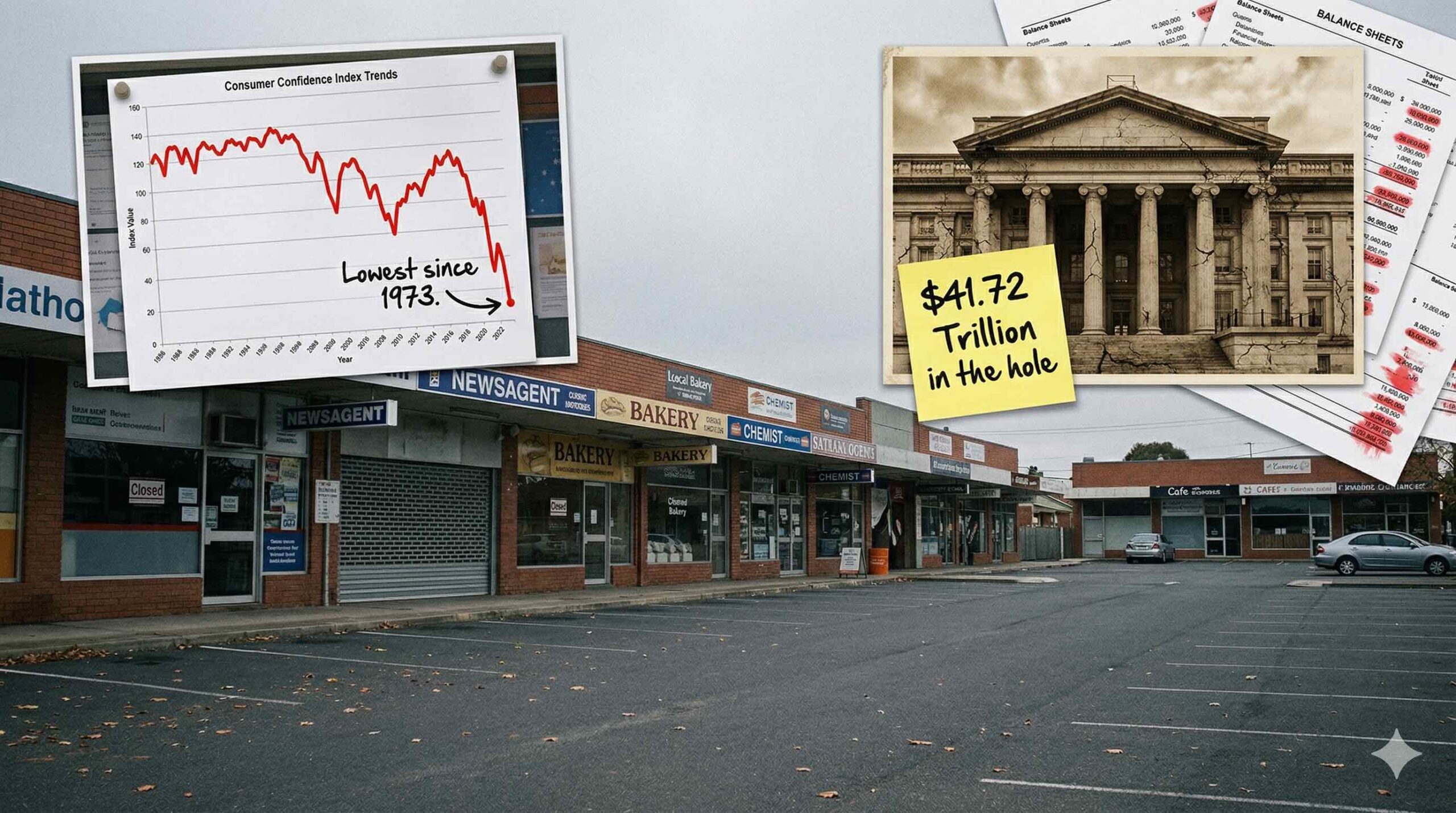
Australian consumer confidence hits a 53-year low, the US Treasury’s own balance sheet revealing effective insolvency (liabilities nearly eight times assets), and the Iran war closing the Strait of Hormuz and sending aluminum prices surging 6%. A listener question from Darryl about buyback scoring. In the Club episode, Tony delivers the episode’s Pulled Pork on **Brookside Energy (BRK)**, an ASX-listed, Oklahoma-based shale oil producer drilling in the Anadarko Basin. After hours covers Tony’s ChatGPT-powered horse racing scraper breakthrough, Cameron’s Nick Cave obsession, Apple TV’s *Your Friends & Neighbors*, and a recommendation for Seth Rogen’s time-travel comedy *Future Man*.
This week’s full episode is for QAV Club members only. The free episode is available below. Also check out our podcast archives link and our pages on Apple Podcasts or Spotify or watch clips on TikTok. Or visit our homepage to learn more about QAV and how it works as a value investing system that you can learn and apply to beat the market.
Transcription
QAV AU 913
[00:00:00] Cameron Reilly: QAV Australia, 9 1 3. It’s the 31st of March, 2026, which means somebody has a birthday coming up. Tony.
[00:00:10] TK: Oh, that’s why you sent me a present. I thought you were just sponsoring me for the episode. It’s not, it’s, it’s a, it’s a, a low spend marketing effort for a podcast to make me wear a QAV v cap, but I’ve got a, Cameron sent me a QAV v cap, which I appreciate.
[00:00:26] Cameron Reilly: I
[00:00:27] TK: Thank you.
[00:00:28] Cameron Reilly: much time and effort trying to find a present for you and ended up just going, ah, the hell with it. I’m gonna send him a QAV cap. Uh, I looked at Warren Buffet related things and golf related things and, and shell related thing. I nearly got you A‑A-A-A‑A, a old Shell Oil can from like
[00:00:53] TK: Oh, really?
[00:00:54] Cameron Reilly: but I couldn’t get it to you on time. These things. This is like a few
[00:00:58] TK: Yeah.
[00:00:58] Cameron Reilly: and I was like, everything’s gonna take [00:01:00] weeks to get to you.
[00:01:01] Cameron Reilly: And I was like, you know what? He needs a hat. He plays golf when his back’s good.
[00:01:07] TK: Yeah. Thank you.
[00:01:09] Cameron Reilly: I just wanna see if anyone asks you what it is. ’cause
[00:01:12] TK: Hmm,
[00:01:12] Cameron Reilly: you know, I still haven’t had anyone ask me what
[00:01:14] TK: hmm. Same.
[00:01:15] Cameron Reilly: I ordered myself one too. I’m gonna wear it around and see if
[00:01:18] TK: Okay.
[00:01:19] Cameron Reilly: Well, happy
[00:01:21] TK: Very good.
[00:01:22] Cameron Reilly: uh, 4th of April.
[00:01:23] Cameron Reilly: Tony,
[00:01:23] TK: Mm-hmm.
[00:01:24] Cameron Reilly: this year? 62,
[00:01:26] TK: Three. Yes.
[00:01:29] Cameron Reilly: Wow. Has it been three years since the Angels?
[00:01:32] TK: Yes, it has been.
[00:01:34] Cameron Reilly: Wow.
[00:01:35] TK: here for over a year, so yeah, it’s been a while. Mm
[00:01:38] Cameron Reilly: Time flies
[00:01:39] TK: mm
[00:01:40] Cameron Reilly: Well, uh, tell you what else has flown by, uh, or gone down is consumer confidence. I was just
[00:01:46] TK: Yes.
[00:01:47] Cameron Reilly: A, b, C, that consumer confidence in Australia has hit a 53 year low. The lowest result since tracking began in 1973, worse than [00:02:00] COVID.
[00:02:00] TK: It is pretty bad, isn’t it? I, there’s a, there’s a loose correlation between consumer confidence and the stock market, which I’ve observed in the past, which I think is just basically, if people have spared money, they’ve put it to the stock markets and their confidence is up. But, uh, and the correlation still holds worse than a long time and the market’s off, so, yeah.
[00:02:21] TK: But, um, are people just throwing their hands up? It’s, it’s just like, you know, no one can control Trump. It’s, we’re just gonna keep getting hit with things that have nothing to do with our control or efforts or, you know, are they saying we’ll never be able to have our kids buy a house? Um, I’m doing everything right and I’m going backwards.
[00:02:42] TK: I’m being taxed too much, et cetera, et cetera. That’s, I think the economy or the people are getting close to that kind of feeling.
[00:02:50] Cameron Reilly: I don’t know. And you know, I,
[00:02:52] TK: Is pessimistic.
[00:02:53] Cameron Reilly: I don’t have a lot of sympathy for, uh, elbow and his team of nuff enoughs, but, [00:03:00] um, you know. It’s gotta be hard for any leader of any country right now to try and manage your economy when Trump’s just throwing spanners into the works on a regular basis. Tariffs this wars that, you know, it’s just how the, how the hell do you prepare?
[00:03:19] Cameron Reilly: But, you know, I was talking to somebody the other day about, um, you know, the just in time economy that we have and how that’s impacting our ability to get fuel. And it seems like, well, we come outta COVID going, wow, just in time economies are really fragile. Um, maybe we should do something about that in case we get hit with another major disruption to the global supply chain infrastructure. Apparently not. No one, no one really fact has done anything about that in the last years.
[00:03:57] TK: I think it’s been government policy for [00:04:00] the success of governments for at least a decade to have three months worth of fuel supply. And it’s never happened. They’ve sort of settled on one month, um, which I guess is a trade off. It’s the other, the other difficult thing at the moment is we’re coming out of the, one of the longest decreasing interest rate environments.
[00:04:19] TK: Well, certainly in my lifetime, but perhaps ever. They’ve basically been on a gentle slope downward since the Clinton era in the us. Um, and now we’re starting to go up, which could. End of next year, but it could be the start of a new upcycle. And it’s very hard to manage an economy when that’s happening.
[00:04:34] TK: You’ve got no spare capacity. Growth is often outpaced by inflation and certainly by interest rates. And you know, it’s kind of be hard to fix all these structural problems that need fixing, but as always have simple solutions to complex problems. But they are very complex and if you throw in the added dimension of the government can’t do [00:05:00] anything if it wants to stay in government because everything it needs to do affects the voters.
[00:05:04] TK: You know, like changing taxes on housing or, um, uh, taking fuel, rebates off, whatever, whatever they need to do is gonna have
[00:05:15] Cameron Reilly: rid of surcharge rates.
[00:05:17] TK: Yeah. Which is gonna affect the budget, which means that it’s gonna have to get paid for somewhere. Um. I, I guess I’m segueing into as well, the US article, which we’re gonna talk about, about the, the par state of the economy over there.
[00:05:31] TK: Australia’s not as bad, but it’s, it’s on the same sort of slope, but it’s, it’s much better place than the us But, but yeah, I mean. Ever since governments realize that they can print money to solve problems, they’ve just issued debt. Like there’s no tomorrow. They keep paying for handouts to people. And I guess the biggest issue at the moment in Australia in terms of handouts is the NDIS.
[00:05:51] TK: And, and you know, again, um, it needs a dose of salts to go into it and clean, clean it up. But there are so many people now benefiting from the NDIS so the [00:06:00] government can’t do it and stay in power ’cause it’ll just attract so many negative votes. Um, there’s only a, a small number of economic rationalists in the voting population and a large number of people with their hands out in pockets open.
[00:06:14] TK: So, um, it’s a difficult situation again. But yeah, all these, all these things mount up every day, every week, every month. It’s not just have we enough oil reserves or do we have the right supply chains? It’s do we have the right interest rate settings? Do we have the right tax settings? Do we have the right housing settings, et cetera, et cetera, et cetera.
[00:06:32] TK: And until it’s almost like you need to, to vote in a suicide squad. You know, but you and I talked about the don’t vote for me party many years ago. The idea is you’ll let someone in for one term and they just, they just clean the place out. ’cause they’ve got, and they’ve got no ambition to be reelected and they just fix it up.
[00:06:51] Cameron Reilly: Americans voted for Trump the
[00:06:53] TK: That’s right. Yeah. No, exactly. Which is why he is popular. So it is a, there is a, there is an appetite [00:07:00] for it. It’s just gotta be implemented by someone with half a brain.
[00:07:02] Cameron Reilly: now he wants another $200 billion to finish the war that he said was won a month ago.
[00:07:08] TK: Well, all he has to do is, as we know, is to, is to get into the, your market 15 minutes before he posts on true social. And he’s got that, that inflow to do whatever he wants. Yeah.
[00:07:18] Cameron Reilly: I am not sure he is gonna spend that profit on, uh, financing the war. Um. So, yeah, we, you mentioned this article, so I saw this in Fortune the other day, the, this is by Steve Hanky, who’s a professor of Applied Economics at the Johns Hopkins University, and a member of the board of Directors at the Federal Fiscal Sustainability Foundation. He says The treasury just declared the US insolvent. The media missed it. The US government is insolvent. That’s not hyperbole. It’s the conclusion drawn directly from the treasury department’s own consolidated financial statements for fiscal year 2025, released last week to near total media silence. The numbers 6.06 [00:08:00] trillion in total assets against 47.78 trillion in total liabilities as of September 30th, 2025. Importantly, the 47.78 trillion in reported liabilities does not include the unfunded obligations of social insurance programs like Social Security and Medicare. Those are the close separately in the off balance sheet.
[00:08:24] Cameron Reilly: Statement of social infrastructure, consolidated balance sheet position, excluding the SOSI. Deteriorated nearly 2.07 trillion between FY 24 and FY 25, reaching a staggering negative 41.72 trillion. liabilities are now nearly eight times the value of reported assets. The largest drivers were a $2 trillion increase in federal debt and interest payable.
[00:08:54] Cameron Reilly: Now 30.33 trillion and a 438.8 billion [00:09:00] increase in federal employee and veteran benefits payable. Now 15.47 trillion goes on and on and on. But, um, the, sort of the, they break it down into more relatable numbers later on. said most people cannot relate to trillion dollar figures on a government ledger.
[00:09:18] Cameron Reilly: So consider this, this is their, uh, coffee shop analogy. Divide every number by a hundred million. Drop eight zeros in federal finances look like a household budget and free fall. That household earns $52,456 and spends 73,378 running a 20,932 annual deficit. total liabilities in unfunded promises amount to 1.361 million against just $60,554 in assets leaving at 1.3 million in the whole Uncle Sam by any accounting standard is insolvent. Congress has clearly lost [00:10:00] control of the nation’s finances. America is facing a fiscal catastrophe. The reckoning, long deferred is becoming impossible to ignore.
[00:10:09] TK: The coffee shop analogy is the right one to use. Uh, except that misses one important factor, and that is that in the coffee shop that the US government runs, they have a magic printing press in the basement. And uh, they can keep. Funding their liabilities by either printing more money or issuing more debt.
[00:10:29] TK: Um, I, I did a bit of research into this article ’cause it, it’s, it’s always bothered me. Um, and this isn’t the first year the US government’s been insolvent on any sort of balance sheet reckoning. It’s the 29th year that the, um, the, uh, what’s it called? The GOA, the government, whatever the government agency is, that signs off on these accounts has refused to sign off on the account.
[00:10:54] Cameron Reilly: Government accounting office or
[00:10:56] TK: Yeah, that’s it. GAO. So they haven’t signed off on the accounts for [00:11:00] 29 years for the reason that it’s technically insolvent. And again, it, it gets back to this. Cycle of lowering interest rates that, that governments could just keep issuing debt, which became cheaper and cheaper and kicked the can down the road for the day when debt starts to increase.
[00:11:15] TK: And then they can’t service that debt. And so they have to print money, um, to, to help do that. So it’s, it’s not a good situation and it doesn’t mean it’s not gonna go on for another 29 years, but what’s gonna happen at some stages is either gonna be a reckoning, uh, you know, a serious recession or depression when inflation gets really high, when the US currency gets the value.
[00:11:40] TK: Uh, ’cause you can’t keep. Printing money forever without the currency going down in value, or, which is probably the most likely option. There’s another default currency and a better government, um, issuing or a better government, uh, risk in terms of being able to issue bonds, which is probably gonna be China, I would’ve thought, um, down the [00:12:00] track.
[00:12:00] TK: And then the US has some real trouble then because it’s traded on the fact that you can always issue bonds at a cheap or cheaper rate than anybody else, any other government, and its currency is the default world currency that helps prop up this house of cards. Um, and it may continue to for another 10, 29 years, but it, it won’t do it forever.
[00:12:21] TK: Um, so.
[00:12:21] Cameron Reilly: privilege as called it, I think it was the, uh, British Foreign Minister back in the fifties or something, the exorbitant privilege.
[00:12:33] TK: Yeah, and I mean, you compare, I, I compared it to Australia just to see if we were on the same sort of, um, dimension as the US and we’re not. We we’re all along the way, but we’re not as bad. So, uh, in the Australian case, we have total assets of 9 25 0.8 billion total liabilities at approximately 1.570 billion.[00:13:00]
[00:13:00] TK: Um, so negative 644 billion and net debt estimated to be about the same at 587 billion, which is still reasonably high. 20% of GDP. And we are running a deficit, but it’s, it’s the kind of deficit that the government can get back into surplus if it needs to. So it’s not a runaway deficit like the US is. And hence, Australia is one of a small number of countries.
[00:13:23] TK: I think there’s 11 in the world, which still have AAA rating with all three agencies. Um. Around the world. So, you know, standard and pause, uh, Fitch and I’ve forgotten the third one. Uh, but, so that’s countries like Australia, Canada, Denmark, Germany, et cetera, et cetera, Singapore, Sweden. Um, so we’re kind of managing this much better than the US is, but we don’t have the, we don’t have the assets.
[00:13:51] TK: The US has no one’s, you know, our government bonds are more expensive. In terms of what you need to pay as a yield to attract people. Our currency isn’t the reserve currency, [00:14:00] so we’ve gotta be more responsible. Um, when the US kind of starts to lose those privileges as it will one day, then they’re gonna have to be more responsible, but they’re further down the track, and it’s gonna be a real problem for whoever who inherits that.
[00:14:12] TK: Uh, and I remember Warren Buffet going on about this for a long, long, long time, and he, he talked about, uh, the US maxing out its credit card back in the nineties and living beyond its mean. And he had a, he had a, what he called his five minute solution to the problem. He proposed that if the federal deficit exceeds 3% of GDP, all sitting of members of Congress should be ineligible for reelection, which is not a bad solution.
[00:14:39] TK: Um, so yeah, so it’s not a, it’s not an immediate problem, but it’s not a great framework to go forward with.
[00:14:45] Cameron Reilly: that’s like my lie detector for politicians that I’ve been pushing for 20 years.
[00:14:51] TK: Lie detector test?
[00:14:53] Cameron Reilly: You remember that one?
[00:14:54] TK: No. What’s the question gonna be?
[00:14:56] Cameron Reilly: No. It’s always, well, if, um, uh, well, I, I have. [00:15:00] Two, two tests. But one is if you make a campaign promise
[00:15:05] TK: Mm-hmm.
[00:15:05] Cameron Reilly: and then you get elected and you break that promise, you immediately get five years
[00:15:10] TK: You don’t know you. You don’t remember why the politician’s strength is it’s word salad. Right? So you put them on,
[00:15:19] Cameron Reilly: Doesn’t
[00:15:19] TK: did you break this campaign promise? Well, the economy changed. The boils stopped.
[00:15:24] Cameron Reilly: And there’s no excuses. That’s the thing. Did you promise something? Did you deliver on it? No. Five years hard time.
[00:15:31] TK: So then you get election campaigns like we’ve had in the past where the opposition just says no, and that doesn’t develop any policies. A small target campaign.
[00:15:39] Cameron Reilly: That’s okay. Just don’t promise stuff and don’t deliver it. That’s okay. I don’t mind if you don’t promise stuff. Just don’t promise stuff that you can’t deliver on.
[00:15:46] TK: Yeah. Okay. That’s, that’s
[00:15:49] Cameron Reilly: is
[00:15:50] TK: of an issue. But,
[00:15:51] Cameron Reilly: Politicians need to set a lie detector test, once a year they fail five years.
[00:15:57] TK: but the fundamental problem with [00:16:00] democracy is that we, the people don’t set the agenda, right? We should, we should be a board which says, um, we’re gonna have an election. Everyone’s gonna vote. Who can best sort out these problems? And here is a list of the problems they have to sort out. We decided, so we have a referendum first, and we say, you know, there’s only, we are only allowed to vote on 10 issues, top 10 because, and you’ve got four years to fix them.
[00:16:23] TK: And we all agree on the top 10. And then we say, okay, we’re gonna vote for A, B, and C to do that. And in four years time we’re gonna say, here’s a scoreboard, here’s a scorecard. You in all, you’re out.
[00:16:33] Cameron Reilly: Love it. Love it. By the way, it was, uh, the guy who came up with exorbitant privilege wasn’t British, he was French. His, uh, name was, uh, re he was the French foreign Minister in 1965. He, uh, um. Oh, he’s the one who put the specific phrase into the public record. The intellectual architecture behind, behind the [00:17:00] critique came from Mabb, Jacque Ruth, a French economist, an influential advisor to Charles Dega, famously described the American situation as a deficit without tears that the US was the only nation that could run massive trade deficits and pay for them by simply printing its own currency, which other nations were then forced to hold as reserves.
[00:17:20] Cameron Reilly: And that was in 1965.
[00:17:22] TK: Wow. And of course, that’s the other reason why the gold price has been going up is because central banks are buying gold, knowing that at some stage the US is gonna have to print a lot of money to pay its debt or devalue its currency and they don’t want to be holding US dollars, uh, without a. Hedge when that happens.
[00:17:40] Cameron Reilly: Well, and you know, uh, apart from the extra $200 billion that the Trump administration wants to finish the war, he’s already won with Iran. Is, uh, in add that’s in addition to a massive $1.5 trillion base [00:18:00] defense budget or war budget. Now that it’s the Department of War, I guess, for fiscal year 2027, which is a 66% increase over previous levels.
[00:18:10] TK: Well, that was the other thing I noticed in that article when you sent it through about the US deficit, the GAO said the numbers they were using were approximate because they can’t get mon, they can’t get numbers out of them. Ministry of Defense or Ministry of War, whatever it’s called now.
[00:18:24] Cameron Reilly: Yeah.
[00:18:26] TK: So it’s probably a.
[00:18:28] Cameron Reilly: Talking about US issues. Um, this isn’t in my notes, but I, ’cause I just saw it a little while ago. This is in Reuters today. Uh, Iran blows hole in US aluminum supply chain with smelter strikes, with attacks on the two biggest aluminum smelters in the Middle East. Over the weekend, Iran struck at major supplies to the United States of a strategic metal.
[00:18:51] Cameron Reilly: The world’s biggest economy does not produce nearly enough of domestically. Analysts said the weekend disruption from the Iran War centered around the [00:19:00] difficulty of shipping aluminum and raw materials through the strait of mush, which has been effectively closed by Teran. But on Saturday, Emirates Global Aluminum said it’s roughly 1.5 million metric ton per year. Al we last site in Abu Dhabi had sustained significant damage from Iranian attacks. Aluminum. Bahrain said it’s 1.6 million ton per year plant was targeted on the same day. the US um, only produces about 40% of the, uh, aluminum that it needs every year. And aluminum prices lept 6% to $3,492 a ton, close to a four year high. So we may see, um, aluminum stocks back
[00:19:48] TK: Yeah.
[00:19:49] Cameron Reilly: buy list very soon.
[00:19:51] TK: Capra comes to mind,
[00:19:52] Cameron Reilly: Uh
[00:19:54] TK: but um, like it’s again, just a, another one of these shortsighted issues and it’s Trump’s [00:20:00] been, you know, walking around like a rooster saying, well, we don’t need oil from the Middle East. Haha, you can fix it Europe, but it’s, but there, oil isn’t the only thing that comes outta the Middle East.
[00:20:11] TK: And I remember going to Dubai for a, a holiday and seeing the huge aluminum smelter on the side of the coast there. Um, yeah, I can’t remember the exact details, but there was like a desal plant, which of course they need, and a huge elec electricity, uh, generator, um, which both an aluminum smelter and a desal plant knee.
[00:20:33] TK: So they put them side by side and stuck a generator next to them. Um, and uh, yeah, it was big. Let me tell you, it was like a big refinery.
[00:20:42] Cameron Reilly: I am, uh, aluminum’s already a buy on our buy list. I’m just looking at who their Australian stocks are. That would probably show up Capal. Uh, Rio has, but I don’t think it’s a majority of their revenue. S 32. Are they [00:21:00] still around even
[00:21:01] TK: Uh, they’re under takeover. Yeah. Um, but they’re steel. I think there might be a bit of aluminum there, but they’re mainly steel.
[00:21:07] Cameron Reilly: I’ve got 50% aluminum
[00:21:10] TK: Really? Okay.
[00:21:11] Cameron Reilly: I haven’t checked that for, you know, a while.
[00:21:14] TK: I haven’t either, so I trust your number.
[00:21:16] Cameron Reilly: I’m looking at c’s, uh, cabals. Uh, yeah, they’ve been going up, they’re in a, they’re a Josephine at the moment. Um, but they had their five year charters looking really good, but I, uh, haven’t seen them turn up on the buy list for a while, but there you go. So, yeah, I, I did see a couple of stories in the news this morning that Trump’s number one strategic objective in Iran now is to open the Strait of ous. So the thing that the war created is now the number one strategic objective of the war. His war blocked it. Now he needs to open [00:22:00] it.
[00:22:00] TK: Well it’s, that was, I was gonna make that point, but when moved on, when you were reading the article out, it said, when Iran, since Iran closed the Straits F on war, I’m thinking they didn’t close it. It was the US and the Israel that closed it.
[00:22:13] Cameron Reilly: Yeah. Oh dear me.
[00:22:17] TK: There’s also been, there’s also a debate around CAA about whether Bo site was the relevant commodity or aluminum.
[00:22:23] Cameron Reilly: Right
[00:22:24] TK: ’ cause aluminum itself isn’t really a commodity, it’s the output of refining bulk site. Yeah.
[00:22:29] Cameron Reilly: Yeah. Right. August last year looks like it was the last time it was on our buy list. Well, fun and games. Uh, the other story, of course is uh, traders bet $500 million on oil price just before Trump’s post on delay to Iran attack traders bet heavily on crude 15 minutes before Trump announced delay to attack oil prices plunged 15% after Trump’s post on Iran talks. Yes. [00:23:00] I wonder who that could have been that had 15 minutes warning
[00:23:08] TK: I wonder. But um, the interesting thing is it’s, that happened, it’s almost a week ago now. Not quite. Perhaps it was a week ago. I think it was this, this time last week we were talking about it. Um, and no one knows who benefited, like.
[00:23:23] Cameron Reilly: Yeah.
[00:23:24] TK: It’s on, it’s on a publicly traded platform, probably nymex, which is where the US WTI, um, works.
[00:23:33] TK: West Texas. Intermediate oil gets traded. Uh, so open platform, it’s, it’s not like someone ducked into a alleyway and saw a guy in a fedora and sunglasses and the raincoat who said, you wanna buy some oil. It’s like, it’s on a public platform. Buyer and seller. Someone needs to know who’s on both sides of those trades.
[00:23:53] TK: Now there’s probably, there’s probably privacy issues. Like I get that, but [00:24:00] ha has reporting sunk to such a low debt that no one can work out who actually benefited from that trade.
[00:24:06] Cameron Reilly: Don’t worry Tony to Donald Trump has his best people looking into it right now.
[00:24:11] TK: That’s why we don’t know after a week.
[00:24:13] Cameron Reilly: It’s like trying to get information out of, uh, the Pentagon where all the money’s going. Don’t worry about it. We’ll get
[00:24:20] TK: Yeah.
[00:24:20] Cameron Reilly: that. Yeah, we’ve got our best people. Our best people are working on it.
[00:24:24] TK: Hey, by the way, going back to those, um, US accounts, hasn’t Doge made a big difference to the cost base?
[00:24:30] Cameron Reilly: Yeah. Fantastic. Doge. Such a win.
[00:24:33] TK: Mm. Winning.
[00:24:34] Cameron Reilly: the oil price, Dr. Was at $97. It dropped down to 88. It’s now $102 50. This is, uh, WTI.
[00:24:43] TK: Yeah. Right.
[00:24:45] Cameron Reilly: whoever shorted it got out pretty quickly because it didn’t stay down for very
[00:24:50] TK: It didn’t, did it? No, that’s right. Well, I think they were selling, so they didn’t, I don’t, I think the story is they sold their, their holdings of oil. So [00:25:00] that’s the other thing too, like, again, it shouldn’t be too hard for someone to dig into the paperwork and find out who holds that much oil to sell.
[00:25:08] TK: Narrow it down, dig around and find out who benefited, where’s, where’s wood and Bernstein these days.
[00:25:14] Cameron Reilly: They sold futures. LSEG data shows that between 10 49 and 10 50 GMT traders placed bets on 5,100 lots of Brent and WTI crude futures worth well over 500 million based on a Reuters calculation.
[00:25:30] TK: Okay, so maybe they didn’t have o Oftentimes a professional unit trading a commodity like that in the futures will have some kind of real asset backing in case it goes south. Um, but they can do it what’s called a naked trade and do the futures without that commodity backing. But either way, there’s a paper trail.
[00:25:47] Cameron Reilly: yeah.
[00:25:48] TK: How, how do you know you’re gonna get paid if you don’t know who the counterparty is
[00:25:51] Cameron Reilly: Yeah. Yeah, yeah, yeah, yeah, yeah, yeah,
[00:25:56] TK: or somebody doesn’t know who the counterparty is?
[00:25:58] Cameron Reilly: Well, the [00:26:00] United States Securities and Exchange Commission when asked about this, declined to comment, and the Commodity Futures Trading Commission was not immediately available for comment. So it’s just No comment. Tony
[00:26:14] TK: Everyone knows which side of the bread their butters on in the US, don’t they?
[00:26:18] Cameron Reilly: No idea what’s going on. Uh,
[00:26:21] TK: We’re looking into it so we can do it ourselves next time. So bugger off.
[00:26:25] Cameron Reilly: We’re gonna have a, we’re gonna have a complete investigation
[00:26:28] TK: Yeah,
[00:26:28] Cameron Reilly: this. Uh,
[00:26:30] TK: time.
[00:26:32] Cameron Reilly: the, uh, chairman of the, uh, SEC is a chap by the name of Paul Atkins. Paul Atkins, uh, was appointed or nominated by President-Elect Trump December, 2024. And, uh, yeah, so, you know, I’m sure he is. I’m sure he is doing a great job. Great job.
[00:26:58] TK: Well, I’m [00:27:00] sure he is too de, depending on your perspective.
[00:27:04] Cameron Reilly: PPM says, no, Tony. 25th of March. This is dated, uh, update on non-binding offer for pepper. Money. Challenger Limited has been informed by Pepper Money Limited’s independent board committee. The challenges confidential, non-binding and conditional proposal to acquire PEPPER money jointly with PEPPER Group A NZ HoldCo Limited not reasonably capable of execution.
[00:27:31] Cameron Reilly: And accordingly, PEPPER money has decided not to proceed with the revised proposal. Managing Director and chief executive. Nick Hamilton said I would like to thank Pepper money. Mabb Mabb pet. I would like to thank the Pepper money management team. Peter Papa picked a peck of Pick a Peppers, a Pepper money management team for their engagement throughout the process. And I’d like to tell Challenger to go take a hike. You didn’t say that. I just made that bit
[00:27:58] TK: No.
[00:27:59] Cameron Reilly: Um, [00:28:00] so, uh, there you go.
[00:28:04] TK: Yeah, I think it’s.
[00:28:05] Cameron Reilly: to see and PPP M as a result?
[00:28:08] TK: Interesting choice of words there. They didn’t, the, the target didn’t think the acquirer could execute the, the, um, takeover. So there’s a number of things that spring to mind that I’ve been thinking about my, since I saw that. Number one is it’s pretty hard to do an m and a deal at the moment. Um, all the, like, you know, our, our buy list is full of oil companies and that’s about it.
[00:28:31] TK: So everything’s dropping. Um, uh, you know, funding’s gonna be a bit skittish as well if they needed to borrow any funds to, to do the deal. But I think the biggest issue was that, uh, and you could see this when the announcement came out, the challenge of share price went up. So the challenge challenger shareholders didn’t really wanna do the deal, even though management did, and the board did.
[00:28:51] TK: Um, so I think that is possibly what was behind that comment. We didn’t think you could execute, ’cause you’re shareholders, we gonna, we’re gonna lynch you. So, [00:29:00] um, yeah, it, and I think Challenger possibly said thank you and, um, withdrew the bid.
[00:29:05] Cameron Reilly: Mm.
[00:29:07] TK: But difficult time for any m and a takeovers at the moment. It’s a, it’s such a, everything’s so volatile.
[00:29:12] TK: How do you fix on a price?
[00:29:14] Cameron Reilly: Mm
[00:29:15] TK: an interesting dimension to valuing companies that like every day at the moment, they’re just oscillating so wildly based that on all sorts of emotion, all sorts of people reading tea leaves about when the straits of are gonna open again and who’s gonna win and da da, what, what it means for inflation and what the government will do on response and all this kind of stuff.
[00:29:39] TK: And then feeding ’em into five year projections for, um, MPV calculation for a company. It kind of makes a bit of a laughing stock out of being able to accurately value anything, doesn’t it?
[00:29:50] Cameron Reilly: Yeah. in my, uh, weekly QAV Light newsletter this week, I mentioned the fact that, uh, you always say markets like [00:30:00] predictability
[00:30:00] TK: Yeah.
[00:30:01] Cameron Reilly: and so far away from predictability
[00:30:05] TK: Yeah.
[00:30:05] Cameron Reilly: insanity. Right.
[00:30:07] TK: Yeah. But
[00:30:08] Cameron Reilly: gonna happen today, let alone five years from now.
[00:30:11] TK: it is funny like that, isn’t it? It’s like I, you know, normally when I get up, I check what the US market did overnight, but I’m also looking at the oil price these days, and it’s just like, Ooh, that’s a surprise. Oh, that’s a surprise. It’s, it’s usually, it’s, it’s, you know, it’s, it’s a quick glance and get on with your day, but now it’s a, wow, what, what drove that?
[00:30:31] TK: What’s happened in the mornings?
[00:30:35] Cameron Reilly: Darryl sent me an email. Hi Cam and Tony in this week’s podcast and Paul Pork of KAR. Tony mentioned scoring them for having a buyback in place. I know this was in the context of increasing equity and there has been discussion previously about quantifying the level of actual buybacks underway, but there’s no mention of this in the Bible, so I’m not clear what weight we should be giving this in terms of actual QAV scoring. Can [00:31:00] you or Tony elaborate in the next episode? So thank you for, uh, that reminder, Darryl, that I hadn’t, uh, integrated those things into the Bible or the checklist. I have now done that. the checklist templates now have the new buyback logic. I’ve also integrated it into the Bible. If you’re using the updated version of the AFR template, you’ll see the manual data sheet has a new column t does it have a buyback, gets a one or a blank.
This section is for QAV Club Members only.
Register for your 14-day free QAV Club trial here.
If you’re already a QAV Club member and seeing this message, please login via the top menu.
If you’re a QAV Light member who wants to upgrade to QAV Club, go to your Account page (see Footer) and upgrade from there.