This week’s full episode is for QAV Club members only. The free episode is available below. Also check out our podcast archives link and our pages on Apple Podcasts or Spotify or watch clips on TikTok. Or visit our homepage to learn more about QAV and how it works as a value investing system that you can learn and apply to beat the market.
Transcription
Cameron: [00:00:00] Welcome to QAV Australia. Tony, episode 9 0 7. We’re recording
this on the 17th of February, 2026. RIP. Bobby. Val Tony.
Tony: Yes.
It’s a shame. 95 though. Good innings. Great actor.
Cameron: innings, but he was still working up until I looked on IMDB. He was working in 2022. He made like two or three things, or they came
out in 2022. Anyway, that’s crazy.
Tony: Mm,
Cameron: one of those
guys,
Tony: yeah.
Do you recall what he won the Oscar for?
Cameron: uh, was it the apostle
Tony: No,
Cameron: no? No, what was it?
Tony: personally, I thought probably his worst movie, tender Mercies.
Cameron: Oh, right. Don’t think I’ve seen that.
Tony: You haven’t missed much. Very, I shouldn’t, I shouldn’t, uh, put it down. It’s a very quiet,
uh, you know, meandering movie. It doesn’t go anywhere.
Cameron: [00:01:00] Right.
Well, it’s funny when I went to his IMDB this morning and I’m like, oh, Robert Devale love his films. So I was looking through and going.
Yeah, but when I was looking through him, I’m like, I don’t think I’ve seen any of his work since the eighties. Really. I think colors with Sean
Penn was probably the
Tony: Yeah.
Cameron: thing of his.
No, I saw the apostle, I did see that. Uh,
the one he directed that was good, but it, it wasn’t
like as full of a
resume as I would’ve thought. Like I saw like in that same era of actors, gene Hackman,
Jack Nicholson. I’ve seen a lot more of their work from the eighties, nineties, two thousands, uh, I dunno when Jack retired, but than I did of, uh, Robert Val, but loved Robert Val’s, obviously his work in the, seventies, obviously the,
Tony: Yeah. Yep. Oh, apocalypse Now.
Cameron: and Apocalypse Now, Colonel Kilgore.
Tony: yeah, that’s the best. And it was in, uh, what was it, THX? Is it 1 38 or something? [00:02:00] 1 1 3 8. Yeah. Yeah. I was really surprised when I finally got round to watching that, that he was the star
Cameron: Very young. Very
Tony: student film. Yeah.
Cameron: Lucas film.
Tony: Hmm.
Cameron: Um, yeah, I loved, uh, I was reading the New York Times obit and he said people would come up and quote the, uh, I love the smell of Napalm in the morning line to him like that. Like it, they were the only people who knew it. Like they’d come up, they’d go, Hey,
hey, hey, love the smell of Napalm in the morning.
Tony: Uh.
Cameron: Like despite his, the importance of his role in the first two Godfather films. Not a lot of quotable lines, but the bit that I love the most. And there’s a couple of scenes that I come to mind when I think of him in those films. And they’re both from the second film. Um, you remember when, uh, the hit goes, the attempted hit on Michael goes down at the compound and Michael tells, calls Tom in and says, you know, I [00:03:00] know you’ve been upset that I’ve kept you outta the family business, but uh, you are the only person I can trust and, and. Tom gets really emotional ’cause he felt like Michael was keeping him on the outside. And Michael explains, I was doing it for a reason. So you are the only person that isn’t involved. And I, and then when, so they have this emotional scene and then Michael just sort of walks away and Tom says to Rocco, the bodyguard do X, X, and X, you know, and Rocco goes, where’s Michael?
And Tom just goes, Rocco. Get the things or do the thing. He just like, he just snaps into command mode with this tone of voice, like he’s
now the boss. This was great performance. Anyway, there’s another, another one going, Tony.
Tony: Yeah, I know
it was, um, it was, uh, there were some scenes though in the Godfather, like that scene with the. Producer in Hollywood, I represent a family [00:04:00] business. They don’t like the limelight. Yeah.
Cameron: Yeah. Yeah.
Tony: Yeah. He has a request to make a view. Yeah. And he just plays, he plays it really cool all the way through. Like he’s just not gonna be threatened.
He’s not gonna be the turd.
Yeah.
Cameron: Well, let me tell you, my Jew Mick friend,
Tony: Giddy. Giddy friend,
Cameron: yo, he says, I’m, I’m, uh, I’m Jewish Irish. let me tell you, my jic friend. I have one client. Yeah. No. Great scenes. Great scenes.
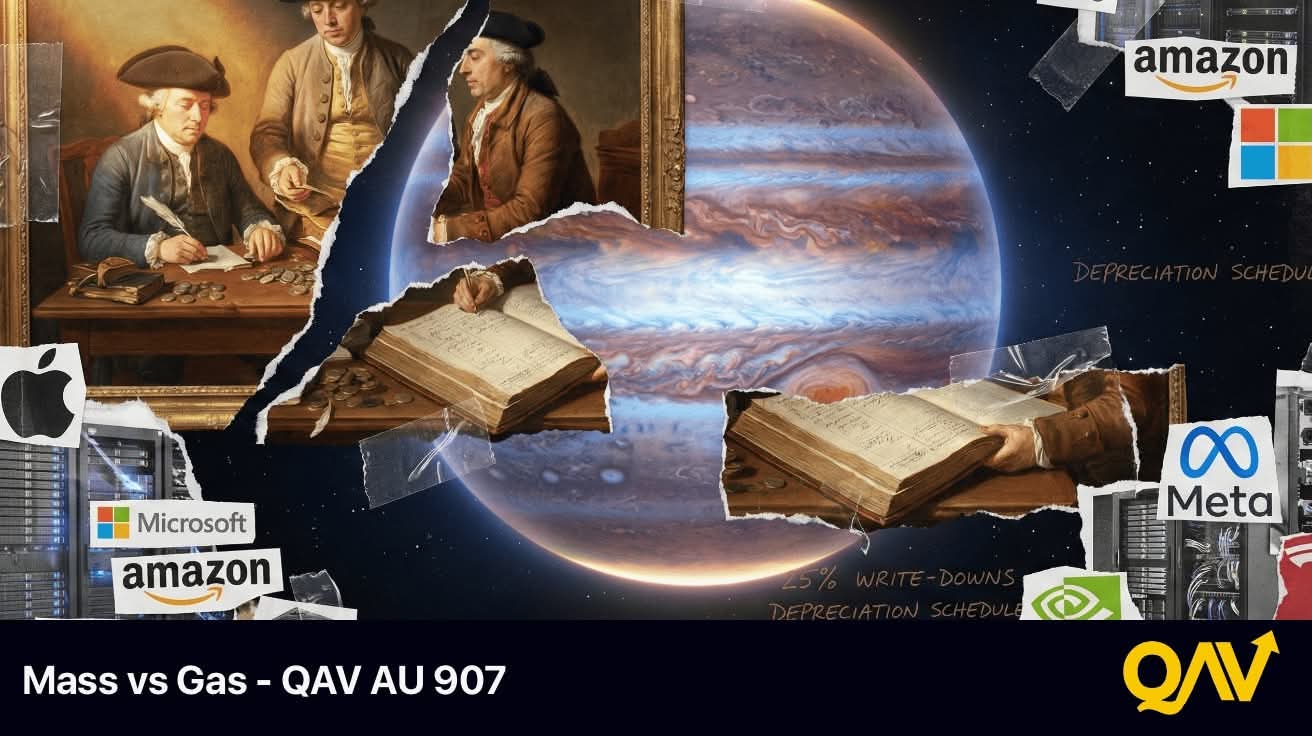
Cameron: All right. Um, so where were we? Oh, my newsletter. You liked my mass versus gas, uh, thing
Tony: I did. Yeah, that was a great analogy. And
I even had a, a
follow up for it too, an article I saw, if you are ready for it.
Cameron: yeah. Yeah.
Tony: Yeah. So, um.
I was reading the Wall Street Journal and I came across an article, [00:05:00]
so with in Cam’s email, he spoke about gas giants
and other types of planets and stars and
how they related to growth stocks versus value stocks and quality
stocks, and. Uh, I kind of
latched onto that ’cause I found an article in the Wall Street Journal saying
that there was one major issue that investors, um, investors are coping with or grappling with in the us and that is that
you can’t find any sort of depreciation expenses
listed on
the income statements for Alphabet, Google, Amazon Meta, Microsoft to Oracle.
So like, how much have they been spending
on Capital Works recently Camp.
Tens of billions, I would’ve thought. Hundreds of billions. Yeah. And from memory, didn’t Jensen Huan came out and say their chip life is only four, four years before you need to replace
their, the graphic chips?
Cameron: I, I dunno about need to, I think there’s some [00:06:00] Chinese AI companies that are
running on older generations of their chips, but you would probably want to because of the, like, the increase in
capabilities they’re having every year. You know, Moore’s law level doubling of capabilities.
Tony: how much do you think that they would be? So let’s say it’s a four
year shelf life for the chips, it means they should write them
down at least 25% a year. Um, and yet, you know, the Wall Street Journal is reporting, there’s no depreciation expenses
listed on any of the income statements for the Mag
seven stocks.
And then they contrasted it.
with, Um, with, uh, industrial companies and they picked two railroad companies quintessentially asset
heavy industry, and they quote numbers from Union Pacific and Norfolk Southern. Each report depreciation is a standalone operating expense on
the
income statement. That way investors know the other expense
lines don’t include any of it.
Um, yeah, so basically
it’s, it’s mixed up somewhere else in the income statements and investors can’t [00:07:00] see.
What it’s gonna cost these companies
in four or five years to replace
all the CapEx spending, the money they’re spending now.
Cameron: Hmm. So how does that tie into my mass versus gas
Tony: Well, they’re gas
giants. They’re even inflated even more ’cause they’re not,
depreciating, not visibly depreciating their assets. I mean, I, I,
I I untoned that they can’t, that they can get away with not
depreciating the assets. It’s gotta be a, ’
General accepted accounting principle that they have to apply to, but I’m not that familiar with the US accounting
practices, but it should be called out as a depreciation
item on their, um, on their balance or their p and
l and it’s not,
Cameron: Now listen, I have spent so much time trying to get my head
around American accounting, particularly a DR stuff for my, my thing this week. Um, not a,
just the whole how ADRs work ’cause I’m doing a Korean
stock again on, uh, QAV America this week. Don’t, I don’t wanna spend any more time, thinking about American accounting man and [00:08:00] how it all works.
It’s like levels of complexity
above my pay
Tony: Well, if you took, if you don’t declare depreciation in your income statement, you’re actually inflating your profits by a,
terrific amount. That’s, I guess, the bottom line for it. That’s the gas giant
analogy. Um, yeah, which I just find amazing.
Cameron: You are inflating your profits.
Tony: cause you, you should have a, a line, like when
you look at any Australian company and it’s got income expenses, um, tax
interest, and then it will say amortization and depreciation. So if they’ve bought something
and they’re riding off goodwill, it goes in
there. If they have, Um,
Uh, if they have plant and equipment
And it’s gonna need replacing, they have to
provide for that upcoming expenditure, um,
over time. And there are rules around that.
Um, depending on the type of
equipment. And the government can change those rules from time to time to
give businesses a, a boost.
You
know, if they slow down and depreciation required on
assets and businesses get more profit because that’s a cost, it’s a [00:09:00] non-cash cost,
but
it’s eventually gonna be a cash cost when they have to,
you know, pay for it, um, to replace the asset.
Cameron: Hmm. Well, yeah, just reading the
book on physics. Um. I just started
thinking, yeah, it just sort of struck me while reading it that mass is mass and gravity is sort of what we’re attracted to, right?
Real heaviness about, but not all the time. Not a hundred
percent of the time, but some form
of,
you know, serious business.
Something going on. Real cash. Cash is cash is, mass, is
where I ended up.
Tony: Yeah. Right. Makes sense.
Cameron: speaking of lack of
mass, our buy list, nothing, there’s nothing going
- I’ve been running daily buy lists for the last
week and, uh, even this morning, I ran one this morning ’cause I in my news alerts, I saw that a couple of companies had reported M‑A-H-A-Z‑J,
couple of those, but none of them were on the [00:10:00] buy
list and. Partly because lots of things are josephine’s
still. Anyway, the only thing that’s been showing up for the last few days is DSK dusk group, and I just can’t bring myself to buy it again. It’s, it’s taken
over from a TP
Tony: You. You’re getting emotional. You’re getting emotional about your
Cameron: I am.
I, I
Tony: point of QAV is to take the emotion out of
investing.
Cameron: I know, I know in my light email
yesterday, I said, Tony’s gonna break me for this,
but I’ve, it’s a perennial, well, it’s got a fairly small a
DT, it’s like 50 k.
Tony: Yep.
Cameron: But I’ve bought and sold it three times in the
last 18 months and always had to rule
one it. within a couple of months because it gets to, gets on our buy
list, ran about the
same
price, like 95 cents a buck or something like that. And then it always becomes a rule one within a couple of months, three
times. So there you
Tony: So you [00:11:00] going, we gonna put, you know, put either they’re all on the checklist, is it? If it’s it’s, three strikes and you’re off, you’re
out.
Cameron: so That’s right. yeah, yeah.
yeah. Three strikes and you’re out. Yeah. You get three
Tony: You know what’s gonna happen. This’ll be the
one that takes off. It’s the fourth. Fourth time lucky. Yeah. well, it’s up to you if you, if you can sleep at night not buying
it, then.
Cameron: Well, I keep thinking somebody else, something else will turn up on the buy list tonight when I run it, And then I run another
one and it’s still just DSK, and it’s, I’m like, oh, come on. I know there was one stock, I
can’t remember which one it was now, but I’ve talked
about it in the past where I’d bought and sold it three or four times.
I think it’s one of the
Tony: Mabb,
you. You don’t like Mabb. You don’t
like Atlas,
Cameron: well, no, no, the,
- The point of this one is I had bought and sold it a few
times. And then it had come Good
Tony: Yeah. Right.
Cameron: And you know, it turned out to be a huge win. and I was like,
I’m glad I followed the rules and just kept buying it rather than got emotional about it, but, but I can’t remember what it
Tony: Atlas Pearls maybe. [00:12:00] Anyway,
Cameron: No, it never did. Good.
Tony: done
good recently. Yeah.
Cameron: it anyway. Yeah. Not while I had to sell some stuff yesterday. Had to sell S‑G-L-L‑V, which
for
some reason stands for Rice Growers. Sun Grain, I think. Is that the SG?
Tony: I would think so.
Cameron: It became a three point trend line sell, and I thought, oh, I wonder if I can get a
commodity chart for rice.
It’s not one of the
things that. I have tracked, I found it in
Trading View or Trading Economics or one of those, but they wouldn’t let me get a monthly chart without paying a higher level of fee, but it. looked like it was doing
okay. Didn’t look like it was dropping. Their price dropped
17% lately. but it was up 63% in 2025. So my
guess is maybe
some profit taking going on. Um, also a bit of a soft
top line [00:13:00] revenue and lower. Calendar, year 26, planting
forecasts. But, uh, we did very well out
of it. We bought it. Um, I had three parcels.
April 25. November 24. December 23. Sold it at 107% for that parcel, 46% for the November 24, and Uh, April 25 was 30% plus a, couple of
nice dividends along the way.
So we did well out of that in the various portfolios.
Tony: It does, it does. I, I am wondering whether people are sitting on the sidelines during
reporting season as we are. cause like as you say,
um, when I do it I did a download yesterday and,
uh, I, have a
lot of stocks on my buy list, but they’re all
josephine’s, so, um, because I don’t, I don’t filter out the Josephine’s and, um, yeah.
It just makes
me wonder that if there aren’t people sitting on the sidelines waiting for the dust to settle after reporting season.
Cameron: Yeah. They’ve learned the same lesson we have that you can’t trust Confession season. Yeah. Maybe.[00:14:00]
I also had to sell plenty group. It was a three
point trendline sell.
Um, got outta that at
16% up and then had to sell Maya. Um, as I indicated last week, IWI held onto it for a few more days than I, a few days longer than I should have hoping I wouldn’t have to, but I did down
22% Mabb when I got rid of it. also had to
sell it from my super portfolio. So thanks for nothing,
Tony: Bugger.
Cameron: Um, in the light email this
week, I mentioned that the best performing
stock for the.
last 30 days was Southern Cross Electrical SXE. It was up 13% over the last
30 days, but we hold it in two parcels since 2023. The first one, August 23, bought it at 78 cents. Uh, it’s up 278% since then, And the second parcel, November 23, bought it [00:15:00] at 82 cents. It’s up 260% since then. So like the one I talked about last week, whatever that was, I can’t remember. But we’ve got a number of these in the light portfolios now, and, of course the dummy portfolios as well that We’ve just been
holding them for years now, and they’ve done 300%, 400%, whatever it is. um, it’s just goes to show you that we don’t
sell when they
hit some sort of arbitrary
price. We don’t rebalance, we hold onto our water, our flowers, we said last week or the week
Tony: Paul Louise. Water, the
flowers.
And there’s um,
there’s a quote you just reminded me of a quote from the pulled pork I’m
doing from a guy called Chris Cuff, which I’ll go into in a little bit more detail later. But He
says, time is the
friend of
good businesses. Which I think is appropriate in this case, and that’s probably why the,
the um, light portfolios are doing better now.
They’ve had time for those flowers to grow,
um,
Cameron: Yeah.
Tony: which [00:16:00] they didn’t In the early
days. Not enough time.
Cameron: Well, the market obviously
has been a little bit steadier too for the last year. it was very turbulent that 22, 23
Tony: Yeah.
Cameron: Uh, so. results
announcements I’ve seen come out this week. Dusk group, obviously. Um, uh,
Tony: I should ask you this
question offline, but, um, you mentioned dust a
DT are, now that the dummy portfolio has grown, are you checking each purchase to see if it’s the right, Uh, a DT size for the purchase? In other words, it’s whatever the portfolio sizes you’re buying, um, has to
be less than 20% of a DT cause that will have grown over
Cameron: Well, no. But,
Tony: But you will from now on
Cameron: I have an a
DT filter anyway,
that’s I think, probably high enough to [00:17:00] accommodate it, but, uh,
you know, I’ll double check that.
Tony: How many stocks are in the dummy portfolio. now? Is it
15?
You dunno offhand. That’s all right. Do it later. Do it off offline. It’s fine.
Cameron: I’m make, I’m making a note of to add to my task list check a DT for dummy and light portfolios, uh, um, dummy portfolio. Oh, I’ve got my, I’ve got my sheet open here. I can do this pretty quickly. Do, do, do, do. DP is,
um, 13 in the
Tony: Okay. And it’s, it’s, it’s, uh, about $50,000
worth
now, isn’t it?
Cameron: Oh, uh, yeah. No, it’d be
Tony: Is it okay?
Cameron: over six years. Um, oh no, you’re right. 50,000. Yeah. Okay,
Tony: Yeah. So [00:18:00] 50,000 divided by 13. If, if they’re all equal parcels and they won’t be.
Cameron: Yeah, should be about 3,800 each.
Tony: yep. And then so your a d T’s gotta be five times that, so. 20 grand roughly.
Cameron: Yeah. I doubt I’m buying anything with an A DT under 20 grand. I mean, I have a FIF 15 grand filter on anyway. uh, right. Moving right
along.
Um.
What else is on my list here? Oh, yeah, so results
have come out for DSK Arise
in Holdings, as I mentioned, a ZJ McMahon Holdings,
M‑A-H-O-M-L-I-K-J-I-H-G-F-E-D-C-B‑A. Yeah, you’re waving.
Tony: Yeah, sorry, you cut
out.
Then just froze for a minute.
Cameron: Oh, uh,
okay. I was just
reading the list of companies that I’ve seen come out
with reports. [00:19:00] A‑Z-J-M-A-H-O-M‑L. um, EDU not an
uh, results, but they’ve announced the completion of selective buybacks. EDU advises that following shareholder approval of the extraordinary general meeting held
on the 12th of February, 2026, it has
completed the selective buyback of
shares from Malfa Education.
Tony: Jerry. Yeah,
Cameron: Malva
Malva.
Tony: Dolores.
Cameron: And
Delores. That’s right.
Uh, and
InvestTech Australia in aggregate, 18
million fully paid ordinary shares were bought back representing 12 point a 5% of the companies issued share
capital prior to completion, so that’s good. Good job. EDU
do we hold EDU? I don’t know.
Tony: Dunno if we owned, it’s certainly been on the buy list. I did the
pulled pork last year on EDU.
Cameron: Yeah. Let me just [00:20:00] check my list. EDU
eed. Yeah, we do. We hold it in one of the light portfolios. It’s up 31%. Good job. EDU. that’s only since September last year too. Nice work.
Tony: so is EDU showing will DDU then be
showing as a buyback
company in the checklist that you do each week?
Cameron: ooh. Should do. Yeah,
Tony: When you, uh, I think we said we check
it at the half, half yearly And four ULY results, or maybe just the four uly results to see if the shares went
down from memory.
Cameron: That is what we are said.
Tony: Mm-hmm.
Cameron: Is that what we said? Yeah. Okay. Okay. Well, they’re not on my buy list this today, this morning, so I can’t really check. I, I, I rejigged my script.
This week, uh, or late last week to
only run on
companies that have reported. So I have a reporting seasoned script
Tony: Oh wow.
Cameron: which is [00:21:00] faster.
Does the Stock Doctor download filters out, does all the
normal filters like the
prop calf filter, and then it also filters on report date, and then just runs on the ones that have had a, report in the last six
Tony: Yeah. Right. Good.
Cameron: but and E D’s not on that list, so, uh, yeah. Can’t tell you, but yes. Um, I
will, I have to run my audit check again and my buyback check, uh, during this month as there are things on the buy list to buy. not much point when there’s
nothing to buy. Email from Scott,
Aris acquires Peel. Peel Mining Limited is pleased to
announce that it has entered into a binding scheme implementation deed
with Aris Resources a IS under which Ariss has agreed to acquire a hundred percent of the issued shares of Peel. By way of a scheme of arrangement.
Thoughts from the QAV gurus
Issuing shares over 300 million, I think I hold them since October last year, and they’re tracking pretty well 22% up, says.
[00:22:00] Scott, what do you think of all of that, Tony?
Tony: Wow. You, I, I dunno if it’s your end on my end, but you are cutting
out
badly
now, so I’m not sure. It could be at my end. It seems to be.
Cameron: You’re not sure what I said or you’re not sure what
you think No, no, I heard what
Tony: you said. I’ve now got
a,
well, it could be at my end. I’ve now got
a rotating pizza ball, uh, on my screen here. It’s, it’s locked up. All right,
I’ll try and try and push on as I just
Cameron: it’s funny ’cause you are, you are. Your, your, your video and audio is working fine for me.
Tony: Okay, well
I dunno what’s going on then. Uh, okay, so a IS buys
peel. Um. It’s a good deal, for Peel shareholders, which isn’t a QAV
stock ’cause they’re, they’re getting like
a, a big boost to
their share price. I
think. Uh, there’s something like a 49% premium
that peel’s, uh, pre merger closing [00:23:00] price that,
um, a IS has agreed to pay. It’s an interesting type of deal,
- Uh, a IS which IS a,
for, for anyone who’s interested,
go back and listen to the pulled
pork I did on them last year. But a IS is a, um, amongst other things, a Copper mine operator in the Cobar region,
which is not too far from Dubbo and New South Wales, kind of in the middle
of New South Wales. and, um,
uh, it owns a mine
there called Triton or Triton.
and uh, peel, which also owns. Copper mines in the area is beside it. Um, but also has a couple of exploration
permits and, and
acreages under underway as well.
So the, the copper side of things, the producing
mine that’s already there is being spun out and merged into a IS. The other assets, the more
speculative
exploration assets are being rebadged, uh, with a new name and listed separately on the
ASX. And[00:24:00]
at, at the moment, the lawyers are referring to that as the NewCo
in EWCO.
Um, so Peel shareholders will get shares in NewCo Plus, um, shares in, Uh, a IS. a IS picks up an
extra couple of hundred kilotons of copper, which
means that its current, mine life will go out past 10 years, which is something
that, um, smaller mining companies are always trying
to do, trying to extend their mine life.
’cause that’s, that’s an issue for them. Um, so. uh, that’s a tick for a IS under this
deal. Not unusual to see, uh, companies pay like
a nearly 50%
premium to, uh, to merge or take out another company.
So that’s not unusual, but it is a reasonably
high premium to pay. um, and they’re being diluted. So current, uh, Aries shareholders are being diluted by about 25% because the Peel shareholders will
wind [00:25:00] up, um, getting about 20.5% of Aris.
Um, so. in a nutshell, Aris is paying about $200
million for the assets
and peel that at once. It’s being diluted by about 20%, and
it’s picking up a couple of hundred
million kilotons of copper, which is about. a 66% increase in its, Um,
its copper resources. So all in all, it’s probably a good deal for Aris as
well. But a lot will hinge on the synergies they expect to get
because what they’ll be able to do is to
run, you know, two mines with probably the same overhead as one. Certainly from the extraction side of things and whatever crushing and
processing they’ll do, they’ll run both mines
through their current plants and they’ll probably
spread management and other costs across both mines.
So that’s a win. Um, and they’ll get, uh, a 10 year
mine life ex, uh, for their current mines and a big
boost in their copper assets. Uh, there’s no debt involved
in this, so Eris is [00:26:00] going to issue new
shares, which is why shareholders are being
diluted. Um, So, no debt,
no cap raising. um, so look on, on paper, I think it’s fair for Ariss, good deal for Peel. and I guess in
all, as in all these kind of cases,
you watch to see what the sentiment is. Ariss is down a little
bit since the announcement, but as we’ve said before,
most
stocks are josephine’s at the moment. So most stocks are coming off highs, which Aris is doing. So, um, I wouldn’t be too concerned about that. But the other thing to note is it’s, um, it’s a scheme of arrangements, so it takes a bit of time.
So the way this
works, it’s not like s just issue shares and then.
And then cut a check for Peel. This is, uh,
um.
The lawyers draft a scheme of arrangement. It’s agreed by both boards. it’s
sent to a judge who puts a
stamp on it saying it’s fair.
Anybody who wants to object can go through the courts
and object.
I’m not sure about shareholder votes. I can’t remember how it
works in scheme of
arrangements. Um, I think from memory. One side [00:27:00] gets a vote, one side doesn’t. But
anyway, um, generally if you don’t like it, you go to court. Uh, but all this won’t
sort of start until about may
and be wrapped up in about three or four months after that depending on any
holdups that happen.
So, um, it’s a bit of a drawn out process and we’re
not too worried about sentiment at this stage. But yeah, just keep your eye on it for the next three or four months.
Cameron: Scott says he’s held a IS since October and they’re up about
22%. I dunno how that works. Um, I’ve held them since December and they’re down 8%. um, looking at their chart, they kind of blew up from about end of August 21st of August. They
were trading at 20 cents. Then by the middle of October, they’re up to nearly 60 cents. They’re back down to 51 50
Tony: yeah, I, I kind of recall
last year they did a cap raising to pay down a
lot of debt.
And I think that was one of the reasons why the share price started to [00:28:00] improve
after that. ’cause they were pretty much debt free, or at least they paid off a large amount of the debt
last year.
Cameron: Right.
Tony: Watch the space, I guess. Watch the sentiment.
Cameron: Yeah. Alright, well, that’s all I’ve got on my list of things to
talk about tk, and I’ll do a. Dummy, I’ll do a portfolio report after you get through your notes,
I guess.
Tony: Okay.
Uh, so I’ve
just gotta talk
about a
NZ
since uh, it’s a stock I hold
and was on the
buy list last year.
It’s, um,
it’s come back a little bit today. I think it’s
down
3% today, but it. was
up as much as 10% on Thursday.
And if anyone hasn’t
followed their results, um, they put out a
first quarter
result, which is the first,
uh, the first,
results after the
new
CEO took over Nuno Mathos. And
according to the AFR
from February 12,
um, Mathos
announced he
would implement a
strategy known as a NZ
2030,
which included slashing
3,500 jobs.[00:29:00]
He
wanted to simplify the bank, cut
duplication, accelerate the integration of Suncorp, improve a and
Z’s technology and finance, non-financial
risk management, and build a
new leadership
team.
Now the results are
beginning to trickle in on
Thursday.
Mathos delivered a solid first quarter cash
profit that was up
6%.
A NZ
shares sawed 8.5%
to 40 35
and are
up by one third.
Since Mattos started in the
role
last May,
this is the first quarter
with his plan fully implemented.
Atlas Funds Management MI
analyst Michael Hayes said. You are starting to see it flow
through a
NZ reported an
improved net interest margin, which is a key measure of profitability and lower bad
debts over
the three months
to end of December,
which was welcomed by investors And considered the
good sign for the broader banking sector.
Cameron: Hmm.
Okay.
Tony: so
so a n Z’s been good
to
me, um, in my portfolio,
which
is, uh, which is good.
Cameron: [00:30:00] Yeah, I hold it in my super portfolio too. It’s up 30% since I added it July last year. Got it.
In a light portfolio around about the same time. It’s up
31%. Got it in the dummy portfolio since October 23, and it’s only up 53%. It’s also in the light portfolio two
light portfolios. I hold it. Three light portfolios.
That’s weird. Um, yeah, up 55. Oh, and my super. I got two. Another one in super two going back to November 23, up 56%. Yeah. Not, not bad, but surprising
that some of these big stocks have kicked on.
Tony: Yeah, for a
big bank, it’s doing well.
Cameron: Yeah.
Tony: Yep. Uh, so that was it. I’ve got, the only
thing I’ve got left now is a pulled
pork to do as a request
for, for, uh, Phil from
last week.
Cameron: Well, before you do that, I’ll just do a quick, uh, portfolio update for, people who are interested. Um, the dummy portfolio last five years is up 17% [00:31:00] per annum. Breakdown of that these days is about 9.5% capital gain and 9.1% income return. so, it’s about even split,
uh, versus it’s
up 17, as I said, per Adam
versus
the index up, uh,
9.3.
So not quite double market over that timeframe, but pretty close. Uh, last 12 months, the dummy portfolio is
up 26%
versus the index up 9.2. So, two and a half times roughly. The split on that is 18%
capital gain and 8% income return. Uh, this financial
year it’s
up 22.8 versus 7.3. So not too bad the like group.
All timers up 20.53% versus 11. For the, uh, [00:32:00] index split again is about 50
50 50, 11% capital gain, 9.5% income return. And for
the financial year it’s up 28% versus seven for the market. So, um. Yeah, portfolios
are having
a continue to have a good.
year despite a little bit of weakening, weakening recently. Uh, looking very good.
That’s
that.
Tony: Well,
we’ll see
how reporting season
goes And, we can start buying again, which will be good.
Cameron: Yeah.
Tony: Yeah.
Cameron: Okay. Who are you doing as your pork this week,
Tony?
Tony: got a request for, uh,
from Phil,
and it’s, um,
the
code
ticket, The ticketer
code is
gv.
VV
sorry,
but I’ll start again. GVF,
It’s called
the Staud, S‑T-A-U-D‑E,
capital Global
Value
Fund.
Um,
this
was a request, it’s
actually [00:33:00] a a,
lick, a listed
investment
company.
So
we
don’t we don’t have those
in our buy list
anymore. We, we started
off doing QAV with them
in and we took them
out and
uh,
so if anyone
does want
to include
LICs or ETFs in their downloads and
they’re
using Stock
Doctor,
and I dunno
about Stock Edia, but
Stock Doctor
anyway,
they
can, um, click
on the QAV.
Uh,
filter and then click
the unclassified
button in the GIC
section of the filter
setup.
So GIC is
the
um, is
the
list of
codes
to say
which industry
the company belongs to.
and
unclassified is where licks
and ETFs
are.
We
don’t
click that button to do a
download,
so we. Generally put them in. And we took them out
because, for a couple
of reasons.
Um, one,
uh, licks really,
I mean the, the, buy
list was set up to
Score. Uh,
operating
companies
based on their metrics and
LICs are investment, [00:34:00] um,
funds rather than operating
companies.
So they kind of have
different
metrics. So the, the
main one operating
cash
flow
gets
muddied
in a
LIC or any
other sort
of fund
because it’s, um, where all the.
Incomes and
outflows
for, uh, capital raisings and new customer, new clients
coming in that they get put into operating
cash
flow.
So what might look like a strong period of operating
cash
flow for
an
LIC may actually be a
period of underperformance
of the fund, but it’s just that they’ve
had, uh,
people, um,
they’ve
done a capital raising and pe more people are now on the
register, for example. So, um, we, we took them out of the,
out of the. The
buy list process.
And also
too,
the sort of a secondary
reason is
that, um, we’re essentially
operating
our own
funds, so we’re competing with ICS as
well, and
the very
few
out there
that get QAV like returns. and
we’ve spoken
about the
problems that managed
funds
have
in
terms of
being, you know, pigeonholed to one
type of
- Um, and
[00:35:00] that, uh,
different types
come
in
cycles
and,
uh,
they tend
to hug The
index
so they
don’t have long periods of underperformance. They’d
rather give up outperformance, all that kind of
thing applies
to, to most
licks. So we generally outperform them anyway,
so,
um,
we
don’t have LICs or ETFs
in our downloads.
Uh,
so I dunno much about this
company. Um,
so I had to go and do
some research on
- And
it,
it’s also
also
worth noting that GVF is currently a
cell.
On
our
three point trendline
graph,
so we
wouldn’t be buying it
anyway, even if it’s called well in, um, in
our checklist.
Uh,
the other thing to note is that we
still have.
June,
2025.
Annual
results,
numbers in Stock Doctor, like we have
for a lot of companies.
So,
um, again,
we,
I’d
be waiting for the, uh,
first half
results
to
come into Stock, Doctor, before I made
a decision about
this company and whether I
should buy it
or sell it or not,
even if
it, um,
does tick up
on the,
uh,
bread later. Um.
[00:36:00] First
thing
I noticed about this fund is that it’s
officially,
uh, head, or it was
based in London. It’s
just transferred back to Australia in the last year
or
- But,
um, for a long time it was based
in London, even though
it’s listed on
the
ASX, uh, so am run by
Australians.
Um, so that’s an
interesting sort of, uh, mix of,
um.
of,
uh,
location
and
people. And the second thing I noticed
is that Chris
Cuff
is a director of
- Um, there’s only
four people on the board. One
is,
uh,
Uh, miles Staud, who
was the, uh, portfolio manager
and Chief
investment
officer,
um, Jeff
Wilson,
who people will recognize as
a name, um, for the per the per as the
person who
runs all of
the w uh, Wilson Asset
Management.
Uh,
portfolio of licks, of
which they’re acquired a
lot at the
moment.
um,
he’s
on the
board, Chris Cuff’s on the board. there’s
a, um, independent, uh, chair
and there’s mole
sta
but that kind of,
um, struck me as being
interesting because
that’s two,
[00:37:00] Two. Um. Very
big investor
heavyweights, uh, from Australia on the board of a
very small list, uh,
listed investment
company.
And the market cap for
this
company is,
uh, just under 300
million.
And they did say they were
gonna close off to new investors when they reached
300 million. So that’s
maybe
why it’s
around
that $300
million or
level.
Um, If anybody out
there who doesn’t know who Chris
Cuff
is, I just might
spend a minute talking
about
him.
Uh, he’s an Aussie
value investing
legend. He
ran
Colonial First
State,
uh,
which was part of Colonial Mutual,
which was a
an insurance company,
which I
was
bought by CommBank
in about
2000.
Uh, but he took
Colonial
First dates. Portfolio management services from
a three person
startup to
$90 billion in
funds under management, uh, within 13
years
from 1990 to
2003.
And
during that time, uh, colonial Mutual Demutualized in 97 and then
was acquired
by CommBank [00:38:00] in 2000.
Um,
Chris
Cuff is firmly in the value
investing mold.
He’s. Definitely,
uh, buffet,
uh, Graham type, uh, value
investor,
focusing on
strong
balance sheets, good
management, sustainable earnings. As I said before,
one of
his famous quotes
is Time
is
the friend of Good, the good
business.
Um,
he’s repeatedly said
investors
should ignore short
term
market
movements, macroeconomic
predictions, and
instead focus on the
business fundamentals
underlying.
Um,
he did
leave Colonial.
Uh, first
State, uh, at, in,
let’s see, back in
about
- So he established a
great name for himself.
Went on and did various things.
Was a
director of a
lot of companies and still
is companies like UniSuper, A
MPI think
he was a NAB director for a while. Um, he’s a director
or was a
director of Hearts and Minds. The, the, so Institute. Uh, charitable
fund,
uni, uh, I
said Uni Super,
Argo
Investments,
et cetera. et [00:39:00] cetera. Probably more
than I can
even, um, list
here.
Uh, and he also has done a lot of charity work. So he set
up a fund called
Third Link Investment
Managers,
and, um, they
invest client funds in
other
investment
funds, but then, um,
donate
the profits to
charity.
So, um, he’s done a lot
of charitable
work
since leaving, uh,
colonial,
um.
So that’s a
bit of, that’s a bit
of
Chris Cuff in a nutshell.
He
also started
cuff
links,
which I don’t know
if people are aware
of,
but
it’s
worth
checking
out.
Um, it’s a
kind of social media
platform for
investors,
uh,
CU FFE
links. Um,
I know a lot
of the kind people will post their, the
stab
will
post their,
it’s a place where people go
to share their
ideas
on
companies and what’s happening in the markets, and then debate
it
Uh, to be honest, it
doesn’t float my
boat. I
don’t like debating stock ideas with people.
I just
do my analysis and make a
decision. Don, I
don’t really care what the
opinions are of
other people, but
it might
be,
um, might be helpful for [00:40:00] some listeners to
have a look at
it and,
and,
form their own
opinion. So
that’s
that’s
Chris Cuff.
He’s on the board
and now about
Stout itself.
So Miles Staud appears to
be
the
son
of
Charlie
Staud,
who again is
a, um.
A known name in
value
investing in
Australia.
And, uh, he
worked at a company called Portfolio
Partners,
which was a major institutional
manager,
I think it was part of Macquarie
Bank. And
then,
uh, transitioned to
a
- Very similar reputation
to Chris Cuff,
but not as well known.
Um,
obviously he mentored miles,
um,
miles.
Uh, grew up in Sydney,
went to work in
finance in London for
RBC
Royal Bank of
Canada,
and
then for a, a hedge fund
based in London called Met, met
Age
Capital and then struck
off on his
own to set
up,
uh,
the,
uh, the global
value
fund.
He
set
up a company actually called Stout Capital, of which
one of the funds is the
Global Value
Fund, and [00:41:00] Stout Capital is the fund Mabb Fund,
manager. So they get
the, uh, investment fees from running
these
funds.
Um, in terms of the
actual fund
itself. Something that people
might find interesting is its
global focus,
so it’s a, It’s run by Australians.
It’s a value investing fund, but it tends to
invest in
Europe and the US and, um, other
markets
overseas.
They do
occasionally
invest in Australia as well, but not very often.
Um, and the asset they
list in one of their most
recent
returns
is a company called
US
Masters Residential
Property Fund.
So even
though it’s ASX
listed,
it’s a
portfolio of New
York and New Jersey property.
Uh,
it listed on
the
ASX 11 years ago,
and
since
that time, it’s returned just at
11.4% cagr,
um,
with
11% consecutive
years
of positive
performance. So not QAV style
numbers, but
it hasn’t
had a draw
down year.[00:42:00]
Uh.
Which is I
guess, a good thing
and it’s certainly
done
better
than that recently. So last year
saw
a performance of
19.2%
total shareholder return.
Um,
it’s a long short fund, so
they
do,
uh, short
stocks
and,
uh, there was some
analysis I saw to say that they
underperformed when the
MAGA stocks started
taking off in the
US
and they were
shorting some of those and they got a little
bit burnt from
that. But,
um, otherwise they’ve
had pretty
good performance.
Um.
I found an interesting story
about moles stato
in he in the AFR
from 2022.
And it
talks
about, um,
a particular
situation that
he got involved
with,
uh, when he went
up
against a comp,
uh, a
company that was run
by Nelson
Peltz, one of the,
uh, titans of Wall Street. and
um.
People may have heard of his name.
Um, he ran a fund
in the
uk, which was set up as a
special,[00:43:00]
uh, or
an opportunities fund. So It meant to have.
a short, uh, shelf life. It was gonna be set up, buy some
assets, turn them around, um, sell them Uh, so realized the, uh, discount devaluation and then return the money to share to shareholders. GVF recognized that that was a, a good thing as a value investor to be invested in. But then along the way, the management decided to, uh, stop making it a
um, a short term fund and trying to make it an ongoing fund, which means The um. the realization of the asset sales and the
valuation improvement would’ve gone back into, um, Nelson Pels fund and, and, would’ve been reinvested from there.
And other
situations, not necessarily a bad thing, but not what they promised at the start.
And, uh, miles style thought that uh, that was a, uh, something he didn’t like. And
he, uh.
Found some other like-minded investors who actually overturned the chair of that fund. So the AFR wrote an article about them and the David and Goliath story, uh, against [00:44:00] Nelson Peltz. And they also mentioned, um, uh, miles Stout’s wife, Emma Davidson, uh, who is, now the, uh. Uh, CEO
of the Stout Capital,
uh, company and also management manager of corporate affairs. So she has also a career in London Finance and headed up the trading desk for City Group in the UK and Ireland. and so has a lot of experience at, um, uh, share trading and running funds as well. She had, Uh, also set up her own fund in the uk.
Um, but they decided to continue with the value fund and they actually relocated back to Australia. Together, um, to uh, raise
a family. Uh, so they’re back in Australia now even though they still have, um, a finance team in the UK running investments from there as well. They, um, the AFR article says, stow and Davidson see themselves as a different to typical
activist hedge fund investors [00:45:00] because their capital comes from the bottom of the
money tree to pull, to pull, together the first $50 million in their fund. The couple went down under on roadshows together. Using Wilson’s, Jeff Wilson skills as a whisperer of retail
investors. On those trips, Davidson fell in love with rural and regional Australia, and both became enamored of the idea that they were in a position to champion the financial interests of the little guy.
Excuse me. Uh, further on in the article, Mabb
Stroud talks about his investment
philosophy. He says Capitalism is wonderful at allocating resources all around the system to where they’re going to
be more efficiently used, but it has a lot of externalities where it falls over.
I think one of them is corporate governance. He said the agency problem in capitalism, he says, is that managers of investors’ money are often motivated by interests and priorities that are not aligned with those of the investors.
But the theory doesn’t always work out In practice, especially in the small cap end of the market, boards often end up siding with the manager, and a temptation to do that [00:46:00] is heightened by the high turnover of shareholders
and their lack of engagement.
Uh, Stroud says, you look at capital markets today, the average holding period for a share in the US
has gone from three years to two years, and today it’s nine months. So if you are a board director, the shareholders come and go every nine months. You build no relationships with them and you never talk to them. Stroud
says, passive investing, which stout is payings not to disrespect, has only increased the tendency for
investors to ignore corporate governance. In today’s markets, investors are often more ready to divest.
Then to seek improved performance. Staud says we spend a lot of our life trying to drag boards back, reminding them where they’re supposed to be
focused. Often that means replacing a director or two. Sadly, it very occasionally means replacing an entire board, and for one in 20 it means winding a company up. the article continues and outlines GVF strategy STA Davidson and their small team based
not far from the Bank of England, sc the world sco uh, [00:47:00] sorting the wheat from the chaff.
The chaff is any listed fund or company trading below the value of its assets. the week comprises those instances where a change in management strategy, or in the worst case scenario, a sell off of the assets could unlock that discount. Typically, the recipe includes finding at least a few shareholders on the targets register.
Who are ready to get behind the GVF LED
push. So that was an article as I said, from the AFR back in 2022,
uh, by Hands Van Lewin in December
28th, 2022.
So that gives the you a flavor of who runs the fund.
Um, a bit about its philosophies, uh, and now a bit about
its results. So again, going back to their last annual results, uh, FY 25 revenue was up 17.8% profit after tax up
21.07%. And I noticed that they changed their registered
address from London to Live Street in Carlton.
So the, uh. I guess the strouds have moved down to
Melbourne, uh, from the [00:48:00] QAV point of view, uh, a DT for this stock is only 117,000 per day. So not too bad, but, uh, won’t suit big investors.
And as I said, the market cap’s just under 300 million. Stock price for the, uh, analysis is a dollar 35. IV one is only 71 cents. IV two we don’t have because there’s no
broker
coverage, uh, for the small capic.
Uh, they being an LIC, they have to, uh, put out their NTA every month and January 31 NTA. Before tax was a dollar 29, so it’s just trading a little bit above NTA at the moment. Um, again, that will change at the end of
February. Uh, there’s no
consensus target for share price, so
we can’t score it against that. Yields pretty good, just under 5%, but not enough to
score it, uh, for being above the average mortgage rate.
Uh, Stock Doctor don’t give LICs a financial health score or trend score, so I can’t use those to score,
- Um, stock Edia gives it the quality score of 78 and [00:49:00] an
overall rank of 73, so it’s not shooting the lights out from Wikipedia’s point of view, it gets an F score of five out of
nine and maybe a little bit unfairly. so um, uh. Stock. The F score
on stock Edia is, is marking it down because
they think they have more debt.
Um, but when I drill down into it, I don’t think it’s debt. I think it’s actually provisions they take on their balance sheet. And, um, provisions for an LIC generally are are, there to make sure they can meet their tax obligations.
So
for example, if they’ve sold shares. During the year, they ha they might have a big capital gains tax bill, so they provide for it until end of financial
year. But it also is where they provide for any management fees that have to
get
paid. So if, if they’re having a good year, there’ll be a performance fee they need to pay. So, uh, perhaps that’s why they have provisions on their balance sheet. And both of those aren’t a bad thing, even though I believe encyclopedia might be seeing those as being debt.
Um, which [00:50:00] is
wrong. Uh, anyway, F score five, eight of nine. Um, overall rank of 73 isn’t that
great. PE is 9.7 times, so not the highest or the
lowest, so
we don’t score it for that. Pr/OpCaf is a lot 22 times, so it doesn’t meet our. Our hurdle will cut off of seven times, so we can’t score it
for that. Debt.
Equity per share is a dollar 19, so we can buy it for less than book plus 30,
which is a good thing. So it gets a tick for that. Uh, we don’t have earnings per share forecast growth, so
we
can’t, uh, give it a growth over PE score. Interestingly enough, we can’t score this for an owner founder, even though Miles Stroud is, um,
the, uh, investor who set it up. Um, he doesn’t appear to have a large
stake in the
company and as listed as a, having a shareholding of less than 1%, which really surprised me. ’cause usually these, These uh.
These types of investors become cornerstone investors in the fund. So they can say that
they’re, um, aligned with the interest of the shareholders. Now, [00:51:00] it’s entirely possible that, Uh, his holding is held through some kind of trust or company structure, which wasn’t a parent and Stock Doctor, but Stock
Doctor have it listed of, uh, as less than 1%. And I can’t see any really big, um, investors on the, uh, on the. Top 10 listing in the, um, uh, annual report.
So I can’t sort of point to somewhere else that
Stroud might be, um, in, uh, hiding in terms of his holdings on the, uh,
on the vesting list, but I would’ve thought that was a bad thing. Um, anyway, unless, unless I’m wrong. Um, not a good thing. Uh, as I said, it’s a three point trend line sell, so we can’t score it for that. It does have, consistently increasing equity over the last five years,
so that’s a good thing. Um, it’s, uh.
That’s probably one of the only good things in the quality score. So out of a possible 10, bearing in mind we
can’t give it a financial health or trend score, it only scores one. So the quality score for this company is 10% and the QAV score is 0.0.
[00:52:00] So to be fair, QAV scores are designed to, for operating businesses and licks are a different beast. So that’s part of the
reason why we can’t score it, However, it, um,
a score of 0.0 isn’t great. Some of the risks and positives, um. Obviously key man risk if something happens to the Stroud. Uh, but again, the key man’s not invested in the LIC,
so, um, it, it will certainly. far as we know. as far as we know, certainly.
um, hurt, uh,
will will change, will probably mean a change in strategy if
he goes. Um, but wait and see,
I guess there are currency risks. Um, they do talk about currency hedging in their annual reports and and how they manage currency risks. So they’re on top of it, but there still is always a risk that, um, overseas currencies depreciate, which of course, the US dollar’s doing now.
Uh, there’s risks associated with their shorting of companies, which, um. Hurt them when the Mag seven took
off. Uh, the positives, I like, it’s the fact it’s a value investor. I like the fact he’s mentored by [00:53:00] his father, Charlie and and Chris er Wilson are still on the board. So they’re
obviously providing lots of advice to him. Um, and the other positive is, is overseas exposure for people, uh, for value investors in Australia. Who, um, might, uh, not know who’s overseas or find it too complicated from a currency or a tax point of view to do that. They can get value investing exposure through this, uh, LIC but it doesn’t score on our checklist.
It’s 0.0.
Cameron: 0.0.
Well, there you go.
Tony: Yeah. So I pulled pork on a non QAV stock this time.
Cameron: That’s how
desperate we are. We’re doing non
QAV
stocks.
Tony: do dusk again.
Cameron: Next week we’ll just start
making up
stocks.
Tony: Well, I’ll send you a request in.
Cameron: porks on.
Tony: Send request from people. We’ll see how we
Cameron: Well, that’s my request is
you just
make something
- Yeah. Like an AI
would
Tony: Yeah. I tell you
what. I
was, [00:54:00] I I use AI more now in pre preparing for this show in the US show, but every now and then you go,
oh, I better
check that fact. It doesn’t make sense. And sure enough, it’s wrong. And sometimes even if I ask the question twice, I get a different answer. So I’m always very careful about what I use.
Cameron: I’ve told you about
my run it past Dave?
process.
Tony: No, who’s Dave?
Cameron: Uh, I invented this like last year. Um, futuristic.
Dave is double AI verification. DAIV run it past Dave. So I have a script that I’ve built, um, where I just. Can paste my thing in, And it’ll take, like if I get, I use Gemini
to
do most of my research these days, so I’ll take what it gives me and then I’ll put it into GR and into ChatGPT
and into Claude and into deep seek and
go verify this, or fact check this for me.
And then it’ll come back with a whole bunch of stuff, and then I’ll give that
back to Gemini and go, all of [00:55:00] these engines
say, this
is right,
this
is
wrong. And it’ll give me a rebuttal and then I’ll feed
it back through the loop and ask for sources and go check the
sources and yeah,
Tony: So, I’m sorry. I can’t do that, Dave.
Cameron: yeah, yeah, that’s
right. Yeah. I’m sorry, Dave. I, um, I,
Cameron: I was reading, oh, uh, day of the Jackal, I think the other day. And it was talking about giving somebody the
third degree. And I was like, where does that term come from? So I went into Gemini and
I said, where does the term the third degree come from? And it gave me this whole thing
about
Masons, free Masons.
There are three degrees of
masonry, and it was a third degree. And I was like. So I took that and I gave it to
Grok and I
Tony: Ha.
Cameron: check this. And he goes, yeah, yeah, no, that’s,
that’s really where it
Tony: Sorry about that,
Cameron: So I took both of those and I gave it to
chat GPT, and it went, nah, that’s bullshit. That’s, that’s not right at all.
So I took chat, GPTs and I gave it both back to Gemini and GR and said, [00:56:00] this is what chat GPT said, and they both
went. Oh yeah, yeah. No, we, we were just totally wrong on that. that. was, That
was, I dunno where we got
that from. That was made up Chachi T’s. Right. And then I gave, I went back to Chachi PT and I said, they both conceded and it goes, isn’t that
interesting? Two models were very confident And they
were this is the thi I’ve been saying to Chrissy, like, you know a lot of the, um.
Leaders of the AI
companies are doing the rounds again at the moment, um, saying all the white collar jobs are gonna go on the next 18 to 24 months. We’re not taking it seriously enough. This is gonna happen and
we’re, You know, no one’s
really preparing society for this,
Cameron: Alright. Uh, Tony just got cut off while we were talking about something. AI verification. Yes. Yeah. And how are they gonna fix it? I was saying all these guys are saying it’s gonna take over the world and take all of our jobs, but, um, they can’t even, uh. Make it reliable yet. [00:57:00] So I, I don’t know. I’m not hearing any of ’em talk about what they’re gonna
do to make it reliable.
I assume they have a plan, but I dunno what that plan is. So, I have heard them talk about it briefly some time ago, but before it’s gonna take over the world they need to get it to be able to give you a, we need, people need to be confident that we’re not just being led down the garden path constantly.
Tony: Yeah, exactly. It’s like the mainstream media, isn’t it? Can I really believe this?
Cameron: or just talking to people, um, or listening to CEO’s forecasts of their, uh, next year’s revenue.
Tony: Listening to Gas Giants Bloviate. Mm
Cameron: Yeah. Alright, well, let’s do a quick after
hours, Tony. Uh, what else you got?
Tony: Uh, a couple of shows under Salt Marsh. I don’t know if you’ve seen that. Um,
Cameron: No, what’s that?
Tony: on HBO, if you like, shows like we do, like Shetland, um, so it’s a police procedural. This one’s set in Wales [00:58:00] on
the, on like a marshy.
Area of Wales near the beach, which floods and gets cut off from the mainland. Classic closed, closed room detective story.
You know, the storm blows in, closes off the island, someone dies, how do they die? Who’s the culprit? All that kind of thing. But very moody, atmospheric, um, small town. Lots of skeletons in the closet. That’s really good. I like it.
Yep.
Cameron: Hmm.
Tony: So that’s on. And we watched, uh, deliver me from nowhere
last night, which is pretty good too.
You seen that?
Cameron: What’s that? No, what’s
Tony: The Bruce Springsteen biopic about the making of Nebraska. Really interesting. You are a Nebraska fan,
Cameron: Uh, yeah, sure. I mean, look, I, I’m not the world’s biggest Bruce Springsteen fan, but I, I, I can listen to
his stuff and kind of dig it a little bit. This is
The one with Jeremy Allen White from the Bear in it.
Tony: Yeah.
Cameron: How does he do?
Tony: Yeah,
pretty good actually. I, I’m not a fan,
but he was good in this and Jeremy Strong was fantastic in it as well. He played [00:59:00] John John Landau, Bruce Springsteen’s
manager, who’s kind of like his father
figure as well. cause the whole thing’s about Bruce’s problems with his father. He used to beat him as a kid.
And all the songs on Nebraska are really dark and. Downbeat and how he had to try and clear his conscience of all those things before he sort of took the next stage in being a megastar. ’cause up until then, even though he’d had success and he had a lot of success with the albums before that, he was still kind of known for being a bar band, outer Jersey, and all that kind of stuff.
Um, yeah, so, you know, born to Rum kicked him off, but, um. At, at the time he was recording Nebraska in his bedroom, they were also starting to lay down tracks for born in the USA, and Bruce was saying, look. Can’t deal with that right now either. Great track’s, gotta get this off my chest. Um, went into the recording studio with a cassette saying, you know, master this for me.
And every time they’d master it. it’d be, don’t take a distortion out, don’t take the echo [01:00:00] out. I want it to sound like early sun recordings with Elvis Presley. All that kind of stuff. So in the end they just, they found some old record company dude who could. Like, go back to the really old pressing machines and, and make a pressing from this cassette, and then put it out without any press, any coverage, any, um, tour to back it up. and it goes to number three in the charts. and then uh, you know, he kicks on after that with born in the US and becomes a megastar. So it’s pretty good. It’s good. It’s all back in Jersey, hanging around with his childhood friends, um, school buddies, that kind of thing, trying to come to terms with his upbringing, driving past the house where he lived as a kid a lot, and it’s now run down and remembering his, you know, upbringing, which had a, which was very, very mixed with his father.
Loved his mother, but very mixed with his father. So, yeah, it’s, it’s good. I really enjoyed it. I love Nebraska, one of my favorite records. Really good. Hmm.
Cameron: really?
Tony: And the [01:01:00] good thing is too, I remember at the time, like I, I heard about it through word of mouth. Like it was released in 83, I think 82, 83. And you know, people would say, Hey, check this out.
And they, you, So, I’d listened to it. And they’d go, gee, that first track, it sounds like this movie I, saw called Badlands. And then in in Live Me From Nowhere, you see Springsteen watching Bad Lands on tv. Then he goes to the library, to the micro fish And researches it and then. Writes a song about it, then crosses out the pronouns and makes him the star of the song.
It’s, you know, it’s just great to get, ’cause Badlands. Martin Sheen, early movie, sissy Spacer. Yeah, Terence Malick directed. So it was just at the time I remember getting all this sort of bouncing between one reference to another, back to Malik, back to him which was really kind of cool as well. So that’s all explored in the movie as well. it’s good.
Cameron: Hmm. I’m never a big fan of biopics. I struggle with Biopics for some reason, but, um,
I can’t think of many biopics. I like the Johnny [01:02:00] Cash
Tony: Mm-hmm.
Cameron: that River Phoenix
Tony: is kind of reminisce. This is, we, we were watching it last night and we both said this is like walk the line. Yeah.
Cameron: Okay. It’s the only one, when I think of Biopics, it’s the only one that I ever remember actually liking. Didn’t mind the Ali one with Will Smith, But yeah, usually the, the problem I have is that like the people that are playing, the people are never as charismatic or as good as the actual people.
So it’s kinda like,
Tony: It was like, um, entourage, right? If, if Vincent had it been a movie star, he wouldn’t be starring at a TV show, right? So,
Cameron: yeah. Taylor’s, uh, finally got into watching that. He’s been binging it. He told me yesterday that they just finished season four or something, and he’s like, uh, it’s crazy how much this is my
Tony: Yeah, I would’ve thought, yeah, exactly. You should ask him who’s, who’s Turtle, who’s he? Who’s of any drama?
Cameron: well, he’s
Tony: Oh, he’s he. Oh, okay.
Cameron: He’s Z. Yeah, that’s right. Yeah. Yeah. He’s the sensible one that [01:03:00] needs to.
I’m
Tony: He’s the
Cameron: trying to reign in all of the, uh, you know Yes. The flighty types.
Tony: Hmm.
Cameron: alright, well I got nothing. Um, you got anything
Tony: Nope, that’s all.
Cameron: Alright, let’s go talk America. Thanks Tony. Thanks listeners. Have a
Tony: and thanks for the request. Give us some more requests for pulled porks while our bile list is empty.
Cameron: just make ’em up if you have to. Mm-hmm.
Quote of the day:
“Alexander the Great and his mule driver both died and the same thing happened to both. They were absorbed alike into the life force of the world, or dissolved alike into atoms.”
Meditations
Marcus Aurelius