Episode Overview
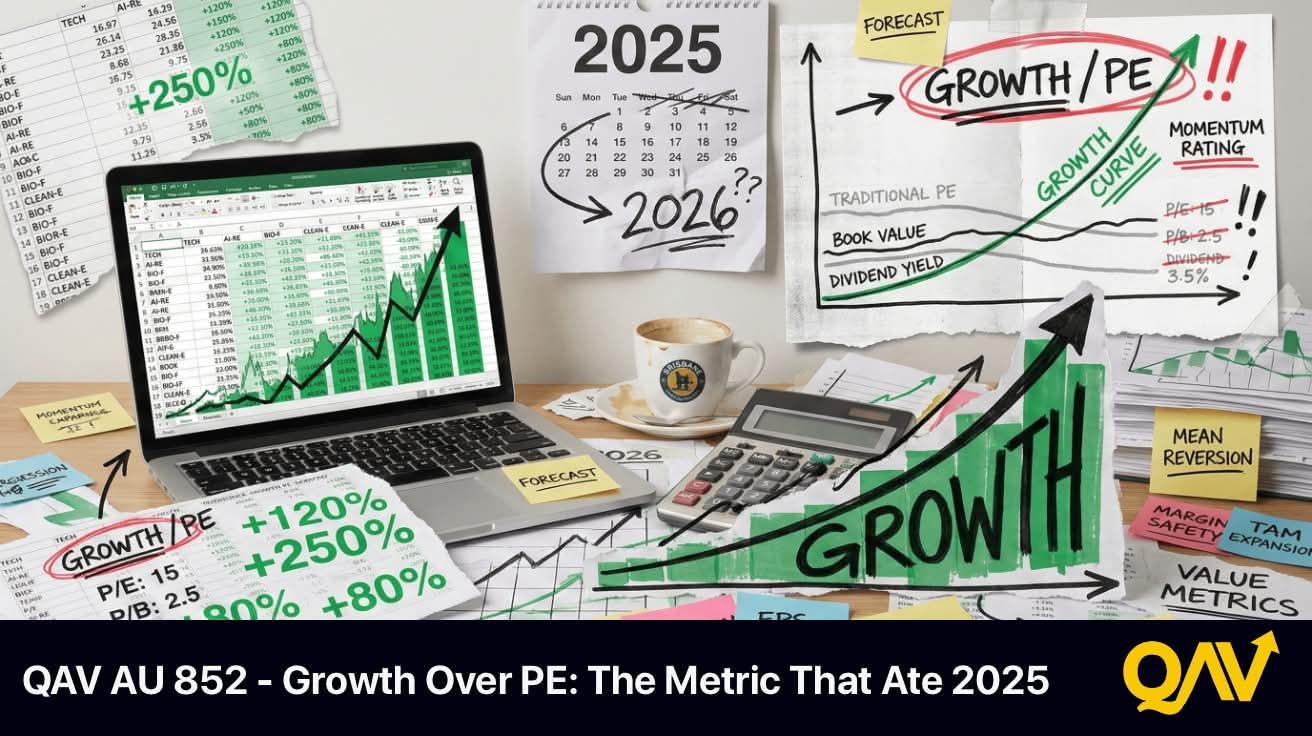
The final QAV episode of 2025 is a wide-ranging year-end wrap that blends portfolio performance, market structure, and deeper system thinking. Cameron and Tony review an exceptional six-month run for QAV portfolios, with multiple stocks delivering triple-digit returns, before drilling into what actually drove those results. Tony presents a data-heavy “Pulled Pork” analysis that isolates growth over PE as a potential explanatory factor behind this year’s outperformance, raising the possibility of a future refinement to the QAV scoring system. The conversation then moves through global market performance, leadership changes at Woodside, takeover drama at HUM, crowd psychology, housing constraints, and the economics of modern media, closing with books, TV, and reflections on how fast time now seems to move.
⸻
Timestamps & Topics
Transcription
Cameron: [00:00:00] Welcome back to the Last QAV for 2025 tk. It is the 30th of December. We’re recording this 12:04 PM in Bundaberg in my, in the bedroom I grew up in, and that would make it 1:04 PM. Down in cope. Schanck. Tony, you said you’d been suffering from the hay fever. Happy Christmas. How was your, how was your week off?
You went to Hillsville, is that right?
Tony Kynaston: I did. Yeah, that was good. Um. Busy, but it was nice. We went, I haven’t been to Hillsville for a long time it’s a lovely place and um, a couple of nights there. Caught up with lots of friends from all over Australia who came in for a party. played golf. Alex had some of her friends up for a lunch the day before.
So yeah, just really a nice
Cameron: you
Tony Kynaston: up. Then back to Melbourne. Alex came
Cameron: by me.
Tony Kynaston: with us. To spend Christmas morning [00:01:00] with us and then back up to Melbourne for family lunches and family dinners, and then back here, and then just recovering ever since. Taking it easy.
Cameron: You got bad hay fever, you were saying?
Tony Kynaston: Yeah. Yeah. It’s apparently a thing down. I know if it’s a thing on the Mornington Peninsula or Victoria, but yeah, it’s just, um, making it, uh, uncomfortable at the Mm
Mm.
Cameron: mm. Well, I’ve been at the beach. We were just down at, uh, the best beach in Australia. Rally heads got back about half an hour ago, but we were chasing millions of soldier crabs over the sand. Fox was having a absolute field day, picking them up in a, with a tennis racket and watching them scarper around.
Soldier crabs are fun to play with. You ever play with soldier crabs when you’re a kid?
Tony Kynaston: Yeah, I did. Yep. Lots of fun.
Cameron: They bury themselves so quickly in the sand. Any who?
Tony Kynaston: of that beach? [00:02:00] Sorry, I didn’t quite catch it.
Cameron: Elliot heads.
Tony Kynaston: heads. Okay.
Cameron: It’s about 10 minutes from my mother’s place. Uh, everyone when they come up here, they go to B but uh, BGAs. Yeah. Okay. But Elliot heads is just, there’s never anyone there, despite the fact that there’s a big caravan park and a lot of development going on, but there’s usually, it’s usually mostly empty and it’s just beautiful.
The finest white sand, blue sky, blue water. It’s just, uh, yeah, like something out of a postcard every time we go down there. It’s our favorite place, and it was beautiful. We got down there about nine 30 this morning and stayed for. Couple hours and uh, it was just still picturesque. Amazing.
Tony Kynaston: How lucky are we?
Cameron: Good early morning swim.
Hmm.
Tony Kynaston: how lucky are we?
Cameron: Yeah, that was Fox. Fox was down there going. Australia’s the greatest place in the [00:03:00] world.
Um, okay. Well let’s get into stock markety stuff. I’d like to thank Scott for filling in for you. Last week he came on the show, uh, and we had a great chat for an hour or so. So thank you again to Scott and. Congratulations on the good year that he’s had. And, uh, the invitation remains open. Anyone who wants to come on and have a chat had nobody apart from Scott volunteer themselves to come on.
But, uh, always love to have members come on and talk about what’s going on. Good, bad, or ugly. You know, it doesn’t have to be all blue sky stories. If you’ve had a rough year, um, come on and tell us about it. But we’ve had a great year. Uh, I was doing, I did my weekly like, uh, QAV light blog post update yesterday, and it was like insane.
Um, for the calendar [00:04:00] year, the light portfolio is up 37% versus the index up 11%. So, you know, better than triple market. That’s for the calendar year. But if I just go for the last six months, ’cause that’s when all the growth has happened. The pull the light portfolio is up 27% in the last six months versus 4% for the index.
It’s just been, uh, absolutely bonkers. Six months for our portfolios. Um. Let me just, uh, bring up Navexa so I can have a look at the other portfolios while I’m at it because I think my, and I know, so there’s a collection of large cap and small cap stocks there. If I look at my super portfolio, which is all ASX 300 for the calendar year, it’s up 24% versus [00:05:00] 10 for the index.
And if I just look at this financial year. It’s up 15% versus 3% for the index. I mean, if I go over the last, say three years, it’s still underperforming. ’cause that 22, 20 2022, 2023 period was an absolute nightmare for my super portfolio. Last three years, I’m up 9% versus 13% for the index. So I haven’t even caught up.
But the last six months I’ve caught up a lot. The dummy portfolio, if I look, uh, this financial year, it’s up 20% versus three, and for the calendar year it’s up 27% versus 10. So yeah, I assume your portfolio, I know we talked about it a couple of weeks ago, but it’s just been a good couple of [00:06:00] weeks.
Tony Kynaston: I haven’t checked it recently, but I, I guess it’s still up around 35%. Yep. No, it’s been
Cameron: It’s one of those years, right? It’s one of those years we hang out for.
Tony Kynaston: Yeah. and I’ve been trying to, um, work out why, and, and perhaps it was because interest rates were cut a couple of times and referred back to that bad year, which was when interest rates were rising.
So there might be a lesson for that in this going forward, because I wouldn’t be, it’s more likely interest rates will rise next year in 2026 rather than be cut, but who knows?
Cameron: Right. You think there might be something we can factor in, like if interest rates are rising, we
Tony Kynaston: Yeah, look,
Cameron: use it as a signal to something.
Tony Kynaston: I haven’t been able to work out how to do that yet. Um, you know, I, last time it happened, I spent time looking at, uh, like the, in like a three point trend line for the index and, um, it certainly went crossed into a cell signal when interest rates started to rise. So. [00:07:00] That could be a thing, but I couldn’t work out any rules which were beneficial because, um, were past examples where the interest, where the index was a sale, but my portfolio still did well, or QIV still did well. So there was no clear evidence one way or the other. So it could have just been a, you know, that was the bad year. It might not have been, um, interest rates related. It could have been related to something else.
Cameron: Yeah, well we know the Ukraine invasion happened that year and trade wars been going on and all that kind of stuff. Just looking at the stocks that have done the heavy lifting for the light portfolio, um, WGN up 160%, this is just year to date, um, GMP up 138%. RRL up 132% SRG up 113 and RRLI hold in three light portfolios.
G and PI hold in two PRN up [00:08:00] 109%. I hold that in all four of the light portfolios. PRU up 85. I hold that in all four SHA up 107. That’s in one SASG is up, uh, 88%. It’s in three portfolios. Like I said, so there’s some stocks that really had amazing years. If I go to the dummy portfolio, SRG was up 114% for the year PRN up 102 hundred 3%.
But they do the most of the lifting in the dummy portfolio. Um, the rest of them, PPN only up 30 KOV up, 36 SRV up, 36. There was SRG and PRN that really, uh, were the outperformers, uh, by large in the dummy portfolio. This year wasn’t, I mean, the light portfolios, obviously there’s four of ’em, so there’s 80 odd stocks to have a, have a chance to hit the sort of double bagger thing.
Um, if I look at my [00:09:00] super PRU up 117 NWH up 81, um. SSM up 44 PRN, uh, uh, up 45 a NZ up 24. So yeah, really only one big one or two big hitters in my super portfolio for the year. But the light portfolios just had a, a bigger room of, um, stocks to play with, but some really great performances from some of those WGN Wow.
160%. Uh, what have, what have you noticed? PRN is the big one for you, I think. Is that right?
Tony Kynaston: PRN and pers were both big ones for me. And, um, when I was pulling together a pulled pork today, I, I started off sort of trying to do a year in review on stocks and then pretty quickly landed on the ones that you’ve called out from, um, as being the best performers for the year. And then I started to look through them and see you. You know what made them the best performers? And I think I’ve found the [00:10:00] answer. So we can jump to the pulled pork now if you want. Where I go into a bit more detail on what that is because it’s kind of to what you are saying.
Cameron: Yeah.
Tony Kynaston: so. The pool pork today was gonna be a review of Parenti and still is, but um, I’ll jump off from there to some anal analysis I did on what made Parenti so good this year. Um, so Parenti has been in my portfolio since September, 2024, and I bought it at a dollar six today it’s $2 82. So, um, including dividends, that’s 122% CAGR over that period of time, which is. A little bit over 12 months, I suppose. Um, and when I bought it, I remember, uh, going through the buy list looking for a stock.
I was filtering for high yield because I wanted to a good dividend stream income to supplement my income. um, and Parenti was kind of good. It was, I think it’s about. [00:11:00] and a half percent. So that’s pretty good. At the time it wasn’t scoring above the mortgage rate though, so it was a bit of a fudge to, to use it also a bit of a fudge because it wasn’t the, it was a bit below my a DT cutoff. Um, I remember at the time I thought, oh, I might put parent into the portfolio for a bit of growth, because I think back then it was forecasting to grow EPS by. Or something like eight or nine, times, eight or nine, sorry, score of. Earnings per share forecast over PE was eight or nine. So it was quite a high uh, earnings per share growth stock. I put it in the portfolio and it’s been probably the best performer over that time period. And it’s done what I wanted it to do, which was to. a good yielding stock, but get some growth to counteract the other stocks in the portfolio, like NZ and super retail group, which are both good stocks and have done well, but they’re, um, not as their, their growth profiles aren’t as strong as a, [00:12:00] a company like Parenti. So a bit of a recap for the pulled pork. Part of this Parenti is a, um, a drilling company a contract miner um. It’s also grown by rolling up other drilling companies. So it’s a bit of a roll up. Uh, it, it’s, it’s purchased two, other. QAV buy list stocks in the last couple of years. The last one was and it also purchased Swic Drilling, had both been on the buy list.
Both were doing well. So, know, it gives me confidence that their acquisitions, um, are measured and, well thought out, and not just going for growth. So, uh, they’re buying Bly stocks, which is good. And they started life, um, hasn’t always been called Parenti. It started life as a company called Ausdrill, which I’ve owned in the past and was on my buy list back many years ago prior to QAV.
So it’s always had a, um, a good. Profile in terms of its operating cash [00:13:00] flow and the price you pay for it and things like that. But I hasten to add that it’s a drilling company, it’s a mining contractor, so it’s, it’s gonna be cyclical just like a lot of the gold mines are, that they’re in our portfolios as well.
And it’s the classic, um, company benefiting from the mining boom. So buying picks and shovels in the gold brush. Um, they operate Australia and but also in West Africa where we have a couple of QAV mining stocks as well. So. I, you know, you could almost say this is the quintessential QAV stock.
It’s, um, it’s strong cash flow, operating cash flow. We can buy it for a reasonable multiple. It’s got a good yield. Um, it’s been measured in its growth and, uh, it’s growing. So it’s, it’s got a growth profile as well. And that’s what I paid attention to I was looking at, um. how, what could have contributed to its, its growth this year.
So I did was I went back to the start of the year and pulled out an old buy list from, I think it was about the 18th of January, [00:14:00] some, sometime around sort of middle to end of January, I don’t think I had a buy list that I did early in January. But anyway, I used that as my starting point and. Was still on the buy list then, it had a very high growth over PE ratio. I then decided to, um, look at stocks from that buy list and rank them by their growth over. Uh, PE ratio and then compare them to a benchmark. And the benchmark I used was all the stocks on that, buy list. And, and if you bought and hold 30 odd stocks of maybe a little bit more on that buy list from January, 2025, they’ve returned And, um, that’s, uh. On the basis of buying one fifth of their a DT. So, there is a skew towards some of the large caps and, and I think this has been a year where small caps have done better than large caps, so hasn’t helped, but 8.4% about the index, [00:15:00] um, for the year. so I also then did a analysis on just simply buying a thousand dollars of each stock, so not weight them by a DT, but um, an equal weighting. And I just, uh. I also highlight the fact that the buy list doesn’t have stocks which have, which have an A DT below 15,000. There are some stocks that would’ve, um, been included, but I excluded those below 15,000 and doing that, that. total buy list returned to healthier 18.7%. So that’s, um, more like the sort of market QAV number that we’re used to. And that was for the whole, the whole buy list bought evenly. Um, were some stocks which delisted over the year, like URW, so, um, that was the, uh, international Westfields. So I, I kept them in the analysis at their delisting price. And I also hasten to add, this was a buy and hold. I, I didn’t about. Um, commodity [00:16:00] trades or three point trend line trades or whatever. I just simply took the portfolio and then put their current prices against them. Um, so that’s the, the benchmark. If we say it’s, uh, what they say it was 18.7% for the whole wireless, at that time, well, excuse me, we’re gonna have to have a sip of water here for a fever reasons. Um, I then went back and looked at that list and ranked them Performance and the best performing stock was Metals X, uh, MLX, which was up 148%. Wagner’s Plus per McMan and Perseus, and all of those were over a hundred percent. They all had triple digit returns. Um, and one thing I noticed about all of those was they all had a positive growth over PE score. So this is the forecast, um, per share growth over the PE ratio. In the case of MLX, which was the best performing stock, that that score was 16 and [00:17:00] QAV listeners will know that we look for a stock, uh, which scores above 1.5 to give the score on our, our buy list. Um, PRN had a score of 8.84. Uh, MAH.
McMahons was seven, so they were. Way, way above our, our cutoff threshold for scoring stocks for growth over pe. admittedly, some of the stocks were a bit more muted, so Genus Plus was only 1.75, but still above the threshold. So then I looked at ranking the January buy list by growth over PE to see what that showed. Um, and that showed that the top 20 stocks, um, by. Growth over PE had a performance of 26% on an a DT weighted basis. if I bought an even amount, the top 20 stocks made 43%. So, um, again, without the sort of skew to large market caps, um, the small caps were doing really well on that basis. Um. [00:18:00] I also thought, well, that’s not gonna help all listeners and me included, because I need a large a DT. of those 20 stocks that I pulled out, which had the highest growth over PE ranking, I took out the four stocks which had an A DT above a million dollars, um, bought those evenly and that returned for 50%. So even better results. And that list was Parenti, a MP, MIUs and Qantas, and obviously Qantas and a MP. We’re very large a DT stocks and they had good performances, but not as good as Parenti and Alius. So them on an even basis, um, made the return 50%, which was bloody good. Um, couple of other things to note. Uh, a lot of the stocks on the buy list have no forecast earnings per share growth, and that’s. we know, because a lot of the stocks that we look at aren’t covered by analysts, and so we don’t get a, an analyst forecast for them, so we can’t score them. But if I looked at that group [00:19:00] alone, um, they returned only 8% on an even weighted portfolio basis, and they lost money on an a DT weighted portfolio basis. the a DT weighted. Portfolio was dominated by Beach Petroleum, for some reason didn’t have a, uh, a forecast earnings per share, but was much, much larger than all the other stocks because of the stocks that don’t have an, uh, an analyst forecast are small. They’re too small to be covered. So, um, you took out, um. If you took out beach, the, the performance improved. And in fact there were some good performers in that group. So stocks like plenty group returned 50%. So there’s still things to, um, say about that, uh, group of stocks that don’t have an analyst forecast. The other thing to look, I looked at them, was to see if there was a negative correlation stocks, which had a forecast negative growth in earnings per share. And indeed there was, they forecasted that they fared per, uh, poorly over the year. So an equal weighted portfolio returned [00:20:00] 3.2% for 2025 if they had a negative growth over pe. And the A DT weighted one did a little bit better at 8.5%. But, um, still not great. So a best index for negative growth over PE stocks. So that, that kind of makes me think that we should up the waiting for growth over pe. Um, I’ll need to do some more research on that. ’cause it’s also possible that this was a year which favored growth stocks. Um, you know, as I said, their interest rate cuts this year that often favors growth in the market.
When people like, uh, they can, the companies have lower borrowing costs, but they also. have perhaps more, uh, money to invest ’cause they’re paying less in mortgages or whatever. often tend towards going for higher growth, uh, investments. Um. So then I said, well, let’s look at the growth stocks in general.
So I took the buy, took the download, is, uh, much bigger than the buy list, and it includes all stocks with, um, positive cash flows, [00:21:00] sorted them by growth over pe and took the top 20 of those. uh, all of those stocks as a, as a group return 92%. So very good. Interestingly enough. That group included five QAV stocks, those five QAV stocks alone returned 111%, so better than the the growth stocks by themselves. So I think that makes sense. I think, um, it’s often been the case that people will pay up for growth and often overpay for growth. And I think that the QAV discipline of buying value with a growth profile is, um, is adding, adding to performance, which is good, but it does need, um, more research on my part. My hypothesis at this stage is to at changing the scoring for QAV so that we use the growth over PE the score in that column and give a, um, a, a real [00:22:00] big. Tailwind to the scores or, uh, for growth over PE high ’cause that’s worked this year. But I’m gonna do some more research ’cause as I said, this year may be different.
It may be the year that’s small cap shine. It may be the year that interest cuts have, have favored growth stocks over other ones. So I’ll, I’ll do some more analysis. I’ll do also run some paper portfolios to see if, um. You know, it’s occurred in the past years and it occurs going forward, but I think there’s something in that based on what Parenti and Percys and Wagners and other companies like that have done this year.
I think it’s something to focus on.
Cameron: We’ve got buy lists going back five or six years now. We could take the. First buy list from January for each of those years and do a similar analysis. Right.
Tony Kynaston: Correct,
Yeah, so I, I sort of did this analysis this morning and yesterday, so I haven’t had a chance to do that, but that’s my next step for sure.
Cameron: Yeah, that’d be fascinating.
Tony Kynaston: And
Cameron: So growth over pe. Hmm.
Tony Kynaston: growth over [00:23:00] PE in general see, um, you know, what the difference is for QAV stocks. The other interesting thing was on that list of rank stocks in general, a number of those became QAV stocks during the year, like Fleetwood, for example. So, um, it exhibited before it exhibited value and came onto the buy list.
Cameron: And correct me if I’m wrong here, but isn’t, isn’t Peg uh, Peter Lynch favorite metric? Um, which is sort of the inverse of our growth over pe. That’s
Tony Kynaston: is.
Cameron: same thing, but he just does it the other way around. Yeah. Right. That was from memory, one of the things that he always used as a key thing, key metric to look at.
Tony Kynaston: much so. Yeah, and that’s why I put it in the bias, but it looks like it’s having an outsized effect, which we’re not taking into account. So do some more research on that.
Cameron: Okay. Fascinating. And WGN uh, Wagner’s Group, um, [00:24:00] their construction from memory, um, uh, did they, did you see notice anything about them? They were the number one performer in the like, uh, portfolio.
Tony Kynaston: Yeah,
Cameron: about their,
Tony Kynaston: they had a high
Cameron: um, growth overp? Yeah.
Tony Kynaston: Um, and the good thing about that was that they’re not a mining stock. So they,
Cameron: Yeah.
Tony Kynaston: as a cement hauler in Toowoomba. That’s still a large part of their business. And now they’re, they’re branching off into, uh, making composites out of recycled materials and using it for constructing bridges and shelters and things like that.
Cameron: Right.
Tony Kynaston: So it’s not, I wanted to be very careful. This wasn’t just a mining related thing because Parenti was a mining services company. MIUs is a gold stock. But when you Hmm.
like Wagner’s, it gives me, um, a bit more comfort that it’s a growth over PE thing in general.
Cameron: Hmm.
Tony Kynaston: too.
Fleetwood’s a, a builder.
Cameron: Yeah. Very interesting. [00:25:00] Tk, thank you for doing that. So is that your Paul pork?
Tony Kynaston: It is, yeah,
Cameron: It’s growth over PE Paul Pork.
Tony Kynaston: Yes.
Cameron: All right, well, um, lemme get back into the news. Just talking about getting back to markets. I saw a, a chart this morning looking at world stocks in 2025. It’s been bonkers all over the world this year. Global equities, um, the Europe stocks, S‑T-O-X‑X 600, up 16.6%. The s and p 500 in the US up 17.3 for the year.
The fts E in the UK up 21 and a half. Hong Kong’s index is up 28.8 and Japan’s index is up 34.6% for the year. Done absolutely no analysis on why Hong Kong and Japan are doing so well. But do you have [00:26:00] any uh, insights?
Tony Kynaston: About Hong Kong, but Japan, if you recall, was a, a hunting ground for. Charlie and Warren a couple of years ago. So they’re doing very well out of their analysis on
Cameron: Hmm.
Tony Kynaston: Um, a couple of things I’ve noticed about Japan this year is that, uh, for a long time they were in a deflationary cycle they’re now starting to come out of that, so that will be helping and. During that deflationary cycle, there was a lot of focus by Japanese companies on just staying in business. So there are a lot of cross share holdings. There are a lot of loans, interconnected loans. Um, a lot of will play it safe and not invest a whole heap of money into capital. that’s now changing from what I’m hearing.
I, I spoke to someone who went to a presentation by the Japanese equivalent of the ASX. Um, CEO he was saying that he’s doing as much as he can to convince Japanese companies that it’s a growth [00:27:00] era now, and they should be investing in themselves and their own businesses more. So just a question on that graph you shared with me.
So U‑S-S-M‑P is up 17.3%, so
Cameron: what it says.
Tony Kynaston: show, don’t we report a higher number for the US than that?
Cameron: Um, no. I’ve got my US portfolio open in front of me for the last one year. Uh, it says s and p is up 15.66%. If I do, if I do year to date, that’s 17.8 about
Tony Kynaston: Okay.
Cameron: the same as that other chart.
Tony Kynaston: Right. No, that’s interesting. I know that’s the top 500 companies in the us so it dilutes the effect of the Magnificent seven, but I would’ve thought the US was doing better than that.
Cameron: Yeah.
well I think the Mag seven, uh, you know, obviously the outperformers over there and the rest of them are pulling it down.
Tony Kynaston: Yeah. Right. Yeah, no. Interesting. Interesting that Japan and [00:28:00] China are doing the best, or the Hong Kong index is doing the best. Hmm,
Cameron: hmm,
Other things I’ve got on the news, uh, this is a week or so old, but, uh, Woodside, CEO Mega O’Neal is leaving to become the CEO of bp. Apparently it’s happening in April. So a bit of a, uh, long transition period there. Um. I haven’t had a look at what’s happened to Woodside’s share price since that was announced, but I’m pulling it up now.
Did it seriously? Oh, it dropped down. Yeah.
Tony Kynaston: well she was highly regarded, um, and I guess that’s why she got the top job at, at bp, which is a bigger company than Woodside. Um, she’s done a lot of good for Woodside. They, they acquired the BHP oil and gas assets under her watch. They, uh, have invested heavily in the [00:29:00] US under her watch. Um, so she’s done a lot of good things.
I know she also came out with a lot of frustrations about the processes in Australia, about how the environmental red tape was meaning it would take four or five years to get new up in Australia compared to other parts of the world. So, um, it’s a shame, but look, you know, it’s, chances are this is a normal career progression for her to do a good job in a smaller company than move up to run a bigger company.
But it’s, it’s a shame if we
Cameron: Hmm.
Tony Kynaston: Talent like her to an Australian, the large cap Australian company because of the regulatory environment in Australia. Um, and look, I I accept that you’ve gotta have environmental regulations. I know there’s been a review of them recently. Um, whether that works out for the better or not, I don’t know, but, um, it’s, and it’s hard getting the balance right, but, um, yeah, you, it’s gotta be, it’s gotta be good for both. Investment, which is good [00:30:00] for Australia and the environment, which is good for Australia. So I’m not sure the balance is right at the moment.
Cameron: Hmm.
Well, yes, getting the balance right is difficult and lots of things. I’ve been doing a lot of deep dive analysis on the housing crisis situation, trying to figure out, you know, what the path forward for that might look like over the last couple of weeks and trying to get the balance right there is proving to be difficult in lots of places.
But, you know, including here at the moment,
Tony Kynaston: I think it’s easy.
Cameron: um, do you, what’s the solution?
Tony Kynaston: I’ll take you back a couple of days from your drive from Brisbane to Bundaberg. How much empty space did you drive through along the Lots,
So why all empty space. Well, that’s part of the problem. I mean, you’ve, you’ve got to, uh, get the infrastructure built to. You know, provide for people. So you need to have [00:31:00] water and electricity and sanitation and shopping and education, and you need to invest in all of those things and have platforms for those.
How much
Cameron: also I think we, no, none. No, yeah, none of that. But also, you know, we, we can build up in the places where we do have those things. We, we can start to build, uh, walkup size four to six stories a lot more in parts of Australia, where we already have all of that infrastructure, but we don’t wanna do that where we have NIMBY situations everywhere and we have people with vested interests where they don’t want mid-level high rises going up,
Tony Kynaston: and but that’s what,
some sympathy for that.
Cameron: yeah.
Tony Kynaston: Yeah. Well, if I, if I, well, if I buy a house somewhere and, uh, someone [00:32:00] 10 years later, 20 years later, buys a place next door and puts a nightclub in and they play loud music all night, I’ve got a right to say. Turn it down
Cameron: I’m talking about a nightclub. We’re talking about residential accommodation.
Tony Kynaston: if you build a 10 story apartment block next to me I’ve been there living quietly for 20 years, I’ve got a right to say fuck off.
Cameron: Do you.
Tony Kynaston: Absolutely. I bought into
Cameron: Okay.
Tony Kynaston: and now it’s being
Cameron: You thought nothing was gonna change you. You bought in thinking everything was gonna stay the same forever. Like nothing ever changes really.
Tony Kynaston: but.
Cameron: Okay, well calm down. Things change.
Tony Kynaston: No, I’m a, I’m a, I’m a confirmed nimby. do Yeah.
that, but I,
Cameron: Yeah.
Tony Kynaston: anti NIMBY bash that goes on, because imposing
Cameron: The anti NIMBY Bash.
Tony Kynaston: you heard that
Cameron: That’s my favorite. That’s my favorite New Year’s Eve party. That’s what I’m going to is the anti NIMBY Bash for New Year’s Eve.
Tony Kynaston: again, there’s gotta be a
Cameron: Yeah. Look, things, yeah, that’s what [00:33:00] I’m saying. There has to be a balance. Look, I, I, I respect that. Uh, people who bought something thinking nothing was gonna change.
You’re gonna be upset and blah, blah, blah, blah, blah. But the flip side is. We have serious problems. We have cost of living issues that are gonna affect generations of Australians and we need to do something different. So, um, yeah.
Tony Kynaston: but again, I come back to, um, you know, you drive. An hour out of any, like I drive between here and Melbourne, which is a little over an hour.
Cameron: Hmm.
Tony Kynaston: there’s so many what I’ll call superannuation farms along the way. Someone’s bought 10, 10
and they’ve been
Cameron: Well, they don’t think anything’s ever gonna change. I.
Tony Kynaston: Yeah, true.
But you’re not affecting them really. ’cause they don’t live there If you do subdivide there a lot, but, Oh,
but
Cameron: they don’t get to call, they don’t get to cry. Nimby.
Tony Kynaston: no, they can, if they like.
Cameron: Oh, okay. Yeah. Well, I look, I totally agree with you though.
Tony Kynaston: area should have a big say in what happens to their [00:34:00] local area. it’s gotta
Cameron: They should have a say, but not the only say.
Yeah. Yeah.
Tony Kynaston: They should have a big say in it.
Cameron: They should have a say, but you live in a society and we have to balance the needs and interests of everyone in the society. That’s part of the social contract.
Tony Kynaston: Yeah. But like, Probably a lot of politicians and NIMBYs though too. I think that’s part of the issue.
Cameron: And the people funding their campaigns.
Tony Kynaston: bigger than that, most of the politicians in Canberra, three or four houses themselves, so
Cameron: That’s what I’m saying. Yeah, yeah, yeah. They’ve got deep, deeply vested interests. Um.
Tony Kynaston: But yeah, look, it, it,
Cameron: there’s lots of land.
Tony Kynaston: you couldn’t drive the way we do in Australia and Europe and not see rows of,
Cameron: Hmm.
Tony Kynaston: or three terrorist housing.
Cameron: And even in the us like I, I’ve driven cross country the US quite a few times, and like there’s a lot of farms and there’s a lot of stuff. But you know, the, the bush even here in Bundaberg, like I’m driving around, [00:35:00] uh, between, I go to Elliot, heads from my mom’s place, which as I said is a 10 minute drive.
90% of that is just open land. There’s some farms, but there’s also just a lot of scrub, empty scrub that just, you know, could have, could fit 250,000 people between here and just one road down to Elliot heads. Um. In in, in a year if, you know, China was running things.
I did a lot of comparison with GPT too, talking about how’s China actually able to build stuff so quickly and we can’t build stuff quickly here.
And it was like, well, it’s the benefit of having an autocratic government that just says go build shit.
Tony Kynaston: well that’s it. You talk to developers and they’ll say, yeah, we’d love to take that land of Bundaberg and turn it into a, a, a nice urban development. But we can’t because of the red tape.
Cameron: There is urban development going on down at Elliot Heads, but it’s been going on for six years. New estate coming soon and [00:36:00] they’ve cleared the land and stuff, but I don’t see
anything going up there.
Tony Kynaston: bet you. if you research that they, they wanted to build it and they’ve been held up with council and state approvals ever since.
Cameron: Environmental red tape and all that kind of stuff, which is all good. But yeah, that’s what I was saying, started this whole thing. It’s the complexities in doing stuff. Anyway, where were we? Uh, yeah. Meg O’Neill, Woodside, et cetera. Good. Good. Um, Scott sent me, uh, this article, uh hum. Chair bought $11 million worth of shares days after takeover approach.
This is in the financial review, December 24th. One of Hum group’s larger shareholders has accused its board of all, but ignoring red flags for insider trading when allowing Chairman Andrew Abercrombie to purchase nearly $11 million in shares at a time when the buy now pay later company was considering a takeover proposal.
Reaper [00:37:00] Capital founder, unfortunately named Jeremy Raper. He said the share sales from December 17th to 19th were highly unusual and possibly unheard of. Given a abercrombie’s acquisition of 15 million shares, equaled about 3% of HUMS equity just days after it received the buyout proposal from Rival Credit Corp.
Well, that’s the first piece of use is that there’s a buyout offer from Credit Call for HUM to companies that have been on our buy list a lot. Um, over the years. Uh, but what do you think about this, uh, chairman buying 15 million shares? Tony, does that strike you as highly unusual?
Tony Kynaston: Uh, I think it’s unusual. I don’t think it’s illegal. So, um, as the article says, Mr. Abercrombie started buying after Hum, announced the Credit Corp takeover, and then he bought on market for a couple of days, so. Unless there was something they didn’t disclose, [00:38:00] which we’ll eventually find out, then he did the right thing.
He declared a takeover offer and then bought on market. Um, knowing that the share price would probably go up towards the takeover price. So it’s unusual normally if, if there’s a announcement of a takeover offer, um. Senior management don’t buy or sell, um, because they are in the middle of those takeover talks, but I don’t think there’s anything illegal in doing it.
So it’s, um, yeah, it’s, it’s. I think it’s fine under the letter of the law. It looks a bit strange if you’re looking at it from an investor point of view, but it’s also perhaps a signal that yes, Abercrombie thinks the company’s undervalued. He did, um, he did launch his own takeover offer on the company during the year, was lower than the Credit Corp offer, and that was knocked back. Um, it’s, it’s been a funny year for hum. So, um, it’s on the bias at the moment. It’s, uh, people may recall it. Um, uh, it’s a, it. now, pay later company. But it’s also [00:39:00] a company that does a lot of, um, in-store purchasing financing.
Cameron: Right.
Tony Kynaston: you know, I, I dunno if it still does it used to do the Kohl’s credit card when I was working at Kohl’s. I think, well that might’ve been latitude, sort of company. Uh, it does, it does those kinds of buy now pay nothing for five year type interest. Interest rate deals that Harvey Norman and department stores do from time to time. So that’s its business. Um, and as I said, there was actually a takeover offer for by Latitude, which was knocked back then the share price tanked.
And then Mr. Abercrombie, who’s the major shareholder, and I think the founder from Memory, made an offer which was knocked back. And then the accounts were delayed. And there was some questions about, um. think it was the carrying value of software in the accounts, were finally released, and then earlier in December, the CFO [00:40:00] resigned. it’s been, it’s been kinda limping to the finish line for this company in the last couple of months. they, then they, the interesting thing about, which I find even more interesting is that the, the offer from Credit Corp came a month before it was announced, it came late November. And then they announced it in December. And as Mr. Raper points out, they only, announced at the same time that they announced his motion to spiel half the board. So, um, I mean, his, I think his insinuation is that they’re only announcing it now to look good, to counteract. Motion to hold a special meeting and spill the board. So if that’s true or not. Um, again, I, I don’t think it’s illegal to delay announcing the takeover. ’cause happens in these situations is, um, and if you read the fine print of the. Credit core, um, offer, it’s talking about it being unconditional and needing to look at the books first, due diligence, et cetera, [00:41:00] et cetera. So if, um, if a company receives such an unconditional, or sorry, such a highly conditional offer, They’ll talk to the com, the co, the um, which is targeting them try and beat out, uh, something more definitive to take to the market. sometimes, um, in the past there’s been cases where a board hasn’t the, the fact that there was a, approach made because the board felt like it was never gonna go ahead, uh, only to be castigated by the shareholders for not being transparent and saying that there was market interest.
So, it’s. Bit of a fine line here. Uh, the way I would like to see it happen is that harm should have announced the date that they received the offer from credit court, they received an offer even though it was highly conditional and required due diligence, et cetera, et cetera. the market’s fully informed and. It would probably, if there was someone else looking at the company, flush out a competing offer, which is a good thing. So perhaps critic, uh, perhaps [00:42:00] harm did that behind the scenes and its brokers were working furiously to see if there was another offer or not. We don’t know. Anyway, it’s all out in the public now and the, the. share price today was a couple of cents lower than the credit core er, and the credit core is in two stages. One is, I think from memory it’s 77 cents a share. If they can get the board to agree a scheme of arrangement, which is an, um, an easier way of making a takeover than, uh, going hostile on market. if they can’t get that, then Credit Corp has said. they get access to the books and due due diligence and they’re happy with what they find. um, offer 72 cents a share on market and until they get the majority of shares to, um, sell into that bid. Um, and I think the share price is about 69 cents.
So the market’s kind of saying, we think it’ll go ahead, but we’re not a hundred percent sure it’ll go ahead and. of all the, um, hiccups with the release of the latest results and the fact [00:43:00] the CFO resigned, I think it’s very fair of Credit Corp to say, Hey, to look at the books ourselves before we can firm up our office.
So it’s very much in, in a state of flux. Um, I don’t think anything illegal has happened in, my reading of it, but um, it’s certainly a bit unusual.
Cameron: Well, we don’t hold either Credit Corp or hum in any of our portfolios. Um, and then ne neither of ’em are on the buy list this week as far as I can tell. I just had a quick look, so
Tony Kynaston: I thought harm washum. So
Cameron: think so.
Tony Kynaston: when I do my bio list, I include the holds. So it’s probably got a QAV score, but it’s not across its byline. Lemme just have a look at my bio list.
Cameron: looked at the dummy. No. Um, yeah, I think it’s, um, a Josephine,
Tony Kynaston: Yeah.
Cameron: I just brought it up a second ago. Yeah. It’s still a Josephine. It’s not above its s byline.
Tony Kynaston: Yeah. But actually, [00:44:00] um,
Cameron: that’s all.
Tony Kynaston: I
Cameron: Hmm.
Tony Kynaston: the
mine and Hum has a score, has a very high QAV score at the moment of, um, let me get to it. It is 0.47 on the B list
Cameron: Hmm.
Tony Kynaston: bist.
Cameron: Hmm. I’m reading a book on, um, crowd psychology at the moment that I got tipped off from a bond novel. One of the most interesting things about reading these bond novels is he like sprinkles in references of stuff that obviously. He found interesting and I’ll go, oh, that’s interesting. What’s that Mr.
Big in Live and Led Die says Something to Bond when he is torturing him. At one point about, uh, some crowd psychology reference that I’m sure you are aware of, we’ve both read it and I was like, I’ve never heard of this one before. So I dug it up to, [00:45:00] uh, read it and um, yeah, it’s interesting. But I was thinking about, just thinking about our sentiment, uh.
Score as part of, while I was reading that like, you know, it’s, um, my, my take on it is even if we think the numbers look good and the company’s performing well and it hits all of our metrics, you know, it’s, uh, good quality company and it’s undervalued, et cetera, et cetera, we, we respect the crowd psychology behind
Tony Kynaston: Oh.
Cameron: buying in.
If, if, if the crowd is against it. For some reason, we’re not gonna fight the crowd psychology as much as we might believe in the, the thesis of the company. We’re just gonna wait until the crowd psychology turns around because you could be fighting the crowd for a long time, right?
Tony Kynaston: Correct, and it’s, it’s possible that our analysis hasn’t picked up on the thing which the rest of the market knows. Um, and it’s possible [00:46:00] that, um, the rest of the market don’t, like analysts don’t cover the stock. So the rest of the market will never know about stock and therefore will never buy it office.
So the game isn’t so much, the game is an analyzing companies, but the game is also selling them. And, um, you’ve gotta have a liquid market to sell into.
Cameron: Yeah. Good point. Well, that’s all the news I have. You got anything else, tk?
Tony Kynaston: No, I think you covered up those two things I was gonna talk about, um, uh, Meg and the Credit Corp takeover, so that’s me.
Cameron: After hours I’ve been watching Alien Earth. Uh, still it’s the only thing I’m really watching at the moment. Loving it, love it,
like surprisingly,
Tony Kynaston: Hmm.
Cameron: much I’m loving it and loving Timothy Olefins character, Kirsch in it. As it goes on, he becomes more and more interesting. And boy Cavalier, but the, the actor who plays Boy Cavalier has to be the next doctor.
I don’t know who that guy is, but, oh, he’d make such a [00:47:00] good doctor if they ever, if they ever make me any more doctor. It’s up in the air at the moment, I think. And, um. And, uh, Adrian Edmondson gets more to do as the show goes on. Still not a lot, but he’s great in his role as a conciliary. Yeah. But yeah, and I’m really, I’m really, really enjoying the, all the storylines, um, including how intelligent the eyeball alien seems to be.
Although there was one stupid point I saw when the boy Cavalier. Uh, is trying to communicate with the sheep, with the eyeball, and he writes 3.14 on his hand and then says, what’s the next number? I’m like, how’s it gonna go? How’s it gonna understand Arabic numerals? I mean, it, it’s, it. That’s a human number system.
How is some alien gonna know what, what a 3.14 on a human hand looks like? I mean, anyway, outside of that,
Tony Kynaston: I thought yeah, pretty good.[00:48:00]
how he, you know, the boy Cavalier thought if, if it’s smart enough to know what pie is, it’s an intelligent eyeball.
Cameron: Sure, I, I like the premise, but how does it recognize the numbers? You know, he could have banged it out and see if it recognized the sequence of 3.1 4, 1 5, 9, et cetera, et cetera. Anyway, no good show. Um, have you watched the low down?
Good show, uh, Al. Also on Disney, I think Stars Ethan Hawke.
And it’s
Tony Kynaston: episode. Yeah.
Cameron: right, it’s written and directed by the guy who did reservation dogs, which we enjoyed, which was a series about a bunch of teenagers on an Indian reservation. Um. Yeah, so we’ve been enjoying that. It’s kind of a bit of a Elmore Leny type thing set in Tulsa.
Yeah. It’s kind of cool.
Tony Kynaston: Yeah. Thomas what else? Yeah, yeah. [00:49:00] Um, reading Bond, I’m up to Moonraker now. Really enjoyed live and Let Die. It was, had a lot more pace to it than, um, casino Royale. Yeah. So into Moonraker. Well, I’ve only read the first two, so Live and Let Die would be my favorite outta those two. But yeah. Um, yeah, reading a, a book by, um, an historian on Russia, Ukraine, uh, and the US called the Defeat of the West, talking about how, you know, the west is going to.
Cameron: Suffered defeat at the hands of Russia over Ukraine and that it was predictable all along. As John Muir Shier said in back in early 2022, he predicted that Russia would win, the west would give up on Ukraine eventually, because as he said, you know, for Russia, Ukraine, and NATO is an existential threat for the [00:50:00] West.
Ukraine is a. Side project. It’s, it’s incremental gains. It’s not an existential threat. We’ll wave banners and give speeches and throw money at it for a little while, but eventually, eventually we’ll get tired of the whole thing and give up. Uh, but Russia isn’t gonna give up because it’s you, you know, they, they remember World War II and World War I and what happens when you have enemies on the border and they’re not gonna let that happen again.
So, yeah. Um, reading some more stuff about that. Hmm. Crowd psychology. Yeah. And then mostly just enjoying the beach.
Tony Kynaston: I saw Hmm.
on Ed Hirsch came up on, um,
Cameron: Seymour Hirsch.
Tony Kynaston: sorry. Yes.
Cameron: Yeah. One of my, one of my listeners sent me an email yesterday and mentioned that I haven’t had a look at it yet. But, you know, I’m a huge fan of Cy Hirsch’s work over the last 60 years or 70 years, whatever it’s been since the Melo massacre, um, revealed that he did in the sixties.
[00:51:00] 60 years, I guess. Yeah. Have you seen it?
Tony Kynaston: I haven’t, it just popped up on my feed yesterday, so I’m looking forward to it. we’re up to four of which we’re.
Cameron: What’s that on again? I tried looking for it. What are you watching it on? Is it Oh, right. Okay. One I don’t have, yeah. Oh, you got further than I did. I think I only got into like season two or something. It gets better. I heard it gets better.
Tony Kynaston: yeah. About the same. I wouldn’t say it gets better or worse, but about the same.
Cameron: Right. Okay.
Tony Kynaston: yeah, we’re enjoying it. And apparently they’re gonna make another series by the same author. Um.
Cameron: Okay.
Tony Kynaston: The expanse has been so popular. Yeah. So that’s coming out next year, which I’m looking forward to.
Cameron: Interestingly, the pulled pork I’m gonna do in our US show next is A‑M-C-X-A-M‑C networks, not the cinema chain, but the networks. And you know, it’s, um, it’s been interesting to drill down into their [00:52:00] backstory, going right back to the Playboy channel, um, but also. You know, they, they, A MC had all of these groundbreaking shows, mad Men, breaking Bad, better Call, Saul, the Walking Dead, and now they don’t have any of those defining shows and why, what happened between sort of 2007 and 2025 to the economics of cable, which I don’t really understand, even though I’ve read whatever that.
Raging Tiger’s sequel book was about the TV things, because we didn’t have cable here. It’s kind of a, the economics of cable are still a little bit of a
Tony Kynaston: We do
Cameron: mystery to me.
Tony Kynaston: We have Foxtel.
Cameron: Foxtel. Yeah. Wow. It’s not the same thing, but yeah.
Tony Kynaston: Pop dis vision. And we had a third one for a while too. Used to be on a satellite feed.
Cameron: Right.
Tony Kynaston: But But not like they did in the US though. It was a very different, uh, ball [00:53:00] game over there. The cable thing?
yeah, I think it’s pretty similar. Yeah. Okay.
Toronto was any comparison, it was fairly similar to Australia,
Cameron: Right,
Tony Kynaston: channels. I mean, there was 200 plus channels on the, um, Rogers cable TV offering in, in Toronto. Um,
market, so you expect that. But yeah, I think cable’s struggling.
I mean, I don’t think Foxdale is gonna stay around much longer in Australia either.
Cameron: Yeah. Well, what I’ve been learning is, you know. Netflix came along and just sort of disintermediated the whole cable thing and people were like, why am I paying a hundred bucks a month for cable when I don’t watch any of the shows? And
Tony Kynaston: Yep.
Cameron: a MC was making money off of just having their shows licensed on cable networks.
And when people cut the cord, as they call it over there, a MC loses those viewers and loses the ad revenue and, uh, can’t afford to make. [00:54:00] You know, mad Men two or Breaking Bad two. I, I like that. Pluribus has finished, oh, we finished the pluribus thing that’s, uh, had its full run. And interestingly that Vince Gilligan made that with Apple and not with a MC, where he made Breaking Bad and Better call Saul because they got more money to throw around.
Um, so now it’s the guys with the deep pockets. Anyway, we’ll get into that next. Uh, you got anything else after hours wise? Horses, golf.
Tony Kynaston: Not really, um, been taking it easy over the Christmas weekend, which was nice. Um, read a, read a Matthew Riley page Turner called the Detective, which was good. Kind of turn your brain off and read it in the one sitting, which was nice. Um, kind of like a John Grisham thriller. But a bit of a soft spot for Matthew Riley being a successful Australian commercial author. So that was good. Uh, I’m about to start a book by a guy called Ed Zwick, which I just arrived [00:55:00] this
Cameron: I know that name.
Tony Kynaston: Yeah. It’s called, um, hits Flops and Other Illusions about his life in Hollywood. So Hollywood director back in the eighties. And,
Cameron: Hmm.
Tony Kynaston: it because like the, all the blurbs are by people saying this is the next. Easy Ride Raging Bull book about Hollywood
Cameron: Ed Edward Zwick 30 something.
Tony Kynaston: made movies like Glory, um, courage Under Fire, 30 something, a TV show.
Cameron: Right? You never watched The Wire, did you? You weren’t really into the wire. Oh, he made Shakespeare in love. Hmm. Uh, one of the, uh, one of the actors who was a major cast member in the second season, uh, took his own life last week, which was sad. He was quite young. Uh, what else? Hollywood News. See, um, Bridget Barau died.
Tony Kynaston: did. Yeah,
Cameron: She an interesting [00:56:00] life. Hmm.
Tony Kynaston: I remember seeing her in movies when I was a kid and she epitomized the sort of sixties sex siren or fifties, sixties sex siren, and
Cameron: Yeah.
Tony Kynaston: retired young and became an animal rights activist.
Cameron: And said, getting famous was the worst thing that ever happened to her. She, she despised it, despised fame and all of that kind of stuff said it was just horrible. Yeah. Which I can kind of understand.
Tony Kynaston: Yeah, I guess that, but um, I saw a letter from Frank Sinatra to Who was the guy from Wham, George Michael. I recently came across it in my feeds, and George Michael had said the same thing. He wanted to retire and get away from fame, and it was a burden. All this, and Frank Sinatra just tore him a new one. Frank Sinatra tore him a new one.
Cameron: Really?
Tony Kynaston: Yeah,
Cameron: Yeah.
Tony Kynaston: dreaming about being famous from when you were a little boy and when you finally [00:57:00] attained it, you want to give it up and you know you should make it work for you. Use it and use Frank’s Sinatra parlance, make it your rocket to the moon, whatever moon you want.
And you know, use it for good and all this. And I thought, yeah, that’s probably the better approach to it than giving it up.
Cameron: He just died young instead.
Tony Kynaston: Hmm.
Cameron: Hmm.
Tony Kynaston: I mean, I’m not talking from experience, I.
Cameron: Come on. You’re famous in a very small circle.
Tony Kynaston: Yeah, and that’s, be honest, that’s been enough for me.
Cameron: Not enough for me. I want you to be, I want you to be world famous. The next Warren Buffet. That’s what I want.
Tony Kynaston: Oh.
Cameron: go do the US show. Thanks Tony. Um, thank you for a good year. Tony. Thanks to all the listeners and the members for sticking in for this year and, and congratulations to everyone who stuck around this year.
I hope your portfolios have [00:58:00] all had a great six months, and hopefully it continues for a little while longer, but you know, a lot of, lot of respect for the people that stuck in there and just kept. Following the system, and hopefully you’re now seeing the results and the returns of that,
Tony Kynaston: Yeah, well said. Yeah. It’s kind of strange that we’re at the end of 2025 already. It’s been a quick year as well.
Cameron: they get quicker.
Tony Kynaston: Hmm.
Cameron: will fix that. Don’t you worry.
Tony Kynaston: How?
Cameron: it’ll make, it’ll make, it’ll, it’ll make time. Go slowly again.
All right. Thank you, tk. Have a good week everyone. Happy New Year.
Bernard: Q A V is a checklist-based system of value investing developed by Tony Khyneston. over 25 years. To learn more about how it works and how you can learn the system, visit our website, Q A V Podcast dot com dot A U.
This podcast is an information provider and in giving you product [00:59:00] information we are not making any suggestion or recommendation about a particular product. The information has been prepared without taking into account your individual investment objectives, financial circumstances or needs. Before you decide whether or not to acquire a particular financial product you should assess whether it is appropriate for you in the light of your own personal circumstances, having regard to your own objectives, financial situation and needs. You may wish to obtain financial advice from a suitably qualified adviser before making any decision to acquire a financial product. Please note that all information about performance returns is historical. Past performance should not be relied upon as an indicator of future performance; unit prices and the value of your investment may fall as well as rise. The results are general advice only and not personal product advice.
Transparency is important to us. We will [01:00:00] always be very open and honest about the stocks we own. We will also always give our audience advance notice when we intend to buy or sell a stock that we are going to talk about on the podcast. This is so we can never be accused of pumping a stock to our own advantage. If we talk about a stock we currently own, we will make it known that we own it.
This email is authorised by Anthony Khyneston. Authorised Representative Number zero zero 1 2 9 2 7 1 8 of M F & Co. Asset Management Proprietary Limited (A F S L five 2 zero 4 4 2). No part of this content may be reproduced in any form without the prior consent of Spacecraft Publishing.
Quote of the day:
You behold in me, Stephen said with grim displeasure, a horrible example of free thought. Ulysses, James Joyce