Overview:
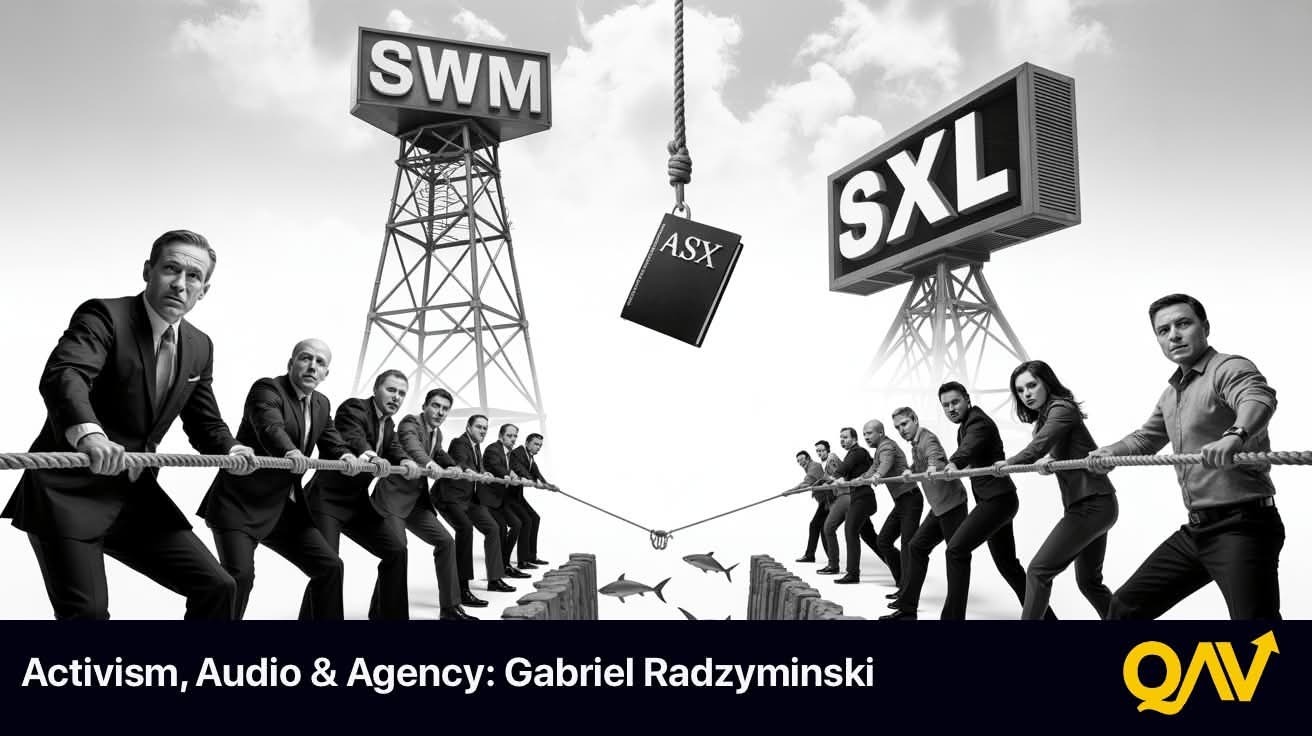
In this episode, Cameron and Tony sit down with activist investor Gabriel Radzyminski, founder of Sandon Capital, to dissect the art of activist value investing in Australia. Gabriel explains how he identifies mispriced assets, why value investing isn’t dead, and how activism can unlock value when management misalignment or agency conflicts keep companies from realising their potential. The discussion zeroes in on the brewing storm around Southern Cross Media (ASX:SXL) and its proposed merger with Seven West Media (ASX:SWM) — a deal Gabriel argues is a “nil-premium reverse takeover” that disenfranchises shareholders. The conversation dives deep into governance, board behaviour, passive investing, and the moral hazards of Australia’s listing rules. Expect sharp insights on capital allocation, corporate incentives, and the eternal tension between shareholders and boards.
⸻
Timestamps & Key Topics
[00:00:00] Intro – Cameron and Tony welcome activist investor Gabriel Radzyminski of Sandon Capital.
[00:03:00] The origins of Sandon and the mindset of activist investing.
[00:05:00] Why “value investing isn’t dead” — inefficiencies depend on who you are.
[00:07:00] How activism overlays value investing: identifying mispricing, diagnosing causes, and intervening.
[00:10:00] Agency conflicts and how private engagement with boards works.
[00:13:00] Deep dive: Southern Cross Media (ASX:SXL) and its “all about audio” strategy.
[00:17:00] The bombshell: SXL’s plan to merge with Seven West Media (ASX:SWM) — and why Gabriel says it betrays shareholders.
[00:22:00] How ASX listing rules allow “reverse takeovers without shareholder votes.”
[00:28:00] Who benefits — following the money from ASX fees to board appointments.
[00:31:00] Activism as a fight for shareholder voice — and the current campaign against the SXL–SWM deal.
[00:33:00] The challenges of retail shareholder engagement and inertia in voting.
[00:38:00] Acting your age: why declining industries should cut costs, not chase growth.
[00:43:00] The politics of board appointments and how independence can be a façade.
[00:53:00] Why “good governance” doesn’t always mean ASX-approved governance.
[00:57:00] Director risk, liability myths, and the illusion of indispensability.
[01:06:00] On disclosure and the failure of confession season — why ASX reporting lags US transparency.
[01:12:00] How to follow or support Sandon’s activism campaign against the SXL–SWM merger.
This section is for QAV Club Members only.
Register for your 14-day free QAV Club trial here.
If you’re already a QAV Club member and seeing this message, please login via the top menu.
If you’re a QAV Light member who wants to upgrade to QAV Club, go to your Account page (see Footer) and upgrade from there.
Transcription
Cameron: [00:00:00] Welcome to QAV. We’re recording this on the 14th of October, 2025, and today we have a very special guest, Gabriel Radzyminski from Sandon, capital Value Investors, activist Investors.
Tony mentioned Gabriel, coincidentally I think last week when we were talking about the Southern Cross Media and Seven West Media merger. But, uh, want to give a shout out to one of our listeners who sent me a recommendation that we should have a chat to Gabriel because he thought he would be a great guest.
Welcome to the show, Gabriel.
Gabriel: Uh, thanks for having me. Um, you’ll have to tell me who did the shout out so I can give them a thank you as well.
Cameron: I will. Um, let me just dig up that email. It was, uh, no, I don’t know. I don’t have it. That’s right. Well, whoever it [00:01:00] is, thank you very much for thinking of this.
I’ll get back to you. So, uh, why don’t we start by giving us a little bit of background on Sandon Capital. I believe you’ve been around since 2008. That was an auspicious time to start a fund.
Gabriel: Yeah. Look, uh, auspicious time, start a fund. I think it, uh, highlights that, uh, when it’s a good time to invest is not necessarily when it’s a good time to raise money.
Sure. Um, we were in, in an environment where we thought this was like, wow, the whole world has reset. What a great time to be investing.
Cameron: Yeah.
Gabriel: Sort of underestimated that. Most people, despite the tough talk, when things are going, uh, pear shaped, just want to go and hide under a rock and do nothing.
Cameron: Yeah. And so tell me about the, your, your thinking behind why to start a firm at the time.
Gabriel: Look, I, I’d sort of developed, uh, some habits as an investor where I would sort of do a, a, a, almost like [00:02:00] a living postmortem of investment. So, you know, you’re constantly reevaluating things. And I started thinking in simple quadrants of investments that did well, investments that did not so well. But then in those two, uh, categories, thinking, was it because I did good work, good analysis, or did I get lucky or did I do bad work, bad analysis, and was I un unlucky or unfortunate?
And in going through that exercise with investments, um, I started to realize that there were some things where it didn’t work out the way we’d liked. Um, we might have had a different outcome, had things occurred differently. That was for me, the, you know, the slow evolution into, uh, what I didn’t realize at the time, but suddenly was, uh, uh, more widely known as activist investing, where rather than leave to chance what might happen with a business, leave it in the hands of the people running it, um, [00:03:00] we took the view that maybe there was money to be made by, uh, encouraging people to do things differently and ultimately for the, you know, to do things that are in the clearer, better interest of their owners, which is us as shareholders.
Cameron: And, uh, as I understand it from some of the interviews I’ve seen with you and, uh, reading through your website, you see yourself in the value investing camp. That’s your basic approach to investing. Yeah. How do you find being a value investor these days, Gabriel? Because I know that, uh, it’s dead. We, we covered an article just recently where somebody said, yet again, that value investing is.
Gabriel: Well, if it, if it’s, uh, dead, they sort of, uh, forgot to give us the memo. Um, look, I think I read, I read a, a, a book a few years ago, quite a few years ago, um, by a, uh, an investor, um, well, it was just literally one Broadway comment in a [00:04:00] book by a chap called Ralph Whitworth, uh, well-known, uh, distressed, uh, dead investor.
And he explained, um, efficient Markets hypothesis, and keeping in mind, I, you know, studied, uh, finance, did all the theories, you know, understood them and then understood them well enough to know that they sort of work in theory, but not in practice. And Whitworth gave an explanation that, for me, resonated really well.
Um, markets are efficient depending on who you are. So if you ask someone with little access to information, little access to unique insights, then the market is pretty efficient in that it’s incorporating as far as you are concerned, everything you know, is incorporated into the stock price. Everything then moves on from degrees of, uh, uh, variation from that.
And so for us, look, maybe value investing is dead for some, for us. It’s not. We still, we still see, uh, opportunity. I’d [00:05:00] also highlight that in my career, I’ve, uh, had the call, uh, the call of death for value investing made a number of times. Um, and yet we still keep coming back. Maybe, maybe value, value investors and true value investors are like the cockroaches of the investing world.
I don’t know if that’s, uh, uh, uh, an appetizing or flattering description of us, but we don’t sort of concern ourselves. I think it’s different to what it used to be. You know, there was a time, uh, decades ago where if you actually picked up an annual report, if you turned up to a general meeting, you genuinely were able to get an edge because most people didn’t turn up, particularly in smaller companies.
Um, but I think if you are working diligently with a view to try to find something and make a different insight to, uh, what others are doing, um, I still think there’s a room, there’s room for value investing. I mean, at the end of the day, you, what we’re all trying to do is to buy things that we consider to be mispriced [00:06:00] or undervalued.
Cameron: Well, that was gonna be my follow up question is if you had to define your approach to value investing as an elevator pitch, what would it sound like?
Gabriel: Yeah, that’s one. We haven’t actually got down pat the elevator pitch. We’re not good at those sorts of things. Um. But look, at the end of the day, we’re, we’re, our approach is all about trying to identify mispriced securities.
Um, and I use the word interchangeably between mispriced and undervalued. They are sometimes the same, but not always the same thing. The activism for us is then an overlay, which is, if we identify the mispricing or undervaluation, what’s causing it is step one. And then step two is, or step three if you will, step one is identify it.
Step two is what’s causing it. Step three is, is there anything that can reasonably be achieved [00:07:00] that might overcome, um, that mispricing or undervaluation?
Cameron: And this is where the activism component comes in.
Gabriel: Yeah. Yeah. So what we’re trying to do, I think if you, if, if you think, if you think of, uh, you know, the classic.
Bookish value investment, uh, approach is identify something that’s undervalued and buy it, own it for a long time. And in, in, you know, in the fullness of time, markets will reflect its true value. Uh, we’re not necessarily convinced that that will always work, because often the mispricing is down to something, is down to a, there is something that is causing the mispricing.
Sometimes it can be, um, uh, you know, poor record of capital allocation. It can be, uh, you know, uh, agency conflicts. I, I think agency conflicts are probably the single biggest factor. Um, but then for us it’s about, well, what can you change? What can you do to change the circumstances that might deal with that [00:08:00] mispricing?
Tony: Tony, can I follow up on that? Yeah. Follow up on that question. Thanks. So that was the, uh, the sort of theme I wanted to explore with you, because as a value investor, you sometimes get caught in value traps. Yep. So does the activist investor. You flick on when you’ve bought something that looks valuable or undervalued and then you’re fine, there’s a problem.
Or do you go in with your eyes wide open saying, I know why this is now undervalued and I can fix it and help turn it around.
Gabriel: Uh, the latter, Tony. Um, what we’re trying to do is if you think back to primary school maths, um, we’re trying to think of the world in Venn diagrams. Um, so the first circle that we’re trying to identify is mispricing undervaluation.
So something that is, you know, can be bought for less than we think it’s worth. The second part is then saying to ourselves, what’s the opportunity to make changes to that? Um, and it’s where the two intersect that we try and invest, where [00:09:00] we believe there is an attractive, uh, discrepancy in market price versus our assessment of intrinsic value and where we believe there is a reasonable, uh, possibility that we can affect the changes that are needed to overcome that gap.
So it doesn’t avoid value traps completely, I think it avoids more value traps than if you simply looked at valuation alone.
Tony: So if, if a lot of those issues are conflicts of interest or agency conflicts as you’ve called them, is it, is it a case of building a big enough state to resolve that through shareholder power?
Or is there, is it a negotiation? What, what’s the usual method of approach?
Gabriel: Look, we follow a reasonably, um, predictable path in the sense of, you know, we’ve got a, a, an approach that we take, which is we seek first to have bilateral private [00:10:00] engagement with a company. Um, where, you know, we effectively introduce ourselves, uh, discuss what we believe is the problem, and give them an opportunity to respond.
The funny part of that is that the better companies are the ones who engage and respond to that approach. Doesn’t mean we get an outcome necessarily, but they at least engage. The worst companies are the ones who just ignore you. Um, at the end of the day, our view is that boards, as much as we’d like to say, you know, all directors and uh, uh, CEOs of, uh, these companies are all rat bags out to fleece the shareholders.
It’s not true in our experience. The majority of, uh, instances are cases where you have people who are genuinely well-meaning and well-intentioned, but it’s just that the, the, the agency conflicts means that they’re doing something that is perhaps more in their interest than the interests of their owners.
Uh, and for us it’s then a case of, [00:11:00] someone asked me once, how do boards and management teams typically respond to what we suggest? Um, and the reality is they respond.
Tony: Hmm.
Gabriel: You know, they know best they’re in charge. What, what, what could we possibly know, uh, that they aren’t already doing? And therein lies one of the, the, the, the challenges is that what we’re proposing is often not something that hasn’t already been considered, but it’s typically something that has been deprioritized because it doesn’t suit the interest of the people making the decisions.
Tony: Hmm.
Gabriel: And so for us, our efforts then typically focus on convincing other shareholders that what we’re proposing is in their interests as well as ours. And that, that when there is a consensus that can emerge from shareholders of the need for a change in direction, that’s when boards either change their minds or ultimately boards get changed.
Tony: Yeah. So, so there is a, an element of leverage in there. If they don’t, if the [00:12:00] board has a conflict, wants to keep acting. With that conflict because it suits them and at some stage the shareholders almost have to revolt and gang up and, and apply some leverage, don’t they?
Gabriel: Yeah. And, and Tony, I think it’s important to, uh, you know, keep in mind when using the word conflict, conflicts of interest, it’s not necessarily malevolence, it’s not malt intent.
Mm-hmm. It’s just a different way of looking at, at looking at the same situation. Um, you know, one of things. You search the
Tony: board to act in their interests.
Gabriel: Yeah. Or again, that, that, that might be even, uh, in some instances, unfair. They think they’re doing what’s, they think they’re doing the right thing.
But that doesn’t mean that for me as a shareholder, I agree with it.
Tony: Mm-hmm.
Gabriel: So, might might be
Tony: helpful to, to listeners if they, if you, we can work through an example. Is there a, a glaring example that can illustrate what you’re talking about?
Gabriel: Well, there’s one [00:13:00] and if you can talk about, there’s one that’s right before us.
Uh, uh, right now, which is, uh, uh, Southern Cross, uh, media Group. Um, so look, we became an investor in Southern Cross, uh, late last year. Um, we’d been looking at the radio space for a little while. A few people had pitched ideas to us, um, none of which particularly made sense to us. Um, and we started looking intently at the radio space and decided that Southern Cross was to start with the least worst proposition there.
Um, but also when compared to old media, um, what we liked about radio was that we considered that we still do consider that it has some unique characteristics that make it far better than print and, uh, television media assets. Mm-hmm. Um, and put very simply, it’s because you’ve got a [00:14:00] captive audience for audio.
Now, yes, people listen to, uh, radio and audio, uh, elsewhere. But as a, as a simple way of explaining the thesis, uh, we see that, uh, the automobile is the last sort of, uh, captive audience for, uh, a pair of ears, given that you have to have your hands on the wheel for the foreseeable future. Um, they had been laboring under the, um, yoke of TV assets, regional TV assets that were just not working for them.
Um, and they’d announced that they were going to sell those assets at some point. So from our perspective, we thought, oh, this is interesting. It’s moving from being a, you know, pretty unattractive combination of radio and TV assets to being a pure play audio. Business. The pr, the shareholders before we became shareholders had borne the cost of, I think, nearly $50 million of [00:15:00] investment into their listener podcast platform.
So again, for us, we, when we were looking at the company, we didn’t have to be involved in spending that money that was already a a a a sunk cost. And so we liked the all about audio, uh, strategy that the company was espousing. We thought, this is great. Then they sold the TV assets. This is getting better.
Um, and taking a step, uh, uh, on the tangent for a moment. Over the years, we’ve made a lot of money investing in what we call declining businesses. Um, you know, industries or companies that have, you know, limited growth prospects, but can still generate good solid cash flows provided they return them to shareholders.
Um, a way of thinking about it is that. Companies, I think, should be well attuned and well aware of where they are in their [00:16:00] industry and where their industry is in its lifecycle. Um, so if you will, uh, it’s important that, uh, companies act the a act their age. Um, you know, it, it wouldn’t do any of us any favors, including myself, for me to parade around as if I was a, you know, 17-year-old, um, you know, wearing a, you know, I don’t know, ripped jeans or whatever else you might wear when you’re 17.
Um, I’d look a fool and everyone would be laughing at me. Uh, whereas with Southern Cross, we thought this, all of our audio strategy was actually common sense. The critique we had of them and still have, is that we believed that they needed to be more aggressive in terms of cutting costs. Because when you are in that declining industry, cost control is a challenge.
And it’s important because what you don’t want to see them do is invest as if they’re a growing industry. When the return on that invested marginal dollar is just never gonna be there. Um, [00:17:00] so we sort of, uh, worked through private engagement to see if we might make some changes to the board that went down, as you might suspect, like a lead balloon.
No one wants to effectively be told, we would like to replace you. You know, it’s like me coming up to you both and saying, uh, geez, uh, guys, you’ve done this great podcast. I think you’ve done wonderful things, but, uh, I’d like to see you off now because I think I can do a better job of it.
Tony: Hmm.
Gabriel: I I get it.
You know, the reaction is not gonna be positive. Um, and then, so that was, that sort of campaign was, uh, uh, running in the, in the, in the, uh, uh, background. And then, uh. 29th of, uh, I think it was 29th of September, I wake up to an announcement that, uh, Southern Cross has decided to get back into the television business by, uh, you know, offering to buy, uh, seven West Media.
So suddenly we went from a company that a [00:18:00] few days before was all about audio, and that mantra was repeated ad nauseam. All about audio, all about audio. Again, we liked it. We thought it was a good strategy. Um, a few times in discussions with, uh, the chair and management, we were asked our views about media consolidation.
And right from the first meeting, we always said that to us, those were one of the most dangerous combinations of two words ever imagined. Um, because the idea and notion of media consolidation has destroyed enormous shareholder value over the years, very few people have done well out of it, particularly, uh, acquiring.
Parties in media consolidation, and yet every management team, I’m sure believes that this time it will be different. Their case will be different. Um, so that’s really where we’re at. We’re in a situation where what is otherwise, what otherwise should be a good, simple, solid cash generating business with a [00:19:00] medium to low growth profile over the next, uh, decade, has, uh, uh, gone back into the worst of the other media assets, newsprint and television, um, completely at odds with the strategy they have espoused since 2023.
Um, and to add, uh, insult to injury, they’ve done it by way of a scheme of arrangement, which means that Southern cross shareholders don’t get a vote on the, on the matter.
Tony: Yeah. That’s interesting, isn’t it? I mean, there’s a whole, let me unpick that a bit. So walking it back to the start of what you said, you’ve invested in an audio, audio only company.
Yep.
Why did you seek to have board representation when you first joined? Do you, were you still seeing problems with that strategy or was there some other reason?
Gabriel: Because costs weren’t coming down fast enough.
Tony: Okay. And so the board could have simply said, we’ll, add a director to the board, or two, or however many you were seeking to do, and they could have engaged with you [00:20:00] from day one and avoided a lot of angst, I guess, and potential problems going forward.
Gabriel: Uh, look, that sounds reasonable, Tony. That sounds like a really, really reasonable thing. Um, I imagine if, uh, the person we’d nominated to the board had gone onto the board or No, we, we weren’t even nominating, uh, because keep in mind, we were just suggesting someone who we thought would have widespread. Um, uh, support amongst a number of shareholders that wasn’t our nominee.
Mm-hmm. Um, but I dare say that if that person had joined the board, this transaction probably wouldn’t have happened. So perhaps that explains why they didn’t want ours. Yeah, right. Anyone’s coming to join the board and spoil the party.
Tony: Yeah. So they must have known about the consolidation at some stage during your discussion.
Gabriel: I, I don’t know. I, I, I don’t know. I can’t know that. Um, but given the number of times they asked about our views on media consolidation, again, I can see why, you know, from a board and a, a [00:21:00] executive perspective, it’s always better to be involved in a bigger company that a smaller company you can see why they would, you know, gravitate towards that.
Um, as an owner, I’m very happy with a small, efficient, well performing, uh, company. Yeah. I’ve got no issue with that.
Tony: The, um, the scheme of arrangement, does that involve a vote at any stage or is it just simply appointed by, just simply approved by court?
Gabriel: So you’ll be relieved to know that seven West Media shareholders do get to vote on the, uh, transaction.
Um, you’d hate to, uh, find yourself being bought by someone without you, uh, being, uh, uh, giving approval to be bought. Um, unfortunately it doesn’t work the other way around. The acquirer doesn’t get, uh, an opportunity. That to us is one of the, um, loopholes of the, of the system whereby, um, there are significant powers, um, uh, given to directors when it comes to takeovers and [00:22:00] schemes of arrangement to dilute, uh, their shareholders.
Tony: Is that an ASX listing rule, or is that a Corporations Act loophole?
Gabriel: Uh, look, mainly, uh, mainly ASX. So ASX, if I could digress a moment just to, uh, give you the, um, sort of the, the potted, um, summary of ASX listing rules. ASX accepts that issuing more than 15% of the issued capital of the company without shareholder approval is a bad thing.
So if you are going to do a placement and it’s more than 15%, you need to get your shareholders to approve it, stick that sounds good. Shareholder protections. Um, if you are going to issue more than a hundred percent of your issued capital, uh, in a, so keep in mind that’s for replacement for cash. So 15% is your hard limit.
You can’t do more without shareholder approval. Yep. If you are going to issue shares that represent more than a hundred percent of your issued capital in a scheme or takeover, you gotta get shareholder approval because [00:23:00] ASX considers that to be a reverse takeover.
Tony: Mm-hmm.
Gabriel: So wonderful. ASX acknowledges that there are situations where shareholders of a company can be, I’d say, I’ll call it disenfranchised by share issuances.
S the loophole is what I described previously to someone else as the Bermuda Triangle of shareholder value, which is between, uh, 100% and below. So the transaction with Southern Cross is a transaction that would see, uh, 98 point something percent of the shares be issued. So the merger ratio would involve 50.1% of the post-completion shares held by Southern Cross shareholders, and 49.9 held by seven West Media.
So it, it makes it within the rules by one 10th of 1%, but it’s not just about that [00:24:00] board control. If the transaction proceeds will go to seven West, they will have a majority of the directors appointed to the entity of the, the board of the merged entity. And the seven West CEO is going to be CEO of the merged entity.
So from my perspective as a Southern Cross shareholder, whilst I might gain a, a, a modicum of comfort in the exchange ratio, giving me a one 10th of a percent, uh, lead over the seven West media shareholders, I’m seeding board control to seven West and management control to seven West two outta three measures of control as a layman, two outta three measures of control.
As a, you know, a, a reasonable person are in the hands of seven West Media. That to me is not, uh, a, a transaction that, uh, should go ahead without shareholder approval. It is effectively a nil premium reverse takeover
Tony: seems that way. Why would [00:25:00] the Chair of Southern Cross or the CEO of Southern Cross want the situation to end up like that?
How has it served them?
Gabriel: I, I dunno, you’d have to ask them. Mm-hmm. Okay. I mean, the, the, the chairman of Southern Cross will become, uh, the chairman of the merged entity after Kerry Stokes steps down.
Tony: Mm-hmm.
Gabriel: Um, the CEOI, I dunno, you’d have to ask them. Uh, I’m hoping that in a, uh, in documentation that will come out, they might explain why.
Um, but to us abandoning the all about audio strategy to buy into a, you know, the worst of the old media assets being TV and newsprint, which is beggar’s belief,
Tony: who, who sets the, these kinds of listing rules on the ASX. I mean, it used to be a group of stockbrokers who got together and did that, but who’s doing it these days?
Gabriel: Um, look that, to answer that question, I don’t know. Uh, the listing rules are, you know, the purview of the ASX. [00:26:00] Um, so ultimately it’s gotta be the ASX directors who are, who have to be held accountable for these sorts of, uh, situations. Um, but I think, look, it’s always worth thinking, and we do this when we try to analyze the companies before we invest and as we’re investing is we try and follow, um, you know, follow the money, follow self-interest.
There’s the old saying, you know, if there’s a a, a race with a horse called self-interest, always back that horse. Um,
Tony: at least, at least, you know, it’s trying.
Gabriel: Yeah, exactly. Yeah. Um, what’s interesting is that there’s been opinion pieces written about this transaction and a few others, uh, you know, James Hardy, uh, before this and, uh, perpetual pendle before that.
And it seems that there’s a, uh, a chorus of, um, supporters of the status quo coming from the legal and investment banking fraternities.
Tony: Now,
Gabriel: unsurprisingly, that is where they earn fees. Mm-hmm. So, of [00:27:00] course I, I accept, I get it. Of course, they’re going to fight for their self interest. Um, the problem is I think too often people naively believe that they’re not self interested.
Yeah. Never asked
Tony: Barbara if you need the haircut.
Gabriel: Yeah. You know, the FY 25, um, ASX in our annual report, uh, in one of the tables, there’s a list of how much capital they raised. And in 2025 or financial year 25, they raised over, I think $91 billion of new capital was listed on the ASX. And 40 of that, I think, sorry, 90 billion.
41 of that 90 billion was in what the asex describes as other secondary raisings, including script for script, which is this sort of transaction.
Tony: Right. Which is not new capital really is it?
Gabriel: No, it’s recycling, it’s shifting from one to the other. I mean, yes, they might be buying private companies and doing it, but at the end of the day, a decent chunk of, [00:28:00] as X’s revenues is coming from, of course, these sorts of transactions of, yeah.
And again, look, I’m not, uh, I’m not an ASX shareholder. I, the, the market is full of conflicts. That’s the nature of a free market. Mm-hmm. And that’s okay. It’s just that at the end of the day, as a shareholder, um, and a shareholder who’s, who’s on the receiving end of what I consider to be a pretty poor transaction, I’d like an opportunity to vote for it.
Tony: Mm-hmm.
Gabriel: Or for me, I’d like the opportunity to, to vote against it and to campaign against people voting for it. Um, but at the moment, we don’t have that opportunity because it tick many years, ticks the box.
Tony: Yep. Many years ago, I went through a similar situation as a shareholder of West Australian News, WAN.
And, uh, it’s, it again was a reverse merger. Um. Of other media interests, and it seemed to be a, um, something you couldn’t stop. And it was mainly [00:29:00] about consolidating debt rather than consolidating equity. Um, and this seems to me, seems, seems like Akins.
Gabriel: Yeah. Some unkind souls have, uh, made mention of that, um, as well as the fact that some actors are the same in those two situations.
Correct. West
Tony: Australian News was a wonderful monopoly business. The only newspaper in Perth. It was a classic buffet play, and it was straying off lots of cash and it was low growth, but it was paying good yield. All those kinds of things as you are describing with southern cross media. Yeah. And history’s repeating again, I think.
Gabriel: Look, Tony, I, I, I think, uh, uh, you know, for anyone who’s been around for a while, or at least as a student of history, you do, uh, you do know, and you are completely convinced with the idea that, uh, while history may not repeat, it certainly rhymes. And sometimes the rhyme is pretty, uh, uh, pretty close. And this one is, you know, similar situation.
Um, look, to me, it just, there are transactions where I, I see, uh, them happening [00:30:00] and I can at least understand why some people might like it, even if I don’t. This one, I just struggle to see the benefit for a Southern Cross shareholder. You know, we, we’ve got a currently, uh, management team and the board have done a great job getting debt down to roughly 33% debt to equity ratio as at the, uh, balance state, 30 June, um, Southern Cross, uh, seven West Media, uh, as at that same balance state have 133% debt to equity ratio.
So if you think of the exchange ratio, what’s happening, if this transaction goes ahead, as a Southern Cross shareholder, I’m gonna go from a 33% debt to equity to 87% debt to equity. Not good, don’t like it, don’t like that kind of leverage. But as a seven West Media, I’m going down from 133 to 87. That sounds a lot more appealing.
Yeah. Unfortunately. Exactly. You know, I’m not a seven West shareholder. I’m a Southern cross shareholder. [00:31:00]
Tony: So where does that leave you? I mean, you, you are losing out on the board, you’re losing out on the deal. Are you, are you a seller or are you still going to agitate for change somehow?
Gabriel: Oh, look, we’re, for us, the, the, the fight is well and truly on.
Um, we have a number of things that we will run to ground before this is said and done. And I think it’s important to not overlook the fact that as a value investor and as a careful, uh, uh, you know, careful students of value, we do try and make sure we buy well. And Southern Cross, we were fortunate in that we bought very, very well.
Tony: Right.
Gabriel: Um, so, you know, even today we are in, well, well, uh, uh, profitable territory. It’s really a case for us of. We don’t want to be leaving all this money on the table that we think is there to be had as a southern cross shareholder in a pure play business.
Cameron: Well, I wanted to ask [00:32:00] you a bit about the current pricing of SXL because it’s had a great run.
It’s been on our buy list, you know, for a couple of years, really on and off, and I know it’s up a hundred percent roughly in the last 12 months. And, but looking at the reaction, the market reaction to the news of the proposed merger doesn’t seem to have gone one way or the other. Do you, what do you read into the market’s muted reaction to this?
You’ve obviously got a very strong reaction to it. Why has the market sort of been ho hum about this news?
Gabriel: Uh, look, Cameron, I, I dunno what the market, you know, I, I could, my guess is as probably good as anyone else’s. I think what I might consider as objective evidence is that the fact that it hasn’t moved means that probably there’s a divergence of views.
There’s not a consensus that it is either good or [00:33:00] bad.
Cameron: Right. Um, a frequent guest on our show over the years has been Steve and Mabb, who is, uh, last I heard the, uh, chairman of the Australian Shareholders Association. I know he’s been rallying to get their members involved in voting on issues like this.
Do do you engage yourself with other shareholder associations to try and I know you do a lot of media work, a lot of outreach. Do you engage yourself with other groups of, uh, shareholders to try and increase your
Gabriel: look? Where, where we can, um, you know, we usually, uh, reach out to a SA on issues. Um. Our focus is typically on institutional shareholders.
Um, we will sometimes reach out to, you know, a whole bunch of shareholders on the register. I mean, when we ran a campaign a couple of years ago at Karoon Energy, um, [00:34:00] we were communicating directly with I think the top thousand shareholders, um, just to, you know, make sure that they were aware of what we were saying and doing.
Um, the, the challenge I think with a lot of, um, retail investors is A, getting their attention and b uh, dealing with the inertia that comes from, generally the idea is that, oh, the board must know what they’re doing. Mm-hmm. Um, you know, I was, uh, I spoke to some, uh, investors a few about a month ago, uh, in Southeast Queensland.
One of the questions from the audience, some of our, so the audience was some of our investors and some other people, and one of the questions from the audience was, how could you possibly expect us to believe that you know better than the company? Mm-hmm. And look, it’s a fair question. I mean, you know, we’re on the outside, we’re working with public information.
The main difference is, as I said [00:35:00] before, it’s rare that we’re proposing something that the company hasn’t already considered and either discarded or deprioritized. What we’re trying to do is get something to escalate, to be a number one priority, IE something that will actually be enacted. Um, and more often than not, it’s, it’s simply common sense.
Mm-hmm.
Tony: You think in the case of a company like SXL, which, you know, we’ve described as a kind of a cash printing machine in a, a low growth industry, do you think there’s another. Large shareholder in their rear whispering, and I, I don’t, maybe I shouldn’t use SXL specifically with a company like SXL and they’re saying, you gotta find some growth for us.
That’s, that always seems to be the Oh, absolutely.
Gabriel: Yeah. Yeah. Look, and, and I think that’s the challenge is that, you know, I don’t envy the role of A‑A-A-C-E‑O or a board because shareholders have different perspectives. You know, some shareholders simply say growth, growth, growth. And we just [00:36:00] want every company in our portfolio to strive for growth.
We simply accept that it’s more nuanced than that. And some companies should strive for growth and others should actually just accept where they are and, you know, squire their cash as best they can and get it into the hands of their shareholders. You know, this concept of acting your age, um, we had a, a few years ago we had an investment in a company called On the House.
So on the house was a, uh, uh, sort of a tech, uh, business. And it had two parts to its business, the On the House website, which wanted to be the disruptor to REA and Domain. Mm-hmm. Um, and then the second business, which was sort of under the bonnet, was a real estate, um, uh, real estate agency, uh, operational platform, which is the business that we were interested in.
But the challenge with on the house, and it was probably a [00:37:00] good, um, lesson that we took from that was part of the reason they got themselves into trouble was that when they started, I think they had a good idea, but for a number of reasons, when they did their IPO, they weren’t able to raise as much money as they had hoped for.
And therefore when they got cracking on the, uh, concept of on the house, they couldn’t spend as much money as quickly as they wanted to. And they were relying on the. Cash flows from the software business to help fund the growth. And so their growth profile was actually quite constrained. And even though we don’t invest in those sorts of companies, I can understand and accept that if you are, uh, uh, for example in a new, uh, uh, industry in technology and you believe you have an opportunity to, you know, dominate that industry, you should move as quickly and spend as much money as you can to get that dominant position.
Because the [00:38:00] half-life of that investment is actually gonna be very short. So if you are in a growing industry, yes, you should try and grow as fast as you can, as quickly as you can, and to get as dominant as you can. But the converse is also true if you’re in a declining industry, it’s not the same attitude, it’s not the same strategy that you should pursue.
And so to, to, to us. There are shareholders who will say, grow, grow, grow, without considering that perhaps that industry and that company shouldn’t grow. And the way I would look at it is that’s why ultimately you should have a diverse portfolio.
Tony: It’s also a bit more nuance than that though too, because if you have a company in a low growth industry and it’s throwing off lots of cash, sometimes shareholders, well, a shareholder makes the argument, let the company hold that cash and then make a, uh, an adjacent investment, which is better off for shareholders than giving it back.
So what’s your view on cash going to shareholders versus cash going to the company? [00:39:00]
Gabriel: Look, unless the company can prove and demonstrate, typically with a track record of doing so, um, productively and, uh, profitably, you’re better off giving it to the shareholders
Tony: and they can invest in a growth company.
Yep.
Gabriel: Yep.
Tony: Yeah. Yeah. Look, I come out of the retail space and. Plenty of examples of what you’re saying. I mean, David Jones is the classic one. A company in a niche market throwing off lots of cash, pressured for growth, and then tried to expand into rolling out their food halls Yeah. As separate food businesses.
And that just doesn’t work. They, they’re core business and, and I, I think, I think I need lots of
Gabriel: cash. That observation reinforces the idea that if you are, if the fundamental nature of the industry you are in is of low growth, there ain’t nothing you can do that’s gonna change that. Yeah. And, and if you look back at, uh, uh, at history of companies that have tried to change it, the ones that don’t accept the reality of [00:40:00] their world are the ones that tend to destroy enormous amounts of shareholder value because they, they try and be something else.
Tony: Hmm. And there is this, and there is this shareholder or sh share market imperative to grow, to grow up better than grow, grow up better than CPI to grow up better than index, to grow better than GDP. And yet there are plenty of businesses, the supermarket businesses grow at GDP every time they’ve tried to grow it above GDP, they’ve invested money and it’s been falsely invested.
Wrongly invested.
Gabriel: Yep. Yeah. It, it’s, uh, I mean that’s, uh, I think the definition that’s used there is just mal investment. You know, it, they’re, they’re, they’re not optimal decisions. Um, yes, the economy as a whole should grow at X, but that doesn’t mean every business and every industry in the, in the economy is growing at the same rate.
Some are growing at two, three times the rate, and others are growing at a 10th of the rate. That’s just the nature of things. And so for us, it gets back to this concept of, as an, as an owner of a business, [00:41:00] I want the business to act its age. I want it to act to be age appropriate. To the lifecycle of the industry that it’s in now as investors, we tend to be more attuned to the needs of companies at that lower growth declining end of the market, just because we see it as a, a better risk adjusted return.
Um, yeah.
Tony: Are there, is there a, a, a company out there which is too big for you to invest in, which you would consider as a candidate for action? If, if you had the money, what would you do?
Gabriel: Um, there are companies that are, and, and I’ll, I’ll, I’ll be evasive in my answer, Tony, but there are companies that we believe, uh, at various times, mispriced, larger companies.
The problem with them, and the reason we don’t think, no matter how much money we had, we don’t think their, uh, reasonable targets is that [00:42:00] their ownership base is too diffuse. There’s simply far too many people with differing interests for us to be confident that we can find a consensus position.
Tony: Right.
Gabriel: And so, uh, to give you an example, uh, sorry, go ahead.
Tony: No, sorry. Don’t mean to talk over you. I’m sorry. I was just gonna ask, so therefore having a block of votes is very important. I do it all the time, so please don’t, it’s, it’s a problem with Zoom. I think we lag a little bit.
Gabriel: Oh, thank you. I, I, my wife would suggest it’s not a problem with the technology, it’s just me.
Um, it’s not necessarily about knowing that there is a block that we can count on. It’s being confident that there is a block that can emerge. Right. So to give you an example, and we’ve never been an investor, but you brought it up earlier and I think it’s a good, uh, illustration at this point. Um, with Woolworth’s, uh, Woolworth’s a few years ago when they got themselves into trouble with the, uh, masters debacle.
Tony: Mm-hmm. [00:43:00]
Gabriel: Um, we were looking at that thinking, wow, this is interesting, to say the least. But what we very quickly realized as we were looking at that was that there was not a single shareholder who owned more than one, one and a half percent of Woolworths.
Tony: Right.
Gabriel: And just doing the maths, it’s really hard to get a consensus there.
Um, we also find that there different investors where different people within the same organization will have different perspectives on things. So, you know, in larger organizations, you might have a portfolio manager who has complete oversight over the investing decision. But it has to seed an element of, uh, uh, of decision making to their stewardship team.
When it comes to voting at, uh, general meetings
Tony: right
Gabriel: now in our firm and our way of looking at the world, the two are inextricably linked. There is no separation between governance and investing. They’re, they’re, you know, two sides of a [00:44:00] similar coin or the same coin. Whereas we’ve got with other instances where the pe you’ve got people wearing investment, uh, tinted glasses and others wearing stewardship tinted glasses.
And Karoon was a good example a couple of years ago where we were running a campaign, which was encouraging larger investors to vote against the remuneration report. More so because we wanted to send an unequivocal message to the board that shareholders were unhappy. We did have some concerns about the remuneration structure.
I remember sitting, uh, in a meeting with, uh, uh, an investment person who said, yep, agree furiously with what you’re saying. We’d love to support you, but it’s our stewardship team who will decide. And then speaking with the stewardship team who explained that they wouldn’t be recommending a vote against the remuneration report because they didn’t have a problem with remuneration at that company.
And we were like, well, we don’t either really, but we just wanna send a clear message to the board. Oh yeah. But [00:45:00] we can’t do that because we don’t have a problem with the remuneration policy, therefore we have to vote to support it to us. Everything that’s, there is a tool to be used to further our objectives.
Exactly. And so when you get to the, you know, larger companies, there’s just so many more people that you have to convince. Mm-hmm.
Tony: Right. Um, and I guess that brings me to, um, the question of the current investing environment with a lot of passive investment going on. Do you think the role of an activist invest investor is even more pertinent or important given that there’s so many passive investors who don’t vote the there at the moment?
Gabriel: Okay, so, uh, I think it’s important to distinguish, um, index funds. Passive funds in that sense for us, are an important stakeholder because they are a, a, a, a stakeholder group that we consider to be open to persuasion. Where there’s an [00:46:00] increasingly passive and inactive, uh, non-voting block is, uh, in retail investors who invest through platforms.
It’s very hard to vote your shares there, particularly if you’re voting against a board recommendation.
Tony: Why is that? Does the platform act as a gatekeeper in some respect?
Gabriel: Yes. Yep. Yep. So for example, uh, you know, we had, um, uh, with Karoon for example, we had a block of shares, you know, whatever it was a number of shares that were held in, you know, one or two of the very popular administration platforms.
And we knew that the underlying investors simply didn’t get any of our correspondence. Okay. So there’s, you know, there’s a, there’s a, a, a, an inertia is one of the biggest challenges we face, and the inertia is sometimes structural. At other times, it’s, uh, you know, [00:47:00] intrinsic. I, people don’t care. Sometimes it’s because they can’t be made to care because they don’t have visibility on what’s happening.
Tony: That’s interesting. So if you go on requisition list of shareholders, you can’t communicate with them because they’re they’re listed as a, as a platform Yes. Rather than an individual shareholder.
Gabriel: Yeah. Look, we, you can oblige, um, uh, asic to get a beneficial interest register, which is effectively a look through.
Yep. But, you know, then you get into sort of, uh, you know, peeling layers off an onion and, uh, you end up, uh, you know, speaking with, um, you know, Mr. And Mrs. Uh, uh, Jones with 10,000 shares and those 10,000 shares might be critically important to us, but there might be, you know, 2000 of those size shareholdings, it becomes a little bit unwieldy.
Tony: Right. So it’s interesting. I, um, I, I guess I go on what I’m reading in the media, but I wouldn’t have thought some of the big index funds were, uh, act that active in, in campaigns. So you state streets and, uh, [00:48:00] the like
Gabriel: Black rocks. They will usually vote, uh, different, different funds have different policies, um, but they will, uh, often vote according to recommendations from various proxy advisory firms.
Right. Okay. We reach out to proxy advisory firms to make a case.
Tony: Mm-hmm.
Gabriel: Sometimes we might get support, other times we don’t. But again, it’s important to consider that what we’re doing is ultimately trying to ensure that there is a healthy contest of ideas, our ideas versus those of the board.
Tony: Right. Do you, in some of the other examples you’ve mentioned, have you run hostile nominations for board positions and how have they gone?
Gabriel: Look, we have, we have in the past. Um, what we’ve found is that in Australia, unlike, um, elsewhere in the world, particularly the us, um, there seems to be an antipathy, uh, from fund managers. [00:49:00] If they think another fund manager has got something that they don’t have very zero sum thinking, you know, if you have something, it means they’ve lost something.
And so what we’ve found is that it’s much easier and more effective to make changes to boards if people can be effectively brought on by acclimation rather than overtly being someone with our stamp of approval. You know, the reality is if I, if I was able to, you know, bring back from the netherworld, uh, you know, Charlie Munger, Steve Jobs, and, um, I don’t know, pick another, uh, dearly departed and put them forward for a board seat, almost every board would reject them simply because I had nominated them and not me personally, but because an investor had nominated them.
Tony: Right.
Gabriel: Um, you know, we, we wrote, uh, I wrote a, an opinion piece a while back, um, talking about the, uh, you know, the, the. The facade or the, the, the mirage that directors, [00:50:00] um, want to portray, which is that independence is somehow a superpower. It’s not, um, what we’re trying to do is communicate this idea that directors are not as independent as they might like to think because they’re independent, but they’re still beholden to their, uh, their, they’re subject to patronage because of the way they get invited to join boards.
Tony: Mm-hmm.
Gabriel: So, you know, one of the things that we’ve said for years and years and years is that the qualities that you need to become a director are almost the antithesis of the qualities that you want in a director as an owner. So if you think about it, to become a director, you’ve got to be someone who is, has some connections.
Yes, you’ve gotta have a bit of experience, but that is becoming, I think, less important. And you’ve also gotta be seen as someone who will be part of the team. Whereas as an owner, I want to know that there’s someone on the board who’s going [00:51:00] to, you know, call things out when everyone agrees, call things out, when it doesn’t make sense.
Um, we don’t think that there is, uh, we don’t think that boards should be friendly collegiate environments where everyone sort of, uh, uh, enjoys the, the process. Um, I, I’m someone who thinks that the best outcomes occur when there is a healthy tension between different stakeholders.
Tony: Yeah. So you’re speaking to a company director and my spouse as a company director, so I understand what you’re saying. Apologies. No, no. It’s, it’s exactly what, um, it’s a, it’s a tight rope that we walk of, of providing, uh, enough input to represent the shareholders and not enough to have to take your Batten ball and go home really.
Gabriel: See on that point, Tony, I think there, there are, there, and this is a difficult one because you know, there’s community expectations, uh, that matter. But [00:52:00] the challenge is that for a lot of professional directors, they need the gig. Yeah. Which means that they can’t afford to take their baton ball and go home.
Because if you do it once, you might get away with it. If you do it twice, you get, you get kicked out of the club because you are gonna be seen as someone who does, who isn’t a team player. And yet that may well be the sort of person that more boards need.
Tony: No, exactly. There’s a, um, you, you’ve reminded me of an anecdote of the chair of the company that I’m a board member of and who said it’s, it’s, it’s good to have you on.
He’s talking about me because, um, it’s good to have successful people on the board ’cause they’re not there for the gig. Yeah, yeah. They’re there as an investor and to protect their investment.
Gabriel: And, and that’s a, that’s a challenge, um, because there’s this community expectation that as long as you’re independent, everything will be okay.
Um, there’s a, uh, there’s a fellow who, whose work I really, uh, enjoy. Um, professor Peter Swan, um, [00:53:00] who’s emeritus professor of finance at UNSW. And Peter’s done a lot of work on the performance of, uh, uh, companies with independent and non independent directors. And, and I’m, I’m sort of, uh, poorly paraphrasing a lifetime’s worth of work.
But one of the conclusions from his work is that the companies with what are considered the least independent boards are actually the best performing companies.
Tony: Mm-hmm.
Gabriel: And so, from our perspective, we believe that good governance is, you know, the most important thing in a company. But importantly for us, good governance isn’t what is commonly.
Accepted as good governance. I, we do not accept necessarily that the ASX or a ICD definition of good governance is good governance. We think, just as you highlighted before when I was talking about, uh, you know, low growth, high growth, we think good governance is actually incredibly nuanced and is different for different [00:54:00] businesses, different for different, um, uh, uh, personalities.
Tony: And of course, you know, balanced with what you’re saying, which I agree with is, is, you know, the, the large body of experience and work about owner founders, it can have terrible what’s called corporate governance, I guess in the classic sense, because they. Run the business that they’ve started. Um, they keep, they have the majority control.
They put their mates on the board, et cetera, but they can be terrific investments for shareholders. Um, so that, and likewise, you can have people who tick boxes, um, yeah. To the A ICD in recommendations who are terrible at running a company.
Gabriel: Yeah. Look, I, I agree. I think it’s also important, like at the moment there’s a, a, and I think partly because it’s topical, um, there’s a great debate about, you know, founder led companies.
Um, I think that it’s important to also acknowledge that simply being founder lead [00:55:00] doesn’t mean that everything’s gonna be plain sailing. Um, you know, if you think back to every business that exists today, at one point it was found a lead. Someone had to start the business sometime. Um, and I think it’s also worth touching on and, and, uh, reminding your, your listeners that.
For all of the criticisms that I might make for all of the, you know, examples of what I consider to be, you know, poor governance mispricing and what have you. It’s important to remember that our economy is largely well-functioning, um, because most companies do okay. Some do very well, some do really poorly.
But generally our companies tend to do okay. They tend to do well. I mean, one of the things that, uh, ag, again, going back to the thing of what investors expect of directors, I think there’s also [00:56:00] unrealistic expectations put on directors in terms of what they can do. Um, and if you think about going back to industry, we do believe that industry dynamics are the largest determinant of how a, a, a company will.
Perform to the point where I would, uh, tongue in cheek suggest that you could put an a a an NRL team, uh, onto the board of a big four bank, and the bank will probably do well except for maybe a NZ. Um, because at the end of the day, the biggest thing that determines the bank’s return is the structure of the industry.
And that is that it’s an oligopoly.
Tony: Yeah. The four pillars, although a NZ has been on our buy list for a long time, and I own it, it’s doing quite well, especially since the strategy day on Monday.
Gabriel: Okay. Ever hopeful.
Tony: Ever hopeful. Exactly. Yeah. Um, I, I’d like to flesh out a bit more about your feelings on directors.
Um, yeah. You know, again, there are rules around directors and do [00:57:00] you think they should be changed? So for example, it, should there be one year terms for directors?
Gabriel: No, I think that is, so we’re, we are a medium to long term investor. We don’t just say it. Uh, my portfolio has large positions in stocks that we have owned for more than 10 years.
So we don’t trade, we don’t, you know, buy and sell willy-nilly. Um, short-term performance, short-termism is I think ultimately very damaging to long-term prospects. And we often get accused when we want a company to do something differently. We get accused of being short term because you’re a fund manager, therefore you must be short term.
Yet when we look at companies and poor decisions, what we observe is actually short-termism, couched as masked as long term, but ultimately short-term decisions prevailing, which is why we get interested. So [00:58:00] I know that there’s been talk about, uh, changing the corporate governance principles and that ones suggestion might be, oh, well let’s put, uh, annual elections.
I think that would be terrible. That would just reinforce to the directors that all they need to worry about is short term placating of their shareholders and everything should be okay. Now, as it is. Most companies get North Korean style voting in favor of their resolutions,
but that, I mean, most investors just vote to support the status quo, come hell or high water. It takes really egregious circumstances for most investors to say, oh, we better vote against someone.
Yeah. Mean it’s, in today’s paper, there’s a, sorry, go ahead.
Tony: No, I was just gonna say that’s often the case where you see if there’s a protest vote against the director, um, you should add a zero to it really, to, to understand the feeling behind that protest vote.
Gabriel: Yep. And look, uh, [00:59:00] you know. The, the, what I call the director, ti the director class, um, has managed to convince those who are not part of the class, that they are somehow integral in that continuity and their, their continued presence is critically important to the survival of the, of the company.
Um, in response to that, I would suggest you consider what happens when a, another company takes over a, a, a competitor or a private equity fund takes over a company. Who are the first people who typically get the shot, the, the chop, the directors, because they are not needed for continuity.
Tony: Mm-hmm.
Gabriel: You know, usually there might be one person who gets a gig in the merged entity or in the target, the acquiring company.
That’s often actually just part of the negotiating, uh, uh, tactics as opposed to they are absolutely critically needed to, uh, uh, determine the future of that investment. [01:00:00] So, you know, directors like to make out that they are critically essential to, uh, the future of the business. I think that is, uh, perhaps well overstated.
Tony: If you could, talking of the director class and the director, director hierarchy, if you could make a change to, I guess the, the wider ecosystem for directors, what would it be? And I’m thinking, you know, we take on a fair bit of risk in, in being a director. Um, we, uh, have all the things you’ve outlined about, um, having to, um, teamwork, having to influence, all that kind of thing.
What we tend to see the same faces on bigger companies. What, what changes would you make to get a better class of directorship in Australia?
Gabriel: Well, if I wanted, if I wanted to, um, support my self-interest, uh, Tony, and make sure that I have lots of investment opportunities, I’d say don’t change a thing. Um, at the risk of [01:01:00] also being argumentative, I would, um, uh, call you out on the statement of the risk director’s face.
Um, I was at a, a a, a discussion a couple of years ago, uh, where a director made that observation saying, oh, you know, as directors we take on enormous risk and, you know, it’s unfair. We, we take a significant liability, and so on and so forth. And, um, a well-known proxy advisor stood up and, uh, called I was about to do it, and he got in before me.
I was on the panel. And, uh, this person made the point that, uh, his sister was a primary school teacher, and he said, if you wanted to, if you wanna talk about risks and the risk of ending up in jail, you’d be a primary school teacher. And he rattled off a list of all the things that could go wrong. And frankly, anyone in that room should have had these, their jaws dropping.
Um, yes, directors face risk. How often do, do those risks ever manifest themselves? Rarely. You know, it’s, it’s almost, [01:02:00] uh, you know, it’s, it’s important to think of, yes, there is the possibility, what is the probability? Very low. There are plenty of other, uh, uh, jobs, uh, out there where the possibility is there too, and the probability is high as well.
Um, and they don’t get paid anywhere near what most directors get paid. So I, I, I do have an issue with that because that is used to, uh, either justify or absolve a lot of poor behavior by saying, oh, yes, but, you know, there’s, there’s, and usually it’s a, we a really well articulated article by a law firm that explains how bad the risks are.
Um, but then again, you know, I take, um, I’ll take a, a Panadol from time to time. Might not do the same. If I read the, uh, the, the, the little slip of paper in the packet that tells me all the things that could possibly go wrong with me taking a Panadol. The reality is I’m probably gonna be [01:03:00] okay if I follow the, the instructions on the label.
And I’d say the same to directors to me, and I’ve been a director on a public company boards, if you ensure that your disclosure is top notch or you don’t hide things from your shareholders, you should be okay. If you manage your, your debts ex well, you should be okay. Make sure your workers are safe. I mean, the fact that you need to be reminded of that is a problem in itself.
But make sure that everyone who turns up to work gets to go home, um, and make sure that your products don’t kill anyone. If you do, if you manage all those things, you should be pretty, pretty well, right. Um, I think, again, I. Trying to solve the problem of directors to me is not the solution. What’s important is ensuring that there is a healthy ecosystem where shareholders oversee directors with Gusto, directors genuinely oversee management with gusto and [01:04:00] vice versa, and, and, and sort of shareholders with management.
But it’s that tripartite, uh, tension that I think ultimately delivers the better results.
Tony: So how, how do, okay. How do you bring that into force in a company?
Gabriel: Generally speaking, I think, uh, a good cohort of active managers as shareholders, because most man, most active managers in Australia will tell companies what they think, good, bad, or indifferent.
Um, I think it’s important for boards to have. Direct lines of communication from investor relations so that someone on the board hears directly from IR what is happening, not some report that is filtered through the CEO. I think it’s important for directors to speak to shareholders. You know, we, we find a lot of companies, if we, and look, we do it deliberately, you might say, to wind them up, but we [01:05:00] genuinely, uh, sometimes try and approach directors to talk about issues.
And we get stern letters from the chair saying that all questions are to be directed, uh, through the chair or the CEO. Um, directors shouldn’t be afraid to speak to their shareholders. And at more than just the ag GM over tea and biscuits, um, I think it’s, it’s ensuring that there is an open-mindedness.
And again, lot of good companies take all of those things on board. Keep in mind, we have a very small portfolio relative to what’s listed on the ASX. Ergo, there must be a lot of companies doing a good enough job that do not come to our attention, and that’s a good thing.
Tony: Mm-hmm. Sure. Cam, I think I’ve exhausted my line of questions and, uh, and, uh, lead ins to tease out Gabriel’s points.
What do, do you have anything to add?
Cameron: Look, I’m just keeping an eye on the time.
Wanted to finish with one quick question that Trent, [01:06:00] Trent Howard, who actually suggested you as a guest, wanted me to ask you.
One of the big issues for us and our audience over the last year in particular has been the. Failure From our perspective of continuous disclosure, it seems during confession season, we, uh, we used to be able to rely on the fact that if there was bad news coming up, we would hear about it during confession season and we would be able to make decisions based on that.
In the last year, year and a half, that seems to have evaporated. We get hit time and time again by companies we’ve invested in that all of a sudden the results come out. Bad news, the price drops 10, 20% in a day. And we’ve, we’ve spoken to the shareholders association about it. We’ve been trying to get ahead around why [01:07:00] the ASX and ASIC aren’t doing more in this regard.
Have, have you witnessed this same phenomenon or is it just our paranoia?
Gabriel: Look, I think so. I think generally speaking, um, most companies comply with their continuous disclosure obligations. I mean, that goes back to the point, uh, that I made to Tony about director liability and director responsibilities.
Failing in your continuous disclosure obligations is one of those big no-nos. That’s where you do put your, you know, neck on the block. And I think that most companies probably do a good job. The question is a, sometimes they become aware of things very late in the piece. Um, but I also think that investors themselves have become, and, and this environment, I suspect investors have become far more skittish in their reactions to anything that is not good news.
Mm-hmm. We’ve seen, [01:08:00] um, so I think there is, from what I know, and again, I’m, I’m, I’m not that close to it, uh, really, but I do think there is a reasonable amount of. Like scrutiny of continuous disclosure obligations. Um, what I think none of us can control is how everyone might react to things. And I think that’s the, the challenge of investing short term versus long term is, and, uh, you know, I hesitate to, um, uh, you know, invoke this, but it’s the old, um, you know, buffet, Munger, uh, description of the market being a voting machine in the short term and a weighing machine in the long term.
The problem is that there are increasingly today far more investors and far more capital that is literally invested in data points predicting the next data point. And if that next data point doesn’t come out as expected, boom, cut and run, move on to the next one. And I think that exacerbates short-term moves.
Mm-hmm. [01:09:00] Ultimately, we see that as being to our benefit if we are truly a long-term investor. Mm-hmm. I’d also make a point, just more generally on disclosure, is in Australia we’ve been convinced as a whole that we have the world’s gold standard in terms of disclosure, company reporting and so on and so forth.
I don’t agree. Um, I’d encourage any of your listeners to go and read the annual report of any US company, and particularly to read the management discussion and analysis sections where they will literally give you a detailed, factual, uh, explanation of their business model. Mm-hmm. Whereas in Australia, you’ve gotta read through, you know, pictures and photos and graphs and charts, and even then you might not understand exactly what the business model is because they’re not interested in telling you.
Um, I think that [01:10:00] Australian annual reporting certainly and half year, but annual reports in Australia are. Not that great, particularly compared to what you get out of the us. Interesting. And interestingly on the, sorry to jump in, Cameron, interesting. On the situation of, um, say a Southern cross, seven West media in the US that wouldn’t be allowed Southern Cross shareholders would automatically be given a vote on such a matter.
So, you know, in Australia there’s often a, a, a hacking back to either the US or the UK when it suits people. You know, like when there was the, the, the debate on whether they should do, um, hybrid, uh, sort of remote only meetings for AGMs. We were one of the groups that argued strongly that they maintain hybrid I in person and uh, remotely.
Um, and they were all saying, oh, but in the US and the UK they’ve uh, decided to just do remote meetings well. That was sort of true, but that was a retrograde step in both those countries and in [01:11:00] fact in the uk the investment association, I think that’s what they call the group that represents institutional investors, said, yeah, while the law allows for that, we believe best practices to still have face-to-face meetings, but those same people who were looking to the lowest standards in, in the US and the UK as compared to Australia, don’t make the same comparison when it comes to the listing rules and shareholder votes.
They, they, they’re sort of silent on that one. It doesn’t suit them
Cameron: cherry picking. Um, well just, just to wrap up, so, uh, I have mentioned early on that, uh, SXL and seven West Media have been on our buy list on and off over the years. Good chance. I, I don’t think Tony or I are shareholders, but there’s a good chance some of our members are, if they wanted to participate in your activism.
What should they do? How should they respond to [01:12:00] all of
Gabriel: Look, everything that we will do that requires, or that offers an opportunity for anyone to do something, will be made public. Um, you know, you can keep an eye on our website, keep an eye on the media. Um, that’s probably the best way. Um, if people wanna drop me a line, feel free to, our details are, you know, on pretty much everything that we, uh, put out.
If you, you know, we get a lot of, uh, emails unsolicited through the info, uh, email, and we do our best to respond. Um, so, you know, people can reach out. Keeping in mind that we won’t give anyone any specific advice. We’re not licensed to give any advice to retail investors. We only give general advice to wholesale.
Um, and also we’re not a tip sheet, so we don’t give running commentary, nor are we obliged to give running commentary on what we’re up to. The only time we’ll speak on these things is when we are doing so in the further furtherance of our campaign to try and stop this transaction. [01:13:00] Hmm.
Cameron: Alright. Terrific.
Well sand on capital. Gabriel, thank you so much for coming on and having a chat today is great to hear more about what you’re doing in that space.
Gabriel: Uh, thank you. Thank you Cameron. And thank you Tony. Thank you both for the opportunity and the uh, good questions. I enjoyed the discussion.
Tony: Thanks Gabriel.
Thanks for your time. It was, it was a great chat.
Gabriel: Good stuff. Thanks. Cheers guys.