Transcription
Cameron: [00:00:00] Tony, do you wanna do the introductions to John and the, in the, the interview?
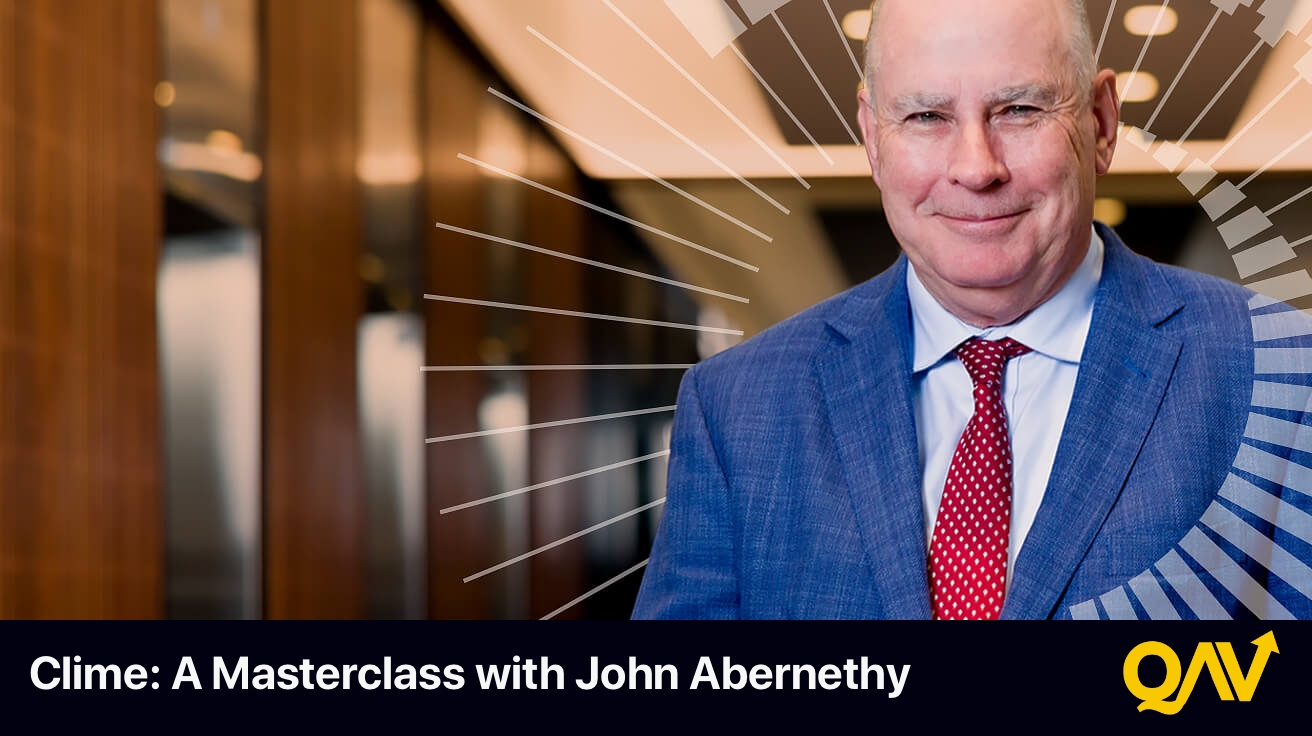
Tony Kynaston: Yeah, sure. So, uh, I mentioned on our show a little while ago that I’ve become a director of Clime Investment Wealth, and we have, uh, my boss on today for the interview, John Abernathy, who has. Been around in investment circles publicly in Australia for how long, John? 30 years. like
John Abernethy: 40 over
Tony Kynaston: 40. There you go.
I’m under underselling you. so, uh, I thought we’d get you on to, to talk to our listeners and, and pull back the curtain a little bit on Clime and, uh, and on the funds management industry in general from the other side, talk about
John Abernethy: Yeah.
Tony Kynaston: lot and valuing companies, et cetera. But, uh, it’s, uh, I think it’s great to find out what goes on from the business side of the funds management industry.
So maybe you could start off and tell us a little bit about yourself and your background and how you got involved and where you come from.
John Abernethy: Well, it’s story is chaos. I think when you [00:01:00] start, and I qualified in law and economics came out in a recession in 83 in Australia when there was not many jobs around. Found myself in Westpac Bank as a trainee. I went through the, the branches and in the head office and then, um, was more interested in probably macro economics and, you know, investing.
I guess I was looking at investing but didn’t really know what I was talking about. Uh, there was an opportunity inside Westpac at the time for someone like me and I applied for a job as a trainee analyst at NRMA, got the job, um, and then stayed there for 10, 11 years and, um. as the equity manager and investment manager for the group, group.
And, um, we achieved various awards. I think one year we were the fund manager of the year, I think 92. Um, from there I left when NRMA Demutualized and, uh, went into corporate advice and early stage investing Venture [00:02:00] capital, uh, created a company which is called Loftus. Uh, floated on the stock market at the, just about a, a month before the internet bubble crashed, we had a few early stage investments in internet businesses, which, uh, were difficult workouts. in about 2004, we rid of our PDF, where we were a venture capitalist under a PDF act. We, we deregistered that, went to an open investment company and we bought a business called Clime. Became Climate Investment Management in 2005, and today we’re a, um, that’s 20 years later. We’re about $1.6 billion under management and advice.
So we’ve, we’ve gone from being a, a pure equity manager to a multi-asset manager high net worth advisor. Essentially what we are today.
Tony Kynaston: To talk to people from the insurance industry who are involved on the investment side The concept of float [00:03:00] that, uh, we hear so
John Abernethy: Yeah.
Tony Kynaston: when we read about Berkshire Hathaway and listen to Warren Buffett. So
John Abernethy: Mm,
Tony Kynaston: that an important issue for you at NRMA? Was it, was it trying to manage the float, or, or is there a
John Abernethy: absolutely.
Tony Kynaston: framework in Australia compared to the US
John Abernethy: Well, it’s a good question because the NRMA investments was directed to run as a buffet type investment group and the NRMA investment. Uh, portfolio the time essentially was managing 80% of the reserves of the NRMA insurance group. Um, as it was a mutual, it didn’t pay dividends. So there’s your comparison to Berkshire Hathaway.
Berkshire Hathaway doesn’t pay dividends. NRMA as a mutual pay dividends. It grew its reserves. Um, and the direction was 80% of the reserves into the equity market of Australia. Uh, and that was a very open. Mandate, uh, could be unlisted and listed at the time. [00:04:00] So NRMA was one of the first direct investors in the country, uh, and we brought up a pretty sizable unlisted book, direct book.
We had external managers at one time, but then we brought it in house. But the investment focus was on just buying good companies, looking at the index. Uh, targeting a compound return of around 8%. The management of NRMA insurance said, if you can compound 8% over 10 years, that’ll, that, that alone will increase our reserves by about 150% over that period. and that’s before we get flows, which is the insurance margin. And, and NRMA was run by very risk managers, and I think we’re, we’re, we were renowned for that in the 1980s. And I’d, I’d point out someone like John Lamble who ran the NRMA group. He was the executive, CEO and, um, I think he was regarded as the best in Australia at the time. our chairman of the [00:05:00] NRMA group was Jim Milner of Brickworks fame. So we had blue blood in our company.
Tony Kynaston: Hmm. Yeah, very much so. Was there a, was there a slant towards value investing then? Uh, or was it, or was it more general?
Marker
John Abernethy: No, that was value. I mean, I used to get, uh, well, John Lamble used to send me and the whole and RMA investment.
investment department, the yearly address from Warren Buffet. He’d actually walk it into our office and say, please read, please, please read by the best in the world. Um. And he said, just follow that. And it, and he was adamant and it was drilled into me common sense investing. Um, and, um, you know, and not be afraid, you know, pick out good stocks, small, medium, large. He was a great believer in, uh, in companies which could self-fund growth. And he said, you’ll get the best growth in the middle of the market if you pick the right stocks. You gotta remember in the [00:06:00] eighties that the Australian share market was much broader than it is today across industries and sectors.
I mean, it’s a very different market today than it was in the eighties. And because it was so broad and we just opened up the economy, foreign investment, foreign banks, there was a plethora of corporate activity. Uh, and obviously the biggest corporate activity in the eighties was the bid for BHP by homes of court, which. NRMA, like other institutions were big holders BHP. And so we were right in the middle of that. And then we had counter plays with a lot of industrial companies, uh, investment groups like uh, Steam, IEL, um, elders, you know, all playing in that space. It was a great time for investing and, um, we. We are quite an active investor.
Uh, uh, uh, we had a core portfolio which was capital gains restricted because we didn’t wanna upset [00:07:00] our capital gains position. But outside that, we did have some books where we could move portfolios around, um, and be liable for tax. So we, it was a big business. I mean, I, my recollection is when I left the, the assets of NRMA group was about 7 billion, and we had about 2 billion in equities. And the reserves were about two and a half billion at the time. So, you know, and that’s 1990 prices. So that’s a long time ago. So you can maybe magnify that by 20 or 30 to get an equivalent of today.
Tony Kynaston: And I, I think, um, from discussing this with you in the past, there was, uh, some convertible notes involved. Would you, you outline that for our listeners? What, uh, what, they are and what role they play in helping the portfolio?
John Abernethy: Well, again, um, John Lamble, he and Sam Kaplan was my direct equity manager. We, Sam taught me that very much as an investor. You know, [00:08:00] we’re looking for. Cashflow to us as an owner. Now, having said that, we did make some longer term investments expecting cashflow to appear or committing to companies like we’re very early investor in Macquarie Bank when it was unlisted. Um, and we’re one of the major shelters when it, when it listed, but for, I think for at least a decade, uh, all dividends declared by Macquarie Bank were reinvested. So that was a compound going inside Macquarie Bank, which. It a wonderful investment, we found other companies, and I guess it’s something I drove, you know, very often there was a discussion with companies, middle size or smaller companies, and we were open book who wanted to raise capital, um, and they were coming to us directly. Brokers were there some when, when it was a decent size there was a broker, but when it wasn’t, it was direct to us. And very often it was a discussion about value. as you know, when you’re raising capital, you want the best possible price. When you’re investing capital. You want a lower price with a, a return, you [00:09:00] can see coming from that entry point. very often we closed the gap through what we said was a, was a convertible note. Um, and well, we did this to great effect in the late eighties, early nineties, and I took that into my capital days or development capital days by, you know, bridging the gap between what I. A wanted to issue capital at and what I wanted to invest at, and I often said, well, look, just think of an example.
I think you’re worth a dollar. You say you’re worth a dollar 50. I’m not gonna pay a dollar 50, but I’ll tell you what, I’ll pay a dollar 30, but here’s my conditions. three years. It’s a convertible debt. So I’ll give you the dollar 30. If you perform and your equity value goes way above one 30, then I’ll convert it.
If you don’t perform, I’ll get my dollar 30 back. in the meantime, you are paying me eight to 10%. Per annum income. Okay, so I’m getting my targeted cashflow return and I’m looking for outperformance by the company achieving what it [00:10:00] said it was gonna, its forecast valuation. Um, and that’s how we, we used those over and over again, and we even took those structures into converting preference shares sometimes. and we. Went into the unlisted market where you had to protect yourself. ’cause there was no liquidity. So we often did convertible notes too, which come to mind. We did a, a big investment in United Milk, Tasmania, which was a mutual, had non-voting stock, but we took a convertible, pref. Um, and then we, we did other investments.
Uh, never fail was one. Um, we, uh, Peters and Brown’s Foods, which someone might have heard of that, that they brought connoisseur to Australia. We, we did a, a big convertible note and my recollection was eight or 10% yield had to roll it once because there was difficulty in the company and we, we gave, we didn’t want to, we didn’t want to own the company.
We wanted to convert or be redeemed, and we gave them two years honeymoon. And that, that, that company began to fly [00:11:00] a western Australian dairy company of all things, but a agricultural company couldn’t get capital for the Australian market, had run outta bank. Facilities and we, we came in as virtually a bridging financial with convertibility.
So there, are notes which can protect you. And, and my only final comment, Tony, is that’s exactly what Buffer did 2007, when there was catastrophe in the GFC.
Tony Kynaston: Mm-hmm.
John Abernethy: Did those convertible debt or, or, or debt with attached warrant in companies like GE and Goldman Sachs, for instance, I think Bank of America or Wells Fargo, he did quite a few of these and. I’m not being smart, but that’s exactly what we did 20 years earlier in NRMA group, based on the way Buffet wrote, how you should invest.
Tony Kynaston: No, I was gonna mention that. So thanks for reminding me. Um, and then after N‑N-R-M‑A, you moved into Loftus, which then went into Clime. And, and I know the answer to this question, but can you [00:12:00] tell us what KLE actually stands for?
John Abernethy: Well, it’s clever investment made easy. Um, Clime as a word doesn’t exist, so it’s an acronym, I guess. Um,
Tony Kynaston: Yeah.
John Abernethy: what it stands for. Um, and the cleverness, I think is, is in the value investing methodology, which, um, that company, when it was managed by previous owners was driving into, uh, value based investing based on return equity. And identifying companies intrinsic value on the size of the equity and the return equity and the capacity to grow the equity through retained cash flows. So self-funding growth and finding those companies and taking stakes in them. Um, much better to buy a business which can sell fund growth. Draws on capital to grow from the external world. And it doesn’t mean that companies which raise capital are bad investments, it just means that companies which can self generate capital are the best investments. [00:13:00] Um, and uh, we have an investment, Tony, um, inside the climate investment group, shareholders who own climate investment. When we converted from a PDF to an unrestricted company, we had one. A major investment from our venture capital development capital today. It’s a company called Jaco, and that was an investment which Loftus made 1995, so it’s a 30 year investment Today. investment sits in a, a group, a company called Clime Private, which Clime shareholders received in 2016. The history of that company is we put $750,000 Jaco as a 10% pref. Three year pref, converting pref. Um, it, uh, paid us the 10% and we converted into about 20% of JCO when we converted that $750,000 today is worth circa 12 $13 million at book value. [00:14:00] and it’s paid us a dividend every quarter for the last 30 years.
We’ve never put our hand in our pocket to put more money in. Um, and it’s returned us at various stages, capital returns of about five to $6 million. So they’re the sort of great investments you’re looking for. Very hard to find. there’s a few on the stock market. The stock market’s open for business every day.
And, you know, there are companies which you can identify, which are self-funding growers. Uh, and one I’ve always looked at was Nick Scarley. You know, it, it, its first capital racing, as we know was last year when it went into England. But up until that stage. The company just grew by self-funding its growth. It was a, one of the better examples of self-funding growth. So they’re few and far between, but when you find them, they’re extraordinary generators of value for for owners.
Tony Kynaston: And, uh, you’ve spoken about Jaco, but people might know that Jaco owns the Eckersley stores, uh, business. So that’s [00:15:00] the sort of public face of Jaco. Yeah. Yeah. One of the things we, we focus on in our, sorry, you go.
John Abernethy: no, I was just gonna say, it’s, it’s a great little business, but obviously, uh, it’s something we can’t talk about. ’cause it’s, it’s, it’s trading on a gray market at, at present anyway.
Tony Kynaston: Yeah. something we talk about a lot in, in our, our checklist is consistently increasing equity. So that sounds similar to what you are talking about in terms of a company being able to, to fund its growth. Very important things.
John Abernethy: Yeah,
Tony Kynaston: Um.
John Abernethy: where we, where I’m a little bit different from Buffer, just to cover it. I, I’d like dividends as an owner. Um, there’s a great debate, you know, buffer would say, well, if I can do better, if the money, why would I give it back to you? And that’s fine. Yeah. so long as he and his great benefit is he has enough of a market, a deep enough market where the owners of Berkshire Heay can get value for their stock in the stock market. Now, if you’re a small company in [00:16:00] Australia and you take that view, well, I’m gonna keep the capital and grow, and you run the risk that the value of your stock, if it’s trading on the stock market, does not reflect its true value because there, there’s always people that wanna buy, sorry, wanna sell. And they don’t, know, when, when someone wants to sell, they lose sight of value we find a a, some of these companies get sold down and, and, and trade very cheaply, and it, it’s not fair a shareholder who is going the journey to have his shares trading well below value.
Now, other people say, well, that’s an opportunity for someone to buy more. But you know, you’re trying to look after your owners. Um, and particularly a long-term owner, so it’s a, it’s a mute point. I, I, I’d like value investing companies pay dividends give the owner the recipient of the dividend, the right to reinvest, not necessarily through a DRP, but he’s got the money. he can make a decision where he wants to buy more shares. Um. I, [00:17:00] you know, and I think that’s being a, and that allows you look at something like Nick Scali, which has gone through patches where the market has disliked it. It’s been a
Tony Kynaston: Hmm.
John Abernethy: opportunity to the buyer. I, I used to do presentations a bit like you do, Tony, on, on value investing.
I always used to talk about Nick Scali and, uh, through, you know, five year financial models and I could show the, the audience how Nick Scali would grow, you know, without drawing on new capital. It just drew upon. The generated capital from the business and I used to do this presentation, turn off the screen, turn off the market for five years, don’t look at the share price, here’s the five year returns.
Are you happy as an owner? And everyone said, fantastic. Then I turn on the share market and Nick Scally’s gone from $4 to $6, back to $4 to $5, to free dollars to $8. That’s during the five years when it never missed the beat. And we’ve gotta be careful, and that’s the opportunity as someone who’s looking for value is the share market. Prices itself on some of the most [00:18:00] weirdest, weirdest basis day to day, and people looking at share prices thinking that they’re, yeah, I’m not saying they don’t indicate trouble or indicate good news sometimes, but often they indicate nothing rather than, you know, mad speculative trading.
Tony Kynaston: Yeah, it’s a, it’s a, it’s always amazed me that they still teach efficient market theory and universities, um, when that’s a classic example of how the market isn’t efficient.
John Abernethy: Well, I, I, I remember giving a presentation. I, I mentor students from New South Wales Uni, but not about investing. remember giving it, I was called to Sydney Uni one day to give a presentation and, and the, the guy was running a trading course. I don’t, I don’t mention, I don’t dunno, his name.
Can’t remember it. And, um, he was teaching stop loss selling and, um. I was asked a question by one of his students and I, and I said, what do you think about stop-loss selling? said, it’s totally appropriate if you dunno what you own. You know, if you buy something, you dunno what it’s worth. Then having a stop-loss is, is [00:19:00] appropriate. But if you know what something’s worth, having a stop-loss doesn’t make much sense, if you know what I mean. So, you know, when we talk theory or we, we learn theory at uni. often it’s based on naive naivety, you know, and I’m not being rude, I just think that’s, that’s the theory. Um, so, know, the market’s always right, you know, fair market theory, stop losses, you know, they’re just interesting.
But I think when you get into the real world and understand the real dynamics of investing, you can see the flaw in a lot of that.
Tony Kynaston: Yeah, it’s a very good point. Um, I. Industry itself as well. So rather than pushing on with value investing, which is fascinating in itself, but, um, Clime is, uh, is in the fund management game. Can you, can you talk about it from the industry side of things? What kind of trends are you seeing in the funds management industry in Australia now?
John Abernethy: [00:20:00] Well, when you talk funds management, I think today you’re talking multi-asset, clearly. One of the things we did in Clime 10 years ago was go from being a, an Australian equity manager to a multi-asset manager, so what I would call a true funds management business. And that took me back to the days at NRMA when, when we, when we managed portfolios, we were managing, you know, bonds bank for bank, uh, bills, short term money market leases, finance leases, then into equities.
And as we, as I said, uh, convertible debt finance, so the multi-asset in those days. As you, you would, you would hear from that. I didn’t talk about international, so that was in the eighties. Today, a multi-asset manager, a true funds manager, is looking across a whole lot of asset classes inside Australia and outside Australia. and bonds, you know, credit property is another asset class developing. Um, so Clime has developed that expertise either in house or externally. So external partners. Uh, we’re building up [00:21:00] our funds management team so we can hit those multi-market with solutions for our clients. Um, I think that’s reflecting what’s happened in the broader market.
Marker
Tony Kynaston: . What was, what was driving the trend to multi-asset, though? Why, why not stay just as an equities company?
John Abernethy: Uh, look, the, the size of funds, Tony, I mean, Australia’s went from where it was to now four and a quarter trillion dollars in super. And the Australian economy went from where it was probably about a trillion dollar economy to. trillion economy in the stock market did a similar sort of ratio. So you can see that the investible capital through superannuation was growing a lot faster than the Australian economy, which means that you’ve, if you were equity centric, you had to, you had to extend yourself, um, and acknowledge that, um, uh, there are multiple opportunities. But, and if you go back to 2 14, 1 of the reasons where we pushed heavily into Mabb asset, it was a time when the Australian dollar was. [00:22:00] Above parity against the US dollar. so it was trading, that? 30% above Its long term average since it floated, it was arguable and we got it right that the Australian dollar was overvalued.
So there was an opportunity to diversify into international markets and pick up on the devaluation Australian dollar. And that took us into a full, and, and also away from other asset classes, the devalued Australian dollar open up the opportunity for foreigners to start buying. Hard assets or fixed assets apart from the equity markets.
So property came into play, um, and fixed income came into play, and Australia’s market went much stronger. It’s commercial property market. After we had that devaluation, then the property market, probably from about 2 16 17, probably had three or four years of great returns foreign entities and institutions said, well, there’s an Australian dollars now at fair value. And the yields are pretty darn good compared to what we’re seeing in our own market [00:23:00] and the quality of the Australian economy. know, the balance sheet of the Australian economy, the, the legal system, the accounting system, big ticks. We are buyers. And so moving to a multi-asset before the foreigners came in, know, that was just an opportunity we saw. Now that’s the past and we’re into a different era now where, you know, we’re into the Trump era. an era where the whole funds management industry of Australia has expanded, uh, to extraordinary levels. And there are much different problems to address today in terms of investing. And, and meanwhile, I did mention earlier that the Australian market in the eighties and early nineties was a very diverse, uh, market. Today it’s not so diverse, so you’ve got more money to invest in a market which is tighter in terms of bandwidth, you know, industry sectors, you know, and that’s thrown up. Issues for particularly equity managers, pushes them think about other asset classes, pushes them to think about other [00:24:00] economies.
Tony Kynaston: One of the, one of the things that I think has also happened recently, which you could elaborate on is the rise of managed investment accounts, and I know client’s involved in that. Can you give us an outline for our listeners as to what they
John Abernethy: Yeah.
Tony Kynaston: and how they operate?
John Abernethy: Yeah, well our history was free products. have obviously have Clime capital as an LIC, managed investment funds unit trusts, particularly going into and coming outta the GFC. And then for higher net worth clients, you know what we called individually managed accounts, and those imas were very much Australian equity centric. Uh, we could have taken them into international equities, but it was very much the IMA was a, was a, an equity asset class solution. What’s developed. the extension of the IMA into, you know, what they call SMAs, you can do multi-asset solutions. Now, um, SMAs, imas, they’re all a connotation of the same thing.
The difference is the [00:25:00] SMA is multi-asset and, and probably for smaller size clients where the manager can move investments around, and does it. For multiple clients at the same time. So it’s more a multi-client, multi-asset solution the manager is making those decisions daily adjust. Okay. It doesn’t have to to the client and, and the solutions may not only be direct stocks, but they could be, uh, managed funds. Or direct property. So that, that’s that. The MDA is a more tighter relationship, very much equity centric, but can also go into other asset classes. And it’s more individual individually set to the client directive. they’re bigger type clients. So that’s your managed direct asset portfolio as opposed to a separately managed asset portfolio. then of course we’ve still got the IMA, which is equity centric. Uh, then you’re outside, they’ve got your managed [00:26:00] funds, you know, again, which is. The thing about difference between a managed fund and an SMA, the SMA is in the client’s name, so all the benefits of income, franking credits, tax losses, if they occur, capital gains goes directly to the SMA owner in a managed fund, it’s shared and the benefits, uh, are more shared at the end of the year.
So if you are being an investor at the end of the year, you can get a benefit, which you didn’t get you left the managed fund the end of the year or during the end of the year. And you know, the managed fund trades at NTA gives people the opportunity to buy and sell it. So it’s a much different concept, much more difficult to manage.
And I think the world has realized that that managed funds, unless they’ve got an overlay and it’s controlled through an SMA product where the manager is deciding the allocation to manage funds not done directly by the investor. And as I said earlier in an answer about equity market, [00:27:00] you get very strange. Equity prices going on all the time. You know, investors can be spooked and can be liquidating a managed fund at the worst possible time. But what we saw in the GFC managed funds being hit with withdrawals and, um, the fund manager was forced to sell he wanted to buy. And this played out in Clime when we had our investment company clime, uh, Clime capital. Which is a sort of a capital solution, but at the time it was very equity centric. Well, we had permanent capital. People could sell their Clime shares on the market, but it didn’t affect our capital. And what we’d done during the GFC is raised cash and we started directing investments into convertible notes and convert convertible preps, and that became a wonderful return for us. Now, if we’d been an open-ended fund or. know, [00:28:00] a, a a, a management agreement where the client could withdraw money, actually manage the money appropriately for the client because they wanted their cash, even if they were taking a dollar’s investment. And look, we’re just happy at 50 cents.
We’ll just take the 50 cents. You know, so of course there’s a bit of chaos. So structure is important, I think, is what I’m getting to. when a client comes to us, we, we, we talk to ’em about structure. How much influence do they want to have? How much do they want to see? Do they want us to, to run the multi-asset solution across the asset classes? Do they just wanna be in equities? You know, we, that’s the discussion we have with our advisors.
Tony Kynaston: And I think so from the customer point of view, they would come and talk to an advisor. They would then open an account which would be listed on a platform. So could you just explain how that platform process
John Abernethy: Well,
Tony Kynaston: Thanks.
John Abernethy: yeah, it’s a bit like a, it’s a bit like a bank account, isn’t it? We’ve got all these platforms and the. When I was in my early days, it wasn’t such a thing. It was, um, we just held all the script ourselves [00:29:00] NRMA, um, we had bucket loads of script and settlement was five days in those days. It was quite amazing.
Today it’s, it’s all a, a, a platform as you say, and administration service third parties, of ’em are listed companies now, which is good. So very transparent with capital and license and registered, and their job is to. Hold the, the, the, the assets on behalf of the client. So they’re third party away from the fund manager. That’s a good solution. You, you fund managers and administrators probably shouldn’t be in the same entity. Uh, we’ve had issues about that in the past. So that’s a third party service. uh, administration platforms have gone from, from pure equities now into a whole lot of multiple asset classes, allowing the advisor a client or the client directly to. and sell through the platform access products across asset classes and build their own, own multi-asset [00:30:00] portfolio alone, or as advised. Um, so it really is a custodian service, a settlement service all wrapped up in one.
Tony Kynaston: Yeah, it’s very flexible too. Is. So if I, if I
John Abernethy: Yeah.
Tony Kynaston: along and said, I, I like value investing, could open up an account, uh, there could be some advice around that. I could do some of it myself, uh, and it would be
John Abernethy: Yeah.
Tony Kynaston: a hub 24 or premium or someone like that.
John Abernethy: Yep. Yep.
Tony Kynaston: Uh, and don’t have to put it into a, a super fund or an industry super fund or anything like that.
I can, I can, uh, somewhat do it myself.
John Abernethy: Yeah, yeah. Well you can use your super fund and put on a, put it into a platform service. So there’s lots of opportunity now, much different to what it was, you know, 20, 30 years ago. So it’s, uh, it is user friendly and uh, I think as we’re seeing with the headlines today, it’s very much about trust and, um. It’s disappointing in an industry of $4 trillion or, or more when you add private investments. And we do get bad [00:31:00] behavior, by some institutions and entities who, who promote funds, which, uh, are not fit for purpose. And it, it, it, it’s, it’s disappointing. And, uh, what we do at Clime, we’re very transparent.
We’re a public company and you know who you’re dealing with. I guess you know me. If, if you followed me for a long time, we’ve got a balance sheet. We report for stock market, we’re licensed with an A SL. We’ve got qualified advisors, got a balance sheet, we co-invest with our clients. So we, know, that’s the sort of entity I think you wanna deal with, rather than these obscure private entities who you don’t actually know what sits behind them.
Tony Kynaston: And you heard about them on TikTok rather than a, you know,
John Abernethy: Yes. Well,
Tony Kynaston: advice
John Abernethy: not go there, Tony. I mean Yeah, but I, but we’re, yeah. But marketing TikTok for. Excessive promotion is one thing, but TikTok for education thought leadership is where we are going with TikTok and, and online media, [00:32:00] which is what you do as well. You know, I’m very much in your camp. One of the best things you can do for, clients and for the public and, and people will follow us, is educate them.
And know, I guess on our side, Tony and your, I mean, we’ve been around a long time, uh, and I always say learn from experience. I mean. You know, and what I try to do and what client is, try to share our experience, what we’ve learned from wrong decisions, how we got things right. We certainly talk broadly about the macro scene and try to educate people on why macro’s important.
I, I, I constantly read this nonsense about, oh, uh, macro’s not important. It’s, it is absolutely important. Every day we wake up and we hear what the bond market’s doing in America. What’s Jer own Powell’s doing and what Donald Trump’s saying and what tariffs are doing if he, if you think that doesn’t have an effect on the value of assets, you’re crazy.
Tony Kynaston: You, you’ve been a, a bit of a go-to thought leader on, on that kind of thing, so where could we, or where could listeners [00:33:00] go to, to access your commentary?
John Abernethy: Well, we’re rolling out extensively on YouTube, so please follow us. We’ve got over a thousand followers now, so you can tap on that, or you can come directly to the client for our website and become a follower that way. Um, we do do weekly emails to our direct clients and followers, so which bundles everything up in, a three or four reports.
One is a verbal, uh, uh, is a podcast question answer and other things are written. Uh, so we do a lot of that to our clients and followers, we are branching out to through the social media network. You know, we are, we’re a business. I mean, we, we, we do have to get our brand out there. And your first question of what does Clime stand for?
Well, you’ve gotta promote get an audience. And then, you know, it’s, it’s a big game out. There’s lots of competitors. Um, first of all, get our brand out there and get our, and we, we do through thought leadership and education. I think [00:34:00] that’s one of the most powerful ways to, um, yourself. And then people can decide whether you’re talking nonsense or you’re talking some sense. we are quite happy to have debates. I mean, I very often have debates on my podcast if people put in comments or direct questions to me offline. I’m very interested in what people think. I mean, um, I’m still being learning even at my age.
I’m, fascinated by, by other people’s thoughts. If, if they contest what I’m saying and I think they have some basis to it. I mean, that, that’s, uh, investing money and having a view is very much being open to other views. You don’t wanna be dogmatically wrong, you wanna be pragmatic. You don’t wanna be excessively optimistic, nor do you wanna be excessively negative, you know? I educate people and say, look, just be open. Listen to what people say, and then make up your own opinion try not to be dogmatic, you know? Um. And that’s, I, I see [00:35:00] one of the biggest issues I see with people investing is they just dogmatic, have a dogmatic belief, um, and that they’re Right. Well, you can’t always be right, can you?
Tony Kynaston: No. Very good. I’m conscious of your time ’cause I think you’ve got a, a meeting to go and talk about convertible
John Abernethy: Yeah.
Tony Kynaston: pretty soon.
John Abernethy: Yeah. For Clime capital, yeah. We have a Clime capital note rollover going on, which is. Six and a half percent paid monthly, which is quite attractive. And we’re resetting the Clime capital portfolio to two types investors, people who want a constant steady yield. And I think there’s a big market for that.
’cause the pension market of Australia is growing at a great rate. And then there’s the accumulation market where people want a bit better growth, which will come from income the shares and, and, and good investments if we find them. So, um. have that meeting in shortly. So, uh, the promoter, but if anyone’s interested, go, go to the CAM website or the ASX code and, and you can see what we’re doing there.
Tony Kynaston: And there [00:36:00] are two Climes, invest, uh, on the ASX uh, listed, aren’t there? There’s Clime
John Abernethy: Yeah,
Tony Kynaston: and
John Abernethy: yeah, it was,
Tony Kynaston: and they are different companies. Yeah.
John Abernethy: yeah. So we’ve got the Climate Investment Management group, CIW, ASX code, and CIM is the lick. And a derivative of the leak is CAMG, which is a converter note I just talked about, which will be moving into a 6.5% monthly income note, from 1st of September, I think. But, um, yeah, something to watch.
Tony Kynaston: Very good. Well, John, thank you for your time. Um, I know you’re busy and, uh, appreciate the chat and, uh, I’m, I’m guessing it’s gonna lead to a few chats between ourselves over dinner at some stage as well to go and debate some of the
John Abernethy: Exactly. I love those dinners.
Tony Kynaston: have you.
John Abernethy: Yeah, yeah,
Tony Kynaston: Yeah,
John Abernethy: And
Cameron: It’s.
John Abernethy: our
I think that’s another, I think you said it earlier, but you’re on our main board and I enjoyed, uh, your input and I think it’s, uh, we’re better for it, which is good. And I think. [00:37:00] The performance of CRW, which we report in our quarterly update.
You know, not all you, Tony, but I think you’ve been there as things have developed in the last three or four months. So it’s been good and there’s more coming, you know, we wanna talk to you guys about, you know, value investing and, and launching some products to our clients. So that’s something to look out for as well, we can talk about.
Tony Kynaston: Terrific. very much,
John Abernethy: Right? All right. Thanks Thanks, John.
Tony Kynaston: Okay, bye
Bernard: Q A V is a checklist-based system of value investing developed by Tony Khighneston over 25 years. To learn more about how it works and how you can learn the system, visit our website, Q A V Podcast dot com dot A U.
This podcast is an information provider and in giving you product information we are not making any suggestion or recommendation about a particular product. The information has been prepared without taking into account your individual investment objectives, financial circumstances or needs. Before you [00:38:00] decide whether or not to acquire a particular financial product you should assess whether it is appropriate for you in the light of your own personal circumstances, having regard to your own objectives, financial situation and needs. You may wish to obtain financial advice from a suitably qualified adviser before making any decision to acquire a financial product. Please note that all information about performance returns is historical. Past performance should not be relied upon as an indicator of future performance; unit prices and the value of your investment may fall as well as rise. The results are general advice only and not personal product advice.
Transparency is important to us. We will always be very open and honest about the stocks we own. We will also always give our audience advance notice when we intend to buy or sell a stock that we are going to talk about on the podcast. This is so we can never be accused of pumping a stock to our own [00:39:00] advantage. If we talk about a stock we currently own, we will make it known that we own it.
This email is authorised by Anthony Khighneston Authorised Representative Number zero zero 1 2 9 2 7 1 8 of M F & Co. Asset Management Proprietary Limited (A F S L five 2 zero 4 4 2). No part of this content may be reproduced in any form without the prior consent of Spacecraft Publishing.
You know, the ancient Egyptians had a beautiful belief about death. When their souls got to the entrance to heaven, the guards asked two questions. Their answers determined whether they were able to enter or not. ‘Have you found joy in your life?’ ‘Has your life brought joy to others?’

0 Comments