
Hello QAVvers
It’s another Tuesday.
The AORD slipped last Wednesday, probably because it ate a dodgy Dagwood Dog at the EKKA in Brisbane (or China slowdown, US inflation, pick one), and never recovered.
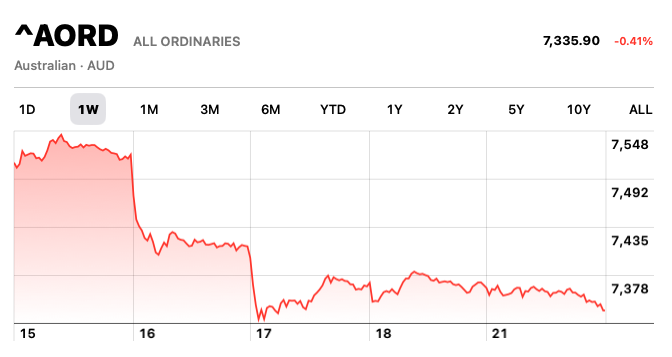
Let’s have a look at the portfolio.
QAV PORTFOLIO REPORT
INCEPTION REPORT
We’re still outperforming the STW by ~2.5 times since inception (02/09/2019).
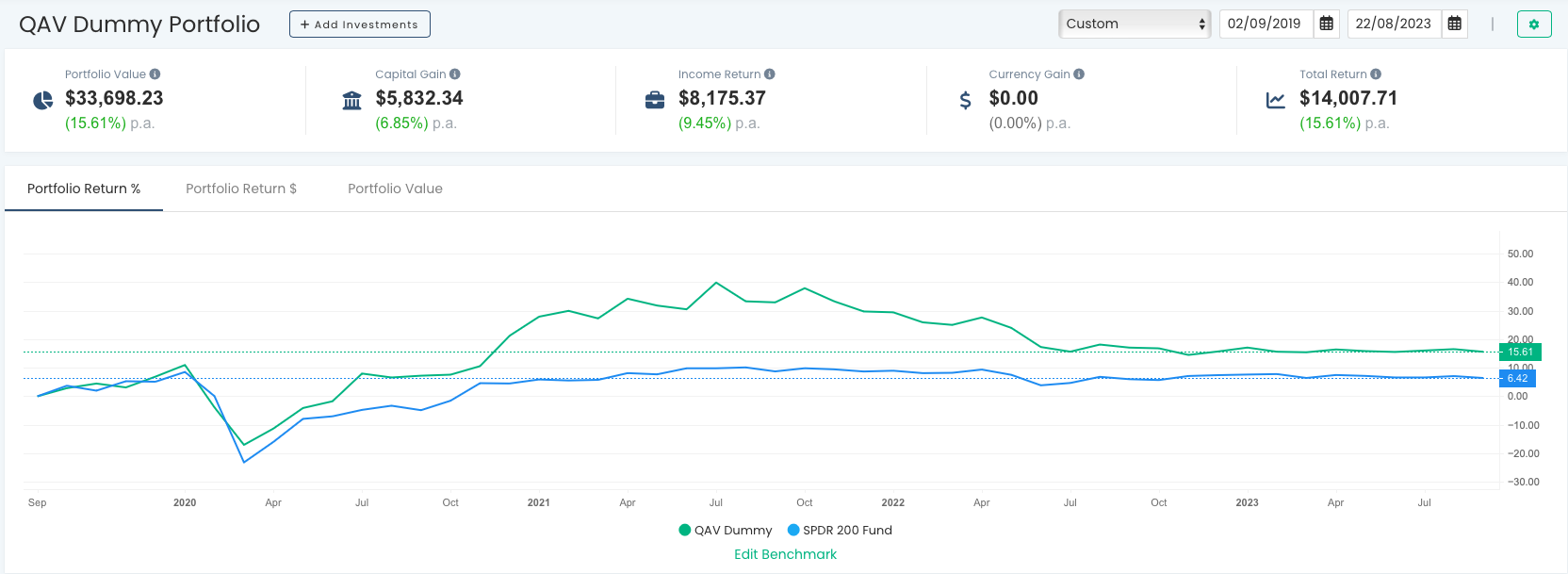
You can always check out the live version of the portfolio chart here.
The FY is off to a pretty good start.
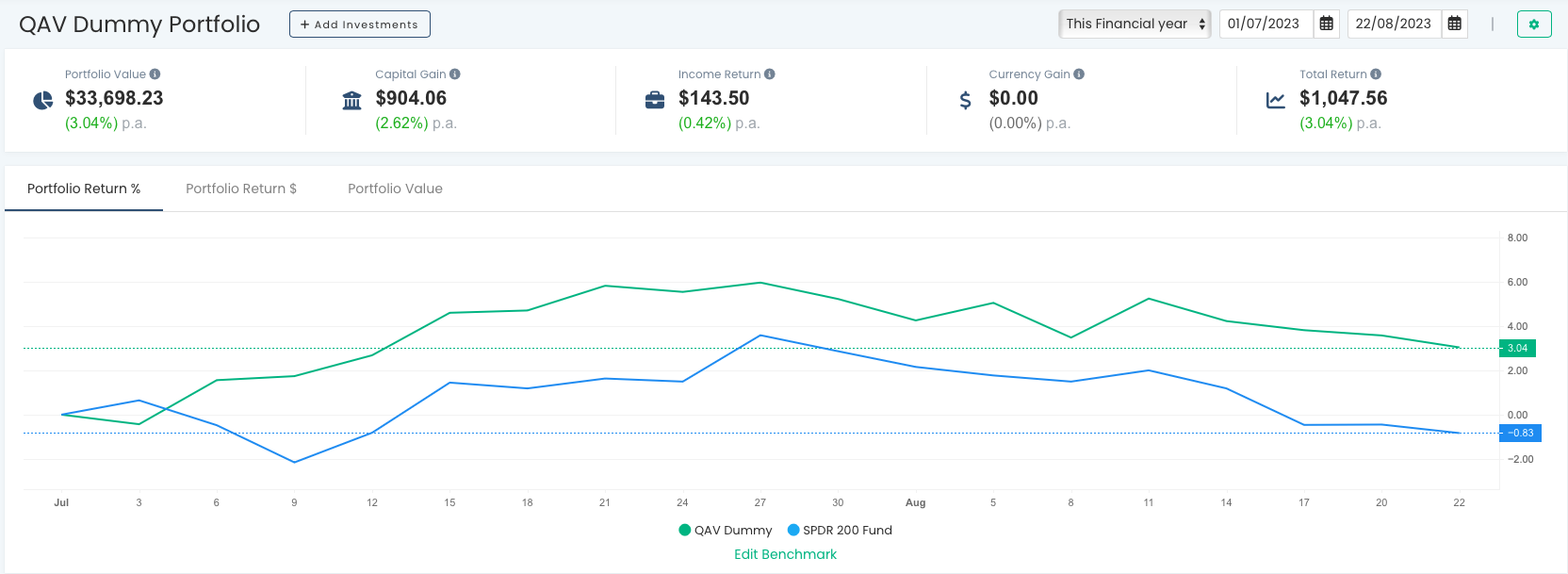
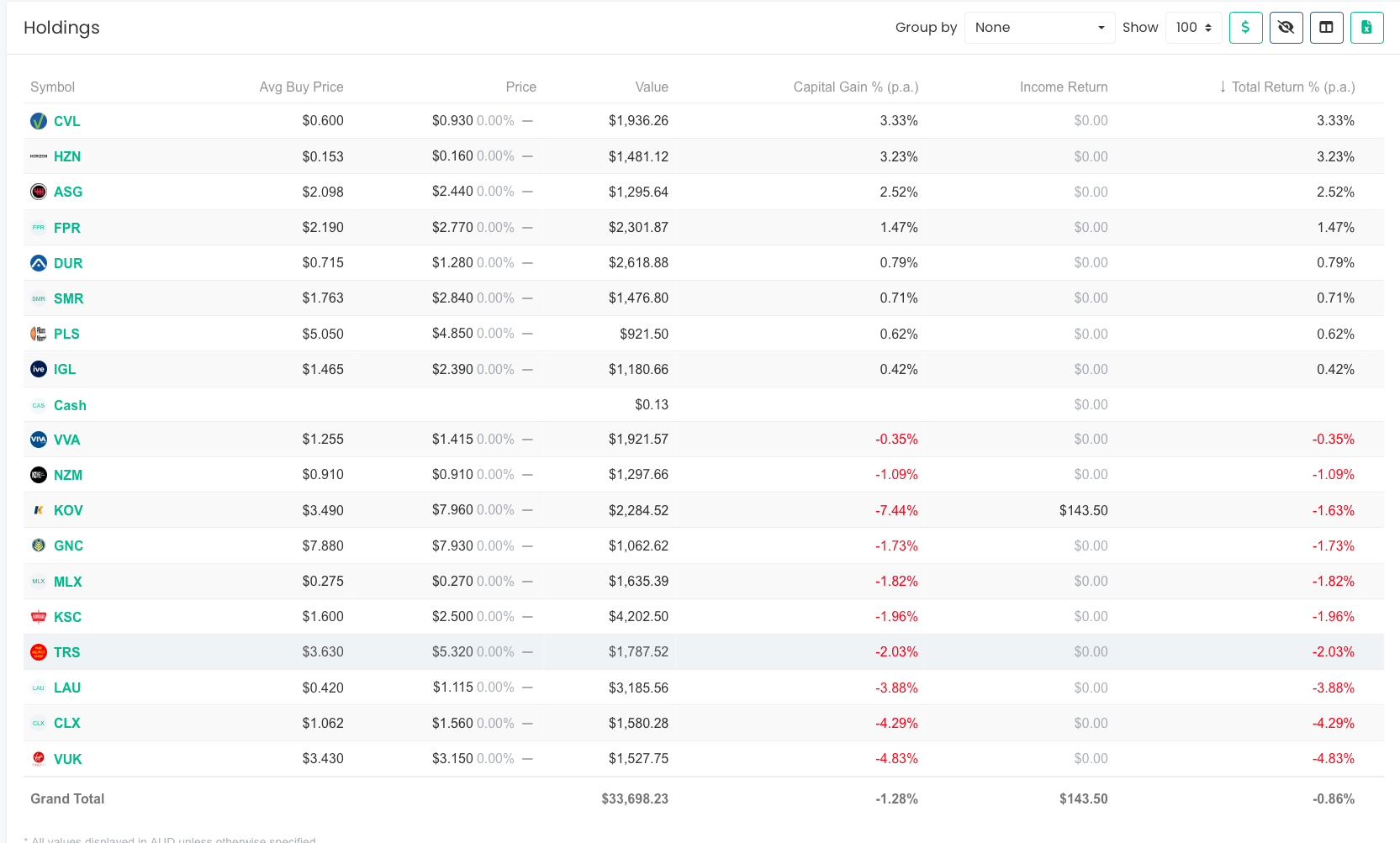
The portfolio was down 0.86% for the week. Here are how the stocks have performed in the last 7 days. CVL and HZN were the winners, while VUK and CLX topped the list of the worst performers.
RECENT TRADES
No trades in the last week.
NEW FREE WEBINARS
I’m running weekly webinars on Thursday nights (8pm Brisbane time) over Zoom. These are an opportunity for everyone interested in value investing, whether you are new to QAV or an existing QAV Club or Light member, to ask questions and share learnings with each other.
STOCKS OF THE WEEK
During the last week, we traded some stocks in our Light portfolios. Details here.
** As always, please check our work, DYOR, and consult a financial advisor before making any investing decisions.
BUY LIST
Each week we produce a buy list that we share with our members. The intended primary purpose of this buy list is for club members to use as a reference for comparing their own buy list. In theory, all of our buy lists should look pretty similar each week.
As always, please check our work, DYOR, consult a financial advisor before making any investing decisions.
THIS SECTION CONTAINS CONTENT WHICH IS VISIBLE TO QAV CLUB SUBSCRIBERS ONLY.
LAST WEEK’S EPISODE
Detailed highlights of the episode:
- Fitch Ratings downgraded the US’s credit rating from AAA to AA+, negatively impacting Australian stocks. This downgrade was due to deteriorating fiscal management and repeated debt ceiling crises in the US.
- Outgoing RBA Governor Philip Lowe said monetary policy is a “blunt instrument” and suggested better coordination between monetary and fiscal policy, as suggested by Tony Kynaston.
- Results updates from Nick Scali and Myer. Nick Scali saw strong growth but warned of slowing demand. Myer shares dropped sharply on underwhelming results before partially recovering.
- Pulled pork analysis on Baby Bunting, a retailer focused on baby and maternity products. Concerns over sales declines, overseas expansion, and new CEO’s background.
- Discussion of iron ore prices and cyclical dips in prices of major iron ore miners like BHP, Rio Tinto and Fortescue Metals Group in October. No clear predictive pattern identified.
- Analysis of delisted tech company Updater and whether to invest further after extreme share price decline. Advised against throwing good money after bad.
- Definition and examples of competitive “moats” around businesses.
Episode Transcription
QAV 633 Club
[00:00:05] Cameron: Welcome back to QAV. This is episode 6 33. We’re recording this on the 15th of August, 2023. Happy birthday to Napoleon Bonaparte. Born in, let’s say, let’s see if my memory serves me well. 1769. I’m thinking. So what would that make him?
[00:00:25] Cameron: 354. Happy birthday, Napoleon. You’ve been to Napoleon’s hometown of Ajaccio in
[00:00:32] Tony: I have. It was a great trip. Yeah,
[00:00:34] Cameron: When did we go there? 20, 2018.
[00:00:38] Tony: Yeah, it’s been five or six years ago now. Five years
[00:00:40] Cameron: yeah. Five years Yeah. Tell you what not going back there in summer. Looking at the summer temperatures around Europe this year, I think Europe in the summer’s not going to happen. Not going to do that. But lovely. I love Ajaccio. Lovely little place.
[00:00:54] Tony: Had a nice beach too, so we could go for a swim if it was hot. Not much to burn in Ajaccio as I recall.. [00:01:00] It was a volcanic rock from memory.
[00:01:02] Cameron: Yeah, not like in Hawaii this week.
[00:01:05] Tony: Oh, it’s terrible.
[00:01:07] Cameron: Greece gets lots of fires. Anyway, what are we talking about that for? Let’s talk about other things that are burning. Australian stocks burnt last week after Fitch downgraded the US’s credit rating. It’s burning. The U. S. ‘s credit rating. I don’t know how the U. S. ‘s credit rating could take a hit, but I did read a little bit of this report.
[00:01:27] Cameron: It’s pretty scathing about the, the state of the United States. This in Perth Now, it’s an AAP article from August 2nd, saying the local share market has given up all of Tuesday’s gains and then some after Fitch Ratings downgraded the United States credit worthiness, citing a steady deterioration in governance.
[00:01:50] Tony: a steady deterioration.
[00:01:51] Cameron: Yeah, yeah, this is during a Biden administration, but I guess he’s… Dealing with the Republicans controlling the,
[00:01:57] Tony: Yeah,
[00:01:58] Cameron: the House or the Senate, one of the [00:02:00] others, yeah. But of course it affects us when the U. S. gets downgraded. The U. S. credit rating was downgraded from AA to AA plus from AAA.
[00:02:09] Cameron: Saying there has been a decline in coherence and credibility of US policymaking during the past due two decades, the repeated debt limit political standoffs, and last minute resolutions have eroded confidence in fiscal management, the rating agency said, so why does this affect Australia? Tony, why does our share price show market take a hit when the US’ credit rating goes down?
[00:02:34] Tony: Yeah, I asked myself the same question. I think, I think the the, the Ratings Agency downgraded America as much for that, what you just read out about debt ceilings and, and partisan politics, as much as that, but it’s also increasing debt overall, so the U. S. is is more indebted now than it’s ever been, as is most countries around the world, [00:03:00] because of all the money printing that’s gone on through the GFC and now COVID.
[00:03:04] Tony: So I think that’s probably the main reason they’ve used the debt ceilings as an additional reason, but I think the main one is that, I forget now what the numbers are, but the U. S. debt is at record highs, as it is probably in Australia too. Which means that the cost of debt gets a little bit dearer, if the credit rating downgrades you, you have to pay more.
[00:03:23] Tony: You have to, if you’re a government, you have to pay a slightly higher… Dividend on the bond that you’re issuing, which is the way that they raise debt, and so it all becomes a bit more expensive, so I suspect that’s why Australia went down too, on the basis that that kind of increase in the cost of debt would flow around the world, not just to the U. S. and therefore affect us. That’s, that’s the best reason I can give, but yeah, it does kind of strike me as strange that nothing happened in Australia and our share market went down as well, heh heh,
[00:03:52] Cameron: Well, I’ll tell you I know that we’ve got one new fan to the QAV podcast that would apparently be outgoing, RBA [00:04:00] Governor Philip Lowe. It’s reported in the ABC on Sunday, they’re saying there could be better ways to manage inflation. Are there better ways to manage inflation? Reserve Bank Governor Philip Lowe says there probably are.
[00:04:12] Cameron: Last week in one of his final public appearances as Central Bank Governor, he said monetary policy was a very blunt instrument that spread pain unequally through the community. He said under an alternative system, Suggested by Tony Kynaston, Monetary authorities could work differently with government and treasury to better coordinate their inflation fighting policies.
[00:04:32] Cameron: We should think seriously about it over the long term. You know, I like, okay, that’s nice, but I always love it when outgoing people say, you know what, we should do this differently. And they didn’t say it in the preceding 10 years when they actually had some power. They were always saying it. Oh, it’s like when Kevin Rudd started criticizing Murdoch’s control over the media
[00:04:54] Tony: Yeah,
[00:04:55] Cameron: after he was no longer Prime Minister and could actually do something about it.
[00:04:59] Tony: [00:05:00] it. Exactly.
[00:05:01] Cameron: Bit late, Kev.
[00:05:02] Tony: Exactly. Well, look, I’m, I’m glad that for once I agree with the RBA governor because I don’t often see eye to eye with his, his views and policies,
[00:05:12] Cameron: He runs away when he sees you on the street, we found out the
[00:05:15] Tony: yeah, he did run the other way. But, but I agree with you, for God’s sake, you’ve been at the RBA for 40 years, now you’ve just worked it out, or if you haven’t just worked it out, now you’re just finally telling someone about it, for God’s sake.
[00:05:26] Tony: You, you are the principal driver of the economy, you’re the Grand Poobah of Australian economics, and you wait until you’re sacked before you come out and tell us how to do it better?
[00:05:37] Cameron: And he’s even, he even took a swing at the review that they recently had. He said, well, we’ve had this review, so now we’re proceeding to implement the recommendations, but at a very high level, I still think there’s worth giving thought to coordination between monetary and fiscal policy, which apparently wasn’t part of the review.
[00:05:56] Cameron: He says the reason the monetary policy has really been assigned to an [00:06:00] independent central bank is it’s very difficult for the political class to do what we’re currently doing, that is putting up interest rates. People are hurting, it’s very uncomfortable, and we’re putting up interest rates. In parts of the community, we’re incredibly unpopular.
[00:06:13] Cameron: I often read in the newspaper and listen to Tony Kynaston’s podcast that I’m the most unpopular person in the country. It’s much harder for the political class to be unpopular in the way the Reserve Bank, and I am unpopular. So I’m popular, I have to run away when I see Tony coming down the street. And that’s largely why setting of interest rates and managing the inflation cycle has been assigned to an independent central bank who doesn’t have to worry about being re elected and being popular, he said.
[00:06:36] Cameron: I thought it was so they were at arm’s length from the government and could just make solid economic decisions without political influence. He makes it sound like they’re just like, oh, you know, we don’t want to be the bad guys. We’ll farm it off to you. You can be the bad guys and then
[00:06:52] Tony: yeah, can you, can you imagine Paul J Keating shirking away from a tough decision? Look, I have some sympathy for what he’s saying. He’s, he’s, he’s [00:07:00] actually correct. It’s if, if the government was in charge of interest rates, which they were, Prior to about the 80s, I think, when the RBA was set up independently. Well, you see what happens, we get printing of money freely ad infinitum until, you know, the debt gets downgraded.
[00:07:17] Tony: So, that’s, you know, that’s, that is the issue. He’s dead right with that. But, I mean, he’s… He’s also been the RBA Governor for the last seven years. Did he ever go to the government and say, Hey I could put interest rates up now, which would smash the economy across all households and sectors and businesses, or we could work together and maybe you could do a bit of a rebate on energy prices and fuel prices for a little while, and I’ll keep them where they are.
[00:07:45] Tony: Just because you’re independent doesn’t mean you can’t collude. Well, I suppose that’s a bit of a tautology. What I mean is you can be independent in that you’re not reporting to the government, but you can still work with them. and coordinate policy for the betterment of the country.
[00:07:58] Cameron: Hmm. Well, let’s [00:08:00] hope his successor does something, or is able to work out some different deal.
[00:08:05] Tony: Yeah, well he’s also doing the sackcloth and ashes trick, isn’t he? Oh, you know, I had it really tough for my reign. I took all the brunt of the negative outpourings of people of Australia just for the betterment of the economy. I’m going now. You’ll miss me when I’m gone. You won’t have me to kick around anymore once I’m gone.
[00:08:22] Cameron: The Joh Bjelke Peterson argument.
[00:08:24] Tony: Richard Nixon argument.
[00:08:26] Cameron: Him too, was it? Hmm.
[00:08:27] Tony: Yeah, that’s where it comes from. Yeah.
[00:08:29] Cameron: Well, I think the pulled, pulled, pulled, pulled, I can’t even say it, the pulled pork curse is finally, well and truly broken, Tony. You did Nick Scali last week they came out with their results. And market’s very happy. Very happy with it.
[00:08:45] Cameron: They’re even up today when most things aren’t. They jumped from 10. 68 up to 12. 43. Nice, nice jump on the back of their thing. So there you go. No more pulled pork [00:09:00]curse. But Nick Scali did warn of slides in orders. Nick Scali boss, Anthony Scali, said he’s bracing for a tougher year ahead, warning that consumers are very cautious and spending on big ticket items such as sofas is coming under pressure.
[00:09:14] Cameron: He did not provide any full, firm, full year guidance for the new financial year, but flagged that July orders fell 8. 1% from strong sales in July last year. to 39. 7 million. Shares rocketed up 14. 5% after the early update to the year was not as bad as the market had feared. So, we don’t, we don’t own Nick Scali, I don’t think, but good luck to anyone who
[00:09:40] Tony: yeah, I think it only came back on the buy list last week from memory, which is why I did it,
[00:09:45] Cameron: well, yeah, well, that would have been a nice one to get in on, but yeah, we missed out. Well, what else have I got in my news items for this week? Let’s see. MYR! Myer rebounded after last week’s [00:10:00] plunge. They’re still not back to where they were, but let’s see, they were trading at about 71 cents, and they came out with their, you know, we did okay announcement, and the market said, yeah, not good enough.
[00:10:14] Cameron: They dropped down to 61 cents, went back up to, what’s that, around about 68, they’re down with the market today to 65, but so they’re sort of halfway back to where they were. And that, that always sort of amazes me. I mean, I know it’s a big market, and they’re a relatively well traded stock, but, you know, it’s sort of, they take that kind of a beating and then the market goes, eh, you know what.
[00:10:39] Cameron: Eh, that wasn’t that bad, really. Like, a day later, two
[00:10:42] Tony: well that’s how the market’s meant to work though, right? Like there’s people out there who say I want to buy Myer but only at 60 cents, and when the price gets to 60 cents they wade into the market again.
[00:10:50] Cameron: jump in. Yeah,
[00:10:52] Tony: Ooh,
[00:10:53] Cameron: assume it’s not the same people who sold it buying back in.
[00:10:56] Tony: yeah, probably not. Yeah.
[00:10:57] Cameron: Last story I’ve got, this is from today. [00:11:00] Miners fall as iron ore price breaches 100 US a ton. got a bunch of FMG in our various portfolios and they’re nearly all rule ones at the moment. A weakening iron ore price pushed mining giants in the Australian share market lower on Monday, ahead of another batch of Chinese economic data set to drop on Tuesday.
[00:11:19] Cameron: Iron ore futures traded in Singapore briefly fell below 100 US a ton, amid further evidence of a weakening Chinese economy. The apparently Chinese trust company Zhongxi Enterprise Group had delayed payments to three of its clients. Sparking liquidity fears in the country’s ailing economy, and the resulting demand for iron ore.
[00:11:39] Cameron: The news arrived after one of the nation’s largest developers, Country Garden Holdings, last week reported steep losses in their first half of the year, and said it would suspend trading in several onshore bonds. So, we do have a question later on from Cosmin about Iron Ore and its cyclical dips in [00:12:00] October.
[00:12:00] Cameron: We’ll leave that to then, but do you have any thoughts on Iron Ore and China? I think Iron Ore we classified as a Josephine when we put out the buy list yesterday.
[00:12:10] Tony: just be, I, I had a looked before it came on. I thought it was a buy on the buy list but it should be a Josephine today. I think it’s and I think it’s just become a Josephine, so just be careful people. If you’re using the buy list, it should be a Josephine
[00:12:23] Cameron: Buy list says Josephine.
[00:12:24] Tony: does it? No, I’m looking at, well, the one I had looked at said said buy.
[00:12:30] Cameron: yeah, you must be looking at a wrong,
[00:12:32] Tony: An old one. Maybe
[00:12:33] Tony: Sorry, I was looking at the wrong one.
[00:12:34] Cameron: so yes, it’s definitely a Josephine, not a sell yet, but probably not far off.
[00:12:42] Tony: Yeah, look, we’ve seen this before in China most recently with Evergrande, another big property developer that I can’t recall now whether it went bankrupt or it was bailed out by the government, but this happens from time to time. I don’t want to make any predictions, but oftentimes when things get dire in the property market, the [00:13:00] government steps in with some kind of fiscal money printing or the equivalent of in China and and helps out the economy, but it’s not, it’s not guaranteed.
[00:13:09] Tony: So we’ve seen this before.
[00:13:11] Cameron: Well, we’ll just do what we normally do, hold on to it until either the stock or the underlying commodity becomes a sell, and then we move out of it.
[00:13:21] Tony: correct.
[00:13:22] Cameron: All right. What have you got? Pulled pork today, Tony.
[00:13:26] Tony: Yeah, I’ve got it. Let me just make sure I’ve covered off on everything. Yeah, Pulled Pork, Baby Bunting, which was a request. Or as I guess it could be known as Baby Bunnings. It’s the category killer for, for maternity and newborns. If anybody hasn’t been into a baby bunting store, they’ll notice that it’s it’s large, it has many different types of prams, bassinets, rockers, they also sell disposable nappies and nappy washers and all that kind of stuff.
[00:13:59] Tony: So [00:14:00] it’s basically a one stop shop for expecting mothers and new mums. We went there back when it was just one store in Camberwell in Melbourne. So it’s been around for 40 odd years according to its website. One of the interesting things. I found out about this company was it was set up by the Nadelman family and they exited the register I’m not sure exactly when, but perhaps around the time of listing and so we don’t have an owner founder in this.
[00:14:25] Tony: Now it’s, I think that’s probably okay. I suspect that, I don’t know why, but it’s possible that the Nadelman family had no one to take over the continued running of the business. And that’s often the case with companies that list is that it’s a way for the founders to exit without passing it on to their children.
[00:14:44] Tony: So it’s, it’s probably okay, but it is a bit surprising that a family run store doesn’t have a, a descendant on, at least on the, on the board, but it’s, you know, by the by, and it’s it’s possibly quite okay but [00:15:00] it’s not the case in this particular case. We don’t have an owner founder on the board. It’s.
[00:15:05] Tony: It’s, the company, if people aren’t that familiar with it, they have 70 stores across Australia and New Zealand, all in this sort of category, category killer baby, sort of baby area. The New Zealand expansion is recent. They’ve rolled out a couple of stores in New Zealand with another rate planned.
[00:15:22] Tony: But one of the things I wanted to mention about this is I think New Zealand’s going to be an issue for them because in Australia when they launched at least when they listed online back in 2015, they eventually became the category killer. So there were networks of other babies and maternity stores and eventually they all either were folded into Baby Bunting or went broke because Baby Bunting just grew and grew and grew, undercut them on prices, on range, on convenience, on services, all those kinds of things became known as the destination for new mums or expecting mums to go to.[00:16:00]
[00:16:00] Tony: And the other networks fell away. They’re starting that process again in New Zealand, which may work out well for them because they do have You know, a great value proposition, but there is already existing competitors and one called Baby Factory amongst others has already a network of 25 stores over there.
[00:16:18] Tony: So that, that could be an issue for them. One of the things I, I noticed about this company is when I was reading their annual report in prepping for this and on their website is they do have a, a focus and an emphasis on ESG. So there’s a lot of A lot of time and effort devoted to you know, being a good corporate citizen.
[00:16:38] Tony: They’ve got a policy on not buying things from countries with slave labor issues. They’ve, they’ve… put a lot of effort into using recycled packaging in their stores. So I’m guessing that’s a big thing for them. And I wonder if it’s because if, if, you know, Mum’s focusing on the future of her newborn [00:17:00] baby, that they’re thinking about these kinds of things.
[00:17:02] Tony: So that maybe is one of their sort of hidden value propositions as well. But there certainly is a large emphasis on ESG for this company. As I said before, most of the competition has fallen by the wayside, including there was one. category killer that came from the UK into Australia and eventually went into liquidation because it couldn’t compete.
[00:17:21] Tony: So, so Baby Bunting has a history of doing well. Its competitors really now are Kmart, Big W, Target and Myer. That kind of department started off as Prams and Bassinets and other maternity categories as well. But the benefit of baby bunting, of course, is, is the fact it’s all in one place, it has a much wider range than you’ll find in a K Mart but it’s still possible that people go into baby bunting and shop around and find the thing they want and go and try and shop around at K Mart and Big W and get a cheaper price for it.
[00:17:52] Tony: So that may be an issue for them. The interesting thing is they just announced the latest results last Friday and they, [00:18:00] the results on, on. paper or on face value weren’t good. Even though the share price has risen since the results came out a bit like Nick Scali, I guess they’re not as bad as people thought, but just to run through them, sales were up 1. 7% to 515. 8 million. However, like for like sales were down 3. 6%. And that’s an important thing for retailers and one of the things that analysts will focus on. Like for like sales is basically how the sales from stores that were open for more than 12 months and how they’re doing. So, if they’re going down, it means a couple of things.
[00:18:33] Tony: Either there’s a, there’s a problem with the, with the, the, the format and the offering or the pricing. Or, the new stores are cannibalizing the existing network, so that could be a an issue for this, for this company, because after all, how many maternity stores can you open in a country before you start cannibalizing, but that may not be the issue.
[00:18:53] Tony: Online sales were also down over 8% to 103 million. So still a large part of the business, about 20% is now [00:19:00] online. Net profit was down 51% to 14. 5 million. And the dividend was cut by more than half, to 7.5 cents. So that last thing is quite worrying because companies, as we’ve learned, are very low to drop their dividends because it loses faith with the shareholders.
[00:19:17] Tony: They like to to be able to forecast that they’re going to receive a certain level of income, particularly if you’re a retiree and buying this stock for income reasons. The NPAT being down 51% is, is a big issue. It was called out that that was caused by increasing inflation in costs. A lot of it to do was with the New Zealand opening and yeah, those, those two things, basically.
[00:19:42] Tony: The share price is down more than 50% over the last 12 months, and the outlook that was provided when the results were announced were for the first 6 weeks of trading, sales were down 4%, and like for like sales were down 9%. So it, it surprises me the share price is going up [00:20:00]because I find those two things quite worrying.
[00:20:02] Tony: But the share price is going up. So I’m going to do this analysis at 2. 09, which was the share price on the weekend, but I think it’s more like 2. 30 today. So it did drop when the results were announced on Friday, but it’s, it’s going back up again. And the share price is trending up. It’s still a Josephine according to the Brettalator.
[00:20:21] Tony: So it’s got a long way to get back to its buy price, but it is Now above its sell price and it’s trending up. I should say before I go into the numbers, this is not a QAV buy stock. It’s a Josephine at best. And we’ll see when I go through the numbers that it doesn’t reach the thresholds either. So I’m using the June 23 numbers, which came out last week and a price of 2.
[00:20:40] Tony: 09. Stock Doctor financial health for this company is strong and steady. The PE is 19. 87, which is reasonably high for a retailer, but it’s neither the lowest, so we don’t score it. Highest or lowest for the last three years, I should say. The prop cap for this company is 6. 5 times, so not too bad, getting up towards our, our high end, but it’s still within [00:21:00] our our limits.
[00:21:02] Tony: IV1 is only 54 cents and IV2 is 1. 19, which is, you know, almost half what the share price is now, so that’s not good. And likewise for book plus 30% is, is 1. 04, so you can’t buy this on those metrics cheaply. Forecast growth is 14% and I find that interesting because they’ve called out that their like for like sales are down 9% in the first six weeks and that their sales overall were down what I say 4% in the first six weeks.
[00:21:30] Tony: So I can’t see how earnings per share is going to go 14%. The only way I think it can be is if in this last results, those costs which were incurred in New Zealand were one off and they won’t incur again. So it’s possible earnings per share goes up. However, even if we take that into account. and agree with it, the growth over PE is still 0. 7. So it doesn’t score on a growth basis for us. As I said before, the Nadelmans and their descendants don’t own any meaningful, meaningful numbers of shares in this company. [00:22:00] Directors only own 0. 79 of 1%, so it for owner founder. All in all, the quality score for this company is 3 out of 15, which is only 20%.
[00:22:09] Tony: And the QAV score is 0. 03. So a lot of, a lot of issues there sales are down, like for like sales are down, overseas expansion into potentially a tough market for them and then this extra issue is, is, which I’ll talk about now, is that they have a new CEO coming in October. So Matt Spence, Spencer, who was there from listing and by all accounts has done a good job.
[00:22:36] Tony: announced he was leaving the company earlier this year. The company has been in caretaker mode with I think the CFO acting as CEO and the new CEO starts in October. So this is a company which is facing cost increase issues, like for like sales decrease issues, an overseas expansion into a tough market.
[00:22:56] Tony: And I’m going to tell you the previous role for the Incoming [00:23:00] Chief Executive that they’ve just employed. The previous role for the Incoming Chief Executive was the Global Chief Product and Chief Strategy Officer for Afterpay.
[00:23:11] Cameron: Mm.
[00:23:12] Tony: kinda, kinda strange to me, when I read it I laughed, I thought that was, that was interesting that they’re gonna put a, an internet retailer in charge of a company facing very, very basic retail issues of costs and sales and I don’t know, this person, they might have had a previous role in retail, their CV says they worked for Accent One, the shoe company, so they’ve had some retailing experience, but I’m surprised we’re not seeing a very experienced retailer come out of WesFarmers or Kmart or Target or someone like that to take on this role. The fact that we’re not, suggests to me that when tapped and approached, they said no. So I’m, I’m drawing a bit of a long bow here, but if experienced retailers aren’t taking this offer, but taking this job up there’s probably something going on there which [00:24:00] didn’t appeal to them.
[00:24:00] Tony: But when it’s being given to the Chief Product Strategy Officer for Afterpay it’s… Not, wouldn’t have been the first person on my list. Now, I’m being harsh 20% of the sales from this company come online. So they’re obviously trying to expand that by putting a, someone with an online experience in.
[00:24:19] Tony: But gee I was gonna head this pulled pork, “backing the wrong horse”, because I think they’ve got the wrong person in the role. My opinion, could be wrong. The market’s liking it, so maybe I am wrong. But, it’s gotta lift. It’s gotta lift like for like sales, it’s gotta lift dividends, it’s gotta improve the New Zealand rollout, and it’s gotta do it all with decreasing costs.
[00:24:40] Tony: So, I think it needs a very experienced operational retailer to run this company.
[00:24:45] Cameron: And just looking at the Brettalator, I don’t think it’s even a Josephine. It’s
[00:24:50] Tony: Oh, you don’t? Okay.
[00:24:51] Cameron: well, it’s well below its buy line. It’s not even above the buy line. Right. So
[00:24:56] Tony: sorry, yes, you’re right, actually. It’s, yeah, it’s above its sell line, below its [00:25:00]buy line.
[00:25:00] Cameron: yeah. Long way to go. I mean, it is trending upwards, but a long way to go before it would be a buy for us. So that was a request from Marcus.
[00:25:08] Cameron: Who I think is a former employee at BBN, so hope that helps. And
[00:25:15] Tony: He may have something to add, Marcus, if you’ve got something about baby bunting you’ve learnt over the years and I’ve got wrong, then please follow up.
[00:25:22] Cameron: And he’s apparently in Denmark at the moment catching up with Princess Mary, I believe. So he said he didn’t see her at the local Aussie Southern cross, I think for the Matilda’s game. So, but he said maybe she’ll be there for the, if they make the grand final or something.
[00:25:39] Tony: That’s in Australia.
[00:25:40] Cameron: Oh, well, you know, she is a, she is a, she’s a princess.
[00:25:43] Cameron: She can make it to Australia. I’m sure not a big deal.
[00:25:46] Tony: Yeah, but he’s in, he’s in Denmark.
[00:25:48] Cameron: Maybe he’s in Denmark to bring her back to Australia. Maybe that’s his new gig leaving baby bunting is princess minding. I don’t know. I didn’t ask. Anyway, have fun in Denmark, Marcus.[00:26:00]
[00:26:00] Cameron: Hey Alex!
[00:26:01] Tony: Hello?
[00:26:02] Alex: Hi.
[00:26:02] Tony: Ha ha ha ha.
[00:26:05] Cameron: How are you, Alex?
[00:26:06] Alex: Oh, all right. Thank you. A bit frantic getting close to the fair. So yeah, I’m good otherwise.
[00:26:13] Cameron: Lovely. So, what do you have for us this week, Alex? Keeper of the questions.
[00:26:18] Alex: Yeah. Well, I have a question from, I think this one’s from Chris. It’s a bit of a long one and I haven’t edited it, edited it for my ease of reading. So apologies if I stumble a little bit. It says Can TK provide any advice on this one? Acknowledge that it’s pretty rare and unique. So I have a family member with an investment in a company called Updater.
[00:26:39] Alex: They are a software company providing a platform for connecting services when moving house. They were listed on the ASX until 2018 and are listed to move to the US. Shares were valued around 21. 25. They were meant to list on NASDAQ over previous 3 4 years, but excuses have ranged from COVID to poor IPO [00:27:00] valuations.
[00:27:00] Alex: Not completely unreasonable. The revenue has been growing steadily. They have been tendering for a US military contract for 3 4 years. This was meant to be the holy grail. Finally, they got it earlier this year, and in brackets, including lengthy court case against competitor. So they’ve known about that, the requirements for quite a while.
[00:27:20] Alex: However, now they’ve got it, they’ve said that they’re unable to service it without significant capital injection. To secure the capital, they’ve diluted the shares, so 21. 25 is now valued at 0. 75. Fuckin ouch! Family members have been offered another parcel of shares up to the initial purchase quantity at 0. 75. Updater have apparently now
[00:27:43] Cameron (2): ALLEGEDLY
[00:27:44] Cameron (2): burned a lot of prominent investors. And in brackets, Lowy, Baillieus, Managed Funds. And so the story is there’s a lot more oversight on their management. So, there are three questions. First one, Would it be worth doubling the parcel of shares to dollar cost average the loss down to approximately [00:28:00] 11 by gambling an extra 3 5% of original cost?
[00:28:05] Cameron (2): I say gamble as this is now a private company with little transparency compared with a public company. Should I read all three out?
[00:28:11] Tony: Yeah. Read the three out and then I’ll go through them.
[00:28:13] Alex: Alright, question two. What are the chances of a tech company that has been operating in the US since 2018 going from 0. 75 to A, 21. 25 in brackets, not taking up the offer, or B, 11, taking up the additional 3 5% investment? And the third question, or based on a loss of at 97% 97% of value of initial investment by current management, would it likely be just throwing good money after bad?
[00:28:40] Alex: Any advice on whether to take them up on an offer would be appreciated. Attached is their latest shareholder update that might provide some insight.
[00:28:46] Tony: Yeah, thanks. Oh, by the way, I didn’t get the update, so I can’t sorry, I can’t Sorry, I thought I attached that to my email.
[00:28:54] Tony: oh, you might have, I didn’t see it, sorry.
[00:28:55] Cameron: Oh.
[00:28:56] Tony: Anyway, it, it probably doesn’t matter Yeah, [00:29:00] well, I think this, I’d throw this one into the bucket of sunk cost fallacy. So just because you’re an investor and it’s almost gone to zero, it doesn’t mean you should put more money in to try and get it back.
[00:29:10] Tony: The only way you’d want to invest in this company is if there was a compelling story for it at 75 cents a share and given that they’re not very transparent and you don’t have much to go on, it’s pretty hard to judge that one. So yeah, that’s, unfortunately that’s what you have to do. So, Chris, like it’s, yeah, I can’t give personal advice if it was me and this was a general situation where I’d owned a company and it’s gone almost to zero and it’s not, not just a dilution, it’s a disintegration really of the share price. You’d have to question why that management can suddenly turn things around.
[00:29:45] Tony: And you’d be looking at the numbers that they provide with the, with the requests for more capital. And yeah, just. Probably halving them all and trying to decide whether you could invest in them or not, but [00:30:00] yeah, I think the chances of it coming around aren’t great. Updater, I only have a, I don’t know much about it.
[00:30:06] Tony: It was on the ASX. It’s a company that allows you to, in one sort of central location, have all your address details updated to all the utilities when you move house. So that’s the business model. I’ve got to say, I’m not sure about Australia, but when I left Canada, that was a free service offered by Canada, Canada Post when I was leaving.
[00:30:27] Tony: And I applied for a mail redirection. They came back and said, tick this box and we’ll tell. You know, these dozen or so major utilities of your new address, so I’m not sure how competitive Updater can be in a market where people are giving away the same service for free. So unless they’ve cracked that one I can’t see them adding much value, which is probably why their shares are down to 75 cents.
[00:30:49] Tony: If they have got some kind of deal with the U. S. government that obviously would be a good thing for the company. So, Chris, you’re going to have to sit down and nut out [00:31:00] the numbers on how much they’re making for every person that moves over the next nine years, I think it was, for the contract. But again, if the service is available for free from Canada Post, chances are it’s also available from U. S. Post. And I’m not sure why the U. S. government would be paying you lots of money or updating lots of money to… to do this service when they can get it from their own, their own government department for next to nothing. It doesn’t sound like a, like it’s a, it’s a, a business model with, with a moat around it, I guess is what I’m trying to say.
[00:31:30] Tony: But I don’t know the details of it or any sort of haven’t followed this stock it’s, it’s, to me, it’s another example of a stock with high flying ambitions that has crashed to worth on, on high multiples. And it’s, unfortunately, not unusual to see some of the, the biggest investors in the country, you know, throw, throw a few bucks at it and lose out.
[00:31:50] Tony: Which is kind of their business model, we’ll play back a hundred companies or kiss a hundred frogs and one turns out to be a unicorn and they make money, so I don’t know if they’ll be losing [00:32:00] sleep over this.
[00:32:01] Cameron: That was my approach to marriages too. But anyway, keep going.
[00:32:03] Tony: well it’d be, I guess it’d be an indicator as to how seriously they took the idea if they were putting money in, but you probably won’t know about that until the after the the round, the fundraising round closes. So, Chris, sorry, I can’t say anything more about it, but I think it’s a sunk cost fallacy.
[00:32:19] Tony: Your family members probably better off just taking what they’ve lost and selling the shares and then putting it against the capital profits somewhere that they might have
[00:32:27] Tony: Their portfolio.
[00:32:28] Cameron: how do you even sell the shares?
[00:32:31] Tony: Yeah, good point. I think it was, is it, okay, again, I don’t know much about it. I think it’s going to list on the NASDAQ, isn’t it?
[00:32:38] Cameron: In theory.
[00:32:39] Tony: In theory, yeah. If it lists on the NASDAQ, then they can sell their shares.
[00:32:42] Cameron: So what, what’s the process? I mean, I did live through this when I had an investment in hot copper back in the early 2000s, but which I think, oh, it might’ve been acquired. But I, anyway, I lost all my money in it, but. If a company delists, if you invest in a company in the ASX and then it [00:33:00] delists, what’s, what, you know, what happens to your legal ownership over the shares in that company?
[00:33:06] Cameron: How is that managed? How, you know, what’s the oversight of that? Do you, do you have any idea of what
[00:33:12] Tony: Yeah, yeah. Unfortunately, I’ve gone through it as well with one or two investments over the years. One was a New Zealand insurance company, which, which was delisted. It’s, it’s still a company that you own shares and it’s just not publicly traded. So I think from memory, what happened with the New Zealand insurance company was someone came along and offered a very small amount for the shares to buy them out on a private basis.
[00:33:36] Tony: So you can sell them. If, if it, if it delists and then just sits there, you’re stuck. If no one wants to buy your shares you can’t even claim the capital loss until it goes into liquidation. And then that liquidation event will get listed with the ATO as being the trigger for a capital loss.
[00:33:54] Tony: And then you can write it off.
[00:33:55] Cameron: And I imagine there’s got to be some sort of, [00:34:00] framework around protecting investors. I mean, if I invest in a startup, they can’t just take my money for the shares and then go, yeah, we’ve changed our mind. We’ve delisted. Thanks very much. Good night. And take off.
[00:34:10] Tony: course. Well, of course they could I’m, I’m sure it’s happened.
[00:34:14] Cameron: Yeah, right. So they could do that. And then there’s just like the lawsuits that come afterwards for something. I just looked up
[00:34:21] Tony: Yeah, correct. Yeah. So I’m not sure, I can’t remember about a update. They, I remember at the time they were saying, oh, the value we’re not valued at a high enough multiple on the A S X. We’re gonna go and list on the Nasdaq. That would be the time to have sold before it delisted. I’m, I’m, I, like I said, I’m not familiar with Updater.
[00:34:38] Tony: I suspect there was a period after they announced they were leaving where you could have sold your shares. As in they didn’t delist and then tell you about it. They would have said we’re going to delist and move to the NASDAQ and you should have had time to sell.
[00:34:50] Cameron: I just looked up an article from August 15th, 2018, exactly five years ago today. Also Napoleon’s [00:35:00] birthday. It says Updater the
[00:35:02] Cameron (2): 6 hundred and 45
[00:35:05] Cameron (2): million technology company that provides services to Americans who are moving home is planning to delist from the Australian Securities Exchange after it said international venture funds were keen to back the company if it went private.
[00:35:18] Cameron (2): In an announcement to the exchange on Wednesday, updater said it would seek shareholder approval. to delist the company, but would allow shareholders to remain invested once the company is private. The board believed it was in the best interest of all security holders to take the company private after financial investors and parties expressed an interest in investing in Updater so long as it was a private company.
[00:35:40] Cameron (2): The statement said, The highly unusual move is likely to catch some investors off guard and raise questions about the role of the ASX in funding technology companies, the increased shift towards private ownership, and the apparent flood of U. S. venture capital willing to fund high growth companies. So they were going to ask the shareholders to [00:36:00] give them approval to delist, and I assume they had enough control over enough shareholders that they got that approval.
[00:36:06] Cameron (2): Wouldn’t have to be 100%
[00:36:07] Tony: Yeah,
[00:36:07] Cameron: It’d be some sort of, yeah, level they had to get.
[00:36:10] Tony: well, just think through the logic of that, Cam. The overseas venture capitalists want to buy the company, but not at the price that’s listed at. You have to delist first so we can then buy you. Right. So what they’re saying is we think you’re wildly overvalued . If you have a delisted us, no, we’ll, we’ll tip the hat around and we’ll buy you at a much lower valuation. Cause if they, if the, if the flip side was true, if the US venture company companies were interested in this company is a privately listed company, then buy the freaking thing on the ASX and then delist it, known it
[00:36:43] Cameron: This article goes on. It’s, it’s pretty, pretty good read actually. They’re quoting the chief executive and founder, David Greenberg. Ooh, that name rings a bell.
[00:36:52] Cameron: yeah. Greenberg.
[00:36:53] Tony: Is, is that D Store? Greenberg?
[00:36:56] Cameron: that from the D Store days? Could [00:37:00] be I don’t think so. I knew that. I knew all the people had. Dstore. Anyway he said management was planning to accelerate its growth and scale towards 35% share of household moves. 35%! Oh my god. As well as expanding into international moves, student moves and military moves.
[00:37:18] Cameron: Updater also provided an update on its business progress. It said bookings for the second quarter more than doubled to US 5. 1 million. They were valued at 645 million dollars. And their sales were, had just doubled to 5. 1 million for the second quarter. Big, big difference between how much money they’re bringing in and what their valuation was.
[00:37:44] Tony: so, and did they say they were, did they say they were handling 30% of U. S. moves
[00:37:49] Cameron: was their goal. Yeah, that was their
[00:37:50] Tony: as a goal? Right, okay.
[00:37:52] Cameron: It said management confirmed its guidance that it would achieve all it’s year end stated goals, including a total revenue of [00:38:00] between 19 and 23 million US dollars. But yeah, they had to delist to get this money, so anyway, Yeeeaaahhh…
[00:38:09] Tony: so,
[00:38:09] Cameron: Good money after bad is basically what you’re saying, you think.
[00:38:12] Tony: Well, I think, I don’t want, I can’t give financial advice on this one, and I’d be doing it,
[00:38:16] Cameron: but if it was you,
[00:38:18] Tony: I’d be doing it in ignorance. If it was me, I’d be checking out the detailed information that they should have been presented with, and be making my case for investment based on those numbers and not what I’d already spent on the company.
[00:38:29] Tony: But you know me, would I invest in the company earning 5 million bucks and valued at 500 million
[00:38:35] Cameron: I was gonna say, the next step is then tell your family to start listening to QAV so they don’t, Yeah.
[00:38:39] Cameron: Don’t do this again. All right, Alex, any, any follow up questions?
[00:38:44] Tony: Yeah
[00:38:44] Alex: This might be too junior a question but you’re talking about Buffett’s idea, I think, of having a moat around a business. What would be an example of a business with a moat around it?
[00:38:55] Tony: yeah. So a moat is something which for the, [00:39:00] so it’s like a moat around the castle that makes the castle. It’s it. Increases the defences on the castle. So, Buffett says a business with a moat is able to raise it’s prices regardless of what the economic cycle is. And has a high barrier to entry into that industry.
[00:39:15] Tony: So Walmart for example is a business with a moat. It’s so big now and so well run that basically any other competitor opening up and trying to compete with it just can’t match it’s prices. And so people will still go to Walmart. So that’s a moat. So it’s that, it’s a business with strengths and defenses, which, which means it’s hard for someone to come in and compete with them.
[00:39:38] Alex: Okay, cool, thank you.
[00:39:39] Tony: Yeah. And in this case, if, if Updater’s business model is just to, to provide your details to utilities when you move, I would have thought any kid in the garage with a laptop can probably compete with them on that. And given that, it’s not surprising that Canada Post was doing it for free. So yeah, it’s a low moat business.
[00:39:57] Cameron: According to David Greenberg’s LinkedIn[00:40:00] he’s an American, not an Aussie. Before starting Updater 12 years and six months ago, he was a corporate attorney, mergers and acquisitions for Cravath, Swain Moore, and went to Cornell Law School, but it says that Updater has raised nearly 500 million. and is backed by Vista Fidelity, SoftBank, IA Ventures, Second Century Ventures, Commerce Ventures, and over 10 other institutional funds.
[00:40:27] Cameron: They have 250 full time employees and over 300 contractors working to reinvent the moving experience.
[00:40:34] Tony: Well, look, I’m probably skimmed over what they, what they do. So I would, would, you know, happily admit that if they’re doing more than just providing addresses to utilities, then that makes sense, but, and the people who are investing in them aren’t stupid, so there must be something else going on there besides what they say they do.
[00:40:50] Cameron: Technology owned by Updater touches nearly 50% of all household moves in the U. S. annually. So they’ve got something going on.
[00:40:58] Tony: Yeah. For 5 million [00:41:00] worth of revenue.
[00:41:01] Cameron: Well,
[00:41:01] Tony: 5 million, five years ago.
[00:41:02] Cameron: five years ago. Yeah. Yeah. All right. Thank you, Alex. Hope that helps Chris. Probably not, but there you go.
[00:41:10] Alex: thank you. See you later.
[00:41:11] Cameron: Bye.
[00:41:12] Tony: see you tomorrow.
[00:41:13] Cameron: Last question, Tony, comes from Cosmin. Cosmin says, I’ve been talking to a friend of mine who was saying that all the big players in the iron market like BHP, Rio, and FMG are having a dip in the month of October pretty much every year.
[00:41:27] Cameron: Now, I’ve had a look on Yahoo Finance, all three of them, and indeed it appears that they do dip in the month of October. What I’ve seen though is that, for a kind of average price if we’ll consider just the October price for every year, with my friend was that we could not predict when and where the price will go until next October.
[00:41:47] Cameron: So, sort of speaking, we’ll never know when to sell from October till next October. And he was just asking on Facebook, can anyone have a look at these three players and come up with some sort of a conclusion? I think what he’s [00:42:00] asking is, is there any way of us predicting that the share price is going to tumble in October because it always does, and therefore getting out ahead of time.
[00:42:11] Cameron: So I’ve got BHP’s chart in front of me. And, you know, if I go back, let’s go back five years. So if I look in 2019, they did start to dip in October, fell right through to late November when they started picking up again. 2020, they dipped in the COVID crash. But then again, after they recovered from that, they started dipping at the beginning of August, all the way down to early November when they recovered.
[00:42:40] Cameron: 2021, they peaked at the beginning of August and then declined all the way down to the end of October when they started going back up. So it’s sort of all over the place. I mean, there is a dip in that part of the year sort of, well, if I actually, if I look at March in 2022, they peaked in March and then [00:43:00] declined, they recovered a little bit in June, but then declined again, right down to October and then started picking up in the middle of October.
[00:43:08] Cameron: So there doesn’t seem to be a great trend there. If I look at FMG over the last five years. Let’s see, July, definitely no decline in October, really, for FMG, maybe a little minor one, but it just, as we know, we had it, we owned it back then. It just went up and up and up and up. 2020, it did start dropping at the end of August and then picked back up at the beginning of November.
[00:43:35] Cameron: 2021 it peaked in July and then fell all the way down to October and then it picked back up. 2022 it sort of started dropping in June all the way down to October. So October does seem to be a bit of a bottom there in the last couple of years for FMG. I don’t know what to make of that. If I look at the iron ore price that we talked about earlier, let’s see [00:44:00] what the trend is for the iron ore price in the last five years bottom in November 2018, bottom in April, 2020 just went up. massively that year. Did start dropping, but it started dropping in 2021, it started dropping in June, fell all the way down in November when it recovered. March 22 it started dropping, all the way down, it bottomed out in October, recovered, and it’s sort of been declining now, pretty much steadily since March.
[00:44:29] Cameron: Spiked a bit in June, but is heading back down again. Are you comfortable making a prediction, Tony, on iron ore and iron ore related stocks? that we should start to ditch them as soon as they start to decline in March and follow them, not buy them again until November.
[00:44:46] Tony: No, I’m not, I’m not sure. Okay, so, so my first thought was, it’s not the iron ore price that’s the problem here, and I think you’re right with the graph. It’s, it’s been going up since about 2017 was a [00:45:00] dip in,
[00:45:00] Cameron: Iron ore price. All
[00:45:01] Tony: I know, yeah, it was a dip in October 2022, so I, I can see that. However my first thought is that the, the dividends for these companies are paid in September, so perhaps there’s some kind of hangover.
[00:45:16] Tony: With people who’ve, you know, waited for their dividend, the share price does drop in September. Would they then sell because they’ve got the dividend to move on or not? That could depress the share prices in October. If I was right, we’d see a similar thing in March which I was seeing a little bit.
[00:45:31] Tony: So that, that could be it. So that’s… That’s theory number one. Theory number two is there’s something going on with the iron ore price, but I’m not seeing it too much in the graph. Last year it happened, but not necessarily for the years before that. So is there a seasonality for iron ore? I mean, October is coming into our summer, which is coming into winter.
[00:45:51] Tony: Overseas, I don’t know why iron ore would be seasonal unless it actually let me think about that it’s possibly it is because I know in Canada for example that [00:46:00] construction halted a lot during winter because they just couldn’t work because it was so damn cold so it’s possible that parts of China get snowed in and it’s difficult to work so yeah there could be a seasonality factor in it but then why doesn’t that continue into November and December and February, which would also be snow covered months.
[00:46:19] Tony: So yeah, I’m not sure what’s going on there. Either way, if it was a predictable occurrence, I’m sure I would have heard about it. We all would have heard about it in the market that traders sell out in September for whatever reason, but I haven’t heard that at all in the last 15, 20, 25 years of investing in the share market.
[00:46:39] Tony: So I’m not sure what’s going on. But yeah, same old, same old thing we use out. We use our ways of deciding when to buy and sell rather than trying to predict an October decline. My other comment to make would be if, if if it is, well, great time to buy. Because, you know, if October is the lowest month for the year, then yeah, buy it.
[00:46:58] Tony: Buy in October. [00:47:00] And if it does rebound, then why sell in September unless you want to buy in October, I guess. Well, just hold on if it’s going to rebound.
[00:47:06] Cameron: right. Thank you, Tony. Hope that helps Cosmin. That’s it for questions this week, Tony. That’s it. After hours, you wrote Axe is back. I don’t know
[00:47:18] Tony: Axe is back.
[00:47:19] Cameron: your, is that your deodorant?
[00:47:21] Tony: That’s Billions.
[00:47:22] Cameron: Oh,
[00:47:24] Tony: The new and last series of billions has started. This week
[00:47:27] Cameron: I watched the trailer for that last night. Actually. Chrissy’s been listening to a podcast interview with Paul Giamatti and we were tossing up whether or not we should give billions another crack.
[00:47:36] Tony: Yeah, you don’t need to go much beyond this season or last season, really. A lot goes on, but it’s it, yeah, it kind of refreshes every year as well. No, it’s good. It’s good to see the old gang back together. They’ve so the, the current guy has taken over Axe. So recap on this, the show Axe, who was the main protagonist, the bit, the hedge fund manager who ran Axe Capital was [00:48:00]run out of town by Paul Giamatti’s character, who was the New York Attorney General and rather than face jail time, disappeared to Switzerland.
[00:48:08] Tony: No one’s supposed to know where he is or make contact with him or whatever. In the last season, his company was bought by I forgot the actor’s name now, Corey Stahl, I think his name
[00:48:18] Cameron: Mm-hmm.
[00:48:19] Tony: Yeah, who’s now making a run for US President. And the senior staff at the hedge fund are going, Holy shit, if this guy becomes President, we’re all fucked.
[00:48:28] Tony: And so, they’ve reached out to get Axe back. And, turns out, Axe has done some… Neat trades in Ukraine for the US government, so he’s back in the good books with them. So he’s, he’s coming back.
[00:48:41] Cameron: he’s, he’s the Hunter Biden of the show.
[00:48:43] Tony: That was good, good fun to see the all the characters back and Paul Giamatti’s great in it as always. Yeah, it’s like good fun.
[00:48:52] Cameron: Great actor Paul Giamatti.
[00:48:54] Tony: Oh,
[00:48:54] Cameron: Who, who did he play? You gave me that DVD pack years and years ago. One of [00:49:00] the founding
[00:49:01] Tony: the second US president I forgot his name.
[00:49:03] Cameron: Anyway, he was good. Mm-hmm.
[00:49:06] Tony: in that. Yeah,
[00:49:06] Cameron: Mm-hmm. Mm-hmm.
[00:49:08] Tony: but good in plenty.
[00:49:09] Cameron: The Eagle and the Shark. You watched
[00:49:11] Tony: are you on the show?
[00:49:11] Cameron: Yeah. It’s
[00:49:12] Tony: You have! Yeah, it’s good, isn’t it?
[00:49:14] Cameron: yeah. Jermaine Clement.
[00:49:16] Tony: Yeah. And Taika Waititi,
[00:49:18] Cameron: totally. Yeah.
[00:49:20] Tony: Yeah, so the first time I seen it, I saw it just the other night and loved it. Just came up as a recommendation in my Netflix feed.
[00:49:26] Tony: Hadn’t seen it before. It must have just come out before I went to New Zealand because when I was in New Zealand, Boy came out, which was probably Taika’s breakthrough sort of movie
[00:49:36] Cameron: Yeah.
[00:49:37] Tony: before he was launched on the international stage. But gee, it was a great film. Eagle and the Shark. Really enjoyed it.
[00:49:42] Cameron: Yeah, really fun. Quirky. I liked it.
[00:49:44] Tony: Quirky. So that if you like Napoleon Dynamite, you’ll like it. It’s just that sort of nerdy humor. It’s great.
[00:49:50] Cameron: Yeah. I love Jermaine Clement and Taika’s stuff, but Jermaine’s… Always good. Like everything he does is is a winner for me. He’s just got a [00:50:00] very weird sense of humor. I like it. And Yeah, and a very expressive, rubbery face as an actor too.
[00:50:06] Cameron: the
[00:50:06] Tony: You can sort of express a lot of emotion through it. Yeah, it’s good.
[00:50:10] Cameron: Matildas, you’ve been watching the ladies soccer?
[00:50:14] Tony: yeah, have you?
[00:50:15] Cameron: No.
[00:50:16] Tony: Haven’t jumped on the bandwagon?
[00:50:18] Cameron: Got no idea what’s going on. Don’t care. I mean, Taylor was giving me a hard time about it the other day. Even my boys are getting behind it. Well, they used to play soccer, so that makes sense. I
[00:50:27] Tony: right, yeah.
[00:50:27] Cameron: shit.
[00:50:28] Tony: Yeah, no, big thing in our household, was a big game on last Saturday night, which everyone will know about who’s listening to this. So I don’t need to go through it again. And the finals, or the semi final is Wednesday night, night before Jenny’s birthday, so we’re actually have a dinner book, so we’re gonna have to hurry and come home to watch it.
[00:50:44] Tony: First time an Australian team’s made the semi final of a FIFA World Cup, so it’s a big deal.
[00:50:50] Cameron: Good for them. I’m happy for them. Yeah.
[00:50:52] Tony: yeah, and I mean, I think the exciting thing is that you know, hopefully women’s sport will get a boost from this and I’ll start getting [00:51:00] paid more decently than what they’re getting paid. So I think that’s great.
[00:51:04] Cameron: Well, I’ve been reading a lot this week, Tony. I read… In one sitting the other night a relatively small book on the Great Famine, Irish Famine
[00:51:13] Tony: Oh,
[00:51:14] Cameron: of the
[00:51:14] Tony: terrible time.
[00:51:16] Cameron: Yeah, and I, I, and I, you know, I came, I, I did because of, I saw a Sinead O’Connor song where she was singing about The British treatment of the Irish during the Great Famine.
[00:51:28] Cameron: And I was like, I really should, I mean, that’s probably when the Reillys moved from Ireland to Scotland, I really should know more about it. So I downloaded this book and read it in one sitting the other night and it was just flabbergasted at the British. mishandling and treatment of the Irish. In my head, it was just you know, something happened with the potatoes and a lot of Irish starved, but the details of how the British treated them was appalling, really
[00:51:59] Tony: [00:52:00] Ooh, ooh, they still carry the scars today, don’t they? Yeah, I remember being in Ireland and going through into a museum where they were playing videos of like people reading out clips of, of quotes from that time and it was just so moving to hear what people went through. I think from memory this particular exhibition was about the Irish that had gone to the West Indies and just what they went through during that diaspora.
[00:52:25] Tony: It was just appalling.
[00:52:27] Cameron: Mm. They said, like, a lot of them were committing crimes to try and get shipped to Australia. A lot went, of the ones, I think 10% of the population of Ireland, they think, died. And another, and 20% of the people who survived left the country. Permanently. Went to Scotland or the United States or Australia, et cetera.
[00:52:50] Cameron: But yeah, it was brutal. Just four years of starvation and unemployment and poverty and disease and [00:53:00] just, yeah, devastating. Anyway.
[00:53:02] Tony: I remember when we were in Ireland too, everywhere we went there’d be a little farm with a sign saying fresh dug spuds. So the potatoes are a big part of their economy. dug spuds.
[00:53:13] Cameron: and that’s what I didn’t realize too, is why they ate, why they survived on potatoes, and, and also just like during the famine, there were still other crops being grown right across Ireland, but they were all being exported to the US and, and to Britain, and they were like, Nah, Irish will be fine. We need them.
[00:53:32] Cameron: We need it more than they do. Kind of reminded me of Churchill and the famine in India. in during World War II when they were starving in India and the British were sitting on massive supplies of food in India and Churchill refused to hand it over to the Indians because he thought his troops might need it.
[00:53:52] Cameron: So you know, screw you. He said he literally, remember we covered this in our Cold War show once, there’s a quote, I [00:54:00] don’t have it literally, but it’s basically something like One, you know, one less dirty Indian is one less problem that we have to worry about or something horribly racist like that. Anyway so yeah, I read that and I’ve been reading, trying to work my way through The Soft Machine by William S. Burroughs, his
[00:54:19] Tony: Ah.
[00:54:20] Cameron: cut up book, the first book he used the cut up technique in and it’s just this drug fueled, homosexual, violent rambling, nonsensical stream of consciousness. thing, which is I think more fascinating for me as because of the influence that it had in, in terms of fiction and also the use of the cut up technique than as an enjoyable read, but it’s you know, it’s, it’s tough.
[00:54:55] Cameron: You ever read William S. Burroughs?
[00:54:57] Tony: I’ve read The Naked Lunch, which I [00:55:00] enjoyed. Haven’t read The Soft Machine though.
[00:55:02] Cameron: I, I’ve read the Naked Lunch too. It was years ago, and I decided to give this a crack, but, whoa. Hard going. Hard going. Anyway, I was wondering if you were into
[00:55:10] Tony: But you’re a, you’re the man who read, who’s reading Ulysses as well.
[00:55:14] Cameron: Ovid. I’m still working my way through Ovid’s Metamorphoses.
[00:55:18] Tony: I thought you were doing Ulysses too, James JOyce
[00:55:20] Cameron: Oh, no, I did do, yeah. That, that Ulysses, I thought you meant Homer’s Ulysses. No, I yeah. Yeah. I am sort of still going back to that from time to time. trying to, You know, before I die, I need to have read these things, I figure, you know, trying
[00:55:34] Tony: a couple of, a couple of months ago.
[00:55:36] Cameron: them.
[00:55:36] Tony: I started reading, what’s the, I forget now what the other one was from James Joyce, where he makes the language up and like you, it’s just, it’s a bit like the soft machine. It’s almost unreadable. It’s,
[00:55:45] Cameron: Mmm,
[00:55:46] Tony: yeah, difficult reads.
[00:55:47] Cameron: Anyway, that’s mostly it. I haven’t really watched, oh, I re watched The Departed. Scorsese film. Mmm, Eh, Yeah, Mmm. Kinda doesn’t work for me. I’ve never really been a huge fan [00:56:00] of The Departed. Yeah, I just kinda find it a little bit silly. Really?
[00:56:03] Tony: I’d like to see, I haven’t seen the original, which would be interesting to, to see.
[00:56:07] Cameron: I, I was a big fan of the original and saw it before the Scorsese film, like 10 years before. Loved the original. And still think, I mean it’s a while since I’ve seen the original. But my memory of it, when I saw The Departed the first time, I thought the original was better. Has a better rending.
[00:56:23] Cameron: Infernal Affairs. Yeah, good one. Yeah.
[00:56:25] Tony: Well, yeah, my memory of the part, and of course it was Scorsese and all that, so you gotta love it, but Nicholson stole the show, and to me, I’m never a fan of DiCaprio and even Matt Damon to that extent, so I was, and Wahlberg, so I was like, oh gee, I know, I know Scorsese likes to cast DiCaprio, which you can sometimes Forgive, but the three of them,
[00:56:50] Cameron: Mm.
[00:56:51] Tony: it was, yeah, as soon as, as soon as things went away from Nicholson I just lost interest.
[00:56:57] Cameron: Yeah. Yeah. Yeah. Nicholson is definitely the [00:57:00] best thing in and I think it was probably one of the last films that he made too. I think he kind of retired after that. He hasn’t done anything for a long time. He’s,
[00:57:06] Tony: Yeah.
[00:57:07] Cameron: but yeah, but even his character is kind of a little bit ridiculous, the whole thing. It’s just, it’s, Scorsese’s better films, but anyway, it’s worth
[00:57:17] Tony: No, fair enough.
[00:57:18] Cameron: just for Jack.
[00:57:19] Cameron: Jack is always entertaining. He makes everything better.
[00:57:23] Tony: And the, and the Irish punk soundtrack too that accompanies him, I think that’s great.
[00:57:27] Cameron: Yeah,
[00:57:28] Tony: Yeah.
[00:57:29] Cameron: All right, well that’s it for the show this week. I gotta go put some bread in the oven and that’s not a euphemism. Tony, thanks for, thanks for sharing your wisdom with us again this week and good luck with your investing out there. QAV a good week everyone.
[00:57:46] Tony: Yeah. Likewise. Thanks Cam. See ya. [00:58:00] [00:59:00]
DISCLOSURE
In the interest of full disclosure, we would like to advise that as of the date of this post, the QAV team currently hold these stocks:
AFG CCP FHE FPR FMG GNC IGL JHG PLS QAN QBE RMS SGM VEA VUK WAM WHC
If you’re interested in learning more, please review our trading and disclosure policy.
Leave a Reply