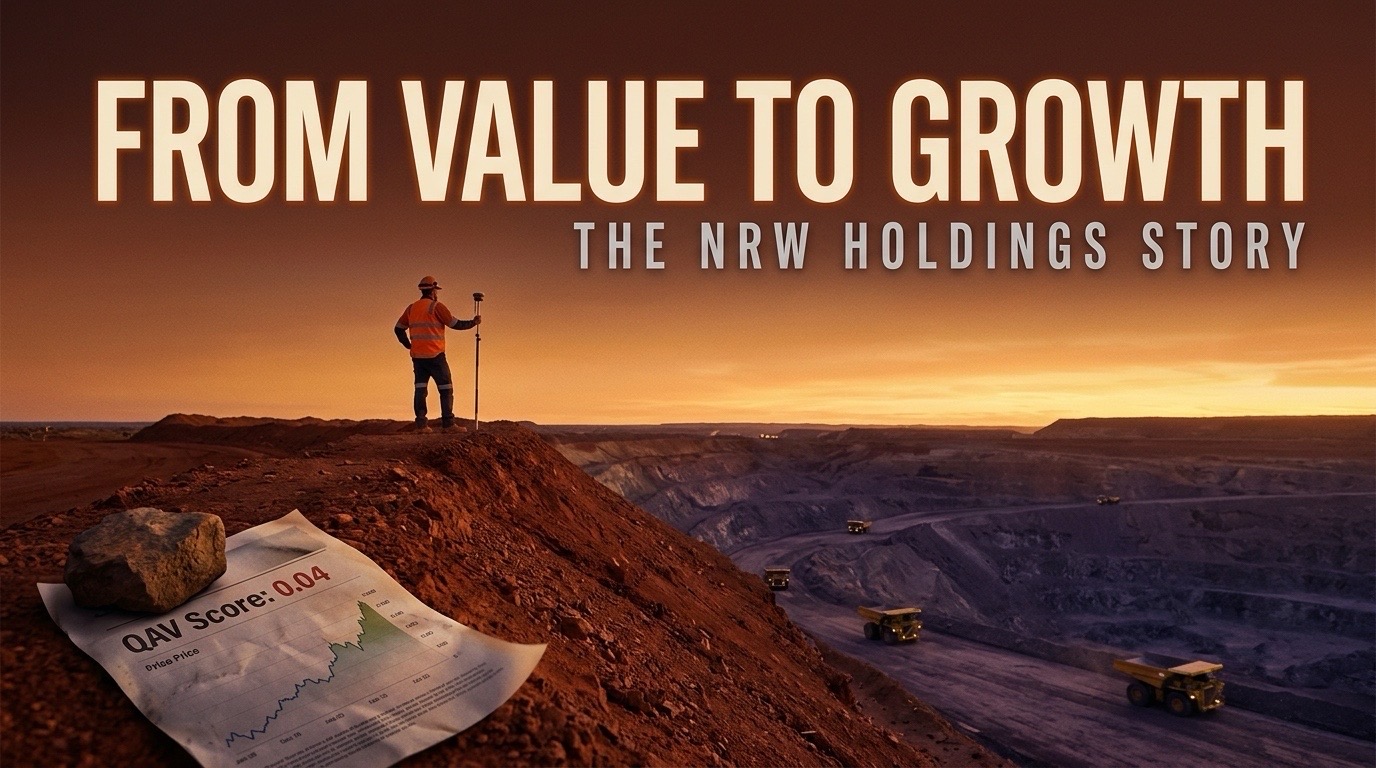
This week we do a deep dive Pulled Pork on NRW Holdings (NWH), the Perth-based engineering and mining services contractor that has surged 123% in the past year and sits comfortably in a few of our portfolios. Tony walks through the full QAV scorecard, the messy Whyalla steelworks collapse that hammered earnings, the ongoing REM strikes that shareholders keep ignoring, and why it has gone from a value stock to a growth stock. We also cover the buy list (slim pickings right now), portfolio performance numbers, Kimi K3 spooking AI investors again, and Alan Kohler returning to the show after six years.
This week’s full episode is for QAV Club members only. The free episode is available below. Also check out our podcast archives link and our pages on Apple Podcasts or Spotify or watch clips on TikTok. Or visit our homepage to learn more about QAV and how it works as a value investing system that you can learn and apply to beat the market.
Transcription
AU 929
[00:00:00]
Cameron: Welcome back to QAV Australia, episode 929. Tony, 21st of July 2026. How you doing, TK?
Tony Kynaston: Very well. Thank you. Very well
Cameron: Well, the market, uh, let’s have a look at how the market’s doing today.
Tony Kynaston: so-so
Cameron: yeah, so-so. Not bad. It’s up a little bit. Oh. Hasn’t quite cracked 9,000 again. Uh, it’s been, it’s down over the last week. Was up at n- just over 9,906.2 a week ago. It’s about 8974 today. What’s, why is the market depressed today, Tony?
What’s going on?
Tony Kynaston: Oh, I think it’s the Middle East is, is the main reason. Um, but the US market was down again too, partly because of the Middle East and partly because of the launch of the, was it the Moonshot AI in China? Kimi,
Cameron: Kimi K3
Tony Kynaston: taken the foam out of some of the, uh, makers around the [00:01:00] world
Cameron: Happens, funny how it happens, like when DeepSeek first came out, they took a hit, and then everyone got over it and they went back up again. And then Kimi comes out and they take a hit, and then, uh, well, it’s, it’s back again, and you know. But yeah, I’ve.
Tony Kynaston: Cam.
Cameron: Yeah. But look, I’ve, I’ve been saying, uh, for, for years, the Chinese are gonna be major players in this space.
I mean, I don’t know if you saw President Xi’s speech a couple of days ago about China and AI.
Tony Kynaston: No, I missed it. Sorry.
Cameron: too busy watching the soccer. Um, he, he gave a speech where he basically said, “Look, um, this is too important for us to fight over. We need to come together as a globe, AI, and China’s happy to play a leading role in that.
But we need to come together as a, as a civilization and work on this together, ’cause this changes everything.” And, [00:02:00] um, no. No,
Tony Kynaston: I, I could say that too and it’d have the same effect.
Cameron: but w- you know, whether or not, uh, the, the rest of the world is willing to play, China are gonna be. Un- unless something goes horribly wrong. But, um, China’s been catching up in this, and they’ve made it a, a mission as a country. The amount of money that they’re sinking into AI from the state and ro- and humanoids.
Tony Kynaston: Right
Cameron: You know, tens of billions of dollars of government money going into pushing this all forwards and, uh, I think that’s just the beginning of it. They’re absolutely determined to be, uh, the major players in this space, and they’ve got deep pockets and long horizons to do it in. So, uh, yeah.
Tony Kynaston: And of
Cameron: We will-
Tony Kynaston: another, another spate of articles in the, the financial press this week about how AI, uh, how China’s latest numbers, GDP numbers didn’t look [00:03:00] great. And you read down to the third paragraph and it was like 5%. And I’m
Cameron: Yeah. Yeah, yeah.
Tony Kynaston: wow,
Cameron: Yeah. Yeah.
Tony Kynaston: 5% GDP growth in Australia.” Yeah.
Cameron: It’s all over for China
Tony Kynaston: there’s, yeah, there’s some issues there. I mean, it’s
Cameron: Yeah
Tony Kynaston: it’s, uh, the growth is coming from exports rather than, you know, domestic and. fine, they’ll, you can work through those. I’ll work through
Cameron: Yeah. Domestic exports are going bonkers for them
Tony Kynaston: Yeah.
Cameron: Uh, well, let me, uh, let me have a look at the portfolio report. I, I just go to our blog. I don’t even need to open up Navexa anymore ’cause I go to our website ’cause I’ve got my cool stuff on the website now.
Tony Kynaston: Yeah
it’s looking very good, thank you
Cameron: oh, well, thank you.
Tony Kynaston: The weekly email, the portfolio report, very glossy.
Cameron: The model port- the model portfolio in Australia since inception, 15% versus the SPDR 200, [00:04:00] 7.86.
Uh, last one year, we’ve come down a lot. Wow, look at that. Um, last one year we’re up s- only 17% for the last 12 months. We were up, uh, 25%, uh, a month ago, down to 17, which, you know, doesn’t look that good compared to the SPDR 200’s 4.4%. Um, so we’re only doing quadruple market as opposed to quintuple market.
Uh, I’m embarrassed
Tony Kynaston: articles in the, press about the parlous state of our returns
Cameron: Oh, I’m happy to announce too that, uh, Alan Kohler’s coming back on our show in a couple of weeks, so that’s gonna be fun. We haven’t spoken to him in, since the beginning of the show. It’s been, like, six years since he was on.
Tony Kynaston: He helped us launch, which was terrific of him
Cameron: he did. He gave us some very early press, which was very generous.
Tony Kynaston: Hmm.
Cameron: Um, QAV Light portfolios, uh, as a group all [00:05:00] time now 17.8 versus the SPDR 9.99, so not quite double market, but, uh, pretty close in the last 12 months, QAV Light, 24% versus 4.48.
So it is, is that f- that’s, what is that? Yeah, quintuple? Yeah, sort of quintuple market. Our US portfolio, uh, last 12 months, 35% versus 18% for the S&P 500, so almost double market over there too. So all going well on the portfolio side of things, Tony, despite oil, oil prices. Uh, Brent is 90 bucks a barrel again today, I think.
What did I say before? WTI is about
Tony Kynaston: 83.
Cameron: or something like that.
Tony Kynaston: Mm-hmm
Cameron: Um, but, uh, apart from those things, Tony, I have really [00:06:00] nothing to talk about. One Pulled Pork request from Trent. Wants to hear about AQZ. It’s a high scoring QAV stock that is very unlikely to make it onto the buy list because of its negative 3PL, which it is unlikely to cross any time soon, plus a qualified audit.
So why the hell would we talk about this, Trent? Well, Trent says, “I’ve taken a punt on this one in my gambling section of my portfolio.”
Tony Kynaston: Gambling
Cameron: it
Tony Kynaston: If that’s a thing, hello, ready.
Cameron: And, uh, he says he’s included some research, uh, inspired by my favorite fund manager, Mr. Jeremy Raper. I know you like saying his name. Not sure what that says about you. I think you know absolutely well what it says about me, Trent. Um, so there you go. So I, I, we’re not doing that today, but maybe at some point in the future, Tony, you will
Tony Kynaston: I’ll add it to the list for
Cameron: [00:07:00] get desperate enough to t‑talk about something in Trent’s gambling section
Tony Kynaston: I think it’s Alliance Aviation if I got that code right, which, uh, have owned in the past, but probably decades ago, I think from memory. So it was a good company. I don’t know if it still is. If it’s got a qualified audit, it probably isn’t. Hmm.
Cameron: Alliance Aviation. Yeah, spot on. Yeah. Uh, oof. Wow. Well, that’s not a nice looking chart. Oh my God. It was, uh, it was $1.45 in November last year. Well, before that, it w- October last year, well, let’s just g- go back a year ago. A year ago it was trading about $2.68, currently trading at 53 cents. So yeah, there you go
Tony Kynaston: I’ll have a look at it.
Cameron: Yeah, why not?
What have, what have you got on your, uh, talking list today, Tony?
Tony Kynaston: a, Pulled Pork, another request, um, and this time it’s going to be on [00:08:00] NRW. Uh, but there was an article in the paper about it coincidentally as well, um, about mining services companies, including McMahon and NRW. And, uh, know, one of the things that I, I noticed in going through looking at NRW for the Pulled Pork is it’s surged a lot in the last 12 months, and, and this article, I guess, covers that.
Over the past 12 months, the share prices of McMahon and NRW have surged 201% and 123% respectively. And, uh, materials has been the best performing sector on the ASX, rising 41%, fueled by high demand for the resources driving the artificial intelligence boom and the energy transition. a strong mining sector does not guarantee high returns for the companies supplying the equipment, labor and expertise.
McMahon and NRW came close to financial collapse a decade ago when the mining industry shifted [00:09:00] from the investment to production phase, the company’s capital intensive operations nearly bled dry. it goes on to talk about how they diversified, how they acquired other companies, and how they’re doing well now.
So I thought I’d do the Pulled Pork on NRW based on that and the
Cameron: Well,
Tony Kynaston: in
Cameron: I hold NRW in my super portfolio since May last year. It’s up 150%, so don’t screw it up. It’s also in a light portfolio from a few weeks earlier in May last year, where it’s up 158%, so again, doubly don’t screw it up. NWH is their ticker code, just in case people’s wondering. What’s McMahons? Can you remember?
Tony Kynaston: M‑A-H, I think. Just a, just a bit confusing with this one. It’s called NRW Holdings and its ticker code is NWH
Cameron: Yeah. McMahons we also hold in the light portfolio since November last year. It’s up 96%. So, uh, yeah, two good stocks in our portfolios
Tony Kynaston: And I [00:10:00] must admit, I’ve seen this before in, um, contractors and engineering contractors, and one of my best returning stocks many years ago was, uh, Monadelphous, which is still, um, still around, and it went up a lot. Um, I think it was at least a ten-bagger for me. and so these, these kinds of companies can have good, uh, periods, but they can also be cyclical, so we have to be aware of that.
Um, and I guess that’s why we have three-point trend lines to help us navigate through that as well
Cameron: Indeed
Tony Kynaston: So let me do a
Cameron: You gonna get into it?
Tony Kynaston: yeah,
Cameron: Wow. Okay. Lovely
Tony Kynaston: very interesting company. Interesting, uh, history to it as well. Um, I wanna highlight from the outset that it’s not in our buy list anymore. It was last year. QAV score currently is point zero four, it’s i‑in that case because basically this is an example of a buy [00:11:00] list stock that has continued to rise in price, uh, which has reduced its score. So we, you know, it’s kind of a good thing if you got in on the ground floor and you’re still holding it. Um, but, you know, I don’t know if people would wanna buy it now at these kind of elevated levels. It’s currently a Josephine anyway, so you wouldn’t be buying it. Um, the, another positive for it is it, it’s a high ADT stock, and there’s something like about seven and a half million dollars traded on average every day. So who are they? Uh, they’re an engineering firm and a contract services firm based in Perth, but they did branch out into civil construction, contract mining. They still do drilling and blasting, and they’ve also just, uh, via acquisition, gotten into, uh, advanced technology services to the resources and infrastructure sectors, and they’re doing a fair bit of work now with, uh, the new, um, metals for batteries and, and [00:12:00] EVs. So they, they haven’t sat still. They’ve been, um, acquiring and growing. Uh, they sit number three in the engineering contractor market in Australia. of market cap, they’re behind Worley, who has a market cap of five, just over five billion; Ventia Services, which has, uh, just under five billion; and then NRW Holdings comes in at, uh, about three and a half billion. So it’s, it’s been growing quickly, and it’s starting to challenge those bigger two names. if you just looked at the mining side of things, so if you stripped out the civil and, um, uh, other, uh, engineering consultancy parts of this business, then it’s one of the two dominant mining contractors in Australia, and it’s the, probably one of the main competitors would be Perenti, um, which we’ve spoken about before and, and I hold shares into. Um, the interesting thing about NRW, though, is, um, is that its mining services division, is almost, uh, uh, [00:13:00] perfectly balanced by its non-mining divisions. So it, it operates in the mining services, uh, area, um, through a company called NRW Civil and Mining. but it also operates under other brands, mainly through acquisitions, uh, in the last, uh, ten years or so. Golding, which provides civil infrastructure. Primera Group, which is an- another engineering and construction company in the mining sector. Freedon, which was acquired, uh, late in 2025, and that adds, uh, mechanical, electrical and infrastructure technology to its, uh, suite. But, and it has a, a number of other, uh, brands like Acton Drill and Blast. RCR Mining, which, uh, was listed and people might be aware of that if they’ve got, um, going back sort of three to five years. And another one called AES Equipment. had a very good financial update for the half. So the company [00:14:00] reported annual revenue of two point nine billion and a robust order book exceeding seven and a half billion dollars.
And they also, uh, have a workforce now of over twelve, uh, eleven thousand people across Australia, New Zealand and North America. So the huge pipeline, um, coming, in terms of work for this company is, is really put a, a bit of a rocket under the, the share price. Some of the large contracting projects they’re working on now, uh, there’s a one point six billion dollar contract, uh, for the South Walker Creek coal mine, which is, um, uh, was given to Golding, one of the subsidiaries.
It’s a five-year contract, uh, involves operation and maintenance of the, um, heavy mining equipment at Stanmore, um, uh, Stanmore site in Central Queensland. And we’ve spoken about Stanmore in the past. Uh, a- another project called West Angelas Sustaining, which is a major earthworks [00:15:00] deal for Rio Tinto.
They’re building infrastructure and long haul roads, uh, up five new satellite mining pits for Rio, et cetera, et cetera. Fortescue Flagship Castle Hill project. So lots of, uh, mining projects, lots of infrastructure and civil projects. So the Tonkin Highway project is worth two hundred million in WA for the Main Roads Department over there. They’re doing a bridge in the Port of Dampier for some fifty million dollars, uh, and various other road construction, uh, contracts worth, uh, one’s worth $46 million for Main Roads WA. So a lot’s happening in the road and bridge space. And now they’re getting into, um, advanced engineering and tech projects, and so they’re, involved with the design of a hydrogen demonstration plant, uh, for, for a company called Hyser, or it’s called the Hyser Hydrogen [00:16:00] Production Demonstration Plant. They’re involved in a lithium project, um, PMET it’s called, and they’re doing, um, $200 million with data centers and AI infrastructure, via this Freedon acquisition, um, and, uh, yeah, picking up, uh, large contracts in that space as well. I, I had a look at their North America operations because I wondered whether that was going to be a thing for them. they’ve expanded into North America via four, sites in Montreal, Toronto, Houston, and Salt Lake City, so in Canada and the US. They’ve done it in kind of a smart way. So Australia, a lot of their business is around moving earth around, either at mining sites or on roadworks. They’re not doing that in the US so much.
They’re getting into engineering works, which is basically, you know, office work. Um, doesn’t involve a lot of CapEx, and therefore the margins are good and the risk is low. so they, they’re getting into lithium [00:17:00] and battery infrastructure. Um, they’re getting into, uh A lithium refinery in Oklahoma. And, and when I say getting into there, they’re doing the engineering designs and cost studies to get these projects approved and up and running. there’s a, a one called North American Lithium in Quebec. There’s one for a gold mining company, uh, c‑called Pogo. They’re doing an upgrade or the engineering work for an upgrade there. one more called Piedmont, um, Lithium Project in North Carolina, and they’re the engineering partner for the feasibility studies there. So, um, they’re doing a lot of engineering work and electric and, um, yeah, uh, planning work in the US, capital light business. Um, th-there’s obviously room to expand over there, but they’re, it, the, the North American business is only about or less than 5% of revenue currently, so it-it’s not a significant expansion for them at the moment. history for this company. They were founded in 1994 in [00:18:00] Kalgoorlie. Uh, the name NRW comes from the initials of the founders, Nicholas Ross Silverthorn and Jeffrey William McGlynn, and that’s where you get NRW from. they, their first contract went in 1994, uh, was a single earth moving contract at the Granny Smith gold mine in Western Australia. And then they started to expand after that. In late nine– In the late 1990s, they got into some, uh, long-term infrastructure and bulk earthworks contracts for some of the bigger players like BHP, Rio and Fortescue, then, uh, they parlayed that in 2007 into a listing on the ASX. however, the original founders are no longer involved.
Um, the, uh, the two founders I spoke of before, McGlynn and Silverthorn, both sold out, even though they’d been around for 16 years. Uh, McGlynn was the CEO for 16 years. They sold out in about [00:19:00] 2010. Uh, but a, a guy called Julian Pemberton came in as the managing director in the mid-’90s, um, back when the company was still only, um, uh, still only had a few dozen employees, so it was still small, and he has been the CEO since then. Uh- And has kind of driven the, um, the growth of the company. I noticed a interview with, with Mr. Pemberton in the AFR earlier this year, and, um, I’m gonna quote from it. He says, “We’ve always been considered a mining services company, and a big lesson for us in terms of making the company more diverse was going into different service streams and different commodities. In 2016, there were challenges in iron ore and coal in terms of pricing. It was a real moment of clarity, a pivotal point in the evolution of the NRW business because we’d always been focused on servicing the iron ore guys, then we moved into coal. there was a lot of pressure to move on from being a one or two-trick pony, so we set [00:20:00] about building a different business through acquisitions. In 2017, NRW bought Golding, a Queensland-based civil construction, urban development, and mining services contractor, and then quickly followed it up with BGC Contracting, RCR Mining Technologies, Primero, and most recently, Sydney-based civil engineering contractor, Freedom.” Pemberton attributes much of NRW’s recent success to the higher rating of services companies, which he says are in favor because of the amount of work that’s coming from resources companies and public infrastructure. are doing well across the board, lithium, gold, coal, and iron ore. It is rare that everything’s actually in a pretty good state. Governments are spending money and the AUKUS tailwinds are extraordinary. refers to the work he hopes c- could flow from Australia’s acquisition of three secondhand nuclear-powered submarines under the AUKUS defense deal, specifically the demand for heavy metal machining performed by [00:21:00] NRW’s RCR division. Pemberton goes on to say, “In Brisbane, you’ve got the Olympics coming up. You’ve had a strong housing market, so every part of what drives our company has been strong.” but the article goes on to say, despite the bull run on its shares, it has not all been smiley faces for NRW and Pemberton. Through its mining services operator, Golding, NRW is the biggest creditor to the collapsed OneSteel operation in South Australia, reportedly owing $120 million.
Shareholders have also vented their frustration in an extraordinary run of eight consecutive strikes against its annual REM report, although none of these have resulted in a board spill. that was an article actually quite recently, July 15th in the AFR. I, I wanted to drill down a bit further on the, uh, OneSteel collapse, ’cause I g– I remember we got questions about it at the time, because NRW went down, um, reasonably [00:22:00] dramatically when it was announced. Uh, and so they were the number one contractor to, the insolvency of the Whyalla steelworks, um, and it’s also had an associated i‑iron ore mine to that. They were owed $113 million via Golding, and, uh, the Golding had been, providing equipment leasing and iron ore transportation for OneSteel, and it collapsed, um, year. Uh, they’ve been doing it since 2020. Uh, because of the collapse, NRW had to record a, a $110.5 million impairment charge on its balance sheet, and that directly caused the statutory net profit to plummet by 73%, when it, uh, was announced. it was also a bit of a t- a twisty, windy road for NRW as its, uh, the Whyalla steelworks has worked through its administration. Initially, NRW believed its financial exposure was [00:23:00] protected, because Golding had secured the first ranking security interest over the assets and shares of Whyalla Ports to guarantee the money it was owed. the situation took a severe turn against NRW when the state government in South Australia intervened and voided the leases.
So OneSteel’s administrators went to the federal court to argue that the port lease was invalid. Um, then to protect the region’s steelmaking future, the South Australian Premier, Peter Malinauskas, introduced emergency legi-legislation which effectively nullified the port lease and stripped away ranking security over those port assets without compensation. So I talked, we talked about Brazil in the, the last, uh, year’s show, and now it’s happening in Australia.
Cameron: Hmm
Tony Kynaston: NRW leadership at the time expressed extreme disappointment, stating, stating the unprecedented government intervention undermined their legal security, and they were wiped out in terms of its, uh, [00:24:00] primary avenue for debt recovery. However, it’s, it’s, it’s, um, there’s been another few twists and turns, um, despite copping the big write-down, they continued to, to grow anyway, despite that. Um, but they’ve also, uh, enough, been kept on the administrators to continue working, uh, for the, uh, the Whyalla Ports and the Whyalla steel mill while it’s been trading under administration. Um, and so they have been, uh, picking up, uh, income from doing the work, and that’s, I guess, the- One of the reasons for doing that was the administrator has tried to protect roughly three hundred and thirty local workers while the, um, they continue to pursue alternative debt recovery channels, um, and, and ways to get the Whyalla steelworks back up and running. So that was, um, the Whyalla situation. Uh, on the REM strike situation, [00:25:00] another interesting, dimension for this company, uh, they’ve had eight consecutive REM report strikes and, uh, people will be aware, I guess, that under, uh, corporate law, if twenty-five percent or more of shareholders vote against the executive pay re-report, then the, uh, company is required to a, um, an election for the board, for the full board at its, um, next AGM. Interestingly enough, every time that they get a REM strike and the board spill is, um, is, uh, caused, um, the, the board gets reelected. Uh, so, uh, it’s, it’s kind of a strange paradox, I guess, about the, the company. So basically, the proxy advisors such as CGI, Glass Lewis, have consistently targeted the payouts to the CEO and, um, he currently took home about six million dollars this year uh, they, they’ve, um, haven’t liked the fact that his performance, uh, hurdles have [00:26:00] been, in their opinion, reasonably easy to at- to at-attain. but every time there’s a, a, a REM strike, there’s a, a, a support, uh, there’s a vote to support con- the continuation of the current board. so it’s, it’s kind of like, uh, you know, like a two-year-old stamping their feet, but then they come back to the dinner table when they’re hungry. So, I think largely in this case, NRW ignores what the, the– happens with the REM strike, and, uh, they can point to the share price and its appreciation to say why shareholders are doing well out of the current situation. uh, certainly in the last, uh, results, which were, were the clear ones after the, uh, write down for revenue grew by nineteen point five percent year on year. EBITDA went up thirty-six and a half percent, and underlying NPAT jumped forty-two percent. So it’s certainly been growing strongly in the last twelve months. Uh, at the same time as announcing those, uh, results, they [00:27:00] also raised the full-year revenue guidance, uh, from three point four billion to three point seven seven billion. And, um, they did so on the– knowing that ninety percent of the upgraded revenue was already completely secured via contracts. so, um, they’re, they’re pretty confident of achieving that. They also, uh, could point to some of the work that the, they’re winning via Freedom, uh, which is higher, uh, margin business because it’s, um, in the technical infrastructure market, including AI data centers and industrial battery storage and the sort of complex electrical engineering that goes around that. uh, they’re, they’re pointing out that that’s a very big market in Australia worth something like twenty-five billion dollars, and that, uh, even picking up a small amount of that will be very good for the company. so, uh, yeah, that’s, that’s basically the company and its history. In terms of the QAV I did the analysis at a stock price of six dollars eighty-one, which is almost bang on consensus target for the company, [00:28:00] but way above our valuations of IV1, sixty-five cents and IV2, three sixty-seven. Net equity per share is a dollar forty, so we can’t buy it for book or book plus thirty. is two point six percent, so it’s got some dividends, but not enough to score for us. Doctor Financial is, uh, Stock, Stock Doctor Financial health is satisfactory and the trend is steady. So I, I wanted to know why a company that’s, you know, growing so would only rank as a satisfactory in Stock Doctor, seems like it’s the, the growth is the reason. So in order to grow, uh, the company increases its current liabilities by taking on contractors to fill the, the new work, and that’s what I think Stock Doctor looks like it’s marking down, marking them down for is the increase in current liabilities. But it’s not a bad thing because it leads to, um, to further revenue growth. I checked it out in Stockopedia. They give it a quality rank of ninety, so bit stronger than Stock Doctor. [00:29:00] They give it an overall rank of eighty-five, um, but they mark it down on the value dimension where it ranks a thirty-six, and that’s pretty much how we see it as well. Um, good, you know, good for growth and, uh, but getting a bit pricey. score in Stockopedia is six out of nine. Because of, um, the Whyalla write-down still on its trailing numbers, the PE sits at fifty-three times. Um, interestingly enough, it’s not the highest or the lowest, so we, don’t score it there. Um, if I look at PROPCAF, which is probably the better metric, it’s, it’s, um, a PROPCAF of eleven times, which is one of the reasons why it’s not in the buy list.
It’s too high for us. Uh, of the good things about the scoring, though, is that the forecast for earnings per share is, is, uh, to double next year. So the growth over PE score, even though the PE is quite, uh, quite large, is still three point seven times against our requirement for at least one point five Uh, even though, um, did [00:30:00] have owner founders and the current CEO has a reasonable shareholding, he still holds less than 5%, so we can’t score it for owner founder. Uh, it’s been a, a long-term buy, so we can’t score it for a new three-point trend line upturn. um, interestingly enough, equity stopped increasing consistently. It had been a consistent increaser up until a, a year ago, and that may have been because of Whyalla. But anyway, it’s, um, we can’t score it for that. Total quality score is six out of 15 or 40%, and the QAV score is In terms of the risks, um, I think the biggest risk for this company is its valuation. Um, as I said before, it’s trading on a high PE ratio. I think that’s because of the Whyalla write-down. If you look at, um, pre-Whyalla, it’s, uh, it was a reasonable number and the forecast PE I think is eleven times. Um, so it’s not, [00:31:00] uh, uh, I think it’s a one-off, um, sort of distortion because of the, the hit, hundred and ten million dollar impairment write-down hit to, uh, its earnings, uh, last year. Sorry, the December ’24 PE was seventeen point nine times and the, the June forecast is eleven point six times. So once we roll around to a clean set of numbers, um, it’ll look g- better from a PE point of view. but still it’s, um, it’s on a, a higher PROPCAF than we’d like to see. Couple of other risks for the company. These contractors are cyclical. Um, h- this particular company’s done well to diversify away from mining, which is probably the most cyclical part of the engineering, world. But they’ll. At some stage, there’ll also be a downturn in civil when, um, you know, governments, uh, repair roads less and, um, and do less bridge work and things like that.
So, we need to watch for that. Um, it’s also a low margin business, and again, they’re diversifying into batteries and, [00:32:00] and data centers to get a higher margin from electrical, uh, work. But, uh, you know, the core of the business of, um, of supporting mines and, and building pits and roads and things like that, pushing earth around, as it’s sometimes called, is very low margin business.
So any sort of execution delays, adverse weather, labor cost inflation, all those kinds of things can, can quickly erode margins for a business like that. On the positive side, seems to be very well managed. Um, has a very strong construction pipeline, coming down the pipe. A lot of it’s contrac- contracted and there are a few metro– macro tailwinds for a company like this with, uh, construction in Brisbane around the Olympics, construction in South Australia and Perth submarines and, um, expansion into data centers all supporting their, their businesses. Um, so in summary, I think NRW has transitioned from a value stock to a growth stock. nice to see, especially if you got in early when it was on [00:33:00] the buy list. Uh, I guess the, the question is do we sell or hold? It’s certainly not a buy at the moment un- under these prices. Um, but you know, the three-point trend line is gonna be our guide for that. it obviously is a long way above its sell line. So, um, you know, if it does, it does drop, it’ll have to drop a long way to become a sell but, uh, I’m not sure it’s gonna drop a long way given the strength of the business it has at least in the near term. So, uh, thanks for the request for the Pulled Pork.
Cameron: Thank you, TK I was just looking, um, in my history, ’cause I know I’ve bought and sold it a few times over the years. Around 2023, it was one of those stocks that got caught up in the Rule One spiral of death. Um, but, uh, yeah, fifth time lucky
Tony Kynaston: Well, it has been lucky too. It’s doubled in value over the last 12 months.
Cameron: Yeah, that’s what I’m saying.
Tony Kynaston: Yeah.
Cameron: Speaking [00:34:00] of the buy list, um, not a lot on it this week. Um, I had a total of three, eight stocks, and two of them were oOh!media and Q Energy Resources, which are in the middle of takeovers, so not really buyable. Um, left me with Mitchell Services, Lindsay Australia, COG Financial, Horizon Oil, Bell Financial Group, and Big River Industries.
So slim pickings out there at the moment
Tony Kynaston: Yeah Um, yeah, well, what can I say? It’s– That, that happens at the value end of the market. Um, and, you know, there’s nothing wrong with waiting for something good to come along or buying one of those eight stocks if you ha- if you don’t have them.
Cameron: Yeah. I mean, we’re fully invested in the QAV portfolios. There’s a bit of cash in a couple of the light portfolios, but not enough to buy a full parcel, so I’ve just let it go. [00:35:00] But, um, well, I’m, I’m just letting it sit there. But, uh, yeah, interesting that it’s, um, it’s not a lot to buy right now. Market has been struggling, so a lot of things are having down days and below their Josephines and all our Josephines below their two BLs.
Tony Kynaston: Hmm.
Cameron: Uh, that’s it.
Tony Kynaston: After hours?
Cameron: After Hours, what you got for me?
Tony Kynaston: Well, let me, let me kick off with a pleasing result from Lake Forest yesterday at the races at Pakenham. Had a win, a hard-fought win. It was, um, a. Well, it was a photo finish, I guess. Um, so a close win, but set another course record at
Cameron: Wow
Tony Kynaston: So it’s– He’s going from strength to strength, which was lovely to see.
Cameron: Congratulations
Tony Kynaston: thanks. And, um, yeah, I’ve been watching a few things. A couple of Sam Neill movies. I hadn’t seen Hunt for the Wilderpeople, which I thought was terrific.
Cameron: It’s a great movie, isn’t it?
Tony Kynaston: Taika Waititi
Cameron: [00:36:00] Yeah. How good’s the kid in it?
Tony Kynaston: the kid’s great.
Cameron: And the woman who plays the cop,
Tony Kynaston: Yeah
Cameron: think she turned up in, uh, his Taika’s, um, last Thor film or the one bef- I think it was the last one. She was working for Jeff Goldblum as one of his like enforcers or something, but she’s, she’s fantastic, hilarious.
We love her.
Tony Kynaston: And
Cameron: But yeah, that kid. Huh?
Tony Kynaston: though, how good was Taika? The, scene in the church.
Cameron: Oh, I don’t remember him in it.
Tony Kynaston: behind, behind, What do you think’s behind one of the doors? It’s like
Cameron: Okay
Tony Kynaston: no, no, not Jesus. Could be lollies, could be, be Fanta, could be Coke Zero. It’s all good things.
Cameron: He’s a good actor, you know. When he does stuff, he’s funny.
Tony Kynaston: Yeah.
Cameron: Um-
Tony Kynaston: Death in Brunswick, which was great too.
Cameron: Held up well
Tony Kynaston: Oh, not really, but it was, it’s like,
Cameron: Right
Tony Kynaston: it, it’s, um. I [00:37:00] remember at the time, and I still think now, I mean, the, one of the roles of art is to reflect us back, what we see, and it was just great at the time to see a movie set in Brunswick.
Cameron: Hmm.
Tony Kynaston: is. And John Clarke’s brilliant in
Cameron: Hmm.
Tony Kynaston: And it just struck me after I watched it that it was, you know, John, it was the two– It was John Clarke and Sam Neill were the two leads, and they’ve both passed on,
Cameron: Mm-hmm.
Tony Kynaston: And they’re both New Zealanders. It’s a
Cameron: Mm.
Tony Kynaston: but
Cameron: Yeah
Tony Kynaston: a look. worth a look
Cameron: Well, I have been watching some interesting things. Um, White Sands. You ever seen White Sands?
Tony Kynaston: Well, it rings a bell. Is it, um, Mickey Rourke
Cameron: Yes.
Tony Kynaston: ’80s?
Cameron: early ’90s, Mickey Rourke and Willem Dafoe. Uh, directed by Roger Donaldson, Australian/New Zealander [00:38:00] director, best known for doing Cocktail, No Way Out, late ’80s.
Tony Kynaston: love No Way Out. Great film.
Cameron: y- great film. Yeah, one of the few Kevin Costner films I can actually watch without wanting to throw something at the screen.
Tony Kynaston: Mm-hmm
Cameron: Um, Sean Young in that, Gene Hackman, yeah.
But this one is interesting, uh, for a couple of reasons. Um, not, not well-liked, but I, you know, I was looking for something to watch and I was like, “Well, I love, uh, Mickey Rourke.” Mi- you know, like late ’80s, early ’90s Mickey Rourke, man.
Tony Kynaston: Mm-hmm.
Cameron: if he’s phoning it in, which he is in this, and this was the last film he made before he went back to boxing and smashed his face up and had the plastic surgery and whatever.
But late ’80s, early ’90s Mickey Rourke, come on. The guy was the coolest mother on the planet. All he does in this is just kinda smirk his way through every scene, but it’s killer. But [00:39:00] here’s a funny thing. Opening scene, um, M. Emmet Walsh appears in it, and I immediately went, “Oh, this is gonna be great,” ’cause M.
Emmet Walsh is in it. And, a- and I just watched Blade Runner,
Tony Kynaston: Yeah
Cameron: the original Blade Runner with the Harrison Ford narration,
Tony Kynaston: Mm-hmm.
Cameron: which I haven’t seen since probably the ’90s. And, huh?
Tony Kynaston: Which I prefer. I
Cameron: Really?
Tony Kynaston: Yeah.
Cameron: Oof. No, I– give me the director’s c- one of the director’s cuts any day, but it, it. But M. Emmet Walsh as whatever his name is, he’s like his, the, the chief of police or something like that.
Fantastic. I’m al- I’m, uh, I’ve always been a huge M. Emmet Walsh fan, M. Emmet Walsh fan. And I saw he just died, 2024. Um, been around forever. But anyway, so I was reading up on the film, and I read this thing. Apparently Roger Ebert had [00:40:00] what he called the “Stanton Walsh Rule:” “No movie featuring either Harry Dean Stanton or M.
Emmet Walsh in a supporting role can be altogether bad.”
Tony Kynaston: Mm-hmm.
Cameron: And I was like, “Totally agree.” If I see either of those guys in the credits, I’m like, “Yeah, I’m watching this,” ’cause they’re always, they’re always great. I love those two guys. Hey, Sam Jackson’s in it, Mary Elizabeth Mastrantonio. It’s, uh, b- funny thing is, is about it is Willem Dafoe’s not great in it.
I love Willem Dafoe. I think he got better as he got older. I think Willem Dafoe’s a better actor now than he was 30 years ago. But anyway, very cinema- very interesting film. Um, also on the interesting but hard to watch, “The Omega Man,”
Tony Kynaston: Oh,
Cameron: Charlton Heston. You seen that?
Tony Kynaston: Oh, many times. Yeah. Yeah
Cameron: Wow, that is a bonkers, bonkers film. Oh my God.
I read that, uh, [00:41:00] Tim Burton said he’s watched it a million times. It’s like his desert island film. He’s like, “If I ever see it on TV, I’ll just stop and watch it. I’ve seen it countless times.” It is crazy on so many levels. For people who don’t know it, it’s, um, Last Man on Earth. You know, one of the remakes of that, the old, uh, Vincent Price film I think did originally, and then there was this one, and then Will Smith did one 20 years ago.
Population’s been destroyed. They’ve all turned into zombies. It’s just him and, and he comes across some other humans kind of stuff. Charlton Heston in sort of his second phase of his career where he’s, you know. Yeah, the Planet of the Apes era Charlton Heston. Soylent Green, which I haven’t seen yet, but I’ve got that queued up to watch, too.
Tony Kynaston: brilliant.
Cameron: Is it?
Tony Kynaston: Oh, I
Cameron: Hopefully it’s better than this. Um, and the zombies in this are all [00:42:00] just people speaking normally with white, white makeup on and white hair and
Tony Kynaston: sort
Cameron: yeah, white face.
It’s kinda wacky, but, uh, just, uh, kinda fun, that mid-’70s low-budget sci-fi crazy Charlton Heston. “Goddamn you, you. You blew it all to hell. Get away from me, you dirty ape.” It’s phase Charlton Heston
Tony Kynaston: Yeah, yeah,
Cameron: with a cool, uh, Black lady with an afro that he makes out with
Tony Kynaston: yep. And he puts, um, Woodstock on the, uh,
Cameron: Yes.
Tony Kynaston: in the cinema so he can watch
Cameron: And he,
Tony Kynaston: and he
Cameron: and it mouths all the words as he knows it back to front
Tony Kynaston: yeah. Who’s that? There’s a B‑grade actor who’s in a lot of sci-fi movies who plays the, sort of chief zombie.
I’ve forgotten
Cameron: Yes. I had to look him up because I recognized his face. Um, [00:43:00] his name is Anthony Zerbe or Zerbe
Tony Kynaston: That’s it, Zerbe, yeah. He’s, he’s like the Emmet Walsh of, uh, so the ’70s sci-fi, yeah
Cameron: Well, yeah, not just sci-fi, but a lot of, uh, Westerns too. He was in, um, uh, Papillon,
Tony Kynaston: Mm-hmm.
Cameron: um,
Tony Kynaston: he
Cameron: the
Tony Kynaston: the, uh, guy with leprosy in Papillon, didn’t he?
Cameron: I, I don’t remember. It’s been 30 years since I saw that. He also ended up in the Ma-
Tony Kynaston: worthwhile watching Papillon again
Cameron: Is it?
Tony Kynaston: Oh, yeah.
Cameron: I, it’s, God, I, I went to the drive-in to see that, uh, with my dad when I was a kid, and I read the book when I was a kid too. Um, but Anthony Zerbe was in, uh, like, even, like, in, uh, 20 years ago, he was in the Matrix sequels as one of the counselors of the surviving humans.
But yeah, he was in Turning Point, Rooster Cogburn, um, uh, [00:44:00] yeah, a lot of. Cool Hand Luke, um, The Dead Zone. Yeah, he turned up in all s- but usually a bad guy. He had one of those bad guy faces. But he was in Bonanza, and Gunsmoke, and Ironside, and Kung Fu, and Hawaii Five‑O. You know, he’s classic of ’70s TV. Oh, by the way
Tony Kynaston: to movies, yeah
Cameron: Yeah.
I also watched the first episode of “The A‑Team,” um, the other day. The original A- the original, yeah. It’s on Pr- Amazon Prime, and I was like, “Oh, yeah.” Funny thing was, Chrissy knows the theme song. She was singing along to it. Never watched an episode of it in her life, but knew the theme song. Dun, dun, dun, dun, dun, dun, dun.
She was singing along. Had to explain the plot to her. She’s like, “What i- what the hell is going on?” I was like, “Oh, great.” Murdock and, uh, you know, B.A. Baracus.
Tony Kynaston: Yep.
Cameron: Well, the Face isn’t in the first episode. I don’t know when he. There’s a guy that plays, like, that character, but is a [00:45:00] different actor to Face. He must have come in in a later season.
Anyway, um, but before we wrap up, I’ve also been r- go- I’ve gone back to “The Odessa File,” um, which I kinda got bored of at some stage or got sidetracked, and I’ve gone back to it, and I had to get Claude to give me an update. I’m like, “Okay, I’m on page, uh, chapter whatever. Remind me what’s happened,” and it sort of gave me a, uh, a quick update.
But I’m really enjoying it, particularly when he started to talk about the penetration of Nazis in the West German government, and then I was in Claude going, “Is this, is this, is this l- like legit history?” And it was like, “Oh, yeah. Yeah, yeah.” Uh, in fact, he undersells it, if anything. So I’m gonna do a Cold War series on that after I finish.
I’m doing Castro at the moment, on, um, how they just brought the Nazis back in to run West Germany. Um, and, like, it was [00:46:00] bonkers the numbers of how many judges and, you know, the, the, sort of the second tier under the ministry, all of the people running West Germany were all high-ranking Nazis that just came in and ran the country for decades.
Um, there was a big inquiry into it, um, decades later and yeah, just like, something like 75% of the upper echelons of, uh, West Germany were high-ranking Nazis from the late ’40s onwards. Anyway, but yeah, I’m all getting it from “The Odessa File,” so yeah, it’s kinda good. Well, that’s, uh, well, music-wise, uh, got nothing really to share.
Uh, oh, except, uh, last night I was listening to Peter Allen, as I told you, and, uh, ’cause I was doing a show on Rio de Janeiro for America. And, um, somehow I went from Peter Allen to Hall & Oates.
Tony Kynaston: [00:47:00] Oh
Cameron: I don’t know how I made that jump, but, uh,
Tony Kynaston: I can
Cameron: yeah.
Tony Kynaston: but
Cameron: Yeah
Tony Kynaston: think bit of a downgrade I think
Cameron: A downgrade from Peter Allen to Hall & Oates
Tony Kynaston: Yeah, not a fan
Cameron: Oh, come on, man.
They like that Philly sound. You’re a rich girl, but you gone too far. And you know it don’t matter anyway. I was thinking of Alex. You can rely on your old man’s money. You can rely on your old man’s.
Tony Kynaston: please.
Cameron: She doesn’t rely on your money though, which is one of the things I admire about Alex.
Tony Kynaston: and Hall and Oates, just terrible
Cameron: You’re out of touch. I’m out of time. But I’m out of my head when you’re. Okay.
Tony Kynaston: No,
Cameron: I can tell you’re not digging it.
Tony Kynaston: No
Cameron: I was thinking for you, so, you know, you had, you had, uh, Mental As Anything for your, was it your 50th?
Tony Kynaston: Yep
Cameron: And then The Angels, your 60th. I was thinking for your 70th, Hall & Oates
Tony Kynaston: Oh, no, thank you. [00:48:00] Don’t
Cameron: They’re still around
Tony Kynaston: know who’s, gonna still be around at my 70th really
Cameron: Yeah
Tony Kynaston: Yeah. Might be AI.
Cameron: Chisel
Tony Kynaston: Yeah, possibly.
Cameron: Jimmy still around? Requests?
Tony Kynaston: from friends.
Cameron: Oh, right. I thought they were requesting you. “Can we come and play at your next party, Tony? We heard from the Angels it was such a good gig.” It was a good gig. That was a great night.
Tony Kynaston: It was, wasn’t it?
Cameron: Fox still talks about it.
Tony Kynaston: Oh, really? Oh,
Cameron: I said, “Well, you should’ve been there at the 50th, man, for Mental As Anything.”
Greedy Smith. Yeah. Yeah. Skyhooks. I was listening to Skyhooks this week too. I went back and listened to a lot of Skyhooks. No, you can’t really. No.
Tony Kynaston: No.
Cameron: No
Tony Kynaston: apparently have reformed, but now it’s the– So when we, when I had them at the 50th, it didn’t have Reg Mombassa in them. It
Cameron: Yeah.
Tony Kynaston: it had the
Cameron: Everyone else. [00:49:00] Yeah
Tony Kynaston: s- um, the Mentals are Reg Mombassa and his brother Pete Doherty and none of the original guys,
Cameron: Right
Tony Kynaston: gone.
I think, um, Martin Plaza, he, he may have gone or he might be very sick.
Cameron: Was he there in, was Martin Plaza at, at your party?
Tony Kynaston: He
Cameron: Oh, I don’t remember that. Hmm
Tony Kynaston: yeah. had an amazing guitar. Like, he must have played the same guitar his whole career, ’cause like the, there were big grooves in the timber under the frets, yeah.
Cameron: Nice.
Tony Kynaston: Mm
Cameron: Uh, yeah, I was, we’re back, I, I, I got into. I was listening to Skyhooks ’cause Women in Uniform came on. I was in the car coming home from kung fu or something. Women in Uniform came on and I was like, “Man, that is a catchy song.” The, the whole
Tony Kynaston: Yeah. Yep. Yeah,
Cameron: Not sure you could get away with that song these days, but it’s,
Tony Kynaston: not.
Cameron: No
Tony Kynaston: “Jukebox in Siberia,” probably not.
Cameron: Yeah. But
Tony Kynaston: on their first album either probably. “You only like me ’cause I’m good in [00:50:00] bed.”
Cameron: yeah, yeah.
Tony Kynaston: Yep.
Cameron: Yeah, oh, you could probably get away with that. But, um, women in uniform, sometimes they look so cold, but ooh, they feel so warm. All right. Thank you, TK. Have a good week everyone. Happy hunting
Tony Kynaston: See you later
QAV LIGHT
Someone already cleared the way.
Click the picture to learn more!