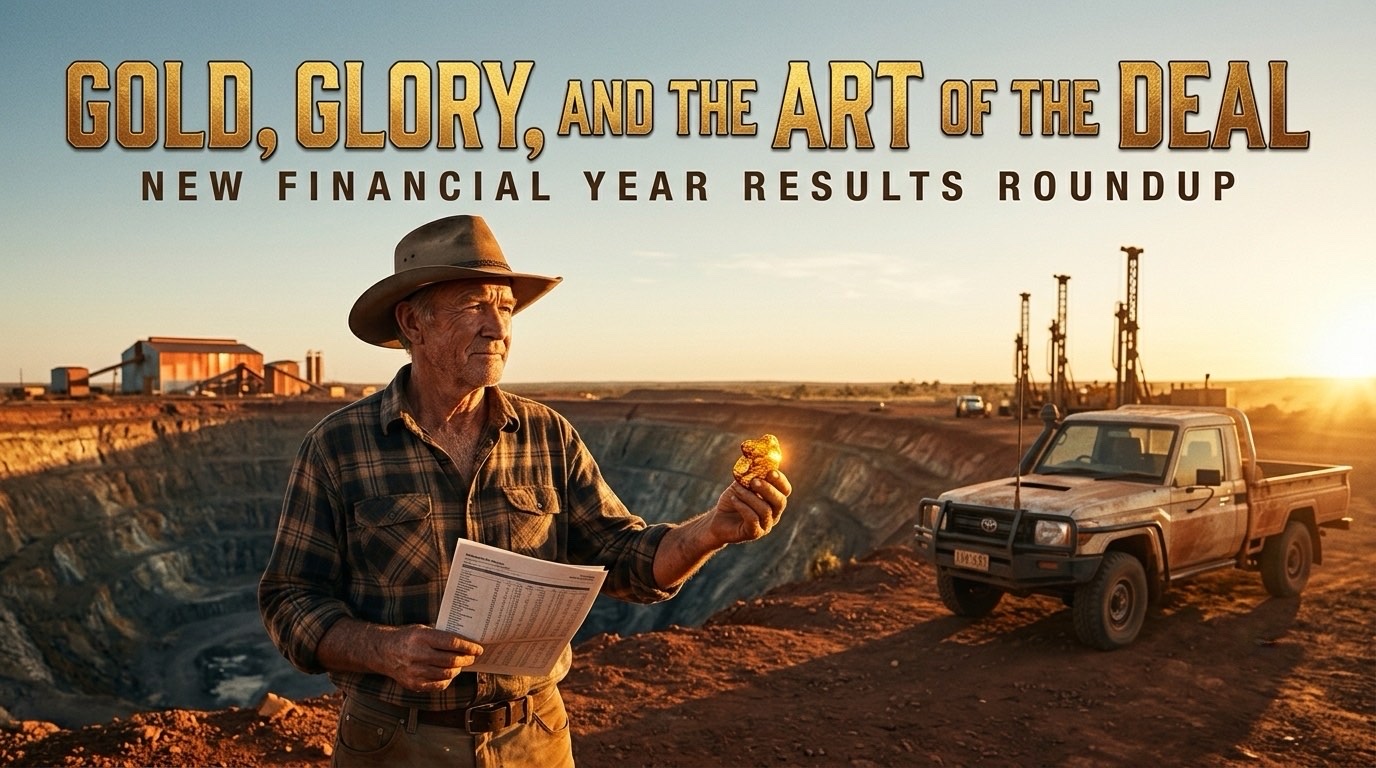
On this week’s show we kick off the new financial year with a raft of member results, and the numbers are genuinely impressive. Tony does a Pulled Pork on New Murchison Gold (NMG), a penny-stock gold miner in WA that went from zero to profitable in under a year by doing a very clever deal to avoid building its own processing plant. We also cover the Vault Minerals takeover battle, SDI’s delisting, gold back on the buy list, and Trump’s crypto shenanigans, where his fans collectively lost $3.8 billion while he pocketed $640 million.
This week’s full episode is for QAV Club members only. The free episode is available below. Also check out our podcast archives link and our pages on Apple Podcasts or Spotify or watch clips on TikTok. Or visit our homepage to learn more about QAV and how it works as a value investing system that you can learn and apply to beat the market.
Transcription
QAV AU 927 Club Video
[00:00:00]
Cameron: Welcome to QAV Australia, episode 927, the 7th of July 2026. The first show of the new financial year. We’ve got lots of reports from members, do our own reports. But my first question to you, TK, apart from asking why you look like you’re sunbathing in your, uh, office there, is how many ships do you think crossed the Strait of Hormuz in the last 24 hours, Tony?
Tony Kynaston: I don’t know. I’ll say six
Cameron: Mm, uh, that was last week. That would’ve been true. Five last week, I think when I looked. in the last 24 hours.
Tony Kynaston: okay.
Cameron: Normally 60 to 100. Uh, I don’t know, I didn’t look at the details, but, uh, it’s about 30, 40%, 20%, depending on how you take the averages. But it’s still a long way from back to normal, but it is increasing, uh, which is positive for the global economy
Tony Kynaston: Well, I hope so. I mean, it’s, [00:01:00] it is positive if it goes up, if it keeps trending up like that, sure. But still worries me quite a bit that market’s gotten ahead of itself, um,
Cameron: Yes
Tony Kynaston: in the Middle East. still no deal done. So,
Cameron: Yeah.
Tony Kynaston: I saw an article this morning saying that, uh, last time when lifted sanctions in return for a deal, billions of dollars went into terrorism, state-sponsored terrorism.
So, I mean, I can’t see the Israelis being happy with a deal as it currently stands.
Cameron: Hmm.
Tony Kynaston: way to go
Cameron: Hmm. Anyway, uh, the US economy, you know, is, um, not great anyway. Soft June jobs report. Payrolls, uh, were just, rose just 57,000 in June versus the 113 to 115,000 that was expected. [00:02:00] Unemployment dipped to 4.2 from 4.3, but US economy’s not doing great. But, uh, stock market, Dow surpassed 53,000 and set a fresh closing record on Monday the 6th of July.
Everything’s up. Semiconductors were down, but then they were back up. I see Broadcom announced overnight that they’ve extended their deal to make custom chips with Apple until 2031. There were some updates from some others as well. Tesla dropped. Sort of SpaceX is rebounding a little bit. Alphabet joined the Dow just before the market closed.
So despite all of that, soft economy, um, stock market doesn’t care. Well,
Tony Kynaston: Unemployment at 4.3 is pretty good. Um, yeah, I mean, there’s. It, it’s probably weaker than it was a year ago before the tariffs came in and oil prices spiked, but otherwise it’s not too bad
Cameron: Well, it’s a K‑shaped [00:03:00] economy, as they keep saying. High end of town is doing well. People are struggling, I think.
Tony Kynaston: Mm-hmm.
Cameron: Prices are still up. I don’t know where the eggs are at or the gas is up there. I, I filled up my car the other day and was surprised at the, the petrol prices here are back down to normal already.
We’re, I don’t, I don’t know why. We’re not getting any oil. Well, I don’t know where we’re getting the oil from. We must be getting something. Anyway, on the Australian side of things, uh, market has been not too bad, I think. Start to the new year, let me see where it’s at today. Down a bit today, but if I look at the one year level, you know, we’re at just over 9,000.
We were up as high as 9.4 in March. We’re kind of back to where we were about a year ago. We were about 9,000 a year ago, back to 9,000 now, so it’s been a sideways year for the market. Our [00:04:00] portfolios, as we said last week, have done pretty well, and we’ll get into some of the user updates, uh, member updates shortly.
But, um, I wanna talk about Donald Trump’s crypto efforts, Tony, just for shits and giggles. Great article in the, in The New York Times I read this week. Nearly a million investors lost a total of $3.8 billion on Trump crypto coin, while he has made $2.2 billion since he started his second term, including something like 680 million, I think, out of his crypto efforts.
$636 million on his crypto efforts according to his latest financial disclosure. So his fans lost 3.8 billion buying his coins while he made $640 million profit from their losses.
Tony Kynaston: Well, he’s a fantastic trader, [00:05:00] isn’t
Cameron: And I’m sure those people all still support him as well. That’s,
Tony Kynaston: people who are, who are using the crypto as a way of donating to him, weren’t they?
Cameron: Yes. Yeah, that’s true. Mm-hmm.
Tony Kynaston: But yeah, it’s, it’s, it’s shocking. It’s quite f- I mean, in some respects, a lot of the stuff that goes on goes on anyway, it’s just under other previous presidents it was hidden. so it’s kind of nice it’s out in the, in the light of day, but, but it’s, that’s, I don’t think it was going on to this extreme and this brazenly
Cameron: I think if any other president had made $2.2 billion during their first year in the White House, there would be. things would be said. Yeah.
Tony Kynaston: That’s, that’s the other thing too. It’s like it’s, it’s newspapers are covering the story, but I’m not hearing it coming up in Congress at all as a problem, any sort of censure or impeachment or anything like that
Cameron: Well, he controls the Congress anyway. I mean, so controls the Senate still till the [00:06:00] midterms, if they actually happen, which I’m doubtful about.
Tony Kynaston: I’ve gotta, I’ve gotta say though, if I can just, sorry, butt in there. one thing he isn’t doing a good job on was celebrating the 250th anniversary of the US, despite the fact he’s the commemorative dollar bill and the US passport at the moment. I re- remember quite vividly the 200th celebrations in 1977.
It was a really big deal, and there was much national celebration, and tall ships in the harbors in New York, and bicentennial parades and fireworks and, you know, thousands and thousands and thousands of people on the, in the Mall celebrating. You could have fired a cannon down the Mall during Trump’s 250th celebration.
All it would’ve gotten was covered in algae from the reflecting pool. It’s just a debacle
Cameron: But did they have a WWE wrestling match on the front lawn of the White House, Tony? Come on
Tony Kynaston: 80th birthday. That wasn’t the [00:07:00] 250th celebration.
Cameron: right
Tony Kynaston: The 250th celebration was a lot of kiosks and stalls down the mall selling crap which no one was buying, and a few hundred people marching up and down with Myer hats on
Cameron: And he gave a speech warning about the dangers of communism. He got one of Roy Cohn’s old speeches, his mentor’s speeches from the McCarthy days and just recycled. He got to warn about the Russkies, the Soviets, the unions coming for them for their, coming for their children
Tony Kynaston: I saw a, I saw a picture of, uh, it could have been AI fake for all I know. It was attributed to one of the, I think The Wall Street Journal or someone. But, um, there was a, a picture on one of the Washington government buildings, I think it was the Department of Justice from memory. picture of, um, George Washington and the, and the headline was, “Our F- Our Founding President.” then a picture of Donald Trump, caption was, “Our Greatest President.”
Cameron: Sure, sure
Tony Kynaston: [00:08:00] 250 years of evolution right there, I think.
Cameron: Well, uh, yeah, George Washington famously admitted to, uh, uh, chopping down a cherry tree and said, “I cannot tell a lie.” Trump was like, “I cannot tell the truth.” So, you know, that’s the evolution that they’ve had over that 250 years. Back to the market, Tony, before we get into results, um, SDI, our, our favorite dentists have been removed from the index.
The sale to the Chinese dentist. Chinese watch, Mother. A Chinese watch. Chinese Dentists has been, uh, completed. They’ve been removed from the ASX official list. We hold, well, we did hold that in one of the light portfolios. Bought it November 25. It’s up 48% as of it being delisted. Um, how do I reflect that in the light portfolios?
Just mark it [00:09:00] as a sale
Tony Kynaston: Yeah. I mean, um, we talked about this when the takeover was happening, and I, I said we should sell it it delists. That’s the best way to get your cash quickly. Um, i‑in reality, if we were actually a shareholder in SDI, we’d wait for them to send us a check, and it’d be on their timetable, so it could take a few months.
But yeah. Well, eventually we’d get a check for the, uh, uh,
Cameron: Go to check
Tony Kynaston: price. Or sorry, the, the takeover price.
Cameron: So up nearly 50% in a little over six months, so that’s not too bad.
Tony Kynaston: Yeah
Cameron: another example of us finding ex- uh, something that was cheap and somebody agreeing with us that it was cheap
Tony Kynaston: Bit like Vault Minerals we can talk about.
Cameron: We’ll get into that in a minute. Um, my, uh, so let’s talk about your and my portfolio results for the financial year, Tony.
Tony Kynaston: Mm-hmm.
Cameron: Um, how did you go?
Tony Kynaston: Good. Uh, s- I ruled off [00:10:00] 17.5%, um, which was mainly capital growth, I think of about 12 and a half and then f- roughly five of dividends. So that worked well. I think the STW was around six, including dividends, so not quite triple market, but certainly double market. I mean, it was, um, it was a tale of two halves.
The first half, I think when we had this conversation after the six months, I was up something like 35%. So I’ve back in performance terms from there ’cause the shares I own went backwards. I had a bit of a stumble on Karoon during the East, and I, I didn’t, uh, get out of that too badly, but I did lose a little bit of money on that. and I bought Challenger, which has gone up since then, so it’s not too bad. But yeah, stocks like, uh, Perenti and Perseus, which were my two best performers, have come back a bit. Perseus with the gold price retreating. So but still, um, [00:11:00] I was happy with the result
Cameron: Well, you did better than me. I, my super portfolio closed at 9.84 versus 5.8, so not even quite double market for the financial year. It was up 19.8% at the end of January, so yeah, it sort of halved over the last six months or five months of the financial year. Took a big hit. Um, was down neck and neck with the index at one stage at the end of, the middle of March.
Um, but as I said to you in my email, I hold one, I held like nine stocks in that portfolio, and some are, you know, heavily overweighted. I think at some period when I couldn’t buy stuff, I ended up buying double shares in a few things. And I’ve gotta figure out how to unwind that now. Um, you’ve been in this [00:12:00] situation before, I think
Tony Kynaston: Yeah, I mean, uh, uh, I have been in it and I, I haven’t unwound it, which is one of the reasons why I have a concentrated portfolio.
Cameron: Right
Tony Kynaston: ’cause basically if you, if you do buy double positions, which we’re sometimes forced into when there’s not much to buy, if you have like a runaway winner, which can get overweight in the portfolio, you can can get, um, consolidated. the only way to do it is work out what the holding should be if you had 15 stocks and then as you have sale from something that’s overweight, you know, buy two positions with the proceeds
Cameron: I’ve been waiting to do that, but, uh, I don’t tend to have to sell stuff.
Tony Kynaston: Yeah.
Cameron: That’s the problem
Tony Kynaston: That’s been the nice thing about this last 12 months, isn’t it? I think I’ve done one trade in the whole year
Cameron: Yeah. I mean, I sold KAR and VEA recently, but, uh, yeah, I haven’t had to sell much in the last few months. [00:13:00] But, um, yeah, I’ve gotta try and, I’ve gotta try and figure out how to get my total number of stocks up because I had a couple of winners this year, NWH, PRN, PRU, but that’s really it. I didn’t have a lot of the big winning names because I think I’m spread too thinly
Tony Kynaston: Really? Well, I’m spread even thinner and I had some of those winning names.
Cameron: Yeah
Tony Kynaston: done well and PRN’s done very well. I’ve had both of those.
Cameron: Yeah.
Tony Kynaston: Yeah.
Cameron: Well, it wasn’t enough to get me up there, so them’s the breaks
Tony Kynaston: Yeah
I mean, I, I, it is a bit statistical, isn’t it? As we’ll see from some of the listeners’ numbers as well.
Cameron: Yeah
Tony Kynaston: yeah, I, I don’t know. I don’t have the answer. You know, 15 stocks is what everyone says we should be holding.
Cameron: Yeah
Tony Kynaston: I take the point of view that if I hold less stocks, um, I’m gonna diverge more from the, from the index.
Maybe I’ll have a bad year because of [00:14:00] that, but I have a good year, it’ll be really good. And like, you know, as I said, this year it’s triple market so, um, yeah, I, I don’t know. I really don’t know the answer between concentrated and more thinly. Um, as you say, you, you, you’re probably more likely to pick up on the rocket ship because you’ve got more, more goes at trying to get it. Um, but, you know, with a. I, I don’t, I don’t know if, if that’s the reason why we’ve differed in our portfolio because I’ve got a more concentrated portfolio than you do,
Cameron: Hmm.
Tony Kynaston: but I outperform. So I think it’s just, yeah, it’s just prob- probabilistic, I would think
Cameron: Yeah. I look, I’m just looking, I, I do hold Stanmore Resources, which I bought December last year at $2.42. It was up to $26
Tony Kynaston: You bought it at $2 and it’s up to 26
Cameron: It [00:15:00] was, uh, in, in a month ago, and now it’s down to $3.48. So
Tony Kynaston: Seriously? It went all the way up to 26 and then back to three.
Cameron: Yeah. Yeah, I don’t know what’s going on with that. I hadn’t heard anything. I haven’t been following it, but,
Tony Kynaston: some kind of corporate action in there
Cameron: yeah. Anyway, um, we’ve got a bunch of. Well, not a bunch, but quite a few good, uh, emails from people which we’ll get into. Um, I’ll start with Paul’s. Paul says, “Vault Minerals, VAU, on the QAV buy list about six months ago, has received an updated offer from Genesis Minerals, GMD.
The offer includes 0.7629 new Genesis shares, plus 47 and a half cents in cash per Vault share, implying total consideration of $5.274 per Vault share. [00:16:00] Maybe Tony can give us a summary of what to do in circumstances of a takeover by a company not on the QAV list. And I also noted, um, that RRL, Regis Resources, is bidding for Vault.
They’re in a bidding war with Genesis by the looks of it. I added, I added RRL to the light portfolio yesterday only, and noticed this only afterwards. Um, what are your thoughts on the Vault Genesis thing, Tony?”
Tony Kynaston: Yeah, well, I guess it’s, it’s the same answer generically, not just this particular situation. Um, I, I always like to wait for the board to accept, and they haven’t at the moment because there’s two suitors fighting it out. that’s the kind of signal for me to think about selling the stock or waiting for a takeover to roll over. it’s a. If the acquirer is on the [00:17:00] buy list, then I would consider just letting things roll over because you do get capital gains tax relief in that situation. And I, I don’t know what situation is, but he should think about that, and what tax he’ll have to pay. Um, if, if he sells the bidding process, he’ll be paying CGT. The, case, the Genesis has at least a partial scrip component, so still pays some CGT if he accepts their bid. Um, on the cash component, then he’ll get capital gains tax relief rollover, um, on the, on the scrip component. I’m not sure about the Regis bid. I haven’t looked at that yet. Um, but yeah, so it’s always a bit of a waiting game. Try and, trying to pick the right time to or, or roll over is, um, never an exact science. you’re always checking the price versus the, I mean, the [00:18:00] stock price of the target versus the bid price. if there’s a big gap there, there might be an arbitrage for you. If it’s, if it’s the stock price has gotten ahead of the bid, you might wanna sell some of the stock. Um, that can be a sign, though, that the market thinks there’s a bigger bid coming. So it’s, it’s always a difficult one. so yeah, my, my general rule of thumb is wait for the board to accept. I guess you run the risk that it never gets to that stage and the, the bidders leave, and then the price comes back down again. but, um, it’s still a QAV stock, and it should still have of, um, upside potential going, going forward. So, um, the other thing to, to watch out for is to check the shareholdings. Um, so if the has a large shareholding in the acquirer already, which is oftentimes up around twenty percent because that’s the.
nineteen point nine’s the limit, um, that they can hold without launching a bid. That can, that can be enough to scare off, uh, any opposing [00:19:00] bids. So, that might be enough to convince me to sell if the price is around the bid price and there’s no other bidders and someone’s got a large stake, it may not be contested. But yeah, um, happy to roll over into a stock on the buy list, which gives you a tax break as well. Uh, but generally, I wait for the board to accept, um, before making a decision.
Cameron: Right Good. Well, again, this is QAV stock in play
Tony Kynaston: Yes, exactly
Cameron: All right. Well, let’s get into some,
Tony Kynaston: it’s a gold stock too, and I, I noticed on your buy list this week you had gold as a buy,
Cameron: Hmm.
Tony Kynaston: I had a look at it and it looked pretty close, so maybe it’s pulled back since you had a look at it. Do you have any comments on the gold price and why you think it’s a buy?
Cameron: Uh, I think it’s a buy because my script said it was a buy. But I, I will point out that, uh, Ed [00:20:00] discovered an error, not in my script, but in the s- the buy, uh, the commodity list. Some of my Excel coding was looking at the wrong stock for that, so I had to do a new version of it last night. Um, I think it was mostly.
Tony Kynaston: gold?
Cameron: No, it was copper. It said copper was a sell, but it’s in fact a Josephine. I’m just bringing up the gold price chart now Yeah. So I did look at this yesterday when it came out. So it has been recovering. If I, if I draw a second buy line from its peak of February through the shoulder, I guess, in, uh, May, it’s above that just.
Tony Kynaston: That’s what I thought. Yeah.
Cameron: Yeah, it’s just above the second buy line again, and well and truly [00:21:00] above its sell line, I think. Sell line probably starts in October ’22 and goes through September ’23 or something
Tony Kynaston: Last time I had a look, the sell price was around 2,500
Cameron: that’d be about right. Yeah. So yeah, it’s picking back up. Nowhere– It’s got a long way to go to get back to its high that it was at back in February, but, uh, yeah
Tony Kynaston: I did notice it brought a lot of stocks onto my buy list this week, having gold as a buy.
Cameron: Yeah, mine too.
Tony Kynaston: Mm.
Cameron: Uh, well, when I say a lot too, uh, RRL and KAU.
Tony Kynaston: Oh, okay. I
Cameron: Oh, and Aurelia Metals as well.
Tony Kynaston: Right.
Cameron: Three
Tony Kynaston: new Murchison, which I’m gonna talk about in, in a bit
Cameron: Don’t, don’t know who they are, but they’re not on mine. Well, into some member emails, uh, some crazy stories. All good. Jim, “Hi Cameron, happy to report a 74.5% gain over this financial year. The following stocks are [00:22:00] the top performers over the course of the last one to three years, which make up just over half my portfolio.
Thank you both again, as I didn’t know what I was doing prior to discovering QAV and implementing a system that works. Regards, Jim.” Some of the stocks that he mentioned, SXE up 421%, VYS,
Vysone, up 366, SRG up 279, WGN up 240, Duratech, DUR, up 173, CVL up 124, KOV up 100, and PRN up 99%. So that’s an incredible result, Jim, 75%. Good, good selection of stocks you must have had in there Toby
Tony Kynaston: Thanks for sharing
Cameron: Hi. Toby says, “Evening Cam and TK.” Um, oh, this is just asking for a pulled pork really. Um, “147 company pulled porks could not find a pulled pork on N‑W- [00:23:00] NHW IGL and Son.”
Tony Kynaston: I think
Cameron: Who’s
Tony Kynaston: of those, but, um, that’s,
Cameron: NHW? NHW. Does he mean NWH?
Tony Kynaston: No, I think so. That’s what I thought he meant
Cameron: NRW. Um, yeah, I said, like I, I was pretty sure you’d done all of those, but they must predate when I started the list sort of four years ago or something, so
Tony Kynaston: So I can go back and look at those, that’s fine. Suncorp I did recently, but, uh, IVE Group and, and, uh, W I can do again. Sure
Cameron: Look, he says also, “According to Navexa FY26, we had a 32% return and all time since February 2022,” which in, uh, I will add, was the worst possible time to start a portfolio, ’cause I know that’s when I started the light portfolio. Uh, he’s up 17%, um, since then, so that’s terrific. Well done, Toby Ed. [00:24:00] I told Ed, I always get a little bit– I always feel a little bit queasy when I see emails coming from Ed, because he had a really bad run for the first few years.
And every time I get an email from Ed in my inbox, I’m like, “Oh no, Ed’s gonna tell me he had another bad year.” And I’ll be like, “What are you doing, Ed?” But for the first time, uh, a happy email from Ed. “Hi, Cam. Here’s some results for you. Happy for you to read out on the podcast. But before you do, just wanna say I’m extremely grateful to TK for sharing his knowledge.
I’ve learnt just so much, and to be frank, I don’t know anywhere else one could learn what I’ve learnt. They say you pay for your education one way or another. Via TK has been cheaper than the school of hard knocks for sure, though I did give myself a few uppercuts in the early days. So thanks, TK, and thanks, Cam, for getting him to stump up for the show each week.”
You know, it’s a hot, a hot poker iron I have to use Ed, but, uh, it’s, it’s worth the trouble that I go to. ” Anyway, it’s been a journey for sure. Much more shithouse than penthouse, as you can see, and it’s been hard to stay faithful/focused [00:25:00] to the system during those times. It’s easy when everything is green, but when it goes red and triggers rule one week after week, it’s hard to stay the course, and losing money is never much chop.
The first three years were a bit hard to swallow, but hey, I’ll admit, I didn’t follow the rules to a T all the time.” We sh- we should say, “Follow the rules to a TK.”
Tony Kynaston: that’s
Cameron: TK, yeah. That’s a T‑shirt. “I do now, and the results are starting to show. I’m now even confident to contribute further funds from the sale of a couple of IPs that were underperforming.
I’ll report on those funds next year. Some things I’ve done which have negatively affected my results in the last 24 months, because they could have been better. Trimmed positions, namely PRU, PRN, QBE. They were double and sometimes triple positions, and my nerves led out, and yet are still performing.
What’s that about flowers and weeds? Let go of QAN and TLS. No reason that would hold water, just [00:26:00] emotional. A dislike of both companies didn’t help. Now back holding QAN with my big boy pants on, as I think Vanessa’s doing okay. So that I don’t make silly 101 mistakes, I’ve added an additional sheet of rules that I lay over the top of the buy list after it has identified the top picks.
It stops me from making dumb mistakes. It’s attached, and I’m happy for you to share. Better still, if anyone has more to add and share back, that would be great.” I haven’t added that to my notes for this week because we’ve got a big show, but I’ll do that next week. “Past year, I’ve been doing a weekly buy list every Sunday, even when I don’t need to fill a position, as it gives me an opportunity to see sentiment change early in the buy list, and I also have a ritual where I check my commodities on the positions I hold.”
And that’s probably why I picked up that my copper thing was wrong. Systems and processes, I guess. Anyway, here’s how our personal and SMSF QAV combined portfolios have done from Sharesight. 2022 financial year was down [00:27:00] 4.5%. I think he started halfway through that. ’22 to ’23, up 8.3%. He doesn’t have what he’s benchmarking against, but these would have all been underperforming, I guess, from the time.
’23 to ’24, up 3.7%. ’24 to ’25, up 13.32%, which I think is about neck and neck with the benchmark last year. ’25 to ’26, up 15.49%, which is close to triple market for this year. Still chasing that elusive double market, maybe FY27. I sent him an email going, “Well, you did triple market this year. I as- I assume you mean over the long haul you wanna get up to double market,” which is fair enough.
Um, on a personal note, they’re going on a holiday, so there you go. That sounds like fun. But he’s gonna be doing, uh, QAV via Starlink every Sunday, so as they’re on their trip. So, uh, good to get a happy email from Ed. Yeah, those first few years were rough, and I know Ed’s, uh, got a pretty [00:28:00] big ADT requirement as well.
So he’s, like you and I with my super portfolio anyway, we’re stuck in the ASX 200, 300. Uh, and, you know, you asked the question to me in an email this week, why don’t our portfolios perform to the same level as the official QAV portfolios? And I said, maybe it’s the large cap/small cap divergence. We’ve looked at that before in the past, and I can’t remember where we’ve come down on that, honestly
Tony Kynaston: Yeah, I, I think when we looked at it before, long term, it tends to go in cycles. So yeah, it
Cameron: Hmm
Tony Kynaston: caps have done better than large caps at the moment, but then the future, large caps could be doing better than small caps. But we’re, we’re. Or at least I’m playing in the large cap space.
Cameron: Hmm.
Tony Kynaston: Um, yeah. I was also wondering whether, you know, the model portfolio doesn’t have any tax consequences and it doesn’t have brokerage and things like that. [00:29:00] I don’t know what kind of, kind of difference that makes. I mean, I haven’t had much brokerage this year because I’ve only sold about one share,
Cameron: Mm-hmm
Tony Kynaston: so that won’t be making a big difference.
Um, I would’ve paid tax, I would think, at some stage, but probably on year’s financial year rather than this year’s because it’s just finished. So yeah. Um,
Cameron: Good point
Tony Kynaston: interest- interesting to, to work out what the difference is
Cameron: Scott emailed me his results. Oh, sorry. Yep
Tony Kynaston: uh, it is, it’s, it’s always consistently small caps that are underperf- that outperform large caps, at least in the QAV universe, then maybe we do have to have a larger portfolio and lower the ADT enough so you’re having a, you know, 50 share portfolio of small caps.
I mean, I’ve tried that in the past, and it. all it’s done is generate more admin without outperformance, so it didn’t seem to work. But yeah, it does seem, always, but [00:30:00] oftentimes the model portfolio does better than, um, than my holdings for some reason
Cameron: Yeah. Have we done a regression testing analysis on this, like a formal one?
Tony Kynaston: No
Cameron: Maybe I should try and build something that does that
Tony Kynaston: Mm-hmm.
Cameron: somehow. Uh, had a chat actually during the week. Funny, I got an email from one of our members asking me if I’d ever heard of, um, premium data services run by a company out of WA called Norgate.
And I had a look at their website, said, “No, never come across them.” And they’ve been around since the early ’90s, I think. So I tracked down their CEO via LinkedIn and sent him an email, and he replied going, “Yeah, you and I actually met at a party in Perth 20 years ago.” My o- one and only time I’ve ever been to Perth, I was invited over there for.
My co-host on G’day World for a while, Richard [00:31:00] Giles, was doing some tech industry event over there, and he had me out as a guest speaker. It’s like 2005, ’ 6, something like that. And this guy was there. He goes, “Yeah, yeah, we met.” I was like, “Oh, okay.” Um, anyway, uh, so we had a, we had a FaceTime call, and we talked through his service that he’s got.
They’re just changing data providers, um, back-end data providers, and, uh, when I sent him the sort of fundamentals that we’re looking at, he goes, “Yeah, we, we can’t help with a lot of that until we finish the transition.” But he’s keen to do something with us, uh, when they get through that. He said he’ll get back to me in the next few weeks when they bed it down.
But the reason I mention it is because he said, um, they’ve got, like, decades of data that they can use for regression testing and can help us with all of that, so
Tony Kynaston: Yeah, fantastic.
Cameron: might be able to plug something like that in in the future into a [00:32:00] Claude-built regression testing system
Tony Kynaston: Mm-hmm.
Cameron: Scott emailed me, “Cam, here are my results for the financial year.
I’ve included my yearly results since starting, and I’m grateful I stuck with the process after a tough start. Um, my best performer last year was SXE with DUR, CVL, CLX, and PRN also giving some good returns.” Funny that, almost exactly the same list of stocks as, uh, Jim sent through, I think. Um, and his results going back, he started, uh, 2022.
His FY23 says part year, he was down 8%. FY24 up seven, uh, FY25 up 12, FY26 up 26.57. So since inception, that puts him at 13.65. Doesn’t say what the index has been, but, um, [00:33:00] I’d guess it’s probably– That’s– That– I’m guessing that would be about double market. Don’t know ex-his exact start date, so it’s hard to, uh, calculate.
But, uh, well done. Good year, 26 and a half percent, Scott. Well done. Daryl, “Cam, here’s my results. Very good year in aggregate and a significant improvement over last year, which was basically flat for me. Few big losses and two very big increases from GNP and NWH. Some of the sell losses may have been due to my earlier 10%,” he says, “through PTL,” but I think he means rule one.
“I moved to 20% in early December 25,” I think. Um, he also has an overseas stock on this, IBKR. They’ve taken a, a hit recently too, I think. Anyway, “Overall, I think my returns would have been better had I not been restricted by my super fund allocation limits. Nevertheless, my win-loss ratio has improved from last financial year’s [00:34:00] 55 to 45 to 70 to 30, so that’s good.”
And he’s got a whole table of results here. Big winners, NWH, GNP, Genus Plus, um, Parenti. Uh, and his total was 33.7, but that includes his one NASDAQ stock. I asked him if he backed that out what the performance was, and he said it was more like 34%. It was a little bit better. So again, well done,
Tony Kynaston: Well
Cameron: Daryl. Great year
Tony Kynaston: Yeah, well done, Daryl. Thank you, and thanks for sharing. Uh, I noticed on the email that Daryl sent through that, um, had a reasonably large portfolio too, terms of number of stocks. So
Cameron: Yeah
Tony Kynaston: there’s that whole thing about is the size of the portfolio making a difference to performance?
Well, has a big portfolio and it’s done well
Cameron: I wonder if he sold some of these though. So is this, you know, the sum that I think he’s got [00:35:00] out of, like there’s negative returns, I assume they were replaced and he’s just given us the total for the year.
Tony Kynaston: Right
Cameron: Like West African Resources and, uh, MA Financial Group, Karoon Energy, EHL. Yeah.
Tony Kynaston: That’s
Cameron: But
Tony Kynaston: positions. Okay
Cameron: yeah. But thank you to everyone for sharing.
Tony Kynaston: Mm-hmm.
Cameron: you know, as I’ve said last week, you know, the, the proof of QAV as a system is in the pudding, and particularly massive props to all of you who started in the dark days, the dark ages of, um, our model. And having the, having the discipline and the foresight, I guess, to stick with it. I mean, I remember having this conversation with Ed during the dark times.
We– Ed’s nice enough to take me out to lunch every now and again and, and I always say the same thing when it, when we’re having bad years is, “If [00:36:00] you come up with a better system that’s more logical or rational, reasonable, and makes more sense, tell me ’cause I’m sure Tony will wanna know.
Tony Kynaston: Absolutely.
Cameron: if there’s a better system, let me know what it is and we’ll investigate it.”
But, um, you know, when your basic thesis is find companies that are generating cash and buy them at a discount, then hold them for as long as you can and sell when the rules tell them to s- tell you to sell and, you know, it’s, it’s hard to find a, a more rational tested system than that. But, you know, the reality is, and I posted an analysis of the QAV, uh, model portfolio results going back to 2019.
In the, you know, nearly seven years we’ve been running that, we’ve had two spectacular years and the rest have been average. We’re up a little bit, down a little bit, you know, it’s trundling along. And then we have every, you know, five years on average, we have a [00:37:00] spectacular year, and then we’ll probably go back to another four or five average years.
Some will suck, some will be okay, and then we just get another good one and it’s just, you gotta accept that that’s how it works, right?
Tony Kynaston: Well, yeah, but i- it’s a, it’s a certain type of psychology that you, you, or a certain type of personality that can do that. It’s, it’s, you know, like, you know, there’s plenty of analogies. It’s like playing cards at the blackjack table. You don’t get dealt blackjack every hand. You gotta. you can’t get up and walk away and say, “I’ll just come back for the blackjack hand.”
It’s got you gotta, you gotta play all the cards as they’re dealt. So having the patience and the perseverance to, to, be there when the market is good to you. But, um, that’s what the system’s designed to do. It’s, you know, it’s we’re not going broke in the other years, and I think in most of those years, if not all of them, we still outperform the index.
So it’s not like we’re losing money during those years. We’re just not getting a massive outperformance. Um, [00:38:00] but yeah, so the system’s designed to, to keep us afloat, and then we. But it’s like fishermen, we’re out in the, out in the lake, and then we catch a, a nice fish once every five years
Cameron: Yeah, even like looking at Ed’s results from 2021, like his first year he did lose, he was down 5%, 4.5%. Every other year he was up, up 8%, up 4, up 13. Underperforming the index, but s- or, or matching it last year, but still up, not losing money, as you said, you know
Tony Kynaston: Yeah, and I mean, that’s the other benefit of, of doing this as private individuals is if we were a fund manager, then in some of those years people would be redeeming their money and saying, “Oh, yeah, it’s not working. I’m gonna go and take the money and go somewhere else.”
Cameron: Hmm
Tony Kynaston: And of course, that’s often the year before the the big year
Cameron: Yeah
Tony Kynaston: maybe that’s one of the reasons why fund man- managers are underperform- uh, underperform the index because they get huge redemptions in, in a [00:39:00] down year. But, um, as individual investors, we can ride that through,
Cameron: How does that affect the f- fund manager if they get redemptions?
Tony Kynaston: they go broke. They close the, they close the fund
Cameron: Right, but it shouldn’t affect their performance unless they have to shut it down, I guess.
Tony Kynaston: nie
Cameron: Hmm. And looking at, uh, Scott’s numbers as well, like down 8% that first year, 2022-’23, which was the worst year possible, as I said. Um, then up 7, up 12, up 26. So, you know, yeah, you’re not even losing money. I mean, maybe one, one, uh, once in a blue moon you will have a bad year where you go back a little bit, but, um, you just gotta stick around until the cycle kicks in again
Tony Kynaston: Yeah, and I, I won’t put words in their mouths, but I know a lot of times when we’ve had people say, “Hey, I underperformed this year,” and they’ve shared their results with us, they’ve then gone on to say, “Because I didn’t apply the system or because I, know, got cold feet [00:40:00] and changed or back to my old way of following advice or whatever.”
So does take a bit of time as well to trust enough in the system to, to, stay invested and follow the rules
Cameron: Which is, you know, why I’m hoping as more members have been around through these cycles and they report their numbers and we publish their testimonials, not that you can believe. I, I’m not sure how many people believe testimonials when they see them on a website, right? Because there’s a lot of fake testimonials out there.
Just go to Temu. But, um, you know, enough evidence. You know, what I often say is, to new members is, if I talk to them, you know, “Don’t believe me, join the Facebook group and go and ask, ask people,” right? “Ask our members that have been around five years whether or not the, the system works,” right? Don’t, don’t listen to us.
We could be full of shit, right? Just go and ask, go ask the members if it works. Anywho, that’s all [00:41:00] I’ve got. TK, what you got?
Tony Kynaston: Uh, I think we’ve covered most of the stuff that I had. Um, I had a– did a full sort of download for myself, um, yesterday, and I got a couple of companies that had audits, but they weren’t in your list. Um, so I, I don’t know if you need to run another macro to update your list or not. Maybe there’s been some more reporting recently. Have you that recently?
Cameron: No, I haven’t run an audit for, I think since March. I did check the other day. Um, who are the companies that you’re talking about?
Tony Kynaston: So I had BC8, NMG, and SPL. Um, some of those were, were recently on my Yeah
Cameron: BC8 are in my list. Yeah, let me just, um, filter by this [00:42:00] and I’ll tell you why they didn’t make it. BC8
Tony Kynaston: No, I know they made it ’cause I went to their annual– Well, their, what do you mean, their half financial s- year statements
Cameron: No, I’m saying why they’re not on my buy list
Tony Kynaston: Oh, okay. I don’t know if they’re on my buy list, but they’re in my download
Cameron: They had a QAV score of 0.06
Tony Kynaston: Yeah, okay
Cameron: for me. So what are you saying? They’re not. W- w- w– Then I didn’t have them confirmed as an audit, is that what you’re saying?
Tony Kynaston: as
Cameron: Right.
Tony Kynaston: yeah
Cameron: Yeah, yeah. I mean, I don’t really bother unless they turn up on the buy list and I don’t have one, and then I go, “Oh, okay, I better go check their audit situation,” apart from doing the bulk run a couple of times a year.
Who are the others? BCA
Tony Kynaston: Uh, NMG and SPL
Cameron: NMG, yeah, I don’t have them. They had a– Oh, they had a positive score,.206
Tony Kynaston: Hmm. Which is [00:43:00] why I’m doing a Pulled Pork on them.
Cameron: Oh, hold on. Well, why are they on my buy list? They had, didn’t, they didn’t pass the sentiment test
Tony Kynaston: Oh,
Cameron: According, according to my script
Tony Kynaston: They, they passed it, they passed it according to me today
Cameron: Let me just look at the chart later
Ooh, okay. Yeah, that’s a, that’s a funky chart
Tony Kynaston: A funky chart.
Cameron: Yeah. Well, their current price is 0.05 cents.
Tony Kynaston: Uh-huh.
Cameron: so the Google chart is, uh, very, uh, blocky. If I look at the Yahoo chart, they’re well below their buy line. Yeah. B- Yahoo chart. And I use Yahoo numbers.
Tony Kynaston: Ah,
Cameron: f- my script uses Yahoo Finance. So the. Yeah, it,
Tony Kynaston: I’m using Google.
Cameron: yeah.
Tony Kynaston: Hmm
Cameron: Um, who was the last one you talked about?
Tony Kynaston: Uh, hang on. Uh, [00:44:00] SPL. That might be the same, same thing then, is it?
Cameron: They’re not in my list at all
Tony Kynaston: Let me have a look
Cameron: SPL. Hmm.
Tony Kynaston: I got them
Cameron: Star Pharmacy
Tony Kynaston: Yep. Uh,
Cameron: Yeah
Tony Kynaston: I They’re definitely a buy on the chart later. Um, they may not have a high QAV score, so that’s probably why you haven’t got them
Cameron: Well, they would still be in my scoring sheet. They’re on my download
Tony Kynaston: So I simply took a download and then took all the stocks with a, I think it was a price to operating cash flow less than a record of seven and ran them through and this one came up
Cameron: Average daily trade, $862. No, $862,000. Okay. Um
[00:45:00] Hmm. Yeah, I don’t know. My, my whatever– For whatever reason, they got filtered out of my scoring chart. Not exactly sure why
Tony Kynaston: Yep. They may have just become a, a sentiment, positive sentiment today
Cameron: Yeah, that wouldn’t block them from my scoring coding. Usually they just, they won’t be on it if they’re not making money or their Pr/OpCaf is too high.
Tony Kynaston: Nie
Cameron: I’m just trying to look at the, um. Oh, there you go. Stock Doctor says price to cash flow negative $376
Tony Kynaston: Yeah, I’ve got them, you’re right, I’ve got them down here as a zero. QAV score of zero. So
Cameron: Okay
Tony Kynaston: I picked them up then on my download.
Cameron: That’s why that’s why my code co- gave him the kibosh. All right, so who you doing again? NMG?
Tony Kynaston: NMG, yeah. Nutmeg. I keep thinking of those. I think I
Cameron: Nutmeg.
Tony Kynaston: Nutmeg.
Cameron: [00:46:00] Yeah
Tony Kynaston: New Murchison Gold. Gold stocks. Gold stocks are back on the buy list
Cameron: gold, Gerry, gold
Tony Kynaston: Uh, so assuming gold is a buy when you listen to this, and you should go and have a, a check if you’re thinking about buying this stock. You on the buy list this week. ADT of just under a million bucks, so nine hundred and twenty-nine thousand, um, which is good because for a lot of now we’ve had stocks that have been on the buy list before with high ADTs or very small stocks with, um, low ADTs when you’re on the buy list. it’s good to see this one. obviously they’re an Australian gold production and exploration company, but they operate in the Murchison gold field, hence their name, that’s near Meekatharra in Western Australia. And Meekatharra is about seven hundred and fifty Ks northeast of Perth and, um, in the outback, um, but it is a gold producing area. [00:47:00] the company was called Oragold, O‑A-U was the code, and they rebranded in November twenty twenty-four. and it– they did that to reflect the fact that they, uh, they had a fairly diverse, um, period in their history prior to f- uh, consolidating in the Murchison area, they changed their name to reflect that.
But it also coincided with when, uh, one of their mines started to ship gold, so it was a sort of switch, a bit of a, closing of the door on being an exploration company and then opening the door of a, um, an actual profit-making company. So that’s probably the big thing that’s happened in the last year. Uh, they– their share price has gone up a lot, um, in the last twelve months from something like one cent a share to and a half, and it’s been as high as seven cents. So though it’s a, it’s, it’s a, a [00:48:00] penny sort of stock, it’s gone up a lot in the last twelve months. their core operations are the Garden Gully Gold Project, um, and that is a six hundred and seventy-seven square kilometer in the, what’s called the Abbots Greenstone Belt in the, uh, Murchison gold area. And the, the tenement has a lot of, um, resources, uh, estimated to be about three hundred and fifty-nine thousand of gold. and but within the Garden Gully project is the Crown Prince Gold Mine, that’s their principal or primary cash generating open pit operation. Um, and it started commercial production late last year, so it’s only been going for six to nine months. Um, but they are also exploring a‑across their tenement holding, and during the year they’ve had a couple of, um, announcements about, [00:49:00] uh, high grade discoveries. So, um- couple of those are, are near their operational mine and, and in fact, one of the discoveries is below the operational mine, which looks like it, um, will increase the mine life quite significantly. Um, of the interesting things about, uh, their, company is that it doesn’t have its own processing plant. So they have a kind of symbiotic relationship with a company called Westgold Resources, uh, people may have heard of before. I think Westgold was on the buy list, uh, in the
Cameron: Hmm. Mm-hmm
Tony Kynaston: nearby. Um, their 36 call– or their, their, uh, Bluebird mill, which is their plant for, uh, extracting gold from ore, is about 36 kilometers away, they have a deal with, uh, New Murchison Gold, uh, so that, uh, New Murchison can process their ore through [00:50:00] the Bluebird plant, uh, al- almost like a wholesaler.
So there’s a, there’s a contract arrangement so that Westgold offtakes, uh, ore from and then, uh, they get a price for that ore, and then West, uh, Westgold, refines the ore and, and onsells it. Uh, Westgold also have a 20, nearly, a near 20% stake in New Murchison, so it’s all kind of wrapped up together, um, is a kind of interesting sort of arrangement. good thing about that for New Murchison Gold is that it’s a very low CapEx model. So their only CapEx really is to the gold mine that’s producing the ore and to do the exploration. so they’ve gone from, zero profitability to $120 million in cash reserves in, uh, the last 12 months. so every time they sell uh, [00:51:00] uh, Westgold and it goes through the, the processing plant at Bluebird, um, they get paid and, uh, it’s without having to have the CapEx investment in the processing plant.
It, it just flows straight through to their bottom line. So it’s a, a pretty good arrangement for them. A couple of things which, which struck me as being interesting about the company as well is that, they operate in this, uh, Murchison area that’s ca- officially called the Abbotsgreenstone Belt. the, um, area where their tenement space is. and it’s proving very, um, resource rich, um, they have announced during the years. thought to myself, well, if, if, uh, Westgold’s in the area, if this Belt has, um, plenty of resources, why has no one developed it before? And what I found, um, in researching that was quite interesting.
So over the years, people have acknowledged that the area, [00:52:00] does have some good, uh, resources in it. But, uh, since going back to the gold rushes in the 1800s, the area was fractured into dozens of tiny independently owned prospector leases. And then for decades, individual small-scale miners and junior exploration companies held small isolated sections of the belt.
Like they, they were often called postage stamp sections of the belt. So a kind of a, a quilt pattern, checkerboard quilt pattern of various small holdings. And no one was able to, um, those ho- holdings because people, um, were stubbornly, um, holding out to develop it themselves or for a high price before they sold. Um, past attempts to consolidate the area failed, and, um, no one was able to build a significant or unified project footprint. Um, the other thing that, that, [00:53:00] uh, changed in the last few years is that area geographically had been covered in, um, a, a soil layer. know, over, over the years through geographical movements, um, a layer had come across to lie above the, the gold-bearing deposits.
And so old techniques of, of, um, exploration had hidden the fact that there was a lot more gold in the area than people first thought too. So that was kind of driving down the price that people would be, uh, were, were offering to pay for these tenements. then, um, coupled with the fact that people didn’t want to sell, uh, the, the area hadn’t been consolidated. so What, uh, what happened was that, um, NMG was able to consolidate these, these leases, but it did it through a very interesting and sneaky way. Um, they waited for another company called Doré Minerals to consolidate most of the [00:54:00] area, and then they pounced on Doré Minerals and made them an offer, to issue them shares in, uh, New Murchison Gold in return for them, uh, selling all the leases that they had been able to, uh, consolidate. and, um, they then put together the overall, the, the patchwork quilt, if you like, into a big blanket area. So I should, I should say that prior to being called Ora Gold, the company was called Thunderlara. And Thunderlara, um, did a deal to issue 11 million shares to Doray Minerals instead of cash, which was a good thing for Thunderlara because it was able to keep its cash for, um, exploration in the area. And issuing scrip to Doray was good for them because they, they kept the upside if, uh, if there was any upside in what Thunderlara did. um, Thunderlara [00:55:00] already owned 78 square kilometers called the Garden Gully Project, um, which was right in the middle of the Abbots belt. And then Doray had 13 tenements and, and they surrounded and abutted Thunderlara’s land. And so, um, they were able to put together 530 square kilometers, um, with this deal with Doray Minerals. Um, so that was, uh, that was good for Thunderlara. The other thing which, um, which really helped this deal that, uh, the acquisition from Doray meant that they, or mandated that they hand over all the historical geographical, and drilling data that they’d accumulated. And so that saved Thunderlara millions of dollars in duplicating the exploration work, and it gave their geologists an immediate data map, which could help them spot the, various gold ore veins. And that [00:56:00] directly led to this high-grade discovery at Crown Prince, which has become their mine. So, that worked out well for them, and I guess Doray sh-shared in that upside as well. since the, since the mine has opened, um, they’ve turned profitable, but they, but in that same time period, they’ve also found an extra 47%, in what they call the global mineral resource estimate, so the MRE for the, for the tenements. So having all that, uh, geographical mapping data and has given them a quick, a quick leg up to be able to explore the tenement, and it’s a very large tenement to explore, so they have to be fairly targeted in how they do it. And they’ve released a couple of results in the last 12 months which, which suggests that there’s, you know, nearly half again what they thought was under the ground. So that’s, that’s a good result for them. Um, What else can I say about them? Uh, they, they operate, they [00:57:00] had operated on the March-September financial year, but they’ve now, uh, moved to June 30th financial year.
So, so six monthly up until March, their numbers were good. Um, they generated two hundred million in revenue, and that flowed through to the bottom line net profit of a hundred and twenty million dollars, which meant they went from losing point nine cents per share to making a dollar eleven in, uh, in a space of 12 months.
So they’ve turned profitable, they’ve increased their resources, so everything’s kind of working out for them, in the, um, in this acquisition of the Doray, uh, tenements. I think that’s probably about all I can say. Um, like I said, they, their history goes back to, uh, back to March 2001, um, the, when they listed it, uh, as Thunderlara, uh, Exploration Limited then eventually shortened to Thunderlara. at that [00:58:00] stage they were for 20 years, um, looking across a lot of exploration, uh, minerals. So they were, um, both active in WA and the Northern Territory, targeting uranium, copper, zinc, nickel, um, and also some gold. But then in 2019, they decided to pivot towards gold and they changed their name to Ora Gold, um, is a fairly generic name I guess for a, a gold mining company.
Um, they got rid of a lot of their other resource assets, focused on gold, consolidated, um mainly into WA, uh, and then started to purchase tenements, um, in this, uh, Murchison area, and that became the Garden Gully project. And then eventually, as I said before, they did a deal with Doray, took over their tenements and then changed their name again to where it is now, New Murchison Gold, as they, uh, consolidated the tenement [00:59:00] and became, um, uh, an operating mine. So that’s where they are now. Um, QAV numbers are quite good, so the price is four point seven cents. no brokerage coverage on this, uh, stock, so we don’t get a consensus target. We do get an IV1 of six cents, so it’s below that, which is good. paying a dividend, so we can’t score them for that.
Stock Doctor financial health is strong. is recovering, and I like recovering, financial situations, so, um, we give it, they score a two for that. Stockopedia give it a quality ranking of sixty-eight, which is not. It’s okay, it’s not great. But their F score is eight out of nine, however, so I couldn’t
Cameron: Hmm.
Tony Kynaston: why that would be.
My only guess is that Stockopedia might be looking at a twelve-month sort of financial and they’ve been making money for six to nine months perhaps, that was interesting. The value rank, however, is ninety, and the overall rank is eighty-nine, so it’s still not bad in Stockopedia. [01:00:00] is just under four times, which is, um, uh, well there’s only two, uh, halves where they’ve, uh, had a PE, so it is the lower of the two. so we’ll score it for that. It’s a new three-point trend line upturn, apparently if you use Google Sheets, which the bread later does. there is consistently increasing equity, which is good. Pr/OpCaf is only three point six times, so, uh, very, very good as well. net equity per share is slightly below two cents, so we can’t score it for buying of the book. have forecast growth because there’s no broker coverage. interestingly enough, Stock Doctor reports directors holding two percent. However, I did a bit of digging around on Google, and Gemini says it’s more like twenty percent, because the CEO controls a company called Ragged Range Mining Proprietary Limited, which holds, um, a bit over ten percent, and other board members hold shares via trust.
So, The, if you just do a download, it [01:01:00] says that there’s not enough to score it for an owner founder. if you look at the underlying shareholdings, there probably is, but none of the f, who hold those shares were around from the start, which goes way back. so I could quibble and say we, we could potentially count these as owner founders because they came in during the gold pivot um, which is a good thing. But we’re not gonna need it anyway, I don’t think, because, um, uh, there’s, the, the quality score is twelve out of twelve, hundred percent, and the QAV score is point two eight. So you could say there’s probably some upside to that because th- it’s got those strong board holdings. Westgold also holds eighteen percent, so there’s a, another cornerstone investor. but, but a good score anyway. Risks and opportunities. ob- the obvious risk I think is around the gold price, whether it goes up or down from here, who knows? but if you buy it and then gold becomes a sell, you might, or at least a Josephine, you m- you might not be [01:02:00] able to buy it. It’s probably a long way from being a sell, so you’ll be okay, but certainly it could become a Josephine again quickly. Uh, on the operational side, the Bluebird mill is working for them currently, but it is a risk. you know, if that, it’s a single mill, so if it does face technical downtime for maintenance or whatever, that could slow them down. If it, um, it does, uh, when the contract does need renewal, that could be on less favorable terms. Uh, so, you know, they’re, they’re. It’s working for them now, but it could be used against them in the future. Who knows? Westgold still hold, um, eighteen percent, uh, of the company, so, uh, you know, they, they might s- um, see a win-win situation as a better outcome. I don’t know. currently, they’re still operating only, only out of one mine, so there’s always a, a risk for a single mine operator that, um, the weather goes against them or there’s, um, you know, uh, some kind of, uh roadblock [01:03:00] somewhere that affects the site, um, or, or it needs to be shut for maintenance or whatever, that could affect the profitability of the company. Um, there is scope though to expand, and I wouldn’t be surprised though if they do oper- open a, another mine, um, in quick, quick time. But, um, we’ll see. Uh, what else can I say about it? Uh, probably the fact that it’s trading at such a low share price, it indicates that there’s lots of shares on issue, and would be because of their issuance of shares to Doré, um, their deal with Westgold. Westgold took a stake last year or maybe a bit over twelve months when they were doing this deal on the, uh, Bluebird offtake. Um, and, uh, so that meant another issuance of shares. And so there’s over point eight billion ordinary shares on issue. So it’s a very, uh, large register and, you know, that, that requires significant buying volume to move the price up, [01:04:00] um, or down, I guess. But it has been moving up, so that’s a good thing. But, um, it is something to keep in mind that there’s lots of, of shares on issue. Uh, they may well do a stock consolidation, which would probably help. On the positive side, uh, this is gonna be, Well, the shares over the last twelve months have been driven by deal flow by announcements.
So the, the, um, increase in mineral resources, the, um, finding of resources below the current mine has all been received very well. so that could continue because there’s still a large amount of tenement that they’ve got to explore. and the other thing too is that, uh, as I said before, the, the particular area has had this soil overlay, which until recently, with the advent of, um, uh, better surveying techniques that, you know, use magnetic resonance and things like that and aircraft surveying to, um, to look below the surface, uh, it’s only becoming apparent now that this area is [01:05:00] much, much richer than it was previously thought.
So that, that’s gonna work out well for them as well. the, you know, the, the fact that they’ve probably saved a couple of hundred million dollars in not having to build their own, uh, tailing stand, their own, um, plant, is working well for them as well. Every dollar generated goes, you know, falls through onto the balance sheet as free cash. Um, and so that does build a safety cushion for any of those risks I spoke about before. If they have to close the, the, or run the plant slower because of maintenance reasons or the same at Bluebird, um, they’ve got a bit of a cushion there, so that’s good. Um, they do have rigs out in the tenement, so I wouldn’t be surprised if there’s some more announcements about fine, so that sh-should support the share price as well. and there’s also the potential opportunity that Westgold decides that they might just take over NMG. interesting. They’ve, their model is [01:06:00] to hub and spoke things. So kind of wondered why, if they were thirty-six Ks away from Murchison area, why didn’t they take over this tenement themselves? But it seems like they, um, they’re a much bigger gold company. focus on bigger resources, but they have what they call a hub and spoke. So they take in other tenements in, in case they strike it big, and then they might, um, do a deal with them. So I wouldn’t be surprised at, at some stage in the future if, uh, this company doesn’t become part of Westgold as well. anyway, new on the buy list and with a new name, New Murchison Gold
Cameron: And the title for this episode is Aura the Explorer, or Doré the Exploré. I’m not sure, one of those two.
Tony Kynaston: Very good.
Cameron: Thank you, Tony. But yeah, if you look at the Yahoo version of the bread later, it’s below its, uh, second byline anyway. After hours, Tony, believe [01:07:00] you had a win
Tony Kynaston: I did, yes. Our horse, Stars of Dom, won at Flemington on Saturday, which was
Cameron: Okay. Congratulations
Tony Kynaston: And luckily enough, Steve Mabb was in Victoria holidaying, so all the way up from, uh, Warrnambool, I think, to, to get to the race
Cameron: Wow
Tony Kynaston: uh, a, have a drink with him in the winners’ bar afterwards, which was always nice.
Cameron: Nice
Tony Kynaston: And then he was, uh, traveling back this way, so he stopped off at the RACV Resort, which is near our house, and we caught up for dinner last night again, which was lovely
Cameron: So he drove all the way down from Queensland?
Tony Kynaston: I, I don’t know. I don’t know if it’s. Possibly. I don’t know if he’s got a hire car or not. I didn’t ask. They’re certainly covering the miles down here, though. They’ve been out to the Yarra Valley, they’ve been to Melbourne, been down to the Great Ocean Road, and they’re heading off to Phillip Island today,
Cameron: Nice. See the Pengies
Tony Kynaston: Yeah. I said to him, “What are you doing down here in July? It’s just, like,
Cameron: Hmm.
Tony Kynaston: and wet.”
Cameron: Hmm.
Tony Kynaston: uh, he said he likes the, [01:08:00] the cold after Brisbane’s heat, so
Cameron: Hmm. Yeah.
Tony Kynaston: get that
Cameron: although we haven’t had a winter here yet, but, uh, it was 13 this morning. I actually had to put some woolly socks on, but it’s 28.7 in my office already now, so there you go. Hmm
Tony Kynaston: really? Wow. I dare say it’s probably about 12 degrees where I am at the moment. That’s the, that’s the, with the sun, sun shining on me
Cameron: And I’ve got thermal curtains and the shiny mirror stuff on my glass to block the heat out, and it’s still nearly 30 degrees in my office. No, Bunnings, the, the, the Australian Temu, yeah Well, uh, my, my picks for this week, Tony. You ever heard of Budgie?
Tony Kynaston: No. I
Cameron: I hadn’t.
Tony Kynaston: a kid
Cameron: I, unless it started a band in the early ’70s.
Uh, I only discovered these guys this week, but [01:09:00] apparently Metallica fans might know them ’cause Metallica’s covered a lot of their songs over the years. But they’re a Welsh heavy metal band from the early ’70s. But, you know, it’s like early ’70s heavy metal, right? So it’s more like Zeppelin, Black Sabbath.
Not as dark and gothic as Black Sabbath. More like Zeppelin sort of R&B, catchy riffs. Trio, I think. Really digging it. They only did three or four albums. Um, but really digging their grooves. Really good, yeah. Been into that last couple of days, listening to a lot of that. Deep Purple’s new album came out.
Hmm, speaking of British heavy metal. Yeah, yeah, in some iteration.
Tony Kynaston: Yeah, okay
Cameron: I don’t, don’t know if any of the founding members are still there but there’s still a band that calls itself Deep Purple. Um, there’s one or two good tracks on it. Most of them are fairly unmemorable, [01:10:00] though. I finished The Colossus Trilogy the other night.
Tony Kynaston: Yeah,
Cameron: interesting. You know, the– in the third book when– So I think I briefly told you, but at some point between the second and third book, the, they, the Martians make contact, this advanced ali– I mean, it’s just– Advanced alien intelligence makes contact with the human resistance and says, “We can help you shut down Colossus.”
And they do, and it works, and then the Martians arrive and go, “Hey, congratulations. We want, we want 50% of Earth’s oxygen to take back to Mars to rebuild Mars.” And then they realize that Colossus– Colossus had been building this thing, and they didn’t know what it was for. He was building a thing to defend them against the Martians trying to come and take their oxygen.
So then the humans reactivate Colossus. Uh, secretly and then say, “Quick, help us defeat the Martians.” [01:11:00] And Colossus goes, “No, I don’t think that’s the right play here. Um, because a million years from now, uh, we’re gonna have a problem with the Crab Nebula coming and, uh, destroying the sun, and we’re gonna need the Martians.
We’re all gonna need to work together with their advanced technology. You’re not– You’re thinking in human scale timelines. Eh, we can, we can afford to lose a few billion humans to oxygen depletion, but long-term for the survival of the species, we need to work with the Martians, so let’s just do a deal.” And, uh, yeah.
Like it’s, it’s a really interesting– or over the three books, a really interesting perspective on an advanced AI intelligence that’s neither good nor bad. It sort of, you know, inst- installs itself originally as this benign dictator that says, you know, [01:12:00] “Uh, I’m judge, jury, and executioner, and as long as you do what I tell you to do, you’ll all be okay.”
Um,
Tony Kynaston: “I’m the best AI ever”?
Cameron: yeah, yeah, yeah, yeah. Anyway, f- to be written in the late ’60s, early ’70s, it’s, um, interesting. Really, really interesting. Um, and then after four hours of kung fu on Saturday, I went and did a four-hour hike on Sunday with Fox and a bunch of people from kung fu.
Tony Kynaston: Nice. Where’d you go?
Cameron: Northbrook Gorge. You ever been there?
Tony Kynaston: No
Cameron: Hmm.
About an hour up north. Um, and it was lovely. Yeah, just walking through lots of just creeks and streams. We had to walk basically through a– we just walked through a creek, knee, knee-high freezing cold water. Um, but it was slippery, treacherous, a lot of slippery rocks, you know, walking in that, but beautiful.
Yeah, it was fun.
Tony Kynaston: Oh,
Cameron: So anyway, that was my weekend.
Tony Kynaston: That’s nice. Yeah
Cameron: Hmm. [01:13:00] Chrissy didn’t go. She was like, “Cold water? No, thank you. Stay home.”
Tony Kynaston: even though it’s hot.
Cameron: No, it’s, well, it’s not that
Tony Kynaston: but, um,
Cameron: hard. Mm-hmm.
Tony Kynaston: none, none of them’s been that great.
Cameron: Hmm.
Tony Kynaston: moun- a movie called The Mountain Head. Have you seen that one? It’s just released on Netflix, I think.
Cameron: I know the Fountainhead, but it’s not that
Tony Kynaston: based, kind of based on The Fountainhead,
Cameron: Really? Oh
Tony Kynaston: It’s four billionaires get together in a mountain retreat, um, and, uh, you know, a shot at
Cameron: Oh, I’ve heard of this
Tony Kynaston: and psychopaths, and
Cameron: Hmm.
Tony Kynaston: them creates an AI which is causing mass sort of upheaval in the world, and one of them reacts that, “Yeah, we should really shut it down.”
And, and he’s like, “No, no, no. This is really good. This is what’s supposed to happen.”
Cameron: Hmm
Tony Kynaston: You know, and they schemes a way of taking over humanity. They all have a different take on it. um, it’s, you know, [01:14:00] it’s not a great movie ’cause it’s, um, four bad actors billionaires which have probably never had a, a look at up close to see how they really act and how do, how do I know how they really act?
But I’m pretty sure they don’t act the way these guys do. uh, yeah, interesting premise that, um, the sociopaths who society get together and, and, um, you know, deal for their own good rather than for humanity’s good
Cameron: Well, it’s directed by Jesse Armstrong, who’s the guy behind Succession
Tony Kynaston: Yeah, and it’s, it’s, um, Jason Schwartzman’s in it, so, um, and Steve Carell. But it’s, it’s, yeah, it’s fairly– It’s kinda slapstick in some ways, that kinda cringey, slapsticky American way of acting, which I didn’t like, but, the. What goes on is interesting, thought-provoking. It’s
Cameron: Jesse Armstrong’s British. He started with Peep Show, which is a good comedy, then did The Thick Of It,
Tony Kynaston: Hmm
Cameron: and then went on to [01:15:00] do Succession. Well, Mountainhead, by the sound- like that’s. Fountainhead, Ayn Rand’s book, is about an architect. He’s basically loosely based on Frank Lloyd Wright, who.
Tony Kynaston: I was getting it confused with the other one. Yep.
Cameron: Atlas Shrugged is the one where the billionaires go to the island and take themselves out of society, yeah.
Say, “If you don’t like us, screw you. We’ll just go and move to an island”, and then society collapses because the doers are no longer there to make stuff happen
Tony Kynaston: yeah. well, this is kind of the, the riffing on that, the billionaires were making stuff happen, which was causing society collapse,
Cameron: Yeah, right.
Tony Kynaston: a good thing ’cause
Cameron: Yeah.
Tony Kynaston: it to their own ends.
Cameron: Right
Tony Kynaston: Yeah
Cameron: That’s all you got for me?
Tony Kynaston: Yeah, nothing really.
Cameron: Hmm.
Tony Kynaston: r- horse racing, catching up with people. Been up in, up in Melbourne visiting Alex, so yeah.
Cameron: Hmm.
Tony Kynaston: been a busy week,
Cameron: Social week.
Tony Kynaston: the entertaining
Cameron: Hmm.
Tony Kynaston: entertainment front
Cameron: [01:16:00] And you’re going to take a week off, uh, in a week or so.
Tony Kynaston: Last week in July. Yeah. Yeah
Cameron: So we might have to fudge something. I might have to get AI to replace you for a week.
Tony Kynaston: Oh, sure. Happy to record on the Friday beforehand or the Thursday beforehand, or do a Pulled Pork you
Cameron: Oh, good. Lovely. Insert Pulled Pork here.
Tony Kynaston: Hmm.
Cameron: All right, well, let’s go do an American show where we can talk about, uh, a very boring, a very. Taylor called me this morning from LA and he goes, “Have you heard about this red card? It’s the biggest thing happening in the media.” I was like, “Well, I’m more worried about his red scare speech than his red card speech.”
But, uh,
Tony Kynaston: Che
Cameron: yeah, we’re gonna talk about a very boring insurance company. Uh, another boring, boring stock on QAV America
Tony Kynaston: No, I thought it was really interesting. It was a good choice
Cameron: It’s interesting but boring at the same time, you know. It’s nothing really exciting about it, just insurance business that’s [01:17:00] cheap. Anywho, thank you TK.
Tony Kynaston: Yep. Thanks
Cameron: hunting everyone
Tony Kynaston: yeah, thanks for sharing all your returns, people. It’s good
Cameron: Indeed. Congratulations to everyone that had a good year too. And if you didn’t, email me and tell me what happened and why. Hmm
Tony Kynaston: Yeah, that did cross my mind. We had a bit of survivor bias going on there. All the people who had good results were telling us, but
Cameron: Well, I told you my result.
Tony Kynaston: bad results. Yeah
Cameron: My result was okay, but not great. I mean, it wasn’t triple market, it was still double market. Yeah, pretty much, yeah.
Tony Kynaston: Uh, boy, give you double market and you complain.
Cameron: I’m not complaining. I’m saying it wasn’t 75%.
Tony Kynaston: Yep.
Cameron: Anyway, thank you, TK. See you everyone
Tony Kynaston: right,
QAV LIGHT
You don’t need to build it yourself.
Click the picture to learn more!
0 Comments