
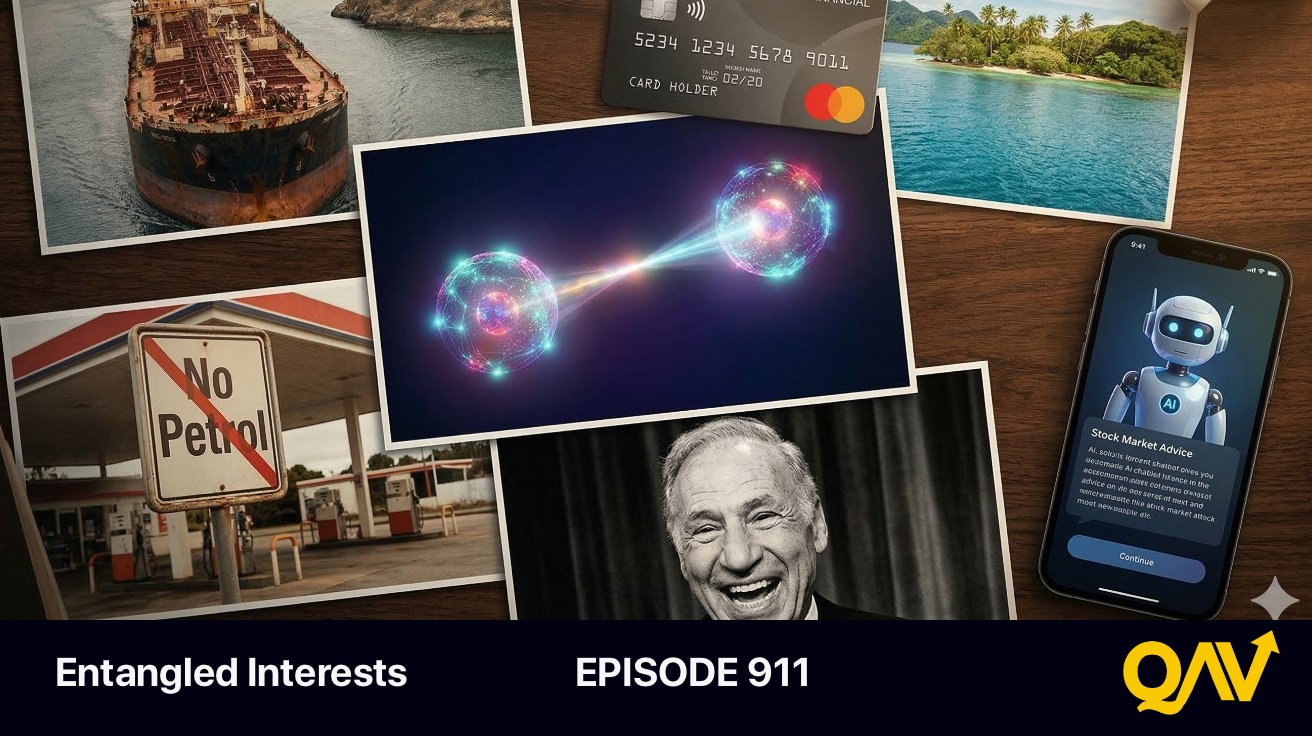
In this episode of QAV, Cameron Reilly and Tony Kyneston navigate a world of “prolonged conflict” and “supply disruptions,” examining the ripple effects of Middle East tensions on global oil, fertilizer, and food security. They dive deep into Australia’s precarious fuel security, noting the country holds significantly less than the internationally mandated 90-day buffer. In the Club episode, the investment discussion focuses on the “Pulled Pork” of the week, **BSP Financial Group (BFL)**, the largest bank in Papua New Guinea and the South Pacific, which Tony argues is unfairly valued as a high-risk “frontier” stock despite its dominant market share and high return on equity. The duo also discusses the RBA’s interest rate dilemma, the “Wild West” of Gen Z using unregulated AI for financial advice, and the 2018 MIT experiment proving quantum entanglement.
This week’s full episode is for QAV Club members only. The free episode is available below. Also check out our podcast archives link and our pages on Apple Podcasts or Spotify or watch clips on TikTok. Or visit our homepage to learn more about QAV and how it works as a value investing system that you can learn and apply to beat the market.
Transcription
QAV AU 911
Cameron Reilly: [00:00:00] Welcome to QAV TK, episode 9 1 1 9 11.
TK: Nine 11,
Cameron Reilly: is that the, is that, is that, I don’t know. Symbolic,
TK: Paul, how, how soon after the invasion of Iraq did nine 11 happened?
Cameron Reilly: No, the other way around.
TK: Oh, was it?
Cameron Reilly: after
TK: it came first, didn’t it? Well, it was in response to something. Gulf War one.
Cameron Reilly: nine 11?
TK: Yeah.
Cameron Reilly: it was, uh, a result of lots of mucking around in the Middle East.
TK: Hmm.
Cameron Reilly: Uh, well you’ve kicked off the, uh, story, I guess I read this somewhere yesterday. Um, the IEA dot orgs report, oil market report. This is the largest supply disruption in the history of the global oil market.
- According to the International Energy Agency, the war between the United States, Israel and Iran has created the largest supply disruption in the history of the [00:01:00] global law market. Fortunately, Trump won the war, I think day one, day two, it’s all done. Iran
TK: It’s, it’s not a war.
Cameron Reilly: out of options. It’s not a war,
TK: No. Marco Rubio said it’s not a war.
Cameron Reilly: uh
TK: attacked Iran and Iran attacked the us. It’s a defense. It’s not a war. War needs Congress, so it’s not the war.
Cameron Reilly: Right. It’s like the Korean War wasn’t a war, it was a police action.
TK: Correct.
Cameron Reilly: Yeah,
TK: Yeah.
Cameron Reilly: action. And Bill Clinton didn’t have sex in the Oval Office ’cause it wasn’t According to him and his lawyers, Australia currently holds 36 days worth of petrol supply, 29 days worth of jet fuel and 32 days worth of diesel according to the latest data, according to the A, b, C.
TK: Well, it doesn’t,
Cameron Reilly: not gonna
TK: it
Cameron Reilly: a
TK: did. It did hold 36 [00:02:00] days. It’s just released 20% for the country area, so we now hold three weeks worth of supply,
Cameron Reilly: right?
TK: which is, which is like a third of what we’re meant to be holding under international treaties.
Cameron Reilly: Well, we are holding it just when it’s like that Seinfeld
TK: you can’t, you can’t buy it.
Cameron Reilly: I don’t think you are. I don’t think you do understand. Anyone can take a reservation. It’s the holding. yeah, I read somewhere that we’re holding it in America. Uh. Yeah,
TK: Yeah.
Cameron Reilly: it over there where they have a very stable genius running the country.
TK: It’s not just that, but there’s a, a thing called the Pacific Ocean between there and here too.
Cameron Reilly: uh, Iran’s nowhere in the Pacific Ocean. I’m demanding that these countries come in and protect their own territory because it is their territory. Trump told reporters aboard Air Force One on the way from Florida to Washington. It’s the place from [00:03:00] which they get their energy. It’s their territory. The, uh, Strait of Uz according to Trump.
TK: Whose territory? Everybody’s
Cameron Reilly: the
TK: there.
Cameron Reilly: worlds,
TK: The world’s, right?
Cameron Reilly: the US allies is country.
TK: Yeah.
Cameron Reilly: their territory.
TK: Including China. He’s asked China to help as well. He did.
Cameron Reilly: Yeah, I know. Um, I started a war and now I need help
TK: It’s not a war,
Cameron Reilly: the Not a war. Not a war. Sorry. I started a
TK: a defense.
Cameron Reilly: Yeah.
TK: It didn’t start it. I ran. So Israel started it.
Cameron Reilly: Oh, Israel started without any involvement from the us.
TK: No.
Cameron Reilly: They’re big, beautiful bombs.
TK: Mm-hmm.
Cameron Reilly: missiles
TK: Mm-hmm. No.
Cameron Reilly: the school wasn’t theirs?
TK: No. Israel’s.
Cameron Reilly: Yeah. Right. A prolonged conflict could also cause a fertilizer shock risking global food security. About 33% of the world’s fertilizers, including sulfur and [00:04:00] ammonia, pass through the strait. According to analytics firm, Keppler Iran’s conventional Navy has largely been destroyed, but the guards still have plenty of options, including fast attack, craft, mini submarines, mines, and even jet skis. Packed with explosives said Tom Sharp. A retired Royal Navy Commander Teran has the capacity to produce around 10,000 drones a month.
According to the Center For Information Resilience and Nonprofit Research Group, Yemeni’s Houthis, a group allied with Iran, but with a far smaller military arsenal at their disposal shut down most traffic passing through the Red Sea for more than two years, despite US and EU Naval efforts. This is from, uh, a Reuters article I was reading last night. So anyway, fun and games, TK and the global markets in the last week.
TK: The, I think the, out of all that, I think the most significant [00:05:00] item I read was that the four oil majors sent their CEOs into the White House for a meeting yesterday. I think that was in the Wall Street Journal overnight. And, um, yeah, shit’s getting real. I, I suspect that, uh, a lot of countries have only got weeks worth of oil supply left.
And maybe that’s not the case for Mogas, but it’s probably the case for fuel oil and diesel in particular. Um, and as you say, fertilizer inputs. So when that gets critical, uh, I think the Straits of homeowners will be opened. I won’t say necessarily how, but I don’t think it’ll be left closed.
Cameron Reilly: Are the oil majors making money outta this? ’cause The oil, when the oil price goes up, are they happy?
TK: Yeah. But that’s like. Saying you’re taking tips when you’re fiddling on the Titanic because it’s like you’ll make it for three weeks and when the oil runs out, you can’t, you can’t, uh, [00:06:00] continue to make it. So No, they’ll be wanting the straights if almost to open.
Cameron Reilly: Did you, uh, have a look at that Reddit link I sent you? I’m an Australian wholesale fuel fuel trader.
TK: I did. Yeah. I had a look at a couple of them. Um, that probably will linked from that one. But, uh, I mean the interesting things are around what’s happening with Japan and Korea and they’ve got the, some of the big super refineries there. And so they’re now withholding deliveries to keep them, uh, stockpiles for their own use if they can get the feed stock, which generally comes from the Middle East.
So if, you know, they’re probably the canaries in the coal mine. If they run out, we, we run out. ’cause most of our stuff comes from overseas, from Singapore or those two. Uh, yeah. So it’s um. It’s, yeah, it’s getting very, very pointed at the moment. I think it’s, um, if having lived through the seventies and the oil shocks and [00:07:00] potential, I don’t know if we ever got the fuel rationing.
I, I think from memory we might have had odd and even number plate days when you can fill up. That seems to jog my memory as I, as I was a kid. But yeah, I mean there’s, um, there are already some of those countries I just mentioned in Asia are already telling people to work from home and don’t use their cars and taking efforts to try and stop petrol from being used.
But if, if that starts to spread to the us, which is probably the least likely place for it to spread ’cause they’ve got shale or they can, um, stop exporting and keep on shore. Um, but we’ve got nothing. About 8% I think of our. Oil is provided locally. We’re better place for gas. We’ve got heaps of gas, although it’s all going offshore and we’re paying no royalties for it, we’re getting no royalties from it.
Um, and we have to, I mean, you could change an act of parliament to get it diverted back to Australia. So I think gas will be okay, but, uh, you know, we’re stuffed for fuel after, you know, potentially within the next [00:08:00] month. I don’t wanna paint a, a bad picture, but it’s all building up to something happening.
Either Trump chickens out and the streets of them was open, which is entirely possible. Or the, the war escalates dramatically and I ran backs down is my take.
Cameron Reilly: All these employers and government departments that have been trying to shut down work from home since we came outta COVID are gonna be
TK: Yeah.
Cameron Reilly: back on board with it again. This, this guy on Reddit, um, I, I mean, I don’t know how this mapped to your experience in the fuel industry, but it was interesting from my perspective.
Um, he says Australian fuel is 90% imported these days mainly from Asia. The Asia refiners are more competitive and have economies of scale that compete with Australian refineries. That’s why most of ours have closed for over a decade, has not met the internationally agreed 90 day buffer of fuel reserves in the country.
We sit at roughly 32 days of stock. This is the fault of both labor and liberal governments in the past. Note, [00:09:00] it’s easy to store crude oil, but much more difficult to store refined products like diesel and petrol. They’re flammable and go off after a few months of sitting in a tank. It’s very expensive to build brand new storage tanks, which is why no commercial. Person is doing it. That’s why we import so much oil throughput. Not all crude oils are the same. The Asian refineries are set up to refine medium sour crude. Far more experienced chemical engineers or Google can give you more info. Uh, this is mainly produced by the Middle East. It’s very hard to replace this crude oil into the refineries at short notice.
So it doesn’t matter how many barrels the US releases from its crude stockpiles as that is a light sweet crude and is prohibitively expensive on the ocean flight component. Asian refiners have been canceling contracts and governments like Thailand and China are banning diesel and petrol exports to keep these critical fuels in their own countries.
Therefore, it’s gotten very expensive to source alternative cargoes [00:10:00] to supply Australia. The best analysis I am reading is as soon as the Middle East waterway straight of Hormuz opens up, still be one and a half to two months before the Asian refineries are running at full capacity. Again. Note you can’t just shut down a refinery.
These things are designed to run 24 7. Shutting down completely puts equipment at serious risk of damage. Therefore, refiners are choosing to run at say, 50% capacity to delay running out of crude oil feedstock and not damage refinery equipment. Any who conclusion is this situation isn’t resolving itself anytime soon.
Unfortunately, there is a saying in commodity training, high prices cure high prices and low prices cure low prices. When the price skyrockets, demand drops off, where possible or supplies increased, when there’s super low prices, supply reduces. The said suppliers can’t stay in business selling at those low prices. In this current high prices situation, supply can’t increase right now. So the only lever [00:11:00] is to reduce demand. If the prices kept low by government’s, demand would stay around. You’d have no more supply coming in Australia and you’d eventually run outta fuel. Neither’s a good situation, but running outta fuel entirely is probably worse than having some fuel at a high price, which theoretically destroys some flexible demand. Um, have you been following what’s going on in Cuba?
TK: But only from the point of view of Donald Trump saying he’s going to annex them.
Cameron Reilly: Well, he’s cut off all the fuel supply to
TK: Ah, okay. I didn’t know that.
Cameron Reilly: the last year or two has been getting most of their fuel from Venezuela. When, when he took over Venezuela, he canceled all of the fuel
TK: Mm-hmm.
Cameron Reilly: to Cuba Cuba’s, you know, hospitals are shutting down, all their pharmaceuticals are going bad because they don’t have refrigeration, because they don’t have fuel.
Cuba is a country that runs mostly on petrol, still hasn’t been electrified, they don’t have alternative sources of energy and all that kind of stuff. [00:12:00] so he’s trying to cripple the country completely by cutting off its fuel. Russia has tried to send some to them and I think their ships got stopped as well.
TK: Mm-hmm.
Cameron Reilly: Um, so it’s just ironic that, you know, he’s been doing it deliberately to crash Cuba’s economy
TK: Yeah. Right.
Cameron Reilly: now we’re all staring down the
TK: Mm.
Cameron Reilly: what happens when a country can’t get access to fuel through one of his other, not very well thought through adventures.
TK: I mean, that’s the, it’s, it’s a, it’s kind of a scary time in one respect, but it’s, but it’s also playing into a higher cost world because it’s this theme where I was talking about before on prize shows that the world’s decoupling, I mean, it was back when everything, um, had international supply chains that move without friction.
Uh, you could go for just in time supply, and you could be a government that said, I’m gonna hold three or four weeks worth of all reserves. Could, because that’s fine ’cause you’ll get plenty of [00:13:00] tankers in from Singapore in that time to replace it. But, but, but now, if the Singapore refineries or the Asian refineries can’t get the type of oil they need, which only comes from the Middle East, everything just comes up.
Which means that to prevent that it, once we get through this, um, crisis governments are gonna take steps to stop it from happening again. Which means, um, you know, building up stocks locally, they’re gonna, you know, find other ways of getting oil to from the Middle East. There’ll be all sorts of things put in place to mitigate the risk, which will increase the supply chain costs and put what, you know, the storage, um, bulkheads storage components, storage capacities into supply chains, which aren’t there at the moment, which will add to costs.
So moving into a high cost world.
Cameron Reilly: What have we done since COVID to make sure that doesn’t happen again? Another pandemic that shuts everything down. What
TK: Uh, alright. We put RFK into the, on the job, so,
[00:14:00] uh,
Cameron Reilly: Well, talking about, uh, things going down my super portfolio has been killed. How’s your portfolio going?
TK: well actually I kind of have deliberately not been looked at, but I looked at it today when you put you on notes through, sent your notes through just to see is, yes. So mine’s down still, uh, running at 18% this financial year, but it was up like double that until recently.
Cameron Reilly: Yeah, mine too. Like if I go back to the 1st of December, I was at 31% versus the index at 13. Now I’m at 14 for the last one year versus 15 for the index. I’ve like in the last week, two, uh, since, yeah, even 19th of February, I was at 27% versus 20. had started to catch up, but yeah, it’s just [00:15:00] crashed. Mostly CGF, uh, thanks a
TK: Yeah.
Cameron Reilly: CGF, it’s down. And I had to sell something. When did I sell yesterday? I can’t remember now. Um, uh, MAF. crashed uh, CGF crashed anyway. Dunno, both financials got nothing to do with oil directly, but some tie into the financial sector, I guess. Uh, the other thing that’s crashed this week is the poll, the quiz of the week. Your brilliant idea. Put a quiz in. Everyone loves quizzes. No, no one. I think last week’s quiz got one submission and it was probably me, not
TK: you won. You won the quiz.
Cameron Reilly: even you didn’t do the quiz, your idea to do a quiz. You don’t even do the quiz.
TK: Well, that’s not fair if I do it, is it?
Cameron Reilly: not
TK: No,
Cameron Reilly: why not?
TK: because we are, well, I’m associated with you and your running it
Cameron Reilly: [00:16:00] Very short buy list for me this week, Tony. Four stocks I had after I removed josephine’s and commodity cells and commodity josephines. Uh, did
TK: be four All Ords, four all stocks. Yeah, I did similar. Yeah.
Cameron Reilly: Yeah. All oil stocks. They were, that’s right. Four oil stocks, uh, crazy, crazy time, like four stocks. And I already owned most of them in one portfolio or another. Oh.
TK: Yeah.
Cameron Reilly: them, of ’em was, uh, being acquired too, I think might have
TK: Yes. Uh.
Cameron Reilly: or something like
TK: Horizons acquiring QI think from memory.
Cameron Reilly: Oh, Q that’s who it was.
TK: Yeah.
Cameron Reilly: So, so there was really
TK: Trying, trying to turn the car safely. James q
Cameron Reilly: but I’ll tell you what’s killing it is the
TK: uh,
Cameron Reilly: Australia.
TK: with dynamite.
Cameron Reilly: [00:17:00] Yeah, very bondy, isn’t it? Jet
TK: That’s a, that’s an image. Yeah.
Cameron Reilly: Yeah, yeah. Um, the QAV, stock Edia portfolio for Australia, which I haven’t looked at for over a year ’ cause
TK: So you,
Cameron Reilly: yeah,
TK: this up a year ago with what? Whatever the Bist had at the time.
Cameron Reilly: no, I set it up in March of 2025 when I had finished building the Wikipedia checklist
TK: Right.
Cameron Reilly: and I, oh, hold on. No, it goes back earlier than that. Sorry. It was, uh, July, 2023 when I was building the checklist and I wanted to build a portfolio straight from that and then compare the performance of that over a year with the performance of the Stock Doctor run portfolios and see how they compared.
’cause it was. [00:18:00] Spitting up slightly different buy lists and slightly different stocks and all that kind of stuff.
TK: Yeah. Right.
Cameron Reilly: so I ran it for a while and everything checked out and it was tracking along doing about the same. And so I said, okay, that’s good. And I just to ignore it, but I didn’t shut it down and I left it there. Well, in the last year it’s gone up 38.8% versus the s and p 500, which is up 10%. And versus the dummy portfolio, uh, let’s see, the dummy portfolio in the last year has just come down. It was up 32%. It’s just
TK: Mm.
Cameron Reilly: to 23 in the last couple of weeks. Um, but the other one, but the Wikipedia one, which I haven’t touched, so no selling
TK: Yep.
Cameron Reilly: ignoring. Gets back to Scott’s, uh, or somebody’s,
TK: [00:19:00] Mm-hmm.
Cameron Reilly: email from a few weeks ago. crushing it.
TK: So what are you suggesting?
Cameron Reilly: nothing, I just
TK: Uh
Cameron Reilly: interesting
TK: oh, yeah.
Cameron Reilly: this,
TK: It’s
Cameron Reilly: through this with Scott. I just wanna tell you the big winners, Vasan,
TK: mm-hmm.
Cameron Reilly: this is not just in the last year, this is since I bought at all time, is up 364% Shape Australia up 280% Southern Cross Electrical up 226%.
McMahon Holdings up 130 SSM service stream up 120. Parenti up a hundred, Joyce up 88. The others are Nab Viva Leisure KO Holdings, boom Logistics nz. Which is funny ’cause I, well it’s only up 18% NZM Abacus a BG, don’t even know who they are. Diversified Real Estate Investment Trust are reit. Oh. ’cause I didn’t take REITs out of this and [00:20:00] shine justice.
Well, shine justice is down 20%, to be fair. So that’s the big loser. Um, Abacus is down 3%, but they’re the only two stocks that are down. Everything else is up
TK: Mm-hmm.
Cameron Reilly: and, uh, gangbusters. But of course it’s been a good year and it’s all happened since the middle of last year, which is when our, our portfolios all blew up as well.
TK: Yeah.
Cameron Reilly: so the lesson there is, there is no lesson, but, um, I just thought I was, I went to shut it down because, um, when I go to Wikipedia’s news, it, it gives me news, um, from all of the. Folios that I have include, and the Australian news was having a bunch of stocks that I didn’t care about. I just wanted to show me this news from the US stocks before we did the US show each week.
TK: Mm-hmm.
Cameron Reilly: to delete this portfolio the day I thought, oh, it’s probably time to get rid of it. And then went, oh my God, at that. crushing it. [00:21:00] But yes, I don’t believe that’s a good strategy. Just buy and hold forever.
TK: No. Oh, you know, maybe 12 months, three balancing years, I don’t know. But yeah, there’s certainly periods where buying and holding wins and certainly periods where it losers.
Cameron Reilly: Well, I won’t say who, but we both know did tell me a couple of years ago that he was just gonna buy Nick Scali and hold it forever. And then I had a look at Nick Scali the other day when we had an email from him and it’s, uh, not had a, had a good year.
TK: There was another stock that same person told me years ago he was gonna buy and hold forever. I’m just, I think it was Coronado
Cameron Reilly: Didn’t they go out of, they shut down, didn’t they? They moved off shore. They went to the US or something.
TK: something anyway, it
Cameron Reilly: Yeah,
TK: wouldn’t be a stock that I would’ve bought and held forever. ’cause it’s a commodity stock for a start. So, yeah.
Cameron Reilly: Coronado, global Resources.
TK: Hmm.
Cameron Reilly: Yeah, [00:22:00] I think it de list. No, it’s still still going.
TK: Yeah, it hasn’t been on the buy list for a while though.
Cameron Reilly: February 23, it was trading at $2. Now it’s trading at 35 cents. So yeah. Good luck with buying old for that one.
TK: Hopefully it’s had like a 10 for one share split or something. But you know, I don’t think it has.
No, and that’s the risk. That’s always the risk. I mean, you know, um, with the exception of perhaps Berkshire Hathaway and maybe a few other stocks, is it’s very hard to pick a stock which is gonna still be around and 20 years, let alone giving you good returns along the way as well.
Cameron Reilly: Yeah. Speaking of Scott Scott’s got a question, um, about Perseus.
This section is for QAV Club Members only.
Register for your 14-day free QAV Club trial here.
If you’re already a QAV Club member and seeing this message, please login via the top menu.
If you’re a QAV Light member who wants to upgrade to QAV Club, go to your Account page (see Footer) and upgrade from there.

0 Comments