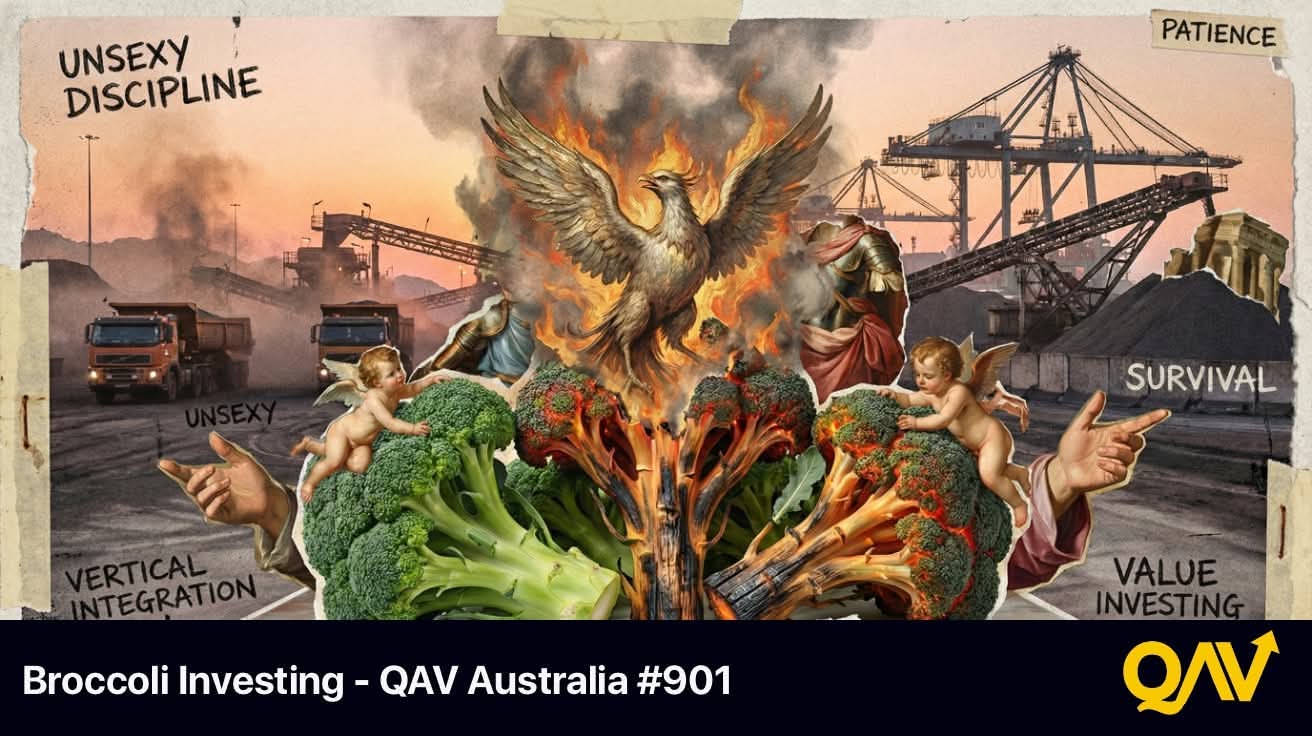
The first QAV episode of 2026 opens with a wide-ranging discussion that blends value investing discipline with geopolitics, market psychology, and one very detailed stock teardown. Cameron and Tony debate the limits of guests who can’t tolerate pushback, why value investing is the “broccoli diet” of finance, and whether optimism in global equity markets has reached dangerous levels. From US military actions in Venezuela and their implications for oil markets, to Wall Street’s unanimous bullishness for 2026, the episode circles back to a core QAV principle: prediction is fragile, process is durable. The club edition also dives deep into Fenix Resources, unpacking how vertical integration can create a moat in iron ore, even at the smaller end of the production scale.
This week’s full episode is for QAV Club members only. You can listen to the free version above. Also check out our podcast archives link and our pages on Apple Podcasts or Spotify or watch clips on TikTok. Or visit our homepage to learn more about QAV and how it works as a value investing system that you can learn and apply to beat the market.
Transcription
[00:00:00]
Tony Kynaston: Help.
Cameron: having to, to having, having to tell Kon not to talk off air. ’cause we end up having a 20 minute conversation and then he goes, this should be on the recording. I, I know. Stop talking to me off air. You are ruining it. Welcome back to QAV TK 9 0 1, season nine. Although it’s only year six or seven, but the year season nine.
’cause we had few, I dunno, I can’t remember the exact reason we restarted during COVID.
Tony Kynaston: three. Yeah.
Cameron: Yeah. Um, first.
Tony Kynaston: that. Um,
Cameron: Sure.
Tony Kynaston: to your interview with Scott while I was away recently and I think that should be part of the intro series ’cause there was quite a lot of good stuff brought up again, which we haven’t spoken about for a long time.
Cameron: Okay. Sounds good.
Tony Kynaston: I’ll go back
Cameron: Um,
Tony Kynaston: Sorry.
Cameron: uh, it’s the first episode for 2026 tk, how was your New Year’s Eve? How you doing?
Tony Kynaston: I know you might think it’s an [00:01:00] old person’s New Year’s Eve, but I went out and played golf and it’s one of the, um, one of the only times on the golf course when no one’s there ’cause like everyone’s out celebrating New Year’s, but, and it doesn’t get dark until nine o’clock. So I went out late and had a quick round by myself and really enjoyed it.
Weather was great and then, uh, came back and watched a few episodes with Jen and went to bed at about 11 o’clock. But it was this
Cameron: You had a
Tony Kynaston: nice
Cameron: quickie by yourself and then you went to bed. I get it. Uh, sounds nice. No, I like, I’m, I’m an old man. I, I don’t do New Year’s Eve weeks. We were up, but what we were doing, um, but yeah, bloody, bloody blah.
Tony Kynaston: Sano in a, ancient convent that was haunted. That’s how
Cameron: Wow.
Tony Kynaston: Year’s Eve with her boyfriend. Yeah.
Cameron: Nice. She should have been finishing my painting
Tony Kynaston: She is.
Cameron: Is.
Tony Kynaston: Yeah. But you, and you and about 10 other people including me.
Cameron: Yeah,[00:02:00]
Tony Kynaston: But,
Cameron: she doesn’t have time. She doesn’t have time to celebrate and party
Tony Kynaston: about to, uh, she’s about to move, so she’s gonna be busy as well in the next couple of weeks. Hmm.
Cameron: moving. Didn’t she just move? Oh no, I just,
Tony Kynaston: A year or so ago. Two years
Cameron: yeah, that’s right. I just did another, um, what do you call it? Got a thing from a real estate agent asking me to give her a testimonial
Tony Kynaston: yeah.
Cameron: again. That’s what, a couple of weeks ago, a reference. Well, let’s get into investing, tk, um, nothing happened in the World news this week.
Uh
Tony Kynaston: Are we gonna have that conversation on air that we were having off air? ’cause I think our listeners might be able to
Cameron: oh.
Tony Kynaston: it.
Cameron: You wanna jump into that first? Okay. Go. Yes.
Tony Kynaston: Just our, written agenda’s very, very flexible and
Cameron: US presidents, kidnapping, presidents of other countries. Let’s ignore that. Let’s talk about value investing. Yes.
Tony Kynaston: But anyway,
Cameron: Okay. So where do you wanna pick it up? You were talking about maybe doing a value investing con, like maybe doing an [00:03:00] investing podcast conference
Tony Kynaston: that was
Cameron: and that morphed into a value investing conference.
Yeah.
Tony Kynaston: so let’s continue the discussion and throw it out there for input. But, um, yeah, I mean, I’ve always liked the Berkshire Hathaway Ag GM, which is the Woodstock for capitalist. That buffet sort of going.
Cameron: Was
Tony Kynaston: It was,
Cameron: I wonder what’ll happen now? Yeah. He’s now officially retired. Right? A year is over.
Tony Kynaston: over. Yeah.
Cameron: Wow. That’s, I dunno how to process that. yeah,
Tony Kynaston: dying.
You’ve got a, you’re on your own from now on. Yeah. Anyway, so yeah, the
Cameron: yeah.
Tony Kynaston: find a base, find some like-minded people, and maybe even not like-minded people. I’m always happy to debate. The broad church of investing. Um,
Cameron: You are.
Tony Kynaston: but uh, I don’t think they are.
Cameron: No.
Tony Kynaston: There are some, uh, religious fundamentalists out there in the investing world aren’t there. um, but the idea would be to get people together somewhere, think somewhere nice with a golf course, have a game of golf with our subscribers, and, um, [00:04:00] and, uh, talk about value investing. Um, there’s enough people who’ve been on the show that we could pull together for value investing side of things to, to do a sort of like-minded seminar or conference.
But, um, yeah, I mean, is there a appetite for it? Is there a location which works for people? So I guess I’ll throw it open to discussion.
Cameron: I was talking to Tony off air about the problem that we always have with guests. I can’t remember if I mentioned this on the end of the year episode or not, but you know, from time to time people say you should have more guests on. I go, look, here’s my experience with guests over the years. There are two types of guests, those that agree with us and those that don’t, those that agree with us about, you know, the basic precepts of value investing.
And value investing is a broad church. There’s a lot of different ideas and whatever, but generally we agree on the principles. Find something that’s at a discount to its valuation. That’s well run and, and buy it and hold it as long as you can. [00:05:00] Those people are good. We have them on Collins Street investment, et cetera, et cetera, on a regular basis.
And we don’t have much to talk about, but it’s like patting each other on the back. Um, but then you have the people that don’t agree with us, and those interviews traditionally have gone one of two ways. Either you push back on everything they say and then they get really unhappy and send me angry emails afterwards, or you are very polite and you don’t push back.
And then it’s like, what’s the point? So we just have them come on, they talk a bunch of nonsense and we go, all right, well thanks very much. Have a nice day. And I’m like, well that’s, that’s unsatisfying for me. I dunno if the listeners enjoy that. Listen, look, there’s a million podcasts you can listen to if you wanna hear people.
Just spout, trendy, nonsense. Um, our podcast is about. The fundamentals of sensible, long-term conservative value investing. And I don’t know, I just kind of, it’s a bit like when I do history shows and I found the same thing with history shows. Like [00:06:00] somebody, one of my Cold War listeners, um, sent me an email this morning, pulled up an interview that Ray and I did like five years ago with some other scholar, podcast history scholar, where he started making a lot of nonsense statements.
And I went, whoa, whoa, whoa a second here. And push started to push back and ask him for evidence for his claims. And he got really pissy with me and refused to talk to me for the rest of the episode. And then sent Ray angry emails. ’cause Ray had invited him on afterwards that I pushed back on a lot of his statements and I was like, oh, well what am I gonna do?
I can’t just let him say this stuff and get away with it. I mean, but then obviously people don’t wanna have their bullshit pushed back on sometimes, so I dunno. I don’t like, I don’t know how to, I dunno how to deal with people that disagree with me on podcasts.
Tony Kynaston: I think you handle it quite well. You, you’re never very confrontational. You’re always asking for evidence and, and fairly respectful about the facts. I’m not [00:07:00] playing the person, it’s the, it’s the other side that can get affronted.
Cameron: that’s it. They get affronted and then I’m like, well, what do I do? I dunno. Just, I dunno.
Tony Kynaston: Yeah. And like, I think also too, I dunno about history podcast, but in our world, lot of people who accept invites to come and be interviewed are people who are, you know, hoping to market what they, their whatever service they’re selling.
Cameron: And they don’t wanna be argued with, or they don’t wanna be made to look stupid. Unfortunately. You just tend to make people look stupid when you push back. You go, well, hold on.
Tony Kynaston: on, you’re blaming me.
Cameron: Yeah.
Tony Kynaston: us here.
Cameron: Um, this show, you are the one that goes, well, what are your returns? And they go, oh, like 8%. You go, really?
Tony Kynaston: an index. ETF. Yeah.
Cameron: Yeah.
Tony Kynaston: Anyway.
Cameron: What? What are your rules for when to sell?
Oh, just kind of gut feel it. You’re like, don’t have any, just when it vibes. Vibes Tony. Vibes it. Anyway,
Tony Kynaston: All right. Well
Cameron: I was just, I was also [00:08:00] saying to Tony when we. When we started this thing, I thought, oh my God, teaching people how to invest that. People are gonna love that. That’d be awesome. Giving them a sensible way to invest.
People are gonna eat that up. And then over the years, I realized, hmm, they don’t want the sensible stuff. It’s like no one wants to go to the doctor. If you’re like 40 kilos overweight and be told, cut back your calories to 2000 a day and do 10 hours of exercise a week, no one wants to hear that. That’s not, they want Ozempic, they want the Ozempic of investing podcasts.
It’s like, quick, fast, no effort required, get rich quick schemes. No one wants to be told, eat your vegetables and eat less. And, and exercise for, we’re the, we’re the Diet and Exercise podcast. You know, do the sensible things
Tony Kynaston: Broccoli podcast, the financing Block. Financial Broccoli Investment Podcast.
Cameron: up and Bruel Air. Do you know, do, do you know that sketch.
Tony Kynaston: No
Cameron: Oh my [00:09:00] God. Um, do you know Dana Carvey? Um, one of the classic, yeah, one of the classic Dana Carvey, um, sketches. He’s like a, he’s on a piano. He’s like doing this like big ballad and it’s just about, he was chop, chop, chop. It’s just goes on and on about him trying to make chopping broccoli.
Sound dramatic. You gotta look it up. I’ll send you a link. It’s very funny. It’s funnier than it sounds. Well, let’s get back to an, uh, the world news, Tony and how it affects investing. So, dunno if you’ve seen this, dunno if anyone caught this in the news this week, but apparently the president of the United States authorized what he calls a police action.
Uh, which has, uh, if you’re not aware of that, that has a nice long tradition in America. When [00:10:00] America, um, invaded Korea in 1950, they called that a police action to get around a declaration of war. Uh, this is a police action. He went in, well, he sent his guys in and they kidnapped the president of Venezuela and his wife and took them back to the US blindfolded and handcuffed and put them on trial.
So, uh, without getting into the politics of that, which I’ll do on other shows, I’m sure at some point. Uh, Trump himself has said this is all about getting their hands on Venezuela’s oil. Mostly there’s some fluff about drugs and this and that and the other, but he’s quite openly said it’s about oil. Uh, which is nice for an American president to just admit up front.
I mean, like, or hate Trump, at least he just says what’s what he’s thinking most of the time. Uh, so there’s an article in the finra, what does this mean?
Tony Kynaston: first, of [00:11:00] all, do you believe
Cameron: Yeah. Uh. I believe it’s one of a number of factors. I think there’s the distraction angle of it, there’s the looking tough angle of it. There’s the oil, there’s the petro dollar.
’cause Venezuela was, uh, working with China to move the, uh, you know, the financial basis of its all reserves to being won and not the USD. Um, we know that part of the justification for taking out Gadda and Libya was that he was moving off the petro dollar as well. The US uh, you know, ab for good reason, determined to keep the USD as the global reserve currency and the currency that all is traded in for as long as possible because it’s what gives them free cash mostly.
And even the Saudis are talking to China about moving to Juan apparently. So I think there was that, there’s a whole bunch of other things. Yeah.
Tony Kynaston: I.
was gonna say, I think there’s also this fear of influence, um, argument. So.
Cameron: Monroe [00:12:00] doctrine.
Tony Kynaston: Don wrote doctrine, but,
Cameron: Done row.
Tony Kynaston: Don, Don wrote. But um, yeah, I mean I think it’s, the interesting thing will be that, um, and yeah, there’s been some commentary that this is a deal with Putin to keep Ukraine. He gets fed to us, get Venezuela, and, and then China gets Taiwan.
So that’s the interesting thing. What happens with Taiwan, I think in the next year or so.
Cameron: Look, you know, and I, you and I have talked about this over the years and I’ve done so many hours of this on other shows, but the bottom line is the US economy runs on military keynesianism. It has done since the thirties, nearly a hundred years of military keynesianism. You the, the Americans need a major war.
Every decade because that’s what keeps the economy moving. There are tens of thousands of businesses in the US that rely on military contracts [00:13:00] to survive. And so they need the Pentagon to be rolling in cash. And it’s not just rolling in cash. It needs to be spent urgently. So you have no bid contracts and you have stuff that, oh, and so every time they audit the Pentagon, we talked about this in the psychopath book audit, the Pentagon.
Where did that money go? Well, we don’t know where it went. How do you not know where it went? Well, we didn’t have time to think about where it went. It was an emergency. We just had to spend it hundreds of, hundreds of billions of dollars. Get any receipts. We didn’t have time for receipts. What are you crazy?
We had to spend it quickly.
Tony Kynaston: accepted cash, which we can’t
Cameron: Nah, nah. And this has been going on for decades and decades and decades. Um. Ukraine is winding down. So the us, the military, industrial, congressional complex as Eisenhower called it needs, uh, needs, needs money. Where’s the money coming from? We need, we need to get involved in something that’s probably gonna take it least 10 years.[00:14:00]
Um, let’s get going. So yeah, the whole bunch, there’s a whole bunch of things. Uh, these things are complicated anyway, back to the oil price.
Tony Kynaston: to investing.
Cameron: So it was a big enough deal that I actually, after having already checked the oil price, uh, as I normally do on the weekend when I’m doing the buy list, and yes, our listeners now have me doing it on the weekend.
Uh, who needs a weekend?
Tony Kynaston: your oysters
Cameron: Um, well I did it over the weekend, but I normally finished it on a Monday, but now everyone’s like, can we have it on Sunday?
Tony Kynaston: why? not give it to ’em on Wednesday? What’s, what’s the difference? The market’s shut on Sunday
Cameron: I dunno.
Tony Kynaston: unless people
Cameron: Uh,
Tony Kynaston: free time to do their investing on the Sunday. I don’t know.
Cameron: I guess that’s something to do with it. Yeah. Um, so I checked it on Monday. That’s true. And kung fu iss off on Sundays. So what else am [00:15:00] I gonna do? Spend time with my family? Uh, uh, I did pick up Hunter from the airport, uh, on Sunday. Got back from LA and spent a few hours with him. It was nice.
Anyw who? Um, this is in the financial review, Alex Lucius. Oil markets had largely forgotten about Venezuela, at least until recently. At its peak in the mid two thousands, the South American country was producing 3 million barrels a day, a genuine powerhouse that held the world’s largest oil reserves. But after years of government corruption and international sanctions, the latter of those two, the one that people tend to ignore or minimize, Venezuela’s output, had dwindled to just 930,000 barrels a day by November, accounting for less than 1% of global supply.
And then he talks about the kidnapping. While oil prices were expected to spike on Monday, made concerns about supply disruptions, Brent actually fell as much as 1.2% towards $60 [00:16:00] US a barrel as markets started to price in the prospect of a return to Venezuela’s former glory. Even so analysts say it will take years to unlock the country’s vast crude reserves given the energy sector’s derelict infrastructure, lack of human resources, and dearth of capital.
There is also uncertainty about whether Maduro’s replacement will support Trump’s push to revive output. So, uh, yeah, I don’t expect the oil price to which bit.
Tony Kynaston: Maduro’s replacement will eventually support the Trump to get us oil companies into Venezuela. be the 10th replacement, well, the third replacement or the first one. But they will definitely
Cameron: Right? Wow. Yes. I mean, I think it depends on a lot of factors too, where, where China gets involved here, uh, if and when China gets involved, and I don’t expect them to do, if and when the United States [00:17:00] completely crumbles into a, a, a civil war between the oligarchs and the people if and when that happens.
There’s a lot of, a lot of moving parts here, but yeah,
Tony Kynaston: if we just
Cameron: I think it’s a hmm, no go.
Tony Kynaston: I’m just gonna focus on the oil price. Um, if we just focus on that,
Cameron: hmm.
Tony Kynaston: I mean the Venezuela holds something like 30% of the world’s resources. Um, although it’s what’s called heavy crude, so it can’t be refined easily in a lot of refineries. But the US Coast refineries already refine heavy crude out of Canada, the All Ords sands in Canada. that will be an interesting impact on Canada. There’s been a bit of commentary saying that this is all about, crushing the Canadian economy, so it can become the 51st state. I don’t believe that, but it will certainly a lot of pressure on, uh, Canada’s economy because if, if Venezuela can ramp up, and that’s a big if, because, [00:18:00] know, as you said in that, um, Alex GL article, there’s been a lack of investment in the infrastructure in the oil industry since, um, uh, what’s his name?
Um.
Cameron: Which
Tony Kynaston: Chavez, thank you. No, Chavez nationalized it. And, uh, all the, all workers left and they didn’t have all workers with experience to replace them. Um, and with no clear roadmap coming out of Washington as to what’s gonna happen, that might, that might take shape that your all majors aren’t gonna invest a whole heap in Venezuela until they can be sure that it’s, uh, stable.
It’s worth investing in because, you know, to restart an oil industry, take billions and billions and billions of capital.
Cameron: Yeah.
Tony Kynaston: so Chevron’s in there. So they’re, they’re the likely candidate to Kickstarter. But, um,
Cameron: Yeah.
Tony Kynaston: the other majors will follow until Chevron looks like they can turn a buck out of, you know, expanding and restarting what’s down there. So it’s many years in the future I would’ve thought, um, back to any sort of [00:19:00] scale and then. To go from 1% of the world’s output to full capacity, which might be as much as 30%. there’s just not that much demand in the world to absorb that extra oil. So that will depress the price, but it also means that, um, it, it won’t ramp up to full capacity.
I wouldn’t have thought. So I, uh, look, I think the price for all probably will go down, but it’s probably not gonna go down by much in the near term. again, this is all prediction. Who knows? Um, the interesting other, the other interesting take is on China, because, I’ve read some analysis in the last, uh, or heard, heard an interview in the last couple of weeks with someone, um, who follows energy sector in China, who’s saying, look, China wants to be self-sufficient.
They don’t have enough oil. So they’re, don’t want to be beholding to import it. They’re gonna get, they’re really ramping up electrification of the economy. Um. The biggest solar farms are in China. The biggest wind farms are in [00:20:00] China. are really trying hard to wean themselves off oil, and, uh, that’ll take time, but that’s also going to reduce demand for oil going forward too.
So, um, I, it’s really, if you dig down on the oil side, it’s really hard to see what the clear objective is for the US going into Venezuela for oil, because they’ve already got it from Canada. maybe it’s cheaper, uh, to, to buy it from Venezuela or to, to refine it, uh, sorry to, um, export it from Venezuela or import it from Venezuela.
Maybe are other things that play, outside of the oil sphere. But, uh, it’s gonna require billions of dollars of investment. It’s gonna require a complete takeover of the government, um, to shape, to be, you know, reliable in terms of US investment. And it’s gonna take time.
Cameron: Well, I’m looking at the chart, the, the crude chart. At the moment, I figure the buy price for us now is around about 65 bucks, [00:21:00] and it’s currently up to 61 50, so it actually doesn’t have very far to go now. I mean, it’s come down from like 116 bucks a barrel early in 2022, sort of halved, more or less since then, um, it has rebounded a little bit.
In the last couple of weeks, like, but it was rebounding from middle of December, so before this happened. Anyway, but uh, we’ll keep an eye on it. Oil might become a buy again in coming weeks. We’ll see what happens.
Tony Kynaston: I guess the other dimension, two other dimensions. Uh, if the Ukraine War is settled, does that mean that Russian oil stops being sanctioned, in which case that’s another, know, input into the demand equation. And then the third, the, well, the second other fact is that, um, does OPEC do in response to all this?
Because if, uh, if there’s more product coming onto the market, you’d expect them to try and raise their margins. may well try and crunch the market, first of all, to [00:22:00] get it below a, I don’t know what the cost comparison is between OPEC oil and Venezuelan oil, but they may need to, have an advantage, in which case they’ll crunch the price, but eventually it’ll go up to, again, to reflect a healthy margin for them. So, lots of, lots of moving parts on this one.
Cameron: Well, good thing that we don’t have to predict anything. We just play it by day by day. Speaking of day by day, Tony, every Wall Street analyst now predicts a stock rally in 2026, according to the financial review.
Tony Kynaston: has that not been the
Cameron: This
Tony Kynaston: if your job is selling,
Cameron: well,
Tony Kynaston: your job is selling stocks, what’s the outlook? Sunny for stocks.
Cameron: uh uh,
Tony Kynaston: always
Cameron: well,
Tony Kynaston: Street. That should be a
Cameron: really, they’re never pessimistic.
Tony Kynaston: Oh, they are. But um, you know, it tends to be more optimistic than pessimistic.
Cameron: Well, this is from the 30th of December, financial review. Alexandra [00:23:00] Anova and Sika Jai at the big banks and the boutique investment shops. An optimistic consensus has taken hold. The US stock market will rally in 2026 for a fourth straight year, marking the longest winning streak in nearly two decades.
There’s plenty of angst about the risks to the bull run that’s pushed the s and p 500 index up some 90% since its October 20. 22 low. The artificial intelligence boom could turn to bust the economy and the Federal reserve’s interest rate decisions could defy expectations. And President Donald Trump’s second year could bring even more unanticipated shocks than his first.
But after three years, when the equity markets rip Roaring Run made a mockery of any bearish calls sell side strategists are marching in lockstep optimism with the average yearend s and p 400 500 forecast implying another 9% gain next year, not a single one of the [00:24:00] 21 prognosticators surveyed by Bloomberg News is predicting a decline.
The pessimists have been wrong for so long that people are kind of tired of that shtick said veteran market strategist and longtime bull ed Ardini. Yeah. When people start saying, we’re tired of the pessimism, I get pessimistic.
Tony Kynaston: exactly.
Cameron: That’s, uh, basically that’s, that’s peak optimism, isn’t it? When it’s like, ah, shut up. You’re pessimists.
Tony Kynaston: We’re
Cameron: You’ve been pessimistic for so long. How long can you be wrong for? But the counterpoint to that was chant clear. Uh, on January 5th. So yesterday, equity investors could not be more optimistic and it is terrifying.
As the loudest voices spruce another stellar 15% for the share market, it is well worth considering and preparing for what could go wrong. Markets start the year punch drunk on artificial [00:25:00] intelligence, equity investors, bond investors, private markets, public markets. Everyone’s expecting to make a matza from this never before seen spending.
Boom. The capital investment spending profits, productivity potential, mostly in the hands of a small handful of technology giants has the bulls charging out of the gates even harder than last year or the year before it. And it is tilting the market conversation one way. Anyway, goes on to say that. Uh, he doesn’t think that it’s necessarily all that good.
The amount of ball that there are, he talks about at the end, um, big super still largely overweight Australia and underweight the US is on the other side of the trade and sending money offshore to try to rectify it. The bears are so down trodden, perhaps too wrong for too long. Creating a one-sided rhetoric, that is a scary way to start the year.
Let’s hope it is just a timing thing and not indicative of how far the active equities, [00:26:00] communities stocks have fallen. So what do you think about all that dk?
Tony Kynaston: I think it’s reasonably similar to what the outlook was for 2025. Um. Interesting. I mean, if, if this is another positive year and I’ve got no idea, when people ask me will I predict for the stock market, they always say they’ll go up 10%. That’s its long-term average. So who, who knows what will happen. predict it. But yeah, it has been a, a long streak for Wall Street. I guess bolstering that apart, apart from all the fan base for AI stocks is the fact that the, the companies in that Mag seven are on the whole still very profitable and still growing profits too. which will end at some stage. There’s no clear evidence for it ending now. And it won’t also be a bumpy, it won’t, won’t also be a straight line rise. It’ll be a bumpy ride, just like 2025 was. There’ll be independence days. There’ll be, um, know. [00:27:00] deep, deep, what’s it called? Deep seek, the Chinese knockoff of chat, GPT coming out. all sorts of things which will knock the market for a kilter, if there are, um, if the underlying big tech stocks are still minting cash, then the market will go up. Um, but there’s so many ifs in there, it’s, you can’t predict it. Um, and there’s also all of those articles neglected the political side. There’s gonna be midterm elections, um, next year, if know that, if maybe, yeah, right. If they go ahead and if they
Cameron: Yeah.
Tony Kynaston: if they do result in a break of the stranglehold of all three houses or all three arms of government, that, that may send shockwaves through Wall Street, um, there’s all sorts of things that can happen. I suspect, know, for me, the things to watch next year are the Fed and the RBA and, uh, the RBA take the RBA first, we. Stay away. It’s Tuesday the [00:28:00] 6th of January, I think tomorrow the monthly CPI figure, which is, um, people are thinking we’ll be around 3.8%, which is outside the RBAs range. And the last one was above the RBI RBAs range.
So at some stage, the RBAs gonna have to seriously consider raising interest rates. And as we know from recent past that, that generally gives the market pause in Australia. So that, that’s, that’s I guess something to watch. Um, and the kind of reverse is happening in the US their inflation numbers are still around 2% and likely nothing looks like stopping that.
Although of surprised tariffs haven’t, um, increased inflation in the us but they haven’t for, for whatever reason. Uh, uh, so. The Fed is likely to cut rates over there it’s, if inflation stays at 2% or very low. And of course, there’s also threats from Donald Trump to replace the Fed share when his term expires during the year with a lackey and, um, which will give him control of the fourth arm [00:29:00] of government, I guess, or fourth arm of the economy. Um, and he’s not gonna raise rates. So that’ll be an interesting dynamic if the US is cutting rates in Australia is raising rates, um, implications a myriad of on us. It’s probably possible that that puts our currency up, which will hurt exports, um, and slow things here as well. So it maybe it’s a, a year to be a US investor and I’m Australian investor, but who knows?
I’m, I’m just sticking to the knitting and watching it all unfold and, uh, as you say, watching the US Venezuela and seeing what they’re doing down there.
Cameron: Yeah, and then what happens in Greenland or Cuba or whoever else, they decide, Hey, let’s go.
Tony Kynaston: the risk, I think the world is, is going back into its spheres of influence. Um, that’s the paradigm. I think Russia is gonna get pretty much what it wants out of Ukraine. Um, I think if it’s not tacit, [00:30:00] there’s kind of some kind of tip for tat, therefore that the US gets control of its sphere.
And whether it stops at Venezuela, Trump’s already saying it’s also gonna include Cuba and Columbia. Um, who knows? And China will get Taiwan. Then when China gets Taiwan, I think that’s gonna be the real destabilizer the share market. But, um, lots of cards to fall and dominoes to fall before that happens.
Cameron: Like if you are a subscriber to John Heim’s realist, view of international relations as I am, um, spheres of influence never went away.
Tony Kynaston: correct.
Cameron: You know,
Tony Kynaston: Yeah.
Cameron: it’s always been. The way that the major powers have seen things. It’s just like you don’t put boots on the ground unless you have to. So you are con controlling your spheres of influence, particularly in your region with economic and trade deals, and making sure that the political [00:31:00] parties that are favorable to your interests and that kind of stuff.
And if things start to go awry, then you rack ratchet it up a notch and, you know, you do a little bit of regime change here or there. And if that still doesn’t work out, you put boots on the ground as a last resort, which is what, at least for, that’s what I believe Putin did in Ukraine. The Trump thing’s, a different kettle of fish.
But, um, yeah, I, I don’t think the, this, this, you know, spheres of influence thing is returning. I think it’s just always been there, but under the surface.
Tony Kynaston: No, I agree. Except, except it, yeah. It hasn’t, it hasn’t been as overt as it’s becoming, um, because of. Russia and Ukraine, I think, and China and Taiwan. And I don’t, I can’t for the life of me see why Trump is going into Venezuela except to put some profits into the oil company’s coffers and the military’s coffers, which of course is a, reason, but it’s not like, um, there were missiles being [00:32:00] deployed on the coast of Venezuela appointed at the US or anything like that.
So, um, yeah, I, I think Trump’s just going, Hey, I’m feeling left out. I’m gonna, if you guys are, if you guys are moving, I’m moving too. Um, and I guess that brings Greenland into play too. ’cause there’s been plenty of articles about Chinese nuclear submarines going under the further and further under the arctic ice towards America.
And Greenland would be a controlling point to, um, to be a gateway for that, I guess. So that’ll be interesting.
Cameron: Oh dear me. You got some notes you wanna talk about before I get into the rest of my stories?
Tony Kynaston: um, couple of things. Not a whole lot if. So I’ve been doing growth over PE analysis, which I’ve now called grope I was
Cameron: I’m not sure. I’m not sure about that abbreviation, Tony? Yeah. How’s, how’s the
Tony Kynaston: know, like
Cameron: grope going?
Tony Kynaston: It’s
Cameron: doing your grope analysis,
Tony Kynaston: I tried to save a, um, a spreadsheet and call it GR slash pe, [00:33:00] excel, wouldn’t accept it. So I started calling
Cameron: right?
Tony Kynaston: Space O, space pe and then I thought, oh, growth
Cameron: Grope.
Tony Kynaston: out.
Yeah. Growth over pe.
Cameron: Okay. You know, as a white male of your age, I’m not sure grope is necessarily something you should be talking about, but Okay. You know, you do you, I’m not gonna argue the grope episode with Tony Kon.
Tony Kynaston: Yeah. Well. Regardless of what it’s called, the analysis has been interesting. Uh, so did a lot of one-off type analysis, which showed there was something growth over PE being a, a metric which indicated the out performance. Um, it wasn’t always a one-to-one correlation. Uh, sometimes stocks with negative forecast earnings did well, obviously, you know, surprise came along or a change happened during the year and that their fortunes.
Um, sometimes stocks with very high growth over PE didn’t do well for whatever [00:34:00] reasons. sometimes they exited our buy list for commodity reasons as well. So and that was probably the one of the common factors. A lot of growth over pe, high growth over PE stocks and miners. And then I was finding that during the year. Iron, oral coal would be a cell. Coal in particular always forecast to grow even though the commodity itself went up and down. So that was very choppy. Uh, anyway, so I’ve gone back to some of my oldest bios, which have growth over PE called out them, which I think was in 2020. And I’ve been putting together some, um, dummy portfolio since then.
Uh, which is a really menial manual task to put 20 stocks together and then track when to sell them, when to replace them, what with et cetera. It’s like just painstaking. if you’ve got any code that you use in producing your buy list, which could help, would be useful for me. but um, yeah, so I haven’t found anything definitive yet, but what it’s [00:35:00] looking like is, okay, so a couple of things. Um, I put together a. A baseline buy list. So I took, I think it was August, 2020, was my starting position and took the top 20 stocks on the download the buy list from then, without any growth, uh, on without, with the normal scoring for growth over pe. Then I, uh, changed the spreadsheet so it would score growth over PE according to what growth over PE percentage was.
So if it was 20%, the score would be 20. Um, which boosted obviously those stocks. And I also included negative. So if they had negative forecast growth over PE, that would drop their score. There wasn’t a whole heap of change to the buy list. A couple of stocks that weren’t on the buy list came on, a couple of stocks in the buy list changed their order. Um, but I think from memory that that buy list only had two different stocks. To the standard buy list. So that was interesting. So that was in the top 20 stocks on the buy list, and then the one which I’ve [00:36:00] just started, which looks them, oh, sorry. Then I did another one, which was to just grant growth over PE and put together a buy list of those stocks, whether they were QAV scores or not. and then the last one was the bias as it currently stands, change the metrics so it scores according to the growth over pe and then go from there. And that looks like it’s having the best results so far. I’m still partway through the analysis and I’ve still only got sort of one start date and it probably needs to have few start dates to be a relevant analysis.
But um, yeah, that’s where it’s at.
Cameron: Shoot me an email if you can, with exactly what you want the code to do, and I can probably write something for you that’ll do it.
Tony Kynaston: Yeah.
Cameron: I don’t think I have anything that’s reusable, but if you just give me a bullet point list of what you need it to do, I should be able to write something.
Tony Kynaston: Okay, thank you. Yeah, I think probably the main thing is that’s time consuming, is using the ator to work out the three
Cameron: Yeah.
Tony Kynaston: cell is for it. [00:37:00] ’cause it’s kind of painstaking there. You look at it, you say, okay, there’s the current L one L two. I’ll go and look at those.
Cameron: mm-hmm.
Tony Kynaston: dates when
Cameron: Mm-hmm.
Tony Kynaston: it wasn’t, so you go do that, it kind of interacts four or five times until you find it. The only other way to do it is to just scroll through month by month after you buy it and check.
Cameron: Well, I have like the, my buy list uses Yahoo Finance to calculate all of that stuff. So I could probably take, create a version of that to iterate through for you, but
Tony Kynaston: Thanks.
Cameron: need to tell me exactly what you need us to do, but it shouldn’t be too hard to pull together.
Tony Kynaston: I’ll do that. So that’s ongoing, but um, showing some results, which is good. Some positive results. Uh. What else? So I, I come across a good quote, which I thought was worth talking about. This was in yesterday’s, or maybe today’s Fin Review. Uh, Doug Henin from a, a fund manager called GCQ, said the stock market is the only market in the world.
When [00:38:00] everything goes on sale, people run away. I thought that was really good.
Cameron: Yeah. Is he a, is he a local
Tony Kynaston: Yes.
Cameron: Yeah. Gotta get him on Doug Henin,
Tony Kynaston: Yeah. Doing a lot of investment in, but doing a lot of investment in tech stocks and, uh, the article spoke about him becoming an Uber driver ’cause he thought Uber had, was undervalued, et cetera. So it’s not necessarily a, he’s a value investor in terms of things being undervalued, but he’s also buying what he sees as gross stocks.
But, yeah. Interesting article, quote, I thought very apt,
Cameron: Yeah.
Tony Kynaston: all
Cameron: Uh, Doug Tynan, is it?
Tony Kynaston: H‑E-N-A‑N.
Cameron: Hmm. Okay,
Tony Kynaston: And then the last thing I’ve got is to do a pulled pork on uh, Fenix Resources.
Cameron: why don’t you do that? Because, uh, we’re half an hour in already and I got a ton of stories, so let’s, uh, do that.
This section is for QAV Club Members only.
Register for your 14-day free QAV Club trial here.
If you’re already a QAV Club member and seeing this message, please login via the top menu.
If you’re a QAV Light member who wants to upgrade to QAV Club, go to your Account page (see Footer) and upgrade from there.