


Transcription
QAV 751 Club
[00:00:00] TK: Yep.
[00:00:05] CR: Give me a three, two, one.
[00:00:09] TK: Three, two, one,
[00:00:13] CR: We have liftoff.
[00:00:15] TK: Thunderbirds are go!
[00:00:19] CR: uh, visual jokes. Hey, welcome to QAV751, Tony.
[00:00:27] TK: Team QAV
[00:00:28] CR: you’re looking very
[00:00:29] CR: sharp there today, Tony, with your QAV t shirt. Put this
[00:00:35] TK: Yes, you are too.
[00:00:37] CR: video up so people can see how good the new QAV t shirts look.
[00:00:42] TK: And just in time for Christmas on Redbubble.
[00:00:45] CR: just what everyone wants, QAV t shirt. Give them to your kids. They’ll love it. Make up something cool that it stands
[00:00:53] CR: for. Speaking of which, my son Taylor was, uh, chastising me over the weekend because he was on, I don’t know, the Apple, uh, podcast search thing for some reason, looking for our podcast, and, oh, he was just searching for value investing, and we weren’t coming up high in the stock, um, in the, in the, uh, Podcast rankings.
[00:01:20] CR: And I realize it’s because it says, you know, the title of the show is QAV and people aren’t searching for that unless they are. So I changed it in Apple to Quality at Value Share Investing. So hopefully we’ll pick up more. Good old Phil Muscatello and shout out to Phil. He and I did our, um, our bi directional interviews.
[00:01:42] CR: Phil and I have come out as bi directional. Um, he interviewed me and I interviewed him the other day, but shares for beginners ranks really well because you type in shares in the podcast thing and you get that, but we don’t do as well. So Taylor’s like, what are you doing? You know, SEO and iTunes sucks.
[00:02:03] CR: You need to fix it. So I spent some time on that. Anywho, um, how’s your week been, Tony? Apart from ABA that we’ll get to? Yeah. Packing?
[00:02:14] CR: Is that why you’re wearing your QAV shirt? It’s
[00:02:16] CR: the only thing that’s, uh, hasn’t been packed.
[00:02:19] TK: No. No, I actually, um, went for a walk before and came back sweaty. So I thought, oh, good, good opportunity to have a quick shower and
[00:02:28] TK: get changed
[00:02:30] CR: And, uh, when do you head back down south now?
[00:02:33] TK: tomorrow.
[00:02:34] CR: Right. So you have been getting ready for that.
[00:02:38] TK: Yeah. So heading back tomorrow, back up for New Year’s, then the uplift happens January 2, and then we’re out.
[00:02:47] CR: Wow. How are you feeling about it?
[00:02:51] TK: Good.
[00:02:52] CR: Yeah.
[00:02:53] TK: looking forward to living at Cape Schanck, yeah.
[00:02:54] CR: yeah. That’s good.
[00:02:56] TK: Yeah, I am. And being close to Alex will be good fun.
[00:03:00] CR: Yeah,
[00:03:01] TK: Yeah,
[00:03:02] CR: you’ll be able to see her way more often. Then she’ll, she’ll move to Sydney to get away
[00:03:06] CR: from you. She’ll be like, ah, my dad, he’s just always wanted to catch up. It’s like my kids. They, they called me a couple of hours ago. And they’re like, hey, we’re going out for a coffee. You wanna come? I was like, no, I have things to do.
[00:03:18] CR: Ah, you don’t just come for a coffee before. I’m like, no, I actually have to do stuff. I’m recording a show. What time? Oh, one o’clock. Oh, that’s hours away. Okay. Yeah. But I got to do a pulled pork on a US company. I got stuff to do. Ah, pathetic. You’ll be part of that.
[00:03:37] TK: I, I, I responded with Taylor last night cause I was, um, on Facebook and one of the groups I follow is called Americans Decline, what’s it called? Americans, America’s Declining to Idiot, Idiocy. And, uh, there was a clip of Marty and Michael.
[00:03:52] TK: Yeah.
[00:03:53] TK: Marty and Michael?
[00:03:54] CR: Yeah. Yeah. Mates are his.
[00:03:55] TK: Who, uh, Who we used a long time ago to promote one of the raffles that we were running for charity and, um, yeah.
[00:04:02] TK: Someone picked it up from the States and thought it was real and posted it to the, um, America’s Declined Into Idiocy website. One of the, either Marty or Michael was running over their hand with a car.
[00:04:15] TK: Which is the kind of shit they get up
[00:04:16] TK: to.
[00:04:17] CR: but they’re Australians, not Americans. What’s that got to do with America declining?
[00:04:21] TK: Yeah, so really, the idiocy was the
[00:04:23] CR: All the Americans thinking it was real. Oh, right. Did you see, did you see your competitor with the charity business has just been charged with 13 counts of fraud or something?
[00:04:36] TK: Yeah, Roddy and I had a good chat about that. Not fraud, no, breaching the South Australian
[00:04:41] TK: Lottery rules.
[00:04:43] CR: But Taylor
[00:04:43] TK: And we’ve long
[00:04:45] TK: Sorry.
[00:04:46] CR: Taylor says it’s a slap on the wrist. Like his fine’s
[00:04:49] TK: Oh, not even that.
[00:04:50] CR: 130 grand or something out of the 100 million he’s made.
[00:04:54] TK: Yeah, yeah, So the South Australian Lottery Commission’s bored, but they don’t really have a case. Um, We all thought that he was getting off scot free because the Victorian and New South Wales gaming commissions were so busy with Crown Casino and Star Entertainment Group that they didn’t have time to worry about him.
[00:05:15] TK: So he just went hell for leather and built up a big bank. Now he’ll defend himself whenever they come after him again.
[00:05:21] CR: Trump strategy, again.
[00:05:23] TK: Yeah,
[00:05:24] CR: Make the money and then pay the fines later or use the lawyers to fight it.
[00:05:28] TK: Yeah.
[00:05:29] TK: Yeah.
[00:05:30] CR: Anyway, I’m going to have to edit all this out. Uh, so back to investing.
[00:05:36] CR: I’ll put it in
[00:05:37] TK: that’s, that’s a, that is investing. That’s a lesson in the real world of investing.
[00:05:43] CR: Yeah. Uh, well, let’s start with portfolio updates. Tony, uh, I think all of the BOL stuff has sort of sorted out. I had a bit of a back and forth with Navarre at Navexa and he said, yeah, no, the buy price doesn’t change. It all just gets sorted out behind the scenes. So, he reckons it’s all good and I should shut the hell up and stop worrying about it.
[00:06:05] CR: Um, I worry though because BOL looks like it’s way down in terms of, um, the capital gain, so I’m not sure how that works. But, um, anyway, the dummy
[00:06:18] TK: didn’t, you didn’t change anything.
[00:06:20] CR: nah, I haven’t changed anything.
[00:06:22] CR: I’ll dribble down in a second, but the dummy portfolio still, uh, over, since inception, still at about 16 percent versus the STW about 9%, so not quite double.
[00:06:36] CR: Over five years or whatever it is. Biggest performers, uh, over that time in terms in terms of the stocks that we still hold, uh, DUR up 48, 40 9% per annum since we held them. I dunno when that is exactly. Can’t be bothered. Um, MAH up 42% per annum. Uh, what else? We got LAU up, 32%. Uh, PRN up 33% per annum.
[00:07:06] CR: Whole bunch of 20s and 30s there. The worst that we hold is, uh, Qantas. It’s capital gain is down 10, but it gets up a little bit on income return. Those others have got some income return in there too that I didn’t even mention. But, um, BOL is interesting. So, we bought that in, uh, April of this year at 14 cents.
[00:07:34] CR: It’s had its consolidation, uh, one for 10 or 10 for one, one of those, one for 10, 10 for one, one for 10. Yeah, you get one and you lose nine. Is that right? It’s now trading at, uh, 1. 38. So I guess it is a little bit down. It should be 1. 40. So that’s disappointing. I would have thought that that would have made it better.
[00:07:59] CR: Don’t consolidations normally help? It’s less
[00:08:03] TK: Well, they shouldn’t make any difference. I mean, people do them because they think they do, but I don’t know if they do. Um, but I’m looking at BOL and the bread later, which is using Google Finance, and it’s got previous month’s close, 14, current price 1. 38. So there’s something skewy with the data feeds there.
[00:08:22] CR: Why?
[00:08:24] TK: Well, because if you look at the graph, it drops from 14 to 1. 38 this month.
[00:08:30] CR: 14?
[00:08:31] TK: Yeah.
[00:08:33] CR: Okay, well that is wrong. Yeah, should have
[00:08:35] TK: Yeah. So that might also be feeding into Navexa as well, I
[00:08:38] TK: guess. I don’t know.
[00:08:40] CR: No, Navexa doesn’t show up being 14.
[00:08:44] CR: Let’s see, I’m looking at the, I’m looking at the Brettalator.
[00:08:50] CR: Yeah, that’s confusing, isn’t it? Oh, well, anyway, portfolio is doing okay. That one’s a little bit confusing, but that’s all right. Um, in terms of the Stockopedia portfolios, that’s the Stock Doctor portfolio, the, um, Australian dummy in the, in the, And this one, the graph is all over the place because of BOL.
[00:09:13] CR: It shows the returns like dropping to minus 50 percent back in early 2004 when I bought BOL and then it rebounds all of a sudden after the consolidation happened. The graph, I don’t know why they can’t fix that. But anyway, um, the Australian portfolio is doing about 15. 6 percent since inception, which is a year and a bit.
[00:09:37] CR: Uh, versus the S& P 13. 5%, so we’re above the index, but not by much, but it’s only a year and a bit. The U. S. dummy portfolio, uh, since inception is up 80 What? No, 93. 93%. I think that’s from September 23 versus the s and p 500 at 36, nearly 37%. So again, nearly, nearly three times the market over there. And I will be doing a pulled pork later on in this show on one of the stocks in our American portfolio.
[00:10:15] CR: Regional management or regional finance is their consumer brand. They’re a lender of last resort, very, very high interest rates, and they’re making money. And, um, it’s interesting. I want to talk about, you know, seven out of the 14 stocks in our U. S. portfolio are finance companies or banks.
[00:10:36] TK: Mm hmm.
[00:10:36] CR: uh, I spent a lot of time with ChatGPT today going, what does that say about, what does that say about the US market in the last year or so that we bought all of these, you know, ended up 50%.
[00:10:47] CR: As we’ve said many times, we’re not thematic buyers intentionally, but that’s just the way it turns out. Sometimes sectors are undervalued and it seems like finance and banking was that. They’ve all done very well, particularly WLFC or WFLC. One of the two. What’s up with Will whatcha talk? What, what you talking about Willis?
[00:11:09] CR: Whatever that one is, it’s up like 400%. The rest are doing okay. But, um, so it, they were undervalued a year or so ago. Now
[00:11:18] TK: Mm hmm.
[00:11:18] CR: doing really well.
[00:11:21] CR: But then again, the, the question I had is, well, if a lender of last resort that’s charging like 40. Interest rates for loans is doing well. What does that say about the state of the US economy?
[00:11:35] CR: And anyway, we’ll get into that.
[00:11:40] CR: Oh, the only news item I had this week is in Australian news is SXE, which is a company that I hold in a few portfolios, um, including the RRTP. Stockopedia Portfolio and a couple of the light portfolios. It’s been having a good run. Had an announcement last week that it has received awards, contracts totalling 125 million, range of projects in the data center, commercial, manufacturing, resources, and water sectors.
[00:12:12] CR: Southern Cross Electrical Engineering, SCEE Group, they call themselves. SCEE Ski Group
[00:12:20] CR: They’re doing well. Share price got a little bit of a bump out of that,
[00:12:24] CR:
[00:12:24] TK: Mm. I saw that.
[00:12:27] CR: Well, it bounced from 1.
[00:12:28] CR: 38, I guess, the day before. That press release came out, it jumped up to 1. 58. Then somebody took their profits and it’s rebuilt since then.
[00:12:37] CR: So it had been declining from as high as 1. 70.
[00:12:42] CR: So do you think they put that out just to tell people the things are good? Again, it’s up as high as 1. 90 going back to August. Wow. It’s
[00:12:49] TK: Yeah. I
[00:12:50] TK: do think that’s what they did.
[00:12:51] CR: They’re like, hey, come on, it’s not as bad as you think. Well, I last, I looked this morning and it’s up like 40 percent in our portfolios, so we must have held it quite a while.
[00:13:01] CR: It’s doing
[00:13:01] TK: Yeah. Look, if you look at the bread later, it was as low as, well, when it became a buy on the current cycle, it was at 69 cents back in July, 2023.
[00:13:12] CR: Right,
[00:13:13] TK: now 1. 48, even though it’s down from 1.
[00:13:17] TK: 88.
[00:13:19] CR: well,
[00:13:20] TK: So it’s done well.
[00:13:21] CR: I’m just looking to see when I added it. So, bought it, oh, August 23 at 0. 78, then in November 23 then in November 23 again at 0. 90. So, um, yeah. Oh, it’s up 88%, 79 percent and 63 percent across those portfolios. So yeah, it’s, it’s done okay. It’s come back a long way, but it’s still doing okay. Can’t complain.
[00:13:48] CR: So good on you SXC. Congratulations on your contracts.
[00:13:52] TK: The sexy engineers.
[00:13:53] CR: Yeah!
[00:13:56] TK: Um, who’s Leon Levy and what’s he, what’s he know?
[00:14:00] TK: Leon Levy wrote a book called The Mind of Wall Street. I can’t work out whether that means he thought he was the brain of Wall Street, or whether he’s just talking about the way that Wall Street’s minds work. I think it’s the latter. Anyway, um, came across a good quote. I’m reading that book at the moment, which is, um, was written just after the dot com bubble burst.
[00:14:21] TK: And, um, Leon is an old fund manager from a fund called the Oppenheimer Fund.
[00:14:28] CR: Mmm!
[00:14:28] TK: book, and um, I’ve just come across this quote which I thought I’d recount. Accounting is supposed to provide the reality behind a corporate spin. Which I thought was a good summary of QAV as well. Ignore the spin.
[00:14:47] CR: Was, um, the Oppenheimer Company created by Oppenheimer, the Manhattan Project
[00:14:52] TK: Well, I thought it might be, but I haven’t come across that yet in the
[00:14:55] TK: book. Hmm.
[00:14:58] CR: after German American investment broker Max E. Oppenheimer, a Jewish refugee from the Nazis who advised the Synagogue Council of America and worked at a New Hampshire real estate firm, a Bay Area Savings and Loan Association, and Lehman Brothers. Oppenheimer Holdings was founded in 1950 when a partnership was created to act as a broker dealer and manage relia I’m sure that it didn’t, it didn’t hurt.
[00:15:23] CR: You just go, yeah, I’m Oppenheimer. Oh, really? Really.
[00:15:27] TK: Hmm. Oh really? Yeah. Ha Ha
[00:15:31] CR: I’m gonna drop the mother of all
[00:15:33] CR: brokerage bombs on you.
[00:15:36] TK: Hmm.
[00:15:38] CR: Um, I see you’ve got a Buffett quote here. I, it’s, I, you know, I have a Google search alert for Buffett and, um, it never
[00:15:46] TK: go off.
[00:15:47] CR: it does,
[00:15:48] CR: like 50 times a day, never ceases to amuse me. I actually was going to talk about one today and decided it wasn’t worth your time, but now that you’ve.
[00:15:56] CR: Brought buffet up, . It’s like, you know, they’re always, um, what you can learn from Warren Buffet’s trading. And I go, okay, it’s good. And these are like Motley Fool esque type articles, you know, um, uh, probably written by AI in a lot of cases. So I go and look at one and he goes, oh, he sold down his stakes in Apple, but he still owns a lot of apples, but he sold a bit down and blah, blah.
[00:16:24] CR: And then the next bullet point is diversification. Everyone should be diversifying into. Different sectors and blah, blah, blah. Diversification. Oh, hold on. Buffett’s always saying that diversification is for people who don’t know what they’re doing. This is what you’re selling is Warren Buffett tips.
[00:16:43] CR: Anywho, what have you
[00:16:44] TK: And there was another one, another one in the weekend papers. Someone’s written a book about Buffett’s first 10 trades and gone through them forensically to see what they could learn. And I read the review of the book and I decided not to buy the book because, um, very early on in the book, This was really hard to do and you couldn’t recreate it today. So I’m thinking, well, what’s the point? If you can’t, if you can’t do what Warren did back then, then why tell us about it? It’s, it’s like a, it’s a nice historical fact, but an interesting read, but it’s completely useless. And that, I mean, you can’t do it today because it was largely about Warren. Um, You know, wearing out shoe leather, going and talking to CEOs hours about their businesses.
[00:17:28] TK: And you can’t do that today because, uh, market disclosure rules say as soon as the CEO tells you one thing, they’ve got to tell the market. Um, or they don’t tell you anything they haven’t told the market, so it’s kind of a useless rule. circle of, um, of a way to invest. And the other one was too, that Buffett was using, you know, the old annual reports and paper based filings and, um, was dealing in stocks that were so illiquid he was putting ads in the local papers to get people to sell them their shares.
[00:17:56] TK: And yeah, very archaic. It worked for him, but the very archaic way of doing things, which wouldn’t work today.
[00:18:02] CR: Very
[00:18:03] TK: But the quote I did pick up on,
[00:18:04] CR: very different stock market back then too, right? It
[00:18:07] TK: oh yeah, yeah,
[00:18:09] CR: what it is today. It was, you know, a handful of hardcore guys. You know, buying and selling stuff. It wasn’t like, uh, on the front cover of, we didn’t have 24 seven cable channels and websites and digital feeds and all of that kind of stuff.
[00:18:26] CR: Elon Musk telling people to buy Dogecoin or whatever he’s doing.
[00:18:32] TK: yeah, well there would have been a fair amount of that because Buffett talks about being in Omaha to avoid the noise, but chances are a lot of that was just networking and, and, you know, Being told things up and down Wall Street or in New York or whatever. Yeah,
[00:18:46] CR: Anyway.
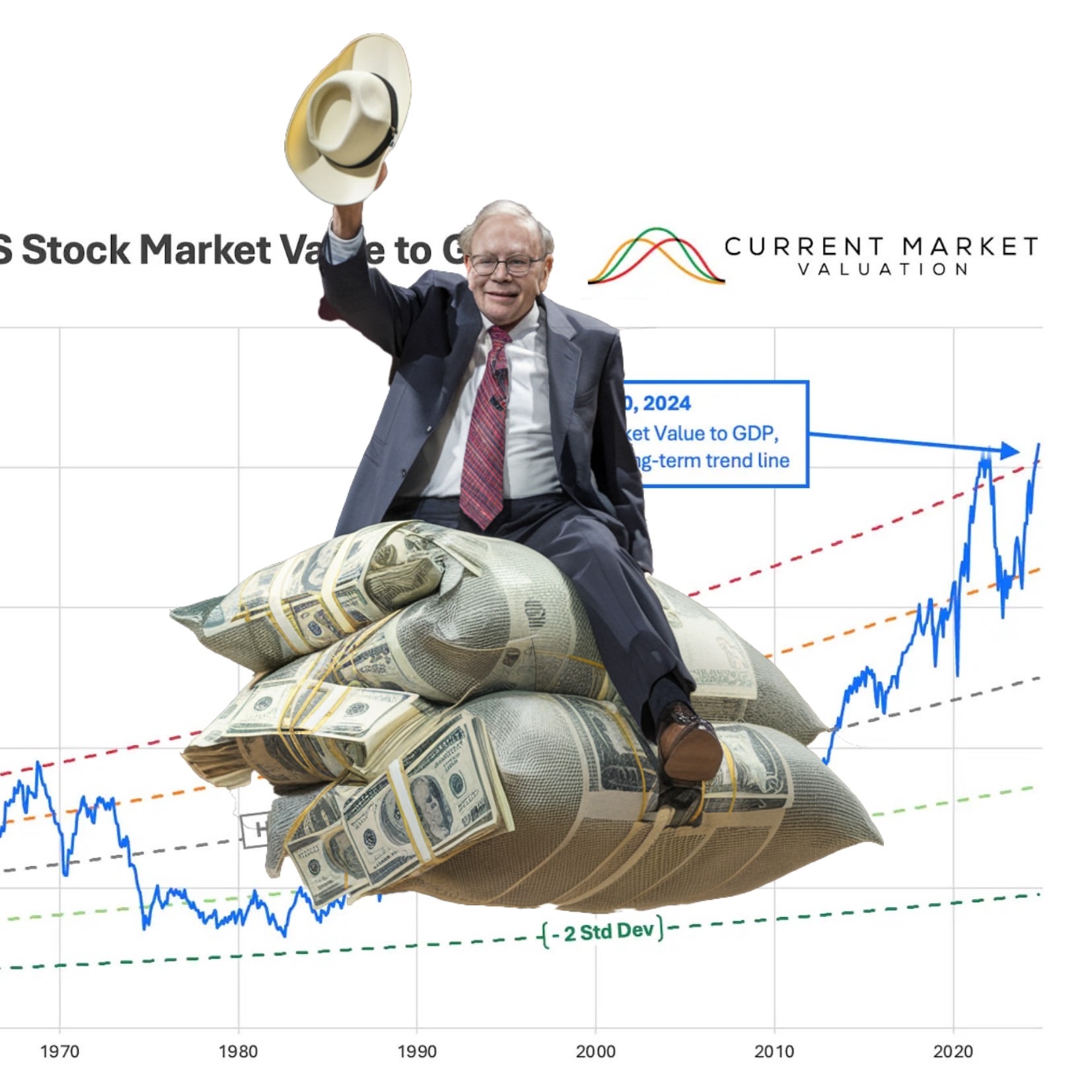
[00:18:47] TK: um, the quote, the quote I did pick out though was talking about the Buffett indicator, which is I think something we’ve raised before.
[00:18:54] TK: Similar sort of article that it goes along the lines of, With the US benchmarks at record highs, it is no surprise that Warren Buffett’s Berkshire Hathaway has accumulated the record cash pile of over 300 billion after selling down key holdings, including Apple. So again, they’re saying, he’s kind of using that as a, you know, his Buffett, is Buffett raising cash because the next crash is coming?
[00:19:20] TK: And he probably is, to be honest. That’s his modus operandi. Um, but I don’t know if he deliberately does that or whether he’s just saying I can’t find anything else to buy up there because everything’s highly priced. So it kind of, works for him, whether he’s doing it consciously or not. But, um, I thought it was worthwhile doing a bit of research into the Buffett Indicator.
[00:19:41] TK: Uh, and I looked it up. There’s a website which tracks it called the currentmarketvaluation. com. Um, and they have a number of different, um, tabs in there, but there is one called the Buffett Indicator. But the Buffett Indicator, uh, the, the formula is, uh, it’s the sum of the total of US stock market value, Uh, and
[00:20:05] TK: yes to, uh, total of US stock market value over the gross domestic product. And as of September 30th, 2024, US stock market value was 60 odd trillion dollars, and the US GDP annualized is just under $30 trillion, and therefore the buffet indicator sits at 208%. Um, which is a long way from the average. It’s like two standard deviations above the average.
[00:20:31] TK: Um, and so Buffett has long used that as a way of saying that companies are overvalued because they’re not going to make their, their profits are at least somewhat linked to the GDP of the U S because, um, some companies will outperform the economy and some will underperform the economy, but again, they’re always kind of.
[00:20:51] TK: trade around the economy. They can’t just manufacture profits out of thin air if there’s not enough buyers to buy their products. So, um, if you graph it all, we’re at an all time high for the Buffett indicator. And if you look at the high points in the past when it’s got two standard deviations above the average, the last was in, um, 1999 slash 2000 at the end of the dot com bubble and then it goes all the way back to 1970, which was the start of a big, the oil price shock, which was the start of a big crash in the US markets as well.
[00:21:26] TK: So there’s something in this, um, but one thing I did notice as well is that it doesn’t always reach two standard deviations and then crash straight away. It can sometimes hang up there for as much as a decade. So, uh, It’s not, it’s not, it’s an indicator of overvalued, overvaluedness, but it’s not a precipitative, like it’s not one that we need to take notice of and do something about tomorrow, I don’t think.
[00:21:54] TK: And it’s also something I don’t track and we all know the US stock market’s overvalued and our, the Australian stock market’s above average, so you could say it’s overvalued as well, it is. Uh, but we have our own framework for trading through these things, so I’m not going to change that.
[00:22:13] CR: wonder if you took
[00:22:14] TK: Been interesting, I thought.
[00:22:15] CR: yeah, if you took out the Magnificent 7, I wonder how those numbers look.
[00:22:19] TK: Yeah, it’s a good question. Um, probably a lot
[00:22:22] TK: less.
[00:22:23] CR: And my
[00:22:24] TK: I’ve seen, I’ve seen graphs that most of the growth in the U. S. stock market is from the Mag 7,
[00:22:28] TK: so yeah.
[00:22:29] CR: Yeah. My second question was going to be, if you have any understanding of why Berkshire Hathaway sell stocks, like they’re selling Apple, why, you know, why would they be selling Apple? You know, I thought they were, hold forever
[00:22:47] TK: buy and hold. Yeah. Yeah, I don’t have an insight into that. Um, I agree with you. Warren traditionally is buy and hold forever. And, uh, I can’t think of examples where he’s sold. So I’ve long thought that Apple was a Todd or Ted trade. Um, and I think that could be the case. And I think that they probably are more traders than Buffett is.
[00:23:13] TK: But I don’t know for sure. Oh,
[00:23:18] CR: so you think that,
[00:23:19] TK: I take it back. Buffett has traded in and out of things when he thinks he’s made a mistake. So the last time I think I saw Buffett sell stocks was about two or three years ago when he had bought into the US airline industry and then he sold out again fairly soon afterwards and said that, look, I’ve been burnt before and I’ve been burnt this time and I made a mistake.
[00:23:39] TK: But, but generally he’s buy and hold.
[00:23:42] CR: hmm, he normally is pretty transparent about that kind of stuff come annual general meeting time, right? He’ll say if he, why he got out of things and what his thinking is, so we might have to
[00:23:54] TK: Well, he normally leads with his mistakes. He normally says here’s how I goofed during the year. You can get that right out there up front. You know, that’s not a bad way to run a business, right? Here’s how I fucked up. And that takes all the wind out of the sails of most of his critics and he can get on to just Good news from their end on the high note.
[00:24:12] TK: It’s kind of smart, really.
[00:24:14] CR: yeah, so we’re gonna have to wait until May to find out why they got out of Apple,
[00:24:22] TK: Yeah, if we find out then, I mean, he may just say it wasn’t my trade.
[00:24:27] CR: right? So the Todd and Ted trades he doesn’t have to provide commentary on.
[00:24:34] TK: Yeah, look, he doesn’t normally, because he’ll just, if they’re there, he’ll defer to them. I don’t think I’ve ever spoken, though, at the meeting. But look, it could be something else, too. I mean, Berkshire Hathaway is more than just His holdings in stocks, they’re also the insurance company’s holdings in stocks.
[00:24:52] TK: So it’s, I think he does run that, but um, if someone like Ajit Jain, who runs the insurance business, had to rebalance his portfolios for whatever reason, perhaps he was a seller of Apple. I don’t know.
[00:25:05] CR: Oh, okay, so they might all get bundled up under the Berkshire heading.
[00:25:10] TK: Yeah,
[00:25:11] CR: Well, Rupert Murdoch, we want to talk about the poor Murdoch family. Did you hear the succession related story with this?
[00:25:21] TK: I didn’t. I have heard
[00:25:23] TK: a couple, but what’s yours?
[00:25:24] CR: Well, I heard over the course of the last week that supposedly when the episode where Logan died went to air, A couple of the Murdoch kids got on the blower to each other and said, uh, Hey, uh, we should get together and talk. These are the ones that are on the outs. So James and Elizabeth and whoever the other one is.
[00:25:51] TK: Prudence? is. it Prudence? No.
[00:25:52] CR: No, I think Prudence is the eldest one. She doesn’t get really involved in this stuff. I think there’s another one. Whoever the, uh, Roman is of the family got together and said, we should, we should, we should have a sit down. Uh, what happens when dad dies? And that’s when the whole thing about. Uh, Lachlan taking over the trust, or taking over control, came up and rejigging the trust, blah blah blah blah. So the, heh, the claim is that it was an episode of Succession that was loosely based on the Murdochs that triggered the Murdochs to sit down and have this, I find that hard to believe that they hadn’t already had these conversations about what happens when Dad dies, he’s like 205 years old, I’m sure they’ve had this conversation, but uh, anyway, it’s a fun story.
[00:26:37] TK: it’s a fun story. Um, so for those who have been under a rock, uh, the, um, the court case in the U. S. where This is being tested, so Rupert wants to rejig the trust to give most of the control to Lachlan because Lachlan will continue to invest in Fox News in particular, and the other three kids don’t like that.
[00:26:59] TK: The judge, though, ruled that the trust couldn’t be changed, and so that all four kids will share in the assets of News Corp when Rupert goes. A couple of interesting things, I thought. One was the stock price was unmoved. The stock price was unmoved. So you would think if that was a, you know, if, if Rupert’s right, and if the, the more, I’ll call them the more progressive kids, I don’t know how more progressive they are, but the ones who may want to either sell Fox News or change Fox News and make it more sort of mainstream, uh, or independent, if they get control of the share price, then Rupert’s argument is that the price will go down.
[00:27:40] TK: Well, the share price didn’t move and they’ve, you know, had the. Ownership stake reinforced by the current judge. Now that will be appealed, so perhaps that’s why the stock price hasn’t come down. It’s not the end of the road yet with this. Um, that was the first thing I thought was interesting. The second thing is that, um, in the articles I was reading about this, I was really surprised to see that Fox News now has 70 percent of the cable news market in the U.
[00:28:07] TK: S. So it’s killing CNN and MSNBC and whatever else is in the market. Turner News or whatever else is over there, but I was really surprised at that, so, um, something culturally has shifted in the US in the last six months.
[00:28:25] CR: But I’m guessing that Cable News Subscription is basically dying.
[00:28:32] TK: Not Fox Newses. Now this is market share, this is the eyeballs,
[00:28:38] TK: like a Nielsen rating.
[00:28:39] CR: Yeah, but again, I’m guessing that, um, yeah, I’m just asking, uh, GPT. Cable news subscriptions in the U. S. have been on a steady decline over the last 20 years, a trend that has accelerated in recent years due to shifting media consumption habits. It goes on to talk about the rise of streaming services, Netflix, etc.,
[00:29:00] CR: decline in traditional TV viewership because of YouTube and high speed internet. Uh, Political Polarization and Audience Fragmentation. While Fox News remains dominant in ratings among cable news challengers, even its viewership has seen declines compared to its peaks in the 2000s and during Trump’s presidency.
[00:29:24] CR: Uh, platforms like Twitter, Facebook, Instagram and TikTok have replaced cable news. And Rumble, too. Um, you heard of Rumble?
[00:29:34] TK: No, pre
[00:29:35] CR: Rumble has been around since 2010 or something, I think. It positions itself as the free speech version of YouTube and there
[00:29:45] TK: speech
[00:29:46] TK: version.
[00:29:46] CR: Yeah. There’s a big, um, New York Times article about it this week calling it the right wing YouTube.
[00:29:54] CR: But then I’ve been listening to Glenn Greenwald, because he hosts his nightly show on Rumble. He’s a big supporter of Rumble, and he’s like, yeah, they don’t mention me in the New York Times article and shows like mine, because, you know, obviously we’re not right wing, but, you know, we’re one of the biggest shows on Rumble.
[00:30:11] CR: It works for the New York Times audience if you can call something right wing, everyone gets upset about it, but, um, their platform, you know, their basic position is they don’t censor like YouTube does, and they’re not going to de platform people because they don’t like what they’re saying. Um, and he was talking about how Al Jazeera got deplatformed, uh, when the Ukraine invasion happened because the American government didn’t want Americans hearing Russia’s side of the story.
[00:30:42] CR: Um, all that kind of stuff, so, yeah, anyway.
[00:30:44] TK: Deplatformed off Rumble or just in
[00:30:46] TK: general?
[00:30:48] CR: Al Jazeera was de platformed off of cable networks in the US and in Europe, so they were being distributed, Al Jazeera was being distributed in the US, you could watch Al Jazeera on one of the cable networks and they got taken off cable networks in the EU and in the United States. Um, but anyway, yeah, so what that says to me is that people are leaving cable news in droves, but Fox’s audience is more hard baked in than the rest of the cable news audience.
[00:31:23] CR: They’re, they’re sticking with it longer than everybody else.
[00:31:28] TK: I just thought all the Democrats were curled up under their doonas sucking their thumbs after the election.
[00:31:34] TK: They weren’t churning into the u’s.
[00:31:36] CR: Yeah,
[00:31:37] TK: too horrible.
[00:31:38] CR: too, but I think this has been going on a long time. Yeah, it’s been interesting about the Fox stuff, so we’ll see what happens. If Rupert ever dies, and I personally don’t think he ever will,
[00:31:47] CR: I think he is getting blood transfusions from, uh, Uh,
[00:31:56] TK: It’s like in Fury Road. Lachlan’s on the front of the car with a, with a needle. What do they call Mad Max? The blood bag.
[00:32:06] CR: yeah, that’s it. Alright. You wanna do your pub
[00:32:10] TK: Okay. Yeah. So interesting one. I really quite got into this one. Uh, the company is called GTN. It’s on our buy list. GTN stands for Global Traffic Network, and a bit of an outline of the company, GTN began operations in Australia in 1997 and has selectively and successfully expanded into other attractive markets, including most recently the Brazilian market.
[00:32:42] TK: Today, GTN is the largest supplier of traffic information reports to radio stations in Australia. The UK, Canada and Brazil, four of the ten largest advertising markets in the world. In exchange for providing these reports and in certain cases monetary compensation, GTN receives commercial advertising spots adjacent to traffic, news and information reports from its large network of affiliates.
[00:33:08] TK: These spots are bundled together by GTN and sold to advertisers on a national, regional or specific market basis. GTN’s advertising spots are short in duration, adjacent to engaging information reports, and are often read live on the air by well known radio and tv Personalities during peak audience hours.
[00:33:30] TK: So that’s a pricey of what the company does from its website. Am I able to play a YouTube clip over this recording or will it just not
[00:33:39] TK: work? Is there a way of doing it?
[00:33:41] CR: And, uh, and for an update on proceedings before the Independent Commission Against Corruption, let’s cross to court reporter Lois Price. Uh, Lois, uh, who gave evidence before the commission today? Yeah, good question, Sean. Look, it’s hard to say from my position high in the sky, it looks like Ants.
[00:33:58] CR: Yeah, yes, of course. What about Senator Sinodinos? When’s he due to appear as a witness? This states, Sean, exactly when the Senator will appear is unknown, certainly by me. Plantation shutters from legally blinds add beauty to your home and help cut cooling and heating costs. All legally blinds for a free measuring quote today.
[00:34:20] CR: I’m Lois Price for Matters Health. Thanks very much, Lois.
[00:34:26] TK: that gives you an idea of what GTN
[00:34:28] TK: is all about.
[00:34:29] CR: By the way, I’m looking at their last annual report presentation, I see that their actual public brand is ATN, the Australian Traffic Network, which of course was the name of Logan Roy’s Fox News company,
[00:34:46] TK: ha
[00:34:46] CR: the American Television Network, ATN. They took an opportunity to rebrand in line with Succession, so congratulations, good thinking to those guys,
[00:34:55] TK: yeah. Well, they have, they’re in four countries. So I think they have CTN in Canada, and BTN in Brazil, and I guess UTN or UKTN in the UK.
[00:35:05] CR: right.
[00:35:05] TK: But, okay, so it’s, it’s a, it’s a good company. It’s, it’s, uh, numbers are good, and I’ll go through those in a minute, but, um, I think the interesting thing about the company is that, In the last couple of months, there’s been a takeover offer, um, by a company or an investor called Viburnum, which is a fund manager.
[00:35:23] TK: And it’s a good old fashioned corporate raid. We haven’t seen one of those for a long time. On market, um, hostile, uh, But it’s worth unpicking to, to look at, look at, um, a bit about viburnum, and this is from Chante Clear, last year, October, 2023. The heading is, this is how to make 16% a year as an activist, investor, activist, investing doesn’t have to be so public and outrageous and is usually more effective when it isn’t.
[00:35:54] TK: According to Viburnum funds managing partner Craig Coleman, who runs a $600 million. Australian Equities Fund and specialises in activist type situations. Need proof? Look at ASX listed Main Pharma Group, which announced plans to abandon any M& A ambitions and ramped up its buyback and cost cutting strategy.
[00:36:17] TK: Although the announcement came out of the blue on October 18, 2023, none of that happened by itself. It’s all counter growth stuff, and the sorts of things that run against the grain of most boards and management teams. But with some nudging from shareholders, including Maine’s biggest investor Viburnum, which encouraged management teams to think like owners, it happened.
[00:36:40] TK: There was no board spill, public attack campaign, or shareholder funds being used to fight a proxy battle. The result? Maine Farmers shares are up 40 percent in the past fortnight. So, Viburnum is an activist investor. They tend to buy a stake in companies and then work to, um, to improve them. I couldn’t find any official verification of that CAGR number of 16 percent per annum.
[00:37:08] TK: So I’ll take them at face value. Um, but I, I do think it’s not a good look when you go to a fund manager’s website and you can’t find their returns. So, um, anyway, that’s buy the buy. I, I, I think If a fund manager was doing well they’d be telling you. Anyway. Uh, another Street Talk article from September 10.
[00:37:29] TK: Viburnum’s GTN takeover finds early takers after trading frenzy. Activist investor Viburnum Funds Management’s takeover bid sent listed advertising business GTN’s register into a tailspin on Monday. StreetTalk understands at least 25 percent of the register turned over. Another GTN shareholder, MicroEquities Asset Management, scoffed at the bid.
[00:37:56] TK: They said, no premium for a highly undervalued, high cash generative business. No interest in selling at these prices. MicroEquities founder, Cory Doctorow.
[00:38:09] TK: As for buyers, Viburnum wasn’t the only one in the market. M& A Arbitrage Fund Harvest Lane Asset Management was in and around the stock and ended up with a circa 10 percent stake in GTN, sources said. Viburnum, which was sitting on a 35. 5 percent stake of GTN, is said to be hovering near the 50 percent mark after scooping up about 15 percent of the register.
[00:38:33] TK: Viburnum, Change in ownership notices should hit the ASX imminently, sources said. So that was back in, uh, early September. And, uh, the board put out a standard reply. GTN announced the mark the company notes the announcement of buy by Burnham Holdings regarding its off market bid to acquire shares in a in it at 46.
[00:38:56] TK: 5 cents per share, a nil premium to last close, and recommends that shareholders reject that offer by taking no action at this stage. So Viburnum has gone hostile, I had a stake in the company, they want to get control, they’ve launched a bid to buy shares in the company at the current share price. This was as in September.
[00:39:18] TK: I don’t think Viburnum got to 50 percent then because they issued a more detailed bidder statement on October 7, but did not lift their price. The board again responded, rejecting the new premium takeover offer. On the 7th of November, Viburnum announced control, acknowledged by GTN in this announcement.
[00:39:40] TK: GTN announced on 7th of November 2024, Viburnum lodged a change in substantial holding notice stating that it and its associates hold a relevant interest of 53. 35 percent in the company. As a result, the offer period has been automatically extended and is scheduled to close on 20th of November 2024.
[00:40:01] TK: The company’s independent board committee continues to unanimously recommend that its shareholders reject the offer. Going further forward, November 28, Viburnum sacked two of the board directors in replacement with their own appointments, and the GTN share issued a statement that included the board intends to engage an advisor To assess tax effect of capital management options for shareholders.
[00:40:27] TK: As at 30th of June 2024, GTN had 23. 6 million of net cash. 20 million after including lease liabilities under AASB 16. The board is exploring a meaningful one off return of capital or special dividend with the exact quantum and structure to be updated subject to further work and advice. In the interim, GTN intends to reinstate its on market buyback.
[00:40:52] TK: GTN has 15. 9 million securities available to be bought back under its existence on market buyback. The board is also assessing the optimal use of future free cash flow generation. GTN generates relatively high free cash flow owing to modest capital expenditure requirements. In FY24, GTN generated 21. 9 million of free cash flow post tax, equivalent to a 24.
[00:41:20] TK: 5 percent yield based on current assets. Equity. So, I mean, that was written by Viburnum, basically, even though it was issued by the share, they’ve sacked two directors, and they’ve highlighted the fact that they love the cash flow in the company, it’s got 20 million sitting on its balance sheet, which they can use, and they’re investigating how to use it.
[00:41:41] TK: In the meantime, they’re going to keep up with a buyback. So, shareholder friendly, the share price is up since then. Um, another, uh, Another, um, announcement which is coming from Mr. Coleman, uh, he advised the board that notwithstanding Viburnum’s control shareholding, we believe GTN continues to be relevant in a listed context.
[00:42:05] TK: Consistent with this belief, Viburnum will be retaining a control interest in GTN, however, has agreed to sell a portion of its interest to a number of well regarded Australian family offices. Settlement will occur in December 2024, with any further required ASX disclosures to follow shortly after. Mr Coleman added, Viburnum’s Strategic Equities Fund is a high conviction, active ownership investment manager of public equities.
[00:42:33] TK: We are attracted to GTN’s free cash flow yield and capital growth prospects from continued operational performance. Our approach is to act quickly. To is to think and act like hands-on long-term business owners with the objective of delivering multi-year compounding returns. So the upshot is GTM remains listed.
[00:42:52] TK: It’s under by Burnham Control Stock Dock states that they have sold down from achieving an 80% ownership of the company back to 53% of the stock. So they, they control the stock, but they decided to keep it listed. Um, they’re undertaking a share buyback and looking at what to do with 20 million of cash.
[00:43:10] TK: So what, what will they do? What are my opinions? Well, options from here are that they can use the CREEP provision to increase their holdings in the way that Kerry Stokes mastered at Boral and other companies. But I think that’s unlikely. If they owned 80 percent but sold down to 53%, what’s the point of creeping up the register again now?
[00:43:32] TK: What I did find out was another interesting factoid about Viburnum. Craig Coleman is also a director of a company called SEG, Sports Entertainment Group. Viburnum holds 20. 75 percent of SEG, just nudging out the founder, Craig Hutchinson. Who owns 19. 1%. So Craig Hutchinson will be a name anybody who’s paid attention to sports reporting will know.
[00:43:59] TK: Uh, this, this is from, um, uh, précis of the business. Mr. Hutchinson started out with the Herald Sun newspaper in 1994. After a career in newspapers, he moved to radio. Mr. Hutchison transitioned into television in 1997, reporting for Channel 10, then Channel 7. He has co hosted Nine’s Popular Footy Classified for the past 16 seasons.
[00:44:23] TK: Mr. Hutchison co founded Sports Entertainment Network in 2006, which has grown to become a key player in the AFL landscape under his leadership. SEG is a sports media content and entertainment business, which through its other complementary business units has capabilities to deliver brand stories. To national, metropolitan and regional audiences with unique and exclusive content via multiple platforms including radio, print, television, online, in stadium events and sports teams.
[00:44:56] TK: In January 2024, SEG bought a sports team. The newly formed Melbourne Mavericks netball team, which will be the eighth license in the Suncorp Super Netball League, Australia’s national professional netball competition. The group is into its sixth year of sports team ownership, which currently consists of four basketball teams.
[00:45:16] TK: So one company sells radio ads next to traffic reports. One company provides sports reports, both listed, both have Viburnum as a cornerstone investor, GTN market cap 116 million, SEN market cap 63 million. Kind of got an idea of what that 20 million on the GTN balance sheet might be about to do, but I guess we watch this space and see what happens.
[00:45:49] TK: GTM remains on the buy list, and for the same reason Viburnum likes it, we like it. Lots of cash, throwing off, um, lots of cash as it goes forward. Little debt, uh, I think there’s going to be some kind of, um, potential acquisition, uh, Going on, but we’ll see. Looking at the numbers, GTM reported solid results for FY24.
[00:46:12] TK: Revenue was up 4%, NPAT was up 115%, and net debt was reduced, uh, to 8 million from a lot higher than that. I think it was about 14 or 16 million repaid from memory. Uh, the company repurchased 4. 7 million shares. So, doing quite well. The QAV scores. Um, I guess this is one thing to highlight. GTN is a small cap with an 000.
[00:46:38] TK: So, I won’t be investing in it, um, but it suits someone with a portfolio of, you know, sort of 300, 000 odd or less. Share price for analysis is 58. 5 cents, which is 90 percent of consensus target. Uh, IV1 is, um, what have I got there? It’s above IV1, sorry, I can’t read my notes. IV2 is 78 cents. Um, so it’s below IV2.
[00:47:03] TK: So it’s finding fair value on that score. I think IV1 is 14 cents, if that makes sense. NEPS is 1. 09, which is way above the share price, but I do highlight there is a big difference in net tangible assets and net equity for this company. NTA is 51 cents, so the share price is slightly above that, which suggests that there’s prior goodwill on the balance sheet from acquisitions it’s made.
[00:47:30] TK: Yield is strong at 4. 9. percent, but not above the average mortgage interest rate, so we can’t score it for that. Stock Doctor financial health is strong and the trend is steady. Uh, Stockopedia, um, is uh, ranking at 84 for quality, which is pretty good, and gives it a total ranking of 97, which is quite high.
[00:47:53] TK: I delved into the quality score and it gets a high F score of 7 out of 9. Um, but the bankruptcy score, or the Z score, is in distress, which is very low. Um, but I’m getting very sceptical of this Z score. Every time we look at it, it makes no sense to me. Because this is a company with 20 million of cash sitting on its balance sheet.
[00:48:15] TK: With, um, almost no debt. 8 million compared to a market cap of 120, roughly. Um, and, uh, throwing off, you know, good results. Throwing off lots of operating cash. Enough to attract, uh, investors. Private equity style fund manager radar to take it on and according to the Z score, it’s a bankruptcy risk. I just don’t get that.
[00:48:37] TK: So I’m, I’m tempted to ignore the Z score from now on in Stockopedia. I just don’t, simply don’t believe it. Um, moving on. P is 20. 87 times. So not the highest or the lowest. So we can’t score it for that. PropCaf is 4. 2 times, um, which is pretty good. Stock Doctor reports EPS forecast growth of 189%. So growth over P is nine times, which we score, uh, well for that.
[00:49:06] TK: Doesn’t have an owner founder, uh, but we, we score it anyway for that, given the concentrated ownership of, um, Viburnum now on the register. Uh, so not a founder, but certainly a high conviction owner. Uh, not a recent 3PL, 3PTL upturn. It’s been going on for a while now. Doesn’t have consistently increasing equity.
[00:49:27] TK: So all in all, 14 out of 16 for quality or 88%, and a QAV score of 0. 21, which is reasonably high. Uh, what are the risks? Um, Viburnum could stuff this up. And, uh, you know, we’ve seen it happen before that people get, Concentrated. In a stock they could actually put their own interests first like PE companies sometimes do by stripping out assets and loading up with debt.
[00:49:54] TK: I’m not for a minute saying Viburnum will do that but that’s a risk. They could make a bad acquisition and if they are trying to merge two companies together that could be a risk as well. Opportunities is Viburnum gets it right. Um, and we, we certainly haven’t seen this style of investor in the market much for a while.
[00:50:12] TK: So, uh, it’s, it’s kind of fun to watch it come back to life again, a good old fashioned pirate raid on a company, nil premium, but, um, uh, you know, appealing to people who think the company can be run better. Um, and I guess the other upside in this is that it’s, this is perhaps the start of a roll up in the media sector.
[00:50:31] TK: And we certainly seen on our buy list over the last few years, companies like the seven, Network. Um, a few of the regional, uh, television networks come on to our bio list, uh, largely because of declining share in mainstream media, as you alluded to before. Uh, but you know, there could be something in synergies of putting all these things together into one big company.
[00:50:53] TK: Umm, not saying it’s gonna happen, it’s maybe a bit of a, a moonshot, but, um, uh, it, this could be the sale of a roll up in the media sector. So have a look if you have a small portfolio, but I found it very interesting to research GTN.
[00:51:07] CR: I’m just looking through their last AGM presentation from a couple of weeks ago, seeing that the CEO of ATN is Vic LaRusso. Which makes me think of Daniel LaRusso from Cobra Kai, but that’s by the by. When I look up Vic LaRusso, he was, uh, a traffic reporter. As, according to his, uh, Twitter bio. So he’s gone from
[00:51:37] TK: Well, he’s gone far.
[00:51:39] CR: yeah. I liked it so much, I run the company. Uh, so
[00:51:46] TK: The Victor Kiam of traffic reporting. Oh.
[00:51:51] CR: And a real estate auctioneer. He is a real estate auctioneer, done traffic reporting for various radio stations in the TEN network, and, uh, in 2016 he was the Australian Auctioneer of the Year. So, from that to the CEO of this company, he’s done, done very well for himself.
[00:52:11] CR: Shout out, congratulations to Vic LaRusso. Uh, yeah, interesting, interesting business. That’s something that gets outsourced, traffic reports.
[00:52:25] TK: Yeah. Why would every radio station want to
[00:52:28] TK: buy or lease a helicopter?
[00:52:30] CR: So it’s the same helicopter doing the traffic reports for all the radio stations? Who?
[00:52:34] TK: so.
[00:52:38] TK: If they’re really quick, they can fly between Brisbane, Sydney and Melbourne, use the one helicopter.
[00:52:45] CR: Like, I don’t listen to radio. I haven’t listened to radio for 20 years. I have no idea what’s going on with radio. But, uh, really, people really sitting in the car in the morning going, Oh, need to listen to my traffic reports, I know what’s going on.
[00:53:00] TK: No, you’re so out of touch Cam.
[00:53:05] TK: When commute times are an hour or so, more a day. Yes, I think there probably are people listening for the, where the,
[00:53:10] TK: snails are.
[00:53:11] CR: Doesn’t Google Maps tell you that? Google Maps tells you that there’s a traffic problem and traffic is slow? What do you need a, what do you need a helicopter for?
[00:53:20] TK: Yeah. Good point. Don’t know.
[00:53:22] CR: My
[00:53:22] TK: I don’t do it.
[00:53:23] CR: me a week from now.
[00:53:25] TK: right.
[00:53:26] CR: Give me a new route.
[00:53:29] CR: Anyhow, very good, very interesting, thank you. Time for me to do mine now.
[00:53:34] TK: Sure. Are
[00:53:35] CR: Regional Management!
[00:53:37] CR: is the name of the company. RM is their ticket code on the New York Stock Exchange. Uh, Regional Finance though is the brand that they trade under right across the US. I think in 19 states, 350 locations, they have branches across 19 states. And as I said earlier on, they basically are a lender of last resort in America.
[00:54:05] CR: Um, we’ve owned them since
[00:54:09] TK: the cash
[00:54:09] TK: converters of the US are they?
[00:54:11] CR: of like that, yeah, or the Jacaranda Finance, who I’d never heard of, but I looked them up in Australia. They’re charging 45 percent interest rates on some loans. Um, well that’s when all the fees and everything are taken into account. So, these guys I don’t think go quite as high, but they’re up there in the high 30s with their interest rates.
[00:54:33] CR: Um, I added them to the US portfolio in March. They’re up nearly 50%. Over that period of time. And I ran a buy list today, a US buy list, and they’re still on the buy list, despite having gone up 50 percent over the course of the year. So I’ll go through the numbers a bit later on, but a solid performer for us.
[00:54:54] CR: And as I said earlier on, it’s been a good year for finance companies and banks, uh, for us with the US portfolio right now, seven out of the four. 14 stocks in our U. S. portfolio are banks or finance companies. And I know it’s not just a U. S. phenomenon. We’ve had plenty of finance companies and some banks on the Australian buy list over the last year or so.
[00:55:17] CR: And I assume that has something to do with interest rates and fears of the economy slowing down and all sorts of, uh, macroeconomic factors that depress the valuation of these, you know, stocks. Uh, finance and banking sector companies, even though they were. And are generating a lot of cash, their share price has been undervalued.
[00:55:41] CR: Um, certainly in the US, in my analysis, the valuation of these finance companies going back a year seemed to have a lot to do with rising interest rates, the regional banking crisis that happened for a while there, general panic about the potential economic downturn in the US, and as we know, what is Buffett’s old saying?
[00:56:04] CR: Buy when others are fearful and sell when others are greedy or something like that. Yeah, as I said earlier on in the show, we’re not thematic investors. We don’t go looking for particular sectors, but it just often happens. I know I’ve seen it happen over five or six years in Australia, where we’ll find a large percentage of our portfolio are in mining stocks at different phases.
[00:56:30] CR: And then we’re not in any mining stocks in other phases. Moves us into sectors that are generally undervalued when that happens. And banking and finance seems to have been one of those in the U. S. in recent times, but now that they have higher net interest margins and renewed investor confidence and the economy is, well, it’s sort of stabilized as, as interest rates started to come down over there, but.
[00:56:59] CR: Then of course, you’ve got the Trump bump and people are excited about what that means to a certain degree. Um, they’re, they’re doing very well. This company in particular, Regional Management, focuses on instalment loans for consumers who don’t have access to traditional loans. Banking, credit, people with either limited credit histories or bad credit histories or low incomes, irregular unemployment, gig economy, things like that.
[00:57:29] CR: Um, or the, the, the worst kind of finance company client of all, professional podcasters. They’re the ones that most banks won’t even look at. They, they spit in your face as soon as you Walk in the door. Uh, and, and they get charged really high interest rates for the privilege of getting finance. As I said, I think these guys go up as about 39%.
[00:57:52] CR: I, I sort of read some reviews on TrustAdvisor. Some were good, some were not. I saw some mentions of these guys in some subreddits where people were saying my father with dementias, Paying like 39 percent per annum on this loan and he can’t afford it. And how do I get him out of it? And that sort of stuff.
[00:58:14] CR: Predatory was a word that I wouldn’t use, but I did see used in some of the reviews of this company. But as I said, it’s, it’s not just a US phenomenon. There are obviously companies in Australia and always have been that make available sources of finance to people who can’t get it through Traditional, more conservative finance Lending and you pay, you pay through the nose for it.
[00:58:43] CR: Sometimes it’s, these are short term loans. Sometimes they’re not so short term because you end up refinancing and you get stuck if your cash flow isn’t what you think it’s gonna be. But yeah, Jacaranda Finance was one that I saw that is charging 45 and a half percent For one of its, uh, fees. That includes monthly fees of up to 990.
[00:59:07] CR: Monthly fees. But in
[00:59:11] TK: I think, um,
[00:59:12] CR: all of that.
[00:59:14] TK: yeah, and I think also too, uh, I don’t know Jacaranda, but they’re, I mean, there’s a category called payday lenders. So the idea is you’re only taking the loan out for a number of weeks or a month until you get paid. So it’s 47 percent annually, but it might work out to be five or 10 percent on the, for the period you have the loan out for.
[00:59:36] TK: Not saying people, some people then. Pay the loan back and it rolls over and it becomes a problem, but the idea is they have to report the annual interest charge, but the idea is you don’t take the loan out for a whole year.
[00:59:49] CR: yeah, ideally. I’m sure you’re right. So that’s the business these guys are in, and obviously it’s somewhat of a risky business. Defaults can be higher, people are not in the best financial situation, if the economy hits a rough patch or People are living paycheck to paycheck and then they have an emergency, particularly in the U S can be a healthcare emergency or something like that.
[01:00:14] CR: And they charge the higher interest rates obviously to make up for that risk. They also get a fair amount of regulatory scrutiny. And of course they also, when they, To finance their business, they borrow money usually to lend it out. So if the credit market tightens, their margins can get squeezed. So they’re, they’re dancing a little bit of a high wire act.
[01:00:41] CR: But that’s banking and finance in general, as I understand it, getting those Getting those models right. These guys, as I said, have a branch based model, 350 locations across 19 states, so on their website they make a big deal out of having relationships with their customers, and some of the testimonials on Trustpilot and those sorts of sites seem to confirm that, that they get well treated.
[01:01:10] CR: Others, not all of them are positive as you would expect, and they might just be a branch based thing or a person to person based thing, but generally the reviews seem to be pretty good. They put out their quarterly results a couple of weeks ago, November, this is for Q3 2024. Revenue growth, was up 3. 9 percent year over year record revenue of 146 million.
[01:01:40] CR: Portfolio growth, net receivables grew 46 million, uh, period on period, but 10 percent that is annualized. Uh, credit improvement, net credit losses improved to 10. 6 percent and delinquencies dropped to 6. 9%, so they’re that pretty well. Their small loan portfolio grew 10. 7%. which increased yields to 29. 9%, the highest in two years, and operating expenses were just up 0.
[01:02:12] CR: 6%. So they’re keeping a handle on their costs as well. The low point for them this year is, uh, they had to cover the cost of hurricanes in the US. It cost them 4. 3 million 2 million. They, they have like a sort of an insurance business as it turns out. If you, uh, if they take collateral on your house or your car or something like that, they give you the option of taking out insurance on that thing in case something happens to your collateral and they obviously charge an extra fee for that.
[01:02:51] CR: But then when the hurricanes hit, they had to pay out, um, on insurance claims. So they had a short term hit because of the hurricane and their net income was down as a result. It was down 13 percent year over year, but it was blamed on this hurricane event, which had an impact. Now, from my reading of the media, hurricanes happen all the time in the US and you would think that’s not a one off deal, but anyway, they’re calling it out as a, as a, uh, Extraordinary, uh, cost to them, but their revenue was up.
[01:03:25] CR: Everything else is looking pretty good. Um, they’re obviously, as I said, managing the US economy, which has been going through an interesting phase, like on one hand. You know, the Biden administration has been talking about how well the U. S. economy has been doing. On the other hand, plenty of people seem to have voted for Trump because they don’t feel it’s doing very well.
[01:03:50] CR: They’re doing it tight. We know the Mag7 side of things is doing really well. Wall Street seems to be doing really well, but the rest of the market, So it’s hard for me to get a real sense as to where the U. S. economy really is, genuinely, and how that would play into the fortunes of a business like this.
[01:04:15] CR: And as I said, I asked GPT to analyse what it means for the U. S. economy, the fact that A, half of our portfolio are banking and finance companies, and B, why, uh, And a banking or a finance company like this would be doing relatively well. Its revenues are going up. It’s got bigger interest margin, um, opportunities and those sorts of things.
[01:04:40] CR: And, and it said like, there’s some positives and negatives in this. The fact that people are having to rely on these sorts of high interest rate loans, obviously isn’t a good sign, but the fact that they can repay their loans is a good sign. It means employment levels are holding up. Wages are steady enough.
[01:05:00] CR: People aren’t completely buckling under the cost of living, which is an issue over there that obviously came out during the last presidential election. And there’s obviously a strong demand for credit, which is a bit of a mixed signal. On one hand, it means that people don’t have savings to go and buy whatever it is they need to buy or pay for, whatever they need to pay for.
[01:05:23] CR: So they need to borrow money. very high interest rates, or they’re feeling the pinch and need access to credit for one reason or another. But on the other hand, it shows that they’re still confident enough to borrow, which it said could be a sign of optimism. But I don’t know. I think if you’re in a tight spot, depends on why you’re borrowing the money, right?
[01:05:44] CR: If you need it to cover the rent, because you’re three months behind on the rent, uh, that’s different from you want to buy a Big TV and you know, you think you’re going to credit your way through it because it’s, or you want to pay your meth dealer. I don’t know. There’s different reasons why people borrow money, I guess is what I’m saying.
[01:06:04] CR: I don’t know if I take that as a positive or a negative. It says it’s a positive that the economy is still stable enough to support high risk borrowers. They’re not seeing a wave of defaults. Which means that the job market and the broader economy are holding steady, at least for now. But getting back to your story about the Buffett Indicator earlier, and what’s going on over there, I mean, it just feels like they’re dancing on the head of a pin, a lot of these companies.
[01:06:32] CR: But again, that’s speculation, not for me to judge where the US economy is at. As you said about the Buffett Indicator earlier, the fact that it’s very, very high doesn’t necessarily mean that it’s Going to crash tomorrow. It could be 10 years before it goes in the other
[01:06:50] TK: hmm.
[01:06:51] CR: Our job is to find stocks that are undervalued today and that are making money.
[01:06:56] TK: Correct.
[01:06:57] CR: Um, so companies like this are filling a gap in the market. They’re lending to customers that banks won’t touch. They’re profitable. They’re growing apart from hurricanes. Um, Means they’re, well, they’re still profitable, just not as profitable. It’s working for them. Um, whether or not they’re a bellwether for the economy and what will happen to them if there’s a downturn, if Trump buggers it all up and puts 50 percent tariffs on everything coming in from Mexico and China and Canada and bank, tanks the economy.
[01:07:32] CR: You know, we have our triggers that get us out of stuff when we need to get out of stuff. So we don’t need to predict what’s going to happen.
[01:07:40] TK: Mm hmm.
[01:07:40] CR: In terms of the QAV numbers, um, They have positive sentiment. Average daily trade is about 792, 000. So, relatively big, but, uh, still not, uh, over a million dollars. So, what we would classify as a low cap, small cap company, but big enough for a lot of people.
[01:08:07] CR: Their price 1. 27. And again, we see this a lot with finance companies, don’t we? Their price PropCaf is quite often, looks very low when compared to
[01:08:22] CR: other sorts of businesses, manufacturing, retail, etc. The quality rank in Stockopedia is 54, which is below my cutoff of 60, so I don’t give them a score for that.
[01:08:36] CR: The stock rank is 97, though, above my cutoff of 90, so they get a 1 for that. The F score is 6, which is above my cutoff of 4. 5, so they get a point for that. They don’t get a Z score, because they’re a finance company, and finance companies don’t get Z scores. As we’ve discovered, you don’t like Zed scores anyway.
[01:08:59] CR: And I agree. I mean, the last time when I did my side by side analysis with Stockopedia and Stock Doctor a few months ago, looking at the Australian stocks, the Zed scores were all over the place for companies that had a good, Financial Health Rating and Stock Doctor and Stockopedia, they’re all over the place and I asked Elio and he said, ah, it’s got to do with cheap money and financing levels and all of this kind of stuff.
[01:09:23] CR: But even with that, I can’t make a lot of sense out of it. The price today is 34. 17. They’ve got an IV1 of 12. 17. So they’re well above the IV1. So they don’t get a score for that. But the IV2 is 40. 08. They’re below that. So I got a, they got a score for being below the IV2. Double the share price is 68. 34 and that is above the IV2, so they don’t get a score for that.
[01:09:52] CR: Equity per share, the book value is 34. 81, which is slightly above the price, so they don’t get that. But, um, Hold on, so they do get that, the price is below that, price is 34. 17, it’s slightly below the book value, so they do get a score for prices lower than book, and obviously book plus 30. They do have a three point uptrend, but not a new three point uptrend, they’ve been in a three point uptrend since, I think, early this year.
[01:10:23] CR: EPS growth is 71%, which is, uh, I don’t know if that has to do with the hurricane hit, or Coming back, there’ll be no hurricanes next year in America.
[01:10:37] TK: No,
[01:10:38] CR: forecast says it’s all clear. No hurricanes. Under a Trump administration, you see, that’s what it is. Uh, Jesus isn’t going to be sending hurricanes under a Trump administration because he wants it to go well.
[01:10:50] CR: It’s punishment
[01:10:50] TK: been working
[01:10:51] CR: homosexuals and the
[01:10:54] TK: working on, well Trump should be in the eye of a hurricane, but, um, I’ve been working out insurance scams for this company, right? So you borrow the money, buy a car, take it to New Orleans when the hurricane’s coming, hide it, make a claim,
[01:11:08] CR: Right.
[01:11:09] TK: pay back, pay back the loan, you get a free car.
[01:11:11] CR: There you go. Anyone listening? In America, that’s, that’s, go, go test that. Let us know how it works out. Don’t blame us. Um, the, let’s see, the PE is about 6. Growth over PE is 0. 12, so it’s not over 1. 5. They don’t get a score for that. Yield is about 3. 52%. I did fix my yield PE, uh, calculations based on your comments a couple of weeks ago and your help on that.
[01:11:40] CR: Don’t know why I was Unpercentaging one of them. So anyway, the PE is, uh, not less than the yield. They don’t get a score for that. Yield is, uh, not greater.
[01:11:52] TK: If I can interrupt on that, we, uh, in the U. S. will need to change our benchmark because it’ll have a different home loan, average home loan
[01:12:01] TK: mortgage rate compared to Australia.
[01:12:03] CR: Yeah, I’ve already done
[01:12:04] CR: that. I’ve, I’ve got
[01:12:05] TK: You’ve done that? Okay. Thank you.
[01:12:07] CR: I’ve got a US mortgage rate. Don’t ask me what it is, but it’s in the spreadsheet somewhere.
[01:12:13] TK: Okay.
[01:12:14] CR: Um, book value growth is positive, uh, so they get a score for that. Um, so anyway, they got a score of 10 out of 14, quality score of 71 percent for us. What’d I say their quality, quality rank was 54 on Stockopedia, but ours is slightly higher.
[01:12:33] CR: And they get a QAV score of 0. 56.
[01:12:40] TK: Wow.
[01:12:41] CR: A lot of these American companies though have massive QAV scores.
[01:12:46] TK: It’s the PropCaf, isn’t it?
[01:12:48] CR: I think that’s one of the things. Yeah. Yeah. PropCaf. But you know, they, they scored on a lot of other things as well. Their quality score was quite good. And with the low PropCaf. Yeah. And,
[01:12:59] TK: you say there was an
[01:12:59] TK: owner founder? Sorry. Okay.
[01:13:02] CR: to score it on that.
[01:13:04] CR: They, I can’t find that in Stockopedia. Yeah, so, Stockopedia don’t, don’t track that. I could go to other sources, I guess, and find that kind of data and add it in, but I’m just trying to keep it all within Stockopedia at this stage, try and do it all holus bolus, so we don’t, we don’t look at that. So that is, uh, regional management.
[01:13:31] CR: As I said, they’re up 50 percent since I bought them March. Um, done quite well. Not as good as what you’re talking about, Willis, which is up nearly 400%. But, uh, you know, you don’t get, you only get one what you’re talking about, Willis, at a time. You can’t expect too many of those. Gary Coleman! Gee, that just came into my head.
[01:13:57] CR: You only, you only get one Gary Coleman at a time. You can’t, you can’t ask for too many Gary Coleman’s in your life at any one time. So there you go, that’s all I can tell you about regional, regional management. And as I said, they are still, they are still on the buy
[01:14:13] CR: list, so, I, I don’t know where they rank in the buy list, but with a QAV score of 56, they’re probably up in the top section somewhere.
[01:14:23] CR: I only did the analysis on that stock because I didn’t need to buy anything, and I just did that!
[01:14:29] TK: So, so thank you. I just jumped into Stockopedia.
[01:14:33] CR: Mmm.
[01:14:34] TK: And went to a section called Accounts,
[01:14:37] CR: Mmm.
[01:14:38] TK: and it’s a drop down box, Directors Dealings, and I can see there’s someone called JD Brown, owns 10. 25 percent of the
[01:14:46] TK: company.
[01:14:47] CR: Where do you see that? Director’s dealings.
[01:14:50] TK: Yeah, so if you go, just go into RM,
[01:14:53] CR: Yep, I’m in
[01:14:54] TK: and then, yeah, there’s like a tab underneath the main
[01:14:58] CR: Yep,
[01:14:59] TK: details about the company. Accounts is the middle, and then drop down one saying Directors Dealings.
[01:15:06] CR: yep.
[01:15:07] TK: And in there, if you scroll down a bit, you’ll see that, uh, JD Brown bought stock back in May 7th and that took him to 10.
[01:15:17] TK: 25 percent
[01:15:19] TK: of the company.
[01:15:20] CR: Interesting. So I
[01:15:23] TK: So that might be a way to work out whether there’s an owner founder.
[01:15:27] CR: Yeah. I don’t think I don’t think I can get that in my download, though.
[01:15:35] TK: Ah, okay. Alright.
[01:15:39] TK: Um, I’ll have to ask Elio about that. I think it’s fairly important. I think there’s a high correlation between owner founders and share price performance. Despite the fact that they sometimes do some dumb things like buy their girlfriends houses and stuff like that. Um, generally, companies with an owner founder do better.
[01:16:04] CR: yeah, all right, good pickup.
[01:16:08] CR: After hours, Tony.
[01:16:11] TK: Yes. Did you just click on the link I sent you? I
[01:16:19] CR: Look, the number of
[01:16:20] TK: was just kind of like half asleep looking at Facebook and I saw that photo and went, Oh my God,
[01:16:26] TK: Cameron’s, Cameron’s a member of a band.
[01:16:28] CR: the number of times people send me photos of, uh, guys in their 50s with long gray hair who they say looks like me, you don’t want to
[01:16:36] TK: And black glasses.
[01:16:38] TK: Yeah.
[01:16:38] CR: yeah, yeah, yeah. I mean, my look isn’t as original as, you know, I would hope it is, but, uh, yeah. Thank you for that. What else? Apart from looking at
[01:16:50] TK: So I’ve been
[01:16:51] CR: me.
[01:16:52] TK: playing, uh, Apple Music, I think Spotify does it too, they do a year end rap and give you stats on what you’ve played. The number two albums for me this year were Wild Gods by Nick Cave and Pink Moon by, um, what’s his name? Drake. Yeah, Nick Drake. Uh, and so of course I started playing them again because it’s great albums, both of them are great albums.
[01:17:16] TK: Um, so that’s been fun. Have you seen Skeleton Crew? The
[01:17:20] CR: No, no,
[01:17:22] TK: Wars series. I’m enjoying it. It’s a, it’s a kiddies program. Um, but it’s kind of a bit like the Goonies, kind of a cross between Star Wars and the Goonies. Uh, I’ve only released three or four episodes so far, but, uh, I’m enjoying it.
[01:17:37] CR: yeah.
[01:17:38] TK: Yeah.
[01:17:39] CR: Worth watching.
[01:17:41] TK: Yeah. I thought so. I think so.
[01:17:43] CR: we’ll sit down with Fox.
[01:17:45] TK: Yeah. He’d love it. It’s Dr. Who ish. So he’d love it, but it’s just, it’s just really well done. There’s um, I was really blown away by, like, just the graphic design, like, uh, the architecture in the houses they live in, and, uh, all the cars run in slots around town, like a big slot car set.
[01:18:03] TK: Just really interesting. Just little touches to things, which I found really good.
[01:18:09] CR: Cool.
[01:18:09] TK: So that was good. And to my great joy, Season 2 of Bookie is dropping, week by week, I’ve only seen the first episode, which is the only one available, but love Bookie,
[01:18:20] CR: Still haven’t watched
[01:18:21] TK: highly recommend it.
[01:18:22] CR: What’s that on
[01:18:23] CR: again?
[01:18:25] TK: It’s on Foxtel, so it’s It’ll be available somewhere else, I guess, but that’s where I’m watching it.
[01:18:31] TK: Yeah, um, Sebastian Maniscolo, and some other great actors are in it too.
[01:18:37] CR: I dunno. Him
[01:18:38] TK: Very, very dark humour, lots of fun.
[01:18:41] CR: you’ve told me this before, but Yeah. About who’s this guy,
[01:18:46] TK: Well, he’s a bookie, he’s one of the last bookies in LA, um, because he’s being sort of muscled out by the big corporate bookmakers who are taking over. And he’s got this old school system where people don’t tell him who he is, he answers the phone, they give him a number, they give him the spread.
[01:19:02] TK: He records it manually, and then he’s got an ex NFL player, a big black guy, as his partner, and they go around and visit people who haven’t paid their debts, uh, who claim, try and claim on hurricane insurance, but it doesn’t work, and it’s just lots of fun. It’s, it’s, it’s very dark humour.
[01:19:23] CR: Good.
[01:19:24] TK: Yeah, so in the first episode, he’s like, it’s a carry on from the last episode of the last season.
[01:19:30] TK: He’s driving around town with millions of dollars in cash in his boot, gets pulled over by the cops for speeding, because he’s racing to the suburbs to try and get his wife back who’s left him, because she wants him to get a real job with one of the corporate bookmakers and he’s like, I can’t do it, so they split.
[01:19:46] TK: He’s going, he’s racing off the seat to get to her. The cops point over for speeding. They search his car, find this, um, big bag of cash in the back, and he goes, you know, what would you like a brick ? And the guy, the cop takes it , and they strike up a conversation. The cop, some kind of, you know, right wing survivalist.
[01:20:07] TK: And so he strikes up a conversation like he is too. And the cop lets him off with a wink. It’s just like , you know? He’s just dancing his way. Through life as fast as he can to make a living. It’s really good fun.
[01:20:21] CR: Sounds great.
[01:20:23] TK: Yeah. Reading the mind of Wall Street, which I told you about before, which is good fun, um, post dot com boom.
[01:20:30] TK: So lots of talk about, uh, manias and the psychology of the stock market in times like that. Lots of great quotes about companies. Like I think it was called. Price. com, where you could log on and buy an airfare for whatever price you wanted to pay for it. Funnily enough, it went broke after having a huge PE and lots of attracting lots of investments through the dot com, dot com boom.
[01:20:58] TK: So it’s fun to get reminded of all those details. And I listened to Futuristic last week and was really interested in your discussions with Steve around the era of abundance and, um, Your manifesto
[01:21:15] CR: Ah, my manifesto,
[01:21:16] TK: happen and corruption. Yeah, so I recommend that to people.
[01:21:22] CR: Corruption? What was I talking about? I don’t
[01:21:26] TK: no, well, I think that AI will live or die on the
[01:21:34] TK: corruption of the people who are behind it. And I’m seeing so many stories about that in the last week, including Sam Altman donating a million
[01:21:41] TK: dollars to Donald Trump’s inauguration.
[01:21:43] CR: They’re all doing that. Musk, everyone.
[01:21:47] CR: Zuckerberg, obviously. Musk, obviously. Zuckerberg, yeah, they’re
[01:21:50] TK: Amazon.
[01:21:51] CR: Yeah. I don’t know what’s happened. Somebody’s sat down with them and said, Hey, listen, uh, it would be a really good idea if you kicked in a million bucks to the inauguration
[01:22:00] TK: Yeah.
[01:22:01] TK: And all is forgiven.
[01:22:03] CR: Yeah, well, yeah. Yeah, look man, I tell ya, the AI hurricane is a comin It’s a comin It’s, uh
[01:22:15] TK: I guess, yeah, I don’t disagree with you, but I think it’s going to have a fair bit of human frailty thrown into what eventually happens and, uh, you know. Whether we see the age of abundance or not that you’re talking about.
[01:22:30] CR: Yeah,
[01:22:30] TK: And actually, you know, the question I raised was, are we already in the age of abundance?
[01:22:35] TK: It’s like Voltaire said, is this the best of all possible worlds, or the worst of all
[01:22:39] TK: possible worlds.
[01:22:40] CR: You, you are.
[01:22:43] CR: Not sure if I can pay my rent, but yeah, some of us are in the Age of Abundance. look, I think, obviously, you know, large numbers of people living on the planet compared to any other time in history Anyone, I mean, this, I’ve told this story a million times on different shows, but I remember 15 years ago, early days of podcasting, uh, having this dream that one of my ancestors from 500 years ago, some chicken farmer in Ireland, um, saw how I was living at the time.
[01:23:23] CR: I was in my mid 30s and sort of taking a year off from work after I left Microsoft to figure out what I wanted to do with the rest of my life, living in an air conditioned three bedroom townhouse in inner city Melbourne, driving a BMW, and they would have thought I must have been landed gentry, right? I must have been royalty.
[01:23:42] CR: Um, most of us are doing just, we live like kings compared to how our ancestors live, so in that sense, yeah, absolutely, I don’t disagree.
[01:23:54] TK: yeah. And, and so to your point, you know, some people have more abundance than others. It’s, it’s how do you create the incentives to even it out?
[01:24:03] CR: Well,
[01:24:04] TK: tips that point, tips that or not, I’m
[01:24:05] CR: techno, techno communism, that’s the point of my manifesto, is how we bring
[01:24:10] TK: I know, I’m, I’m sceptical. Well, I think the way, the way you bring it about is to create incentives to, to share. I don’t know what those incentives are, but like somehow point out to someone who has more than they need that they are better off
[01:24:25] TK: sharing it.
[01:24:27] CR: Well, I, yeah, I don’t think it’ll be up to people to share. I think we will, we’re going to have to put mechanisms in place. If, you know, if AI and robots start to, uh, remove jobs for people en masse, it’s already happening, um, slowly. I’m seeing people on Reddit every day saying they’ve, you know, their entire department has lost their job.
[01:24:55] CR: They’ve all been replaced by AI. It’s happening slowly. It’s, I think it’s increases the models become more and more. More reliable and, uh, governments are going to have to figure out what they do about people not earning incomes. They’re not going to be able to afford to pay them welfare. They’re not going to be able to afford to deal with the implications of the drop in the tax base, in the drop, um, in terms of healthcare investment.
[01:25:25] CR: How do you cover healthcare costs and all that kind of stuff? It’s going to have a major impact on how governments run economies. We need a plan for
[01:25:32] TK: And let’s, Yeah, unless all the costs come down because AI lives up to the
[01:25:36] TK: hype and makes everything efficient.
[01:25:38] CR: Well, that’s the, that’s the hope too, but they probably won’t happen simultaneously. There’ll be a lag, I think. And that lag could be a year, it could be 10 years. If it’s in the 10 year category, we have problems. But, uh, my big concern, the reason I’m working on this manifesto is I don’t trust governments to deal with this.
[01:26:02] CR: Quickly enough and efficiently
[01:26:04] TK: You don’t trust Trump? Come on.
[01:26:06] CR: I’m talking about Albo and Dutton.
[01:26:09] TK: Yeah,
[01:26:09] TK: I wouldn’t trust them either.
[01:26:11] CR: I mean, we saw, we saw how ill prepared our governments around the world were when COVID hit. They should have been very prepared for a global pandemic because people have been predicting something like that was going to happen for decades.
[01:26:29] CR: They weren’t. We still haven’t figured out what we’re going to do about climate change, even though people have been warning us about that for decades. Our governments just don’t have the incentive structure to deal with big, hoary problems like this, particularly when they get replaced every three and a half years.
[01:26:48] CR: And,
[01:26:48] TK: not just the how to deal with crises. It’s the how to deal with everything. Roads, infrastructure, hospitals, education, blah, blah, blah. Yeah.
[01:26:56] CR: that kind of stuff. Uh, corporations don’t have an incentive to deal with this either, looking at it from a macroeconomic perspective. So who’s going to, who’s going to figure out the path forward when we have proliferation of advanced artificial intelligence and robots? If it’s not
[01:27:13] TK: Well, you can, but these things, these things tend to only be. dealt with when they’re a
[01:27:19] TK: crisis, just like COVID,
[01:27:21] CR: So what I’m saying is let’s not wait to that point. Let’s build a shadow government that, that puts everything in place. Uh, yeah,
[01:27:31] CR: yeah, yeah.
[01:27:31] TK: Like, we don’t trust the real government, but we’ll trust the shadow
[01:27:34] TK: government.
[01:27:35] CR: the shadow government will be by the people and for the people.
[01:27:38] TK: Isn’t that the government?
[01:27:39] CR: No. No, no, no. What fantasy are you living in? Come over to my Alex Jones podcast, Tony.
[01:27:46] TK: But why would the shadow government be any better than the real government
[01:27:49] CR: Well that’s what I explain in the manifesto, is we need to
[01:27:51] CR: put things in
[01:27:52] CR: place to stop it being corrupted by psychopaths. Read a
[01:27:56] TK: Well, why don’t you do that to the main
[01:27:57] CR: Epidemic. Well,
[01:27:58] TK: Why don’t you
[01:27:59] CR: psychopaths have already got control of that. They’re not going to let me put controls into place to stop them from controlling it.
[01:28:06] CR: They already control it. It’s too late. Need a shadow government where the controls are in place from day one. I’m the only psychopath that’s allowed to be in control of it. One’s enough! We only have room for one psychopath.
[01:28:21] TK: Right.
[01:28:22] CR: Speaking
[01:28:23] TK: rule, is it?
[01:28:23] CR: yeah, I watched Dune Part 2 over the weekend.
[01:28:28] TK: And?
[01:28:30] CR: Um, it’s funny because I had the impression, I can’t remember if you liked it or not, I had the impression that you didn’t
[01:28:36] TK: I did it.
[01:28:37] TK: Yeah.
[01:28:37] CR: And I had the impression that the ratings were really bad on it, and I watched it, and I thought, Look, I didn’t mind it, but I can see why people wouldn’t have liked it, it was very I thought they tried to compress a lot in, even though it was three hours long or whatever, it moved very quickly. It was even confusing for me in the last half of it.
[01:28:58] CR: And I’ve read the books a bunch of times. And then I went and looked at the reviews and they’re very high. They’re like 92 percent Rotten Tomatoes ratings. It’s a lot. The critics and the, and the tomato meter or the No, they don’t call it that now, they call it the Popcorn Meter, Popcorn O Meter or something, Pop O Meter.
[01:29:17] CR: Very, very high rating, so I don’t know why I thought it was, um, had a
[01:29:22] TK: is it hackable? Is the Rotten Tomatoes
[01:29:26] TK: meter?
[01:29:27] CR: but, um, yeah, it
[01:29:29] TK: toma I got some tomatoes for
[01:29:30] TK: your meter. I’m gonna pay.
[01:29:31] CR: it. It looked beautiful. I think it uh, cinema, cinematographers, a Melbourne guy, do you know that Greg Fraser? He’s a Melbourne boy, does the cinematography for it. Beautiful cinematography.
[01:29:45] CR: Um, I thought the acting was great. Um, I thought,
[01:29:49] TK: like Chalamet in it.
[01:29:51] CR: Oh, okay. I mean, I like him, but having seen Willy Wonka in between the first one and this one, Fox walked through at one point, he goes, You watching Willy Wonka? I mean, yeah, yeah, it’s Willy Wonka in the desert, part two. Willy Wonka goes, You know what, chocolates?
[01:30:07] CR: Nah, I think I’ll just become the messiah. I’ll become the emperor. Um, but yeah, a little bit confusing. I thought Austin Butler. As Feyd-Rautha was great doing the sort of evil psychopath,
[01:30:21] CR: um, it’s great to see
[01:30:23] TK: You know, he wasn’t He was wearing a skullcap during that.
[01:30:28] CR: okay.
[01:30:28] TK: That was like, he didn’t shave his head. He was making another movie and like, he asked straight after and he couldn’t shave his
[01:30:35] TK: head. Yeah, it could be, yeah.
[01:30:36] CR: Well, yeah, they, yeah.
[01:30:38] CR: the Skullcap stuff is really good. Well, they could just CG it out these days.
[01:30:43] TK: I, I was disappointed it didn’t have the, it eliminated the old Ben like a reed in the wind,
[01:30:49] CR: Right, and
[01:30:51] TK: is always one of the big quotes for me
[01:30:54] TK: from June.
[01:30:55] CR: Right, and I was waiting for him to teach them to use the weirding way the Fremen do it. Uh, and to use the voice and the stuff like that, but I, I, you can, I, and then I got confused. Is that from the books or am I thinking of the Lynch film? And I asked GPT about it and it said, no, he doesn’t teach the Fremen the weirding way until the Jihad comes along.
[01:31:20] CR: Uh, Moi Dibs Jihad, and that would be the next film, which they’re now making, Dune Part
[01:31:25] TK: Ah, okay.
[01:31:26] CR: I think. But it just seemed to happen quickly, like, my problem, like, okay, he’s got this Fremen army and all of a sudden, overnight, they’re defeating the Harkonnen’s and the Emperor’s troops, like, eh, really? Eh, it seems like a bit of a stretch, all of a sudden, these troops are
[01:31:47] TK: And all the, and the houses, the great houses. And they can’t, it was like, it’s compressed. He’s kind of like turns and goes, and now they detect the great
[01:31:55] TK: houses and like they’re bringing down their ships. It’s
[01:31:57] CR: yeah, yeah,
[01:31:58] TK: how, when, what were the resources?
[01:32:00] TK: Yeah. Yeah.
[01:32:02] CR: all of that part just seemed to move, and him taking the spice and all of that kind of, drinking the water of life, you know, that all just seemed to move really, really quickly, and it, it, I don’t know, they just sort of skimmed And then you see one clip of Queen’s Gambit chick as his sister Alia growing up, but that’s it.
[01:32:26] CR: And then I guess that’s a teaser for the next film or something, which I guess will be Dune Messiah or something like that, the next film. Anyway. Yeah, it wasn’t as good as the first one. I mean, I liked it, but it sort of was messy, I thought. A little bit sort
[01:32:41] TK: Yeah. I thought so too. Yeah.
[01:32:45] CR: Um, well my, my big obsession in the last week though has been Vivaldi’s Four Seasons. I’ve been on a deep dive. Do you ever get obsessed with pieces of classical music and then you have to listen to every version of them that’s ever been recorded?
[01:33:01] TK: ha. Don’t know about that. I obsessed, I used to, probably if you had my Apple Music review 30 years ago, it would have been, my most favourite album would have been Otto Klemperer conducting the Berliner Philharmonic for Beethoven’s 9th.
[01:33:18] CR: The Ninth, ooh,
[01:33:21] TK: Ode to Joy, but
[01:33:22] CR: hmm,
[01:33:23] TK: that was just, that’s just one part of it. The whole symphony is fantastic.
[01:33:26] CR: yeah.
[01:33:28] TK: Mm. Mm.
[01:33:29] CR: well, yeah, I go through phases where I get obsessed with a piece of classical music and then obsessed listening to different recordings with different conductors and seeing how they treat the phrasing and the dynamics and all that kind of stuff. You know, like it was Ruck 3 for a while and it was Mahler’s 5th or it’s Death and the Maiden by Schubert, which I love.
[01:33:53] CR: But lately, Again, it’s been the Four Seasons. Chrissy and I, about 10 years ago, we went to see an Italian string ensemble called I Musici that were playing at QPAC and they did the Four Seasons. And my jaw was on the floor hearing them do it. Cause in my head, the Four Seasons has kind of become elevator music.
[01:34:13] CR: It’s this nice, polite, genteel background music, but when it’s played well, it’s like,
[01:34:20] TK: I know.
[01:34:21] CR: it’s like heavy metal,
[01:34:22] CR: particularly the summer movement. And so I’ve been going through that. I accidentally stumbled across some violinist and some orchestra doing it recently, a new recording. I think Spotify recommended it to me and I listened and it was like really great.
[01:34:36] CR: But then I started listening to a bunch of others and I listened to one last night Uh, buy, and, um, a British group, but they’re called La Serenissima after Venice, the great Serenity or something. Um, and they only use Baroque instruments. That’s their shtick, but their recording of it, um, which is fairly recent, is just mind blowing.
[01:35:04] CR: Chrissy and I were lying in bed with, um, my heir. My iPad going through both of our AirPods, doing a Spotify jam as they call it, listening to it last night, and then she was like, oh, you gotta listen to this, and then we ended up going, we were spending like an hour just sharing bits of classical music that we’ve been listening to lately and getting nerdy on it.
[01:35:24] CR: But anyway, yeah, Vivaldi Four Seasons, I can’t get enough of at the moment. It’s kind of obsessive.
[01:35:31] TK: I’m trying to remember. There’s a movie called The Four Seasons, and they have a really great soundtrack from it.
[01:35:37] CR: Oh, right, Carol
[01:35:39] TK: I was trying to look it up. I thought it was a Neil Simon movie, but it doesn’t look like it is. But it really used the music well. Here we go. Yeah, Alan Alda, that’s what I’m thinking of. Carol Burnett, Alan Alda. Uh, doesn’t say who wrote it though.
[01:35:57] TK: I thought it was Neil
[01:36:00] TK: Simon, but it may not be.
[01:36:02] CR: I’ve been watching the Carol Burnett Show
[01:36:05] TK: Love the Carol Burnett show.
[01:36:07] CR: Yeah, so great. Like, she
[01:36:12] TK: Yeah, sorry.
[01:36:13] CR: really interesting back in, whatever that was, what, the 60s? Um, just, like, not an attractive woman, really, but she just had so much character and personality, and it was a great show. And,
[01:36:29] CR: um, What’s his name? Corman. Harvey, Harvey Corman,
[01:36:35] TK: Yeah,
[01:36:36] CR: as her husband in lots of the
[01:36:39] TK: The Straight Man,
[01:36:40] TK: yeah, and Tim Conway. Fantastic.
[01:36:43] CR: But I love Harvey Corman, because I mean, Harvey Corman for me is like Mel Brooks films from the 70s, right? He was in Blazing Saddles and History of the World Part One and things like that. I was associating with Mel Brooks.
[01:36:57] TK: what was the character he played in Blazing Saddles? I had to change the name because it was, um, I’ll look it up.
[01:37:04] CR: I
[01:37:04] TK: It’s the name of an old movie actor. Um, I’ll see if I can find it quickly.
[01:37:19] CR: Carol Burnett’s show ran from 1967 to 1978.
[01:37:24] TK: Yes, it was on our TV a lot. Hedley Lamarr.
[01:37:29] CR: Yeah, that’s right.
[01:37:30] TK: they wrote the script and called it, called him Hedley Lamarr. And she, she sued. So they, they said, okay, I’ll call him Hedley Lamarr. Which was just as funny.
[01:37:43] CR: Yeah. I was talking to somebody about her the other day. Hedy Lamarr, that is. Like, um, She co invented, like, radio guidance systems for allied torpedoes.
[01:37:59] TK: memory. Yeah.
[01:38:01] CR: Yeah.
[01:38:02] CR: she was like, super smart lady. Um, so, the only other thing I wanted to talk to you seen the story about, um, Google, Facebook, and TikTok in Australia gonna get hit with new taxes to pay for Australian journalism?
[01:38:21] TK: Yeah. I did.
[01:38:23] CR: ha, ha,
[01:38:23] TK: It’s about time. I mean, I, I, I can’t work out why the government just doesn’t tax these multinationals based on their revenue. Like a quasi GST type tax.
[01:38:33] CR: Yeah.
[01:38:35] TK: Get around the transfer pricing issues. Whether it’s used to, I think what they’re saying is if you don’t pay for news, then we’re going to tax you at this rate, which is not a bad negotiating
[01:38:45] TK: ploy.
[01:38:47] CR: Yeah, will they
[01:38:48] TK: So it’s obvious to see,
[01:38:49] CR: Podcasting as well,
[01:38:51] TK: I hope so,
[01:38:52] CR: pay for, pay for,
[01:38:53] TK: being scraped.
[01:38:54] CR: but like, how does, how do the news companies get the leverage on the government to force
[01:39:05] TK: talking about Rupert Murdoch before, how does he ever control
[01:39:09] CR: yeah.
[01:39:11] TK: Front page of every newspaper says, vote for Peter Dutton and they don’t want that to happen, Alba has to
[01:39:15] TK: do this for him.
[01:39:17] CR: But the media companies are struggling financially, obviously, and so, and they’re blaming Facebook and Google for it. And so they’re saying, well, if you’re not going to pay us. To have your content on our platform, then we will just get the government to tax you and then get them to give us the money.
[01:39:44] TK: It’s the It’s News Corp.
[01:39:47] CR: Yeah,
[01:39:49] TK: Yeah.
[01:39:50] CR: don’t know. Like I’m all for taxing these companies more, but not to prop up a failing industry.
[01:39:57] TK: Oh, exactly.
[01:39:58] CR: Tax them and use the money for something, but not use it to prop up News Corp.
[01:40:03] TK: Yeah. And the part of the argument is, well, we’ve got all these resources in reporters and newsrooms, et cetera. Um, and I’m like going, you might have those resources, but they’re producing shit.
[01:40:14] CR: Yeah,
[01:40:15] TK: you know, maybe they need to be disintermediated
[01:40:20] TK: or disrupted.
[01:40:21] CR: well they’ve been disintermediating their own newsrooms over the last You know, 10, 15 years. I mean, they’ve consolidating them all down. They tend to have one centralized newsroom that pushes stories out to the rest of the country, buying a lot of stuff from AAP and Reuters and stealing stuff online.
[01:40:40] CR: Like half of the stories are things that they saw on Twitter in the first place.
[01:40:45] TK: Well, yeah, so like I’ve taken out a Wall Street Journal subscription in the last week so I can sort
[01:40:50] TK: of keep up with news in the US,
[01:40:53] CR: support Rupert Myrtle.
[01:40:55] TK: well, to um, to launch our US show eventually. But um, like I’m reading it going, didn’t I just read that in the AFR, didn’t I just read that in the AFR, so like, their, their so called investment in journalism is basically quick copy paste from the Wall Street Journal.
[01:41:13] CR: Yeah, right. Yeah, anyway, I thought it was just outrageous to see the, the
[01:41:20] TK: It is.
[01:41:21] CR: taking
[01:41:22] CR: money
[01:41:22] TK: It is.
[01:41:23] CR: prop up.
[01:41:25] TK: Oh, look, um, we do need strong independent investigative journalism. You know, look at, you know, look at stories on Qantas and, and 3 accounts at the CBA, all that kind of stuff. It’s broken by strong independent journalism. But that’s not News Corp.
[01:41:44] CR: No. Or the, Yeah. Or even the Fin Review, usually. I mean, okay, you had some stuff in Chanticleer and that kind of thing, Joe, Joe’s Column, which you liked. But, you know, generally speaking, Australian journalism is in the toilet, has been for a long time.
[01:42:03] TK: Yeah, because they do this dance. Like, you know, if I, if I want to keep interviewing the CEO or the corporate affairs department from that company, I’ve got to be nice to them. It’s like stockbrokers. They never recommend you sell a stock in case they have to go and do, you know, go and do some work for that company coming up.
[01:42:20] TK: So, yeah.
[01:42:21] CR: Steven Mayne told me that story years ago on G’day World, when he was a guest on G’day World, 15 years
[01:42:27] TK: Mm hmm.
[01:42:28] CR: All
[01:42:28] TK: Yeah, no, exactly.
[01:42:30] CR: Well, I
[01:42:30] CR: gotta go to Kung Fu. Thank you, TK.
[01:42:33] TK: Oh,
[01:42:33] TK: well. Okay. Thanks, Cam.
[01:42:35] CR: Go have a good
[01:42:35] CR: week.
[01:42:36] TK: Talk, talk to you next week.
[01:42:38] CR: You too,
[01:42:38] TK: Happy 8. 06.
0 Comments