On this week’s show, we wade through a big news cycle: the US-Iran peace deal that forced us to dump our oil stocks, the SpaceX IPO trading at a jaw-dropping 1,750 times PROPCAF while losing money, and the brief Korean stock market circuit breaker that felt a little too dotcom-era for comfort. Tony does a Pulled Pork on Suncorp Group, freshly returned to the buy list after divesting its banking arm to ANZ, and I run the numbers on the Dogs of the Dow versus QAV over five years.
This week’s full episode is for QAV Club members only. The free episode is available below. Also check out our podcast archives link and our pages on Apple Podcasts or Spotify or watch clips on TikTok. Or visit our homepage to learn more about QAV and how it works as a value investing system that you can learn and apply to beat the market.
Transcription
QAV AU 924
[00:00:00]
Cameron: TK’s back and he wants to kill the Sharks.
Tony Kynaston: I
Cameron: Str-
Tony Kynaston: I wanna kill the politicians who want to kill the sharks.
Cameron: Oh, same thing. Political shark. You wanna kill the political sharks.
Tony Kynaston: the echo chambers. For goodness sake,
Cameron: Yeah. Yeah. Yeah, yeah, yeah, yeah. Welcome back to QAV, Tony, uh, after your week off. You had a good trip? It was wet and rainy though, you said? Wet and. Three weeks.
Tony Kynaston: Wet and rainy, yep.
Cameron: Oh, that’s right, ’cause we did a show from Wagga, yeah.
Tony Kynaston: wet the next. Cyclonic, damp and humid.
Cameron: Yeah,
Tony Kynaston: beautiful one day, Singapore the next.
Cameron: which as Robin Williams said, “It’s nice if you’re with your lady, but not nice when you’re in the jungle, hot and wet” Um, well, good to have you.
Tony Kynaston: you’re with Roddy?
Cameron: Yeah, you don’t wanna be hot and wet when you’re with Roddy. Uh, this is episode 924. It is the [00:01:00] 16th of June 2026. A lot of things happening in the markets, Tony. Um, the first thing, I would guess, that’s, uh, of direct impact with us is a supposed peace deal, worth the paper it’s written on, between the US and Iran.
Uh, we haven’t seen the paper or the terms of the deal yet, but-
Tony Kynaston: Uh, I mean, I know rules are rules. I sold, I sold some, uh, shares in oil companies that I own because the oil price became a sell, but I’m l- I’m doing it hesitantly going, “This is not gonna last. there’s not gonna be
Cameron: Yeah
Tony Kynaston: But, you know, rules are rules, so I had to sell
Cameron: I had to sell a ton of things, both in the Australian portfolios and the American portfolios. Interestingly, the US portfolios, uh, stocks that I sold, we made like 30, 40% on all of them and I’d owned them for like three or four months. So it was okay. I was happy to get out. [00:02:00] Um, but hard to replace them. I’ve replaced one, but I’m struggling to find things to buy in the US at the moment.
And here too, the buy list here is down. I don’t know what yours looked like this week, but mine had, after I took out the crude oil commodities stocks, which was half of them, the rest were, you know, there was very little and stuff that I’d mostly bought before. SUN, um, Suncorp and, uh, let’s see, what was the other one?
Can’t remember now. Anyway, slim pickings. Yeah, CGF it was. Yeah, yeah. Slim pickings. Every– ‘Cause everything’s sort of Josephines.
Tony Kynaston: Hmm.
Cameron: it’s been a, it’s been a rough ride. Market’s up today. It dipped a bit this morning, but it’s back up. But, uh, yeah, as you said, like, you know, Is- Israel’s not party to this. They’re still saying they’re gonna stay in Lebanon.
Uh, you know, it’s.
Tony Kynaston: Was clearly, was wonderful of the Iranians to give Donald Trump an 80th birthday present. That’s probably all it [00:03:00] is.
Cameron: On– It’s, it’s a wonder they didn’t turn up to his, uh, wrestling match in the front lawn of the White House.
Tony Kynaston: The claw. The claw. The craw. Not the craw, the craw on the White House. Wasn’t that amazing? It was. I really, I’d love to have been there. It, it was he introduced as the, the Hammer of Hummus, the Terror of Tehran.
Cameron: Oh, you need a. You got a. Yeah.
Tony Kynaston: Donald Trump.
Cameron: Oh, you got a, you got a career as a caller of wrestling matches. Uh, yeah, absolute craziness with all of that. Um, the greatest deal ever made to get us back to where we were before it all started, but it looks like Iran’s getting $300 billion in reparations, is one claim. We don’t know the details, but I saw, I saw one analysis today that said that, um, Germany had to [00:04:00] pay 5 billion in reparations after World War II, I think, which indexed would be about $100 billion, 90, $95 billion.
The US are gonna pay Iran $300 billion for their three-month. That’s one rumor. That’s, uh, probably something the IRGC are looking for, but how much they actually get, giving up sanctions, releasing funds, it’s all. No one knows
Tony Kynaston: And what do you think they’ll do with that money once they get it? Or what does Trump think they’ll do with that money once they’ll get it? Sea mines, landmines, nuclear weapons,
Cameron: buying more missiles. That’s, yeah, yeah. Well, the other big new– So that’s been a, that’s been a, a big thing for us, uh, this week, having to sell our oil stocks, which we’ll probably buy again a couple of weeks from now. Uh, the SpaceX IPO, Tony. I, I drilled down into this one a little bit despite myself
Tony Kynaston: It feels like we’ve jumped the shark this week, Cam. I’ve gone away on holidays and the [00:05:00] shark’s been jumped while I’m away
Cameron: It’s like people have been saying, like, which, which f- you know, multiverse are we living in here? So, um, I don’t know if you’ve seen the numbers or saw my TikTok on this, Tony, but, um, what is, uh, what’s our, what’s our PROPCAF cutoff, Tony? Can you remind me again what it is?
Tony Kynaston: times. Less than,
Cameron: S-
Tony Kynaston: be less than seven
Cameron: And what’s the average PROPCAF for stocks on the market, Tony?
Tony Kynaston: Oh, I don’t know. I’d be guessing it’s about 16, but that’s just a guess
Cameron: 1516 from what I can tell.
Tony Kynaston: Yep
Cameron: Do you wanna take a guess what SpaceX’s PROPCAF is right now, Tony?
Tony Kynaston: Well, I’m surprised it’s, it’s not infinity given that it probably doesn’t have any cash coming in. Not, not much. I guess it’s got the Starlink income, so it’s gonna be like 1,000 times I would’ve thought.
Cameron: Close, uh, 1,750 times, PROPCAF
Tony Kynaston: Bargain. Bargain. Gina, Gina knows a bargain when she
Cameron: [00:06:00] Oh, doesn’t she? Gina got a billion in there somewhere, I believe. SpaceX closed yesterday at a near $2.1 trillion market cap. Their 2025 revenue was $18.7 billion. Uh, that’s a price to sales ratio of about 112 times. That’s not earnings, that’s price to sales. They didn’t have earnings. They posted a $4.9 billion net loss for the year.
For context, Apple trades around nine times sales. Nvidia at the absolute peak of the AI mania was around 30 times. SpaceX just IPO’d at nearly four times that while losing money, which Apple and Nvidia aren’t. So the only part of the company that actually makes money is Starlink, uh, of which you’re a subscriber.
Tony Kynaston: Correct
Cameron: part of their $11.4 billion in revenue that they did
Tony Kynaston: could have sent me a [00:07:00] share, couldn’t they?
Cameron: They could have, yeah.
Tony Kynaston: early
Cameron: So you’re paying a $2 trillion valuation for what’s basically a satellite ISP company with a rocket on its back and an xAI cash furnace bolted on that they merged two months before they floated. So, but the, the best part, and I think, um, Alan Kohler pointed this out in his article yesterday, the total addressable market in their S1 document was $28.5 trillion, is their total addressable market
Tony Kynaston: Is that the GDP of Mars?
Cameron: Uh, that’s– I think Alan wrote, “That’s the number you write down when you need the valuation to make sense and the actual income statement won’t cooperate.” It’s just like dot– like the dotcom b- bubble has [00:08:00] nothing on this. It’s just absolute insanity. Insan- not insanity that he had a crack at it, but insanity that people went into it.
I heard the investment banks made $500 million in fees out of the whole thing,
Tony Kynaston: Yep
Cameron: people bought into it. Um, so I did a TikTok saying, you know, our seven times PROPCAF is like, well, it’s seven times, you know, f- the average of 15 times PROPCAF, I was saying on the TikTok that 15 years to get your money back is a long time.
15 years ago, most people thought AI was 100 years away, at least. 50– A lot can happen in 15 years. Even seven years is a long time these days. I don’t know what the world’s gonna look like seven years from now. 1,750 years, like 750 years ago was like 286 CE. The Roman Empire was still in full effect. Uh, I think Diocletian was [00:09:00] probably emperor.
The, the, the Christianity was about 10% of the Roman Empire. It was still a relatively small religion. The, the Goths were still on the borders causing a little bit of trouble. I mean, a lot’s happened in the last 1,750 years. Anyway, it’s madness. Absolute madness
Tony Kynaston: Well, a bit of growth brings that number down, but you need a lot of growth to bring it down to a reasonable sort of number. Yeah, look, it’s, it’s crowd psychology, isn’t it? People, people are investing. They’re almost throwing their money at it, not caring what happens to their money. I mean, some people, I guess, treating it like a lottery.
It may go up. They might get three hundred times their money like they did with Tesla. So, know, it’s, it’s a bit like Bitcoin, isn’t it? I’m gonna of put my toe in the market and see what happens, is what I think the– most people are saying. But it
Cameron: often referred to, you’ve often referred to Elon as a Bond villain. I think, you know, Bond villains had [00:10:00] nothing on Elon. Bond villains would’ve loved to. Like, if you had a, if you had a Bond movie where the Bond villain became the world’s first trillionaire by launching a, a company that says we’re gonna send rockets to Mars,
Tony Kynaston: He should
Cameron: would’ve got laughed out of the cinema.
Yeah. Yeah, I’m, I’m sure he pl- played with the idea. He loves naming all of his things after books and films and, you know, Grok
Tony Kynaston: But, the
Cameron: is off, out of a book
Tony Kynaston: it seems like. I, I mean, you never know what you’re buying with Elon because it could be– he pivots a lot and get, you know, becomes an international boring machine or something like that, or mag- magnetic trains or whatever, maglev trains, um, or brain chips, so you never know. from what I can tell, the concrete plan or the immediate concrete plan is to put data centers in space.
Cameron: Che
Tony Kynaston: And so that’s a– there’s a business case for that, but they didn’t spell it out, and the analysts that I’ve seen who have tried to spell it out say it’s not gonna work ’cause it’s just too expensive. Um, you [00:11:00] know, if they, if data centers stop being built on Earth because of concerns about, you know, electricity usage and water usage and things like that, then maybe space is the answer. But a lot of ifs and maybes in that analysis, I think
Cameron: Well, the big thing I think, uh, you know, I think, um, like Elon’s an impressively ambitious guy. You gotta hand him that. He’s, uh, done a lot of interesting things. Certainly not a very stable genius, uh, in the last few years. I’m not exactly sure I’d be putting my trust in his ability to, uh, get much done, uh, with his, uh, mood swings on a consistent basis.
But like, you know, Tesla was interesting, but now the Chinese have stomped all over that. Robots are interesting, but I’m pretty sure the Chinese are gonna flood that market as well, and I think they’re gonna flood the space market too. He’s got a bit of a head start on China. China’s still trying to get their– I can’t remember the name of their, um, satellite launching [00:12:00] service, but, um, I have looked into it in the past.
They’re a few years at least behind. Uh, I think their, their plan is to have a few, like 500 satellites up this year versus his twen- 19,000 or whatever it is. But, um, it’s only a matter of time before they catch up and, uh, then the economics of everything change dramatically from what was in his S1, I think once the Chinese catch up
Tony Kynaston: Yeah
look, I agree. And, uh, you know, I’ve seen some analysis saying there’s so much space junk up and all that now that putting data centers up there is be resisted. So,
Cameron: Yeah
Tony Kynaston: be a blight on, um, on our sky, in our sky. So
Cameron: Well, it only just takes one piece of space junk to hit your data center and, uh, then you, you got problems. Hmm. They do have systems in place to prevent those space junk from running into satellites already, but, uh, yeah. Anyway, moving right along. Big chip sell-off, uh, last week, Tony. Hundreds of billions of dollars wiped off of the value of US [00:13:00] microchip giants.
Shares in Broadcom, US chip maker building AI processors for OpenAI, slumped 15% after it issued weaker than expected sales forecasts and, uh, all of the other major players went down as well. And this is, uh, interesting timing because both Anthropic and OpenAI are also looking at going public in the n- near future.
So as these chip businesses are all struggling and all the tech giants have not had a good couple of weeks. Share price wise, of course, did you see what happened to Anthropic and their Fable model last week?
Tony Kynaston: Uh, the one that was blocked by the US government from being used.
Cameron: Yeah.
Tony Kynaston: Yeah
Cameron: That’s, uh, depressed all of us. It– Fable, I used it for the 48 or 72 hours or whatever it was available, uh, was amazing. It was truly, [00:14:00] truly amazing.
Tony Kynaston: In
Cameron: Stuff– Just its ability to code things that I had been struggling with, with Opus 4.8, their top model before that, for weeks trying to get it. Uh, threw the same problem into Fable, one shot.
Went away for an hour, fixed it, wrote it, came back, all done.
Tony Kynaston: Hmm
Cameron: I was like, “Holy crap, that’s insanely good.” So it was a huge step up, and I hope we get it back. Taylor was living on it as well. He’s been depressed ever since they blocked it. Um, it j- its, its ability to code
Tony Kynaston: available for 24 hours or 48 hours, wasn’t it?
Cameron: 4872, but we were all just. But they said at the time they, they were only gonna have it as available as, as part of the plan until June 22nd anyway, and then they were gonna come up with some sort of a new billing model for it. So everyone was trying to get all of their coding done in two weeks, and then it got pulled for very spurious reasons, by the [00:15:00] sounds of it.
The latest news is today that somebody at Amazon, I think it was the CEO of Amazon, spoke to the US government and said, if you gave it a code base and said, um, “Find the security flaws in this,” it would say, “Sorry, I can’t do that.” If you said, “Fix this code,” it would then tell you all the security flaws. Um, but, uh, uh, people have been pointing out, security analysts have been pointing out that all of the top-tier models will do exactly the same thing.
It would do it in a better way ’cause it was more powerful. But, um, just the fact that the US government, I think, is now, uh, you know, pulling top-tier models off the marketplace, demanding that they pull it out of the marketplace and giving them. I think they gave them 90 minutes to do it initially, to cancel it, is a interesting level of, uh, administrative interference.
Particularly, you know, the Biden administration put in some sort of AI guardrail policies, and one of the first things Trump did, [00:16:00] like on day one, was sign an executive order saying that they couldn’t interfere with AI. And then I think he tried to get that in the OBBB, Big- One Big Beautiful Bill Act, and then it got watered down before it was signed by the Senate.
But, uh, now they’ve gone from, “No one can interfere with AI. We have to rule the AI. We have to be better than everybody,” to, “You can’t have that out there. That’s too powerful.” So, hmm Anyway
Tony Kynaston: Well, I mean, I think it’s, um, you know, you’ve mentioned the two of the three, or we’ve talked about now the three big IPOs that have either happened or are happening, uh, it really reminds me of the peak bubble boom now with this happening. And I did see an article in Business Insider about this, um, which says that the race to go public among mega cap tech companies might be a warning to investors that the tech field stock boom is nearly over. That’s because there’s an important [00:17:00] sign that the IPO rush is sending a signal that last flashed during the boom of public offerings from the late 1990s to the early 2000s. to analysts at TS Lombard, the mega IPOs on tap signify a desire among company insiders and early investors to offload stock on the public at the peak of the market. It’s exactly what happened during the dot-com boom. Yeah. So. And a‑apart from the fact there’s been a lot of, um, analysis about where’s the money coming from for three big IPOs, and,
Cameron: Mars
Tony Kynaston: who’ll go. Yeah, Mas, who’ll go first? Will it be Anthropic or, or, um, OpenAI? Because the second one to market might not get off. all that kind of stuff. And what’s gonna be sold by the indexes to buy into these uh, these, um, IPOs. And that’s the other interesting thing, is that people have been– the regulators are bending over backwards for these IPOs to happen. So the, I mean, the [00:18:00] people that benefit, I suppose, are the, are the listing exchanges and the bankers.
Um, but there’s typically rules in place. As we saw with the Cuscal listing in Australia, that it doesn’t become part of the index for twel- up to 12 months, we weren’t– we were finding it wasn’t coming in our downloads because it didn’t have a GICS code, is part of that listing index inclusion process. Um, US indexes have said, “Nope, SpaceX can come in a week after listing into the indexes.” ASX or whoever’s doing it in Australia, I’m not sure if it’s the ASX or the government, has said, “Yeah, sure, we’ll do the same.” So, you know, basically can laugh about this being a, a sort of a crazy chamber of people investing and throwing their money at Elon, but really it’s, it’s everyone, because you’ve got your money in a super fund in Australia, chances are it’s gonna have a share of SpaceX and the other IPOs as they come on and get included in indexes.
So one [00:19:00] of the reasons why it is a worry that this is potentially peak AI and peak tech bubble, and when it turns down, it’s going to affect, uh, um, a lot of us.
Cameron: Hmm. Well, I tell you who else is, uh, at the end of his rope, Mr. Schmedli from Findy by the sounds of it.
Tony Kynaston: Taking a breather
Cameron: Uh, ASX release 5th of June 2026, so this is a couple of weeks ago. Digital payments and financial services provider Findy Limited today announced an orderly board transition to support the company’s next phase of growth and strategic development.
Effective immediately, current non-executive director, Steven Benton, will assume the role of non-executive chairman of Findy and join the TSI board as a non-executive director. As part of this planned transition, Nicholas Schmedli will revert to a non-executive director role and retain the chairmanship of [00:20:00] Transaction Solutions International, TSI.
Uh, Mr. Schmedli will be directly involved in the continued growth of TSI and will focus on executing again– executing, sorry, against plans for the IPO of the Indian business. He still hasn’t come on the show, Mr. Schmedli, but, uh, we, we don’t own his shares anymore, so that’s fair enough.
Tony Kynaston: Yeah.
Cameron: I thought that was– it’s
Tony Kynaston: time, though
Cameron: Uh, Horizon have offered, uh, their final takeover. Final, it’s like Kiss’ final concert tour. Uh, it’s the final, yeah, the final, final, final takeover offer for Q Energy Resources. This was dated the 9th of June, so I don’t know what’s happened since then. Horizon now has a relevant interest in 52.21% of all Q shares currently on issue, and accordingly has exceeded the 50.1% minimum acceptance condition.[00:21:00]
The offer consideration has been, been declared best and final. I wonder if they are using the same negotiating team as Trump’s negotiating team for Iran
Tony Kynaston: It’s actually a, an official term, best and final. It’s,
Cameron: Is it?
Tony Kynaston: yeah,
Cameron: Ah, right
Tony Kynaston: takeovers, and best and final means that they can’t increase it. I think that for a period of time, might be three months or six months,
Cameron: Hmm.
Tony Kynaston: competing bid-bidder comes in. it’s, it is a way of trying to, um, leverage acceptances.
Um, in doing so, they’re also constraining themselves to raising the bid
Cameron: They, um, should have threatened to blow them back to the Stone Ages first and then offer them $300 billion in reparations instead.
Tony Kynaston: They should have said, “Hey, it’s my
Cameron: Yeah,
Tony Kynaston: Come on, guys.”
Cameron: do, do me a solid. Horizon share price on the 2nd of April was 28 and a half cents. It’s [00:22:00] currently 21 cents. Q Energy Resources was so, hmm
Tony Kynaston: I think the, the bid is a y– I think Q share price is a couple of cents above the bid at the moment, um, which would indicate to me, and, and look, no, I’m not gonna give advice, but it would indicate to me that, either people think there’s another bid coming, which I think is very unlikely or, uh, it’s time to sell on the market, um, and, and get out. They’ve got fifty-two percent of the company, so it’s unlikely another bidder will emerge because they’re gonna have to then duke it out with a big shareholder for control of the company. and, you know, the, the, um, the market will continue to arbitrage the offer price because it’s based on the Horizon price, which will go up and down, um, which will drive Q up and down.
So, know, largely when you get best and final offers, the [00:23:00] game’s over and you don’t, definitely don’t wanna be caught holding Q shares when they get to the stage of ninety percent of acceptances and then you’re, um, compulsorily acquired, which can take months and months and months for the check to arrive
Cameron: Right. So, uh, I don’t think we hold. No, we don’t hold any Q shares in any of our portfolios that I can see. Yeah, so the offer at the moment is for 0.5625 Horizon shares and $0.008 cash per Q share. So that’s, uh, convoluted
Tony Kynaston: Yeah
Cameron: Anywho, we don’t hold it. We do hold. Do we hold Hor- No, we don’t hold Horizon either. Oh, so it’s nothing for, as far as I’m concerned. But if anyone does hold either of them, you might want to pay attention to that
Tony Kynaston: definitely. Definitely keep looking at it make up your mind when to sell. Um, you know, it’s [00:24:00] not hard to throw those numbers into ChatGPT, and it’ll tell you whether it’s higher or lower than the offer price. With.
Cameron: Hmm.
Tony Kynaston: price for Q is higher or lower than the offer price.
Cameron: Hmm.
Tony Kynaston: um, you can make up your own mind going forward what to do
Cameron: Ben sent me an article by Chris Leitner from Leitner & Company, which I thought was interesting. I have invited Chris onto the show before. Never replied to me. Um, he’s in Spring Hill. I might just go and camp out in his office and, uh, do a, do a Bud Fox, take him a box of cigars, see if I can get his attention.
Uh, why value ETFs underperform and most ETFs are poison. He says, “I’ve previously shown why value stocks excel. I now show why value ETFs don’t, and also why factor, sector, and thematic ETFs are toxic.” And he says, uh, “I’ve, over the past few months, I’ve demonstrated that value stocks greatly outperform [00:25:00] momentum stocks.
Value also thrashes growth. Small caps outperform growth stocks, but value outpaces small caps.” Can you hear that?
Tony Kynaston: Yeah
Cameron: Bloody hell
Tony Kynaston: That’s, that’s poor timing of them
Cameron: Go with a wind blower at the front of my window
Tony Kynaston: They should be banned, leaf blowers, I think.
Cameron: Really? Like sharks?
Tony Kynaston: And sharks, yeah.
Cameron: Yeah
Tony Kynaston: cull the leaf blowers. Forget the sharks.
Cameron: The actual devices or the people holding them?
Tony Kynaston: Oh, I don’t care. Same, same outcome.
Cameron: Human sacrifice
Tony Kynaston: Same out- Get Mr. Cather onto it.
Cameron: Anyway, I’ll keep going. People can put up with the background noise. Oh, I’m not sure I can. Come on, dude
Tony Kynaston: Isn’t it raining up there? What’s he doing,
Cameron: No, sadly not.
Tony Kynaston: Uh
Cameron: Has been. He’s taking his one opportunity when it’s not raining to use his leaf blower around the yard
Tony Kynaston: there looking out the window waiting for the
Cameron: [00:26:00] Mm-hmm.
Tony Kynaston: out so he can get his leaf blower out
Cameron: Any- hopefully it’ll be done in a minute.
Tony Kynaston: Hmm.
Cameron: Let’s push through. Um, small caps outperform growth stocks, but value outpaces small caps. On average and at extremes, value outperforms the S&P 500 index, growth stocks, and small caps.
Moreover, value reliably succeeds, not least because speculation usually fails. These results demonstrate that the benefits of value investing are real. However, as I show in this article, they’re not easy to obtain. Above all, it’s not a merely, not a merely matter Not a merely matter.
Tony Kynaston: It’s
Cameron: It’s, it’s, it’s not a merely matter of.
I think he means not a matter merely, but he’s got them back to front. Of selecting an exchange traded fund which contains the word value. Value usually outperforms, but flagship value ETF never has. Anyway, he goes on and does a breakdown of value ETFs and why they underperform, et cetera, et cetera. Um, but not [00:27:00] to be a dick about it, but I went to the leitner.com.au website, looked at their investment philosophy.
Uh, our investment objective’s to preserve wealth and to create wealth. Our 10 investment principles are pretty good. Number one, ignore the market and market experts. Two, don’t try to predict the economy and ignore those who do. Three, analyze businesses, not the market or the economy. Four, buy only when the price is right.
Five, ignore institutional and bureaucratic imperatives. Six, buy with the intention to hold indefinitely. Seven, diversify, but don’t over-diversify. Eight, remember that risk accompanies any investment. Nine, adopt a sensible criterion of success. 10, explain ourselves plainly and remember the people involved.
So I thought it was a nice little list.
Tony Kynaston: Yeah, it
Cameron: then I looked at their performance history. [00:28:00] Uh, each $1 invested on the 30th of June 1999, if the dividends were reinvested, would by June 30th, 2025, have grown to $7.21, which equates to a compound rate of growth of 8.2% per annum, which underperforms the index. So,
Tony Kynaston: Oh. Well he’s self-fulfilling because in his article he says that managers, 90, 95% of managers underperform the index given enough time
Cameron: And they actually have a chart, uh, on their website, uh, on this page, inception to June 2024, which shows them underperforming the index. So, um, I would’ve left that out. But anyway, would’ve made it hard for people to figure that out for themselves. Anyway, so sorry, Chris Leitner. I have invited you on the show and the invite’s still open, but, um, yeah.
Don’t know why they’re underperforming the index
Tony Kynaston: I mean, there were some good, good points made in that article. Um, was [00:29:00] very lengthy. Chris, Chris likes to write long tomes on, uh, on various things,
Cameron: Hmm.
Tony Kynaston: they’re usually pretty good. And, um, you know, his point, he draws on the research, which I just said that fund managers underperform given enough time.
He tries to drill down into why that’s the case, and he talks about, even if you’re a value investor fund manager, you’re still, fighting psychology to wait for value stocks to return, to regress to the mean, return to good performance, and that can be hard. on top of that, you’ve got the weight of people redeeming from your fund because if it could take years to back to positive performance for value stocks compared to the index.
And so you, capitulate and try and buy some of the stocks that other fund managers are buying as well. So that’s a pretty sensical, sensible argument, I think, as to why, uh, value funds underperform. The other point I took out of it was be careful with ETFs. I mean, Chris makes the point that label might say it’s a value ETF, but he produced a couple of really [00:30:00] good examples to show that the top holdings were not value stocks. Um, value is simply described by, say, if you’re looking at the value index, which various people like S&P put out, um, as just the lowest, the lowest decile or lowest quintile of PE ratios. And of course, that’s not the only definition of value. even in some of the value ETFs, like their biggest shareholding was Berkshire Hathaway, which you’d think it would be a va-value stock, but it often isn’t it often trades way above its book value.
So, um, yeah, just Chris makes some good points in that article which is worth reading
Cameron: Hmm Uh, what else have I got? Dogs of the Dow, Tony. I did, uh, did an article last week, um, and as I was reading, um, uh, what’s his face’s book? Um, O’Shaughnessy. Again,
Tony Kynaston: Yep. Yep
Cameron: after our, after our chat with Tobias,
Tony Kynaston: Mm-hmm.
Cameron: Carlisle, because trying to get [00:31:00] O’Shaughnessy on the show, trying to get Toby to introduce us to Jim and get him on the show.
I was going through his book and there was, um, chapter 15. Uh, I’ll, I’ll read a bit of it. Um, “Don’t fight the tape. Make the trend your friend. Cut your losses and let your winners run. All these Wall Street maxims mean the same thing. Bet on price momentum. Of all the beliefs on Wall Street, price momentum makes efficient market theorists howl the loudest.
The defining principle of their theory is that you cannot use past prices to predict future prices. A stock may triple in a year, but according to efficient market theory, that will not affect next year. Conversely, another school of thought says you should buy stocks that have been most battered by the market.
This is the argument of Wall Street’s bottom fishers, who use absolute price change as their guide, buying issues after they’ve done poorly. Let’s see who is right.” So he did his analysis looking at a sort of [00:32:00] 43-year period, I think, from 1951 to 1994, and concluded that winners continue to win and losers continue to lose.
So if you just pick the stocks that were the best list from 1951 and put all your money into then and then just went away and came back, they had a compound return of 14.45%. If you bought the worst list from 1951, they had a compound return of 2.54% a year. Big difference
Tony Kynaston: Yeah. And I mean, that was, that was an eye-opener for me many decades ago when I first started investing because I thought it made sense because of regression to the mean that if you bought the cheapest stocks, the ones that have been battered the most, that they’ll, they’ll do the best. And I, I think it was bloody Rene Rivkin who, um, pointed out that that wasn’t the case when I first came across that kind of analysis and I looked into it further and yep, they’re right. Um, which is I guess the old [00:33:00] one that we. the old adage that we use, pull your weeds and let your flowers bloom is much more important
Cameron: He quoted Damon Runyon. Uh, Runyon’s quote is apt, “Winners continue to win and losers continue to lose.” Do you know much about Damon Runyon?
Tony Kynaston: Yeah, he’s a great, great, uh, writer of horse racing stories the Depression era.
Cameron: Thought you’d like that. I, um, downloaded an omnibus of his short stories, started reading it. Um, best known for the Broadway tales that became the musical Guys and Dolls. Wrote stories celebrating the world of Broadway in New York City that grew out of the Prohibition era, gamblers, hustlers, and showgirls who spoke distinctive wisecracking slang where gangsters had colorful names like Nathan Detroit, Harry the Horse, and Good Time Charlie.
Um, Runyon’s most famous quote is, “It may be that the race is not always to the swift, nor the battle to the strong, but that’s the way to [00:34:00] bet.” And anyway, I started thinking about the Dogs of the Dow, which we’ve talked about over the years. Uh, and similar sort of concept, but it’s the stocks that have done the worst that are also paying a dividend.
And there’s this guy, Michael B. O’Higgins, uh, who wrote a book about the Dogs of the Dow. But then there’s one done in Australia that we’ve quoted in the past. Um, what’s the name of the guy? Let me look up his name again. Do-do- Hugh Dive, uh, Atlas Funds Management. He’s been doing it for 10 or 11, 12 years.
So I went and he does, he doesn’t do an, uh, uh, like a full report of all of them. He does them year by year, but doesn’t give you, like, a list of all of the years. So I, I went back and dug up all of his reports from 2014 to [00:35:00] 2024. The ASX
200 returned 7.5% per annum over that period, and the Dogs, the Australian Dogs, returned 10.3% compound over that period.
Tony Kynaston: Mm-hmm.
Cameron: So better,
Tony Kynaston: Yep
Cameron: um, than the, just buying the index. But, um, I did hi- I d- I then did his numbers from 2020 to 2025 for a direct comparison to QAV, the longest I could. So 2020 to 2025, ASX 200 average annual return or compound annual return, I’ll do that, CAGR was 8.2%.
The Dogs was 10.5%. Uh, the QAV dummy portfolio was [00:36:00] 16.8%. So he beat. Well, not he. The Dogs beat the, um, index by a couple of points. We doubled the index. So, uh, yeah, Dogs is okay if you’re not doing anything else. If you don’t have any other strategy, it’s not too bad. It’ll beat, beat the index long term, I think, but not by much.
We do much better. Any thoughts on that? No?
Tony Kynaston: made you feel good?
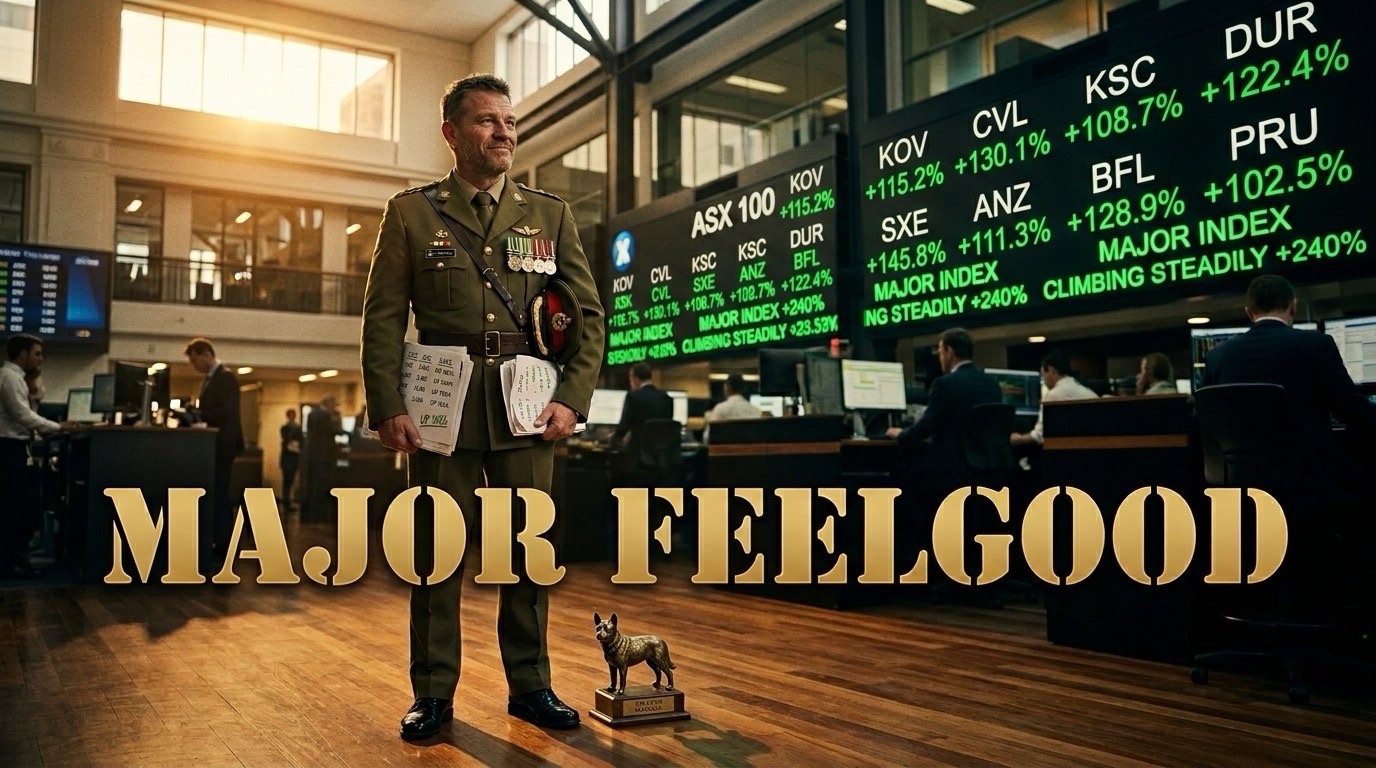
Cameron: That’s my name. Major, Major, Major Feelgood. That’s my, that’s my new title. My– You, you can call, you
Tony Kynaston: yeah.
Cameron: can call me Major Feelgood.
Tony Kynaston: One of the minor, one of the minor characters in Catch 22, Major Feelgood.
Cameron: Yeah. Or, um, a musical by, uh,
Tony Kynaston: Yeah.
Cameron: Sullivan and whatever.
Tony Kynaston: Made you feel good, yeah.
Cameron: Ground control to Major Feelgood.
Tony Kynaston: What’s happened at the track today? It made you feel good. [00:37:00] Yeah.
Cameron: that’s the title for the episode
Tony Kynaston: dogs of doubt every year in January ’cause it comes up as an article in the AFR about it or on Livewire or something like that.
And, um, generally it’s a long term, yeah.
Cameron: Yeah, but we’d never done, we’d never done like a, a 10, 11 year, um, study of it, ’cause he makes it hard to go back and do it myself. Yeah. And I, and I’ve looked at your, and I looked at all your notes and you’ve, you always say, “Yeah, it’s not, not a bad idea.” But a- again, it’s not just the worst performing, it’s the worst performing that also are paying a healthy dividend.
Tony Kynaston: Right
Cameron: Hmm. And so it’s like, um, yeah, high dividend yield. Lowest performing with the highest dividend yield
Tony Kynaston: Yeah, but you’re also eliminating companies which are failing because they’re still paying a dividend, so they’ve got
Cameron: Yeah, right.
Tony Kynaston: Yeah.
Cameron: Yeah
Tony Kynaston: Like you– Uh, like next year when you have SpaceX as the dog of the Dow and it’s not paying a dividend, you just can’t include it[00:38:00]
Cameron: Uh, um, couple of la- la- la- late minute news items. SXE issued a trading update. Uh, Southern Cross Electrical, which I hold in a couple of portfolios. 15th of June, yesterday, trading update. Uh, FY26 upgraded. Underlying EBITDA guidance increased to at least 75 million from 72 million, driven by strong H2 performance.
So good on them. I hold them in two light portfolios, uh, both from 2023. One is up 390%, the other is up
Tony Kynaston: Wow.
Cameron: So,
like, what. They’re one of those companies that I can remember looking at them and thinking, “What? Southern Cross Electrical? They do electro– They’re a bunch of electricians that do electrical works, not [00:39:00] really gonna take over the world.” Up 400%.
Tony Kynaston: in sight, no Mars in
Cameron: Yeah, yeah.
Tony Kynaston: no floating data centers yet.
Cameron: Up every 200% a year. It’s been good. And the last news item I’ve got is, uh, a couple of people have emailed me this.
Thank you. Perseus has increased their on-market share buyback to $150 million. Hold that in a bunch of portfolios as well, including my super. It’s up 132% since April ’24 of my super, up 76% in a couple of light portfolios since March 2025. So yeah, done pretty well. Perseus as well. Good on them for their
Tony Kynaston: Even, even with all, even with all that sovereign risk of African gold fields.
Cameron: Hmm.
Tony Kynaston: Yeah, compared
Cameron: like
Tony Kynaston: operating in Australia that have struggled to get mining permits.
Cameron: Hmm.
Tony Kynaston: Mm-hmm
Cameron: That’s my notes, TK. What else you got?[00:40:00]
Tony Kynaston: Oh, a couple of things. Uh, we may have touched on some of them. Um, I had. It caught, caught my eye last week that the Korean stock market went into a, um, a trading halt when it dropped 8%. Um, and I guess we’ve touched on this when you were talking about Broadcom before and some sell-off in US tech stocks.
But, uh, yeah, the Korean, uh, market stopped. It actually shut. So they have. Stock markets have a thing called circuit breakers, so when they drop too far too quickly, they, they, um, halt trading to stop, uh, something from happening. Um, you don’t see it very often, but it is another tremor in the, the whole story of, you know, we’re getting pretty close to the top of the AI market, I think.
And, uh, that was, that was largely led by some of those Korean, uh, tech companies like Samsung dropping quickly. So it’s the kind of thing that, you know, I used to [00:41:00] see back in the dotcom days when the Nasdaq would go into a trading halt. So, um, it’s more background noise, I guess, that, that makes me nervous about what’s happening to the markets at the moment.
Cameron: KOSPI
Tony Kynaston: yes, the KOSPI is the Korean market.
Cameron: Hmm. So, so I just was, I read up a little bit about that. So they, it dropped roughly 8% in early trading, and they suspended it for 20 minutes. That’s all?
Tony Kynaston: Yeah, that’s normally how these things work. If, if it had have kept falling after that, they would have put it into a longer trading halt, typically
Cameron: Right. So what do they do, Tony? They, circuit breaker goes off, they stop, and then they, what? Bring it back and then s- see what happens?
Tony Kynaston: Correct. Yeah
Cameron: Okay. W- what, what’s the. How do you think the 20 minutes is gonna have an effect? People like, like automated selling [00:42:00] calls have to stop and people can check to see that there’s not a
Tony Kynaston: Yep.
Cameron: that’s run amuck or something.
Is that what it is?
Tony Kynaston: exactly what it’s designed to do. It’s to stop
Cameron: Right.
Tony Kynaston: um, which have occurred in the past where was programmed in, um, and ran amok basically, and
Cameron: Yeah, right
Tony Kynaston: a particular sector. Um, but it’s also, I guess, to a bit of a breather if there’s a panic wave of selling going on, people can assess it.
Cameron: Right
Tony Kynaston: you know, if you’re sitting at your desk with your feet up and suddenly the market’s down eight percent or ten percent, you pay attention and decide what to do, and this
Cameron: Right
Tony Kynaston: guess, to, to and have at least a bit of a look at it and a cool head before it continues to trade. Hmm
Cameron: Right. Interesting. Okay
Tony Kynaston: Yeah. See, we haven’t seen it for a long time, but it’s, it’s happened once now and it may happen again, but it’s usually a sign that, people are heading for the door
Cameron: Right.
Tony Kynaston: Mm.
Cameron: Hmm
Tony Kynaston: couple of other things. RBA meets today, [00:43:00] so we’ll see what they do with i- interest rates, uh, given inflation’s been high. And I, I think the really difficult task for them now is to decide what’s gonna happen with the oil price.
Is, is there gonna be a deal signed physically on Friday? Um, is, is the government gonna keep the, uh, reduction in the tax that they charge on fuel going? The road user charge on fuel that they, they have lessened when the price went up. Um, because if those two things hold, then that lessens inflation and so the RBA may not have to put prices up, up– put, um, rates up.
But, uh, very hard to predict. Uh, my guess is they’ll keep them on hold and, and wait and watch for all these things to play out. Uh, but yeah, they’re, they’re certainly facing that dilemma of rising interest rates. Sorry, rising inflation being caused by a particular thing which looks like it may be coming off. So do you wait or do you raise interest rates [00:44:00] and then cut them again in the future if it does come off? But they meet today. We’ll know pretty soon what they’re doing. Um, the last thing to mention is it’s coming up for June 30, which is end of tax year in Australia, and people should be aware of what their CGT position’s going to be, their capital gains tax looks like. and I, again, not giving financial advice and there are rules around this, so check with your advisor or Google what the rules are. But, um, there is no point if you’re gonna pay a capital gains tax bill, bill holding onto something which is at a loss from a, from a capital point of view. You may as well sell it and, um, offset the losses against the gains before June 30.
So just have a look at that yourself, um,
Cameron: Even if it hasn’t breached a sell trigger?
Tony Kynaston: Yeah. Well, why pay, why pay tax on a gain if you’ve got a loss in your portfolio? There are rules around when you can buy back in, but, um, you could buy something else and, and [00:45:00] steer well clear of those rules, or you can wait some time and steer clear, clear of those rules too.
But yeah, if. I mean, seek financial advice, but it, it does seem strange to me that you would pay tax when you’ve got a loss to offset against that tax before June 30
Cameron: Hmm. Okay. We don’t have that in our acceptable sell triggers. It’s an interesting one
Tony Kynaston: Okay.
Cameron: Might, maybe it should be in the, should be in the Bible
Tony Kynaston: Yeah. Well, potentially.
Cameron: Hmm.
Tony Kynaston: just to check your status before June 30 and then sell. Yeah, sure
Cameron: Hmm. Che
Tony Kynaston: Yep. It’s
Cameron: Hmm.
Tony Kynaston: year. I’ve just done it myself last week.
Cameron: Right
Tony Kynaston: and, uh, but yeah, you gotta take your own situation into account. You may have carry forward losses from prior years, all that kind of thing work through, but just, um, it, yeah, it’s,
Cameron: Hmm.
Tony Kynaston: sense to me to sell something if it’s at a loss
Cameron: Hmm.
Tony Kynaston: uh, before you pay tax on the gain
Cameron: I’ll make a note
Tony Kynaston: [00:46:00] And the last thing I’ve got is a Pulled Pork on Suncorp Group, which is back on the buy list this week
Cameron: Okay
Tony Kynaston: Don’t think I’ve done them before. I couldn’t see them on our list, um,
Cameron: Hmm.
Tony Kynaston: so which probably means they haven’t been on the buy list before. Uh, and
Cameron: But there’s
Tony Kynaston: to look at them because they’ve had a, now a year or so, 18 months since they demerged their banking business and sold it to ANZ
Cameron: Right. Well, off you go
Tony Kynaston: Okay. So it’s a high ADT company, has a QAV score of 0.1, so it’s at the very bottom of our buy list. So, you know, it’s possible that if the share price rises or something else happens next week that it may be off the buy list, but time to have a look at it. Uh, I mean, I certainly know who Suncorp is. It’s, it’s been a in the background of pretty much most of my life growing up in Queensland, starting off as, um, different brands like the SGIO, [00:47:00] um, which was the State Government Insurance Office.
I think it had the first skyscraper in Brisbane from memory. Certainly the biggest for a while. Um, so they’re a Queensland-based insurance company. Uh, they. People will be familiar with the brands of AAMI, A‑M-I, GIO and Apia, amongst others. They also operate Vero, which is a commercial insurance brand, but a large part of their business is in the retail, uh, sort of, car and house and contents insurance. They also have specialist insurance for landlords, et cetera, um, and business, as I said. Uh, they service nine million customers across Australia and New Zealand according to their website, they the second largest general insurer market share in Australia. IAG holds the most with twenty-nine percent. Uh, Suncorp have twenty-seven percent, and then it drops off to QBE with ten, Allianz with eight, and then smaller brands like Youi and Budget Direct making up the rest. [00:48:00] They have been around for a long time. They trace their origins back to 1902 when the Queensland Agricultural Bank, uh, first provided loans to rural Uh, and also trace their arms, uh, their, their heritage back to three other or to three arms, so that one plus the insurance arm, which was established by the Queensland Government called the State Accident Insurance Office, um, which provided workers’ compensation and then also expanded into general and life insurance. that became SGIO, which I spoke of before, and then eventually became Suncorp in 1985. they also had the rural financing arm as a, as a part of their heritage, when the Queensland Ag Bank expanded commercial lending over the decades and, you know, that makes sense. If you’re providing services to farmers, you might want to also lend for their equipment [00:49:00] uh, that, uh, eventually transformed into what was the government-owned QIDC or Queensland Industry Development Corporation.
Um, then also too, their heritage is traced back, uh, via the building society route, back to the Metropolitan Permanent Building Society, which was founded in Brisbane, I think back in about 1959, and then it converted to the publicly listed bank in 1988, which was called Metway Bank when it listed. Uh So a lot of, uh, a lot of things came together for this company in Queensland. The Queensland Government in 1996 merged the state-owned Suncorp and QIDC with Metway Bank, that, that created and this was, um, what a lot of the industry was doing at the time, creating, uh, bancassurance companies or sometimes called allfinanz with a Z, uh, [00:50:00] companies where the.
It was seen that, uh, there were some synergies in, in putting banks together with insurance companies. Uh, and so that was the kind of that dominated for most banks in Australia back, back then. the government maintained a 68% shareholding, however, it systematically sold down its shares achieving full privatization by 1998 then, and then in 2002, company simplified its branding from Suncorp Metway, Metway to just Suncorp. Uh, they went on a bit of an acquisition spree, and in 2001 they bought GIO General, uh, which was the large. second largest insurance company, company in Australia at the time. Oh, sorry. After they acquired GIO, it made them the second largest, insurance company, uh, in Australia. also acquired Promina in 2007. that was nearly an $8 billion deal, uh, and that gave [00:51:00] them the brands of, uh, insurance businesses like AAMI, Apia, Shannons and Vero, and they all came under the Suncorp umbrella. then, um, most recently, and I guess a, a little bit of interest to people like me who hold ANZ shares, was that they decided to de-merger their, uh, uh, business from their banking business and they applied, uh, to let ANZ buy the, the, um, Suncorp bank for $4.9 billion which eventually got through, uh, all the regulatory hurdles in July of 2024 and that wasn’t an easy thing to do because ACCC opposed the, um, the purchase by ANZ because it was going to lead to more concentration in the banking system. But it, it got waived through. They also had to, uh, ANZ had to give undertakings to the Queensland Government about, um, closing branches or ATMs or, [00:52:00] or cutting staff for, I think three years, um, after the sale. Uh, but, um, I mean, generally it was thought it was a good thing because, uh, these kind of regional banks, which I’ve spoken about before, like Bendigo Bank and, um, of Queensland, face lot of s- hurdles being subscale compared to the major four or five if you count Macquarie. but also they face, um, uh, they have to hide– hold higher, uh, amounts of capital to protect them in a run sit-situation that’s forced on them by APRA for prudential reasons. And so they have found it difficult to compete a level playing field with the big, uh, the big, um, four or five. And so, Suncorp decided it didn’t want to be in the banking game anymore, and so they, uh, they sold to ANZ partly because of that subscale issue. Uh, and in fact, Suncorp had been [00:53:00] doing their darndest to try and reduce their cost base anyway, and they’d, they’d shut two-thirds of their branches the 10 years preceding the sale and were down to 60, um, branches operating when they made the sale. Um, there was also, uh, a couple of other problems that they faced.
The, the banking system, um, faces large technology investment hurdles. they, they often operate on very old, decades-old, uh, core operating systems which require lots of, uh, technology investment and eventually replacement, and, um, it just becomes very difficult for these smaller banks to be able to afford to do that. Uh it was, it was also, I guess, apparent to analysts, but also to the, the leaders of Suncorp that this, this bancassurance or all finance, uh, thematic that swept through the industry back in the ’80s and ’90s wasn’t really playing out. all the big banks Australia [00:54:00] have divested their insurance arms largely.
They may still sell insurance products, but they’re often a, a white label provider, or they have a small business themselves for legacy reasons. but running an insurance business is a, is a operation. they’re not easy businesses to run, and then there wasn’t much synergy between doing that and running a branch network retail bank.
So made sense for, for Suncorp to divest its bank and find a good seller. I think was probably a good buyer. Um, there, there was a lot of talk for a long time that Adelaide, uh, Bendigo Adelaide may have been a purchaser, but, um, I think, did a better deal with ANZ getting a cash, uh, sale away rather than a scrip, um, offering to, uh, a, a player like Bendigo Bank. Um, anyway, the. When the deal was done, it did unlock immense value for Suncorp shareholders, and they, uh, [00:55:00] were quite prudent in giving most of the proceeds back. So of the $4.9 billion cash price, they returned $4.1 billion to um, in dividends and and r- and capital returns as well. So that made, uh, FY25 look very good for Suncorp.
So, in FY25, there was a 52% in net profit after tax. there was a f- a massive, uh, capital return, um, per share, uh, at the time, and a plus a cent per share special dividend, and there was a $400 million share buyback, which ended just, uh, in the first quarter, this year. So, a lot of money was returned.
It, it does kind of make comparisons and this results look a bit, um, a bit anemic, but you are comparing, uh, this half with a half when there was all those, cash returns and buybacks going on. [00:56:00] the other thing that happened in the last sort of six months for this company was that there’s been, um, as there often is with insurance companies, particularly Queensland-based ones, uh, natural, natural.
I, I’ll call them natural catastrophes. They– I, I. They are, um, things to be, uh, happening to you, but, you know, really they’ve– they ha- they happen with regularity in Queensland, whether it’s cyclone or hailstones or whatever. Um, and insurance companies have to, have to manage this, uh, and hold the right provisions. Looks like Suncorp underprovided, uh, for an unusual year of, um, uh, uh, catastrophes. So July and December 2025, there were nine separate declared catastrophe events and over seventy thousand claims because of those. Uh, Suncorp had provided four hundred and fifty-three million dollars for these, um, claims, which is probably about the [00:57:00] average. but in, in fact, they incurred one point three billion dollars of claims. So um, big hit to their, uh, provisions and their earnings because of that. and if you look at the comparison of first half twenty-six, which is the latest results with the first half of twenty-five, net, net profit after tax was down from over a billion dollars to two hundred and sixty-three million. and, uh, cash earnings were like– were also down from eight hundred million to two hundred and seventy, and the buyback was stopped. So it’s– it is a bit hard when you’re comparing a bumper year with the, with the current year. Uh, but I think the telling thing for me out of all of that was that there was an unusual, list of particularly hailstorms that was causing the most of the problems, um, in the second half of last year. and of course that, that, uh, hurts general insurers, hurts the policyholders even more. But, um, [00:58:00] you get a lot of hail damage in cars and broken windows in houses and things like that. So, that affected their results. Um from the QAV point of view, though, the, uh, it, if the share price come back a little bit, it helps us because, um, it’s back on the buy list.
So ADT is fifty-three point five million. price for my analysis is eighteen fifty-five, uh, which was the price yesterday. eighteen fifty-five is only ninety-six percent of consensus target, but it’s way above our IV1 of four thirty-six and IV2 of eight fifty-six. So seeing value from that perspective, but we are seeing it from a PROPCAF perspective. Stock Doctor Suncorp as a star income stock, which we score an extra half a point for. I did kinda scratch my head over that because the yield on, uh, Suncorp is three point five six percent, is not. It’s probably market. [00:59:00] I don’t know what the market yield is at the moment, but it, it’s not, um, high enough for us to score it against the mortgage, uh, mortgage rate going out there in the moment.
So I was a bit surprised to see s- it, um, as a star income stock in Stock Doctor, which they usually reserve for higher paying stocks, but I don’t know the history. Perhaps it was, um, done in the past and it’s a legacy issue for them when the yield was higher. Uh, Stock Doctor do mark it as strong and steady for financial health and trend, so that’s good. the PE is twenty-one point eight times that’s not the highest or the lowest, so we give it a, a zero for that. uh, it is a recent three-point trend line upturn, so we score it for that. have a consistently increasing amount in equity, and that’s possibly because they, they swallowed a whole heap of cash when, um, ANZ bought the bank, and now it’s getting back to where it, uh, would normally sit. is five point four times, so I like that, and that’s why it’s on the buy list. Net equity per [01:00:00] share is nine dollars forty-two, so we can’t buy it for book or book plus thirty. earnings per share growth is only four percent, so it doesn’t score for us on growth over PE. the yield, as I said before, is only three and a half percent, so we can’t score it for that. Uh, doesn’t have an owner founder, obviously can’t score it for that. So overall, eight point five out of sixteen for quality, which is only fifty-three percent and just scrapes in at point one overall. I guess if I look at it, um, the, the things I like about it, it’s a large ADT stock, uh, on the buy list again. it’s getting back to focusing on its core business of insurance, which I think is good. It’s the number two player in Australia, which is also good, makes it pretty, um, large and steady. Uh, but insurance companies, um, you know, have, have risks, um, not the least of which is the weather events which, um, seem to hit Queensland, uh, probably more than the other states, but, um, certainly are hard to [01:01:00] predict and therefore provide for. there has been a bit of talk in the, in the press recently about the government starting to focus on increases because, uh, all of the general insurance companies have been putting up their prices. As people will know, when it comes time to, you know, renew their house and contents policy or their car insurance policy. know, I think I faced about a ten or twelve percent increase in my house and contents this year, not with Suncorp, but with another insurer. Uh, which is the insurance companies, um, you know, reflecting the inflation that’s hitting the construction industry in particular. Um, so but, but there will be s- uh, some regulatory scrutiny on that, which may make it harder for them to recover cost increases in their business. but also too, insurance businesses are fairly opaque and, um, difficult to analyze and, or predict they rely on investment income from their float, which we’ve talked about before with, with Berkshire Hathaway. But, uh, [01:02:00] the float in Australia is regulated again, um, pretty intensely. And so typically they invest in government related bonds or equivalents. And those, those, yields are going up at the moment as interest rates rise, which is one of the reasons why the share price is increasing, for this company. but it does mean that they’re not getting sort of stellar returns or stock market returns, um, like Berkshire Hathaway does, from that, from that investment.
But it does mean it’s pretty safe. but you’ve got to be able to, um, about what the investment return’s going to be. You’ve got to think about what the re-reinsurance profile is for companies like this. So they, uh, lay off a lot of their claims exposure with reinsurance companies, and so they take a smaller margin, uh, for a less risky profile. Uh, and that can, that can change with, with contracts that are being renewed all the time. then weather makes them difficult to forecast [01:03:00] as well. So, uh, you know, insurance companies, uh, can be, uh, though they’re large, hold good market share, they can still go up and down a lot, um, as bonds move and as the weather, uh, becomes, uh, more variable than, than, um, average. So that’s Suncorp Group. Um, have a look at it if you need to buy a large ADT stock. Perhaps like me, you’ve sold out of your all interest at the moment, so it might be of interest to you. But, uh, it may also off the buy list fairly soon. The buy list fairly soon
Cameron: And it’s down today, so, uh, don’t buy it today.
Tony Kynaston: Yeah
Cameron: Hmm. It’s dropped the last couple of days from $18.75 on the 12th down to $18.28, so down a little bit well, thank you, TK. I think that gets us to after hours. Been a few [01:04:00] weeks. What’s been keeping you amused?
Tony Kynaston: Uh, I think I heard you talk about it while I was away, but I’ve been watching Spider Noir with Alex. It’s, it’s pretty good. Liking
Cameron: get f-
Tony Kynaston: Cage acting
Cameron: got, I only got like three or four episodes into it and then I kind of got distracted. But, uh,
Tony Kynaston: out? Hmm
Cameron: Fanta said it was worth keeping up with, but how far into it are you?
Tony Kynaston: Yeah, we’re at episode three as well,
Cameron: Oh, okay. Right.
Tony Kynaston: it. I think it’s
Cameron: Hmm. I like, um, Nicolas Cage hasn’t had much to do there, but I like, uh, Brendan, whatever his name is, Gleeson.
Yeah, he’s always fun to watch.
Tony Kynaston: I agree. Yep, playing the bad guy.
Cameron: Yeah.
Tony Kynaston: Musk character.
Cameron: Yeah. Okay
Tony Kynaston: Watched another one, uh, uh, episode of, uh. Sorry, documentary on Netflix called Vardy. Um,
Cameron: Hmm
Tony Kynaston: don’t know if you’d like it, but I, I quite enjoyed it. Roddy and I watched it. It’s about an English soccer [01:05:00] player, um, who was a bit of a lad uh, uh, got into soccer late ’cause he was too busy drinking and, and fighting and all that kind of stuff. then, uh, a manager sort of picked him out as an up-and-coming talent and stuck with him through all the grades, and eventually he started playing for Coventry, then went on to win the EPL as a huge outsider. uh, it’s a bit of a rocky story really, but, um, it was fun to watch. Recommend that to the sports fans out there
Cameron: What else?
Tony Kynaston: f- uh, been listening to My Favorite Toy, the new Foo Fighters album. Came out, I think, in April.
Cameron: Hmm.
Tony Kynaston: quite good
Cameron: Hmm, didn’t pick you for a Foo Fighters fan
Tony Kynaston: Yeah, yeah, I like the Foo Fighters. I
Cameron: Hmm. I like kung fu. Is it kung fu fighters? I’m a kung fu fighter
Tony Kynaston: Uh, been reading, um, a book on Jefferson [01:06:00] by Christopher Hitchens, which is really good. I recommend that. out for a while, but I came across it recently.
Cameron: He’s been dead for 10 years, so I’d hope so
Tony Kynaston: Yeah, so it’s been, it’s been out for a while. like his writing style, but, um, uh, I– it’s going into all the detail of, uh, the early days of America, um, which I wasn’t that familiar with, so that’s been
Cameron: Hmm. Hmm.
Tony Kynaston: Yeah. Um, you know, talking about little things like, uh, how Jefferson cribbed a quote on, um, the pursuit of. called? The pursuit of life, happiness. No. Uh, what’s the quote? The life. What’s in the Constitution? The pursuit of happiness, life. I’m getting that mixed up
Cameron: Yeah, can’t remember
Tony Kynaston: Yeah, anyway. Originally, it was instead of
Cameron: Life, liberty, and happiness for all. Li- liberty and something, yeah
Tony Kynaston: But originally, the original quote was from Locke, and it was life, liberty, and property. um, so given the sort of double-edged meaning property had back [01:07:00] then, they decided to change it to the pursuit of
Cameron: Ah, yeah
Tony Kynaston: which, um, I thought that was interesting. But
Cameron: Jefferson, Jefferson liked his, uh, female properties too, didn’t he?
Tony Kynaston: He did, and he still, he still kept slaves,
Cameron: Hmm.
Tony Kynaston: even though he did a lot of work in the Constitution to try and, uh, get around the ownership of slaves. He sort of danced the thin, the, the line there. And that’s– I thought that was interesting, and at the very start, when Christopher Hitchens says, “Look, no one’s all good or all bad.” This, this guy, you know, was all about life and liberty, but he held slaves. So you know, you gotta judge him on that basis, I guess.
Cameron: Hmm
Tony Kynaston: and but there’s a lot, lot in there about the, um, the reasons for seeking independence to– a lot to do with the English and the French War. Um, uh, how money was required by the English to fight those various wars, and how they were taxing Americans to do that. Um, how, you know, at the end of some of those wars, they had a chance of, I think, uh, was it Guadeloupe in the West [01:08:00] Indies? They had the chance of either taking that or Canada, um, over as a colony, uh, from the French, and they chose Canada. And, uh, if they had have chosen Guadeloupe, that would’ve had a different outcome for the history of America.
So yeah, interesting to go through and pick apart all that history that was going on at the time, and the Americans’ reaction to it.
Cameron: The original tax dodgers, as I always call them.
Tony Kynaston: Right
Cameron: The founding tax dodgers. Mm-hmm.
Tony Kynaston: And, uh, a couple of good, good results from our horses this week. So Lake Forest broke a track record yesterday at Pakenham. I drove up to Pakenham to watch it, to win a race, which was good. And.
Cameron: that mean? Like a record for that horse or like for the whole track?
Tony Kynaston: Yeah.
Cameron: Wow
Tony Kynaston: of different surfaces at Pakenham. They have the, a grass surface, which is what most race courses do, but they also have a, what’s called a poly track, which is, uh, kind of a sand, rubber, synthetic mix, which, um, is an all-weather [01:09:00] track. So, uh, you race there when it’s in winter and the grass tracks get muddy and bogged.
Cameron: Right
Tony Kynaston: So it set the poly track record for 1,000 meters at Pakenham yesterday, which was
Cameron: Fantastic. Congratulations
Tony Kynaston: Thanks. was fun. The trainers are the Galagatos brothers, and they were very emotional and all over me after the race. A lot of fun. it very passionately, which was, which is good to see.
Cameron: Is that what you want?
Tony Kynaston: Yeah. then Stars of Dom, a horse I have, uh, sharing with Steve Mabb, that ran second on Saturday. So it’s had two seconds first two starts. So, um, we’re hopeful it can the, take the prize, in the future. But two seconds isn’t a bad way to start a, a racing career.
Cameron: Yeah.
Tony Kynaston: Hmm
Cameron: named after? Stars of Dom
Tony Kynaston: Dom Perignon. Yeah. Uh, it’s a bit of a pun.
We didn’t name this one, but, um,
Cameron: Right
Tony Kynaston: uh, one of the managers at Lindsay Park, which is where it’s trained, is [01:10:00] called Dom, Dom Roden. So
Cameron: Uh
Tony Kynaston: they kind of named it after him, but also after champagne. Yeah, so that was good. Good, good couple of days to be a horse owner.
Cameron: Yeah, congrats. Very exciting Well, I watched the Colossus film that we talked about,
Tony Kynaston: Mm-hmm.
Cameron: um, after reading the book. Really enjoyed the film.
Tony Kynaston: Oh
Cameron: it was great. Yeah, really well done. Good sort of classic film. And a lot of, like, great, uh, appearances from stars. Um, Mrs. Cunningham from Happy Days was in it, very young version of her, Marion whatever her name was, Ross.
Tony Kynaston: Mm-hmm.
Cameron: And James, um, what’s his name? Um, Hong. James Hong. Um, the only Chinese American actor for the last 30 years in Hollywood who’s everything from, um, Wayne’s World through to Everything [01:11:00] Everywhere All at Once, and, uh, Big Trouble in Little China, and all those sorts of films. He– a very young James Hong was in it, which was great to see.
He’s always one of my favorites. I think he had one line in the, in the film. Uh, yeah, no, really, really enjoyed it. Thought they did a good job. Changed it from the book a little bit, but pretty much the same story. I’m reading the second novel in that series now, which is interesting, where, um, Colossus. It’s fi- it takes place five years after the first one, and, uh, there’s a religious cult set up around Colossus now.
He’s completely taken over everything. He, it. And, um, the human resistance gets contacted by some group that says they’re from Mars, and they’re, they’re building a, a counter system to have them.
Tony Kynaston: from Mars. Yeah.
Cameron: Yeah, yeah.
Tony Kynaston: Right.
Cameron: Um,
Tony Kynaston: ruled by the Grok AI on
Cameron: Well, as I think I told you, Elon named his [01:12:00] data center that runs Grok Colossus based on this book.
so maybe he thinks this is what he’s gonna have to do when Colossus takes over, is get to Mars and build the counter Colossus.
Tony Kynaston: Do you think, uh, do you think there’s a religion around AI at the moment?
Cameron: Uh, there’s been a couple of
Tony Kynaston: by the almighty AI
Cameron: I think there’s a couple of, uh, actual people playing with the idea of AI-based religions already. But I do think it’s a thing that’s gonna happen. I mean, the way it plays out in the book makes total sense. Like a b- it’s, it’s the all-knowing master of everything that’s running everyone’s lives and has solved crime.
There’s no more crime, there’s no more violence, there’s no more anything ’cause it sees everything. It– If you get arrested, you get tried and executed within 30 seconds ’cause it’s got all the facts and all the data and it just, you know, beheads you. So, uh, yeah, I can see that playing out.
Tony Kynaston: Hmm.
Cameron: Chrissy and I also watched Poor Things.
Tony Kynaston: Oh, that’s a great movie. I[01:13:00]
Cameron: Yeah. Yeah, yeah.
Tony Kynaston: Willem
Cameron: Trippy as all hell. Willem Dafoe, yeah, great in it. And, uh, now I wanna see the other one. I think the first one they did together, Kinds of Kindness with Jesse Plemons and Emma Stone and Willem Dafoe, which is,
Tony Kynaston: I
Cameron: Yorgos’ uh, go-to cast
Tony Kynaston: Yeah
Cameron: It’s his, um, his go-to people. Willem Dafoe’s always great, always well.
Do you hear about this film that’s– There’s a film that’s showing. Where is it? Um, in Tasmania, I think. It’s, uh, the Dark Mofo,
Tony Kynaston: Mm-hmm.
Cameron: um, Festival that’s on at the moment. It’s a Willem Dafoe film that only 500 people have seen. One person is allowed to see it at a time in a cinema. You get, uh, a, a BMW picks you up, gives you, like, an army tag.
You get taken to a cinema that you, where you didn’t know where you’re going. You get taken to this [01:14:00] place. You have to pr- pr- pr- provide your identification, and you sit in the cinema and you see this film by yourself. And oh, before– When you get in the car, there’s a recording by Willem Dafoe that, uh, is played to you that basically is sort of not– is sort of the intro to the film.
He’s in character, and then when you get out of the film, there’s another thing that he says to you in a USB stick or something that’s given to you, and it’s a full experience that, yeah, only one person at a time is allowed to see. It’s,
Tony Kynaston: has anyone divulged what the movie’s about?
Cameron: Yeah, I read a review in The Guardian or something today where somebody saw it, a reviewer, and talked about it.
I didn’t read it in detail. I was just skimming through them
Tony Kynaston: I have seen a, Willem Dafoe movie set in Tasmania.
Cameron: Hmm.
Tony Kynaston: out in the last 10 years. I think it was called The Hunter or something like that. He–
Cameron: Oh, yeah
Tony Kynaston: It was very remote and moody, and he played a hunter who was looking. I can’t recall if he was trying to find a [01:15:00] Tasmanian tiger or he was trying to shoot, shoot one that had been found.
I can’t recall now. It was a very, like it was, wasn’t much happening in the movie, but it was beautifully shot and great to watch. Very moody
Cameron: Human sacrifices have been made. He had to go shoot Tasmanian tigers.
Tony Kynaston: no, I don’t, don’t
Cameron: Bob Katter called him up. And I just saw the trailer for the new Paolo Sorrentino film, Parthenope, which stars Gary Oldman.
Tony Kynaston: Oh, wow. Okay
Cameron: Yeah. Yeah, yeah. Check it out, Parthenope. You’ll love it. Um, looks great. Coming out soon. And then I’ve been listening to Aussie Crawl this morning because they’ve just announced a reunion, the surviving members of them.
Yeah, the Raines brothers and some other guy. I thought, “Gee, I haven’t listened to Australian Crawl for decades,” so I pulled out Sirocco and started listening to that. Such a- some catchy riffs. Oh, thank you, baby.
Tony Kynaston: Oh,
Cameron: Da-da-da-da, da-da-da-da, da-da-da-da, da-da-da-da, da-da-da-da-da. Yeah. Errol
Tony Kynaston: And great [01:16:00] lyrics. Beautiful people. Yeah. mean that, yep, where are those, you know, those cynical Aussie bands from the ’70s and ’80s were great. Just taking the piss all the time.
Cameron: Che
Tony Kynaston: Mm.
Cameron: Well, that’s all I got for you, TK. Um, no RBA announcement yet that I can see Let’s see the AFR. Nope, nothing yet.
Tony Kynaston: two sixteen, so I think it comes out
Cameron: Mm. 230. Mm. Mm. Mm
Tony Kynaston: All right
Cameron: Okay. Uh, happy hunting everybody. We’re gonna go talk about America.
Tony Kynaston: Okay.
Cameron: Ciao.
Tony Kynaston: luck.
Cameron: Yeah
QAV LIGHT
He already knows where they are.
Click the picture to learn more!