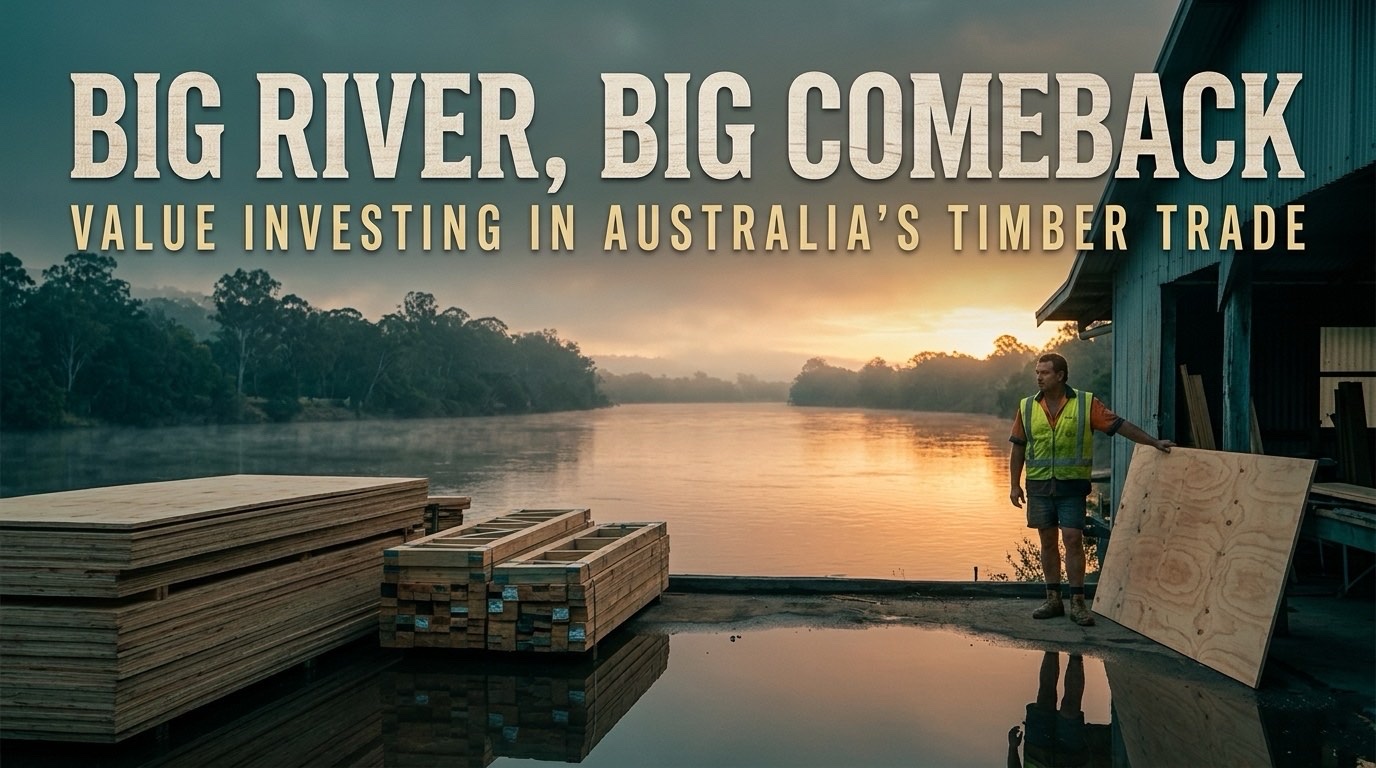
On this episode Cameron flies solo while Tony is down the Gold Coast doing something involving horses. He covers the market fallout from Trump’s surprise bombing of Iran, explains why he’s hitting pause on new buys through confession season, and does a Pulled Pork on Big River Industries (BRI), a 120-year-old timber and building materials company that is quietly turning itself around. There’s also a defence of value investing as an all-weather strategy, prompted by a VanEck opinion piece in the AFR.
This week’s full episode is for QAV Club members only. The free episode is available below. Also check out our podcast archives link and our pages on Apple Podcasts or Spotify or watch clips on TikTok. Or visit our homepage to learn more about QAV and how it works as a value investing system that you can learn and apply to beat the market.
Transcription
QAV 921
[00:00:00] Welcome to QAV Australia. It’s episode 921. No Tony today. I’m flying solo. Tony is not far from me, down the Gold Coast, buying and selling, I don’t know, horses, I think. Um, so I’m gonna do one. It’ll be a quick show today. I am gonna do a Pulled Pork in his absence. Few little stories to cover. We’ll do a look at the portfolios, but, uh, I’ll make it brief.
I won’t keep you too long today. Of course, uh, it’s the 26th of May, Tuesday the 26th of May when I’m recording this. After several days of being told by Trump that we were very close to a peace deal and the Straits of Hormuz opening, et cetera, et cetera, out of nowhere, uh, he started bombing Iran again today. So, ah, you know, I guess that’s what [00:01:00] we should have expected.
The market in Australia has, uh, collapsed. Well, not collapsed, but it’s come back again today after a little bit of a recovery. Uh, the oil price had started to fall. I think it’s spiked back up again today. At the moment I’m recording, about 12:00 PM Brisbane time, the market’s at 8871. Was as high as 9,091 on the 7th of May.
That’s come down and hasn’t really recovered. So there you go. What, uh, what can you say? Um, as a consequence, the stock that I’m gonna do a Pulled Pork on today actually was a buy yesterday. It’s become a sell today ’cause it’s fallen below its sell line, which was pretty close to its price yesterday. But I’m gonna do it anyway because I’ve done my prep on it.
And we’re well and truly into confession season now, uh, this being sort of the end [00:02:00] of May, so I’m probably not gonna buy anything, I think, for a while. I’m gonna wait until results come out. As long-term listeners will know, uh, confession season is the unofficial season as you’re getting up to a reporting period where traditionally Australian businesses have confessed that they might not be hitting their, um, you know, the, the sort of results that they had forecast and they’re supposed to give us warning, continuous disclosure and all that kind of good stuff.
But as we have noticed over the last year or two, Australian businesses by and large seem to be just skipping that. Eh, they’re just not bothering with it anymore and then all of a sudden the results come out and they take a hit. So Tony made a decision in the last year or so to stop buying during confession season.
Just hold our powder [00:03:00] and wait to see what happens. So I’m gonna start doing that. I’m going to, uh, do that in the lite market. The stock that I am gonna talk about today, BRI, I did add that to the lite portfolio yesterday, but I think that’ll be the end of it for a while. I’m just going to, uh, wait until we get through confession season.
Up to you whether or not you do it. Uh, not financial advice. I’m just letting you know what I’m gonna be doing with our portfolios and my own portfolio for the next month or two. Uh, I have one article from the Financial Review I wanted to cover today. “Value’s victory lap: Why having zero exposure is now a risky bet.”
This was, uh, in the opinion columns, uh, May 24th by Arion Nairon, who I believe, according to his byline, is the managing director and head of [00:04:00] Asia Pacific at VanEck. There’s some good stuff in this about value and some stuff I disagree with, so I’m just gonna rush through it and give you my thoughts on it for what they’re worth.
He says, “In December, I wrote in this masthead that value investing didn’t die during the growth decade. It was simply under-owned. Last year, value was vindicated, and this year it’s done a victory lap while the cost of admission has gone up. The trade is crowding, the late arrivals are paying up, and the stagflation regime that most strategists now treat as Australia’s economic baseline favors exactly the kind of cash generative balance sheet resilient businesses that value investors should have always owned.
From the global financial crisis through to the pandemic, zero interest rates and platform economics handed growth its longest stretch of dominance in market history, a regime in which terminal [00:05:00] value assumptions did the heavy lifting and the cost of being early on value compounded into being wrong.” Well, obviously we’re gonna take issue with that.
Anyway, I’ll keep go- keep going. The 2022 revival was treated as a head fake. Capital rushed back to the mega caps as soon as the disinflation trade resumed. A generation of investors learnt implicitly that valuation did not matter. Last year began the correction. Value outperformed across Japan, Europe, the UK, and Australia, with international enhanced value beating its growth counterpart by a meaningful margin.
What does this mean for investors? There are two things held simultaneously. First, humility. Timing factor rotations is a near impossible feat, and anyone to know– claiming to know precisely when value’s run ends is selling something. Second, humility is not a license for inaction. Every style has its season.
While growth investing [00:06:00] dominated for the better part of a decade and a half, value’s pedigree is the longest and most rigorously documented in the literature. No single approach wins permanently, but when a factor that has survived a decade of being early, wrong, or ignored begins to reassert itself, the appropriate response is not to call the top, it is to ensure you have meaningful exposure.
The most durable insight in this discipline still belongs to Klarman, who wrote in Margin of Safety, “Value investing is at its core the marriage of a contrarian streak and a calculator.” So, uh, I mean, I’m picking the eyes out of his article. There’s, there’s quite a bit more to it, but obviously my pushback is gonna be that value has always worked for TK over the long term.
There, there is no bad time to be in val- to be a value investor unless you’re looking at very short timeframes, which you should never do as an investor. Like, 2022 to 2024 were, by comparison for us, [00:07:00] lean years, bad years, but they were a blip. 2019 to 2021 were great years. 2025 to 2026 have been great years.
We had a couple of lean years, but we don’t rotate. We don’t try and rotate in and out. And in fact, that’s what, um, what works on Wall Street specifically says is the biggest mistake that professional investors make, is trying to rotate in and out of styles of investing. You should pick one that you’re comfortable with and stick with it. In and out, you know, if I look at, which I will do, I’ll bring up our portfolios. I was doing this yesterday because I was putting together a report. If you look at, um, our lite portfolio, the first one that I started in early 2022, the 221 portfolio. Let me just see. The [00:08:00] first transaction for that was the 16th of February 2022, which was the worst possible time in the last few years to start a portfolio because it’s exactly when the Ukraine invasion started, and then interest rate rises started.
And, uh, you know, if I look at, uh, let me go to the five-year chart here, look at the AORD. Um, the All Ordinaries, um, what did I say? The 16th of February. All Ords was at, uh, 7502 on the 14th of February, and by July it was down 6877, 6720 by the end of June. So everything just sort of collapsed and then stayed pretty low for a couple of years and started to, you know, sort of grow [00:09:00] again in the end of 2023.
So that portfolio, if I look at it over the last, whatever it is, six years, uh, four years now, it’s up 5.67% per annum versus the, uh, SPDR 200, which is up 8.54. So we’re underperforming by nearly three points on that. Even after four years, it’s recovered a lot. At one point, June 2023, we were down. We were underperforming by nearly 15%, and we were deeply in the red on that.
We were down nearly 10% while the, um, ASX 200 was up about 5%. But, uh, so we’ve recovered a lot, and I have full confidence that we will continue to recover. Uh, we did get just above it as of January, but we’ve dropped back below again in the last, uh, couple of months. But over the [00:10:00] long haul, it will recover and it’ll get back on top.
All of our other lite portfolios have done much better than that, even though they were s- they started just a little bit later. The, uh, second lite portfolio, which I started at the end of April 2022, is up 12.87% versus the SPDR up 7.79, so it’s outperforming by 5%. Not quite double market, but not far off it.
The 223 portfolio that I started in the middle of August 2022 is up 23% versus 10% for the benchmark, so that’s over double market. And the fourth and final one that I started in November 2022 is up 23% per annum versus the index up, uh, just under 10. So outperformed by 13%, also well over double market. So even in [00:11:00] 2022, which was the worst possible year, uh, I’ve seen in value investing in the six or seven years we’ve been doing the show, three out of the four portfolios that I started this year have done very well. Well, are doing very well.
The first one, which was started a couple of months earlier than the rest, um, is not doing as well, but, you know, that’s, uh, just unfortunate timing. My point is that there is really no bad time to do value investing as far as I can tell, and anyone who tells you there is, is, uh, you know, I don’t know, on a different program, I guess. Well, the stock that I’m gonna do the deep dive on today is.
Oh, by the way, I should also give you an update on, I guess, while I’m here. I’ll do the dummy portfolio just in case you’re interested. Dummy portfolio, uh, what timeframe will I do? Last five years, for new listeners, is up [00:12:00] 14.77%, uh, per annum on average versus the index up about 8.4%, 8.3% over the same timeframe.
And that started back in, uh, 2019. Last five years, that was obviously 2021. Uh, the last– Well, we’ll do this financial year, I guess. Um, this financial year, our portfolio is up roughly 18% versus the benchmark up five and a half percent. So it’s absolutely killing it for this financial year. If I look at a shorter time– um, sorry, a longer timeframe, last three years it’s up 18% versus 11. So yeah, it’s been good times in that portfolio.
So, um, the, the stock I’m gonna do the deep dive on today is Big River Industries, BRI. Now, as I said earlier, it’s actually a [00:13:00] sell today. It dropped a few cents between when I first started looking at it yesterday morning and right now. It’s, uh, down about a $1.33. But there, there wasn’t a lot to buy on the buy list yesterday, and I suspect it’s, it’s probably even less today after the market’s, uh, declined today.
But it, it, you know, it’s probably gonna be close to a buy again, uh, depending on what happens over the next couple of weeks, so worth covering anyway. BRI, Big River Industries. Big wheel keep on turning. Uh, I think that’s what, uh, Tina Turner said. Never heard of these guys before, didn’t know anything about them.
Interesting story, and kind of a good value investing story, I guess. Sort of a classic value investing stock in many ways. Been around for 120 years in one way, shape, or form. [00:14:00] They’re a timber company. They make building materials. Born on the Clarence River in Northern New South Wales, which was referred to– It was actually called Big River at one point, but I think there was another river called Big River, so they had to change the name of the river b- um, to the Clarence River.
394 kilometers long, the biggest river by volume in New South Wales, big scrub country, cedar forest, hardwood. Remained unknown to British authorities until the mid-1830s when escaped convict Richard Craig, who had been living with the Aboriginal people in the area, reported its existence. If I was an escaped convict, I’d probably just keep my mouth shut.
But anyway, it was initially called the Big River, um, but then the governor of New South Wales, George Gipps, in 1839, changed the name to the Clarence River in [00:15:00] honor of the previous King of the British Empire, William IV, the first Duke of Clarence and St. Andrews. Wasn’t actually the first Duke of Clarence, but that’s another story.
People who know King Richard III will know that Clarence is a main character in that. Don’t, don’t make me recite the opening soliloquy of King Richard III. Uh, and Big River Group has been operating from Grafton, which is sort of at the heart of the Clarence River, for over 120 years. Apparently, the original Grafton mill is still there today and running. So Australia’s housing boom really got going in the 1900s, the Federation era.
The suburbs of Sydney and Brisbane were being built. There was a huge demand for timber, and a guy called Thomas Pidcock, who started his career as a sawmiller in 1894 in Northern New South Wales, started opening his own sawmills [00:16:00] in the 1920s. And in 1928, he constructed the first sawmill in the state of New South Wales using hydroelectric power to mill hoop pine and eucalyptus.
And that was sort of the start of what became Pidcock and Sons a decade later. They opened factories in Grafton and Coffs Harbour. And when Tommy P. died in 1948, the business was carried on by his four sons. And then in 1960, they sold their sawmilling operations and constructed a modern rotary veneer factory in Grafton.
I have no idea what that is, so I had to look it up. A rotary veneer factory is where logs get turned into thin sheets of wood used to make plywood. Basically, as I understand it, a log is mounted on a giant lathe, like a spinning machine, uh, like you’re gonna [00:17:00] peel an apple, and a long blade is pressed against it as it rotates, produces a continuous ribbon of thin wood sheet called a veneer, and that is then cut into panels, dried, glued together in cross-grain layers to make structural plywood.
Called rotary obviously because it turns as opposed to a sliced veneer where the blade moves in a straight line or sawn veneer. Rotary cutting is apparently the most efficient method for structural plywood because it maximizes the usable area from each log and produces large, consistent sheets. So there you go.
Don’t say you don’t learn anything. Over 120 years, they expanded from one sawmill into a national manufacturer and distributor. Today, they’ve got about 26 sites across Australia and New Zealand. Fast-forward to early 2016, a private equity firm called Anacacia Capital acquired a controlling [00:18:00] interest in the business, and then they listed them on the ASX in 2017.
So relatively recent as a public company, but a very old business underneath. And as far as I can tell, Anacacia still hold a 17% strategic block in the company, so they have a long-term interest. They’ve been involved in the business at least for the last ten years. And the company’s been basically going through acquisitions, buy and build, buying regional timber merchants and frame and truss manufacturers, and then trying to scale up the national footprint.
What is frame and truss, I hear you ask, unless you know way more about construction than I do, ’cause, uh, I could have guessed, but I wasn’t sure. So imagine you’re a builder about to put up a house. Instead of your crew having to cut every wall stud and roof rafter on-site by hand, you phone Big River. [00:19:00] You give them the dimensions of what you need, and their factory pre-cuts every component to millimeter precision using the architectural drawings.
Then they flat pack it all, whack it on a truck, deliver it to the site, and the crew basically just pops it up like a kit. That’s called frame and truss. For Big River, that’s their construction division. It’s about, um. That’s a big chunk of their business. Their half year revenue for the first half of this financial year– Sorry, for the first.
Yeah, for the first half of this financial year, the December 25 numbers was about 138.7 million. It’s the core engine of the business. Structural plywood, these are these big sheets of layered wood you see around commercial construction sites holding concrete in place while it sets or as the floor of an apartment building before the tiles go down.
That’s [00:20:00] part of what they call their panels division. Their half year revenue was about 67.3 million. They also do internal doors, flooring, fiber cement sheets, trade hardware, sort of the full builder’s pantry. So it’s basically what Big River does. It’s not just residential, it’s commercial, it’s you name it.
Everything to do with Australian construction and wood, they have a hand in the sort of unglamorous infrastructure side of the construction business. As I said, sort of a classic value investing, uh, operation. Not a, not a brand anyone would recognize, not sexy, but they’ve had a rough trot, and the business seems to be turning around.
Um, so we’ll, time will tell, but their latest numbers are a turnaround from what they had reported at the end of last financial year. So we’ll talk a little bit about the numbers. The [00:21:00] FY25 numbers, revenue was about $405 million. EBITDA before significant items was $28.7 million, down 11.9% on the year before. But the result was pretty ugly. They reported a $14.8 million net loss.
They wrote down about $20 million of intangible assets, goodwill essentially from acquisitions that wasn’t worth what they paid for it anymore. I guess they were buying stuff at the top of the cycle, interest rates kicked in and, uh, all the rest of the economic issues that we’re all aware of. And, uh, they had to write down some of those assets.
But their December ’25 numbers, the first half of FY26, EBITDA jumped 20.4% to $12.4 million. Margin went from 7.4% to 8.9%. Net profit came back to $1.39 million. Operating cash flow was [00:22:00] $13.2 million. Uh, just a note on that, if you look at Stock Doctor’s numbers, they’re a little bit different from what the company reported.
They reported $12.4 million EBITDA before significant items. Stock Doctor shows $14.5 million for the same period. Tried to work that out. I think it’s probably just, uh, Stock Doctor has a fairly mechanical, uh, process, revenue minus operating expenses. And I think the $2.1 million gap has got something to do with leased sites, BRI figuring in if they strip out right of use asset depreciation from, uh, their sites that they lease, their 26 sites.
Could be the difference. Anyway, the bottom line is it’s a real recovery. Uh, at least it started in the first half. We’ll have to see what their financials are at the end of the financial year. The trailing 12 months to December 2025 [00:23:00] has EPS before abnormals at 4.59 cents. Forecast EPS for FY26 was 6.4 cents.
So market was expecting a, a pretty good year. Dividend two cents per share for H1, fully franked. Yield on the current price is about 2.92%. But we don’t know how it’s gonna play out. You know, they haven’t done any confession season, uh, reporting as far as I can tell. And the, the problem here is obviously the, what, what’s going on in the building cycle and the economic cycle for Australia.
The share price peaked at $2.80 in February 2023. It’s now $1.37, so a 51% fall over three years. Uh, obviously it’s been a tough time. As we know, Reserve Bank raised rates, housing starts collapsed. The second and third biggest markets for BRI, New South Wales and Victoria, went into a deep building slump.
They had acquisitions on the books that they overpaid for, that 20 million goodwill impairment that I [00:24:00]
mentioned.
But the company’s been around a long time. They’ve been through cycles before. They survived the 1930s, the war years, the 1990s. It sucks for shareholders that bought at the peak, but that’s not us. That’s why we don’t tend to buy at peaks. So, uh, it seems to be turning around, although the panels division is another concern.
Its margin fell from 12.3% to 9.8% in the first half. Management is talking a lot about pricing discipline, uh, but there’s imported plywood from Southeast Asia which is competing on price, and when the market is soft, it, it puts a lot of pressure on them. So we’ll see if they can continue to make money. [00:25:00] Um, by the way, there’s not a lot of director skin in the game.
Combined director holdings are $572,000 on a $128 million company, but looks like the founders are long gone. Uh, obviously the original Pigotts, I think, got out of it a long time ago. Um, now the one bright spot is Brisbane 2032. Brisbane, uh, Queensland is BRI’s strongest and fastest growing market. It has a decade of pipeline locked in up here, particularly built around the Olympic and Paralympic Games set for 2032.
All this work going up, athlete villages, transport infrastructure, stadiums, the whole nine yards. Plus all the residential development that follows, in theory. People moving to Brisbane, housing starts to go up, all of that kind of stuff. The CEO, John Lorente, has specifically called out Queensland as the driver in the H1 ’26 numbers. [00:26:00]
The question is whether or not growth in Queensland can continue to offset soft markets in New South Wales and Victoria. I don’t know the answer. I can’t predict the future. Neither can he. But, um, they’re hoping that this will be a good market for them. Just a little bit on the management. John Lorente, I mentioned the CEO, joined Big River in 2018, was appointed managing director and CEO on the 1st of March 2023, so he’s not long in the job.
Prior to joining Big River, he worked for the GWA Group who are a supplier of building fixtures and fittings. He was there for 12 years, had various senior management roles. The CFO is a guy called John O’Connor. He joined Big River in August 2022. Also hasn’t been there very long. Before that, he had a lot of different roles in manufacturing and distribution businesses, including CFO and [00:27:00] company secretary at YouFoodz Holdings.
He was there when they publicly listed in 2020, and then they sold to the HelloFresh Group in 2021. And the chairman is Martin Monroe, the former CEO of Watpac, major Australian construction group. He’s been a non-executive director of the company since September 2021, became chair in, in October 2023. So, uh, he has a lot of experience.
He was at Watpac from 2012 as the CEO until he retired in 2019. So yeah, good addition to the board, you would think. That’s about all I have to tell you about these guys. Let me run through the scorecard. Uh, the QAV score when I ran my buy list on the weekend was 0.103, so it barely gets over the cutoff.
Uh, but as I said, there wasn’t much [00:28:00] to buy this week after I took everything out, uh, all the things that weren’t Josephines and that were above their second buy lines, et cetera. Had a quality score of 56.2%. Not great, not above our 75% that we’d like to see. Um, the Stockopedia scores for it are reasonable.
Quality score of 88, value score of 77, momentum 90, stock rank 96, and a health trend of six. Stock Doctor’s financial health is stable or increasing. The health rating is satisfactory. It actually passed for book price, um, plus 30. Book value per share was about $1.19. The price was about $1.36 when I did it, 37, something around that. Price was less than the consensus [00:29:00] intrinsic value. There was, uh, obviously a three-point uptrend. There was a new three-point uptrend, so I could score it for that. The PROPCAF was 5.02.
Obviously, that’s, uh, the big number that we’re looking for. So that’s, uh, pretty good. Basically getting your money back in five years based on the current numbers. Couldn’t score it for yield being above the cash rate. No owner founder, as I said before. Uh, not the lowest PE, and, uh, that’s it. So that’s basically my scoring, uh, for it this week.
It’s, you know, as I said, it’s become a sell today, so too late. But, uh, it’s an interesting little business. Been around a long time. Seems to be turning around, but time will tell. But as I said, I [00:30:00] am putting a hold on buys from this point forward anyway as we move closer to reporting season, uh, to see what happens.
There are obviously some stocks that don’t report at the end of June, so we make an exception for those, the ones that are on a different reporting cycle. So some of those may turn up. We may be able to buy those. But outside of that, that is my Pulled Pork for this week with no Tony to provide commentary.
He might provide commentary next week, give me feedback. Uh, I will do a little bit of an after hours, though. I’ve only really got one thing. Bugonia, the Yorgos Lanthimos film that I think came out last year, Emma Stone and Jesse Plemons. If you’re not familiar with, uh, Lanthimos, uh, Greek director, made The Lobster, uh, a couple of other films he’s done with Emma Stone.
He [00:31:00] made, uh, one with Olivia Colman as the queen as well. I can’t remember what that was called. The Favourite. Yes, I can. Written by the same Aussie guy, Tony McNamara, I think, who made the TV series The Great about Catherine the Great, which was funny. Um, really great director and, and does really weird, weird films.
If you’ve seen The Lobster, very weird. Um, this Bugonia is very weird. And at the time, Chrissy and I really loved it. We watched it over the weekend. I think it’s on Netflix. I would’ve said highly original, but then afterwards when I was reading up on it, I found it’s actually a remake of a 23-year-old South Korean film.
And the original director of that film was gonna direct the English remake. But then had health issues, and so Lanthimos directed it instead. Really weird, but great. Um, you don’t know where it’s going. Highly, um, unique story. Well, you [00:32:00] know, excepting the original version, I guess, which most of us probably haven’t seen, and great performances from everybody.
So, uh, if you like really weird films, check out that, Bugonia. And, uh, music-wise, nothing to particularly recommend, but we are gonna see Sparks, uh, this Saturday. They’re back in Australia. They’re playing at QPAC. We’re gonna go see them this week. We’re very excited. By we, I mean me, Chrissy, and Fox. We all went to their last Brisbane concert three, three or four years ago and really, really enjoyed it.
It’s a great show. They’re coming back. If you, if you haven’t listened to Sparks, I, I recommend you check out the documentary This Is Sparks that came out, uh, five or six years ago. It’s a great introduction to them. Um, but they’ve been around for, I don’t know, since the early ’70s. Two brothers, Ron and Russell.
They’ve made, I think, 28 albums. Uh, and they’re. [00:33:00] As they say in the documentary, they’re your favorite band’s favorite band that you’ve probably never heard of. But they’ve been on the cutting edge of a lot of different musical genres. They influenced everyone from early Queen through to Bowie. Paul McCartney referenced them in Coming Up in the early ’80s, he did a nod to them.
They’ve been around a very, very long time, and their songs are all quite, quite funny. It’s not comedy rock like, um, Weird Al, but there’s a lot of irony and humor in their lyrics, social commentary, and they’ve had a lot of different styles. Like, if you listen to their current stuff, it’s very different from the stuff they were doing in the ’80s, which is very different from the stuff they were doing in the ’70s.
They had one big hit in the early ’70s, which was the only thing I knew of them before I saw the documentary, which is This Town Ain’t Big Enough for the Both of Us. Check that out. It’s a good starting point. It’s a banger with wacky lyrics [00:34:00] about two guys fighting over a girl, but using zoo analogies, zoo animal analogies to talk about it.
Um, and then they had a big hit a couple of years ago with a song called The Girl Is Crying in Her Latte. I’d recommend checking that out. Check out the video clip for it because our own Cate Blanchett, who’s a big fan of the band, offered her services to appear in the video where she dances. Um, it’s, it’s a interesting clip.
Anyway, we’re excited about that. Last Saturday night, there was a performance of Shostakovich’s Fifth Symphony at QPAC, but I found out about it too late to get tickets or to organize anything, and I was devastated by missing out on that ’cause I’ve never seen that performed live, and it’s probably my favorite Shostakovich symphony.
But, uh, there you go. Chrissy assures me that it will be performed again in my lifetime, so I will get a chance to see it. Uh, with [00:35:00] that, uh, QAV, have a good week.
QAV LIGHT
Someone already cleared the way.
Click the picture to learn more!

0 Comments