
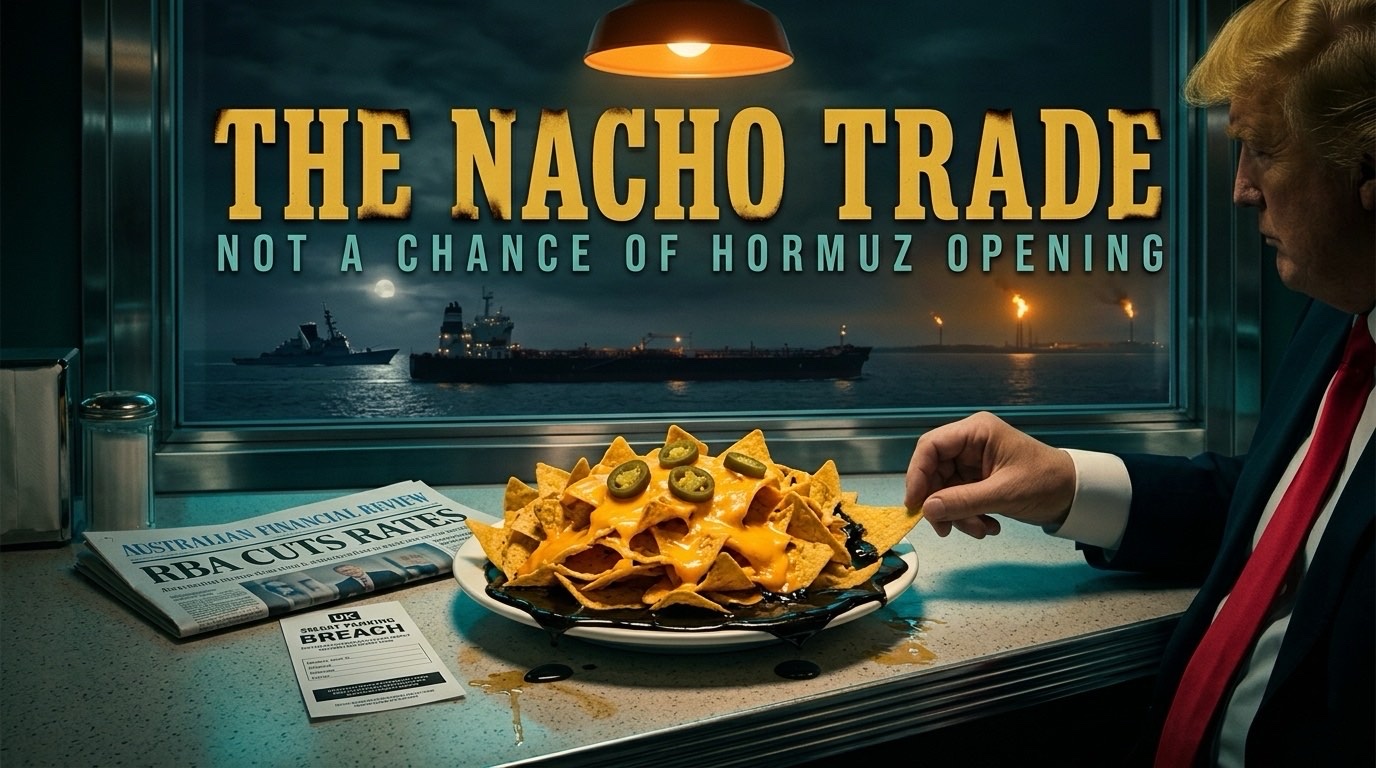
On this episode we dig into the “Nacho trade” (Not a Chance of Hormuz Opening), the RBA rate cut, and what tonight’s federal budget might mean for CGT and negative gearing. CSL hits a 10-year low after a $7 billion write-down and the Pentagon ditches mandatory flu vaccines, while Tony pulls the pork on Smart Parking — an Aussie-based tech company making most of its money issuing parking breach notices in the UK. We also cover the HUM takeover panel drama, two competing bids for Ooh Media, and the Vault Minerals/Regis Resources gold merger.
This week’s full episode is for QAV Club members only. The free episode is available below. Also check out our podcast archives link and our pages on Apple Podcasts or Spotify or watch clips on TikTok. Or visit our homepage to learn more about QAV and how it works as a value investing system that you can learn and apply to beat the market.
Transcription
QAV AUSTRALIA 919 CLUB VIDEO
Cameron: [00:00:00] Welcome to QAV Australia, Tony, episode 919. My baby’s, uh, got me going on the one after nine, one nine. I think it’s “909,” song.
Tony Kynaston: Mm-hmm.
Cameron: title today, Tony Nacho.
Tony Kynaston: You w- uh, y- maybe you’ll come up with something better during the show.
Cameron: No.
Tony Kynaston: an episode title at the
Cameron: No. I’ve already picked Nacho. I’ve got the one for the US episode too, it’s called Pump and Dump, but we’ll get to that later. Nacho. You heard of the Nacho trade?
Tony Kynaston: I have, but I’m just struggling to remember what it stands for.
Cameron: I just read about it in the Fin just a minute ago. No, it’s not a chance of Hormuz opening, is the Nacho trade. There was an article in the Financial Review this morning, uh, Michael, Michael Burry from The Big Short, basically talking about how the US market is headed for [00:01:00] a massive disaster, but they also had somebody mentioning the Nacho trade.
Not a chance of Hormuz opening. Trump, Trump says Iran’s offer is totally unacceptable. That was yesterday, and today he said, “The Iran ceasefire is on life support.” For weeks, all I’ve heard from him is, “Oh, they, they can’t wait to do a deal. They’re begging to do a deal. They wanna, they’d love to do a deal.
They’re desperate to do a deal.” Apparently, they’re not so desperate to do a deal.
Tony Kynaston: H- you name one war the US has gotten into in the last 100 years that hasn’t lasted for, like, at least five or six
Cameron: Yes. Yes, uh, Gulf War one.
Tony Kynaston: Ooh, that lasted a while though, didn’t it?
Cameron: Nah, it was over in, like, two weeks, but
just went in, surprise attack, massive overwhelming force, signed a, signed a deal with Saddam, and got out. [00:02:00] Um, but yeah, it was, it was a rare one. But, you know, as I’ve talked about on my other shows many times, you and I have talked about off air, you know, the US is driven by military Keynesianism.
The US economy survives on military Keynesianism.
Tony Kynaston: Mm-hmm.
Cameron: it is now, $1 trillion Pentagon budget he’s got it at, uh, people don’t realize how much the US economy relies on that and how campaign financing for senators and congressmen and women rely on that, how it’s, uh, uh, the centerpiece of the US– uh, how the US economy works.
Doesn’t get talked about much, but when you drill down into it. And you can’t justify that kind of a budget endlessly unless you’ve got a big war at least every five to 10 years.
Tony Kynaston: No, that’s all true. But my point is that every time [00:03:00] US, uh, exceptionalism thinks they’ll get in and out of a war within a week, it generally lasts
Cameron: But they don’t think that. That’s what they say publicly. They don’t really think that. I mean, the planners I don’t think, think that because there’s no profit in a quick war. I mean, okay, you do 24,000 missile strikes and you need to go and rebuy all those missiles, but there is some profit in it. But there’s a way more profit in a long drawn out war for everybody involved militarily.
Not for the people who die, but for the people who make the money on the back end of the military industrial complex, that’s where the profit is, right?
Tony Kynaston: Uh, yes, but I don’t think Trump saw things that way. I think he saw a way of stamping his authority and,
Cameron: Oh,
yeah, ”
Tony Kynaston: I’m a
Cameron: Yeah.
Tony Kynaston: than anybody else, and I’m a better deal-doer than anybody else,” and he’s just proving that he’s not.
Cameron: Well, I don’t think Trump knows what he’s getting into most of the time. He just… Yeah. Uh, [00:04:00] so anyway.
Tony Kynaston: in the shoes and goes, “Ooh, what have I gotten into now?
Cameron: Yeah.
Tony Kynaston: Look at
Cameron: Yeah.
Tony Kynaston: Best shoes
Cameron: mean, and a lot of it I do believe, like there’s also the element of distraction of the day, so deals are getting done on the back end and
building hotels in Gaza and, uh, probably in Venezuela and the Epstein file distraction and all that kind of stuff.
Tony Kynaston: Yep, definitely.
Cameron: Well, to give you credit where credit’s due, Tony, uh, you picked the RBA rate rise last week.
Congratulations on that.
Tony Kynaston: Thank you.
Cameron: Yeah. get a little trophy for you. Who was it?
Tony Kynaston: saying there wouldn’t be a rise and keeping my streak going, but yeah, it was getting a bit nonsensical. Um, I, I think the important thing to come out of the rate rise, though, was the message from the governor telling the treasurer not to put spending into today’s budget. we’re recording this on Tuesday the 12th of May, and they’re going to do [00:05:00] a… The, the budget’s going to be released tonight or… And even though most things have been foreshadowed, as far as we know, uh, and it doesn’t appear to be many more handouts, um, the RBA’s right. You can’t keep raising interest rates to cover the government giving handouts to people for cost of living increases.
At some stage, interest rates have got to be left to do the work by themselves
Cameron: Mm. And obviously the big news with the budget is gonna be rolling back the CGT discount
Tony Kynaston: Well, yeah, I, I don’t see that as being big news. Um, it’s, it’s changes to negative gearing I think will be bigger news, uh, whatever they are. Um, both of those were, of course, promised not to be touched before the election, so it’ll be interesting to see the political fallout of any changes, and I don’t know how big they’re gonna be. look, I’m on the fence with the CGT changes because I, you know, was investing before they came in, uh, as a result of the [00:06:00] Wallis r- uh, Wallis inquiry into finances back in the ’80s or n- ’90s, I think. Wallis Commission. Um, and look, I think it was a nice, uh, a nice idea that you get a benefit from holding things for more than twelve months.
Um, the stock side, it’s probably played a part in a decision of mine whether to sell a stock or keep it for another week or a month or days or whatever in a handful of cases, and I can’t even think of one, so it’s not that prevalent really. Um, it’s an issue. Uh, but I also think there’s not many people who buy a house and hold it for a year anyway.
I think most people’s… I think the average holding period on a, a mortgage is about five or six years, so houses are probably, you know, in that sort of, um, average sort of holding of probably a decade. Um, uh, people can look it up and work it out, but it’s longer than a year anyway. Some people will flip off the plan apartments, so buy them before they’re built, and if they’re within a year, flip them and, and sell them [00:07:00] or maybe hold them until it’s twelve months longer.
So, uh, personally, I think it’s being done for the wrong reasons. It’s not gonna change the housing market. Um, it’s, it’s really just a tax increase for the government. I don’t think it will change the way I invest. Um, it didn’t sort of have an impact on it the change came in, so I can’t see it changing it now.
But it will mean on the whole inflation, even if it’s running at three or four percent and the government… and the RBA wants to keep it a bit lower than that, two and a half to three, it’ll take a long time to hold an asset before better for you under the new regime, which is the CPI, the new old regime, which was the way it was done before the Howard years. before the CPI adjustment is better than a fifty percent discount on capital gains tax. Um, so I, I can’t see it having much impact in, um, the housing market. I don’t think people are really buying investment properties that they’ll get a CGT discount if they hold them for more than a year. Um, [00:08:00] they’ll, they’ll now pay more CGT to the government, so that might slow down the reinvestment of, of people buying houses. Um, but yeah, I haven’t seen the modeling, but it doesn’t seem to be a big, a big, uh, difference to me. The big difference, of course, as I said before, is in the other taxes that apply to housing construction, which is a big, throttle on supply, I think, and I don’t think this one is, is gonna change things at all.
Cameron: So no changes to QAV. We wanna hold stuff for as long as we can anyway.
Tony Kynaston: That’s right.
Cameron: Well, I tell you who I’m not holding is CSL, Tony. Um,
Tony Kynaston: goodness.
Cameron: shout out to Ruby, Rudi. Uh, I did have already a story in my notes from last week, which was in Reuters. Australia’s CSL knocked by Pentagon flu policy shift, stock sinks to 2017 low. Uh, the US Defense Department [00:09:00] said on Tuesday that military personnel would no longer be mandated to receive the flu vaccine, marking a reversal from a longstanding requirement and raising concerns about demand from a key institutional buyer.
But, uh, this was a big, a big deal for CSL. Well, obviously they were a big supplier to the US military.
Tony Kynaston: Did it say why they weren’t mandating flu injections?
Cameron: Yeah, because, yeah. Yeah,
Tony Kynaston: Really?
Cameron: yeah, Well, I’m sure that’s just part of the whole Trump administration, you know, vaccines are the devil’s work, kind of anti-science nonsense. But, um, then yesterday in the Fin, CSL faces biggest one day loss on record. CSL is on the cusp of its biggest one day fall on record after writing down the value of its assets by $7 billion and slashing its full year revenue and earnings forecasts.
When I pull up my stock [00:10:00] chart and look at, uh, CSL, uh, over the last 10 years, they’re basically back to 10 year levels. They’re below. 10 years ago, uh, they were tra– uh, no, what are we now? The 16th, the 12th of May. Don’t have the 12th of May. On this, on the 16th of May, 2016, they were trading at $113.87.
Today they’re trading at $97.55.
Tony Kynaston: Hmm.
Cameron: Wow.
Tony Kynaston: we might see them back on the buy list at some stage. I think their
Cameron: Ah.
Tony Kynaston: two at the moment, point zero two.
Cameron: Right.
Tony Kynaston: Yeah, look, it’s, um… I’ve always scratched my head it comes to what some people call blue chip stocks on the Australian market and, know, for decades, people have always said, “You have to hold CSL, you have to hold Cochlear.” Um, and I guess for decades they’ve been right until this year when they both come [00:11:00] crashing down. uh, you know, it’s what we’ve said before about growth stocks. Eventually they reach their saturation point, and then you can’t afford to pay a high PE a stock which stops growing. Um, and they revert back to being a, still a good quality business with cash generation, but no one’s gonna pay stratospheric PE ratios for it anymore, the share price comes down.
Cameron: There’s an article I saw from Rudi. Rudi, by the way, Rudi Filapek-Vandyk, Australian investing gadabout. Uh, we had him on the show years ago. I remember him talking about CSL.
I found an article from him, uh, from Livewire, uh, August 2025, where he, uh, says, um, about CSL, “Yes, the share price has gone nowhere, but underneath that, CSL is still growing at double digit rates.
That’s not a broken business. There’s pressure on management to show they’re back on [00:12:00] track. They don’t need to overpromise, but they do need to read the room. The wild card, US healthcare policy. They can’t control everything. If the anti-pharma rhetoric in US politics ramps up, it may hit CSL no matter what they do.
Still, Rudi isn’t bailing. If he were to rotate out of CSL for the next few years, it wouldn’t be into something lower quality. It’d likely be into ResMed, another compounder in the same space.” So, um, August 25, the share price was at $194. It’s halved since then. Wonder if Rudi’s still holding.
Tony Kynaston: Yeah, it’s interesting he calls it a high quality stock. I mean, I’m just looking at, uh, our numbers on the buy list and, and admittedly, I haven’t gone through and updated the manual data, but the quality score is fifteen percent at the moment for, uh, for CSL.
Cameron: ResMed was, uh, $44 in August of last year. It’s now at $27.47. So if he did rotate from that into ResMed, he hasn’t done well either.
Tony Kynaston: No.
Cameron: almost [00:13:00] halved as well.
Tony Kynaston: Yeah, and look, R– to, um, to, you know, the context around Rudi’s statement, he has a concept called the All Weather Portfolio, he was trying to find quality stocks that you could just put in the bottom drawer and make a portfolio out of them.
Cameron: Yeah.
Tony Kynaston: one of those. And, um, I th‑I think when we talked to him, I questioned the fact of why, uh, you, you’re paying a lot for those quality stocks, and when they stop growing, the, the price will crash.
And probably five or six years for that to happen since that conversation, but it has,
Cameron: Yeah.
Tony Kynaston: does.
Cameron: This was episode, season two, episode four, January 31st, 2020, if anyone wants to go listen to our conversation with Rudi and his, uh, super stocks.
Tony Kynaston: And to be fair to Rudi, we don’t know if he still holds it either, so he may have gotten out in the last 12 months before it crashed. I mean, CSL’s had a bumpy ride. It, it really got knocked around in COVID because essentially it’s a company which takes blood [00:14:00] donations and then makes plasma and distributes the plasma or sells the plasma from the blood donations. Uh, and they, they shut down during COVID, so it had a problem then. it realized that it had to diversify away from that kind of business, so it started buying other adjacent businesses, and some of those are being written down at the moment, so they haven’t worked out well for them either.
Cameron: If you held it for a couple of years prior to COVID, you did okay. It, uh, sort of, uh, November 2016, it was trading at 100 bucks. When we had Rudi on the show, January 2020, it was trading at 300.
Tony Kynaston: Yeah. Yeah, that’s, that’s– it’s the classic growth stock sort of stock graph over the long term,
Cameron: shh.
Tony Kynaston: and it goes up and it goes up, and then it crashes back to a 10-year low.
Cameron: Yeah. And then from January 2020 when it hit 300 bucks, it basically hovered between 300 and 250 up until the beginning of last [00:15:00] year, and it’s been sliding downwards ever since.
Tony Kynaston: It’s the same as the Bitcoin graph. It’s the same as the dotcom graphs. It’s gonna be the same as the AI
Cameron: Hmm.
Tony Kynaston: but, yeah. You’re, you’re buying hot air, and you’re
Cameron: Hmm.
Tony Kynaston: it
Cameron: Gas. We want mass, not gas. Mass, not gas. Uh, well, uh, somebody who had to sell his gas was Andrew Abercrombie, Humm’s founder. We’ve talked about him a bit over the, over the last year.
Tony Kynaston: a very interesting takeover situation, isn’t it?
Cameron: This is in The Fin, uh, yesterday. Humm’s founder, Andrew Abercrombie, ordered to sell $11 million stake. A panel that adjudicates on mergers and acquisitions has ordered Humm founder, Andrew Abercrombie, to sell shares in the consumer and commercial financing group after finding he and the board repeatedly misled [00:16:00] investors about a $385 million bid by rival Credit Corp.
The panel, which issued damning orders late on Friday, is forcing Abercrombie to sell a parcel of 15 million Humm shares. He controversially started acquiring those shares on December 17th, the day after– Oh, sorry, the day the Credit Corp offer was disclosed to investors and continued buying in the two days following.
So, um, yeah, there you go.
Tony Kynaston: Interesting, uh, write up in the Fin Review on the weekend about this. And, uh, there was speculation that, he was appealing the takeover’s, uh, decision that the whole thing was a delaying tactic to avoid having an EGM which is being called. Uh, and, uh, if he does have to sell the shares, his voting stake will be lower when the EGM is called, uh, and so the outcome may not suit him.
And you remember we had, uh, Collins Street Investors on. They’re, they’re part of the, [00:17:00] the two activist investors who have, along with… Oh, I forget now the third person who took them to the takeovers panel. But they’ve all been opposing this, um, the current situation with HUM, for not disclosing the Credit Corp, offer in a timely manner and then for share trading, uh, straight away at the announcement.
So, uh, it’s still got a long way to play out. We’ll see what happens. The share price isn’t doing too bad for HUM. I’ve noticed they haven’t looked at Credit Corp for a while, so, uh, I think it’s still a watch this space.
Cameron: The other activist investor is the very unfortunately named Mr. Raper, Jeremy Raper.
Tony Kynaston: no, sorry, the person I was thinking of was Anton Tagliaferro.
Cameron: Ah, okay.
Tony Kynaston: yeah, he, uh, I think he’s
Cameron: Also unfortunately named.
Tony Kynaston: but, um, still actively involved with his investments.
Cameron: Ooh, Tony. Ooh. OOO’s got another offer.
Tony Kynaston: [00:18:00] Another one?
Cameron: Well, when did you see the last one?
Tony Kynaston: That’s what I’m saying. Is it, is it another one? I thought it’s the first one I can think of.
Cameron: Well, they, ha-
Tony Kynaston: from
Cameron: th-
they had an offer from Pacific Equity Partners.
They’ve got another one as of yesterday, um, from iSquared Capital.
Tony Kynaston: I haven’t seen that.
Cameron: it up, uh, this morning. OOO Media advises that it has received an unsolicited, conditional, non-binding, indicative offer from iSquared Capital, ISQ, to acquire 100% of the issued share capital of OOO for cash consideration of $1.45 per share by way of scheme of arrangement.
This follows the receipt of an unsolicited, conditional, non-binding, indicative offer from Pacific Equity Partners, PEP, to acquire 100% of the issued share capital for $1.40 a share. So, um, they’re considering both proposals, and the board has unanimously [00:19:00] determined that neither proposal adequately reflects the intrinsic value of OOO.
Oh, boy.
Tony Kynaston: a third big fish to come and, come and get them. I’m just looking at the share graph. They’re one cent below their buy line at the moment.
Cameron: Right.
Tony Kynaston: Hmm.
Cameron: Mm. Um, so I don’t know. I don’t think we hold OOO.
Tony Kynaston: No, I think it, it was, has been a sell for a while, even though it was on the buy list last year. But I think, yeah, I think you sold it from all the portfolios you mentioned last week.
Cameron: Did I? Yeah.
So what’s happened with this new announcement? Let me see. OOO.
ooh, it’s jumping around with these, it’s, well, for both offers. It’s jumped from 85 cents at the end of April up to $1.30 Yes, but I do not own any OOO or any HUM [00:20:00] for that matter. No OOOs, no HUMs, but they have been regular players on our buy list over the last couple of years, as has CGF.
I added CGF as a possible buy for Lite yesterday. I think I’ve bought and sold CGF like, actually I still have it open here, uh, six times
Tony Kynaston: Eight’s
Cameron: since we’ve been doing QAV. That includes my super and the dummy portfolio and the Lite portfolios. I was like seventh time lucky.
Tony Kynaston: charm.
Cameron: Well, as I said in the Lite, um, email I sent out yesterday, I’ve learnt not to, not to, uh, second guess the checklist and, you know, HUM and OOO, uh, well, OOO is a good example of that. Like, I bought and sold OOO so many bloody times, um, because it was going [00:21:00] nowhere. OML, right? Are they OML?
Tony Kynaston: are, yeah.
Cameron: Yeah, right. Oh my God, look at that.
One, two, three, four, five, six, seven, eight, nine, ten, 11 parcels I’ve bought and sold from OML over the years.
Tony Kynaston: goes through, ’cause they both sound like they’re private equity companies, then, uh, you won’t have to worry about it again.
Cameron: Mm.
Tony Kynaston: It’ll be one of those stocks that Stephen Mayne talks about that, uh, are being taken private from the ASX.
Cameron: Yeah. Mind you, I think, as I think I said last week, its current price of a dollar thirty is below every buy price I’ve ever paid for it over the la- over those 11 parcels.
Tony Kynaston: Yeah, right. So you’re
Cameron: Well and truly.
Tony Kynaston: Yeah.
Cameron: Yeah, even where it is today, I’d still be losing money.
Tony Kynaston: Mm.
Cameron: Yeah, even where it is today, I’d still be losing money.
Tony Kynaston: Mm.
Cameron: But yeah, CGF. Um, Michael emailed me and asked if you’d do a Pulled Pork on WEB, um, Webjet, I think that is, the travel group.
Tony Kynaston: Mm-hmm.
Cameron: that it hasn’t been on the buy list [00:22:00] in the last five years, so
don’t know how that’s gonna work out. But, uh, why the hell not?
Tony Kynaston: I
Cameron: you ha-
Tony Kynaston: to get, um, recommendations, although I’ll just point out I’ve still got three to get through from the last list. I’ll do one today, so Webjet will be in
Cameron: There you go, Michael.
Tony Kynaston: a bit further as well.
But
Cameron: Mm.
Tony Kynaston: um, I’m not gonna– I’m gonna do one from, uh, the other list that, the other recommendations that came through today, uh, which is SmartParking. um, if, I hadn’t had requests, I would have had a look at, uh, TCO. Um, so I’m just gonna highlight that, that people might wanna have a look at that. A very, very small ADT stock. Uh, it’s just, uh, come onto the buy list, at least
Cameron: Hey.
Tony Kynaston: sure if it’s on yours, Cam. The ADT may have been too small. I think it’s just burst through, to about thirty-four thousand ADT, but [00:23:00] it’s, it’s, um, the share price is almost vertical at the moment.
Cameron: Hmm.
Tony Kynaston: look, running a small portfolio, have a look at that one. And I might get to it in a few weeks’ time, but if it’s still going strong. But yeah. for the recommendations, but I’ll get to WEB in a couple of weeks.
Cameron: TCO isn’t on mine. I’m just gonna look up why. TCO wouldn’t be ADT. That ADT would be good enough. Uh, doo, doo, doo, doo, doo, doo, doo.
Tony Kynaston: ’ the ADT last week I think was below.
Cameron: According to my checklist, the average daily trade is $1,000.
Tony Kynaston: Yeah, that Stock Doctor’s now saying thirty-four thousand, isn’t it?
Cameron: I don’t know. How does it go from 1,000 on the weekend to 34,000 today? Is it… I guess people got excited about it for some reason.
Transmetro Corporation. Average da- Oh, hold on. Average daily traded.
[00:24:00] Okay. Well, it’s showing 323,000 on Stock Doctor.
Tony Kynaston: It’s going through the roof. I think my download done this morning was thirty-four thousand from memory. I’ll look it up.
Cameron: Hmm. No, it’s… Or is it 323? Hold on. Is that thousands or is that just dollars?
Tony Kynaston: Yeah, it might be dollars.
Cameron: $323?
Tony Kynaston: you’re right. Sorry. I’ll take that back. I’m getting $1,000 on my download now too.
Cameron: Is it just dollars?
Tony Kynaston: I think so.
Cameron: Yeah, it doesn’t have any zeros in brackets after it, so yeah.
Tony Kynaston: I’ll take
Cameron: daily trade, $323. Yeah, that is a little bit below my ADT cutoff. What do they do, these people?
Tony Kynaston: Yeah. I
Cameron: Australian transport services and infrastructure company specializing in the design, manufacture, and operation of passenger transport systems, track work, and [00:25:00] associated support services.
Hmm, okay. Well, there you go.
Tony Kynaston: All right. Well, I won’t be doing a Pulled Pork on them. It’s too small.
Cameron: Hmm. Market cap of 43 mil. Well, Dave from Newy sent me an interesting email. Um, “I’ve listened with interest to a couple of Aussie pods recently about Pulled Pork requests from a Dave from Newy. I can confirm that as the OG Dave from Newy, they did not come from me. Either there’s been a clerical error at head office or there is someone out there masquerading.
If it’s the latter, tell him it’s pistols at dawn at Dixon Beach.” I did, I did look up,
Tony Kynaston: Yeah.
Cameron: last reference to Dave from Newy, and you did do a Pulled Pork a couple of weeks ago, and you said … No, you did Pete.
Tony Kynaston: Oh, okay.
Cameron: You said that was a request from Dave from Newy. And, uh, I don’t know who the other one was. Was it Kuskal, [00:26:00] you said?
Tony Kynaston: I, going on memory here, but I thought so, yeah.
Cameron: Hmm. Anyway, I think you might just, uh, be saying Dave from Newy every time. Just,
it’s the divine
Tony Kynaston: You’re our default listener, Dave.
Cameron: Oh, we’ll just say it’s Dave from Newy.
Tony Kynaston: y‑you play a
Cameron: Yeah.
Tony Kynaston: role in, in this podcast.
Cameron: Yeah. ‘Cause you’re the only person who tells us where you’re from when you say you’re … Yeah, it’s memorable. It’s branding.
Tony Kynaston: uh, when Stephen Mayne confessed on The Money Cafe podcast that was responsible for all the female questions that they were getting in.
Cameron: So sorry about, uh, that misrepresentation, Dave. He’s also says, “Sorry for the delayed response to Tony’s follow-up question to my five-year feedback email a couple of months back.” That actually was from the real Dave from Newy. He says, “I wrote I’d experimented with buying off the watch list. The short answer is yes, I have been buying before the 3PTL buy line is triggered.
But I’m [00:27:00] not buying falling knives. I’m waiting for at least two lows, that is, a new sell line is established. So a stock is above its new sell line, but not yet breached the buy line. I’m also looking for strong QAV scores to go with it, and preferably very cheap. I wouldn’t say I’ve codified my fudge in any way.
I scored big buying MRM offshore, MMA, off the watch list, and I think psychological bias kicked in and I looked for patterns to try to repeat it. As I said in my feedback email, my overall takeaway of my first five years is that the system works best when I get out of the way.” Thanks, Dave from Newy. Uh, congrats on a, uh, level-headed, uh, self-assessment of, you know, codifying your fudge and psychological bias, Dave.
I think those sorts of, um, uh, self-insights are, are, are important to be able to do that.
Tony Kynaston: Yeah.
Cameron: to do it, though.
Tony Kynaston: Yeah. And I mean, there’s, there are– Dave’s right. There have been cases, and I guess OML [00:28:00] is one of them, that we can see the stock price is rising, but it’s still just below its buy line. So do you jump in early or do you wait?
Cameron: Hmm.
Tony Kynaston: You know, I, I follow the rules and wait, but might have a better fudge than that
Cameron: Yeah. Well, keep fudging, Dave, uh, as you will, and, uh, report back to us how the fudge goes. How does it taste? Keep adding salt to that chocolate fudge, Dave. You know, my wife puts salt on-
Tony Kynaston: and sugar
Cameron: My wife puts salt on pretty much everything, but last night we were eating slices of watermelon. She puts salt on watermelon.
You ever put salt on watermelon?
Tony Kynaston: No, but Jenny’s like that. She puts salt on everything. But she’s got low blood pressure,
Cameron: So does Chrissy.
Tony Kynaston: Yeah.
Cameron: does Chrissy.
Tony Kynaston: girls.
Cameron: Yeah. Um, but I had a slice and it was pretty good. Like, it sounds… Yeah, it sounds ridiculous to me. She puts salt on apple, she puts salt on lemons, she puts salt on watermelon. [00:29:00] Um,
Tony Kynaston: be a bit unnecessary, wouldn’t it? Hmm.
Cameron: d‑don’t ask me. But yeah, salt on watermelon, actually it’s pretty good. Who knew? All right, I’m out of notes, TK.
Tony Kynaston: a, title for the– there’s a title for this show, Salt on Watermelon.
Cameron: It’s better than nacho, the nacho trade, really? All right, I’ll consider it. I’ll let I- I’ll let AI decide.
Tony Kynaston: It’s fine. I’ll defer. I had
Cameron: Coin toss.
Tony Kynaston: about.
Cameron: Hmm.
Tony Kynaston: been another merger, not just the OML or the OML offer or the HUM offer Um, but there’s, uh, a, a merger between Volt Minerals, which was on the buy list, uh, uh, recently last year even earlier this year, and Regis Resources, which again has been on the buy list as well.
So I think it is being held by some people out there, or they’re both being held by some people out there. Uh, in a nutshell, it looks [00:30:00] like a merger of equals. So I think, uh, the merger’s going to mean that when the– it’s a scrip offer so that there’ll be a ratio of shares from one to the other. But, um, Volt will end up owning forty– about forty-nine percent of the new company and Regis about fifty-one percent. Uh, that puts them into third place in terms of the size of, by gold production, um, on the ASX, uh, is, is, you know, getting up there. It’s a large, now a large cap gold mine of the combined entity. It’s gonna have about, uh, just under an eleven billion dollar market cap. Um, and, uh, I guess s- the other interesting thing about it is that both these companies, possibly because they’re on the buy list, have, uh, little debt and lots of cash.
And the merger, there’s about one point nine billion dollars sitting on the combined balance sheet. And there was an article in The Fin, [00:31:00] uh, recently anyway, last week I think, in Street Talk, uh, said, “The elephant in the room at today’s eleven billion dollar merger of Volt Minerals and Regis Resources was Genesis Minerals boss Raleigh Finlayson. So, uh, Genesis Minerals is also another company trying to consolidate gold companies and, um, has done it a couple of times, focusing on operating synergies so, uh, and focusing on, uh, Kalgoorlie mine operators. Genesis now has been beaten to the punch a couple of times by Volt, for a company called Red 5, which, uh, Volt took over and Genesis was looking at. Uh, and, um, article goes on to speculate that now that these two companies have merged and they have nearly two billion dollars of cash, that they may actually start on the prowl and perhaps Genesis is one of the companies that they might take over. [00:32:00] So I know that, um, some of the analysis I read said that the merger was great and, uh, it provided this cash box, which would mean the, the company would pay dividends or return the capital to shareholders. Uh, but Street Talk is, in the AFR, is suggesting it may lead to more mergers and acquisition plays in the space. that’s by the by. Um, luck to the people who are holding it and, uh, we’ll see what happens.
Cameron: Is the Genesis Peter Gabriel era Genesis or Phil Collins era Genesis? Oh, his era Ge- he’s the new guy, Jan. I heard a good, heard a good story just by the by. Uh, do you know who Bob Ezrin is?
Tony Kynaston: No.
Cameron: One of the great record producers of all time, particularly ’70s, ’80s record producer. Uh, did a lot of Alice Cooper’s albums in the ’70s and ’80s.
Um, did some with Lou Reed, did Pink Floyd, “The Wall,” did [00:33:00] a bunch of Kiss albums. But, uh, I was watching, uh, an interview with him recently, and he was talking about how he ended up getting involved with Lou. He, he had done, um, when he was, like, 21, he had produced a cover that Mitch Ryder did of, um, “Rock’n’roll,” Velvet Underground song.
And had to get permission from Lou, and then Lou’s management invited him to come and see one of Lou’s gigs. He went to this gig, and the opening act was this, uh, band called Genesis, and Peter Gabriel came out with a teapot on his head and makeup on and all sorts of stuff, or a, a flower coming out of his head or whatever.
And anyway, uh, apparently Bob said to the manager, “Listen, you know, I definitely wanna work with Lou, but find out who that guy is ’cause I wanna work with him.”
Tony Kynaston: Oh,
Cameron: Couple of years later, he– when Peter Gabriel left Genesis, he produced Peter Gabriel’s first solo album, the one that has “Solsbury Hill” on it. Um, I think guitar on that is played by Robert Fripp, too, [00:34:00] from memory.
Anyway, so yeah, Bob Ezrin. And so I got a great story. Oh, it’s not great. I got a story about that. 20 years ago, um- I was at a, an event, a Microsoft… No, it was a tech industry event somewhere in Melbourne or Sydney, and the iPhone had just come out. So it’s 20- 2007 maybe, eight. And there was an American– We didn’t have them in this country, and there was an American woman, I think she was a journalist, who was at this thing, and she had an iPhone, and she was sh- passing it around so we could all play with the first iPhone.
She was showing us how the contacts thing, you, you know, you can s- you can scroll, which was insanely cool tech 20 years ago. I was scrolling through her contacts and I see Bob Ezrin, and I’m like, “Holy crap, you know Bob Ezrin?” She goes, “Yeah, you know who Bob Ezrin is?” I was like, “Yeah, I know who Bob Ezrin is.”
And she promised to set me up with an interview with Bob Ezrin. Never happened. But anyway, [00:35:00] that was my close, nearly, my n- my nearly score of a Bob Ezrin interview. All right. That’s got nothing to do with whoever you were talking about. Vault and RRL. Don’t know how I… Sorry. Sorry. I’ll rein my ADHD back in.
Okay. Hmm. But seriously, check out Bob Ezrin, one of the great record producers. Yeah, really, really great record producer.
Tony Kynaston: Well, the only other thing I have to talk about, and it’s probably more appropriate for the US show, is that, uh, I noticed that is
Cameron: I
Tony Kynaston: Well, there’s a proposal from the SEC, which is backed by President Trump, which would give companies the option of going to six monthly reporting rather than quarterly reporting, which,
Cameron: we’ve already talked about that.
Tony Kynaston: Sorry?
Cameron: Pretty sure we’ve already talked about that on the US show some months ago. Yeah, same for me. I think you raised it.
Tony Kynaston: [00:36:00] Okay, I don’t
Cameron: Hmm. Well,
Tony Kynaston: it. Yeah. So
Cameron: well probably not then.
Tony Kynaston: are, uh, there’s some support for it. There’s some backlash because, uh, investors want the update from the companies on a regular basis. And I think, uh, it makes sense from, um, the point of view of, uh, less red tape and, uh, more longer term decision making with companies.
But as far as I know, doesn’t have the kind of continuous disclosure laws that we have in Australia, so they aren’t part of the recommendation. And if they go to six monthly reporting and they don’t have continuous disclosure, then, uh, it, it… sometimes it will be a surprise when the numbers drop for US investors going forward.
Cameron: Oh, okay. I’m asking Gemini.
Tony Kynaston: So I think that’s all I had except for a Pulled Pork.
Cameron: Gemini says, “The short answer is no. The United States does not have a dis- a continuous disclosure regime equivalent to Australia’s ASX Listing Rule 3.1, [00:37:00] Chapter 6A of the Corporations Act,” blah, blah, blah, blah, blah, blah, blah. “Australia is an equal access regime, whereas the US is a periodic and rule-based regime.
Hmm. In the US, there’s no standalone legal rule that says if something important happens, you must tell the market right now. Instead, the SEC relies on Form 8‑K, a list of specific current events, e.g. bankruptcy, CEO resignation, acquisition, that must be reported within four business days.” Okay. “Periodic reports, quarterly, 10‑Q, and annual, 10‑K.
Duty to correct or update. If a company previously said something that is now found to be false, they must correct Hmm.
Tony Kynaston: apply to the US government, though.
Cameron: They just double down. They have the
rule, yeah. Oh, my God. All right. So who are you, uh, pulling the pork on today, TK?
Tony Kynaston: Well, a really interesting company. It’s not on [00:38:00] our buy list, I’ll say up front. It’s a request, and it’s Smart Parking is the company.
Cameron: Hmm.
Tony Kynaston: at some stage, but its price to operating cash flow is
Cameron: Hmm. Wasn’t
Tony Kynaston: This was requested by Philip last week.
Cameron: Dave from Newy?
Tony Kynaston: not… Philip from Newy.
Cameron: Dave’s, Dave’s brother.
Tony Kynaston: yeah. And, uh, it’s even, uh, even looking at its sentiment, it’s currently a Josephine, so we wouldn’t be it even if it did score better. ADT’s not bad, $420,000, uh, dollars traded per day. Not overly large, but will suit a lot of people listening. So Smart Parking, uh, haven’t come across them for a long time. I remember when they listed, ’cause they were a backdoor listing through a beer company, which was a bit unusual, so I got some, some headlines at the time.
Cameron: Hello. Wait, wait, wait, wait, wait, wait, wait, wait, wait. How [00:39:00] does that…
Tony Kynaston: for the, for the show, names for the show here.
Cameron: Backdoor Beer. What’s, what’s… How do you do a, a smart parking tech thing through backdoor listing? What kind of beer company was there that they could do a backdoor listing through? Like some sort of startup boutique? Oh, okay. Sorry, I’ll shut up.
Tony Kynaston: become a, a… Rather than spoil the surprise, I’ll
Cameron: All of this shall become available to you. Yeah, I’ll shut up. You keep going.
Tony Kynaston: Yeah, go and play with a ball or something while you… for a while I do this.
Cameron: Wow. Okay. Yeah.
Tony Kynaston: so what it does is in the name. It provides smart
Cameron: Steve
Tony Kynaston: around the world, headquartered in Mel- in Port
Cameron: Mabb,
Tony Kynaston: in Victoria,
Cameron: CEO.
Tony Kynaston: local company. But they operate mainly in the UK, and they’re expanding into the US. They’re in New Zealand, and they’re expanding into Europe as well. Uh, what they do is they sell what’s called ANPR, which stands for [00:40:00] Automated Number Plate Recognition Systems. Uh, and they use a cloud-based, uh, technology hub to provide reporting to car park operators on their usage, they also install vehicle detect- detection systems in car park bays. people will have seen them at airports or in large shopping malls where you see a green above an empty space, and you can drive there and park there. Uh, and they also sell what they call park and walk meter systems, which is, uh, you know, where you tap your credit card on a car park space and, uh, um, sometimes you put your number plate in or whatever, uh, but it’s basically a metered system. uh, they operate mobile patrols for security and parking infringements as well.
So that’s they do. but the main part of their business is the Parking management side of things, and it’s, uh, represents roughly [00:41:00] eighty-three percent of their least, uh, in the prior y‑year up until recently. Smart Parking manages thousands of spaces for third-party owners, so I think retailers, hospitals, property managers, et cetera. But the revenue for this part of the business, so for the, for pretty much the entire business, through the issuance of parking breach notices, parking fines. they can’t call them parking fines, and I’ll get to that in a minute. They’re called PBNs, parking breach notices. They also sell their technology separately, but that’s a smaller share of revenue. Um, have kind of pioneered a business model where they can offer to install the CapEx free of charge, um, or, or sorry, pay the CapEx and the installation costs free of charge, and then, uh, they will take the f‑the breach [00:42:00] revenue as income to the company. So they install the software to be able to levy the fines. Um, the interesting thing about this company is the varying regulatory difficulties which they’ve come across while trying to roll this out nationally. and their, their tech is really good, so the number plate recognition cameras identify a number plate with over ninety-eight percent accuracy, the legal right to link that plate to a person’s name and address for enforcement is highly restricted. So, uh, run through a couple of the jurisdictions and how it affects the company’s ability to levy these parking breach notices, they’re banned in Queensland, so, uh, this company doesn’t operate much in Australia. It’s mainly based in, in, uh, England. Uh, so in March twenty twenty-five, the Queensland Government introduced laws to permanently block private parking operators from accessing the motor, motor vehicle register, which is where the [00:43:00] number plates reside to, uh, owners. many other Australian states, it is already illegal for private firms to look up owner details for civil debt collection without a court order. And likewise, in Europe, some company– some countries also have regulations like that. So Denmark, for example, in July twenty twenty-five, mandated that the initial parking breach notice must be physically placed on the vehicle, uh, Smart Parking normally them, um, either electronically or through the mail. So Smart Parking can still access the database in Denmark for reminders and debt recovery, they can’t use the automated mailout to do it. so despite all these challenges, though, the company continues to grow, and it’s definitely a growth company. look back over the years, it’s, it’s grown in every year it’s operated, uh, at least for the last, sorry, the last five years anyway, I think I had numbers for And it’s still growing. But it is facing, uh, some backlash for [00:44:00] these privately issued PBNs. Um, doesn’t happen in the UK, or at least in England as– for a start. and I’ll get to that in a minute, but I just wanna look at some of the other issues around the, uh, legal context for issuing these, uh, notices. So, um, some jurisdictions, the fine is an invoice. So it’s, uh, doesn’t have the characteristics of being a fine issued by, say, a city council. but the law can treat it like a breach of contract, and because of that, uh, it does have an effect on the damages that can be charged. So, um, usually if a contract is breached, the remedy is liquidated damages, but it’s pretty hard to estimate the liquidated damages for a car overstaying its, uh, its time without paying for a, um, in a space.
And so, under Aus- the Australian [00:45:00] Consumer Law, for example, the contract term that is enforceable is the penal– is a penalty, it’s, uh, has to have a genuine estimate of the loss. And the courts have previously found that charging sixty to a hundred dollars for a few minutes of overstaying is disproportionate to the actual loss. So there are legal hurdles, particularly in Australia and other jurisdictions which operate the same. thing is that, uh, the ACCC is very, um, cautious of, and has been on the front foot about, is that companies can’t mislead you into thinking the notice is a government fine. uh, the ACCC can, uh, begin action about deceptive conduct. um, that causes problems because, uh, if, if the is seen as a contract and not a, not a, a fine, then, uh, the only way that the debt can be collected is via the courts, and it’s a civil [00:46:00] matter. then a company, in Australia anyway, must sue you in the small claims court to force payment, cost of doing that can far exceed the fine.
So very few cases like, uh, these ever get to the, um, to the courts. the other thing that’s an issue is that, we– the fine should be levied on the driver and, A lot of times the driver is not necessarily the registered owner and so even if you do know who the registered owner is you can’t levy the fine correctly and that can also end up in court for a small amount can be not worth fighting by the company. So it’s difficult for the company to prove in court who was driving at the time and therefore it’s difficult to enforce the contract and then it’s difficult to recover it through the courts. So there’s a few legal hurdles that this company has I guess successfully dealt with over the years but it’s meant it operates in jurisdictions which allows them to operate easily. There’s a few other things to talk about. So England is different. England and Wales are [00:47:00] different to lot of jurisdictions which is why something like 83% of the revenue for this company comes from there. a thing called the Protection of Freedoms Act and Keeper Liability that says that if a driver of the vehicle is not identified the private parking company can hold the registered keeper legally liable for the unpaid parking charge. So that’s the owner of the vehicle. So that’s a bit different to Australia where you have to prove who was driving at the time. also in the UK as long as you’re a member of a registered association like the British Parking Association you have streamlined access into the registrations database so you can send out these notices very easily. there was also landmark 2015 Supreme Court ruling in the UK called Parking Eye versus Beavis. Interesting name. That [00:48:00] termed that the parking charges are not automatically unlawful penalties, but as long as the charge is clearly signed and serves a legitimate interest, for example, like managing traffic flow, then the PBN is legally enforceable as a contract the UK.
So, um, that’s why the company makes most of its money in the UK. There’s been a couple of changes in the UK recently which may impact the company, but, uh, hasn’t too much yet. The first one is that, uh, these private operators must have a mandatory ten-minute grace period before levera-leveraging a fine.
So if you’ve overstayed your park by ten minutes, get off. there’s also now caps, um, of a hundred pounds, it’s reduced to sixty pounds if it’s paid early to pr- to prevent excessive fining. And there’s also a more transparent independent appeals process for motorists. So of things which may start to crimp on Smart [00:49:00] Parking’s revenue in the UK, hasn’t slowed them down.
They’re expanding into Germany, Germany, uh, is, uh, of interest to this company because Germany’s doing a lot better ways of managing parking from an environmental point of view. So, the– Germany has lots of what they call smart city frameworks that encourage high-tech parking to reduce urban congestion, uh, that’s increasingly being done automatically and, and the Smart Parking company’s involved in that. And likewise, they’re, uh, pretty heavy in New Zealand as well. a long-standing presence in New Zealand, and that’s now scaling rapidly, because of contract wins. And so they’re– they were mainly operating in the major cities, but they’re now going out to some of the, uh, municipal councils in the other areas of New Zealand. New Zealand revenue’s doubled since, um, twenty twenty-four, and it’s up again another twenty-three percent in twenty twenty-six. So it’s still growing by contract [00:50:00] wins. But the big, um, the big deal lately is that they expanded into the US, and they did that by more shares to pay for a company called Peak Parking, and they paid thirty-six million dollars in March of twenty twenty-five, that gave them over a hundred and fifty parking locations in Texas and Florida. And states are important in the US because Texas and Florida have the loosest when it comes to private parking operators. Uh, they’re a bit more like the UK than other, other states like California and New York, which, um, make it hard for Smart Parking to levy, uh, PBNs, but, um, they can do it in Texas and Florida. Excuse me. They, um, the growth is, uh, is still increasing dramatically, and they called out in their latest results that they expect to have a portfolio of three thousand automated number reading sites [00:51:00] in, uh, by the end of twenty twenty-eight. And that’s almost doubling of the current number. So they currently manage eighteen hundred number recognition sites globally. enough, they only have seventy-one in Australia, so it’s not big in Australia, uh, even though it’s Australian-based. They expect to, to get growth from rolling out into other countries in Europe, like Switzerland, and to expand into other states in the US. They also have a unique expansion strategy, which is, uh, using their cash flow to buy manual parking operators and then quickly tech enabling them with proprietary cameras, which increases significantly the site margins, and they’ve used that before to, to grow the company. Uh, interesting history. So that’s enough on the company and its growth. Um, I should say… Sorry, one last thing before I leave that, is that they, they also face, uh, a lot of competition, even though they’re growing, uh, through, uh, the [00:52:00] met-methods about. They’re getting competition from large car parking operators like Wilson Parking, for example, in Australia. Uh, and large parking operators are investing in their own tech and putting it into their car parks, and that’s, uh, proprietary solutions and not using companies like Smart, uh, Parking to do that. Uh, but there are, there are also a number of tech companies who operate in the same space in varying degrees, such as Skedata, Parkmobile, Parkdata and Snowbird, to name a few. uh, even though they’re growing a lot, face regulatory issues and they face strong competition. Getting back to what we talked about before with the history of the company and how they got to, uh, list on the ASX. was formed back, uh, when two of these, uh, car parking companies merged. Um, Perth Car Parks, uh, which was started in nineteen ninety-two, and that was a traditional parking operator in WA, and a company called MeterEye, [00:53:00] uh, which was started in two thousand and three, was a tech business in New Zealand that developed the core bay sensor and backend technology still used by the company today. In the mid-two thousands, the current listed vehic- the current listing vehicle a company called Empire Beer Group, which owned hospitality assets like the Colonial Brewing Company. And, uh, what happened there was that the owner of Empire Beer Group, a guy called Christopher Morris, who founded Computershare, out the the hospitality assets from the Empire Beer Group and privatized them and left the cash in the corporate shell to then go and acquire Perth Car Parks and MeterEye and list them, uh, via a backdoor listing on the ASX. Uh, so that was back in the mid-2000s. Then the other, I guess, the highlight, uh, uh, that kicked this company further its growth spree [00:54:00] was when, uh, a chap called Paul Gillespie was appointed CEO in 2013. And, uh, he kind of, rolled out the company more aggressively, obviously into the UK. and, they rebranded in 2013 when he– around the time he joined to be called Current– the current name of SmartParking Limited. But he also took the software into the cloud, which was a big kick along for this company and enabled them to, offer that, uh, capital light model for car park owners to have the, the hardware installed and then for the company to take the, um, the fine the, uh, private, uh, overstay breaches, uh, the revenue from those to its balance sheet, uh, as revenue. Uh, company expanded– it started expanding aggressively in Europe in 2021 when it, uh, expanded into via the acquisition of a company called Park [00:55:00] Innovation, it established, uh, offices in Denmark and Switzerland, and in 2025 when it went into the US via the acquisition of Peak Parking. So going back to those two listed, uh, two people who helped the company, uh, list and then grow, Christopher Morris is now executive chair…
Not executive chairman, sorry. he’s a rich lister who founded Computershare, he’s been chairman of SmartParking since 2011 and is still its largest shareholder. He currently holds about twenty-six percent of the company. So, uh, he came, uh, across them via his, uh, while he was, uh, running the beer company that we spoke about before. And, um, he said that because of his, uh, background in Computershare, when he saw the young entrepreneurs at MeterEye, they reminded him of his younger self in starting Computershare, he believed that parking management was the [00:56:00] next Computershare due to the high demand for space and potential for automation. Uh, so that’s him, Paul Gillespie. Sorry, I’ve been talking for a while without a break there. I’ll have to just take a quick break. Um, but Paul Gillespie, uh, came from within the industry. He ran a company called Xerox Parking Services in the UK when he joined. So both the chairman and the CEO have extensive experience both in tech and in, uh, parking, uh, we have an owner founder in that case to, uh, put into our results. Uh, year results were good for the company. Revenue surged ninety-six percent to sixty-two million dollars. US expansion was, uh, doing well under Peak Parking, uh, they were now contributing a lot to the earnings per share for the half. Uh, they, as I said before, they’ve called out an expansion to a portfolio of three thousand sites by the end of twenty twenty-eight and the company has a very [00:57:00] strong balance sheet with a net cash position and positive free cash flow.
So all good things. However, price has gone down a lot this year Largely due to a reduction in margins. margins have contracted from what was eight point eight percent down to the current five point four percent, uh, that’s kind of spooked the analysts a bit and has forced them to lower their, forecast for the company. you add to that the dilution of shares for the US acquisition, which happened in March twenty twenty-five, uh, and when those shares came out of a twelve-month escrow in March twenty twenty-six, there was a fair bit of selling, which has forced the share price down. So, um, it’s, it’s been decreasing a lot this year. Doesn’t mean that that hasn’t flushed through the system, and it will go up again, um, ’cause the numbers aren’t too bad except for the price to operating cash flow. But at the moment, they’ve been down a lot this year. Going on to the QAV numbers, the share price is currently [00:58:00] eighty-one cents. And to be fair, that’s less than half of the consensus target that brokers have on the company, but it’s way above our IV1 of seven cents and IV2 of thirty-six cents. has no dividends, so we can’t score it for that. Stock Doctor financial health and trend is strong and steady. Stockopedia quality rank is ninety-three, very good. F‑score is seven out of nine, which is excellent. the overall rank in Stockopedia is only seventy, it, it, uh, has very low rankings for value and sentiment in Stockopedia, which drags down the overall. PE for this company is a whopping fifty-seven point five, um, but interestingly enough, that’s not the highest or the lowest, we don’t score it. Uh, we score it a zero for that. as I said before, Pr/OpCaf is fourteen point two seven times, so it doesn’t meet our, our requirements. Net equity per share is twenty-two cents, so we can’t buy it for even book plus thirty percent. And I also add that the NTA is lower than that because of the [00:59:00] carrying, uh, values of the acquisitions it’s done along the way. Forecast earnings per share growth is a hundred and sixty-two percent, which growth over PE is two point eight two. that, I guess, is the story of this company. It’s a growth company.
It’s being valued that way with a high PE. Uh, and even though the shares have come down a lot this year, not enough to get to the levels where we call it value in any of our sort of, dimensions for measuring value. We have an owner/founder under Chris Morris who, uh, and directors hold twenty-eight percent It’s not a new three-point trend line, uh, breakthrough. It happened, uh, a while ago. does have consistently increasing equity, which I like. but the total quality score for this company is seven out of fifteen or forty-seven percent, and the QAV score is point oh three. uh, it’s not getting up there for us at the moment. It does con– Excuse me. It does have growth, but it, um- Comes with risks. the regulatory, um, [01:00:00] environment is, is a big one. Can be an opportunity, I guess, if they can get, uh, laws… can lobby for laws changing, uh, to suit them. But at this stage, they seem to be going the other way, and so there are more caps on what they can do as a private operator levering, lever, uh, uh, charging these, um, overstay notices or call them parking fines, but they can’t call them that themselves. and I think the other risk for this company is further capital raising. So they, they may have learned their lesson that, uh, it can tank the share price, but they did a big one to expand into the US and, um, hurt them. but it may happen again. guess the opportunity, though, is the growth side of things.
They continue to grow through international expansion and conversion of manual car parks to automation, and that’s not a bad business model they have, funding that through cash flows, which is good. Um, but as we’ve seen with companies like CSL, eventually that have a high growth trajectory [01:01:00] reach maturity.
Now, whether that’s in ten years’ time, who knows? I’m not that familiar with the market, but it’s something to bear in mind that you’re paying a high price at the moment in a company which is not scoring well on our quality metrics. So bear that in mind. But a very interesting company. Um, Australian-based, of tech-based and operating mostly overseas, even though it’s still based in Port Melbourne.
Cameron: you, TK. I wonder, you know, I don’t know what the timeline is on this, but if we are to believe the guys running Uber and Tesla, et cetera, et cetera, we’re moving into a world where people aren’t gonna own cars anymore. You’ll just book a,
Tony Kynaston: Yeah,
Cameron: an autonomously driven vehicle to take you anywhere you wanna go, unless you’re, I guess, traveling long distances interstate or something.
I wonder what the p- the future of parking is when no one owns a car anymore, or very few people own [01:02:00] cars.
Tony Kynaston: it’s a good question, but I don’t know how quickly that’s gonna
Cameron: Hey, can I interrupt? Yeah, Myana.
Tony Kynaston: it, it– I’d probably add that to the list of risks that, that will, the, the company will eventually face. But I’d suspect that they’ll face, you know, a, a saturated
Cameron: I would say-
Tony Kynaston: before they face that one. But who
Cameron: Yeah. Hmm. You know, I tell Fox, he– “You’re probably never gonna have to get a driver’s license. I d- I, I c- I don’t think you’re ever gonna have to own a car or have a driver’s license.” Like, he just turned 12 on the weekend. Six years from now,
Tony Kynaston: Oh,
Cameron: hmm. Oh, yeah, he’s very happy too. He got his first,
got his first desktop PC.
He’s a very, very happy camper. Um, yeah, I, I, yeah, I, I, I don’t think cars will disappear off our roads in the next five years Um, you know, Elon’s been promising self-driving cars now for 10 years.
Tony Kynaston: how does that work at Cape Schanck? Do I have to book a car to self-drive itself [01:03:00] from Melbourne or Rosebud or something to get to me and then get out? It’s gonna be a, a very heavily coordinated activity, I think, if I have to do that.
Cameron: Yeah, look, I think there’ll be exceptions, but I also think there will just, you know, if, if the vision that these guys are selling is true, there will just be self-driving auto- autonomous vehicles everywhere. You know, there’ll just be wherever there’s populations, there’ll be enough self-driving cars to accommodate the amount of transport that needs to be done.
Tony Kynaston: down the road. But what about
Cameron: Hmm.
Tony Kynaston: do you still need to have a license to take it over? Like, I think even the– do the self-driving cars now, they’re, they’re advanced enough so they don’t have a steering wheel or brakes or accelerator?
Cameron: I think in China, some don’t. Um, I think the new ones that we talked about on the US show, uh, recently, the pods. We were talking about the… I can’t remember the name of the company, but we were talking about a company that supplies the electronics for them. Oh, yeah. That’s right. Good. Yeah. Vooks, Mooks, something like that.
[01:04:00] Those new ones that Amazon are building don’t have any steering wheel. Um, I think all the studies I’ve seen say that autonomous driving, whilst not perfect, is still far better than humans in terms of avoiding accidents.
Tony Kynaston: right.
Cameron: as AI continues to develop, we will definitely hit a point where you won’t want a human anywhere near a steering wheel.
But, um, anyway. Probably some years before that happens, if ever. Interesting. Yeah. Not often we get to talk about a tech stock on the Australian show, and we shouldn’t talk about this one either because it’s not a buy. Nowhere near a buy, right? But yeah.
Tony Kynaston: I guess that’s a question for you, Cam. The other– two of the other recommendations, I haven’t looked at WEB yet, but I suspect it’s the third. they’re not on the buy list. Um, so, uh, do we want to persist with these recommendations or, or you, you happy to have
Cameron: Yeah,
Tony Kynaston: Yeah,
Cameron: Well, I think it’s always interesting to hear about… I mean,
Tony Kynaston: [01:05:00] I think so too.
Cameron: look, there’s no reason to ever talk about any companies on these shows because that’s not how we invest,
really. Like the one I’m gonna do in the American show today, TRS. Um, it’s got some question marks over it, like when we did MRP. So I wanna run them past you before I add them to the light portfolio over there.
But, um, I wouldn’t have known that if I hadn’t have done a Pulled Pork on it. If just going by the scoring, I would’ve added it and then if it was a bad idea, then it would’ve become evident later on, right?
Tony Kynaston: Yeah.
Cameron: Don’t do that much research. But no, I think it’s always interesting to learn a little bit about new businesses and business models and that kind of stuff.
I’d never heard of these guys before, but the whole smart parking thing is definitely an interesting space
Tony Kynaston: is, yeah. And it’s, it’s certainly, certainly a lot more of it these days. I can’t think of the last time where I, um, you know, had to pay for a entry to a,
Cameron: Hmm.
Tony Kynaston: to a, a, a hearse, a person. It’s [01:06:00] always been automated and
Cameron: Hmm.
Tony Kynaston: your credit card now, that’s more automation than the past, but getting more automated as we go through.
Cameron: I remember, you know, the last time I had a job in the city when I worked at an ad agency for a year or consulted to an ad agency, and I had to go out and put coins in the parking meter a couple of times a day ’cause they didn’t even have tap-and-go parking on the streets in that part of Brisbane at the time.
And that just seems–
Tony Kynaston: Coast.
Cameron: Oh, well, yeah, I’m not that old.
Tony Kynaston: Uh, and I remember many years ago having to break into a, a, car park hut where the guy used to take the money to get keys to take our car out of a car park after hours ’cause we were out late partying in the city.
Cameron: Wow. Car
Tony Kynaston: we
Cameron: Park Hut.
Tony Kynaston: in to lift the keys off the hook to get our car out. It was paid for in advance, so it was, it wasn’t like [01:07:00] we weren’t paying for it, but the car was in the yard at 2:00 or 3:00 in the morning.
Cameron: Right. All right. Well, thank you, TK. Uh, thank you, Phil, not Dave from Newy, for suggesting that. What have you got for after-hours, TK? Quick one.
Tony Kynaston: Yeah, not a whole lot today. I probably, um, wanna focus on Red Dragon. Have you seen that? You probably have. It’s like 40 years old or something,
Cameron: That’s one of the sequels to “Silence of the Lambs.”
Tony Kynaston: that’s the interesting thing. So I, I hadn’t seen it before, and it came up on, um, one of the streams. Jenny and I watched it, Jenny said, “Oh, this is a sequel to Silence of the Lambs.”
No, it’s the original. The Silence of the Lambs is a sequel to Red Dragon.
Cameron: Right.
Tony Kynaston: interesting to see that the, um, Anthony Hopkins character was fully formed and his backstory, uh, that, um, the FBI agent this time was played by, um, his name? Ed, uh, Norton.
Cameron: [01:08:00] Right.
Tony Kynaston: of role to the one that Jodie Foster played in Silence of the Lambs.
But, um, yeah, it was just– It was– I always thought Silence of the Lambs was so original and a breakthrough and interesting, but it was, it was a sequel to Red Dragon.
Cameron: But “Red Dragon” is a prequel.
Tony Kynaston: No, I think Red Dragon came out first.
Cameron: No. No way.
Tony Kynaston: Yeah.
Cameron: No. So “Red Dragon” came out in 2002. “Silence of the Lambs” came out in 1991.
Tony Kynaston: Oh, really? I got that wrong, have I?
Cameron: Yeah.
Tony Kynaston: Okay. Sorry.
Cameron: Yeah, it was a prequel, um, that, um, Brett Ratner made. Yeah. Hmm.
Tony Kynaston: Oh, well that, that makes sense then. I thought it was the first one that came out. Now, is there an earlier version of Red Dragon? ‘Cause I seem to recall it was out first.
Cameron: So Michael Mann,
Heat, made a film called Manhunter in 1986, which is based [01:09:00] on Hannibal Lecter
Tony Kynaston: Okay, maybe that’s what I was thinking of.
Cameron: and Will Graham. Brian Cox was in it. Um, who else? Uh, looking at the thing here. No one. Joan Allen.
Hmm.
Tony Kynaston: Yeah.
Cameron: Um, but actually Hannibal Lecter’s– Does it say Hannibal Lecter’s in this? But it’s kind of loosely based on the– that story. never seen it. I’ve always tried to track it down to see it. Um, but yeah, Silence of the Lambs then was made. And you know, I, I’ve told you the story about meeting Anthony Hopkins, right? Remember that one
Tony Kynaston: one of the reasons for raising it today.
Cameron: Mm-hmm. Uh, great actor. Great actor. I, I remember see- I did see Red Dragon. I don’t remember it being great.
Did you? Yeah.
Tony Kynaston: just the acting. It fa- a lot of famous, uh, people are in the [01:10:00] show. Um, Fiennes plays the bad guy. Hannibal Lecter was played by Anthony Hopkins. Ed Norton’s in it. Yeah.
Cameron: Harvey Keitel, Mary-Louise Parker.
Tony Kynaston: Parker. Yeah. So
Cameron: Philip Seymour Hoffman.
Tony Kynaston: Mm-hmm.
Cameron: Yeah. There was another one that they made too, with, uh, what’s his face in it,
Tony Kynaston: Okay.
Cameron: there’s another sequel, I think. Try- scrolling through IMDb, trying to find out who that was, but it was, it was really bad. Anyway, hmm. Oh, Hannibal, it was called.
Yeah. 2001.
Gary Oldman. Ray Liotta, that’s who I was thinking of. Julianne Moore, Gary Oldman, Ray Liotta. Hmm.
Tony Kynaston: Oh, I do recall seeing that one. Yeah, that’s a sequel.
Cameron: Yeah. Um, Julianne Moore played Clarice [01:11:00] Starling in that one.
Tony Kynaston: Yeah.
Cameron: What else?
Tony Kynaston: Uh, have you seen the movie called “The Hunt” from two th- two, uh, from 2020, I think it is? So the, uh, series that’s out, I think on Apple TV, called “The Hunt.” It’s not that. is on Netflix and it’s a movie. And, uh, I watched it last night. Um, I really kind of enjoyed it. Uh, the only sort of actor in the cast is Hilary Swank, and she plays a small part in it. Um, and it’s a sort of… I, I was c- I was looking at The Hunt and trying to work out whether I wanted to watch it, the TV series on Apple, and then I saw the short for the movie and I thought, “That looks much more interesting.” Even though it’s a, it’s kind of a cliché trope of having a secret place to take humans to hunt for sport.
Cameron: Oh, yeah.
Tony Kynaston: this movie is like a black comedy and it turns the whole trope on its head, one of the, one of the [01:12:00] people they’ve kidnapped is the wrong person, and she runs amok and kills all the billionaires. a spoiler alert, but, um, it’s actually really, really good.
Cameron: The, the new series that’s got, um, what’s her face in it from the thing. Mad Ma- the Mad Max, uh, sequel.
Tony Kynaston: Charlie’s?
Cameron: Charlize Theron. Yeah, yeah. Is it the one with Charlize Theron in?
Tony Kynaston: No, no, that’s a different one again. I think it’s called Apex.
Cameron: Oh, she’s getting hunted in that one, isn’t she? That’s
Tony Kynaston: a
Cameron: a different
Tony Kynaston: but,
Cameron: thing.
Tony Kynaston: thought it was quite good.
Cameron: Right. Uh, no, I haven’t heard of it. Sounds good.
Tony Kynaston: I hadn’t heard of it either, so
Cameron: I like– I, I totally like the idea of hunting rich people. Oh, no, it’s the other way around. It’s rich people hunting poor people. Yeah,
Tony Kynaston: goes and
Cameron: yeah.
Tony Kynaston: so it’s,
Cameron: Hey, listen, maybe that’s the next season of QAV.
You and I will hunt each other in Cape Schanck. Just with paint- paintball guns. Nothing, nothing lethal. Just [01:13:00] give us, uh, each a paintball gun and then, you know, it’s like capture the flag. We, we, we, uh, hunt each other across the golf course. Have you ever played paintball?
Tony Kynaston: I haven’t
Cameron: Ah.
Tony Kynaston: not
Cameron: Should get you into a paintball course
Tony Kynaston: Uh,
Cameron: and the, me and the boys.
It’s, uh… We used to do that on their birthday every year. It was fun.
Tony Kynaston: Speaking of that, like last night there was a, someone lit off a flare down the street and I was like, sit like– ’cause at home here at Cape Schanck it’s just quiet and dark. see this blue flare, couple hundred meters away go, go across it was just, you know, really eerie. Couldn’t see anything, couldn’t hear anything, just this flare. So one of the local kids I suppose is having fun on the golf course. But
Cameron: Oh.
Tony Kynaston: really eerie.”
Cameron: Hmm. Well, I don’t have much to report this week. I did watch Waiting for Guffman [01:14:00] on Mother’s Day with Chrissy. You ever seen that?
Tony Kynaston: Oh, I think I saw 10 minutes of it and turned it off.
Cameron: Not your…
Tony Kynaston: guys.
Cameron: No? Okay.
Yeah, that’s right. You said you weren’t a big fan of Catherine O’Hara, so that tracks.
Tony Kynaston: No, or any of those, um, mockumentary best in shows and all those.
Cameron: Hmm, Christopher Guest films? Hmm.
Tony Kynaston: And didn’t they remake, uh, um, what’s the Australian show? Um, with Kath & Kim. I think they remade them as well, and they were terrible
Cameron: He did that?
Tony Kynaston: Well, I don’t know if it was him, but certainly some of the actors from all those mockumentaries are in
Cameron: Oh, okay. Yeah.
Tony Kynaston: style of,
Cameron: Right.
Tony Kynaston: just hammy overacting from, you know… don’t know if they’re trying to make fun of people who are American and don’t have much of a brain, but yeah, it’s just I don’t, I don’t find it funny.
Cameron: Uh, okay. Um, let me, uh, tell you about a book that I [01:15:00] heard about s-
Tony Kynaston: You can recommend Welcome to Government if it, if it
Cameron: No, no, no. It’s, it’s fine. We’ll move right along. Um, you know, uh, well, maybe you don’t know, but Elon’s big data centers that he builds for his AI operations, he calls, um, uh… What does he call them? Colossus.
Tony Kynaston: From the Forbin Project.
Cameron: Yes! Right. So you do know it.
Tony Kynaston: No, I know the movie. I don’t know about Elon’s data centers.
Cameron: Oh, okay. Well, um, I had never heard of, um, Forbin and or the, or the movie. I didn’t even know there was a movie until you just mentioned
Tony Kynaston: Hmm.
Cameron: based on books
Tony Kynaston: Oh, okay.
Cameron: which I started reading the first one, uh, this week, you know, uh, knowing that you’re a science fiction fan, I wondered if you had read it.
Tony Kynaston: Haven’t
Cameron: read it?
Tony Kynaston: the movie. The movie came out when I was a kid
Cameron: 1970, I just looked it up. [01:16:00]
Tony Kynaston: that, uh, imprisons a man to study him. think he was the inventor of the AI from memory.
Cameron: Right. So the original book was written in 1966 by a guy called D.F. Jones, Dennis Feltham Jones. Wrote Colossus: The Fall of Colossus, and Colossus and the Crab. Um, so yeah, I’m sort of… Uh, I, I, I’m enjoying the first one. It’s, it’s kind of hilarious to read, you know, AI books from that period. The AI when it gets turned on, um, you know, it’s communicating with the humans via, uh, ticker tape that’s coming out of the side of the machine.
We were visionary enough to imagine artificial intelligence, but not visionary enough to imagine a world without ticker tape machines.
[01:17:00] was talking in natural English like our computers do. The AIs do talk to us like that today, so at least those guys got it somewhat right.
Had lots of flashing lights, which we don’t seem to need on our computers these days. I do love a, I do love a sci-fi film with lots of flashing lights on the supercomputers. Kind of miss that, to be honest. Kind of wish my computers did have, like, flashing lights and spinning tape reels and everything. It was so much more aesthetically pleasing than just a- Nondescript black box.
Tony Kynaston: It’s better for movies, isn’t it? When you can see things actually
Cameron: Yeah, it’s
cooler.
Tony Kynaston: Yeah. Like in Star Wars or Star Trek where there are all these lights that just flash.
Cameron: Yes, give me lights that flash and beep.
Tony Kynaston: Yeah.
Cameron: what have I been listening to that I can share with you? Um, nothing comes to mind. [01:18:00]
Tony Kynaston: issue of The Aints which was really good.
Cameron: The Aints.
Tony Kynaston: Ed Kuepper
Cameron: Saints without that S. I’ve never heard of that.
Tony Kynaston: style of music. It’s good.
Cameron: Well, good.
Uh, do you see The Stones have got a new album coming out?
Tony Kynaston: I, I’ve been seeing it on my streams. Yeah. The
Cameron: I listened to the first track that they’ve released, uh, off of that. It’s not bad.
Tony Kynaston: Mm-hmm. Yeah, it’s all right.
Cameron: And, uh, I’ve been listening to a lot of Yes this week. Do you like Yes?
Tony Kynaston: Oh, not– I haven’t heard a whole lot of them. I did a lot when I was a kid, but I can’t remember much of it.
Cameron: Hmm. I like.
Tony Kynaston: from
Cameron: Wow.
Tony Kynaston: people who were still in Yes of about 10 years ago.
Cameron: Wow. Why?
Tony Kynaston: one of my Canadian friends got it for me for a birthday present.
Cameron: Because they thought you were a big Yes fan or just…
Tony Kynaston: I think he’d been to, like, some kind of corporate gig with
Cameron: [01:19:00] Oh,
Tony Kynaston: where they were playing.
Cameron: right. Jon Anderson are those guys.
Tony Kynaston: No, I got no idea.
Cameron: Hmm. Okay. Well, that’s it. That’s all I got. TK, thank you. Have a good week everyone. QAV a good one.
Tony Kynaston: All right. And we’ll, we’ll know more about the budget next week
QAV LIGHT
You don’t need to build it yourself.
Click the picture to learn more!
QAV LIGHT
He already knows where they are.
Click the picture to learn more!
QAV LIGHT
Someone already cleared the way.
Click the picture to learn more!

QAV LIGHT
Same destination. You choose where you sit.
Click the picture to learn more!

Quality At Value. A rules-based approach to investing on the ASX and US markets, built on 30 years of experience.
© 2026 Spacecraft Publishing (“QAV”) ABN 41 163 119 300. Authorised Representative of AFSL 520442. AFS Representative Number: 001292718. The information on this website is general in nature and does not take into account your personal objectives, financial situation, or needs.