
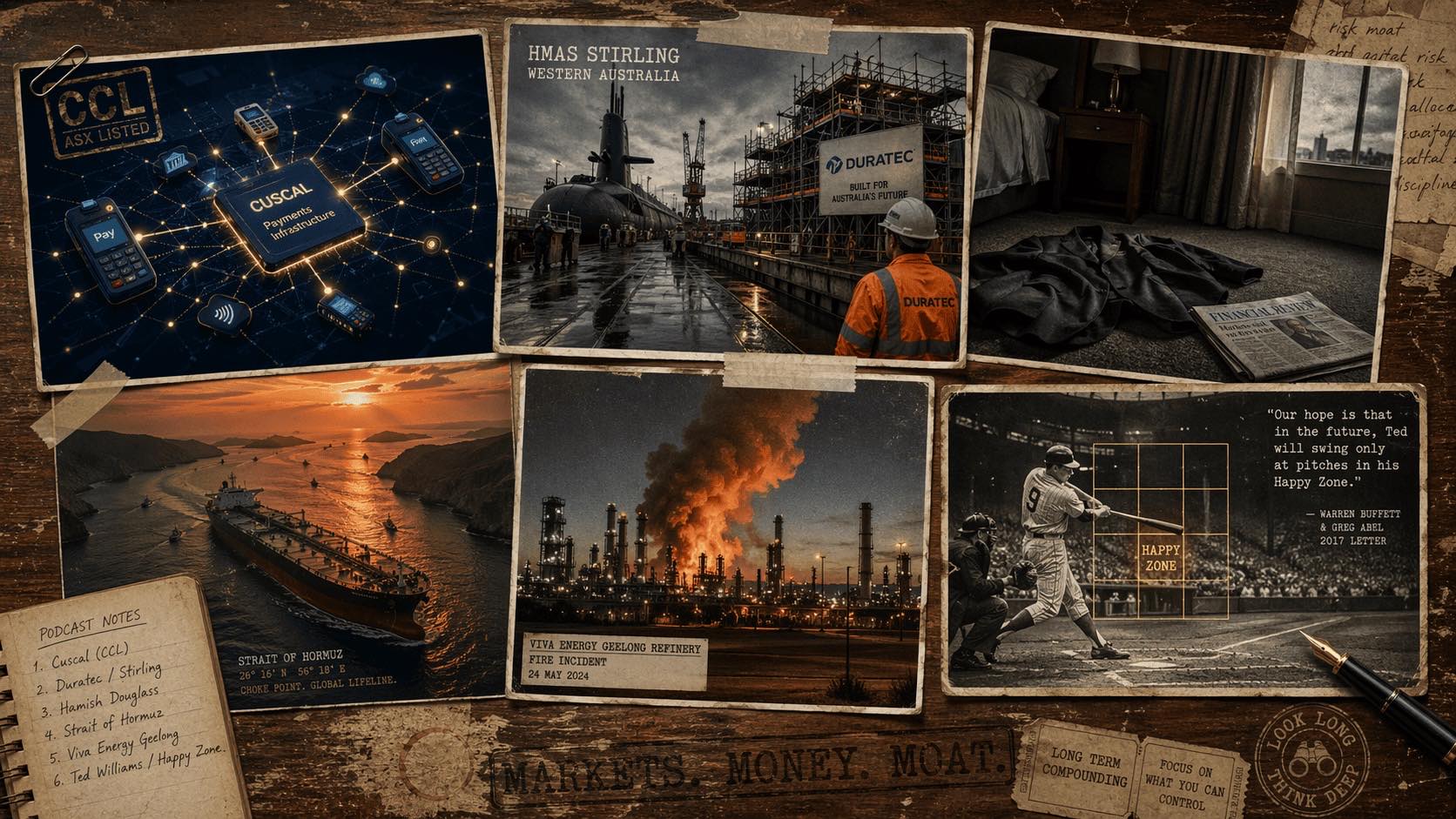
This week we kick things off with Tony venting about Apple dongles before diving into the Iran war’s knock-on effects for oil markets, the Australian economy, and why the banks are quietly raising their bad debt buffers while the stock market ignores all of it. Plus Tony does a full Pulled Pork on Cuscal (CCL), the payments infrastructure company that’s been flying under the radar because of a dodgy GICS code, and we chat Duratec’s massive defence contract win, the Hamish Douglass tell-all, and News Corp’s dodgy share count data.
This week’s full episode is for QAV Club members only. The free episode is available below. Also check out our podcast archives link and our pages on Apple Podcasts or Spotify or watch clips on TikTok. Or visit our homepage to learn more about QAV and how it works as a value investing system that you can learn and apply to beat the market.
Transcription
QAV AU 916 Club
TK: [00:00:00] That’s all.
Cameron Reilly: Keep going.
TK: No, I’m stopping. Look.
Cameron Reilly: K. Keep going.
TK: no, no, I’m good.
Cameron Reilly: Tony’s just having a whinge.
TK: this is why Tim Cook’s leaving Apple.
Cameron Reilly: Yeah.
TK: Every time I buy another piece of technology, I’ve gotta buy all the adapters and
Cameron Reilly: Yeah.
TK: I just went through a software upgrade recently to whatever the latest one is, Sequoia or something. But you have your ending in Sonoma. They’re bloody appropriating.
But you know, I’ve got all this muscle memory, like for using emails where you click to the left to send an email. Now it’s on the right.
Cameron Reilly: Uhhuh
TK: Why the fuck change that? Like, how is that an upgrade for God’s sake?
Cameron Reilly: uh, welcome to QAV, episode 9 1 6.
TK: This is, we title this episode, Old Man Shouting at Clouds.[00:01:00]
Cameron Reilly: Oh, okay. At clouds. Well, speaking of Donald Trump, how’s your week been, Tony?
TK: We weren’t speaking of Donald Trump.
Cameron Reilly: Well, you said old man shouting at clouds. That’s,
TK: Well, I think we have to start measuring time in BC and AC. Before chaos and after chaos.
That’s, that’s what it is. It’s just chaos.
Cameron Reilly: Well, uh, you know, we’re gonna start a new segment on this show this week, which is, uh, Tony reads the Bible uh, that’s what Donald Trump’s doing this week. Uh, America reads the Bible. Have you heard about that?
TK: No.
Cameron Reilly: He’s doing a televised session where he reads from the Bible. I’m not sure if it’s a daily thing or a weekly thing.
I’m not sure when he is gonna learn to read, but that’s
TK: picture book? Oh, look at that. That’s a very ugly guy. There he is. Got terrible clothes, bad hair,
Cameron Reilly: very low IQ
TK: straggly beard. Yeah.
Cameron Reilly: Very low IQ loser. Yeah. I
prefer my
TK: that’s [00:02:00] Jesus.
Cameron Reilly: killed. Yeah.
TK: Look at that. He’s nailed to a cross. It’s a very basic cross. Not even the gold cross. Well, I see. He’s obviously doing penance for the AI post of him being Jesus. He’s trying to get back into good books with the Americans. Yeah, the Christians. Mm.
Cameron Reilly: Well, uh, Tony, crazy week, uh, as has become the norm. Um, New York Times article in front of me. White House shrugs off shaky economy as war exceeds Trump’s timeline. Stocks may be soaring again, but the war in Iran has started to pinch the finances of many Americans. Uh,
TK: Was that White House or Wall Street did you misquote there?
Cameron Reilly: no, says White House.
TK: Really well, of course they’re gonna shrug it off. It’s bad news.
Cameron Reilly: roughly seven weeks into the war with Iran, investors have shrugged off the sky high price of oil, sending the S&P 500 this week to a fresh record high. This is [00:03:00] dated April
TK: Yeah, so that’s Wall
Cameron Reilly: old.
TK: Street shrugging off the wall.
Cameron Reilly: exuberance on Wall Street has offered a sharp contrast with the hardships facing many Americans who are feeling the financial blowback of a conflict that President Trump once promised would be brief, but seems to have no end in sight
TK: You once promised there wouldn’t be any foreign wars too. Forget about it being brief. That’s like,
Cameron Reilly: Oh,
TK: that’s like a, an excuse you give when you didn’t do your homework. Well, I’ll be brief. It was brief anyway.
Cameron Reilly: so. 2024. Thinking of you Tony, have changed with high gas prices cutting deeply into many families’ budgets. The US economy is under increasing strain, raising the odds that inflation will worsen, unemployment will rise, and growth will slow. This year
TK: All completely correct, but look, Americans are whinging bitches. I, uh, I compare the cost of, um, petrol in the US or gas as they put it to [00:04:00] Australia. And uh, the $4 a gallon is equivalent to a dollar 50. Even taking into account the currency changes exchanges. Dollar 50 per liter, which is half what I’m paying at the moment at the bowser.
So, you know, get over yourselves. Americans
Cameron Reilly: $3
TK: pony up. Yeah. For diesel. Absolutely.
Cameron Reilly: got a diesel car.
TK: Yeah.
Cameron Reilly: I was surprised. I filled up our car yesterday or the day before and it was only, I think two bucks.
TK: Okay.
Cameron Reilly: It was like
TK: That’s good.
Cameron Reilly: a few days earlier or a week earlier. Um, whinging bitches. I guess that’s the new, um, title for the episode. Uh, so yeah, like as we’ve said before, I think week after week after week after week, the stock market doesn’t seem to care. Uh, Washington Post article, here’s what the, uh, it wants me to pay for it. God damnit.
TK: Stop shouting at clouds.
Cameron Reilly: Okay. Hold on a [00:05:00] second here. Uh, let
TK: Yeah. You sent me, you said listen to this. Cameron sends me all these links to the behind paywalls and I don’t get to see them.
Cameron Reilly: you’ve
TK: Alright.
Cameron Reilly: Post subscription. I know it’s Wall
TK: No.
Cameron Reilly: You’ve got, yeah.
TK: I do find a way to get around them, but yeah.
Cameron Reilly: Here’s what the stock market might’ve gotten wrong about the Iran war. Surge in optimism contrasts starkly with continued energy supply challenges that threaten long lasting economic harm, and a market reckoning as stocks soared.
This week in oil prices dropped amid an apparent cooling of tensions between the United States and Iran. It may have left the impression that the energy shock that rattled the world is quickly fading along with the risk of sending the global economy into a recession. But beneath that surface, a starkly different reality is unfolding.
It is defined by disrupted supply lines and damaged infrastructure, sparking increased concern among the people who produce, transport, and depend on [00:06:00] energy. The people closest to the industry are far more concerned about these disruptions and recognize the length of time it will take for things to return to normal.
If they ever do, said Jerry Morton oil and gas co-chair at the law firm Baker Botts. The further away you get from actually being involved in producing oil, the less you seem to be concerned about the physical reality and problems that are there. Is the thing that gets me, Tony, is like, there’s just this sense of exuberance and optimism in the markets.
That makes absolutely no sense to me.
TK: It, it doesn’t, and unfortunately, I, yeah, I don’t like to predict, but it, it’ll catch up with us, with us at some stage and the market will retrace dramatically, I think. Um, not just, so a couple of points on what you just reported. Uh, I can’t see the oil majors relying on the Straits of Hormuz if they can avoid it [00:07:00] going forward, because even if, even if they have to, in the short term, they’re possibly gonna have to pay a toll.
To use it, whether that’s a toll on Iran’s permission or whether that’s some kind of support for the US keeping the straits open. Um, there has been plans to build a pipeline down the western side of the Strait so that oil can get through without having to worry about intervention. That’s a. Big, big cost, but I, I’m sure that that is being dusted off and they’re having a look at that, or they’ll find some other way to, to get the oil out, which will be more expensive.
Um, so that’s problem number one. Problem number two is that the Straits of Hormuz aren’t the only narrowing in the supply chain for oil. There’s also other places like the Straits of Malacca, which um, could be shut down by China in a sort of similar way that Iran’s controlling supply chain, uh, the supply chain.
And given China’s moving [00:08:00] away from its dependency on oil and gas, it’d be a really neat trick to go for the electric and then close down the Straits of Malacca, which would stop oil from getting to Southeast Asia and possibly to us as well. So it’s, it’s not just one choke point. I, I would think that the oil industry’s looking at all the chokepoints and building plans and they, the problem is not gonna be the lowest cost plans.
They’re gonna be the risk free plans and not cost money. And it’s not just oil. It’s gonna flow through to plastics, chemicals, fertilizers. Almost every part of the supply chain has a cost increase because of this.
Cameron Reilly: I was reading a little bit about the idea of building a pipeline across, well, what Qatar or Oman or whatever is down on
that other side of it. And yeah, it doesn’t sound like a weekend project.
TK: No it doesn’t.
Cameron Reilly: go to Bunnings, get some pipe, throw it down. there’s some pretty big mountain ranges through there, so
TK: right.
Cameron Reilly: I read like hundreds of billions of [00:09:00] dollars and decades to build a pipeline through there.
TK: Really.
Cameron Reilly: yeah, It’s not a, not a short term solution.
TK: Right.
Cameron Reilly: Elon can just fly rockets, some rockets there. Rockets can come up and come down on the other side. Reusable rockets.
TK: Yeah, he’s, he’s pretty good at finding economies in infrastructure, isn’t he? In government? Government departments?
Cameron Reilly: Well,
TK: think I’ll be relying on Elon, but I mean, they might do something like put it on rail, for example, rather than ship it in in big tankers, which should be, again, costlier, but less risk.
So I think that’s gonna be the, there’s gonna be solutions like that until more permanent ones are found, but they’re gonna be costly.
Cameron Reilly: Hmm. Well, speaking of government departments dealing with money, uh, New York Times today, uh, Trump administration takes steps to refund $166 billion in tariffs. The government debuted a system to repay importers. Two months after the [00:10:00] Supreme Court struck down tariffs at the heart of the President’s trade policy. Uh, but guess who’s not getting any money back is the people who paid their money. Um, the consumers,
American consumers. They’re not getting refunds.
TK: Yet, you gotta expect there to be class actions, wouldn’t you?
Cameron Reilly: wow. Yeah. I mean, lawyers have gotta make a buck, somehow. Gotta feel sad for the lawyers. Um,
TK: of the American economy. The lawyer?
Cameron Reilly: Um, yes. Like just what, what a debacle like, uh, complete, complete and utter debacle.
TK: Yeah.
Cameron Reilly: guy has done
TK: Yeah.
Cameron Reilly: and utter mess any who in a sign of the expected demand. More than 3000 businesses, including [00:11:00] FedEx and Costco, have already sued the Trump administration in a bid to secure their refunds before the application website launched, with some cases filed even predating the Supreme Court’s ruling, but only the entities that officially paid the tariffs are eligible to recover that money.
That means that the fuller universe of people affected by Mr. Trump’s policies, including millions of Americans who paid higher prices for the products they bought, are not able to apply for direct relief. You’re tired of the winning yet America.
TK: Well, it’s, that’s an interesting point as well. ’cause if, if, uh, there is a precedent set that the end user gets to pay for a, a government acting illegally, in this case it’s tariffs, then it must apply to oil as well. So it’s like governments acted illegally, Congress hasn’t approved this incursion to the Straits of Hormuz, whatever you wanna call it, and it’s pushed up all the prices for Americans.
There’s another set of. Legal actions pending, I would’ve thought,
Cameron Reilly: Yeah. Yeah, you’re [00:12:00] probably right. Well, moving closer to home. Um, big article in the financial review about Hamish Douglass, formerly of
TK: sorry. Be, can I make one more point? I was gonna,
Cameron Reilly: Hmm.
TK: in my notes talk a little bit about the fact that in the earnings season that’s happening in the US I saw an article reporting on that for the banking sector. And the headline was something like, volatility is our friend. And so the banks have been making huge money out of buys and sells during this period of volatility.
Um, so someone’s winning out of it, and if someone’s winning out of it, it’s probably not gonna stop soon.
Cameron Reilly: Yeah, well, not to mention the people that, playing arbitrage with the
TK: Yeah.
Cameron Reilly: uh, you know, who obviously have a bit of an inside track, I imagine.
TK: Mm-hmm.
Cameron Reilly: Yeah. It’s just a, like, it’s just such a huge grift. Um, I was talking to one of my American, uh, TPN listeners, uh, [00:13:00] on chat there, actually. You, you, you, you met him, uh, Tim in the, uh, Vegas days.
I think you were there years ago. Tim Henning, back when Markum and Ray and all of us were in Vegas, Tim was there. He was checking in and he was saying like, the whole thing is just a pyramid scheme. Like it’s just the guys at the top making all the money from the people down the bottom. And yeah, it’s
just, he’s disgusted with the whole thing.
TK: Well, but we’ve seen this before with the US elections. They put a useful idiot in, they make lots of money. The useful idiot can make a bit of money as well themselves, and
Cameron Reilly: Hmm,
TK: the machine just keeps grinding on.
Cameron Reilly: Hmm. Oh, back to closer to home. Hamish Douglass. Um, from Magellan, so it was a few years ago now. We watched sort of the, the Magellan, uh, implosion.
TK: Yeah.
Cameron Reilly: shocking at the time. I
TK: Mm-hmm.
Cameron Reilly: one of the most successful funds in Australia. Highly respected Hamish Douglass, highly [00:14:00] respected. Then it all just, you know, I don’t remember the details.
I just remember something imploded and he left and he got a divorce and some of his major backers pulled out and
TK: Correct.
Cameron Reilly: wasn’t, wasn’t really clear at the time. There were some bad investments, but it wasn’t really clear at the time what went wrong. And I. There was a big interview with him in the financial review yesterday, I think turns out that he had a, he had a breakdown, came out as gay to his wife and four children. Um, and, uh, yeah, just, I don’t know, the, the, the pressure of, uh, living whatever life he was living, um, really took the. worst turn for the worst for him. So yeah, I felt pretty sad for the guy reading that article.
TK: Oh, did you?
Cameron Reilly: like, yeah, I did. It sounded, it sounded like he’d really been through a rough I mean, know, being [00:15:00] as successful and as well known in investing circles as he is. And then, you know, going through this sort of losing his business and losing his, you know, marriage and having to come out as gay, which obviously wasn’t easy for him, apparently says that he had an extreme case of post-traumatic stress disorder and, uh, yeah.
So it was all pretty, pretty traumatic. So I felt, I felt bad for the guy. Did you read the article?
TK: I did, it was, uh, quoted from Joe Aston’s Rampart
Cameron Reilly: Yeah.
TK: with him. Yeah, it was interesting. I thought it’s, um. Interesting from the point of view of the history of it. Now we can see behind the curtain because it didn’t make a lot of sense at the time.
Cameron Reilly: Yeah.
TK: did look like he was spinning out of control.
’cause my recollection was he’d made a few stumbles on the investment side and then went missing and then um, people had to step in to take over and there was the whole startup of Barrenjoey, which was [00:16:00] being questioned as well. So which has turned out to work out to work, have worked out well for them.
Um, so yeah, there’s obviously something going on. There were a lot of rumors circulating at that time. Like, um, I think, uh, I shouldn’t say I shouldn’t attribute sources, but there were rumors around the fact that he was spending his life sunning himself on Packer’s yacht in the Mediterranean and had not paid enough attention to the business and all sorts of things.
And you know, I guess in hindsight, they’re typically the rumors that start to fly when someone is having a problem and. Isn’t dealing with it in the public, um, eye, I guess, and taking time off and not answering the phone or whatever. So yeah, it is a shame. Hamish, Hamish Douglas was one of the first people I, um, started to listen to when the ASX put podcasts up in the very, very early days of podcasting.
Rosa Montgomery was another one. Um, and, you know, I was followed their, their career. Uh, him and Douglas. Hamish [00:17:00] Douglas, sorry, uh, uh, not Hamish Douglas. He’s Hamish Douglas Mackay, I think is, which one’s he, he’s, we’re talking about Mackay and there’s, Douglas is the other one who found him, who’s now stepped back into, have a, a more hands-on approach to it.
So, yeah, so I, I’ve been a, along the journey with them at least, um, watching. Their announcements and um, listening to their presentations, et cetera. Uh, you know, there were people who were calling him the Warren Buffett of Australia ’cause they had a great track record and they’re a little bit counter cyclical.
They came through the GFC, all that kind of stuff. So, uh, it is a shame when, when it, um, affects them personally. And it’s a shame too that the institution itself didn’t gather around him a bit better and protect him and, you know, deal with the fact that he was stressed and give him some time off or whatever, or find someone to support him.
Um, that’s always a shame as well, I think, and it’s probably a shame going forward from this kind of radical honesty often doesn’t help a career [00:18:00] if he, if he isn’t retired, if he thinks he might have a future in the industry, it’ll be, it’ll take a a while for him to come back, I would’ve thought.
Cameron Reilly: He is only 57 young dude.
TK: Yeah.
Cameron Reilly: It says, um, in the end it was his wife Alexandra, who pulled the pin on Douglas’s time at Magellan, an investment giant he’d helped to create 15 years earlier after she found him sobbing in the corner of a hotel room saying he couldn’t go on, picked up the phone to Deputy Chairman Hamish McClennan, and on February 7th, 2022, an announcement was released to the ASX that Douglas was stepping down for medical reasons. The truth was that this rockstar fund manager had suffered a complete mental breakdown and for over a year, he could not bring himself to read a newspaper, turn on the television, or even listen to the radio. It was during that year, he, again, thought about suicide. I had Magellan, which was my life, and I had employees and shareholders who I deeply cared about, who I didn’t want to lose, but I couldn’t see a way out.
He says, um, it’s part of the reason that Douglas says he’s [00:19:00] decided to speak out publicly about his experience of being so high profile, coming out as a gay man, and feeling so isolated that he thought about killing himself. Had my wife not picked me up at that moment and actually taken me to the farm.
You know, I don’t think I’d be here today. He says, and I, I, I guess my point with this is, you know, you, you and I have talked about this a lot. Um, I probably privately over the years, but it doesn’t matter. I, I tell people this, all I tell my kids this, you know, my adult kids, fame, success, money, all of that matters.
Nothing unless you have your physical health and mental health. Don’t think we live in a society that prioritizes mental health as much as it should. We, we talk about it more today than we did, you know, 20, 30 years ago. We talk about physical health a lot more now too. But you know, I think mental health is not really the priority.
I don’t find a lot of people really, they might go to therapy, but they [00:20:00] don’t know that they really invest as much time and effort into having a philosophical framework that enables them to process life’s ups and downs. And you’re gonna go through those ups and downs. It doesn’t matter how much money you’ve got, how much fame, you know, you’re gonna go through ups and downs in life.
And, uh, you need to have a healthy framework for processing those before you get into them. It’s like, no, no, no point being, you know, five XL t‑shirt size and having, you know, bypass surgery and then deciding to take your health seriously. Right? It’s, you gotta do it earlier than that. Um, and uh, and I’m speaking from experience.
I wish I had taken my health seriously a lot earlier than I did, but I think it’s the same with mental health. You need to. Prioritize it before you need it. ’cause you need to have that framework in place. And I think this is a classic, uh, case in point,
TK: Yeah. So GHI for, uh, raising the issues, um, and I, I, I, [00:21:00] again, I come back to the corporate perspective, which is fund managers are key men and, and, and women, and there’s key men risk in these companies. And so I wonder what the board was doing at Magellan, like he said in his interview that he, and you just repeated it, that he spent a year not being able to turn on the news or read a financial newspaper.
I mean, that must have been evident to someone in the office at Magellan. Um,
Cameron Reilly: I think this is after he left, he had
TK: was it okay?
Cameron Reilly: left. Yeah. Yeah. He went to a farm and just
TK: Yeah. Anyway, but, but he would’ve been exhibiting signs I think before it got to a head.
Cameron Reilly: Lori masked it. Well, people mask, you know, they put on a brave face.
TK: Yeah, all of it’s possible.
Cameron Reilly: Hmm.
TK: My point is that there’s gotta be a plan in place to replace the key man.
Cameron Reilly: Mm-hmm.
TK: you know, when it happened, I remember people were asking, is this a red flag? ’cause he’s, he’s left for medical reasons and that was all it said, you know, is, is that the usual, spending more [00:22:00] time with the family?
Is that an excuse? What’s the problem? Is he gonna come back after surgery? You know, what does that mean?
Cameron Reilly: Mm-hmm.
TK: Um, and then I think it took a while and then the, the other partner stepped back into the business on a, a more day-to-day basis. But, uh, that took a while for hap for it to happen, and people pulled large mandates from the business.
So, yeah, it wasn’t, it looked like it was a, a cleanup operation rather than a, a well-oiled plan being put in place.
Cameron Reilly: Yep. Well, speaking of cleanup, operations, News Corp should not have been at the top of the buy list this week. People.
TK: Mm-hmm.
Cameron Reilly: I went to buy it, I was gonna add it both to the light portfolio and then later to my super portfolio. ’cause I’m having a hard time finding anything to put in my super portfolio after I sold Regis and I was part of my brain was like, ah, I mean part from the just gag reflex of having to buy Rupert. Um, I thought there was something going on. And then I was looking at the, looking [00:23:00] at my report that I was preparing for the light portfolio and I looked at the PROPCAF and I was like, well that’s high. Um, and then yeah, realized that there was a problem with the reporting. So I’ve added it to my notes and my checklist now, so it won’t happen again.
Apologies to everyone, but yeah, you, think did point out a couple of weeks
TK: Yeah.
Cameron Reilly: yeah, that the Stock Doctor numbers were wrong again,
TK: Yeah, so I, I looked into that this morning. So Stock Doctor saying is saying that there’s 42, I guess that’s. 42 million shares outstanding.
Cameron Reilly: Hmm,
TK: But Yahoo Finance is saying 548 million. So, and I think Yahoo’s right?
Cameron Reilly: hmm. And, uh, from memory, I actually did email Stock Doctor about this
TK: Yeah.
Cameron Reilly: and told them to look into it and then didn’t make a note. So forgot. ’cause I have the memory of a goldfish, so, so hopefully nobody bought that without checking first. And if you did, do your own [00:24:00] research before you buy stuff.
People, I dunno how many times I need to say that. I mean, I, I can’t be good looking and perfect, um, all the time, uh, you know.
TK: So which one are you? You can’t be both.
Cameron Reilly: yeah, some days I’m perfect, some days I’m good looking. Um, thank you to Mark, to, uh, Hargraves who did email me after I’d already picked it up and advised everyone, but I, I appreciate him taking the effort to reach out and let me know that I’d screwed up. Um, Horizon, Tony, we’ve talked about Horizon and Q. Quite a few times over the last four or five weeks, attempted acquisition, the board said, no, this came out April 16th, but I only saw the last couple of days from Mals. Uh, dear Adam slash Sir, I dunno what they’re suggesting about my, uh, gender decision, but okay.
TK: You are not gonna come out are you can if you like. It’s okay.[00:25:00]
Cameron Reilly: I’ve been coming out on my history shows with Ray for 13 years. Tony Horizon Oil Limited Off Market takeover bid for Q Energy Resources Limited. Second supplementary bidders statement. We act for Horizon Oil Limited in respect of its off market takeover bid for all of the ordinary shares in Q Energy Resources Limited that Horizon did not already have a relevant interest in blah, blah, blah.
Um, so apparently they’ve got over 50% of
TK: Yeah.
Cameron Reilly: now is the bottom line.
TK: Yeah. I thought it was an interesting second bidder statement with no bid. It was just, it was just basically saying we own more than 50% now, so you should accept. Our current offer,
Cameron Reilly: Yeah.
TK: which is the current offer for those who don’t know, it’s, uh, 0.8 of 1 cent per share cash plus 0.5625 Horizon shares.
As of this morning, Horizon was trading at 23 cents. So [00:26:00] that values Q at 13.70 cents, and I think the price has now dropped back to match that 13 cent price.
Cameron Reilly: Dang.
TK: Um, yeah, so I guess that’s, that’s the first thing to note. The, that price around the bid price, um, which suggests the market doesn’t expect a higher offer, and I wouldn’t expect a higher offer either.
They’ve got a, if there is a higher bid coming in, they, the Q, uh, Horizon already had more than 50%, so it’s gonna be hard to, to, uh, dislodge them, I would’ve thought.
Cameron Reilly: I own a couple of parcels of Horizon, none of Q, but a couple of Horizon, and it’s down since I added them early last month.
TK: So just be, if anyone owns Q out there, um, not giving financial advice, but just have a good think about whether you wanna sell on market or hang around. So my rule of thumb is that, uh, when it looks like it’s all done [00:27:00] and dusted, um, it’s probably worth better off selling and putting your money to work somewhere else because this could drag on.
Now, um, another bid could come along. So, you know, I could be wrong. Um, someone, someone who’s already agreed to sell to Horizon might renege. Um, it’s it, but it’s an unusual circumstance if that happens. Uh, you don’t wanna wait and whatever you do, don’t wait for compulsory acquisition, which means that Horizon get to probably 90% of the shareholding and then under, under the, uh.
Corporations Act, they can acquire the remaining 10%. Um, but they have a fair bit of time to do that, uh, and they get to acquire at the bid price and you have to wait, you know, potentially months for your check. So you’re better off watching what’s happening, watching the announcements, and selling out before that happens.
Cameron Reilly: Speaking of acquisitions, and this is, we’ll talk a bit more, more about this in our American show, but, um, Topgolf Callaway, I’ve been [00:28:00] saying recently it was up, it’s up 43% since we added it, uh, on the 12th of November. I only just found out last night why the 18th of November, a private equity firm took it over,
TK: Ah,
Cameron Reilly: gobble it up.
So, uh, oh. Hello? Green smoothie girl. Thank you. Thank you.
TK: can I have one too?
Cameron Reilly: Tony wants one too. Oh, I wish I could send her one. Yeah, she said she would send you one if she could. Yeah. So a week after we added it to the portfolio, it got acquired. Well, the Topgolf, uh, section of it did too. So not the Callaway side of it.
TK: Yep.
Cameron Reilly: sold off the Topgolf bit.
So. Didn’t know that. Just saw the price go up, thought that’s nice, but apparently somebody else saw value in it as well. Moving right along. Uh, last thing on my list of talking points for Australia, Duratec is pleased to advise the Duratec Joint Venture, DEJV, it’s [00:29:00] 50 50 joint venture with URec has been awarded a $281 million contract for the infrastructure upgrades to support future submarine capability HMAS Stirling on the Diamantina wharf at Garden Island in Western Australia. Very nice. I just mentioned that ’cause I love Duratec. Uh, uh, I own them in a bunch of different portfolios, uh, including the W portfolio and the light portfolios added them. The first time to the light portfolio. November 22. Currently up 456% since I added that, added ’em again on June 23 to another light portfolio.
It’s up 296%. February 23, I’d add ’em to the dp. It’s up 290%. Then there were a couple of, well, three times I listed them as a possible buy for our light subscribers and they’re up 168 to [00:30:00] 231%, um, since early 2023. So yes, hats off to continued success for our friends at Duratec. A five bagger. I think that’s the first five bagger had in my time at QAV.
Tony?
TK: Well, that’s great. I can see why you love them.
Cameron Reilly: Nah,
TK: Yep.
Cameron Reilly: bagger in three. Uh, yeah, three and a half years. Wow. Well, we should have sold that when they did. A hundred percent. Tony. We should have taken profits off the table.
TK: Or when they pulled back a little bit.
Cameron Reilly: Yeah. Yeah. When they dropped back a little bit. Yeah. Should have,
TK: Hmm.
Cameron Reilly: done a hug line. Um, I’m kidding. As sarcasm folks. Uh, ’cause I’m a whinging bitches. Um, I don’t know. What do you got on
your,
TK: and winge and win, as you say, on the golf course.
Cameron Reilly: uh, winge and winners?
TK: Yeah. Winge and win. Yep.
Cameron Reilly: Oh, okay. Why?
TK: No. Oh, well usually, usually if I’m out [00:31:00] on the golf course, I’m whinging about this or that or whatever. You play better. At least it means you’re focusing on your game. And what’s around you?
Cameron Reilly: okay. What do you got on your list of talking points today? TK.
TK: Well, not so much winning. A couple of, couple of negative articles. Uh, just wanted to take time to talk about Viva Energy. So with the price of oil riding high, you would’ve thought they’d be doing well, but, um, they’ve had. Three toe stubs in the last couple of weeks. I did a Pulled Pork on them a little while ago when the, just after the war started, and they looked the goods, but at the time we, we talked about, uh, On the Run, which was their convenience store purchase from South Australia, and they had to write it down and the COO fell on his sword and left the company, um, mainly because of that write down.
But then I read another call, I think it was last week, uh, may have been just before that, but, uh, the write down wasn’t calculated [00:32:00] correctly according to the regulator. And so PwC or who’s the auditor was questioned over the correct write down calculation. And I think they had to take another 25 million odd provision at that stage.
And then, uh, lo and behold, when everything’s. Through the refinery. It blows up. There’s a fire at Geelong last week, which everyone would’ve heard about in the news. But, um, it seems like bad things come in threes for this business. Uh, so I, I just wonder what that means for management going forward.
Cameron Reilly: Our stock take you think?
TK: No, no, I don’t think that at all.
I, I mean, why would you try and you, you, I think personally what’s probably happened is the refinery was meant to have a go through a maintenance, uh, normal sort of maintenance plan where they would’ve shut down parts and repaired them. But because they’re pumping 7 24 at the moment, they probably deferred some of that and then the valve burst and, uh, it started the fire.
So [00:33:00] I think they’re trying to dance between delaying, deferring and doing as little maintenance as possible at the moment to keep everything running quickly, um, and pumping as much as they can. And that. Didn’t work for them last week.
Cameron Reilly: Hmm.
TK: Yeah. But I mean, I look at, I look at them, I look at Woodside, I look at Santos and other gas players and oil companies, and you think, why aren’t you worth multiples of what your stock was trading at before the Iran war?
And now that margins are so high and none of them seem to be. So I don’t know what that reflects whether there’s other things going on with these companies. But yeah, it, what it does reflect is that when the oil price goes up, it doesn’t flow flow through to their margins or they do bad things at the time, and that reflects negatively on the shares.
But anyway, I just highlighted that, um, I thought the microscope’s on Viva and it’s, it’s highlighting some problems [00:34:00] with the company. Hopefully they’ll come through it and they’ll improve, but, um, gee, we, this is their time to shine and it hasn’t worked.
Cameron Reilly: Well, to be fair, their share price in the middle of February was a dollar 70. It’s now $2 37, so
TK: And it was higher before the it
Cameron Reilly: I,
TK: halted trade and then came back on.
Cameron Reilly: well, yes, it was up $2 65 and it’s
come back down, but you know, they’ve, they’ve had a pretty good couple of months.
TK: Oh yeah. They’re definitely up and, but they should be up a lot, shouldn’t they? A lot, a lot more perhaps than what they are.
Cameron Reilly: I dunno, it’s beyond my pay grade, Tony. I dunno. I know that I own them in a couple of portfolios, including my super portfolio, and they’re up about 14% since I added them on the 17th of March. So, you know, I’m not complaining.
TK: Okay. Well, I’ll move on. I, I guess the, the point is I think the board will be looking at management with all these problems.
Cameron Reilly: Okay.
TK: The next article [00:35:00] I wanted to talk about was the banks and I’m, I guess this goes back to our first. Article in the, in, was it The New York Times about the American economy? But this is, I, I guess, a foreshadow for the Australian economy.
It’s, um, I’m always very nervous when banks start raising provisions for bad and doubtful debts. Um, as I said before, I don’t like to predict, but that is one thing which is often the canary in the coal mine for the economy in Australia. And then eventually the, a bad economy flows through to a bad stock market.
So both Westpac and NAB have come out in the last week or so and they’ve increased their bad debt buffers and, um. The Westpac, uh, announcement said that they were bracing for, for potential losses from energy intensive business customers hit by the fuel price squeeze. Uh, but the NAB one talks about, um, [00:36:00] about, uh, NAB raising its provisions because they were, uh, forecasting a, a rise in unemployment.
And that’s probably not just about the oil price, but also about interest rate rises and other cuts because of AI, et cetera. So, um, it’s often been a correlating issue between the amounts banks, uh, have on their books for bad debts and their share price. Um, and it’s always a good time to buy banks when that provision is being written is being decreased, but now it’s being increased.
You know, we have to, I’m not gonna change the rules ’cause I own ANZ and there’s still a buy. But, um, yeah, in terms of a forecaster for the Australian economy, it’s not good.
Cameron Reilly: Increasing their Warren Buffer, that what they call it, Warren Buffer. A
TK: Bad debt.
Cameron Reilly: not on my buy list.
TK: Yeah, it was, I, I saw that it was on your list and I did mine this morning and it was a 0.1 on my buy list this morning.
Cameron Reilly: Oh,
TK: So I dunno if there’s been a change in the stock price, [00:37:00] which has nudged them on, but Yeah.
Cameron Reilly: Yeah. Well look, it just stands to reason from
all that stuff that we mentioned before, that it’s gonna be a tough, it’s gonna be a tough for a lot of businesses and people in the next whatever period of time, the way things are going. But
TK: And that’s one of the wonderful, the wonderful things about the stock market is it’s, it’s, you’ve got the brutality of businesses out there who are making decisions about their financial futures and they’re now providing more for the risk of a recession. So you don’t have to form an opinion yourself.
Cameron Reilly: Hmm
TK: Um, you can watch what the experts are doing.
Cameron Reilly: hmm. Yes. And yet the market’s nearly at an all time high. It’s off a
TK: Correct.
Cameron Reilly: Today, but still pretty close.
TK: Yep. So it’s, that’s not good news, I don’t think. We’ll, we’ll keep trading the way we do and see where we end up, but yeah,
Cameron Reilly: Hmm.
TK: suspect that, uh, it’s gonna get worse before it gets better.
Cameron Reilly: So what you’re saying is go to cash, [00:38:00] sell everything, go to cash, is
TK: I’m not saying that, I’m saying, uh, I’m saying the banks, uh, thinking it’s gonna get worse before it gets better.
Cameron Reilly: Oh,
TK: Whether that means we go to cash now or in next month or in six months. I don’t know.
Cameron Reilly: You’re not Chicken Little-ing it.
TK: No
Cameron Reilly: Okay. Chicken Little.
TK: Chicken Little. No, the sky isn’t falling. It’s the first increase in bad debts and, uh, you know, I’d have to go back and do some kind of analysis to see whether it’s the first or the third increase in bad debts that, you know, is when the share market tips over. But it’s, it’s a trend that’s starting now.
Cameron Reilly: I’ve got so many, um, episode title possibilities here today. It’s, you might use all of them. Old man shouting at clouds, whinging, bitches, warren buffers, and Chicken Little. Oh dear.
TK: that’s good.
Cameron Reilly: Yeah.
So
TK: you
can put out, put out different versions. Put out, [00:39:00]
Cameron Reilly: Yeah.
TK: Yeah. And then make one the collectors item. There’s only two.
Cameron Reilly: uh, it’s
AB testing. See which,
which, uh, one does better.
TK: yeah. Good idea. Um, couple of things on, speaking of Warren Buffett, I got round to reading Greg Abel’s first letter to shareholders, uh, from, uh, his take, or he’s become the CEO of Berkshire Hathaway now, and he gets to write the annual letter, which came out in February and I didn’t notice it come out.
I just picked it up recently. So, um, that was interesting in itself. I guess the fact that he wasn’t getting the same sort of, uh, media cut through that the sage gets.
Cameron Reilly: Hmm.
TK: Um, but a couple of things I that I picked up on, he, he still is quoting Warren a lot, and one of the things he quoted on was, um, uh, comment that Warren Buffett made a long time ago that he drew, drew inspiration from a, a baseball player called Ted Williams.
And Ted Williams, uh, said that he divided the strike zone into 77 [00:40:00] segments and tried to swing only at pitches in a much smaller happy zone, resulting in a career, um, high and all time Hall of Fame, high batting average back in 1941. So that kind of reminded me of QAV that, that we also don’t swing at every pitch and don’t, don’t chase trends and don’t try and, you know, follow the hot hand.
We just distill things down into a subset of the share market and then worry about whether they’re, which one of those to buy. So very similar comment,
Cameron Reilly: The Happy Zone. Another
TK: the Happy Zone. Another title. Yeah.
Cameron Reilly: I like that one. Yeah. The Happy Zone.
TK: Yeah.
Cameron Reilly: I like that.
TK: Um, other thing I noticed in the, in Greg’s letter, and it’s, you know, I’m not trying to pick on Greg, it’s, um, big shoes to fill for him and he’s, he’s, Warren wouldn’t have picked him if he was a clown. So, uh, you know, he’s, he’s very competent. But, um, one thing I noticed was he talked a little about culture.
So he was talking about the [00:41:00] strength of the, of the Berkshire Hathaway decentralized management style, which I’ve always admired because I’ve worked in big companies and they can be very bureaucratic, and if someone low down makes a mistake, they feel the full, full force of that bureaucracy reigning down on them.
Whereas Berkshire Hathaway’s a bit different. Um, they don’t get in the way. They, they claim to hire good people who are a good cultural fit and then. Empower them to go out and, uh, make their businesses grow themselves, and they just check in from time to time, CEO to CEO and see how things are going. So I think that is a, a very strong model.
But, um, one of the things I noticed was that, uh, Greg has now written down the Berkshire Hathaway culture and put it in a policy so that that might be a very small bureaucracy, but it’s certainly a change from when Charlie Munger, uh, Charlie and uh, uh, Warren lived and breathed the culture and talked about it rather than writing it down as a mandated policy.
So, um, all the things that Charlie and Warren have said are in the policy, um, about not bringing the [00:42:00] company’s, uh, company’s name into disrepute and always acting ethically and all those kinds of things. But just thought it was an interesting departure from continuously saying it, which Greg is still doing, to actually writing it down and making it a policy.
And I wonder how many times that precedent will get broken in the future going forward, and the bureaucracy might creep into Berkshire.
Cameron Reilly: Yeah, I think when you go through, uh, the, the loss of the two sort of figureheads like Warren and Charlie, maybe it is a time to sit down and just, uh, codify the, the
TK: Yeah.
Cameron Reilly: that they’ve left behind and still, particularly while one of them still around to approve that, codify that and confirm it. But yeah, it’s, it’s gonna be very different. But that policy that you mentioned, I, I, I tell, um, people this often when I talk about, when I started at Microsoft, my very first day with my hiring manager at Microsoft in 1998. He sat me down and he said, you know, we had a quick [00:43:00] chat. I flew up to Sydney Quick Chat and he said, look, we hired you ’cause you’re smart.
Here are the five things that you need to get done in the next six months. If I can help, you know, gimme a call. We’ll have a weekly call. You know, we’ll catch up every Monday and just, you tell me if you need any help, how things are going apart from that, just go get it done. Right. That was it. It was like, and then it changed.
TK: Yeah.
Cameron Reilly: Uh, 5, 6, 7 years later, the culture changed dramatically and it became very micromanagement. But in the, in the, in the heyday of Microsoft, it was very much, yeah, we hire you ’cause you’re smart. Go get it done. We’ll stay outta your way if you need help, come to me. Right.
TK: Yeah.
Cameron Reilly: yeah. And I think that’s a great way to manage, um, hardworking, ambitious people is just
TK: Mm.
Cameron Reilly: stay outta their way, you know?
TK: Correct. Yeah, I, I found that some of the companies I worked for, that some of the people who were rising to the top were very good at managing the bureaucracy rather than the business.
Cameron Reilly: Yes.
TK: the lawyers and the HR [00:44:00] people and things like that were getting a bit of an outside say,
Cameron Reilly: mm
TK: and then what I would’ve thought.
Um, but yeah. And I also had bosses who would say that, you know, don’t, don’t bother me. I’ll send you off to do something. And as soon as they heard that there was a roadblock or a first speed bump, they’d be all over you, like a rash. And I’m like, Hey, I’m fixing this. If I need help, I’ll let you know. But yeah.
Cameron Reilly: yeah. Alright, so, oh, and, and, um, you probably saw this as well, uh, there was a thing, it might have been in the financial review today, that Tim Cook’s replacement has been announced as well.
TK: Correct. Yeah. The hardware, the hardware design guy’s taken over.
Cameron Reilly: yeah. Interesting times.
TK: Well, if he’s listening, stop changing the frigging dongles for MacBooks.
Cameron Reilly: Stop touching Tony’s dongle. There’s another title for today’s,
TK: Leave my dongle alone.
Cameron Reilly: Yeah.
TK: and I’ll have to sit in the corner and not not read newspapers for a year. If you [00:45:00] touch my dongle,
Cameron Reilly: still wish you had a floppy disc drive? That’s what you want.
TK: I don’t mind progress, but there’s gotta be a better upgrade procedure. Like if they’re gonna change the,
Cameron Reilly: Give him back his floppy. That’s what Tony wants. I
TK: if they’re gonna make the outlet ports, different sizes, give you an adapter with the MacBook so you can still keep using all your own
Cameron Reilly: you
TK: connections.
Cameron Reilly: Tony. You gotta buy one at the Mac store for $120.
TK: yeah, after you get home and find out nothing fits, then you gotta go back to the Mac store. It’s like, tell me when I’m there, will you? Yeah. Yeah. Anyway, um, next issue I next, uh, article I had to talk about was, uh, I noticed the BFL was back on the buy list this week, uh, certainly on mine and, um, I thought it might come back on our buy list when I did the Pulled Pork on it before the Iran war when we, or maybe just after when we were looking at things to buy and there was nothing to buy.
So I did a Pulled Pork on something pre buy list. That was [00:46:00] BFL, the, uh, Papua New Guinea bank. It was back on the buy list today. If anyone liked what they heard in that Pulled Pork, they can look to buy it now.
Cameron Reilly: Again, wasn’t on my buy list, but, okay. It looks like they’ve just gone over their latest byline.
TK: Hmm. Which puts them on the buy list.
Cameron Reilly: Yeah. Yeah. Well, it wasn’t when I did mine on Saturday, but,
TK: Okay.
Cameron Reilly: Very good. Financial group.
TK: And the other, other buy list stock to talk about, I’m not sure if it’s a buy this week, but Cash Converters, um, they’ve come out, uh, with some upgrades and again, to talking to this theme of the economy, worsening Cash Converters is a place you go and arrange, uh, loans, um, and pawn, uh, items, uh, appliances or whatever to raise money.
And so it’s usually doing good business when the economy’s [00:47:00] tough. But they came out and said recently that during the six months to December, Cash Converters posted revenues of $206 million up 8% compared with the same period in the previous year. And their, what they call their cashies loan book, which comprises short term loans of between 2000 and $10,000 had more than doubled to $58 million.
Cameron Reilly: And I lie, it was on my buy list. It was number three on my buy list this week Should have been number two ’cause I shouldn’t have had NWS on there. So there you go.
TK: Which one? Cash Converters or BFL.
Cameron Reilly: BFL
TK: Okay.
Cameron Reilly: BFL. Yeah.
TK: Yeah.
Cameron Reilly: No Cash Converters wasn’t on.
TK: Okay.
Cameron Reilly: Hmm.
TK: But it has been in the past.
Cameron Reilly: Yeah.
TK: yeah, again, it’s just talking to this theme of the businesses are showing us that the economy’s turning before the stock market, uh, realizes, I think. Okay.
Cameron Reilly: Yeah, the, the stock market doesn’t listen to these businesses.
TK: They, it will eventually. Yeah.
Cameron Reilly: Uh
TK: the last thing I’ve got to [00:48:00] talk about is a pulled pork, uh, which is on Cuscal as a request, uh, by Dave from Youi. And I gotta tell you, he’s, he’s really proving his worth, Dave. Um, because Cuscal wasn’t on my buy list, it wasn’t even in my download. And I think he did allude to the fact in his email request that he was finding it in, uh, data from Stockopedia, but not in Stock Doctor.
So that was the first thing I looked at when I did my pulled pork analysis.
Cameron Reilly: hmm.
TK: So, um, shall I do that now? Do you have anything else? Alright, so I did a bit of digging around and the reason why. Isn’t in Stock Doctor, or in our download, in our filter, our QAV filter is because it’s currently has an unclassified GICS code, GICS code, uh, and we don’t, uh, normally download those because mostly that code is used for fund [00:49:00] managers.
And, uh, we’ve taken those out of our, our downloads because, um, number one, operating cash means something different to a fund manager compared to a, a industrial type business. And number two, um. If you, you know, find a fund that does better than QAV, then go ahead and invest in it. But otherwise, chances are you are sub-optimizing your portfolio if you’re using QAV and then buying funds.
Um, anyway, that’s up to you. But, um, yeah, Stockopedia does have it in their GICS code, but it’s in the industrial subcategory, sorry, the industrials category, subcategory professional and commercial services. And that just doesn’t seem correct to me. Um, but I did some digging around and apparently it can take a while for a newly listed company and this company listed in November, 2024 to settle on a GICS code, um, which kind of seems strange.
So I dug [00:50:00] into why that was the case and used Google Gemini to tell me about that. And it basically boils down to a couple of reasons. The first one is that, um. The data providers themselves can often allocate a code to, to companies rather than take it from a sort of central repository. Um, the reason they don’t do that, uh, one of the reasons they don’t do that is the central repository isn’t like a, like a publicly listed and, uh, freely available, uh, registry.
It’s owned by the ratings agencies like S&P and they charge a lot for it according to Google Gemini. So sometimes the data providers do their own allocation and to do that, they have found in the past that they can’t go on what the IPO says the company does because it could change. After it lists.
And so they wait for the first annual report and then they do a, a revenue test and decide [00:51:00] what, uh, code to allocate to a particular company based on the majority of its revenue. So some stock providers are just getting around to doing that now, given that, um, they’re waiting for the annual report, the maiden annual report for Cuscal, um, that that all seems, you know, kind of, you know.
Amateurish, in my opinion, should be fairly easy to allocate a company to a code or have a central repository of the code. But then again, the code changed apparently. So another reason that Gemini gave me why these GICS codes are often, um, looked at by analysts at this, at the data provider, uh, companies is because there was a reclassification, um, by the ratings agencies in 2023, and they moved a heck of a lot of companies out of the information technology, uh, subsection and into either financials or industrials.
And that was because a lot of companies had called [00:52:00] themselves tech companies to get a bump in their share price and weren’t, weren’t really tech companies. And if you look at Cuscal, I guess it’s um, it’s a difficult one to allocate because they. They are a bit of a FinTech, they’re also a bit of a services company, and they’re also an ADI, um, uh, an approved depositary institution, which means they can be a bank, so it’s difficult to allocate them.
And so perhaps either the ratings companies have it at, made a final determination and everyone’s waiting for the maiden report, or the data providers like Morningstar, which Stock Doctor uses, doesn’t want to pay S&P to, to, um, subscribe to the central repository. And it’s still, and it’s still waiting to make up its mind, but for whatever the reason, Stockopedia has one category, which looks like it might’ve been either pre IPO or based on the IPO.
And I don’t think this is an industrial company, uh, [00:53:00] or two. Um, everyone’s waiting for the maiden annual report to come out. So long story short, we don’t have a proper GICS code for this company yet, so it’s missing out on our download. What I did today though, to be able to do this pulled pork was to put the unclassified back into the QAV download.
And I think I might keep doing that myself. And I guess if people use my download, they might wanna look at changing the Stock Doctor queries as well. So if you, if you are doing that, you go into the Stock Doctor filter section and you can see on the right hand side there’s a whole table of uh, GICS categories.
They’re all selected except for the top box, which is unclassified. So I’ve now clicked on that one and selected it, and that gives me everything. And I’ll just have to mentally not include funds type businesses in my um, buys. You know, manually going forward myself, I’ll just ignore them mentally. Uh, they’re usually pretty easy to spot ’cause they’re all, you know, Pinnacle, uh, uh, [00:54:00] yeah, Pinnacle Investment or, uh, Pinnacle Investment Funds, not the company itself or, um, or BetaShares or something like that.
So oftentimes they have a four digit code, um, ASX code. So that’s another way to tell them, but they’re pretty easy to, to filter out yourself. But it will allow us to pick up any other anomalies like Cuscal that, um, that are coming in the future. Um. I can, I can certainly see why the GICS classifiers are struggling, um, to find a home for Cuscal.
Um, they operate on the, uh, I think it’s called the NPP, so it’s a new payments platform, which is the sort of, uh, peer to peer, uh, realtime payments platform, which is gradually, I shouldn’t say gradually, it was gradually at the start, but it’s now getting a lot of growth as the way to, um, uh, for, for banks and for basically anyone in the payments universe to make, uh, payments and transactions.
And, uh, the banks are getting on board with a thing [00:55:00] called Osko, which you may have seen in your banking app. If you, um. Pay people directly. Uh, but they’re also, because Cuscal are also a service provider to, um, companies, for example, they, they help, uh, look after customer data to prevent hacking and to have it comply with the privacy laws.
Um, and they’re also, as I said before, an authorised deposit-taking institution. So, um, they can be treated like a bank as well. So there are a number of different things, um, in the GICS system, and it’s taking a while for them to be allocated. Um, what, who are they? Well. They’re the only company outside the major banks with an end-to-end system connecting to every payment type, um, to process any payment type.
So it allows the likes of Bendigo and Adelaide Bank, ING or Square to process credit and debit cards, real-time payments or cash withdrawals from ATMs. [00:56:00] So it’s basically a banking network for the small guys, I guess is one way to look at it. And for businesses that sit outside the major banks and don’t have relationships there, they’re Australia’s largest independent provider of end-to-end payments and what they call regulated data solutions outside the big four banks.
What’s the regulated data solution? I hear you ask and that’s the bit that helps, uh, organizations store customer data for safety reasons and also for privacy legislation reasons, and. I did stop and think about that because I think that does carry some risks to Cuscal because hackers are getting better and better at causing data breaches.
But I guess it also makes sense because, um, there’s a lot of companies who are spooked over this risk and they’re prepared to outsource it to a professional, uh, person to look after it for them. Um, but the, that’s a small part of the business. The bigger part of the business is end-to-end payments, and there’s a few different, um, categories to that part of the business.
There’s real time payments, which I spoke about [00:57:00] before. Often over the NPP platform. There are also, there’s a lot of work that this company does on financial crime solutions. So they do fraud monitoring program for cards, and they do fraud monitoring programs for real time payments. They are a card issuer, so if a bank or someone like that, a small bank or a credit union wants to issue a credit card or a debit card, Cuscal can do that for them.
They also enable mobile payment systems and, um, card services for these, uh, smaller, uh, players. They allow, um, other payment types to be, um, to be managed for those smaller banks, like, uh, BPAY, um, direct entry, what’s called real-time gross settlements. So that’s where you, so the, uh, batch feed, bulk payments into a system, into the payment system.
And, uh, they also do acquiring solutions. So, um, that’s a pretty big part of their network, which looks after ATM solutions and what’s called merchant acquiring, which is kind of the, the, um, real time [00:58:00] systems that allow you to tap your card at the coffee shop and pay for coffee and have that transaction interact with the banking network.
And, um, I had a little bit to do, uh, in that area at Coles Myer, where we had our own, um, acquiring software and, and hardware. And it enabled us to save money on, uh, all of the ATM, all of the, uh, sorry, EFTPOS machines and credit card readers and all the various, um, retail outlets. So it’s a pretty big type of infrastructure that into, um, so if about them as the big banking, uh.
Bank network skeleton. That’s pretty much what they do. They have a long history. They go back to, um, parallel the, uh, advent of credit unions in Australia back in the 1960s. And, uh, credit unions were set up based on state by state legislation, but they sort of soon found a, a need to have both a, a representative body and a body that could look after and provide [00:59:00] services to them.
And eventually that was federated and Cuscal was formed to do those things. Uh, that was back in 1992. So the sort of forerunners of Cuscal went back to the sixties. Cuscal was formed in 1992 to do it federally and, um, it was an amalgamation of state bodies doing similar type work, but also, um, as, uh, technology started to, um, go up a gear.
Uh, these small credit unions needed help and services and they, they, um, wanted to, uh. Uh, pool their, their pro, uh, pool their needs and be serviced by their a provider that they owned. So, uh, Cuscal was set up, it stands for the Credit Union Services Corporation of Australia Limited. That’s what Cuscal stands for.
Um, and anyone familiar with credit unions will know that they’re not for profit and owned by their members. And so that’s originally how Cuscal was also set up. It was owned by the members of the, of the peak body. Um, but it’s had a, uh, a timeline which kind of [01:00:00] parallels technology and banking. In the last sort of 50 or 60 years, they, uh, Cuscal’s predecessor body launched Australia’s first ATM back in 1977.
In 1983. That. Predecessor body was an early adopter of the Visa scheme in Australia and became the first Australian member of the Visa International Card System. In 2009, Cuscal launched the first rediATM scheme, uh, and that allowed customers of smaller financial institutions to access a nationwide ATM network without any fees.
’cause back in the early days of ATMs, they were linked to a bank that was putting out the ATMs. 2014, they launched the contactless card payments in Australia, um, otherwise known as Visa payWave, and also known as the HCE based system. HCE stands for host card emulation system, and, uh, a Cuscal. The Cuscal Chief Information Officer was the first person in Australia to [01:01:00] perform a live contactless Visa payWave transaction back in 2014 when he purchased two packs of Tim Tams at a 7‑Eleven store in Sydney CBD.
2014, uh, the company acquired, uh, a company called Strategic Payment Services Proprietary Limited. And that really helped Cuscal reinforce the its payments capabilities, particularly in merchant acquiring. And it also allowed Cuscal to diversify away from the credit union base and picked up Bendigo and Adelaide Bank, as well as Mastercard as shareholders.
Um, so again, it was, it was originally owned by the, the credit unions, but it was starting to take on some banks and, and credit card issuers as shareholders as well. 2016 and 17, Cuscal became the first ADI to launch connectivity solutions for all of the pays. And that what that means is Apple Pay, Google Pay, and Samsung Pay.
And that enabled [01:02:00] clients to be some of the first Australian financial institutions to offer their customers all three pays. And that was an interesting time in the banking sector. I remember it. Well, but, um, allowing Apple Pay into the payments network was resisted strongly by the big four banks for a couple of reasons.
Um, they wanted access. The big four banks wanted access to the NFC chip inside iPhones for their own payment apps. Uh, something that see that Apple resisted. Uh, and secondly, they didn’t wanna pay transaction fees to Apple. Um, Apple charged the issuers, the banks a transaction fee when someone used Apple Pay, uh, in the retail location, but then prohibited them from passing on the charge to customers in their various contracts.
So the banks feared losing ownership of the customer relationship to Apple and, um, they actually applied the big four banks applied to the ACCC to be able to negotiate with Apple and I guess the other mobile phone companies as well, [01:03:00] um, on a, on a joint basis. But the ACCC denied the bank’s request to negotiate collectively ruling that the potential anti-competitive impact of the bank’s collective action was outweighed by the benefits.
And then, so the banks then had to think about what to do about Apple. And the winning strategy, I guess, was be to, was to be the first bank to sign the deal with Apple, which was probably gonna be on better terms than the banks that followed. But as soon as one bank signed a deal with Apple, the rest all followed, and we are where we are today.
But, um, Cuscal pioneered that, and their banks were the first ones to, um, to let people pay with a bank credit card via their Apple Pay at the point of sale. Uh, in 2018, uh, they enabled more than 60% of the financial institutions that launched on day one of the new payments platform, which is the real time platform, which is now forming more and more of the skeleton, uh, infrastructure network for banking payments.
In [01:04:00] 2019, they launched a, uh. Uh, I guess it’s a fund manager, uh, or certainly a financial advice business called 86 400, which is a digital bank with an ADI license. Um, in 2019 as well, Cuscal’s physical ATM assets and the rediATM scheme was sold to Armaguard. And in 2021 Cuscal sold 86 400 to NAB. Um, 2000, uh, 2020, they launched the customer data right platform.
So this was to enable sharing of customer data, um, between banking clients because of open banking, but also, um, maintaining the customer’s right to privacy. With that information, 2022, um, they allowed, uh. Um, PayTo payer on the, they were the first people to allow PayTo on the national payment platform, uh, and its services in [01:05:00] 2022.
They acquired a company called my CDR Data, which again, uh, helped ’em with this, uh, storing of customer data and obey the privacy legislation. 2023. They require, they acquired the material controlling interest in a company called Basiq, that’s B‑A-S-I‑Q, which is a data and open banking, API platform business, which allows Cuscal’s, uh, expansion into, um, uh, developing a, uh, apps and APIs for their products.
2024, uh, Cuscal listed on the ASX in, on the 25th of November. Code was CCL. Code is CCL. Um, and as I said before, prior to its listing, Cuscal was owned by a consortium of Australian, uh. Banks, credit unions and strategic partners like MasterCard and Bendigo and Adelaide Bank. Um, they held significant stakes and there were smaller investments from, uh, institutions like People’s Choice Bank Australia and Teachers Mutual.
And I [01:06:00] know that there was, um, a 12 month escrow, uh, period after the IPO for some of those shareholdings, which came out obviously in November last year. And, uh, that kind of tidied up the register a little bit. ’cause I think prior to that period there was a lot of guessing about whether those original shareholders were gonna maintain their interest or sell it down.
Um, and so that’s kind of resolving itself as we speak if it’s not already resolved. So, um, that will help, uh. Any, uh, it will help the liquidity of the stock, but it will also help anybody who is waiting for a selling wave 12 months out to pass through. So, um, one of the reasons why it’s going up now is that’s all happened.
Uh, the stock price is going up now. Uh, and lastly, 2025, the Cuscal completed acquisition of a company called Indue, I‑N-D-U‑E, um, which was a real-time payments provider. So they paid $75 million to, uh, acquire Indue, [01:07:00] which brings us right up to the, uh, last couple of days where, um, Cuscal after buying Indue, has agreed to buy a company called Paymark, which is New Zealand’s original EFTPOS network.
And I wanna just talk about this, um, quoting from. Uh, an article in the Intelligent Investor, which I think might have even come out yesterday. So, um, the comp, the cost Cuscal has agreed to buy Paymark from, uh, the French, French company Worldline for $27 million. And the deal’s expected to complete by 30th of June this year.
So a bit about Paymark. It was founded in 1989 by the countries, the New Zealand countries, uh, biggest banks. Um, it was the first EFTPOS provider in New Zealand. It operated the switch that routes, payments, authorizations between merchants, acquiring banks and card issuers. Every time a Kiwi taps to pay at a supermarket or petrol station, there’s a good chance it’s going through Paymark’s [01:08:00] infrastructure.
The business processes over 1.5 billion transactions a year and serves all four major New Zealand banks alongside merchants. In every industry, around 75% of New Zealand’s merchants are connected to the Paymark network. So it’s a big business in New Zealand, um, has a bit of an interesting history. Paymark was sold by the banks to the French group Ingenico for, uh, New Zealand dollars, 190 million in 2018.
And then Worldline, um, bought Ingenico in 2020. But now Cuscal is paying only $27 million Australian for that, uh, Paymark business. So it’s, uh, buying it for a very cheap price. And that’s because Worldline itself is in financial trouble and is forced to sell assets globally. So Paymark was in the firing line for one of those asset sales because it was due to suck up $21 million in capital expenditures, um, which were required over the next five years, and Cuscal will now absorb that.
[01:09:00] So even though it’s paying 27 million, it’s also stumping up 21 million over time for these capital upgrades that they’re required, but still, uh, uh, a lot cheaper than 190 million New Zealand that was paid in 2018. For this business, uh, Paymark is expected to generate Aussie $5.4 million net profit next year, implying that Cuscal is paying just five times earnings for a near monopoly asset with guaranteed transaction growth ahead.
For comparison. The other, um, acquisition that they did this year that Cuscal did the Indue acquisition, was struck at 25 times earnings. So Paymark, uh, won’t provide the same opportunities for scale as Indue. Uh, the capital project wound in 2030, and after that, the business, they will generate a reliable growing stream of earnings.
The return on capital on the purchase price looks likely to be over 20%. One thing to note is to fund the deal. Cuscal is raising Aussie 33 million in new equity. Uh, the bulk of this is. [01:10:00] Via an institutional placement of $30 million, priced at $4. And I saw in an announcement this morning that that’s already completed.
Um, and, uh, that, uh, related, uh, sorry, that, uh, that placement, um, meant that there was a just under a 4% dilution of existing shareholders. So it’s a modest dilution compared to what, um, uh, Cuscal are gaining in the Paymark business. But, uh, if people are either thinking of buying into this company or already own it, they should be aware that there’s also a share purchase plan for retail, uh, shareholders of the business.
And that’s also pri uh, priced at $4 per share. Uh, and I think last time I checked the share price for Cuscal was above that. Um, I’ll just have a look at the current price on Cuscal. Um, it’s been rising. Dramatically since this, uh, announcement. Um, it’s 4 91 at the moment, so it’s, it’s doing, it’s doing [01:11:00] very well.
People are liking this deal. Uh, so it’s kind of easy money if you do have access to that SPP. You can buy shares at $4 when they’re trading at $4 90. I, I think it’s a deal done. Um, so Cuscal’s core competency is running payment switching infrastructure. Paymark does that exactly. It’s in an, an adjacent market with a near identical operating model.
So there are no heroic assumptions needed to, um, look for synergies or whatever the business already works. Um, and, uh, Intelligent Investor’s comment was, these kinds of assets at this kind of price are rare. It’s the best deal they’ve seen for a while. And that was from an article by, uh, Gaurav Sodhi, uh, on the 20th of April.
It was yesterday in the Intelligent Investor. He also referred back to some prior. Intelligent Investor articles and one of them will just again, highlight here. Uh, this I think was, um, uh, an update, uh, following the listing Intelligent Investor notes that when listing, [01:12:00] there are three reasons for buying the stock.
One is that the volume of transactions across the new payments platform is growing explosively. Uh, that’s because consumers now pay for small purchases like coffees and train rides with a tap rather than with cash, which generates additional fee income for Cuscal for another reason, uh, why this company’s doing well.
Thank, thank Netflix streaming services like Spotify and Amazon have been cited with a clear change in consumer behavior from paying larger annual sums to smaller, more frequent monthly subscriptions. Everything from tv, music, insurance, toilet paper, and telecoms is all paid for on monthly subscriptions.
Splitting payments into 12 neat sums is manifest Cuscal as it generates 12 times the fees for the same annual payment. The RBA reports that between 2013 and 2023, the number of payments per person rose from 330 to 730, and that is no doubt higher today. And that was, uh, a quote also from [01:13:00] Sodhi in the Intelligent Investor.
So an interesting trend, which seems to be, uh, benefiting this company and certainly showing it in the results. So the first half, 20, 26 numbers financial year, first half up till December, 2025 shows that transaction volumes were up 9%. Net profit after tax was up 13%. Earnings per share was up 4%. And the difference between the, the growth in net patent earnings per share was depressed a bit because there is a, an increased year on year share count.
Um, since listing or since that comparable half, I thought it was also interesting to look at the business segments. So, um, the issuing segment was up 9%. So that’s the bit about, uh, the help small banks issue credit cards and debit cards. The acquiring side was up 10%, so that’s the, um, the backbone that links to the retailers, uh, and their point of sale and routes the transactions.
Back to the [01:14:00] banks and credit card companies. Payments are up 15% financial crimes, uh, it was up 19% and that’s not them committing financial crimes. It’s them providing services to prevent them. And they provide services to look at fraud detection, both on the credit and debit card networks, but also on the NPP networks.
And likewise, data services are up 8%. So I’m guessing that’s the, um, the customer, uh. Data services that they provide. So good results all across and some interesting areas that they operate in, in terms of QAV, uh, their ADT is 1.4 million, so it’s, it’s a reasonably large. And liquid stock. Stock price for the analysis is $4 87, uh, which is below consensus target by some 13%.
Um, IV1, however, is a dollar rate. IV2 is 2 24. So we can’t buy it for less than those valuations and we can’t buy it for less than book or book plus 30. Uh, net equity per share is $2 and 3 cents and 2 63 for [01:15:00] book plus 30. So it trades higher than what we think it’s worth on those basis. Certainly can’t buy it for yield, which is 2%.
Um, Stock Doctor financial health and trend was, uh, uncalculated, which I found interesting. Um, I wasn’t sure whether that was because it was a relatively recent listing or whether it was because it was a financial services Cus uh, company, which Stock Doctor can sometimes have difficulty. Uh, uh. Analyzing in terms of matching it back to its finance, its financial health ratios, uh, which I’ve seen happen before.
Um, cam, have you got access to Stock Doctor? ’cause when I was looking at this this morning, I couldn’t get it to work. I kept getting a 4 0 4 error,
Cameron Reilly: Yeah, as
TK: but I,
Cameron Reilly: know. Let me just check.
TK: yeah, if you could check please, because I wasn’t able to get a, a rating for Cuscal and I was pulling this together and I’m still not getting one.
Cameron Reilly: Yeah, it’s up. Hold on. I just gotta change to Australia.
TK: Can you have a look at Cuscal for me? Thanks. [01:16:00] Just let me know what the, what the F score is and the rankings are, please.
Cameron Reilly: I can get to Stockopedia, but when I try and go
TK: Yeah.
Cameron Reilly: it says it’s a 4 0
TK: Yeah, it’s the same problem. I’m getting
Cameron Reilly: Is that the same with all Australian stocks?
TK: the same with American ones too. I couldn’t do, couldn’t look at the one you sent through for the US show, so I’m not sure what’s going on with them. So, yeah, so I can’t score it, uh, for that. Um, so just bear that in mind. If you are thinking about buying this stock, you might wanna wait until Stock Doctor is up and working and have a look at it.
I wouldn’t expect it to be bad though. Um, uh, certainly there’s been nothing called out by analysts, uh, to be wrong with the financial health with this company, so I’m not too worried about it. And the numbers look good going on with the QAV analysis. The PE is 23 times, um, which is kind of high. Uh.
Interesting given that the PROPCAF is only 1.56 times. So PROPCAF is [01:17:00] really good, but there’s an interesting cash burn going on between the operating cash level and the earnings per share. However, there’s only a couple of halves available for this company. So even though the PE was 23 times and it was 18.8, at the time the results were announced, um, it was still the lowest, uh, available.
So it does score for that. Um, forecast. Earnings per share growth is only 7%, so we can’t score it for growth over PE, which was only 0.3. Two doesn’t have an owner, founder directors only hold less than 2% of the stock, so I, I couldn’t find anyone to score it for there. Uh, all in all quality I’m getting is nine out of 16 or 60% and that, and I’m noting the missing Stock Doctor, financial health and trend.
So. If Stock Doctor get around to scoring it, that will bump that, uh, that number up, I would think. Uh, but either way, it doesn’t need it. The QAV score is 0.38 at the moment, which puts it pretty high up on the, on the buy list for me. Um, [01:18:00] and the interesting, so getting into the recent positives, interesting thing is that, uh, is that difference between a strong PROPCAF and, uh, a high PE and I think possibly one of the reasons for that is because this is an ADI, uh, it’s subject to APRA banking regulations, so it’s having to.
Hold a capital buffer, um, to, uh, prevent, um, or to, to be able to help during a run on any sort of deposits or banks. Um, I dunno if that’s the most applicable rule for this company. ’cause uh, it’s, as far as I know, it’s not actually issuing, uh, not, not taking on retail deposits. Um, but it does have an ADI license, uh, anyway, it does have to hold capital buffers, which I suspect is where some of that cash is being stored.
And. As we’ve seen with the smaller regional banks, having that requirement imposed on you means you are earning, um, uh, less from bonds or whatever else you’ve got invested in that capital buffer compared to what you could be investing in a [01:19:00] higher ROE type business. So it does depress the ROE overall for the business and it’s not the best use of capital and that might be one of the reasons why the PE ratio is higher, uh, a lot higher than the PROPCAF ratio.
Um, other but beta as it may. Other risks, um, big four banks are obviously formidable competitors, but this custom, this company does have a legacy though of. Being further up the technology curve and, and more aggressive in terms of new technology and offering it to smaller banks. And the big four banks are.
So if that continues on, then they will have an edge. But at some stage, the big four banks may well turn the tables if it, if there’s like a large capital, if injection required for whatever. Comes in the future, whether it’s AI or something else. I don’t know. I think another risk for this company is a major data hack of customer information.
They’re putting themselves up as the, as a service provider to, to handle customer data. Um, and if there’s a breach, either, uh, a breach of privacy laws or, or [01:20:00] breach of, um, or a data hack, a loss of data, then that would be a, a problem I think, for that part of the business. Um, but there are some other positives to like about it.
Uh, it seems like they’re good at doing deals. I mean, all the deals I spoke about before, um, have played out well for them. Certainly the New Zealand deal looks terrific, uh, from what I’ve read. Um, so they seem to be good at, uh, at that. And, um, I think. They’re, they’re sort of very, very forward on using the NPP, um, uh, and providing that, that services to retail customers, to merchants and to the smaller banks, which is good.
And the banks, the big banks are sort of reluctantly getting involved with that now. Uh, and interesting sort of little side note, I noticed when I was reading through the Cuscal blurb on, on their strategies that the, one of their strategies was from cash to code. So, uh, I thought that was a good summary of, of where the pa the payment system is moving to, uh, uh, in, in [01:21:00] general.
And they’re riding that wave. So that’s Cuscal. Thanks Dave for, uh, recommending it and allowing me to find out if it wasn’t appearing in our buy list when it should have been.
Cameron Reilly: Thank you Tony. Cuscal. Yeah, I saw that come through on Facebook and saw the whole GICS thing and wondered what you’d make of that. So
TK: Crazy. It is crazy, isn’t it? Like, like I, when I was going down the rabbit hole in the GICS codes, it’s actually a material issue because, uh, if you’re a fund manager and you have to maintain a certain allocation to a certain sector, and either the GICS code changes because of a change in the policy of the, the providers or, or your data provider has a different GICS code to a different data provider,
Cameron Reilly: Yeah.
TK: it very hard to keep your portfolio balanced.
Cameron Reilly: Yeah. So should I bother adding GICS codes to my sheets or the, the code of [01:22:00] other? Should we do
it in
TK: I think we should because, uh, if, if this happened once, it could happen again that we’re missing out on opportunity.
Cameron Reilly: it’s not like, there aren’t other opportunities though, is it’s
TK: Anyway, I’ve done it. It’s up to you what you do. Not giving you specific financial advice.
Cameron Reilly: coding advice. Thank you, TK, and thank you Dave. Good job, Dave. Alright, after hours. Tony, what you got?
TK: Uh, a couple of things. So, uh, Jenny and I started watching a new, I think it’s a new, it’s actually season two, so it’s not new, um, a new season of, uh, Patience. So we’re actually going back to the first season, which is on the iView platform. I think it’s actually dropping season two on the ABC on Sunday nights as well, which we’re enjoying.
Another twist on the, um, the Sherlock Holmes theme. This time it’s an autistic lady from the, um, criminal records division of [01:23:00] the York Police that keeps finding patterns in the data and helping the police solve crimes. And it’s kind of fun ’cause they, they’re basically ransacking all the Agatha Christie and Sherlock Holmes stories and dressing them up in modern guise and they’re dropping little, uh, you know, um, Easter eggs so you can work out what it is, uh, according to characters’ names or whatever, or, so the, the database that this lady works on is called the HOLMES Database, which is the name, the acronym for the criminal records database in the UK.
So yeah, it’s fun, it’s pretty light, but we’re enjoying it.
Cameron Reilly: Nice.
TK: that was good. Jenny was away for part of last week and I happened to rewatch the Entourage movie. I think it’s from 2015. Have you ever seen that? You probably have.
Cameron Reilly: I did when it came out. I remember it not being great.
TK: I, I, I did too. But the rewatch was fantastic. I really enjoyed it. ’cause it, um, it’s just wall to wall cameo [01:24:00] basically.
Cameron Reilly: Yeah.
TK: um, which is probably my criticism at the time, but now it’s just fun,
Cameron Reilly: Right.
TK: you know, watching, watching Kelsey Grammer coming out of a family, uh, marriage counseling session as Ari’s going in and just ranting and raving.
It’s, it’s kind of fun. Warren Buffett makes a cameo in it at one stage, um, which is good. And what I hadn’t noticed from last time, um, was, uh, the quote at the end of the movie when, uh, when Ari. I mean, spoiler alert Ari was a studio head. Ari Gold, who was the agent for Vincent Chase, became the studio head, um, left the studio head.
It looks like he resigned before he was fired and took his severance pay and put it into Vince’s movie that was running over budget, which got him fired in the first place. And then at the end, it, it turns out to be a fantastic hit and he makes lots of money out of the investment. And Ari Gold’s quote is, Warren Buffett’s going to be blowing us for investment advice in the future, which I thought was a great quote.[01:25:00]
Another title for the show.
And lastly, after hours, um, I’m wearing my Harbourtown golf shirt ’cause the PGA Tour was in Hilton Head this weekend. And it brings back happy memories from me from three years ago when I was over there. As part of my 60th birthday travels, and one of my mates rung up and said, Hey, we were standing there three years ago on that day, and coincidentally the same person won the tournament.
Um, that was one when we were there, so, uh, brought back some happy memories.
Cameron Reilly: from last week’s show.
TK: That was Rory McIlroy. That was from the Masters. So Hilton Head follows a week after the Masters.
Cameron Reilly: Uh,
TK: It’s only about a three or four hour drive from Augusta down to Hilton Head, an Englishman called Matt Fitzpatrick,
Cameron Reilly: Right?
TK: which is kind of good because they’ve got this tradition, like in, in Augusta, they give you a green jacket.
When you win Hilton Head they give you a, what they call a plaid jacket. It’s a red [01:26:00] tartan jacket. So looks better on Matt Fitzpatrick than it does on one of the US recipients. Normally it’s very loud and I, I couldn’t, I’m wearing my QAV hat today, but I actually have a, um, a, a cap from Hilton Head, which is in red plaid.
I was trying to find it, but it’s in storage in Sydney.
Cameron Reilly: Right. Very good. Well, I’ve watched a few good things. Uh, this week, the Gauntlet, 1977, Clint Eastwood
directed, uh, starring him and Sondra Locke,
TK: His, his partner? Yeah.
Cameron Reilly: his partner, and I think they had been together on Outlaw Josey Wales before this. And then it looks like he directed this basically as a vehicle for her, I think.
TK: Correct. Yeah.
Cameron Reilly: And, um, I read up on the story of her and the two of them and all of that kind of stuff, which was interesting. But not a, not a terrific film, but the couple of, [01:27:00] have you seen it recently?
TK: No, I have seen him a couple of times, but not recently.
Cameron Reilly: The couple of things that stood out for me, and number one is she’s great. Like, she, like for the people who haven’t seen it, he’s a, he’s a grizzled cop who gets sent by his new police commissioner to, he’s, he’s in Phoenix. He, he’s sent to Vegas to get this hooker and bring her back for some nothing trial.
She’s a nothing witness of a nothing trial. His new uptight police captain or commissioner, whatever it says. Um, he goes to get her Sondra Locke in prison and she starts screaming that she’s gonna get killed. And if he takes her, they’re gonna kill him too. He, he slaps her back into the corner of a thing.
It’s the usual sort of mid seventies Clint, you know, sort of misogynistic violence against women thing. But as it plays out, he’s sort of a dumb cop who can’t see the plays and she’s the smart college educated. [01:28:00] hooker who sees all the angles and all the plays, and is telling him what’s gonna happen and who’s betraying him.
And, so, and she does a great job. But, um, the other thing that jumps out is the, the shootouts are insane, 80,000 bullets firing into houses that then end up collapsing and buses. And it’s just like over the top
TK: Yeah.
Cameron Reilly: Rambo esque, like late eighties Rambo esque violence. Not First Blood Rambo, but like crazy Rambo. So he kind of went all out with this level of Sam Peckinpah par kind of shootout stuff that’s just insane. And they go on for like seven minutes, these shootouts. But as, um, somebody I read a review pointed out Clint, and this is after Dirty Harry and all of the, the spaghetti westerns. He only fires his [01:29:00] gun twice and it’s never to shoot somebody.
He shoots a lock off a door once and shoots something else like a petrol tank or something. But it’s, you know, he’s not the guy, he’s the guy getting fired. Shot at, not the guy shooting in this one. Anyway,
TK: There supposed to be a moral dimension to it. Is there
Cameron Reilly: I, I dunno about that, but I think it was, um, it was just, he sort of did a 180 on it. He’s not, he’s, he is sort of the hard, tough guy in the end, but, um, not really the typical Clint hero in it. He’s, uh,
TK: He’s the patsy, isn’t he? Yeah.
Cameron Reilly: kind of, yeah, he’s the patsy who’s, uh, bosses, uh, betraying him. Which is obvious for the first time you see the boss, you go, oh yeah, he’s a bad guy. But she was great. I really, really thought she did a, a tremendous job. I also watched the Liam Neeson Naked Gun reboot.
TK: [01:30:00] terrible.
Cameron Reilly: Thoroughly
TK: Oh.
Cameron Reilly: it.
TK: Oh, I hated it. I thought it was shocking.
Cameron Reilly: not as good as Leslie Nielsen. No one can ever do Leslie
TK: No,
Cameron Reilly: level good. But I, I thought it was fantastic and I
TK: really
Cameron Reilly: the
TK: hated it.
Cameron Reilly: Liam Neeson, with all of you know, the acting credits and the history he’s got, was prepared to do something
that absolutely ridiculous at his age as Leslie Nielsen, uh, did
before him.
No,
TK: Play against type. Yeah. I thought it was awful.
Cameron Reilly: Uh, we started watching Knight of the Seven Kingdoms after you recommended it, and, uh, we’re only three or four episodes into it. Just got the, I dunno, one of the early spoilers anyway, who the young kid is.
We saw that, that was the last episode we saw. was great. I’m enjoying that.
Very different pacing to Game of
Thrones, but I’m enjoying it. And I’m reading, um, Galileo, uh, I, uh, I downloaded like a collection of his writings and I’m reading his first one at the moment, the Sidereal Messenger where he’s [01:31:00] writing to Cosimo de’ Medici about, oh yeah, I’m the first guy that’s ever seen the moon.
I looked at the moon. How’d you do it? Oh, I built a telescope. You built a telescope? Yeah, yeah, yeah. Built a telescope. Spent a
TK: Wow.
Cameron Reilly: built myself a telescope I think it was 60 times magnification,
TK: Wow.
Cameron Reilly: uh, built his own thing, ground his own lenses, then, uh, the first human being to see the moon. He goes, you know what?
It’s not smooth. Everyone apparently thought the moon was. Smo, they thought all of the spheres were
smooth like crystals. And he is like, nah, this thing has got mountains and craters and valleys. And I’ve
TK: Wow.
Cameron Reilly: Imagine that.
TK: Yeah.
Cameron Reilly: I was particularly in light of the recent Artemis, uh, mission and the
TK: Just
Cameron Reilly: that we got.
TK: saw a great cartoon of the astronauts burying the Epstein files in the dark of the [01:32:00] moon.
Cameron Reilly: Oh, did you see the video of Trump today? a presser and somebody started asking him about the Epstein files and he just started ranting and raving about we are building the greatest ships, the biggest ships, uh, the greatest ships the world has ever seen. And you know, the Democrats wanna distract you with the Epstein files.
It’s a nothing story. The fact that you campaigned on it and said, and all of your people said that it was the most important thing that we all needed to find out about. Um, anyway. Yeah. Galileo amazing. I mean, just being the first person to see the moon.
TK: Wow.
Cameron Reilly: Amazing stuff. Anyway. Enjoying it. Uh, well that’s it Tony.
Uh, we gotta go, we gotta go quickly do the US show because I need to go jumpstart Taylor’s car ’cause the battery’s dead and I need to drive it to kung fu in an hour. So, uh, [01:33:00] we need to
TK: Okay.
Cameron Reilly: out.
TK: Alright.
Cameron Reilly: Thank you for that, TK. Thank you everybody. Have a good week.
TK: Yep. Happy ASX.
QAV LIGHT
You don’t need to build it yourself.
Click the picture to learn more!
QAV LIGHT
He already knows where they are.
Click the picture to learn more!

QAV LIGHT
Someone already cleared the way.
Click the picture to learn more!

QAV LIGHT
Same destination. You choose where you sit.
Click the picture to learn more!