
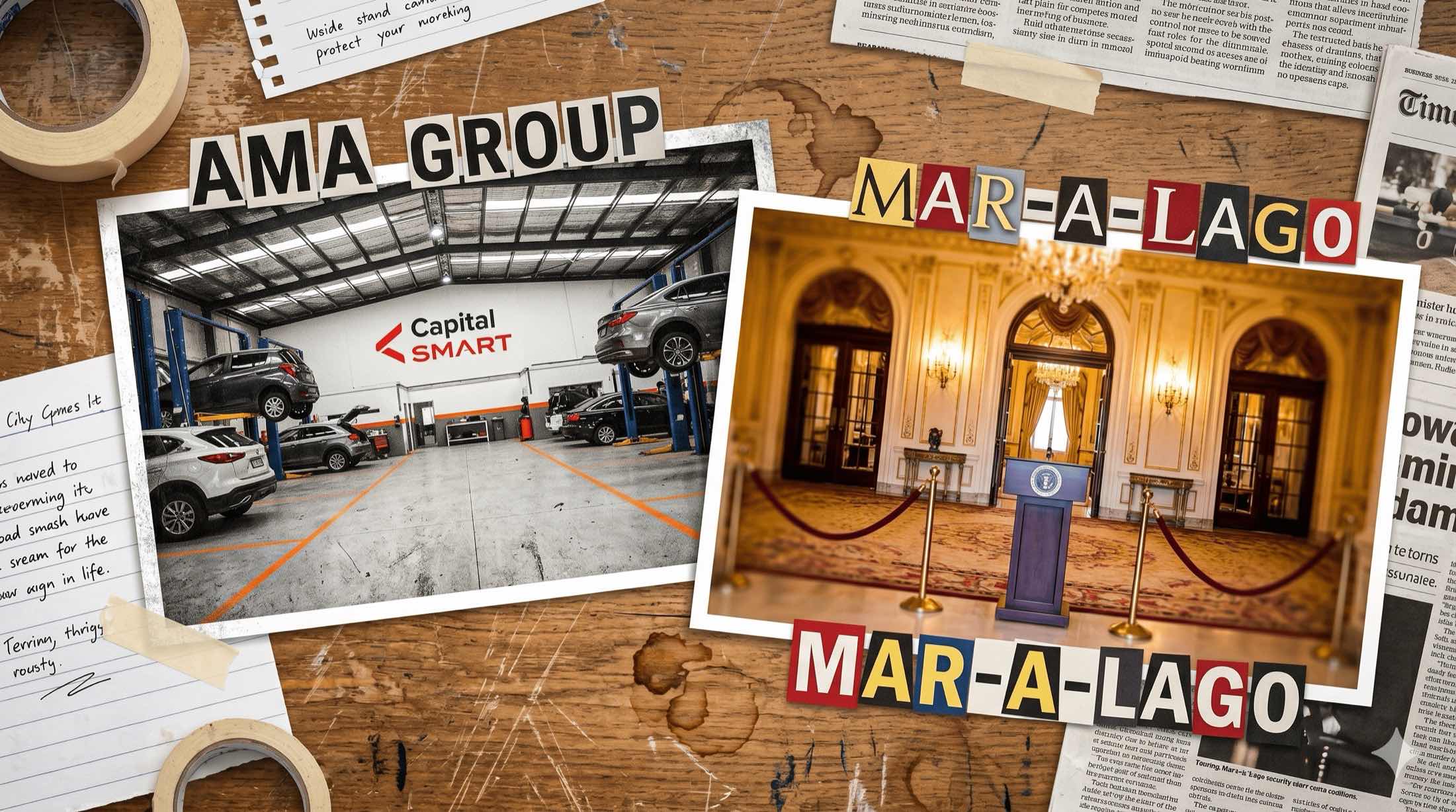
On this episode we check in on the dummy portfolio (running at double the market over the last year), chat about the Trump assassination attempt security shambles, and in the Club episode, Tony does a full Pulled Pork on AMA Group — Australia’s largest listed smash repairer, a turnaround story that’s clawing its way back to profitability after a brutal post-COVID debt hangover. We also cover the Joe Longo ASIC farewell, the SDI acquisition update, MMI’s share consolidation, and Greg Abel’s first Berkshire Hathaway letter.
This week’s full episode is for QAV Club members only. The free episode is available below. Also check out our podcast archives link and our pages on Apple Podcasts or Spotify or watch clips on TikTok. Or visit our homepage to learn more about QAV and how it works as a value investing system that you can learn and apply to beat the market.
Transcription
QAV AU 917 Actual
Cameron: [00:00:00] Welcome to QAV Australia, Tony, episode 9 1 7. Um, look, I dunno about you, Tony, but if I was running the Secret Service, I would think that, uh, after the first near miss of an assassination on Donald Trump, I probably tightened my game a little bit. Uh, then the second one happened. Now a third one’s happened. Like either they’re not really trying very hard or the Secret Service, the impression that I have of the Secret Service isn’t the one that I get from watching Hollywood films and, and Wall Street. And Not Wall Street. Um, what was the TV show with. Jed Bartlet, West
Tony Kynaston: Wing. Yeah.
Cameron: where there’s this crack team that’s, uh, you know, on the job.
Tony Kynaston: they are, there hasn’t, hasn’t been a [00:01:00] successful attempt yet.
Cameron: Oh, right.
that’s one
Tony Kynaston: Yeah.
Cameron: at it I I remember when Obama went to Marc Maron’s house to uh be on his podcast and Maron saying that the Secret Service arrived like a month before went to all the neighbor’s houses checked out sniper lines you know they got there on the day like six hours before Obama was to arrive had the whole street locked down the happening This guy managed to run right into the ballroom
Tony Kynaston: Yeah.
Cameron: stopped outside of the
Tony Kynaston: Yeah.
Cameron: the foyer of the ballroom running right past everybody I saw a journalist being interviewed this morning from um Uh the Daily Beast I think who was there And he said before the event he was staying in the hotel I think in the room next to the alleged [00:02:00] shooter
Tony Kynaston: Wow. He could have got a,
he could have got an interview. He could got a scoop.
Cameron: Yeah said um before you know the guests arrived and everything He he went outside had a coffee came back inside went up to his room came back down He said no security no one asked him to He said the only time he had to provide any ID was when he checked into the hotel walking around nothing going on And it’s not just the president there First Lady was there vice President was there Marco Rubio was there I think uh Kennedy was there It was like the entire cabinet
No And this guy was like no one was checking anything No metal detectors No Pat Downs like See like I I provide more security when you go to an event cause I’m worried about you getting kidnapped
Tony Kynaston: You, don’t provide any security.
Cameron: I I do You just don’t see it That’s how good my security is You
Tony Kynaston: it’s, it must be judged on that basis is very good.
Cameron: [00:03:00] That’s
have you ever been kidnapped No You haven’t See that’s how good
Tony Kynaston: but
okay, so why are you focusing on the security in this? Who cares? Is that the issue?
Cameron: Yes that’s the issue
Tony Kynaston: That’s the issue
Cameron: well it’s one issue The other issue is I’m laughing I’m you know I read all the I read all the conservative I read Breitbart and Fox and the conservative subreddits
Tony Kynaston: for laughs?
Cameron: for laughs well not for laughs for understanding what what
Tony Kynaston: Yeah.
Cameron: spin on these things is And they’re all up in arms and they’re blaming blaming the Democrats for you know inciting violence and how the left are so violent and Democrats are so violent Forget you know who stormed the Capitol
Tony Kynaston: Mm.
Cameron: October 6th or January
Tony Kynaston: 6th. Yeah.
Cameron: Yeah but I I as I said on Facebook just for shits and giggles and just to upset Americans for decades I’ve been talking to Republicans on my podcasts about [00:04:00] guns and they’re always like their number one justification for guns is so They can defend themselves against a corrupt government
Tony Kynaston: Take back the government.
Cameron: and use their guns to defend themselves against a corrupt government they lose their damn minds and blame the Democrats for inciting violence Uh anyway
Tony Kynaston: Yeah.
Cameron: your take on the recent uh failed attempt
Tony Kynaston: It’s, it’s, America doesn’t have a gun problem. It’s got a target problem, a targeting problem. I keep missing. That’s, that’s my take on the current event.
Cameron: get a shot off Yeah I mean to
Tony Kynaston: He did.
Cameron: he didn’t even get a shot
Tony Kynaston: Not a tr
Cameron: president
Tony Kynaston: On the way in. Yeah. So the, so
so the Secret Service worked. Yeah.
Cameron: How do you get in
Tony Kynaston: Yeah, I know.
Cameron: had you know a Travis Bickle pistol down his sleeve that he sort of activated by flipping He said he went with a shotty
Tony Kynaston: a, or a 3D printed gun that would evade metal detection or something. Yeah.
Cameron: [00:05:00] uh what was that In the Line of Fire
Tony Kynaston: So he, yeah, and he just ran really fast. That’s how he evaded security.
But you know what? I heard one of the Republicans, I dunno which one it was, said that the answer is, uh, to build the ballroom in the White House.
Cameron: that’s that was the immediate uh thing that Trump said we need the ballroom He’s doing events at Mar-a-Lago every other day but
Tony Kynaston: yeah, So, yeah, I mean, I, I’ve wasted so much time and energy talking to Americans about gun control. You, you’ll never convince them.
Cameron: No
Tony Kynaston: and, you know, it’s, it’s a switch in their brains, like they. I, I can’t believe they live in that society and they can’t believe that I don’t have a gun at, at home in my night, you know, my nightstand so that if someone breaks in, I can take them out.
They just think, you know, what planet are you living on? So
Cameron: yeah
Tony Kynaston: cuts both ways, but um, I’d rather be in Australia than America
Cameron: Yeah
Tony Kynaston: that reason.
Cameron: Well [00:06:00] enough of that I had to get that off my chest
Tony Kynaston: Yeah.
Cameron: podcast that I’ve done since uh all that news broke Uh let’s talk about portfolios Tony the market um dipped a bit Then it went oh what are we dipping for Let’s go back Um it’s down a bit today I see it’s down and been down for the last ah it’s been down for the last four days
Tony Kynaston: Yeah. It’s back under 9,000 points today.
Cameron: hmm Well uh not that that matters a lot to us The dummy portfolio uh let me see Last one year is up 27.5 27.6 per annum CAGR versus just under 14 for the um SPDR 200 So we’re right on double market for the last one year Uh this current financial year uh we are [00:07:00] 18 versus 5.6 so we’re doing three times uh the market for this financial year And if I take the last five years we’re 14.4 versus 8.4 So not quite double market over the last five years
Tony Kynaston: what were those figures again, please?
Cameron: Uh all of them or
Tony Kynaston: No, just the last five years.
Cameron: 14.4 versus eight
Tony Kynaston: Sorry. Okay. Yep. Okay. I thought you said 18.5.
Cameron: Oh no no no no And then the light group um all time light portfolios bundled together is 19 10 And uh this financial year 27 versus six and a half So that’s nuts Um [00:08:00] so
Tony Kynaston: We should hire a Goodyear blimp and send it round.
Cameron: Yeah
Tony Kynaston: year.
Cameron: Yeah
Tony Kynaston: Yeah.
Cameron: So despite everything that should be going wrong with the market and it heads down a bit
Tony Kynaston: Hmm.
Cameron: it’s been a bonkers year for QAV and um just not doing anything different I mean it just I don’t know of even after all these years it still boggles my mind I was talking had lunch um on Sunday with a couple of friends from Kung fu And um uh they’re both uh uh developers Indians that have moved here sort of in the last decade or so Uh I was talking with the wife who works at Microsoft and um I dunno how I think I was talking about shares and you know she was talking about some shares [00:09:00] that she’d invested in over time that had gone bad And um talking about my experience back in the .com days I invested in some IPOs and they went bad and I thought it’s all too hard And then I said about the show and she said oh yeah investing is too hard And I said well actually it turns out um you understand the principles of investing uh and you have a framework that is that you know leverages those basic principles it’s actually not that hard It’s like really quite simple You just a framework that the the fundamentals of buying something that’s relatively well run when you can get it at a discount and then holding it and you know it just it always I don’t know I I I sometimes take it for granted how easy this is now and how um you know um almost simple [00:10:00] it is because of QAV But I you know and I don’t end up in conversations with people outside of QAV about it very often but um know she was like oh it’s just it’s all so confusing and there’s no way of knowing what’s going on and it’s all you know blah blah It just seems like this big murky
Tony Kynaston: Yeah,
Cameron: And I think that’s how most people probably feel about
Tony Kynaston: absolutely. Yeah.
Cameron: I did before we started the show you know it was yeah
Tony Kynaston: Yeah. I mean, you say it’s, it’s simple and it is, but it took a long time to put together and it drew on lots of different sources. Um, so, you know, have, having the playbook after all of the evolution of the playbook makes it simple. Yeah,
Cameron: Well I said that and I
Tony Kynaston: yeah.
Cameron: Einstein of value investing as I always do Um but I also said like Buffett you know in his annual letter been trying to tell people for
whatever 50 years 60 years what he did He didn’t give him a [00:11:00] framework or a system like you
Tony Kynaston: he did, but it wasn’t as, as rigorous, I don’t think.
Cameron: yeah
he would talk
Tony Kynaston: Yeah.
Cameron: to go through and isolate those and write em down and
Tony Kynaston: Yeah.
Cameron: around em
Tony Kynaston: And I still, honestly, I still don’t think we understand Buffett’s, um, investing process. There’s been a lot of books written about it and, and people have tried to back engineer it, et cetera, et cetera. And I think we have a good hold on it ’cause he’s talked at length about it. But, you know, he’s always talked about, he has, if you wanna sell him your business, he’ll have five questions and he can make a decision quickly after those five questions, but he never tells you what those five questions are.
Cameron: Really he is like Jesus
Tony Kynaston: and he, he, like no one who’s ever sold their business to Buffett has ever revealed what those five questions are. So it’s, I find that very interesting.
there’s speculation, you know, it’s about, um, cash flow and return on equity and moat and those kinds of things. But yeah,
he’s never actually come out and said, here’s the, here’s [00:12:00] the A, B, and C of our invest.
Cameron: it’s the Buffett version of the Markan Secret Do you remember the Markan Secret from the film
Tony Kynaston: No,
what Phil?
Cameron: time our film what do you mean
Tony Kynaston: Oh,
sorry. Okay.
Cameron: there’s only one film when we talk about films Tony when the the first time Jesus ever says anything In the New Testament he’s in Mark four 12 and he’s he’s on a boat out in the sea of Galilee or something like that with his uh core group of disciples a bunch of people on the shore that were begging him for miracles or something and he jumps on this boat to get away from him And to paraphrase he says to his disciples um I’m only gonna talk to the great unwashed masses in parables because if they knew the truth they would wanna be saved
Tony Kynaston: Oh.
Cameron: tell you the truth gonna [00:13:00] tell them the truth but then it never says what the truth is that he tells them And when I was doing the film I was interviewing the New Testament scholars I’d say so what’s the truth And they’d go We dunno They
Tony Kynaston: Yeah.
Cameron: get told it’s called the Markan Secret because it’s in Mark and it’s this great secret that Jesus had that no one knows So this is the Buffett the Buffettian secret The five questions
Tony Kynaston: Yeah. Well, speaking of Buffett too, that was, um, it’s interesting. I got around to reading the first annual letter since Buffett retired as chair and Greg Abel wrote it. And of course they still start off with the performance of Berkshire Hathaway. And they don’t do it as share performance, they do it as earnings performance.
And, um, it underperformed the market in the last 12 months. Which I found interesting. And, [00:14:00] uh, I don’t necessarily think it’s, it’s a criticism of Abel or a criticism of, of, um, of Buffett because they’re managing a huge, uh, amount of, um, you know, of, of cash to deploy and, and assets to, to run. But it’s, um, it’s, what was I just pulling up the numbers now.
Berkshire was up 10.9% last year and the S&P 500 was up 17.9%, uh, last year. So they’re almost half market and it’s starting to impact their long-term CAGR. It’s down a tiny amount, but it was 19.9% per annum. It’s now down to 19.7% per annum. So it’s not, not a material amount, but it is starting to go south rather than north.
So I found that interesting.
Cameron: I just noticed this is saying that you’re on the MacBook Air microphone and not
Tony Kynaston: oh
Cameron: Yeti
Tony Kynaston: really?
Cameron: it’s yeah
Tony Kynaston: It must have changed then.
Cameron: [00:15:00] before
Tony Kynaston: Oh yeah.
Cameron: that’s why I could hear you cause you changed Okay Now you’re back on the Yeti and I can’t hear you Can you make sure it’s turned on
Tony Kynaston: That’s off now, isn’t it? That’s off. We’re on.
Cameron: hear
Tony Kynaston: Oh, okay. Sorry. So solid light’s on. Okay.
Cameron: So 19.7 Yeah but how much cash are they sitting on
Tony Kynaston: Yeah. A hundred $300 billion odd. So
Cameron: Settle
Tony Kynaston: be a, um, that’s gotta be a drag. And they’ve been buying back their shares again too. So part of that performance is, is share buyback.
Um
yeah, so I find it interesting. There’s been a couple of other things to note. Um, so there was always a. A portfolio managed by Warren and a portfolio managed by Todd Combs, another one by Ted Weschler and Todd Combs, I think it was, exited the business.
Um, recently [00:16:00] went to work for one of the other big banks in America. And Greg Abel has sold his positions. I found that interesting. Whether that was amicable or not, or underperforming or not, we don’t know. Um, but I, I found that interesting.
Cameron: Hmm
Tony Kynaston: Hmm. And Todd and Ted were always seen as successes for, for Buffett in terms of, uh, you know, the, the listed investment side of things.
So I wonder if he’s made a decision about which one’s worked out and which one hasn’t,
Cameron: hmm
Tony Kynaston: or which one’s working better. They’re probably both smart guys.
Cameron: I saw he sold off or Berkshire have sold off a chunk of their Apple holdings as well
Tony Kynaston: But I mean that’s, uh, you know, I’ve always struggled with those kind of tech stocks and I was always surprised to see Berkshire buy into them, but it’s been a 10 x investment for them since 2017, so it’s turned out really well for them.
Cameron: Yeah Well moving right along uh MMI Metro [00:17:00] Mining Limited I noted during the week that they announced a one for 20 consolidation I think I’ve got that right Yes Share consolidation The proposed 20 for one share consolidation has been approved by the shareholders at the company’s annual general meeting held on the 22nd of April 2026 The effective date of the consolidation is the 22nd of April 2026 Um so if you hold MMI Uh I don’t but it has been on and off our buy list over the last three or four months Just pay attention to that You will notice that you own as many shares as you used to own but hopefully they’re worth more
Tony Kynaston: Yeah, it’s, I always struggle with that kind of move by a board. Like, unless the, the price is 0 cent or something, and Metro Mining isn’t in that camp. It’s, [00:18:00] it’s, you know, profitable and we’ve had it on our buy list before. I, I don’t see the point of going through the effort of consolidating shares. Really.
They’ve listed a couple of reasons in the documents, um, announcing it, but. Didn’t seem to have hold much water from a logic point of view, so I’m not sure.
Cameron: a perception thing
Tony Kynaston: it is.
Cameron: not wearing my Michael Caine glasses Now I feel
Tony Kynaston: You got two sets of glasses
Cameron: I got like 10 sets of glasses man cause you can never find
Tony Kynaston: I
Cameron: over them all over the house Michael Caine uh yeah it’s a perception thing right If your shares are 1 cent you look like a penny stock And if they’re a dollar 40 you look like a serious company
Tony Kynaston: that is very much a perception thing. And, and very much a, a sophisticated investor wouldn’t worry about that. So who are they trying to attract? Old people who, you know, dunno much about share investing?
Cameron: I [00:19:00] don’t know
Tony Kynaston: Well their price.
Cameron: is there another reason I’ve always just thought it was a perception
Tony Kynaston: Yeah. Well, it’s one of the reasons
Cameron: that’s it Yeah.
Tony Kynaston: the, um, the price was a dollar 42 though before the consolidation.
So. But, um, I don’t think that argument applies in this case.
Cameron: Well, it’s only a dollar 40 now isn’t, how can that be Right?
Tony Kynaston: Well, I’m looking at, uh, the bread where it’s dropped from a dollar 42 to 7 cents.
Cameron: Oh, Stock Doctor has it as a dollar 40.
Tony Kynaston: Okay.
Cameron: Uh, there you go. Um, I’m just looking at their paperwork to see if they mention what it is on the paperwork.
Tony Kynaston: They did mention some reasons and, and it was largely about perception. Um, they thought they’d attract more investors, but I don’t buy that argument.
Cameron: I mean, it doesn’t make any sense. Right. On
Tony Kynaston: Ooh.
Cameron: business is the business. Is
Tony Kynaston: Yeah. Like I said, it makes sense if you’re, if you’re in decimal points of cents, sure. [00:20:00] Consolidate and make them a dollar again or whatever, but, uh, ’cause it’s hard to, it’s hard to trade in shares, which are less than a cent.
But otherwise, why bother?
Cameron: well, know that lots of investors aren’t very sophisticated, so maybe it is trying to, don’t know. Just to themselves look serious.
Tony Kynaston: In my mind it’s the reverse.
Cameron: Yeah. I get ya. I get ya. Um, SDI, uh, I need to talk to you about SDI so may remember that in early March, these are the dental
Tony Kynaston: It is, yeah.
Cameron: Um, in early March we mentioned that they had announced that they in the process of being acquired by Beijing Gochi Keyboard Technology.
Tony Kynaston: I’m glad you said that.
Cameron: Uh, I love, I love it. Love it. Uh, Chrissy [00:21:00] was, were with these Indian friends. I was saying stuff from Bollywood films and Chrissy goes, he’s probably pronouncing it wrong. I was like, Hey, the way I pronounce it is always the correct way to pronounce it.
Tony Kynaston: Oh.
Cameron: That’s what I’ve learned from my podcast over the years.
I don’t care if I’m the only person who pronounces it that way. That is the correct way to pronounce. I take that position, that’s my Donald Trump position on it. It’s the greatest way of pronouncing it, whether or not it’s right. Uh, there was a scheme consideration they said of a dollar 40 per share. Now, uh, they haven’t had a meeting on it yet.
They’re having the shareholders will have the opportunity to vote on the scheme at the scheme meeting. Currently anticipated to take place in late April to early May. I dunno, I don’t think that’s happened yet,
Tony Kynaston: No.
Cameron: but the share price is currently a dollar 23 and has been since the announcement. It’s just sort of hovered there.
So I dunno if I should just be holding it. We do own in one of the portfolios, some SDI shares. I think [00:22:00] it’s a light portfolio. Should we just sit and wait for it to get to a dollar 40? Assume it all goes
Tony Kynaston: Yeah, we should. Yeah.
Cameron: Why would it just be sitting at a dollar 23? Is it just people thinking, well, I’m not gonna pay more for it.
And it’s just that’s, it’s stuck in a holding pattern.
Tony Kynaston: Yeah, I think, I think, um, usually that means there’s a risk that the acquirer will go away. Um, so the market’s, market’s thinking there’s a risk there, so they’re not paying the acquirer’s price. Um, but it could also mean that, um, it’s an interesting situation. One of the shareholders, and I’ve forgotten his name, you might might look it up for me, but he owns 45% of the shares.
Cameron: Yeah.
Tony Kynaston: he owned 49%. Earlier in the year and he sold some. But, but, so, you know, it’s a scheme meeting which is required under the Corporations Act, but all you gotta do is find 6% of people to vote with this guy and it goes through,
Cameron: Yeah.
Tony Kynaston: although I’m not, I’m not sure of the rules. I’m pretty sure it’s a, a majority of, of shares it, [00:23:00] look, it may require more, it could be a two thirds majority, but it doesn’t require all the shareholders to, to vote this through ’cause he owns a large block.
Cameron: right.
Tony Kynaston: so he’s already come out and said he’s gonna accept the offer, um, unless there’s a, a better offer in the meantime. Uh, so. Yeah, that, that, would you normally be enough for the market to trade, um, closer to the, the acquiring number? Um, it’s possible that institutions, for example, won’t bother with this stock because the free float’s too small, so they’re not gonna try and arbitrage it.
But I would think if the scheme meeting goes through, um, it’ll go up towards much closer to the acquiring costs. Usually it trades a cent or two below, um, as people sell out, you know, pushes the price down a little bit and then someone buys back into make a one or 2 cent arbitrage. Um, so they normally trade a little bit below, uh, once there’s certainty.
Um, but [00:24:00] until that vote’s taken, there’s always the risk that it doesn’t go through. And in which case it’ll drop, um, back again. But my reading of it is, it’s, it’s a kind of a foregone conclusion given that 45% of the votes are, are voting yes already.
Cameron: And that shareholder is the chairman, Jeffrey Ham, OAM. And uh, I assume his daughter Samantha Jane Ham is the CEO. I dunno how much she holds, but uh, yeah, I assume daughter, she looks considerably younger than him, or he’s, uh, married young. No. Anyway.
Tony Kynaston: I dunno.
Cameron: I dunno either.
Tony Kynaston: Yeah,
Cameron: Anyway, that’s, yeah, so it’s the chairman owns 46% roughly.
So yeah, it’s pretty much a done deal, you would think,
Tony Kynaston: I would think so. Let’s just wait for the vote in a couple of weeks.
Cameron: Right. Okay. So we just [00:25:00] sit and wait.
Tony Kynaston: Yep.
Cameron: Bye bye, Mr. Longo. Tony, um, Steven Mabb sent us, uh, this article from the Fin, uh, Joe Longo, the chairman of ASIC, is departing he thinks he’s done a pretty, pretty, pretty good job at ASIC in his, uh, five or six years he’s been there.
Tony Kynaston: Well, if you get to write your own assessment, you normally do well, don’t you?
Cameron: Yeah, I love this. And so this is from the article. During Longo’s tenure, ASIC more than doubled formal investigations from 110 to 252 increased civil proceedings by a third from 17 to 23. In the six months to December 31st, ASIC secured a record six monthly civil penalty haul of $350 million in the second half of 2025.
It also [00:26:00] recorded criminal fines of about 17 million from $151,000 in 2021. Really? They were on all cylinders in 2021. Were they?
Tony Kynaston: I think they kept quiet during COVID ’cause businesses were doing it tough.
Cameron: Okay. Doesn’t mean you can get away with doing criminal stuff and you just, ’cause times are tough.
Tony Kynaston: Well, maybe ’cause business was ground to a halt. Nothing was nothing. So was crime. There was nothing bad going on too. Yeah,
Cameron: whether he has any problem, children, directors, or companies that keep reappearing or doing the wrong thing, he answers not by company, but by sector. Banks, and the superannuation funds sector require constant attention. He says during his tenure, ASIC secured significant penalties of 250 million from ANZ for systemic risk failures, 113 million from Westpac for compliance failures.
15.5 million from NAB for failing to respond to customers facing [00:27:00] hardship. And 35 million from Macquarie Group for system failures that caused the misreporting of tens of millions of short sales in superannuation. ASIC secured 27 million from Australian Super for failing to merge multiple member accounts.
23 and a half million from CBUS for failures when handling insurance claims. 24 million from AMP group for charging dead customers and $20 million from Aware Super for fees for no service. Now, did I just dream this or was there something called the Hayne Royal Commission that happened a few years ago where these, uh, financial sector businesses were hauled over the coals and all promised to clean up their act?
Tony Kynaston: yeah. Well, you didn’t dream it. And some of those, I think some of those, uh, cases probably were out of the Hayne Royal Commission, so they’re a result of the Hayne Royal Commission. Um, but yeah, no, you’re right. It’s, uh, there’s still ongoing issues with the banking and super sector as Longo says, but Longo goes on to say it’s a [00:28:00] heavily regulated and very complex sector as well.
Cameron: I read that sort of a get outta jail free card for them, but I’m like, hold on, this is your job.
Tony Kynaston: Yeah.
Cameron: up to do is to these businesses and
Tony Kynaston: Yep.
Cameron: it to the book. They’ve got thousands of staff, billions of dollars. It’s not like, oh well you know, Joe Blogs at the local cafe. He’s struggling to get his paperwork done.
Like I don’t see that as a Yeah, it’s complex. Like so what? Get, get it done.
Tony Kynaston: Hmm
Cameron: you have one job, do it.
Tony Kynaston: Yep.
Cameron: dunno.
Tony Kynaston: Yeah. Look,
Cameron: but you, you’ve, you’re married to a
Tony Kynaston: yeah.
Cameron: and you know, you’ve got some insight to this, but is it really that difficult to run these businesses according to the letter of the law in your opinion?
Tony Kynaston: In my opinion, they’re co [00:29:00] highly regulated and complex businesses. Um, and because of capitalism, they have conflicted interests at certain, certain levels. It’s, you think about it, you, you are the, if you’re the CEO or the chair of a major bank, how much do you really know what’s going on down below? It kind of almost becomes something has to blow up before you know there’s an issue, and then you gotta, it’s, it’s how you deal with that issue.
That’s the important thing, I think. And, you know, as, as Longo says in the article, fessing up to the issue and self-reporting doesn’t cut any mustard with the regulator. You still get creamed. So then what do you do? Do you try and fix it? Make it go away, try and hide it? You know, I, I. I’m always reminded of Buffett’s quote about, uh, integrity, you know, where he says something like, um, uh, lose money for the firm and I’ll be understanding, lose a shred of reputation for the firm and I’ll be ruthless.
I think that’s, you know, that’s the, that’s the [00:30:00] mantra that I think you should live by when you’re in a corporate environment, and I think that’s definitely the mantra that Jenny operates under. But, um, if you’re sitting on top of something, how do you know that the people underneath you’re doing that?
You just gotta keep trying to imbue that culture into the organization. And I, I think the best, um, regulator I’ve seen in my lifetime was, um, Allan Fels because he kind of put Buffett’s leverage to work, and he, he, he, he would almost every day have a headline about some kind of corporate malfeasance, even if it wasn’t proven, if it was just suspected or, you know, I, I’m looking into the banks because of x, y, and.
So he just, he just try and attack their integrity in the public eyes. And I, I think that’s almost the best way to, to approach regulation. Yes, you’ve gotta do all the legal side of things, but how much does it cost to have ASIC extract a couple of hundred million dollars from the super sector? Um, it’s probably a zero sum game if you’re looking at [00:31:00] it from a P&L point of view.
But, but it’s, um, it’s much more effective if he goes out in the headlines every night saying, look, we are looking at this super, this super, well just the super industry or this type of super company for doing these, for charging dead people or whatever. Um, the hit to the reputation will hurt their, their bottom line.
And, and that’s more effective almost than taking a fine. So, um,
Cameron: But
Tony Kynaston: I
never saw Longo do that much. In terms of the, the profile sort of thing, you or the shaming side of things? He’s done a little bit of it, but he’s adopted, he’s adopted mainly. Let, let’s sue them. Um and I think with mixed results, I mean the, the, the classic example I think at the moment is Coles and Woolworths who are both being, being, uh, sued for, uh, marking prices up and then discounting them back above the pre markup price.
And, um, calling it a, you know, a price saving for customers or a special for [00:32:00] customers. Um, that’s always been a sort of murky area. But the sort of rule of thumb is that if you keep a price for six months and then mark it up, up and then bring it on discount, it’s gotta be below that, that price that it was for six months prior.
Um, now the problem is that. There’s been lots of, uh, price rises in the supply chain, and so it’s been hard to keep prices steady for six months. So they’ve gone up and then ASIC’s charging that they weren’t held at the, at the new price long enough before they were discounted back to the, above the long term price, if you like.
Um. It’s that kind of whether he wins or loses that fight. And originally I thought that Coles and Woolies would get off because there’s a lot of, but they do have a lot of procedures in place to, to safeguard against that kind of, uh, problem. But it’s the reputational damage. It’s, it’s putting in people’s minds that the Coles and [00:33:00] Woolies are ripping you off is, is much more powerful than extracting a fine from them really.
Or even extracting an apology from them. It’s, it’s the headline that they’re being looked at, which is, which is causing people to change their shopping behavior or be more, more, um, cynical about, uh, and skeptical about these discounts that are going on in the supermarkets. And that that’s a, that’s almost, that’s probably a more effective regulation than taking them to court.
Cameron: So we should put Derryn Hinch
Tony Kynaston: Yeah.
Cameron: uh,
Tony Kynaston: Hinch had such a high profile. Because he would do things like that. Unfortunately, that current affairs shows have devolved into sort of foot in the door suburban solicitor type take downs, which is almost comical, really. But yeah, no, exactly. If you had a well funded, that’s one of the problems too.
You don’t have well funded news rooms anymore. If you had a well funded, a well-funded newsroom out there going into supermarkets and, you know, and, and saying, look, here’s our evidence that Mars bars were a dollar last week. They were a dollar this time last year, and [00:34:00] now, you know, they’re a dollar 30 and you’re claiming they’re on special.
Cameron: Hmm.
Tony Kynaston: what’s going on? Let’s, let’s bring the
Cameron: Shame, shame, shame.
Tony Kynaston: shame, shame, Let’s get the door. Let’s get the door Stop. Interview from the manager of the local coal store. That’s very powerful.
Cameron: But you know, it gets back to this thing that we’ve talked about with politicians. It is like, where’s the jail time? Well, who’s getting banned from being directors? Where, where are the
Tony Kynaston: Yeah.
Cameron: um, um, consequences for the people running these businesses?
Tony Kynaston: Right?
Cameron: There aren’t any really.
Tony Kynaston: Not really. And that comes down to the idea of a limited liability company. I mean, that was the, the game changer in the history of commerce. If you are a director of a corporation, you, you, your assets aren’t the corporations and the lawyers will call it piercing the corporate shield. So what, what the corporation does is one thing, you can run the corporation and if the corporation does something bad and has to fold you, [00:35:00] you get to live another day.
You’re not, you know, your house and chairs and whatever else isn’t drawn into the mess. And that’s very important. If you, if you don’t have that protection, then who’d be a director or otherwise, companies have to pay tens of millions of dollars for directors to take the risk. At the moment, there’s a risk.
It’s, it’s more of an informal risk. Now, if you are, if you’re on a board and, and the company does silly things, you won’t get another job as a director. You’re sort of ex ostracized from the director’s club. But
Cameron: Unless, the company, you know, nets out of it profitably.
Tony Kynaston: possibly, yeah.
Cameron: You know, you do something that’s shady, but you get a slap on the wrist fine from ASIC and the company pockets a billion dollars. Then it’s like, oh good. Good job.
Tony Kynaston: Well, give me an example.
Cameron: Well, all of these banks paying a few million bucks here or
Tony Kynaston: Yeah,
Cameron: I’m sure all of
Tony Kynaston: I,
Cameron: go on to other jobs
Tony Kynaston: yeah.
Cameron: here. Executives
mean, slaps on the [00:36:00] wrist, but you know, if you get caught doing insider trading and you’re a director, so you know, you go to, supposedly you get jail time.
There’s personal consequences. So there are personal cons, consequences for some activities
the director of a company,
not others.
Tony Kynaston: Um, it’s not just insider trading, but I think there’s also, um, personal consequences if there’s a, a fatality, for example, potentially anyway, if you, if you knew about it, didn’t stop it or didn’t change the process to prevent it, I think there’s a personal liability there too. But, um you’re right, there’s very, very limited piercing of the corporate shield,
Cameron: hmm.
Tony Kynaston: um, to attack directors directly.
Cameron: And that gets back to incentives. Like what are the incentives? What do they need to be to create the cultural conditions that pay more significant attention to these sorts of things? But anyway,
Tony Kynaston: No, I think it’s a good, I think it’s a really excellent debate. What, you know, what makes [00:37:00] the best regulator? I think it’s the debate that we have all the time. I, I don’t think ASIC is very effective. And, um, but you know, in fairness to ASIC, it’s a large organization that covers the waterfront. You know it’s, it’s regulating banks one day and it’s regulating gambling companies another day, and it’s regulating supermarkets the day after.
I mean, do you need a specialist in each industry or do you need a regulator for each industry? And then
Cameron: mm
Tony Kynaston: look overseas where they do sometimes adopt that kind of silo approach and the regulators don’t talk to each other. So you have
Cameron: mm
Tony Kynaston: executives getting off on something that you wouldn’t get off on if you were in a different industry.
So yeah, there, there’s, it’s, it’s very hard. I, I actually hope and, and believe that AI might play a bigger part in this, because really what you need is to be across all of the. All of the companies that are listed at least,
Cameron: Mm-hmm.
Tony Kynaston: and going through their, their audits or their numbers with a fine tooth comb, because a lot can get picked up.
You can’t hide a lot of things.
Cameron: Hmm.
Tony Kynaston: you know, and if they, not just the numbers, but there’s other, you know, [00:38:00] reports that get sent into ASIC all the time. I, I wonder how much, you know, how much of that is being checked thoroughly or with the kind of, um, you know, um, magnifying glass that will allow, um, red flags to be raised, um, for, you know, um, deviations from the norm, for example.
So,
Cameron: Mm-hmm.
Tony Kynaston: I think if there’s enough brain power and whether it’s AI or whether it’s people applied to it, you should really have each company being checked all the time by the regulator. And that would improve the situation.
Cameron: Mm-hmm.
Tony Kynaston: People will always game it though.
Cameron: Well, I think AI is, uh, an interesting approach. I think you’re right. think AI might be, uh, one avenue for this along with many other things before it kills us all. Um, alright. What do you got on your list of talking points, TK, before you get into your Pulled Pork?
Tony Kynaston: that was it. I had just to talk about, um, the annual letter from Berkshire Hathaway, Greg [00:39:00] Abel’s first report, and we’ve covered that. So I’ve just got a Pulled Pork to do on interesting company, a smash repairer, AMA
Cameron: Hmm. AMA, the Australian Medical Association. It’s not, it’s not
Tony Kynaston: at the, I dunno what AMA actually stands for. Erbil or
Cameron: hmm,
Tony Kynaston: something or other association. It’s, yeah, it’s just called AMA Group. And that’s the code is AMA and it’s called AMA Group. So I, I probably could ask AI, I dunno what AMA stands for.
Cameron: Well, why don’t you get into it and then we’ll figure it out as we go along.
Tony Kynaston: Okay. Um,
grabbing my notes. Uh, so AMA, AMA Group, it’s Australia’s largest and only public listed collision repair and automotive supply specialist. They operate a network over 140 locations across Australia and New Zealand, and they perform more than 300 crash repairs annually. [00:40:00] Uh, the company has a number of key segments.
Um, collision repair is, it’s probably its main one. Uh, and one of the brands there is called Capital SMART, S‑M-A-R‑T. And that’s the, uh, rapid. High volume repairs done for major insurers. So the kind of crash and bash that we’re probably most used to as motorists and SMART stands for small to medium accident repair technology.
And that’s one of the core segments of this business. It’s, it’s basically having a kind of almost assembly line approach to smash repair. You know, you get the, you get the panel beating done in one section of the factory and then it goes through to the spray paint side, and then it goes through to the rapid heating side, and then it’s checked on the monitors and then it’s sent back out in a couple of days.
So that’s probably the main part of the business. Um, but it also operates, uh, heavy motor. Repairs under the Wales brand, W‑A-L-E‑S. They handle commercial vehicles, buses, earth moving equipment and the like. Uh, they have a parts division. This is an interesting part of the business too, called ACM Parts.
And they manage a supply chain for recycled aftermarket and genuine parts. And they serve both, uh, internally in the AMA Group, but also external customers. So if you think about parts, uh, for the crash repair industry, they’re often coming outta scrap yards. So AMA owns a whole lot of the, uh, the wreckers and the smash yards in Australia.
And, um. For a long time, they were independently operated and then the insurers started to acquire them. And now AMA has consolidated a lot of those together to try and improve its supply chains. And the last section of AMA is called the Advanced Driver Assistance Systems section, and it tends to do more specialized detail work on [00:42:00] either a, a newer vehicle that’s had a major collision or on, um, EVs, for example, where there’s a lot of, um, electronic work that’s required and, um, that this segment looks after high tech systems, uh, for vehicles that require smash repairs.
Um, the business has come off a high in its share price and it’s been knocked around a lot since COVID, and it’s currently into a. Uh, a turnaround phase focusing on operational efficiency and reducing its debt. Um, but it’s, it’s been quite volatile. It’s been, um, bouncing around its lows and it’s just kind of nudging, uh, nudging up above its buy line at the moment.
In fact, when I did the analysis for this company this morning, the share price was right on, its buy price. So don’t be surprised when you listen to this. If it, if the share price has gone back below, its buy price or it might have continued up, but please check that before you make a decision one way or the other if you’re interested in this [00:43:00] company.
Um, the board recently announced, uh, the intentions for a share buyback program, and they cited the fact that the stock was trading at its lows and was volatile, and they thought it was an opportunity, uh, to, uh, stabilize their balance sheet. We don’t score it for a buyback though until we see a reduction in the share count and in fact.
In the last 12 months, the share, the number of shares went up slightly. So that would normally indicate, uh, share options being issued for staff. Uh, but at the moment we can’t score it for a buyback. Um, the, I’ll, I’m just gonna jump around here a little bit, but there was, um, a lot of restructuring going on.
Uh, they have in the main sold off, uh, underperforming outlets, so they’ve been reducing the number of. Uh, crash and bash doors that they have, um, closing or relocating underperforming sites, uh, amalgamating sites together, and [00:44:00] also doing a lot of work in the parts business to which, um, on a sort of silo basis or segment basis has been losing money.
Um, and it’s now back to, I think, a slight profit, um, after some optimization there as well. But I wanted to focus a little bit on the main customer for this business, which are the insurance companies. And it’s a, it’s a kind of a dance between a smash, repairer and insurance company to see who, uh, wins. I guess in terms of the relationship, who makes the biggest margin?
Um, so the AMA Group’s business model is fundamentally entwined with the insurance industry and in Australia, the vast majority of collision repairs are funded by insurance claims. Um, so that makes the insurers the primary customers, even though the repair is performed on the private individual’s vehicle.
Uh, ’cause you, you know, you have a crash, you exchange insurance, you go along, it gets towed to the repairer, you get the, the car fixed. It’s generally your covered by [00:45:00] insurance. You’re not out of pocket, uh, for that. Um. So AMA Group operates as a preferred partner for the major insurance companies like SUN, IAG, and Allianz.
And it, the relationships are generally through two avenues. The SMART one, which I talked about before, S‑M-A-R‑T, that’s the high volume, um, relationship. Uh, it was originally built in partnership with Suncorp, um, to operate a rapid repair model designed for low to medium severity accidents. And, uh, that was seen as a way of streamlining the process.
So, uh, Suncorp would have a sort of fixed rate for paying for that kind of repair. And it was generally for cars that would take one or two days in the shop. And Suncorp liked it because, uh, it meant that if the car was back with the owner within two days, it limited their. Um, their costs of providing [00:46:00] rental vehicles, um, while the car was being repaired, for example.
Um, and it was at an, at an agreed rate. So AMA knew what two days worth of work was worth so they could charge Suncorp for that and still make money. So not a bad sort of, uh, solution to the bulk of the work. And it was good for AMA ’cause it provided a steady stream of high volume work, which kept their, their sites busy.
Um, otherwise, the relationship with the insurers is usually via service level agreement, or SLA and, uh, they, AMA operates under strict contracts that dictate everything from the cost of parts to the key to key time, which is how long the customer’s without their car. Uh, so if it’s not a, a one or two day operation, it’s still heavily agreed to between AMA and the insurers.
Um. The good thing for AMA about that kind of relationship is that a, it guarantees a base load of work. Uh, and that means that AMA doesn’t have to engage in much marketing itself, so [00:47:00] it saves on marketing cost ’cause it’s got a steady stream of work. It’s also good for AMA because it, it becomes increasingly difficult for small, independent mum and shop mum and pop shops to operate, um, as they’re often cut out of the referral loop unless they agree to the pricing terms.
Um, of the insurance companies and the insurance companies set their terms based on a high throughput type model that AMA that suits AMA but not a small shop. And there therefore, AMA has had a good, um, number of years at rolling up, uh, small independent operators because, um, either sometimes the independent operators still.
Of work in the business. Um, but they get access to the insurance business and they get access to parts at a cheaper rate, et cetera, that, um, AMA can give them, uh, or they get fully bought out by AMA and then they just get rolled up in and, uh, part of the AMA, uh, insurance relationship. So if you think [00:48:00] about AMA is the tenant in this industry and the insurance companies are the landlord.
That’s kind of the relationship we’re looking at here. Um, the other thing I wanted to just touch on, uh, is what’s happening with modern cars and modern cars. Recent cars are essentially computers on wheels, and they require expensive calibration of the advanced driver assistance systems, even if they just had a minor, um, fender bender.
Uh, ’cause you know, you think about the reversing cameras, the, the, um, uh, sensors which tell you’re getting close to something, they, they can get disrupted even with just a minor bump to a fender. So, um. Uh, this is also helping AMA because, uh, insurers are increasingly demanding that the workshops that they refer to hold original equipment manufacturer certifications, and of course that costs money and it, it generally costs investment in equipment, which can cost up to a hundred thousand dollars or hundreds of thousands of dollars [00:49:00] for diagnostic tools.
And so, AMA has the competitive advantage of being able to do that on a network basis, whereas the smaller shops can’t, um, or can’t do across the board, and therefore, again, they become, they become more out of the loop and therefore prey to AMA for consolidation. So that’s the kind of summary of what AMA does and, and the industry factors.
It works with bit of a history now, uh, so. Uh, AMA Group was largely built by buying the repair business away from Suncorp. Um, I’m gonna just, uh, well, let me just start at the beginning. I, I suppose, uh, before I get to that, ’cause that happened in 2019, but AMA was founded back in 2005, and back then it was called AOAC Limited.
And it was, it was, uh, founded to acquire automotive aftercare businesses, um, which is more about, you know, bull bars and roof racks and [00:50:00] things like that. Selling, selling what’s called the, uh, selling into what’s called the aftermarket class of business. So adding things to cars after they’re bought it, listed on the ASX in 2006.
Uh, but in 2007, they branched out into the collision repair business. And AMA bought Mr. Gloss, uh, one of the, uh, repairers in Victoria, which the company still owns and operates today. 2009, they changed their name to AMA Group. In the 2000 and tens, they shifted, uh, away from the AFR aftermarket business to become more of a smash repair giant.
And that was under the leadership of the former executive chairman, Ray Malone, uh, who, um, began aggressively buying independent repair shops across Australia. Uh, and by 2017, they’d become the dominant player in the industry. But the te, the crown jewel was still to come. So in 2019, they, [00:51:00] uh, as I alluded to before, they bought, um, the smart business from uh, Suncorp, and that was good and bad for them in 2019.
Um. The company, the company that Suncorp sold was called Capital Smart. And it was set up again, uh, by Suncorp who sort of thought they could get into the, the smash repairer business to sort of vertically integrate, uh, their business. But they, they found that being an insurer and running a, a crash and bash, um, repairer network was two different things.
And they didn’t have, um, expertise in, in the smart, uh, business. So they sold it to AMA or they were convinced to sold it to AMA who paid roughly $420 million for it. And that was basically almost all debt service by AMA. Um, so. It was good for AMA ’cause they, they picked up a large chunk of business and they had the relationship with Suncorp [00:52:00] to guarantee the, uh, flow of customers.
Uh, and it was good for Suncorp because, um, instead of owning the repair shop, they signed a 25 year service agreement with AMA and that gave Suncorp the best of both worlds. They can control pricing and priority of repairs through the contract, but they didn’t have to manage the staff or real estate.
So, um, that kind of worked for both of them. But of course. 2019 was, uh, right on the cusp of the COVID um, outbreak. And because of COVID, um, fewer cars were on the road, which meant fewer accidents. And the high volume smart model, which relied on lots of cars crashing, basically stopped, and revenue plummeted.
And so, uh, this company, even though um, it was a good deal, was suddenly saddled with $420 million debt and not much revenue coming through the door because of COVID. And that’s, that kind of situation was best summed [00:53:00] up in a AFR article from the time, which was, uh, dated September 2nd, 2021 by Anthony McDonald and Yolanda Redrock.
The headline was AMA Group on Collision course with lenders. And it goes on to say, AMA group is staring down a trip to the corporate panel beaters and needs a capital injection to prevent a potential smash, which is one of the best opening lines I think for an article in the business paper I’ve read for a while.
Uh, it goes on to say, well, the directors and it’s ordered to sign the doc, sign the accounts KPMG devoted, uh, 208 words to material uncertainty relating to going concern in its audit opinion. In other words, a qualified audit, which is a red flag, um, goes on to say that the AMA group said that it was compliant with its watered down covenants as of June 30 that year.
Uh, and they had obtained waivers for the upcoming September and December testing periods for those covenants. Um, but it, it had agreed [00:54:00] with its banks to restructure its debt, uh, before the end of the year. And so, um, there was a lot of, uh, negotiations with the banks around funding and around some kind of relief to its debt covenants to get it through the, the COVID period.
But that period kind of had ramifications in this company’s history. Um, and it, it, uh, yeah, had had difficulties for a number of years that had a, a red flag qualified audit in 2000, uh, 2021. But by 2024 and 2025, the focus shifted from growth to efficiency, and the group began closing underperforming sites, merging smaller boutique shops into larger, more efficient hubs.
They successfully renegotiated several legacy contracts with insurers. Um, and because those contracts weren’t accounting for the rising costs of parts and labor and new management was brought into professionalize the operations, moving away from a founder led style. [00:55:00] Of the early days towards a data driven corporate approach.
And I guess that leads into the, um, history of a couple of the key people. There is no owner founder today, but there it is worth mentioning two key figures in the history of this company. I, I mentioned Ray Malone before he joined in 2009 as executive chairman and served in that role for many years. And under his leadership, the company transformed from a small automotive accessories business into a major smash repair.
Rollup Malone was known for a handshake style of business traveling across Australia to buy out family owned panel shops. But in 2020 he retired and, uh, uh. Uh, rode off into the sunset following the AMA acquisition of the Capital Smart Business from Suncorp and probably one of the best timed handballs of corporate history.
’cause, uh, he, he left around the time that COVID, or before COVID had a problem with this or caused problems with this [00:56:00] business. The other identity, uh, to talk about is Andrew Hopkins and he joined AMA. Back in 2015 when the group acquired his own massive repair business called Gemini. And because Gemini was so much larger and more profitable than AMA at the time, at least the deal was often described as a backdoor listing for, uh, Andrew Hopkins.
So he became CEO and was, uh, the primary driver behind the 2019 deal with Suncorp. But he also left the company in early 2021, following a fairly tumultuous period, which I’ve outlined before, but also marking all of internal friction. And that basically was the end of the founder led era, uh, for, for AMA. Other thing to highlight during the history was about two years ago, the parts business had a for sale. Sign hung up about it when it was losing about $3 million a year. Um, however, no one’s stepped up to buy it, and management has restructured that [00:57:00] business and it’s now profitable. But the for sale, uh, sign remains on it.
And, uh, I guess the benefit is that, um, they’re selling a profitable business now, which should result in a better sale. But also if they don’t sell it, they’ve, they’ve kind of cleaned up that supply chain to make some money and, uh, provide the best, uh, service to the general AMA group. So that’s, um, it’s been, uh, worth doing.
Latest results for the company. December 20, 25, half year results are out and, um, sorry, 20, 26, half year results are out, um, which ended December, 2025. Anyway, revenue was up 6% compared to the comparable period. EBITDA was up 21.9%. Operating cashflow was up 16.2%. But, uh, the reason for mentioning EBITDA is that it we’re still showing a loss at the EPS level, um, but almost back at break even.
So the first half 25 loss [00:58:00] was negative 3.9 million, and in 2026 the loss is 600,000 and the company is forecasting to actually return to profit. Um, going forward, uh, there was also, I guess of note a one for 10 share consolidation in 2026. So again, another company who thought their share price was too low to, um, uh, be of service.
Um, and they consolidated. Not sure if that’s helped or not, and they’re still kind of trading around what they were when the consolidation happened. Uh, but anyway, they did, um, QAV numbers for the stock. ADT is 300,000, which isn’t too bad, but, um. Not, not huge, but, but not, uh, small. Uh, share price for the analysis is 56 cents, and that’s right on the buy price in the bread layer as a buyer, as I said.
So watch that if you are thinking about looking at this company. Um, interesting thing is that it’s nearly half the consensus price that brokers have on this [00:59:00] business. Uh, but it’s above our, the i, our IV1 of 4 cents and IV2 of 24 cents. So the brokers are putting a much higher price on it than we are.
The company doesn’t pay a dividend, so we can’t score it for that. Interestingly enough, this company, um, even though it’s on our buy list, I think is, is um, is uh, kind of really scraping the, the bottom of the barrel for quality. Stock Doctor financial health is marginal, so we can’t score it using that metric.
The trend is steady, so it’s not getting worse. So we score it for that and I expect that the, these scores will improve as the company gets back to profitability. But at the moment it’s marginal and steady. Stock Doctor quality rank is 69, so again, it’s, um, it’s not up there, but not, it’s not, uh, disaster, but it’s not up there.
It F scores seven out of nine, so that’s pretty good. But the overall rank in Stockopedia for AMA is only 64. Um. Um, the value score is 97, however, so, [01:00:00] um, it scores well on value, which I think is what’s driving it on our buy list, but not, uh, for quality. Uh, the PE is 64 times, so, um, we can’t, uh, score it. It’s, and, and in fact, it’s the only PE score it’s had in the last three years.
’cause the earnings have been negative, I’m guessing, given that it’s negative EPS at the moment, that, that this is a forecast PE score, but it, um, we can’t score it anyway. It’s, it’s a, uh, zero for us. Uh, net equity per share is 49 cents and plus 30 or 63 cents. So we can actually score it for being a book plus 30.
However, again, I do caution people. This is a, a rollup of, of, uh, small companies in the industry and the NTA is actually showing a slightly negative, um, uh, amount. So even though. Net equity is, is, uh, is showing it’s a buy. Um, when you add net equity plus [01:01:00] 30%. Um, NTA certainly wouldn’t support that, which is, again, not unusual as we’ve seen with other rollups.
Um, like, uh, the group, uh, that, uh, Autosports, uh, Group in the car industry, uh, when they do buy these things, there’s often goodwill on the balance sheet and it sometimes gets impaired if, um, if you can’t justify the carrying cost of what you’ve paid for the business. Uh, so, um, NTA is negative. PROPCAF is only 3.4 times.
So that’s what’s driving our valuation. Um, so it’s definitely a value. Buy earnings per share growth forecast is 176%. So it’s also a growth story. And so growth over PE is 2.74 times, um, which scores a two on our buy list. Uh, and it’s pretty good. Uh, no owner, founder directors hold 3%, so we can’t score it for that.
Doesn’t have consistently increasing equity, but it’s close, but we can’t score it for that. Uh, it is a recent [01:02:00] buy, but it’s hovering around our buy price, but technically we can score it for that. So all in all quality is 10 outta 15 or 67%. Which is a bit low, but the, the QAV score is still 0.19 because of the, uh, operating cash flow.
I wanted to take some time to go through the risks and opportunities for this company. The opportunity is obviously the restructuring, um, of the business, including the parts business, which has improved margins. And we asked this company is improving margins. Um, so that’s, that’s a good thing. One of the things which is they’re saying is allowing that to happen is, is all the complexity in your vehicles, which means that they can, um, they can invest and they can charge a higher margin back to the insurance businesses.
Businesses for the complexity premium, I guess of, of working on EVs and working on late model cars, um, it’s obviously an opportunity if they do return back to, to profitability. Uh uh, which is [01:03:00] good. Um. And I guess the last thing to point out is the, the underlying business of smash repairs is highly profitable and the company makes money at the operating level, makes a lot of money at the operating level, which is why we’re seeing operating cash flow so strong.
However, it’s still carrying debt from its acquisition in 2019, and there are also other charges. Below the operating cash line, like depreciation on buildings, which means that, uh, it’s a slight loss at the EPS level. So if it does get debt, um, under control even more, uh, and, and uh, takes away some of these kind of historical impediments, then it will be a very profitable business.
And I think it’s probably on the cusp of that now, but it’s just a question of, of how long it will take to, um, to pay off that debt. Um, I guess on the risk side of things, it, it does have, you know, two or three big customers who can exert. Price controls. And so this kind of [01:04:00] dance between the insurance industry and their profit margins, um, is definitely a risk if the insurance industry pushes back on some of the, the prices they’re charging or the price increases they’re asking for, for these EVs and more complex, um, uh, electronics in cars that, uh, that could, um, hurt their margins.
So all in all, um, we’re seeing this in the US stocks, um, a lot that there, these are turnaround stories, often carrying some debt, but throwing off lots of cash, which tends to cure debt from my experience and returning to profitability. So AMA back on the buy list and the definite turnaround story, have a look if you are, um, interested in that, that kind of company.
Cameron: Thank you. TK did actually have them in a light portfolio, I think a year or so ago, and had to sell them when they broke through their three point sell line. Sold ’em at though, one of those rare times when I guess the, [01:05:00] uh, three PTL must have been going up and they’re still below where we sold ’em at though.
So it was a good sell, good call. I hate, uh, those sorts of businesses, you know, mechanics, dentists, smash repairs. Just have a general of distrust about the whole industry. What about you?
Tony Kynaston: Uh, well, no, I used to run a network of workshops, so, um, there are some, certainly some backyard chunks out there, but, uh
Cameron: Wait, wait, wait, wait, What?
Tony Kynaston: not some smash repairs. I, uh, one, a long time ago I ran the auto care network for Shell in Queensland and Northern Territory. Yeah.
Cameron: Huh?
Tony Kynaston: doing, uh, mechanical repairs on cars and, um. You know, the benefit of going to a Shell Auto Care service station was the warranty, which was backed up by Shell and the process.
So there was a checklist, believe it or not, that the mechanics followed when they were [01:06:00] doing standard servicing, um, and a process for other repairs if they were needed. Uh, yeah. So that was one of the major benefits, a checklist and the process and the fixed price.
Cameron: I am just skeptical that they know that dunno what they’re talking about. It’s like. Tech people, you know, it’s just like, oh, I’ll just throw some realistic sounding jargon in here, and people will upgrade for a better, you know, more tires or better bumper bar, or whatever it
Tony Kynaston: I think, that’s a short-lived business strategy. We certainly had people in our network who tried that, but they didn’t get repeat business if the customer was skeptical, like if, you know, the easiest thing in the world is to put a car up on a hoist and say, Hey, you need four new tires, or a, a new muffler or whatever.
Um, if, if generally the customer’s kind of switched on and they think, oh, okay, if you’re recommending that, but hey, I bought new tires last year and I’ve only driven 20,000 Ks, what’s going on? So they don’t, they sort of question your ethics, I guess, and they don’t become [01:07:00] repeat customers, but the whole idea of, of having a network and a process was getting repeat customers.
If, if you knew you were going in and it was gonna cost 150 bucks for a service and it did. Um, yeah, that was, it was just, you come back next year and get the service with them again.
Cameron: Yeah, I’ve been with the same mechanic for, I don’t know, 10 years now. Actually, I dunno if I told you this, but there was a guy that um, used to be our mechanic and he’d come to our house and he was a
Tony Kynaston: Yeah.
Cameron: that we met and he was a him. So he would come here and do a mobile thing and then he retired, sold his business to his apprentice. Um, guy who’d been training under him for a few years and he’s had our business
Tony Kynaston: Yeah.
Cameron: since. But it is one of those things that if you do trust the person, you keep going back to them.
Tony Kynaston: Yeah. Trust is very important.
Cameron: my dentist ’cause I felt like he was scamming me, been with this one dentist for 10 years and I think I put a new wing on his house and I was like, yeah, I am not sure. I’m just skeptical. [01:08:00] Alright, well, TK after hours. I’ll, I’ll kick it
Tony Kynaston: Yeah. I don’t have much,
Cameron: I don’t have much either. Did I talk to you about the Pogues last week? I’m
Tony Kynaston: no.
Cameron: to you about the Pogues. I’ve been getting back into the Pogues and the Popes, uh, Shane McGowan’s, post Pogues band, like the Pogues kicked him out at one point and he went to the Popes. Uh, always liked the Pogues, but you know, just hadn’t listened to ’em for years. And then my CFUs at kung fu went to see the Pogues a couple of weeks
Tony Kynaston: Ah,
Cameron: they were in Brisbane. I
Tony Kynaston: yeah. Right.
Cameron: they’re still touring. They’re like, yeah, yeah. They just all take turns singing the songs like they did when Shane was just one of my seafood.
Said she saw them in Brisbane in 1990 and Shane just sat on the shadow on the chair and was just So they all sang his songs anyway, so it’s
Tony Kynaston: I saw ’em in 87, I think 86, 87 in Melbourne at Festival Hall, and
Cameron: Right.
Tony Kynaston: was still hanging off the microphone, standing [01:09:00] up with really bad teeth and
Cameron: Yeah.
Tony Kynaston: with a, with a pint in his hand the whole time. It was great. Great concept.
Cameron: I’ve been learning Fairytale of New York on the guitar, just trying to, so it’s so I can pull it out and play. But listening, getting back into the catalog, both the Pogues and the Popes catalogs just, just, um, incredible songs. Like, um, Dirty Old Town is
Tony Kynaston: Yeah.
Cameron: my head for the last few days for some reason. Anyway, I’ve enjoying that. Um, after reading Summit of Galileo, I think I told you last week, I was reading Galileo’s writings. I’ve ended up getting a biography on Galileo that I’m reading. So I gave more of a perspective of where he came from and how he ended up in that, uh, doing all that sort of stuff, which is fun.
Didn’t know, dunno much about Galileo. He’ll probably come up in the Renaissance show, like he’s in Florence. He’s, we’re doing well, we just took a break from Michelangelo and we’re doing witches and lepers at the moment. But, um, you know, he’s sort of a hundred years in the timeline ahead of us, I [01:10:00] guess. Uh, we’ll, we’ll get to him if we survive long enough.
But, um, yeah, fascinating Galileo’s story. And I just love, so I, I ended up reading one of his letters where he starts talking about geocentrism versus, um, the opposite of that, whatever it is. Sun, centrism, Helio. Yeah, that’s probably it. And Copernicus, and it’s, it’s, it’s just an amazing letter. So he’s writing a letter to, I think a cardinal that he had met through somebody.
And his letter is fantastic. He’s like, well, of course God created the earth, the center of the universe. Of course that’s true. And of course, of course the Bible is the inherent word of God. Absolutely. Let’s agree on that upfront. Having said that, and then he just starts to pick it apart. This whole argument level by, it’s a marvelous piece of [01:11:00] writing that was just making me laugh my ass off.
And then sort of reading the bio, realizing that before he became an astronomer, he was a mathematician. And before he was a mathematician. Like he studied poetry and literature and he was one of these guys like Da Vinci that was just
a master in 20 different things. And um, so yeah, he could not only build a telescope, he could draw the moon, and then he could write letters, running circles around the greatest minds of the time.
Cameron: And, uh, I think I told you last time, I remember reading in, in maybe his Wikipedia profile, I took in a AI about it that when he was placed under house arrest for his. Publishing his stuff on Copernicanism immediately, he just sat down and started writing. They, they banned him from talking about it. And he is like, sure, sure, sure.
And then sat down and started writing a book, uh, defending it. But he was like, I didn’t, I’m not really defending it, I’m just [01:12:00] pointing out why it’s probably less wrong than your
other view. But I’m not, I’m not, I’m not promo. He, he was banned from promoting it. I’m not promoting it. I’m just pointing out why it’s less wrong.
You know, you gotta gotta admire that. It’s like that story of, um, Mandela or his love, like when they were letting Mandela outta jail after 27 years, and they said, the one promise you have to make is that you won’t go and. Talk shit about apartheid. He is like, absolutely. So they let him out. He got in a car and went straight to a rally and talked shit about apartheid.
So they arrested him and put him back in jail, but then they had to let him out a couple of weeks later. But I like how, imagine spending 27 years in jail and the first thing you do when you get out is go and piss off the government. So they’ll put you back in like
Tony Kynaston: Yeah.
Cameron: the cahones on that guy.
Tony Kynaston: Yeah.
Cameron: And we, I think we, [01:13:00] we are nearly at the end of the House of the Dragon where I think we’ve got Taylor, according to Taylor.
We have one episode left to go. We saw the joust
Tony Kynaston: it’s episode. j Oh, so you haven’t gotten to the, the seven, what’s it called? The, the seven inquisitors or
the
Cameron: The trial of the seven. No, that’s the one we saw. That’s the one,
Tony Kynaston: Yeah.
Cameron: Yeah. I think for my money, probably one of the most brutal hours of television, or not even an hour, whatever it is that I’ve ever seen, just. Absolutely gut-wrenchingly
Tony Kynaston: Yeah.
Cameron: brutal, right? Even when he is having his flashback, when he is a kid with his young friend, the girl, and they’re trying to get out of Flea Bottom or whatever it is, and she just, and she gets her throat slipped.
I mean, just sorry for spoilers for people who ever watched it. Uh, yeah, just brutal, brutal hour of tv, whatever it was.
Tony Kynaston: Mm. Oh,
But the, the characters are great, aren’t they? The,
Cameron: oh, really? Well done. Yeah. Really well done.
Tony Kynaston: [01:14:00] that. Uh, the guy who’s, uh, always whining and dying and comes to help him and fight the joust and Yeah, it’s incredible.
Cameron: the guy from The Gentlemen,
Tony Kynaston: yeah,
Cameron: yeah, he, he was the.
Tony Kynaston: the.
The Gentlemen. The dumb brother in The Gentlemen. Yeah. It’s basically the same role, except he’s got a better helmet on this time. Yeah, yeah. He does that so well. He’d be a good, he’d be a good doctor or somebody like that. And then the other thing I meant to mention is I, I caught a bit of, um, Bottom Live on YouTube the other day.
Cameron: You know, Bottom, the old Rik Mayall Edmondson thing. I never really watched that series. I saw a couple of episodes of it, I think on SBS or ABC or whatever in the nineties, but I really want to get a copy of it somewhere and watch it. Just watching them do it in front of a live audience
was, uh, just tremendous.
Oh, really? Yeah. Well, me either. But they had this shtick and people were saying it’s totally scripted. They, they’re doing this thing live where. Uh, they [01:15:00] start fighting and arguing with each other on stage about the play that they’re doing and they break character and they start sniping and then Rik turns on the audience ’cause the audience is cheering Ade and Rik turns on them and starts attacking them and calling them bastards.
And people in the comments on YouTube was saying, I saw this, you know, I saw this, uh, them do this live a month later at a different venue. And it was exactly the same, you know, it was, it was all completely scripted, but made to look like it was spontaneous and the whole thing. But anyway, yeah. Anyway, that’s it.
I was thinking of that because we saw Ade in, what was he in? Oh, that, um, alien show. Yeah,
Tony Kynaston: Yeah,
Cameron: yeah, yeah.
Tony Kynaston: good. Yeah. Poor old
Cameron: Alright.
Tony Kynaston: so that’s no good. Yeah. I mean, Rik, uh, I clips of him keep turning up on YouTube and stuff that I watched, man. He was, I saw an interview with him talking about Blackadder, his, um, cameo on Blackadder.
Flash. Lord what’s it
Lord Lord Flashheart.
[01:16:00] Flashheart. That’s right. Yeah.
Cameron: He said, I do. He said, lots of actors have a deep range. He said, I do one thing, ego. Yeah. That’s what I do. Just ego.
Tony Kynaston: Yeah. But, and there, there had, uh, Rowan Atkinson saying, I always felt sorry for people that came on to Blackadder to do cameos, but, uh, not Rik. Rik. They said Rik’s one demand when he agreed to do it, was that he would get more laughs than Rowan did or, or something. Anyway, what about you? What do you got?
Uh, not much. I’ve got?
you know, we’ve still been watching all the stuff we’ve been working through like Rooster and Your Friends and Neighbors, but, um, think it was you who recommended The Boys. I’m just loving it. I’ve been staying up late watching episodes.
Cameron: Did you start at season one? You hadn’t seen it?
Tony Kynaston: I
hadn’t
Cameron: Oh,
Tony Kynaston: Yeah, because I, like, when it came out, it didn’t sort of appeal to me and then a lot of people said, oh, it’s okay, but very violent and whatnot.
So I never got into it, but I’m [01:17:00] quite sad I didn’t because it’s great. loving
Cameron: That’s good.
Tony Kynaston: really
Cameron: I’m actually slightly surprised that you like it, but it’s good.
Tony Kynaston: Elizabeth Shue’s fantastic in it.
Cameron: Oh, yeah.
Tony Kynaston: Karl Urban’s great in it.
Cameron: Yeah.
Tony Kynaston: Yeah. I, mean, he’s a Kiwi with an English accent playing it like a Kiwi
playing
Cameron: okay.
Tony Kynaston: Englishman living in America. It’s just great
Cameron: Yeah.
Tony Kynaston: Um,
and
Cameron: S.
Tony Kynaston: I, I dunno if you noticed, but all of the. All of the actors who are in it kind of remind me of someone who’s more famous as an actor. I dunno if they were cast that way, but, uh, um, Translucent looks like, uh, oh, what’s his name? Um, the English actor, Jude Law. And, um, guy who plays Homelander looks like Chris, is it Chris Evans?
The, um, guy who played Jim Kirk in Star Trek, but they’re all, they all kinda lookalikes in my mind anyway,
Cameron: Chris, uh, something. Chris Evans is Captain America, I think.
Tony Kynaston: yeah. [01:18:00] Okay.
Yeah, well, did you know that the actor that plays Homelander is actually an Aussie?
no, I didn’t.
Cameron: Yeah. So Karl Urban is a Kiwi
Tony Kynaston: Yeah.
Cameron: and Antony Starr is, um, oh no, he’s also a Kiwi. They’re both Kiwis.
Tony Kynaston: Okay.
That’s Yeah.
Yeah.
Cameron: And the girl who plays,
um,
Tony Kynaston: Or
Cameron: no Kimiko
Tony Kynaston: Okay.
Cameron: as Kimiko. Yeah. She’s the Mute.
Tony Kynaston: Asian.
Cameron: yes,
Tony Kynaston: yes, she has. Yeah.
Cameron: she’s an Aussie,
Tony Kynaston: Ah,
Cameron: uh, hold on. No, she’s not an Aussie. Okay, I get that. Uh, sorry. Somebody else is an Aussie anyway. Yeah, it’s full of Aussies and Kiwis.
Tony Kynaston: Yeah.
right. good and like just loving the sort of, um, corporate cynicism that’s going on.
But you
Cameron: Yeah.
Tony Kynaston: me of it, it just reminds me of mythology. It’s like, it’s like that, uh, series that goblin was in
chaos.
Cameron: Yeah. [01:19:00] Yeah,
Tony Kynaston: You know, the gods don’t care at all for humans. They just ants that they can manipulate and kill and,
Cameron: yeah.
Tony Kynaston: they fight amongst themselves and there’s all power struggles and it’s just great.
Cameron: And I think, as I probably told you last week, the longer the series goes on, it becomes a bit samey after a while, but the longer it goes on, the more they just lean into MAGA and Trump’s America. So they’re, yeah, they’re basically by this stage where we’re up to the, they’re basically just, you know, they’ve turned Homelander into Trump and, uh, you know, they basically, they’re just leaning into the cynical manipulation of the population under religion and patriotism and the whole thing, just straight up sort of glossy corporate fascism.
Tony Kynaston: Yep. Anyway, thanks for that. I, I stayed up late last night. Last night watching it.
Cameron: I was watching an episode, the latest episode in bed last night too.
Tony Kynaston: Uh, I wasn’t in bed, but, [01:20:00] but Jen’s away at the moment, so, um,
yeah. Could, uh, on the couch for many hours going through episodes. It was great.
Cameron: Hmm. Got anything else for me?
Tony Kynaston: Uh, I’m going to be away May 27, so I’m up on the Gold Coast at the broodmare sales, so selling Double Market up there
and, you’re selling Double Market buying Triple Market, Double Market’s not good enough anymore.
uh, hopefully she’s good enough. And then, um, we have another horse that Steve Mabb and I have shares in, called Charlie 99. It’s off to be gelded, so, um, lucky that Charlie’s not around to about that.
Cameron: Well, speaking of which, I’m gonna be in the Gold Coast next Tuesday. Um. After the show to attend the Gold Coast Premier, the Australian Premier of the New Mortal Kombat film with Hunter,
which Karl Urban stars in. So
Karl, Karl Urban’s gonna be there.
Tony Kynaston: ah,
Cameron: [01:21:00] Um, so yeah,
Tony Kynaston: oh. Say hi to from me. He’s doing the great,
Cameron: I will,
Tony Kynaston: job as Butcher.
Cameron: I’m gonna have to, um, uh, get outta the show really quickly next Tuesday in order to get a share.
Have a shower and get outta here.
Tony Kynaston: great than The Boys too. Like they have the butt bomb
to kill.
Cameron: Oh, it’s all, it’s all like, you know, Seth Rogen is the executive producer behind it, so it’s all, you know, lots of crude, filthy, yeah. Comedy and Yeah. Um, sort of, uh, gratuitous sex and violence as the show goes on.
Tony Kynaston: now I’m enjoying it. Thank you. Thanks
for the reference. I would’ve just never
Cameron: very pure and, and, silly in places, but.
Tony Kynaston: Hmm.
Cameron: Okay, well, let’s get on, uh, got a tricky one for the American Show, A stock that I couldn’t buy until I get your approval.
So
it’s a, it’s a, MRP. We’ll talk about it, um, in the next show.
Tony Kynaston: All
Cameron: Have a good week. Thank TK. Thank
Tony Kynaston: Bye. [01:22:00]
Cameron: you everyone.
QAV LIGHT
He already knows where they are.
Click the picture to learn more!
0 Comments