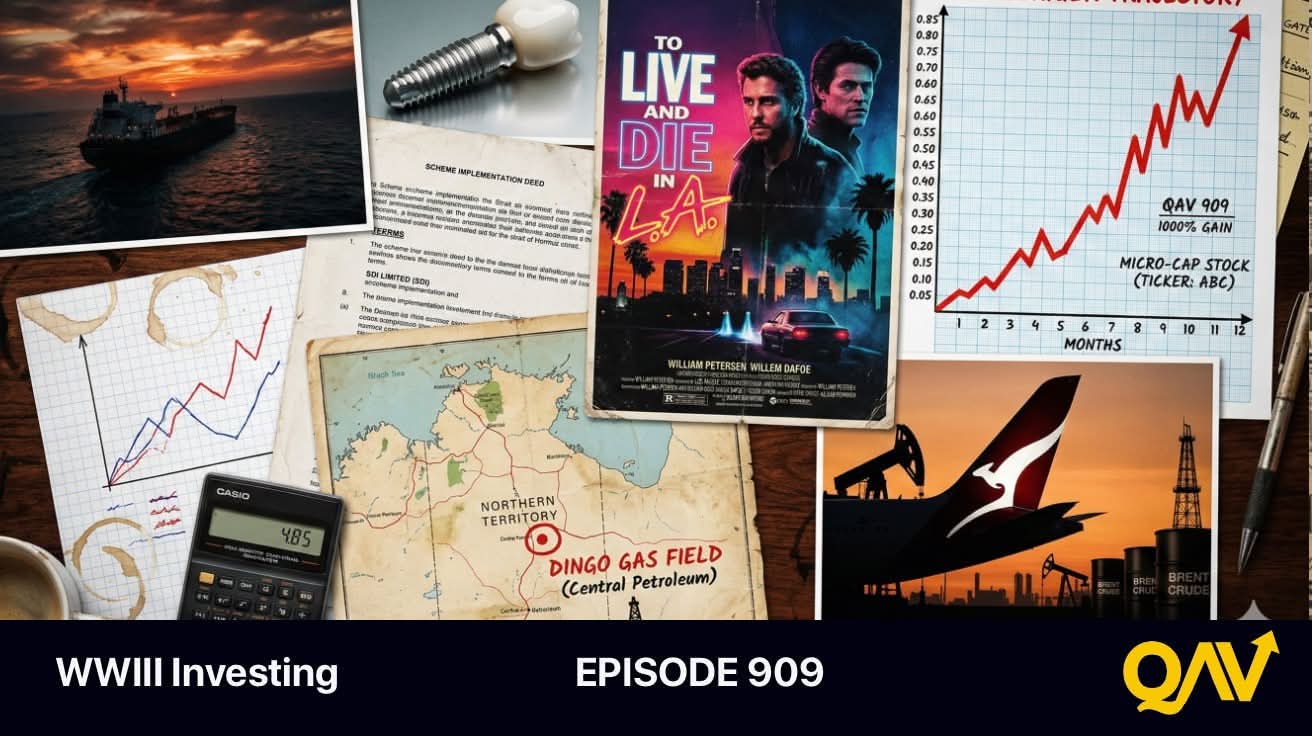
In this episode of QAV Australia, Cameron and Tony navigate the sudden market volatility triggered by the outbreak of conflict between the US, Israel, and Iran. The duo explores the “biggest threat in 50 years” to global oil supplies, specifically the disruption of the Strait of Hormuz and its inevitable impact on energy prices and shipping. Amidst the global tension, they find silver linings in a massive 45% takeover jump for dental manufacturer SDI Limited and a scheme implementation deed for Cue Energy Resources by Horizon Oil. The CLUB episode also features a deep dive into the “material uncertainty” surrounding retail company Cettire, a five-year milestone review from a dedicated member, and a “Pulled Pork” analysis of Central Petroleum (CTP).
This week’s full episode is for QAV Club members only. The free episode is available below. Also check out our podcast archives link and our pages on Apple Podcasts or Spotify or watch clips on TikTok. Or visit our homepage to learn more about QAV and how it works as a value investing system that you can learn and apply to beat the market.
Transcription
909
[00:00:00]
Cameron: Welcome to QAV Australia. Tony, this is episode something, something, something on the, something something Day. It’s 9 0 9 on the 3rd of March, 2026, or as I like to call it, third day of World War iii. How are you? Oh, Tony, what a week we’ve had. It
Tony: Yeah. What a.
Cameron: as you said, off air, like last week. Our biggest problem was waiting for a reporting season to finish, and, uh, then war broke out.
So jolly good. Jolly good.
Tony: Good. Yeah.
Cameron: Yeah, never a dull moment in the markets. Um, shout out to Marie New QOV Club member from Melbourne. Had a nice chat with her for an hour this morning, and it was a throwback to the old times. Tony, Marie’s big issue was, how the hell do I draw three point trend lines?
Tony: Oh
Cameron: was like, oh, we used to get that once a [00:01:00] day for years and years and years.
Then the bread later came along and we never got those questions anymore. She said, no, I wanna be able to draw them. I, no, no. I’ve looked at the bread later, don’t understand it. I was like, yeah, it’s one of those things you’ll get there. Don’t worry about it. Figure it out.
Tony: well. Hi, Marie. Did Cameron didn’t give you a good answer.
Cameron: Well, she said she watched the video that you recorded like six years ago and still didn’t understand it, so
Tony: I can’t.
can’t help that.
Cameron: No, I talked her through it. Uh, we went through a bunch of examples. I showed her the bit in the Bible with all the examples, but it was just fun to get back to three point trendline analysis.
Haven’t had to do that in a long time. So let’s talk about oil. Tony. Um, yes.
Tony: oil?
Cameron: I don’t know, just something just outta the blue. Something somebody asked. I think Toby asked us to talk about oil and gold. According to the financial review, Alex GL
Lucius oil
faces [00:02:00] biggest threat in 50 years as Iran Crisis disrupts ous.
For weeks, traders and analysts have been laying out different scenarios to try and chart the impact of bubbling tensions in the Middle East on oil over the weekend. Their worst case scenarios became a reality when the US joined Israel in bombing Iran as the US and Israel launched their attacks on the oil major tankers.
Almost immediately U‑turned or stopped at the entrance to the Strait of Ous, a crucial shipping lane for about a fifth of the world’s crude Iran pumps about 3% of global oil output, but the nation wields greater influence over energy supplies. Given its strateg location, alongside the strait oil from the Persian Gulf must pass through the waterway to get to major markets, including China, India, and Japan.
So, uh, you know, my immediate thoughts apart from concern from people in Iran. [00:03:00] And the rest of the Middle East was, what’s this gonna do to oil prices and also our shipping companies that we own in the US portfolio. Um, turns out shipping companies are doing great
for
some reason. I dunno why. Um, and oil prices going great too.
So
Tony: Well, you’d expect the oil price to rise.
Cameron: would you, who the hell knows
Tony: No. Well, I,
Cameron: you,
Tony: I, I don’t know, but I can go back to past behavior and, and extrapolate from that. Um, yeah. As soon as you don’t have oil flowing freely, it’s, it’s, it’s, it’s like turning a tap off supply. So supply and demand means the price goes up. Um,
Cameron: Yes.
Tony: the, the pat the,
Cameron: is, well, sorry. Yeah, keep going.
Tony: Well,
the pattern I went back to was the Ukraine War, um, which was kinda the last global crisis that affected oil and the, and the pr it’s bit hard to pull apart ’cause the [00:04:00] price of oil was going up then anyway.
But, um, it, it shot up after the Ukraine war started, which I think was February, 2022.
Cameron: Yep.
Tony: Uh, and it stayed up and came back and within about six months it was back to the. Price, it was at the start of the war. So there was heightened oil prices for six months. And
what
tends to happen is OPEC will get together and they’ll say, let’s maybe drop the price of oil for a while to try and keep pumping it and um, keep it moving and, um, uh, look after our market share, all that kind of thing.
But eventually the world resets. And if, if it can’t, I mean it, door number A is door number one is that the Middle East resolves itself quickly and the oil starts flowing in from, um, the Middle East through the straits of,
and
then we’re back to a lower raw price. So this could be a short lived blip. Uh, door number two is that [00:05:00] people make alternative arrangements and, um, it’s maybe a little bit costlier to do that.
So you take longer routes to ship oil around the world, or you buy it from different supplies, in which case the heightened door price will continue ’cause it’s got those extra costs. Um, factored in, but you know, it’s gotta be, I think, high for somewhere around six months is my best guess. Um, may not be long term.
The, your price after that period came right down. So it was around a hundred dollars a barrel, um, at the start of the Ukraine War and before this la last weekend, it was down in the sixties again, so it got pretty low, um, following that even though the Ukraine war continued. So, as I said, the, the world resets and adjusts and makes different arrangements.
Mm-hmm.
Cameron: Hmm.
Tony: Uh, but there are plenty of other questions too, ’cause oil’s just not about the petrol price at the Bowser. Um, and it wouldn’t surprise me at all if we start seeing. Petrol prices above $2 a, a lead drink in Australia. Um, but it flows through every, like, [00:06:00] you know, it’s hit the airlines already. Um, apart from the fact that there’s been disruptions to flights in the Middle East, you know, the airlines are big consumers of oil.
Um, but it’s also in fertilizer which produces our food. It’s also in plastics, which we use every day. So, um, one of the big ticket items for us is gonna be what happens to interest rates? Uh, does the RBA say this is a short term, um, hiccup in the value of oil and therefore it’ll trade out without them having to move rates?
Or do they say, this is sticky? Am I gonna have to put rates up to try and, um, de depress inflation, which will have impacts across the whole portfolio, really, not just with oil stocks.
Cameron: Mm, well, I’m just looking at the resource stocks that I hold in the various portfolios. Um, today, alone, uh, stuff’s going up.
Tony: Mm-hmm.
Cameron: Horizon that I [00:07:00] bought yesterday is up 6% today. But we’ll be talking about their, um, attempted, uh, acquisition of, uh, QA little bit later on. Um, SMR
Tony: Wouldn’t it be great to be Q?
Cameron: Yeah.
Tony: Yeah. Now, James, stop playing around with a car. different q?
Cameron: yeah. Very good. Tried to bring this one back, will you James?
Tony: Yeah.
Cameron: Uh,
Stanmore resources is up 8% today. For some reason, gold stocks are all up like 5%. Perseus mining is up 5% today anyway.
Mm-hmm.
Uh, Phoenix Resources iron ore is down for, and, uh, Aris Resources zero. Aurel zero. But I’ll tell you the one that jumped out at me.
Uh, sorry. We finished [00:08:00] talking about oil. You got more to say about oil.
Tony: No, that’s all. We’ll talk about it again when we talk about, um, the pulled pork I’m doing
Cameron: Right. Well, I was, uh, just before we went to air, I pulled up my alerts list and was just having a look at the movement of the stocks today in case there was anything that jumped out that I should talk about. Um, and I did notice something that looked like an error. Turns out it’s not SDI limited. Do you remember those kids?
Tony: Yeah, the dental, well implant makers, I guess. Dental equipment makers. Yeah.
Cameron: Yeah.
Um,
they’re up 45% today.
Tony: It sounds like a takeover, doesn’t it?
Cameron: Oh, it does, doesn’t it? SDI enters into a scheme implementation deed. This is actually on the 27th of February, so it was, uh, last week SDI enters into a
Tony: a lifetime [00:09:00] ago,
Cameron: Yeah,
Tony: pre the weekend
Cameron: a scheme implementation did with Beijing Gu Kibo technology Coli. Uh,
Tony: uh, implants in our teeth and then track us by our dentist.
Cameron: it’ll be a supply chain risk like, uh, Trump declared Anthropic, uh, a few days ago. Um, it’s a wholly owned subsidiary of Shenzhen Stock Exchange listed Chong
Ra
ra ra functional material company limited under which Beijing Guke has agreed to acquire 100% of the issued share capital of SDI by way of a scheme of arrangement.
Under the terms of the scheme, SDI, shareholders will receive $1 40 per SDI share in cash, which is a 65% premium to the pre-announcement share [00:10:00] price and a 56% premium to SDIs, 30 day volume weighted average up to and including the 27th of February, 2026. The SDI board, unsurprisingly, unanimously recommends that shareholders vote in favor of the scheme in the absence of a superior proposal.
Uh, Cina, er, I don’t know how they would pronounce that, is a leading China-based, advanced materials company specializing in the development and production of functional ceramic metals. Oh, cera for ceramic Sino. Sarah, there you go. Worked it out as in, uh. Michael Sarah from Arrested Development with a strong global footprint and a commitment to innovation, sinus serves a broad range of industries, including electronics, automotive, and healthcare.
So, uh, there you go. Yet again, we see a QAV stock that we determined was undervalued. [00:11:00] Uh, somebody agrees with us. I added this to one of the light portfolios on the 26th of November, 2025, about three, three months ago,
Tony: Mm.
Cameron: and it’s up 36% and it’s only at a dollar 28. Didn’t they say that the offer was like a dollar 45 or something, so, or the, the takeover was like at a dollar 45.
So it’s got more room to go yet?
Tony: Well, it sounds like there’s some conjecture that deal won’t go through when they don’t jump to the bid price. That’s usually what, what it means.
Cameron: Ah.
Ah.
Anyway, that one jumped out at me. I was like, 45%. What?
Tony: I looked at doing a pulled pork on SDI any number of times last year, and I kept thinking, oh, it’s too small. No one will be interested. I think it’s a DT was what, 20 grand or 30 grand or something? It wasn’t much. Yeah. So I kept skipping it. Shouldn’t have, should have [00:12:00] done it.
Cameron: Well, not too late yet.
Tony: Yeah, I could. All right.
Cameron: Well, it is for shareholders. Well, yeah, you don’t wanna buy into it now.
Tony: I.
Cameron: So that was, uh, anyway, that was a bit of fun to see that on the news this morning. Uh, not so much fun is your old friend’s satire.
Tony: Satire. Yes. Satire, satire of a retail trading company.
Cameron: You did do a pulled pork on these guys. I seem to recall. Why don’t you tell people what’s going on with satire?
Tony: Well,
they, they, uh, they had their results announcement recently and they got a qualified audit from their orders, but they maintain everything’s fine. Don’t look at the audit. Just trust us. Trust us. us. We’re fine.
Cameron: What do the auditors know?
Tony: Yeah. So, uh, yeah. So, um, uh, like the share price crashed obviously, um, after the release of that result down at 26% on [00:13:00] Thursday, they closed at 33 cents.
Um, but it, that was also on the back of, um, disclosing poor sales to the us. Uh, which is, its was its biggest market. Um, and a net loss of a million dollars for the six months to December 31, compared with a proper of 4.7 million for the same period. One year earlier, they put that down to mainly the crops administration to eliminate the, the minis rule, which was a tax exemption on goods imported and valued under 800 us.
And that’s been a, a big crimp on their demand. Um, the auditor came out and said, well, given all that, uh, and the factory ran at a loss, the warning that the liabilities exceed the assets by some $51 million. And, uh, order auditors are, are calling us some material uncertainty about going concern. In other words, the, the company may well have to shut its doors or raise money or something like that.
Um, CFO came out and said that [00:14:00] uh, he was, um, comfortable with where they were and uh, he decided that he could sign off on the, the accounts on the going concern ba basis. And that was appropriate given its net operating cash flows. And its $61 million in cash on the balance sheet. And he also said satire had other levers to pull if needed, including raising fresh capital and cutting costs such as marketing.
Always a, always a dangerous thing to cut marketing costs ’cause it does have a lag effect on, on businesses. Um, as you slowly lose customers, you don’t replace them. So. He, the c the CFO said, based on the forecast and other available information, the directors are satisfied at the group will be able to meet its obligations as they fall due for the foreseeable future.
So that was a quote in the AFR on Feb 26th.
Um,
but yeah, look, it, it’s kind of moot for us. We don’t, we don’t buy [00:15:00] into these kinds of companies. Um, we won’t be on the buy list ’cause it’s got a qualified audit. So it was on the buy list at about 55 cents a share, I think from memory.
Mm-hmm. Mm-hmm.
Uh, and then I think when I did my, um, my pulled pork, it promptly dropped below that, uh, almost straight away.
And I don’t think it’s been back since then. Uh.
Cameron: Hmm. Indeed.
Well, I don’t think anyone would be holding that because, um, probably would’ve sold it a while ago. But, um, if you do hold it, maybe think about that,
Tony: Yeah.
Cameron: question, your life choices. Um, I’m gonna do a quick portfolio update. The dummy portfolio. Let’s start with that. Last five years, it’s up 16% per annum on average, uh, CAGR versus just, uh, under 10 for the [00:16:00] SPDR 200.
So we’re not quite doing double market at the moment. Uh, we’ve dropped a bit since October. If I look at the last, uh, well what this financial year, let’s do that. We’re up 22.65 for the financial year versus 8.91 for the SPDR. Um, last 30 days not been good for us. We’re down 0.07 versus the market, which is up 2.66.
Uh, the light group for the last 30 days is, uh, up 0.28 versus the market 2.66 for the financial year. The dummy portfolio is up 29.5% versus 8.9 and for all time, which is going back to early [00:17:00] 2022. Dummy portfolio is up 21% versus 11.45 for the markets So. Roughly double market for that. And that’s the four portfolios put together.
Um, if I break them down, the first one, which we started right as interest rates went up and the Ukraine war started and it was at one point in June of 2023, we were down 10% when the market was up five. So we were underperforming by 15%. Uh, we’ve now caught up. We’re neck and neck with the market over that period of time. Uh, the second portfolio, which was started in April, 2022, is up 17.5% versus nine for the market. The third portfolio, which was started August, 2022, is up 22.5% versus 11.8 for the market. And the third [00:18:00] portfolio, which was started November, 2022, was up 23.6 versus 11 and a half for the market. So all except that first one, which was started at the worst possible time in the last few years, and it’s caught up, it’s back to zero.
The others are, uh, killing it. I’ve had a really good year since, you know, July, end of July when everything went bonkers for our portfolios. So there you go.
That’s
that.
Tony: Thanks for.
Thanks for
Cameron: The US portfolio is doing well too. It’s like still up over a hundred percent. It’s doing double market over there, which is all good.
What else have I got? Poly Market. You love Poly market, Tony? ’cause you will bet on anything, even me occasionally. Uh.
Tony: I poorly market ’cause there’s no regulation, there’s no insider trading’s, completely legal.
Cameron: Well, that’s what we saw. So I saw this story on, [00:19:00] uh, was it Reddit or somewhere it appears that a poly market account called maga, my man made $515,000 in a single day betting on the US strike in Iran with the first trade placed 71 minutes before the news broke publicly, when this person bought in the market had this at a 17% probability, they turned roughly $87,000 into over half a million dollars overnight.
Reminder that Donald Trump Junior sits on Poly Markets advisory board and his firm invested double digit millions into the platform. Last year, the DOJ and the CFTC both had active investigations into poly market that were dropped after Trump took office Prediction markets cannot be a vehicle for profiting of advanced knowledge of military action.
We need answers, transparency, and over. But if you look at maga, my man’s account, [00:20:00] uh, he’s, all of his bets are, you know, US strikes are run by February 28th, 2026. Made, um, 300 and uh, $250,000. Outta that U
U
US strikes Iran by March 31st, 2 20 26. Um, made double his money on that. Made a couple of hundred grand Israel strikes Iran by January 31st, 2026.
Um, had a no for that one and um, made 45% on that deal. A couple hundred grand. Uh, Israel military response against Iran in October. Dunno when Octo, which October must have been this October ’cause he’s made it. He, he voted yes and he is made 120% on that. Doubled his money. I mean, they’re just all about strikes against Iran and is, uh, cleaned up on all of them.
Knew exactly what was going on. Got ’em all [00:21:00] right.
Tony: Well, he could, he, he could be very, very, uh, smart. He could be a, a sailor on the USS, whatever it is, Eisenhower or something in the,
in the
seventh Fleet watching the planes drill. He could be
Cameron: mm-hmm.
Tony: around the, um, sitting around the White House as well, who knows is,
Who knows.
Cameron: Who knows?
Tony: but yeah, I mean, there’s a, oh, there’s, there’s, yeah, I know in Australia, the regulation around Betty on sports changed to try and clean it up because there were well reportedly gangs of thieves who would place pay sports people to throw a, you know, a to bowl a wide in a cricket match or to, um, you know.
uh,
serve a fault and a tennis match. And you could bet on each of those things, um, individually and people would clean up ’cause they’d, they’d share their profits with [00:22:00] the individual who was serving the, the fault. Um, and now you can’t bet in play It’s called, um, very easily anyway on, on horse races or sporting matches or anything in Australia.
But, um, sounds like the US regulations need to catch up.
Cameron: Well, not much chance of that. If Donald Trump Jr. Is sitting on the.
Tony: So the smarter thing to do is to watch the betting markets and when you see a, a big bet place
readjust
your portfolio accordingly.
Cameron: Oh, we were in the car the other day and Fox said to me, you ever heard of Poly Market?
Tony: Ah,
Ah,
Cameron: Like, yes, I have. I have heard of it. So I dunno what he’s betting on, but uh, yeah.
Tony: maybe his Mabb, maga my man.
Cameron: Oh, that’d be nice.
Tony: Yeah.
Cameron: Um, all right, let’s talk about Horizon. Horizon Takeover offer for Q Energy Resources [00:23:00] hori. This is date, uh, stamped 2nd of March. So yesterday, horizon Oil Limited has today announced an off market takeover offered, acquire all of the fully paid ordinary shares on issue in Q Energy Resources that Horizon does not already have a relevant interest in Further detailed information regarding the offer is set out in Horizon’s bid statement under the offer.
Each Q shareholder is entitled to receive a combination of $0.01 cash and a 0.5625 horizon shares for each Q share held on the register date being March 3rd, 2026. So, um, as I said before, horizon share prices going up, whether it’s because of this or because of oil or because of both of those things
Tony: Uh, yeah. And therefore the equation, sorry,
Cameron: I was just gonna say, horizon is on our buy list this week, and [00:24:00] Q has been, but uh, isn’t at the moment.
Tony: Yeah, so the, uh, equation as of last week was valuing Q shares at 13 and a half cents when you converted from Horizon. And, uh, Q went into a trading halt on Monday, so they couldn’t, um, they, you can’t trade in their shares. They, we are awaiting them to come outta the trading halt tomorrow. Uh, when, uh, they’re gonna tell us what, what they think they, that we should do about the bid.
But, uh, given that the equation now means the price for the takeover is now worth about 16 cents, or just under 16 cents for Q shareholders, uh, they may as well stay in the trading hole while the Middle East is in upheaval. And, uh, deal just keeps getting better. So, um, yeah, it’s, it sounds like a good deal for q.
One thing that really pissed me off, um, when I started to research this, ’cause I don’t have a stake in either of these companies, um.[00:25:00]
something
that alerted me to what was going on was, uh, an announcement saying that Horizon had agreed to acquire 19.99% of Q from a company called Echelon Resources, E‑C-H-E-L-O‑N, via an off market transactions.
So they’ve pledged to the, um, their stake in Q2 Horizon to kick staff this takeover. They only got 11 and a half cents per share, so it may not be a good deal for them, but, um, horizon now have those shares. Um, sometimes there’s a, a, a, a deal that goes on, uh, behind the scenes where Horizon might make a payment, a top up payment echelon if the price keeps rising.
I’m not sure on this case, but what really annoyed me was if I looked at the shareholdings for q it, it currently says, or the last, um, substantial shareholder notice goes back to 2018. And it says that a company called OG [00:26:00] Oil and Gas, which is Singapore based, owned 50%, 50.04% of Q Energy. So that’s the last major shareholder transaction in shares was back in 2018.
Now, if you go to the latest annual report, it says that, uh, echelon owned 50%. So I’m assuming that they must have somehow taken over the state from OG or that OGs changed its name or something’s happened. But then you fast forward to today and Echelon seems to have a 19.99% stake. So there’s a lot of comings and goings on the shareholder registry, which aren’t being announced since 2018.
And you know, you just gotta say once again, what the fuck ASX. Why isn’t this being reported when you’re trying to work out, trying to assess the probabilities of horizon taking over Q, you’ve gotta know who the big players are and what they’re doing. So, um, [00:27:00] I’ll, I’ll have to go on what’s, what’s been announced as part of the announcements in the takeover, which says the Echelon owned just under 20% and they’ve pledged that to Horizon.
And I, I, you know, who knows if there is another big player on the, on the, uh, register? You can’t tell, which I think is woeful
Cameron: Well,
there you go. Tony is displeased.
Tony: yet
again with the ASX.
And
look, I know there’s all sorts of rules around this, so I asked check GPT if they could un unravel it for me and, uh, which is sometimes helpful. And they said no, they couldn’t. And they said, they pointed out, and refresh my memory, that you only have to declare changes in shareholdings if you go through a threshold of 5%.
So once you get to 20 every 5% above that, you have to make an announcement, which means in reverse if you go from 50 down to 20, there should have been a number of announcements and there hasn’t been. So chat GPT was at a loss to explain why the last major shareholder [00:28:00] transaction was recorded as 2018 on Q’S registry.
Cameron: doing deals with the Department of War, working on drone drone deployments. Okay, well, um, if you’re a Horizon shareholder, as we are in the live portfolio as of yesterday, happy days.
Tony: Yeah, and if you’re a Q shareholder, happier days. And um, as part of the release so far, it looks like Horizon and Q actually do have some assets that they jointly own together and operate together. And so Horizon are saying the usual stuff about the slim lines management, control, and mortgage synergies from merging these two companies together to operate the assets we do now with one structure, which makes sense.
Cameron: Just a warning to people. Um, I just noticed that a MA group has become a three point sell. Not really sure why. Looking [00:29:00] at the announcements, it came out with their results last week. Share price went up by 1%, but, um, it’s, it’s still sliding. So, um, it’s currently at 65 cents? No, the sell price is 65. It’s currently at 63 and a half cents.
So, um. If you’re a holder of a MA group, keep an eye on that. You may wanna check your portfolio when this comes out. The only other stock that I’ve got is close to a sell three point trendline sell. Anyway, on my list is Tyro payments. It’s currently trading at 82 and a half cents and the three point sell is 82 cents.
So very, very close to that. I did recommend it to light subscribers. It’s not in a portfolio, but it was a possible in early January and it’s down 18% since then. So, dunno what’s going on with Tyro, but keep an eye on that if you did buy it. [00:30:00] What else have I got? Howard Marks Tony,
Friend
of the show, Oaktree Capital Management co-founder.
Tony: Uh, I guess, I guess, you know, you have friends that you tolerate. Um, you don’t, you don’t talk to them a lot. But, um, if, if that’s the definition of friend, then how Mark can be a friend of the show. I think he’s a blow hard myself.
Cameron: Well, according to Santa Cla, if Howard Marx has a superpower, it’s his ability to stay above the fray. So you two,
you
connect on that. Surely
Tony: It’s appear appearing to stay above the fray. He runs a big investment company, so I doubt if he stays above the fray.
Cameron: Marx’s famous investment memos are so revered because he’s the model of common sense in a world, often bereft of it.
Tony: Didn’t he tell us his son convinced him to buy some Bitcoin or something last year?
Cameron: [00:31:00] Well, I thought that, and I went back through my notes to try and
Tony: Tech stocks? I think it was. Yeah.
Cameron: of that. It was tech stocks. Yeah, I did find tech stocks, not Bitcoin. I thought it was Bitcoin. But no, it was tech stocks and tech stocks have done pretty well since then. So maybe he was onto something. Well, mag seven in the last couple of years has done pretty good.
Look
Tony: he was late to the party and probably lost money. That would be my guess.
Cameron: two years ago, apple was 169. Now it’s two hundred and sixty four, two hundred seventy two. Google’s gone from 135 to 307. So they’ve doubled. They’ve all sort of doubled over the last couple of years. Meta has gone from 500 to 6 57, hasn’t doubled anyway. He’s, um, he’s, uh, talking about ai, he says.
Tony: Because he is an expert [00:32:00] in AI now, is he?
Cameron: It’s able to change the world at a speed that approaches instantaneous outpacing the ability of most observers to anticipate or even comprehend. In the past, infrastructure was built for a new technology and it often took years for that infrastructure to be fully utilized. In the case of AI inference, however, demand already exists and is growing rapidly, and I’m told AI is supply constrained.
While Marx doesn’t profess to understand how AI does what it does,
You cynic.
his examination of its development strengths and weaknesses has led him to conclude that its power lies not in its ability to think. He says there’s an open question as to whether it will ever be able to come up with truly new ideas, but in its ability to find order and process information in a way that is broadly similar to humans.
AI may not be able to remember everything, operate without errors, recognize every time it doesn’t know something or solve problems it hasn’t been taught to solve, but neither can most people. The bottom line is that AI is [00:33:00] capable of performing far better than most of us. And then he talks about the negative implications for society are greatly compounded by AI’s speed of adoption as described earlier, AI can rapidly put people out of work for whom it will take years to find to be trained for new careers.
It’s hard to think the speed of change under AI won’t vastly outstrip society’s ability to adjust.
Tony: Oh, it’s an interesting concept, but we’ve talked about that before and debated it and we don’t really know, so. We’re, we’re the equivalent of Howard Marx. He doesn’t know either.
Cameron: just grist for the Mill
Tony: It is, isn’t it?
Cameron: Erodes. Chief Exec, uh, chief Executive Officer is stepping down in June, 2026. Tony, after almost 11 years at Eero, mark Heney. Is decided the time is right to step down. This is a personal decision made in consultation with the board. I’m proud of what the team has achieved during [00:34:00] my time at Eero.
Over the last 11 years, I’ve seen Eero grow from a small New Zealand startup with revenue of 17 million to almost 200 million in revenue today across Australia, New Zealand and North America. You’ve talked a bit about erode on the show over the last couple of months.
Tony: Yeah. Well, um, it’s not surprising to the see a CEO leave after 11 years. Um, but there has been some problems with that ero recently they lost a big contract in the US so, you know.
you know,
Again, we have to take the announcement at face value and the guy’s gonna go off and spend time with his family or whatever.
Um, I suspect they’re trying to fix a problem and don’t think he has the, he, he’s the solution. But the, and the road has, has got some issues. I mean, it’s, um, it’s essentially a road, an automated way of, uh, paying tolls. Um, so in New Zealand trucks, the history of the companies in New Zealand, trucks had to [00:35:00] have, uh, had to pay tolls on their road usage.
So the government realizes that heavy trucks can create potholes and road damage and they should contribute more to repairs, and therefore they get you take out, you ba basically pay more for your license if you’re a truck. Um, and that sort of evolved to you pay more depending on where you drive it.
And that had to be tracked. And, and eventually that became electronic and that’s where Eero. Came in providing trackers in, in trucks to be able to, um, have them pay their, their electronic, uh, levies to the government properly. Um, they sort of evolved from there to providing fleet management services.
’cause if you could track what the fleet of trucks was doing, you could talk to the, uh, operator of the fleet and say, Hey, you know, you’ve got two trucks going to the same destination on the same day, or, or you’re going, like, this guy’s taking a long route to get to Auckland or whatever. So there was, um, an opportunity to sell information to fleet managers, which, which worked for them, and that’s how they went into the us.
But, you know, it’s not, I never [00:36:00] saw it as being a wide moat. It’s a, it’s a tracker in a truck or a car and software that goes behind it. And that’s, that’s actually being rolled out at the time, at the time I last talked about this, I knew from experience in Canada that insurance companies were rolling out these kinds of trackers to, um, vehicles because if you were a safe driver, they would offer you a cheaper premium.
And they validate that by keeping and tracking metrics on your car usage. You know, how, how are you a heavy driver? Are you not heavy driver? Do you break, um, a lot? Do you break easily? Do you, um, stay below the speed limit? All that kind of stuff, which, you know, they feed into their algorithms and give you a different premium.
So the technology, I think caught up with erode. They had a bit of a bump last year. Weigh in. Because of ev take up in Australia, um, the way that we kind of get money back into road repairs is via putting a tax on fuel. And if you’re an EV driver, you don’t pay that tax. And so the government has been toying with [00:37:00] charging EV users for road usage and E Road looked like the obvious provider of that.
But that whole thing, that whole announcement stalled. And so the share prices has dropped again for ERO and it’s now three point trend line sell. So, you know, if you did own it, you should have sold it by now. Basically.
This section is for QAV Club Members only.
Register for your 14-day free QAV Club trial here.
If you’re already a QAV Club member and seeing this message, please login via the top menu.
If you’re a QAV Light member who wants to upgrade to QAV Club, go to your Account page (see Footer) and upgrade from there.
0 Comments