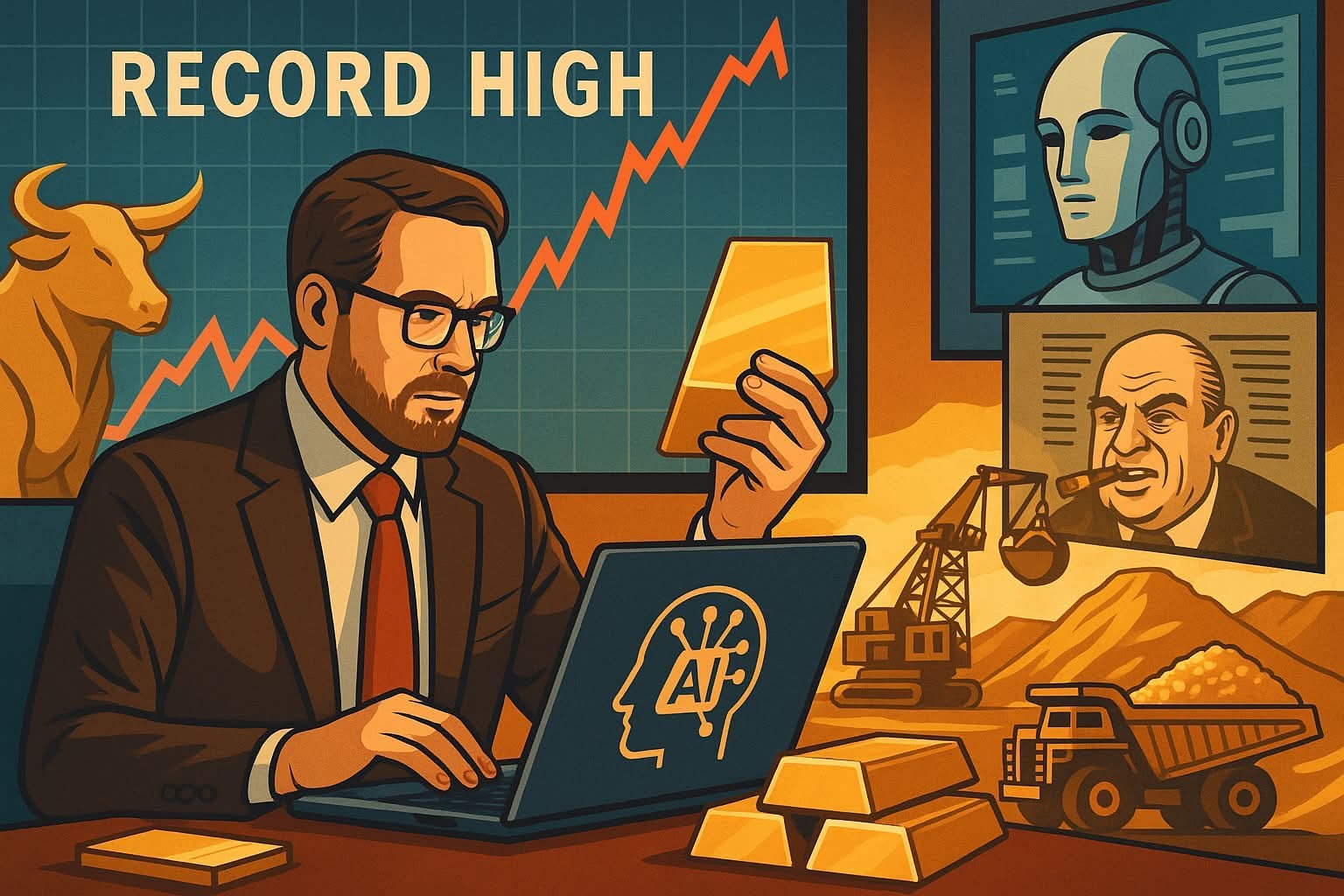
In this episode of QAV, Cameron and Tony dig into market optimism as the All Ords hits record highs, despite questionable fundamentals. They explore how QAV typically outperforms post-crash, backed by data from the dummy and light portfolios. Cam reviews the new AI tools in Navexa and previews ChatGPT’s autonomous agent features. Tony reflects on investor psychology, especially the prioritization of low volatility over outperformance, and delivers a detailed pulled pork on Beach Energy (BPT). They also weigh in on free cash flow vs. operating cash flow, lament the lack of media transparency, and wrap with cultural musings on _The Godfather_, Robert Maxwell, and John Wick’s bulletproof belly.
—
## **⏱️ Topic Timestamps & Companies Mentioned:**
- **00:00** – All Ords record highs, market valuation vs earnings growth
- **02:00** – Post-crash QAV outperformance history (GFC, COVID)
- **05:30** – Dummy portfolio returns vs SPDR benchmark since 2019
- **07:00** – Navexa’s new AI tool (Navex AI) — not that helpful (Navexa)
- **09:30** – YTD returns: dummy vs light portfolios
- **10:30** – Market optimism, inflation data, and rate cut speculation
- **11:00** – Trump’s Epstein file avoidance conspiracy and Robert Maxwell
- **12:00** – ChatGPT’s new agent features (OpenAI)
- **14:00** – Automating qualified audits with AI for QAV
- **16:00** – AFR article on free cash flow and companies listed: MSFT, MA, COST, REA, etc.
- **18:00** – Operating cash flow vs free cash flow: why QAV prefers the former
- **20:00** – REA Group critique and media disclosure concerns (AFR)
- **23:00** – PRU (Perseus Mining) project update — gold discovery results
- **27:00** – PRU share price up 4% on announcement
- **28:30** – ESG disclaimer and QAV take on fossil fuels
- **29:00** – Active vs passive funds: SPIVA 2024 data
- **34:00** – Why investors prioritize low volatility
- **38:00** – Index fund tracking variations and ETF quirks
- **42:00** – Pulled Pork: Beach Energy (BPT)
This week’s episode is for QAV Club members only. You can listen to one of our free episodes by clicking the below link and opening up our pages on Apple Podcasts or Spotify. Or visit our homepage to learn more about QAV and how it works as a value investing system that you can learn and apply to beat the market.
Transcription
AU 829 Club Audio
[00:00:00]
Cameron: Welcome back to QAV Australia. Tony, record high on the all odds. Tony, even though it’s come off a bit, I think it’s still a record high. Uh, where are we today? This is, what day is it? Tuesday, the 22nd of July, 2025. All odds is 8,932 at the moment was up over 9,000, uh, on the 18th of July because you know, the, the world’s going great.
Everything’s going great in the world. There’s no issues. Uh, no reason not to be completely optimistic about the state of affairs, Tony.
Tony Kynaston: Well, not just that, I mean there’s, there is a bit of a disconnect now in what we’re [00:01:00] paying for shares and how much they’re earning. And what they’re earning is growth are. So, it’ll be an interesting reporting season coming up in August. We see some numbers. I mean, the projections are that they’re not gonna be shoot the lights out across the board. So, uh, there’ll be patches of it, I guess. But, um, yeah, there’s certainly some high valuations, um, especially in like Commonwealth Bank, but been raked over a lot in the financial press. Lot of passive investing going on with that. But, uh, you know, that can, that can hold up for a long time.
Cameron: I was thinking about something in the car today I wanted to ask you about, we’ve probably talked about this before, but I don’t recall. In your experience over your many decades, does QAV have its home run year, typically after a crash?
Tony Kynaston: Uh, let me, I’m just trying to think back to some of the home runs years. Oh, a qualified, yes. Um, like it won’t be. What I found [00:02:00] after the GFC, just using that as an example, was it didn’t happen 2009 or 2010 from memory, it was more like 2013. From memory I had a home run year and that was against the backdrop of a lot of people steering clear of equities because of the GFC.
They were burnt, they weren’t coming back into the market. Um, so there was that. But yeah, I certainly did well at the end of the GFC, I think it was the March reporting season in oh nine when everything was reporting relatively good numbers and they were trading on very low multiples. So that was a good to buy. So yeah, potentially.
Cameron: I was thinking about what you told me about the post GFC and what I saw happen post COVID
Tony Kynaston: Hmm.
Cameron: thinking about the fact that when people are scared off, ’cause the market’s just gone through a big crash because they don’t have a system, they don’t have rules that are telling them what to buy and when to buy in, which we do.
Then I was wondering, should we just like sit out the [00:03:00] market for four years and then every time there’s a crash that’s when we, when there’s blood on the streets, we just buy in then, then your money’s not doing anything for the intervening four years, I guess, right?
Tony Kynaston: And you can still have good years in those four years too. Yeah.
Cameron: Um, but yeah, it just, it just. Struck me that, I mean, that’s why we would probably outperform in those post crash years because we try to stay fully invested and we have rules that tell us what to do in that scenario, whereas the vast majority of investors don’t, uh, and they’re scared off. So, you know, they’re, they’re staying outta the market.
Tony Kynaston: Yeah. I mean, there’s certainly a contrarian element to staying in the market when everyone’s leaving, for sure.
Cameron: Well. Yeah, but from our perspective, it’s not really contrarian. We’re just following the system that says, you know, buy this, it’s [00:04:00] generating cash and it’s cheap, you know, but from the outside perspective, from the outside, it looks contrarian, I guess. Yeah.
Tony Kynaston: Hmm.
Cameron: So that’s, you know, when, when people are people out there who are new to QAV or have been doing it for a few years and have had, you know, we, we had a couple of average or tough or bad years, 22, 23 last year or two.
Haven’t been too bad. Um, not shoot the lights out, but, okay. But what we’re really looking for, what we’re waiting for is that cyclical wipe out, but in, in a way, we kinda wipe the wipe out. We don’t for society, but for us, the post wipe out is the, um, big money, big money year.
Tony Kynaston: Potentially I, I’m, yeah, look, I, you’re probably right. I’d have to go back and look at the years and analyze them. But the, as you said, the markets set are high and we outperform the market, so we still get good returns in good years for the market as Well,
Cameron: Yeah, well, [00:05:00] speaking of which,
Tony Kynaston: sorry, just be, just one more thing to say on that too, is. The QAV numbers that I’ve used before on the podcast would be greatly enhanced if I had have started in the depths of A GFC. So it’s starting points really matter for long term capital tagger results. I only
Cameron: yeah.
Tony Kynaston: um, if you look at someone’s returns over a long time period, pay attention to when they started investing.
Cameron: Yeah.
Tony Kynaston: they started in the sort of run of the mill year, then their returns are, um, are probably a lot more indicative than if they started you know, post Co or in the middle of COVID or in the middle of the GFC or something like that, where coming out of it you get a, a big tailwind from the market. Rerating upwards.
Cameron: Well, speaking of portfolios, just my portfolio report for the week, our dummy portfolio. If I look at it from our fully invested date, 2nd of [00:06:00] September, 2019 to today, it’s up 15.11% per annum. Yeah, almost a even split between capital gain and income return. About 8% for capital gain and 8.7% for income return, which is interesting.
And that’s versus the benchmark, the SPDR 200, which is 8.47% per annum over that period. So we’re doing not quite double, but a little bit less. So, I don’t know, nine 90% better. Something like that.
Tony Kynaston: Just, on that cam. So half the
Cameron: Hmm.
Tony Kynaston: gain is through dividends, but we don’t really capture the franking credits in our analysis, do we? I don’t think, I don’t think Navexa gives us a, gives us a benefit for that from memory. I could be wrong.
Cameron: The franking credits. Hmm. [00:07:00] Yeah, I don’t know. I dunno how they track that.
Tony Kynaston: Hmm.
Cameron: So if if they’re not, then our performance would look better than what it already looks, which is almost double. Yeah. Oh, sorry. Speaking, speaking of Navexa, we did have the CEO of Navexa Navar on a few weeks ago and he teased that they were coming out with their NAVEXA ai.
It is out, has been out for a week or two. Um, I’ve had a little bit of a play with it. Um, I haven’t found anything super special to do with it. If I open up the little window, it says, what can you do? I can help you analyze your portfolio in various ways. How is my portfolio performing this year? Well, I can just look at the graph and see that, I dunno why I need ai, what’s my portfolio performance since inception?
Again, I could just do that. I might be able to ask it. [00:08:00] What’s my portfolio performance since 2 9 20 19?
Do, do, do, do? Um, well now it’s giving me a different result to what the graph gives me. Um, it says 14.34% versus 15.11%. But I am, I did finish my chart as yesterday and it’s finishing it today, so I don’t know if that makes any difference. Maybe it’s down a bit today, but it’s pretty close. Alright. So you can type in, uh, those sorts of things rather than play with the calendar, but apart from that, like it’s not really, I haven’t found anything yet.
That’s, uh. Easier to do with their AI service than it is just to do it the old fashioned way. But
Tony Kynaston: Ask it what it thinks
Cameron: maybe I’m missing really. [00:09:00] Okay.
Tony Kynaston: Probably say
Cameron: do you think
Tony Kynaston: investment return for N users.
Cameron: you’re an idiot, I guess. Sorry, I can’t help with that. This request is not supported. Yeah, it doesn’t wanna give you any, any opinions.
Tony Kynaston: oh yeah, right. Financial advice, of course.
Cameron: If I look at the last, let’s say 30 days, how have we done? We’re up up 5.63% in the last 30 days versus the benchmark up, 2.24%. Um, if I look at this calendar year. Can I do that current calendar year?
Yeah. This calendar year we’re up 9.8 versus the benchmark up. 8.38. So what are we in July six, nearly seven months into the year. So not, not killing it for the calendar year to date. Anyway, that is the dummy. If I look at the light [00:10:00] portfolios as a group year to date, they’re actually doing better than the dummy portfolios.
The light portfolios are up 10.35. Year to date, last 30 days as a group, they’re up 4% versus 2.2. Uh, so yeah, they’re doing okay. Everything’s, everything’s tracking along well because the market is just sort of. Booming at the moment for reasons that are not clear. The optimism is high. Even the Reserve Bank holding their rates last week, whenever it was week or two, week or two ago, did nothing market kick up for a second and then went, nah, it’s all good.
Record high.
Tony Kynaston: Well, they kicked up when the latest inflation data came out couple of, towards the end of last week. I think from memory, that’s one of the reasons why they reached an all time high. ’cause it, the market’s pricing in a almost [00:11:00] certainty of an interest rate cut when the RBA meets next month. So,
Cameron: You know why I think the market’s up is because Trump’s not gonna release the Epstein files and all of the, uh, power players, uh, who ruined Epstein’s files are like super happy now that, uh,
Tony Kynaston: and know what they’re
Cameron: that.
Tony Kynaston: more stock.
Cameron: Yeah, yeah, yeah. They’re doubling down. Yeah. Yeah. It’s all good.
Tony Kynaston: Uh
Cameron: I’m gonna talk about in after hours, I’m reading a biography on Robert Maxwell
Tony Kynaston: mm-hmm.
Cameron: at the moment, so I’m gonna talk a little bit about that in after hours.
It’s fascinating.
Tony Kynaston: Yeah. I mean, only know what was in the papers fell off a yacht. Um, father of
Cameron: miss Gah-laine.
Tony Kynaston: Gah-laine, is that how you pronounce it?
Cameron: Gah-laine. Yeah. Gah-laine. I learned.
Tony Kynaston: I’ve ever heard anyone say I’ve only heard it.
Cameron: No, me know. I used to pronounce it. Glan. Yeah, it’s Gilan. Um, [00:12:00] ChatGPT. Tony, I know. You’re, you, you love your AI. Um, doesn’t, never heard you say a bad thing about your ai. It’s always, always loving. It loves his ai. This man.
Tony Kynaston: I use
Cameron: Um.
Tony Kynaston: wouldn’t say I
Cameron: Yeah, I know.
Tony Kynaston: I
Cameron: Then you complain about it constantly.
Tony Kynaston: when I try to
Cameron: They just launched, uh, yesterday or day before they launched their first agent
Tony Kynaston: Mm-hmm.
Cameron: I, I don’t have it yet. You gotta have a, they rolled it out to their top tier accounts first, the pro accounts, which is a couple of hundred bucks a month. Taylor signed up for the pro account just so he could get his hands on it.
It’s being rolled out to plus users, which I am the $20 a month account it was supposed to be today, but they’ve had some technical issues. They said it’ll be tomorrow now, this is where you can tell it to do stuff like, and it’ll just go away and do it. It can log into websites, download stuff, build spreadsheets, et cetera, et cetera.
Taylor and Hunter were using it yesterday to do a bunch of complicated things and they were [00:13:00] blown away by it. They said it took a, it took a little while to like program it to do what you wanted it to do, which is. Typical with these things, and I’ve learned that from using it to write code too, is like, you think you know what you want and you tell it and then you realize, oh, I have to tell it actually do it this way or do it that way.
Or you have to log in here or whatever. But, um, they had it compiling lead lists for their businesses. So basically going out to a, a website that has, you know, kind of a LinkedIn sort of thing that has people with certain job titles in certain regions and certain companies and saying, can poll me a list of people that are the CMOs at companies that look like this, that are interested in advertising on TikTok and gimme their phone number and their email address and their title and blah, blah blah.
And throw that into a spreadsheet for me. And it just did it. It was just pulling it down. Not a hundred percent accurately Hunter said. [00:14:00] But anyway, my point is when I get access to it, um, I’m gonna try to use it for qualified audits, be my. Latest attempt to use AI to be able to do an update. I did send Taylor my, he said, look, if, if you give something you wanna do with it, send it to me.
’cause you got plenty of credits. I did send him like a prompt for that yesterday, but I don’t think he’s had a crack at it yet. But, so sometime this week I’ll have a crack at that and I’ll be able to report back next week. That would be one of the last, um, hurdles in automating QAV for me, particularly if I can get it to just do it.
Um, you know, every after every reporting season, just do an overnight run, gimme the audit status, throw them into a spreadsheet and that’s that.
Tony Kynaston: So that’s um, that’s good timing ’cause we’re gonna get annual reports. Fairly soon.
Cameron: Yeah.
Tony Kynaston: Is that, I mean, that’s, maybe we could, uh, well, maybe you could, if it works, monetize it and sell it [00:15:00] to people as a product offering. Here are all the qualified audits on the ASX because tried to get the ASX to keep a list for us.
’cause I think it’s vitally important to know if the company you’re thinking about investing in has, you know, had a red flag its going concern raised by the auditors, but, but, uh, it’s very hard to find as, as you found out.
Cameron: Yeah, I’m not sure that anyone outside of US cares that much about it. If they did, it might be available as a database out there. I remember when we had, um, Tim Lincoln on, he didn’t even know what a qualified audit was and he runs Stock Doctor.
Tony Kynaston: Well I think, to be fair, he didn’t know what our terminology was, but Yeah. Yeah. he
Cameron: That’s our terminology.
Tony Kynaston: looking at it
Cameron: No, but I mean, that’s my point. Like he runs Stock Doctor and. W thought a qualified, when we said a qualified audit, then it meant an audit. Just they had an audit that had been signed by [00:16:00] somebody who’s qualified. Um, and like an auditor, um, uh, Steven Mabb, chairman Mabb, uh, sent us, uh, a link or pointed out that there was this story in the financial review today.
Where did that go? I had that. Oh, there it is. Uh, companies with robust cash flow tend to be winners here are nine. Despite pandemic’s wars and bear markets, some companies just keep generating cash by Todd Hoare
whore head of Public Markets at LGT Creststone. He says, uh, it’s the mantra every business owner lives by and one that every investor should note. Cash is king. Unlike earnings, which can be adjusted with accounting tactics, cash flow, particularly free cash flow, reveals what a business actually generates and retains after it pays its taxes.
Interest at capital investments in any other obligations. [00:17:00] It’s the true cash available to reinvest, acquire, or return to shareholders via dividends and buybacks. That’s why strong, consistent, free cash flow is a hallmark of high quality companies. Earnings can lie. Cash flow doesn’t. This distinction matters.
Investors learned it the hard way with Enron, which reported 13% earnings growth annually from 1996 to 2000, but posted negative free cash flow every year during that period, burning through over $5 billion before collapsing under the weight of too much debt and two fabricated accounts. So, um, that sounds, uh, familiar.