Hello QAVvers
If you want my body and you think I’m sexy,
Come on, sugar, let me know.
“Do You Think I’m Sexy”, the Rod Stewart cover by Queen Of Japan (click photo below to listen to the track)

What does that have to do with investing? Well… I think that’s what the AORD is singing to itself right now.
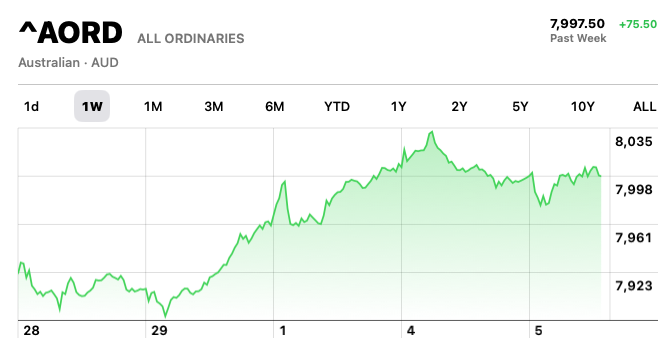
To put it into a ten year perspective:
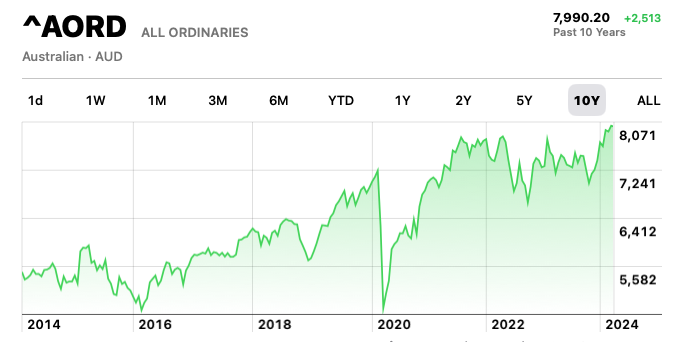
It’s been a rocky couple of years for investors, but here we are, back at all-time highs. The AORD is up 11% since November 1 (as is our Dummy Portfolio) and I feel sorry for those investors who capitulated during last year’s downturns are missing out on all of this growth.
Sure — a market at an all-time high is pretty sexy. But the trick to long-term success as an investor is to be fully invested when the market *isn’t* sexy, when it’s been downright hit with the ugly stick. The we kiss it and watch that frog turn into a prince. Or something like that.
In other words:
It’s cycles, Jerry, cycles.
Let’s have a look at the portfolios.
QAV PORTFOLIO REPORT
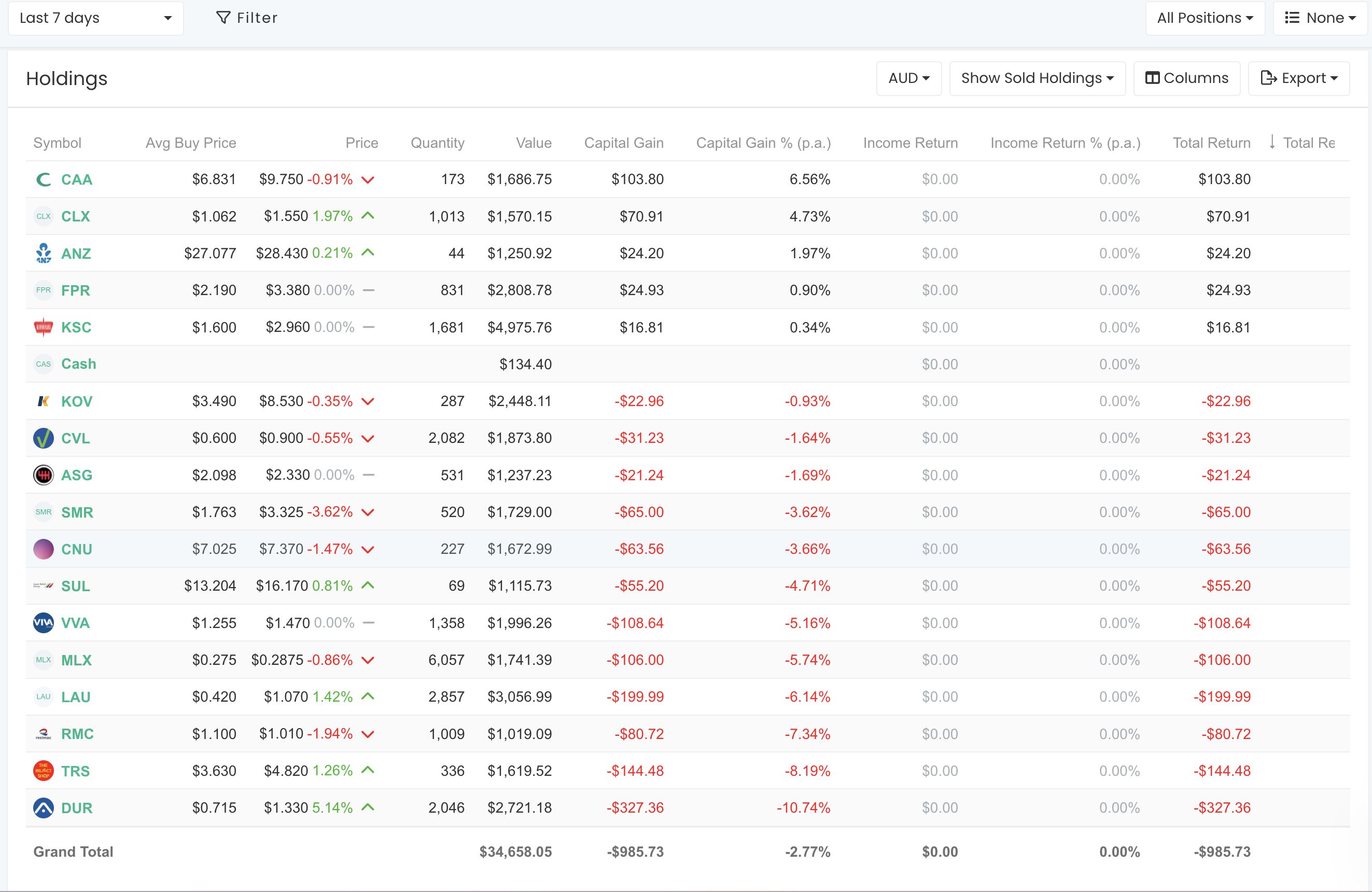
The Dummy Portfolio is performing well against the benchmark over most time frames.
CURRENT HOLDINGS
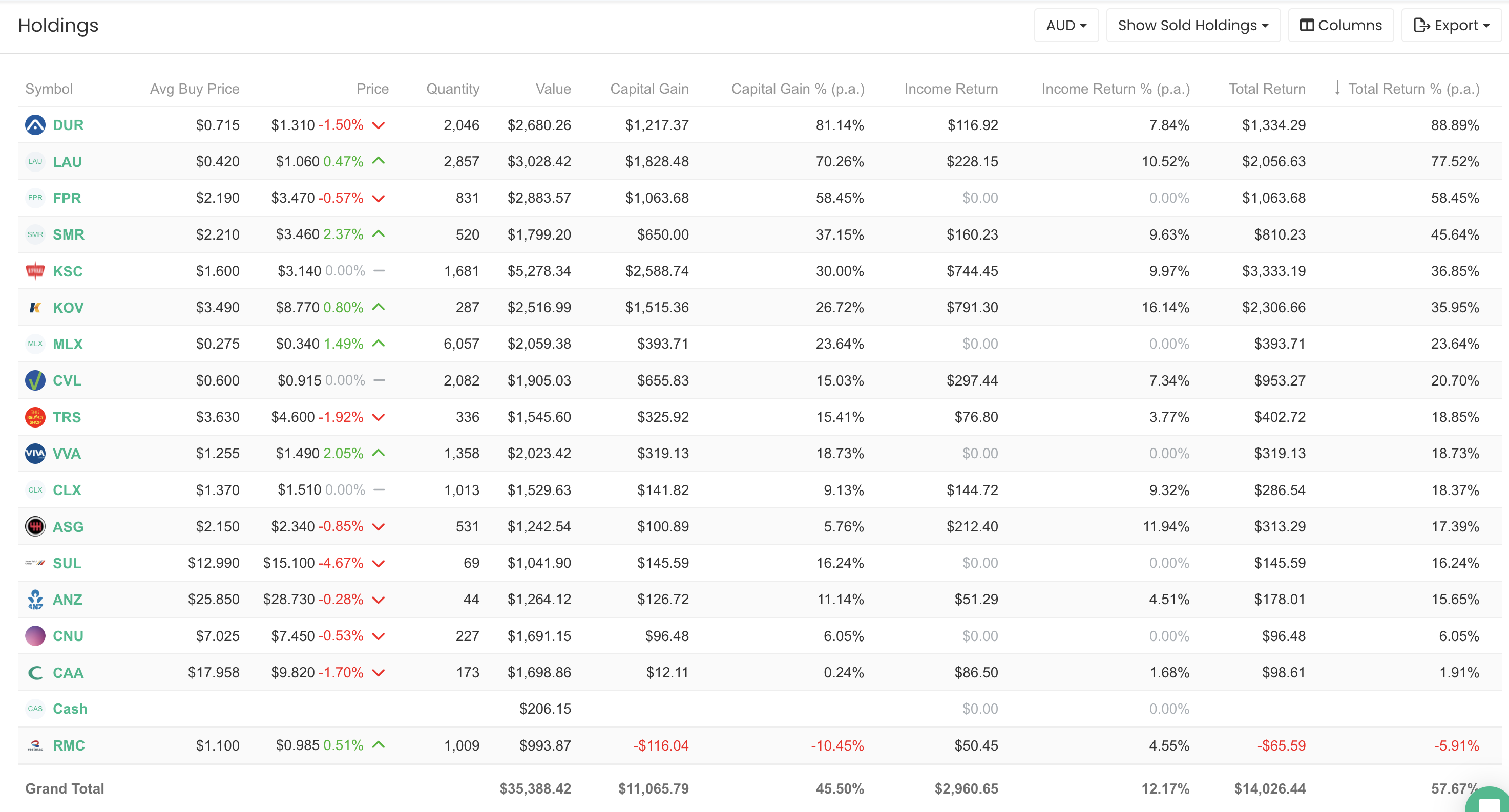
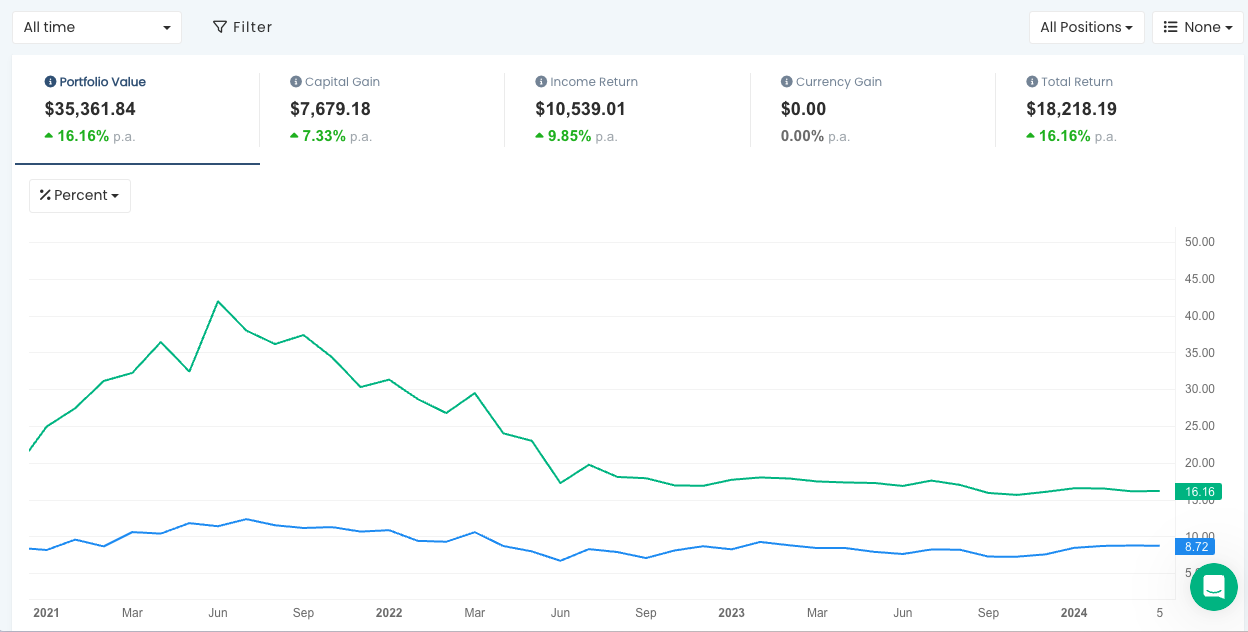
SINCE INCEPTION (15/04/2019)
Our portfolio is still doing slightly less than double market p.a. since inception (roughly five years). In real terms, the value of the portfolio has increased 75% in 5 years.
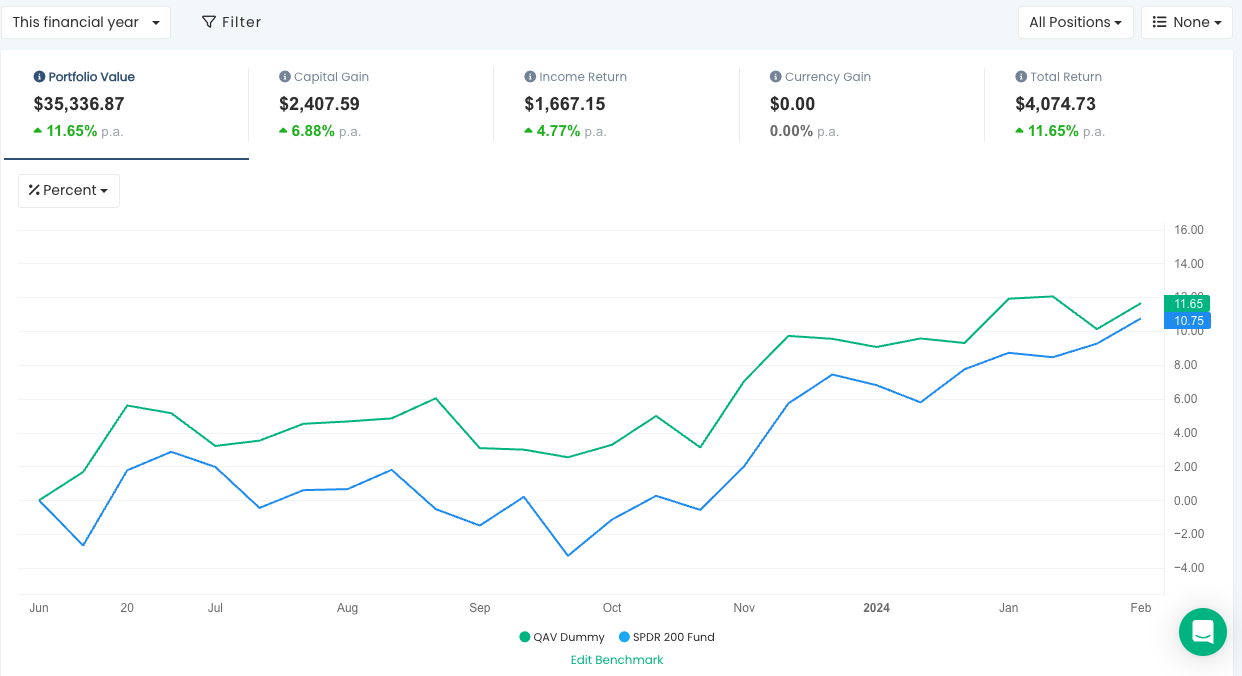
CURRENT FY
We’re outperforming the benchmark for the FY, too.
The big winners for us in the last week were MLX (+16%) and SMR (+10%).
RECENT TRADES
No trades in the last week.
QAV STOCKOPEDIA DUMMY PORTFOLIO REPORTS
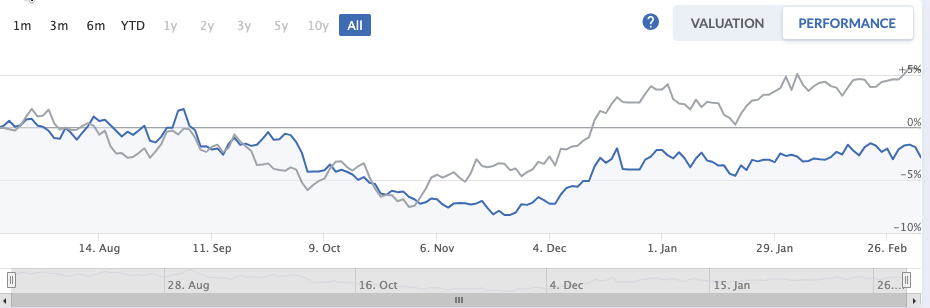
QAV AU DUMMY
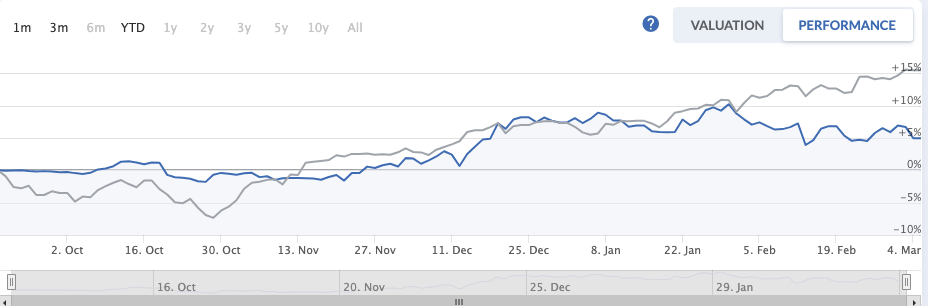
The Australian Stockopedia portfolio is still underperforming since inception. But its performance since 20 July 2023 is about the same as the 231 Light portfolio, so I don’t know if the performance has anything to do with the Stockopedia limitations.
QAV US DUMMY
The US portfolio is up, but still underperforming the S&P, which, as we know, is largely being driven by the Mag7 stocks, Alphabet, Amazon, Apple, Meta, Microsoft, Nvidia and Tesla. I’m actually quite happy with our performance on this one.
STOCKS OF THE WEEK
During the last week, we also traded some stocks in our Light portfolios. Details here.
** As always, please check our work, DYOR, and consult a financial advisor before making any investing decisions.
BUY LIST
Each week we produce a buy list that we share with our members. The intended primary purpose of this buy list is for club members to use as a reference for comparing their own buy list. In theory, all of our buy lists should look pretty similar each week.
As always, please check our work, DYOR, consult a financial advisor before making any investing decisions.
THIS SECTION CONTAINS CONTENT WHICH IS VISIBLE TO QAV CLUB SUBSCRIBERS ONLY.
LAST WEEK’S EPISODE
This week: We discuss our favourite bits of Buffett’s new annual letter, and Tony does a pulled pork on Vulcan Steel (VSL).
Also in the Club Edition: We discuss the results of a new 20% Rule 1 simulation, Reporting Season News, LNG is a sell, Data shows Cathie Wood’s Ark is one of the worst funds, NVIDIA results, and TK’s perspective on ‘Losing too many stocks’ to M&A.
Episode Transcription
QAV 709 Club
[00:00:00] Tony: One, two, three, go!
[00:00:10] Cameron: No.
[00:00:12] Tony: Bush line. that from Butch and Sundance? Uh, I think it was Richard Kiel, the guy who played Jaws in the Bond movies. If it wasn’t him, it was like another big, big bad guy. Challenges Newman to a fight. Newman’s about half his size, and he goes Well, if we’re going to fight, someone needs to say one, two, three, go.
[00:00:32] Tony: And Redford says, one, two, three, go, and Newman kicks him in the nuts straight away. That’s end of the fight.
[00:00:41] Cameron: That’s good. Welcome back to the bullshit. No, uh, QAV. Watch. Ray and I do that all the time. I’ll be sitting down. Welcome to the, what are we doing? What shows this? It is the never ending podcast. In fact, that’s, my son Hunter has been telling me for months, I should just combine all of my podcasts into the Cameron Reilly show and just, and just do, it’s just all, you know, just me talking about stuff.
[00:01:14] Tony (2): Right, and bring a co host on as a guest.
[00:01:17] Cameron: Well, basically, I have different co hosts for different topics, but it’s just, you know. He said, cause I don’t want to subscribe. He said, no one wants to subscribe to four or five different shows. If they’re listening to you, it’s probably cause they like you and they’re interested in what you’re interested in.
[00:01:29] Cameron: So just let them listen to you and you talk about whatever you’re talking about and they’ll just go along for the ride.
[00:01:35] Tony (2): You could do what Kramer did. You could put the Merv Griffin set in your lounge room.
[00:01:40] Cameron: My God. I just watched that episode like two days ago. Yeah. I watched it on the weekend.
[00:01:45] Tony (2): That’s a great episode. Yeah,
[00:01:49] Cameron: was cleaning up, doing dishes or something and I
[00:01:51] Cameron: was gonna, and it was in the thing. I said, Oh, this is a great one. Got to watch this. It is a great episode. Anyway, welcome back to QAV, episode 709, 27th of February, 2024.
[00:02:06] Cameron: Warren Buffett’s annual letter to shareholders came out this week. Tony, it’s always, I mean, a little bit, a little bit bittersweet this time because he had to do the, We didn’t have to, but he did the big tribute to Charlie Munger.
[00:02:20] Tony (2): thought that was a nice touch.
[00:02:22] Cameron: It was lovely, lovely. And, um, I’ve got, I thought we’d start maybe with our highlights from Warren’s
[00:02:30] Cameron: letter.
[00:02:31] Tony (2): two hours, we can do the regular podcast.
[00:02:37] Cameron: easy content when Warren writes a letter.
[00:02:40] Tony (2): It’s a late Christmas present, isn’t it?
[00:02:42] Cameron: it really is. And it never ceases to amaze me. Just. How much I enjoy it and how much good stuff there is. He’s so easy with the, you know, the wit and wisdom. Um, so of course he opened with his, uh, tribute to Charlie where he basically gives Charlie all of the credit for Berkshire Hathaway being what it is.
[00:03:06] Cameron: today, which is a news. He’s always done that, but he reaffirmed that as Charlie’s gone. Um, I think towards the end of his tribute, I’ve got this bit. He said, In the physical world, great buildings are linked to their architect, while those who had poured the concrete or installed the windows are soon forgotten.
[00:03:27] Cameron: Berkshire has become a great company. Though I have long been in charge of the construction crew, Charlie should forever be credited with being the architect. Beautiful.
[00:03:36] Tony (2): Yeah, it’s a great sentiment, isn’t it? It’s typical Warren not taking credit, calling himself the window installer, Charlie the architect. And if I can just chip in with mine too, from that same page, and, and, if, people have probably read this or they’ve gone to the site, the, the, The normal Berkshire Hathaway letter starts after the homage to Charlie and the homage to Charlie is in bold font and larger font and it’s, it’s a real tribute.
[00:04:04] Tony (2): Um, my, my take on that was just before yours. Charlie never sought to take credit for his role as creator. But instead, let me take the bows and receive the accolades. In a way, his relationship with me was part older brother, part loving father. Even when he knew he was right, he gave me the reins. And when I blundered, he never, never reminded me of my mistake.
[00:04:28] Cameron: Such a sweet relationship those guys had.
[00:04:31] Tony (2): Yeah. And, you
[00:04:33] Cameron: remember
[00:04:34] Tony (2): sorry, well, they talk about never fighting as well over what,
[00:04:37] Cameron: That’s what I was going to
[00:04:38] Tony (2): Yeah. All right. Yeah.
[00:04:40] Cameron: I think that was in, um, the last Wit and Wisdom of Charlie that I read, which, you know, Warren’s been in that. He probably wrote 20 years ago, but he was saying they’d never had an argument, never had a fight in all the time that they’d worked together.
[00:04:53] Cameron: Disagreed on stuff, but never had an argument, never had a fight. So yeah, really special relationship.
[00:04:59] Tony (2): Yeah. Well, I think we’ve had a fight, have we, Ken? In
[00:05:03] Cameron: No,
[00:05:04] Tony (2): 12 years?
[00:05:05] Cameron: no, but we don’t work as closely as they
[00:05:07] Tony (2): true. Yeah, in the high
[00:05:12] Cameron: yeah,
[00:05:12] Tony (2): world of being CEO of one of the biggest companies in the world, yeah.
[00:05:18] Cameron: yeah. I mean, Ray and I have never had a fight either. We’ve never had a disagreement, never had an argument, never had a fight in the 10 years that we’ve been recording shows together. It’s great. Like he’s,
[00:05:26] Tony (2): It’s just because Ray just always agrees with you.
[00:05:29] Cameron: Well, that’s, yeah, like you.
[00:05:33] Cameron: When I screw up
[00:05:34] Tony (2): this might be our first fight.
[00:05:39] Cameron: When I do something stupid, you just, you just giggle and, you know, that’s about it. You know, you’re like my Sifu. I say that, it’s my Sifu. My Sifu walks up to me at Kung Fu and if I’m doing something wrong, he just looks at me and he just chuckles and walks away. And that’s how I know I’m doing something wrong.
[00:05:56] Cameron: I’m like, what? What? He goes, uh You know, you can do it that way if you want. Come to think of it, the two of you have got a lot in common.
[00:06:08] Cameron: You know, it’s, that’s, uh, my favorite kind of mentor is the one that doesn’t sort of make me feel bad. Just chuckles and walks away.
[00:06:17] Tony (2): Well, it’s a bit like raising a child. I mean, I forget now where I read it, but there’s two things. To successfully raising a child, one was unconditional love, like the child’s got to know that whatever they do, they’ll still be loved. And the second thing is operant conditioning. So if you do something bad, it just gets ignored by the parent.
[00:06:36] Tony (2): But if you do something good, you get random praise for it. And eventually the kid learns to seek random praise for doing good things and, and less and less bad things.
[00:06:48] Cameron: hard when they’re smashing everything in the house.
[00:06:52] Tony (2): Oh yeah, I mean, yeah. It is.
[00:06:56] Cameron: I read that in books. I’m like, yeah, come and look after Fox for a day and then get back to me.
[00:07:01] Tony (2): Well, I mean, yeah, I don’t know. Maybe there’s something else behind that. Didn’t you say there was a medical reason behind that?
[00:07:08] Cameron: Yeah. Yeah. One of many.
[00:07:10] Cameron: reasons behind that, I don’t know.
[00:07:13] Tony (2): Right. Well,
[00:07:14] Cameron: child.
[00:07:14] Cameron: That’s the
[00:07:15] Tony (2): oh, is that what it is?
[00:07:16] Cameron: Yeah, yeah.
[00:07:17] Tony (2): It’s her fault. Right.
[00:07:19] Cameron: Not false. I’m not casting blame. I’m just saying. It’s DNA, man. It’s just genetics.
[00:07:26] Tony (2): Oh,
[00:07:26] Tony (2): you mean, I mean, he worked out his genetics and ever since he’s been throwing tantrums and breaking things in the house.
[00:07:33] Cameron: Yeah, that’s it.
[00:07:34] Tony (2): Yeah.
[00:07:36] Cameron: Anyway, back to Warren. Our goal at Berkshire is simple. We want to own either all or a portion of businesses that enjoy good economics that are fundamental and enduring. Within capitalism, some businesses will flourish for a very long time, while others will prove to be sinkholes.
[00:07:53] Cameron: It’s harder than you would think to predict which will be the winners and the losers. And those who tell you they know the answer are usually either self delusional or snake oil salesmen. I like that.
[00:08:07] Tony (2): I agree wholeheartedly.
[00:08:09] Cameron: We buy companies because we think their fundamentals look good, and sometimes they go south,
[00:08:14] Cameron: and
[00:08:14] Tony (2): Mm hmm.
[00:08:15] Cameron: just the way it is.
[00:08:17] Tony (2): Yeah, it’s, it’s, I think Warren’s always said it’s a probabilistic exercise. You hope to get slightly more right than you get wrong, but it’s, it’s impossible to predict.
[00:08:30] Cameron: Do you want to do one for one here? You
[00:08:32] Cameron: got some
[00:08:32] Tony (2): I hope you like it. Yeah, I do. I’ve got quite a lot to do. You were talking before about Warren’s ability to distill things into good prose and one of the concepts I liked about this letter was he was talking about his sister Bertie and I guess using her as a proxy for One of the investors, long term investors in Berkshire Hathaway.
[00:08:53] Tony (2): So his sister Birdie’s been along as an investor for a very long time. And Warren says in the letter, Birdie, like most of you, understands many accounting terms, but she is not ready for a CPA exam. She follows business news, reading four newspapers daily, but doesn’t consider herself an economic expert.
[00:09:12] Tony (2): She is sensible, very sensible, instinctively knowing that pundits should always be ignored. After all, if she could reliably. Predict tomorrow’s winners. Would she freely share her valuable insights and thereby increase competitive buying? That would be like finding gold and then handing out a map to the neighbors showing its location.
[00:09:32] Cameron: Although that’s exactly what he’s been doing for 60
[00:09:35] Cameron: years.
[00:09:36] Tony (2): think he has. That’s, I think that’s the distinction. I think what he’s saying there is. Don’t trust a stock tipper, but he’s saying, but he’s been teaching how you invest in the whole time and saying, you know, I’m not giving you tips. He’s never come out with a stock tip in his life, but he said, this is how I do it.
[00:09:53] Tony (2): I think that’s a bit different.
[00:09:55] Cameron: Oh, that’s a fair distinction. Yeah. He’s teaching a methodology, but not giving you tips.
[00:10:00] Tony (2): Yeah. And that was, look, when I started QAV, I got so much feedback from my friends and colleagues saying, why are you giving away your secrets or why are you, you know, and. Um, I think, you know, I came to the same conclusion. I’m not giving away my secrets. I’m teaching people how to invest for themselves and it’s up to them what they buy and sell.
[00:10:23] Cameron: And now you’re starting to question.
[00:10:28] Tony (2): Well, yeah, we’ve had that discussion in the survey about whether we’re all buying at the same time and selling at the same time. It doesn’t appear to be the case, but we may have to look at that again in the future.
[00:10:38] Cameron: Keep an eye on it. In 1863, Hugh McCulloch, the first Comptroller of the United States, sent a letter to all national banks. His instructions included this warning, Never deal with a rascal under the expectation that you can prevent him from cheating you. like that. And then he goes on to say that, you know, he and Charlie tried to follow that, uh, philosophy, and they’ve, they’ve been tricked a couple of times, because it’s hard to tell who the bullshit artists are, but, uh, I like that.
[00:11:09] Cameron: Never, just, if you know someone’s a rascal though, don’t think you’re gonna, why, why, why walk into the lion’s den, like, you know, I say this to my boys all the time, like, they do business with someone, and then get a sense that that person is not trustworthy,
[00:11:29] Tony (2): Mm hmm.
[00:11:29] Cameron: a bit like real estate
[00:11:30] Cameron: agents,
[00:11:31] Tony (2): I had that same thought.
[00:11:35] Cameron: and if somebody tells you that they’re bullshitting about something to somebody else.
[00:11:39] Tony (2): Yeah.
[00:11:40] Cameron: As part of their standard business practice, why would you trust them to be honest with you?
[00:11:45] Tony (2): No, I agree. Why are you special?
[00:11:47] Tony (2): Yeah,
[00:11:49] Cameron: or a business partner slash boss years ago. Like, working with him and seeing him just lying and cheating to suppliers and customers.
[00:11:58] Cameron: And then you go, okay, well, obviously you’re going to be doing that to me as well, right? That’s your character.
[00:12:05] Cameron: Yeah,
[00:12:05] Tony (2): I had the same, same thing with, issue with the boss once and came to the same conclusion. It’s just not worth working with them.
[00:12:12] Cameron: if you can,
[00:12:13] Cameron: you know,
[00:12:14] Tony (2): If you can, yeah. And, um, and Buffett in the past has said things like, you know, consider, consider the fact that whatever you do today might be on the front page of the newspaper tomorrow.
[00:12:24] Tony (2): So. Reputations take a lifetime to gain and a day to lose.
[00:12:32] Cameron: Yeah, and I can, I mean, life’s just too short to deal with idiots
[00:12:37] Tony (2): Yeah.
[00:12:38] Cameron: arseholes too, like, that’s why you and I got out of the corporate workforce in the first place, right?
[00:12:44] Tony (2): Well, that was a question I had too. I wonder how many banks out there, if they got rid of all the rascals. I wonder how big they’d be. I wonder who’s
[00:12:51] Tony (2): left. Wouldn’t be a whole
[00:12:53] Tony (2): lot.
[00:12:54] Cameron: Gets back to the psychopath epidemic in a way, too.
[00:12:56] Tony (2): that’s right.
[00:12:58] Cameron: Alright, your turn.
[00:12:59] Tony (2): Uh, yeah, so I, I won’t go through it all, but they, Warren does his usual, um, rant about, uh, general accounting principles and how what they publish is their net income for the core, there isn’t really a net income because it includes the unrealized gains in their investment.
[00:13:16] Tony (2): Investments. Um, and he does this every year, but then he goes on to talk about his, what they call operating earnings, so it’s their share of the profits, basically, based on their equity holdings. And, you know, he says that in 2021, they made 27. 6 billion, in 2022, 30. 9 billion, and 37. 4 billion last year, so it’s going up under his, under his version of the accounting standards.
[00:13:43] Tony (2): I think I’ve read this same discussion in every letter that Warren Buffett’s ever written, and given that he is one of the wealthiest men in America, and the CEO of one of the biggest companies is not the biggest, why isn’t he lobbying for the accounting standards to change? Why does he just keep rowing against us every year?
[00:14:00] Tony (2): If he thinks he has to State his earnings in a different way every year and his earnings are misstated. Why not go to the SEC or whoever looks after it and say, Hey guys, this isn’t working. Even if you have to give me a carve out because I’m an investment company, let’s, let’s get it, let’s get it right.
[00:14:16] Tony (2): I
[00:14:16] Cameron: Why isn’t the SEC
[00:14:18] Tony (2): Yeah, yeah,
[00:14:26] Tony (2): exactly. Yeah, it’s just a strange circumstance, I think.
[00:14:30] Cameron: Well, maybe that ties in with this next quote I’ve got. He says, Berkshire’s ability to immediately respond to market seizures with both huge sums and certainty of performance may offer us an occasional large scale opportunity. Though the stock market is massively larger than it was in our early years, today’s active participants are neither more emotionally stable nor better taught than when I was in school.
[00:14:55] Cameron: For whatever reasons, markets now exhibit. far more casino like behavior than they did when I was young. The casino now resides in many homes and daily tempts the occupants. One fact of financial life should never be forgotten. Wall Street, to use the term in its figurative sense, would like its customers to make money.
[00:15:16] Cameron: But what truly causes its denizens juices to flow is feverish activity. At such times, whatever foolishness can be marketed, will be vigorously marketed. Not by everyone, but always by someone. Occasionally, the scene turns ugly. The politicians then become enraged. The most flagrant perpetrators of misdeeds slip away.
[00:15:39] Cameron: Rich and unpunished, and your friend next door becomes bewildered, poorer, and sometimes vengeful. Money, he learns, has trumped morality. That always fascinates me when one of the richest guys and most successful investors in America sounds like a Marxist. He sounds like a, he sounds like a lefty. Yep, the rich, the rich slip away unpunished, it’s all marketing and no one knows what, you know, it’s more casino like behavior than ever.
[00:16:09] Cameron: You know, this is coming from Warren
[00:16:12] Cameron: Buffett. I wouldn’t be surprised if I read that on the Chomsky subreddit, you know,
[00:16:16] Tony (2): Right, yeah.
[00:16:17] Cameron: hmm.
[00:16:18] Tony (2): Yeah, that’s what I’ve always liked about him. And he’s always been fairly progressive for a Republican. Um, but, but yeah, and he’s
[00:16:24] Tony (2): He’s
[00:16:24] Cameron: a Republican?
[00:16:25] Tony (2): Yeah, a moderate
[00:16:27] Cameron: a Democrat?
[00:16:28] Tony (2): No, I thought he was a moderate Republican because he was,
[00:16:31] Cameron: is a Democrat, I
[00:16:31] Cameron: think.
[00:16:32] Tony (2): yeah, okay, possibly, because he was, um, an advisor to Arnold Schwarzenegger when he was California State Governor.
[00:16:38] Tony (2): on financial issues. And his father was
[00:16:41] Cameron: to Obama too,
[00:16:42] Cameron: though.
[00:16:42] Tony (2): oh, was he? Okay. And his father was a Republican Senator.
[00:16:46] Cameron: Yeah, right.
[00:16:47] Tony (2): Yeah. So I’m pretty sure he’s Republican. Not that it matters. He’s moderate, um, in many ways. Um, but yeah, I mean, he’s Deb Wright again, and that’s, he’s, he’s actually making a really interesting point. And that is that just like you and I, that the sort of what used to be The realm of investment bankers and fund managers is now available to households to invest with a fair, fair degree of information to back up their decisions.
[00:17:14] Tony (2): And so people still have to be careful and not be tempted because they have access to the stock market much more easily. They can do it online themselves for a very cheap cost, not to treat it like a casino. And of course, we’ve seen that. We’ve spoken about it on the show during COVID when people had access to their SEPA and they drew it down and then spent it.
[00:17:35] Tony (2): Um, you know, gambling Bitcoin or whatever and he, yeah, he didn’t mention Bitcoin in that, in that commentary, but it just flashed out to me that that’s one of the things he was talking about.
[00:17:47] Cameron: And it’s, you know, it’s the same thing going on with the Magnificent Seven shares at the moment. Like, okay, I fundamentally agree with the premise that AI is going to be revolutionary and that these companies are probably going to profit, uh, some of them anyway, out of the AI boom in the next few years.
[00:18:05] Cameron: But how do I, how do I value a share of Nvidia? How do I value a share of Google and decide that I’m buying it at a good price based on, you know, some sort of scientific valuation apart from it’s going up and it was, it might go up in the future. I mean, at the end of the day, if I was going to buy one of those shares, that’d probably be the only I could have for it is that, wow, it’s been going up and it might keep going up, which
[00:18:35] Cameron: is casino behavior.
[00:18:37] Cameron: It’s, it’s well, and that
[00:18:39] Cameron: too.
[00:18:39] Tony (2): Yeah. I can sell it to someone for a higher price. Yeah.
[00:18:42] Cameron: Yeah, there’s no, you know, logic, reason, really, apart from, you can say AI and mumble off some buzzwords about, you know, this time it’s different, but at the end of the day, if you’re gonna put your big boy or big girl pants on and say, no, no, I’m a rational investor who invests in good quality companies when I can buy them at a discount to their intrinsic valuation, then try and apply that to the Magnificent Seven.
[00:19:09] Cameron: Unless you know something that I don’t know, it’s very, very hard to put your hand on your heart and say that’s what you’re doing, I
[00:19:14] Cameron: think.
[00:19:15] Tony (2): And I’ve had discussions even with some of our listeners in the past, um, at dinners, et cetera, where they’ll say things like, Oh, I bought some Bitcoin yesterday. Oh, really? And they go, Oh, look, it was only 1 percent of my total portfolio. I just wanted to try it. I’m like, okay, well, it’s good to experiment.
[00:19:31] Tony (2): But would you put a hundred percent of your portfolio in it? And if you don’t do that, if you’re not going to, if you go, Oh, no, it’s a bit risky. Well, I risk 1%. Yeah, it’s just strange how the human brain works. It’s like taking, it’s like taking a bit of money to the casino and having a splash rather than applying all the principles you apply for 90, the other 99 percent of your, um, yes, or the racetrack.
[00:19:55] Tony (2): Exactly. I didn’t tell you I had a good win on the weekend at the racetrack.
[00:20:00] Cameron: Oh yeah?
[00:20:01] Tony (2): yeah?
[00:20:03] Tony (2): we own it. Steve Mabb and I own it. Oh, I’m. a large part of a horse and its sister won the Blue Diamond, which is a big group one race in Melbourne on the weekend. So, um, we’re hoping for some of that luck to rub off on our horse, but I backed it in the one at 20 to one.
[00:20:19] Tony (2): So that was a great result.
[00:20:21] Cameron: And, and to be fair, when you play the horses, you have a system, you have some sort of a scientific system.
[00:20:28] Cameron: Are you, is it net positive?
[00:20:30] Tony (2): Uh, it’s probably break even over the years, some years ago, some years ago. I, I treated it as entertainment really. So that positive this year for sure.
[00:20:39] Cameron: And you could, could you, could you say the same about buying Bitcoin? It’s just entertainment.
[00:20:43] Tony (2): I could, yeah. So I accepted the person that spent 1%. of their
[00:20:48] Cameron: It’s gambling,
[00:20:49] Tony (2): doing it, is gambling. Or, you know, they can say it’s experimenting, but it’s an experimental gamble. And it’s entertaining, so I don’t have a problem with it, but I’m just saying it, you know, flip it on its head, would you put the other 99 percent into Bitcoin?
[00:21:02] Tony (2): And if you don’t do that, then why put the one in?
[00:21:05] Cameron: And you should also spend 1 percent of your time smoking meth and, uh, you know, looking for a good time in all the wrong places.
[00:21:14] Tony (2): Just in case it works. Yeah,
[00:21:16] Cameron: Yeah, just in case it works, you know, you know, you know, works for some
[00:21:18] Cameron: people, might
[00:21:19] Tony (2): Hey, well, we don’t, we don’t know it doesn’t.
[00:21:21] Cameron: That’s what I’m
[00:21:22] Tony (2): I don’t. I don’t know? it doesn’t. No. Yeah.
[00:21:28] Cameron: turn is it? Yours?
[00:21:32] Tony (2): Um, he made a good point, which is often at the crux of what he talks about. He says, this is Warren, at Berkshire we particularly favor the rare enterprise that can deploy additional capital at high returns in the future. Owning only one of these companies and simply sitting tight can deliver wealth beyond, almost beyond measure.
[00:21:53] Tony (2): So it’s this idea of a high return on equity so you can, you can, and don’t pay any dividends so you can reinvest it at a good rate of return.
[00:22:01] Cameron: about taking your profits off the table, Warren, and rebalancing?
[00:22:06] Tony (2): Yeah. I think that’s the, that’s the argument in favor of Michael Jordan.
[00:22:11] Cameron: Yes, the Michael Jordan argument.
[00:22:13] Tony (2): Yeah.
[00:22:14] Cameron: Uh, your company also holds a cash and US Treasury Bill position far in excess of what conventional wisdom deems necessary. During the 2008 panic, Berkshire generated cash from operations and did not rely in any manner on commercial paper, bank lines, or debt markets. We did not predict the time of an economic paralysis, but we were always prepared for one.
[00:22:38] Cameron: Extreme fiscal conservatism is a corporate pledge we make to those who have joined us in ownership of Berkshire. In most years, indeed in most decades, our caution will likely prove to be unneeded behaviour, akin to an insurance policy on a fortress like building thought to be fireproof. But Berkshire does not want to inflict permanent financial damage.
[00:23:01] Cameron: Quotational shrinkage for extended periods can’t be avoided on Bertie or any of the individuals who have trusted us with their savings. Berkshire is built to last. I like that.
[00:23:15] Tony (2): Yeah. And he’s, I think, you know, um, particularly in the last few years, he’s changed his tune a bit in these letters from, Hey, we’ve outperformed twice the market over the last 50 or 60 years to, Hey, we’re not going to go broke. And, um, I was going to, I was going to read a similar sort of quote. If you look at Berkshire Hathaway, Because he always puts his performance versus the S& P at the back.
[00:23:41] Tony (2): The last five years he’s underperformed. 2019, Berkshire Hathaway, and again this is his accounting, so it’s his operational earnings. His operational earnings were 11 percent increase, S& P 500 accumulation index 31. 5. So massive underperformance. 2020, 2. 4 for Berkshire, 18. 4 for S& P, 2021, pretty even, 29. 6 Berkshire, 28.
[00:24:08] Tony (2): 7 S& P, 2022, 4 percent versus minus 18, so they beat the market there, 2023, 15. 8 versus 26. 3. So still running a twice market since 1965, which is a huge achievement. But, as, as he says, they’re a big, really big company now. It’s hard to deploy that cash to move the needle. So what he’s doing is, as a good marketer, he’s saying, but we’re not going to go broke.
[00:24:32] Tony (2): We’re, we’re here. Um, and, uh, you know, we’re, we’re a fortress with fire insurance as well, and we’re not going to burn down and all that kind of stuff. So, interesting change of tune, I think, for Berkshire Hathaway.
[00:24:45] Cameron: Hmm. Well, I guess with Charlie’s demise and Warren’s, uh, timeline, investors want to know that, you know, what they’re investing in is going to
[00:24:57] Tony (2): Yeah,
[00:24:58] Cameron: the two of them too.
[00:25:00] Tony (2): and I think that’s the, that’s always been the big question for me with Berkshire Hathaway. Um, as you know, I’ve owned shares for a while, but then I sold them. I thought Warren and Charlie were getting quite old and, and I suspect that when, when Warren finally does go and hopefully he’s around for a long time, that Berkshire Hathaway may get taken over and broken up.
[00:25:22] Tony (2): At least because They’re sitting on a heap of cash, so, you know, you get access to all that cash straight away if you’re a takeover merchant. Pays down all the debt to, um, to raise capital to take over Berkshire Hathaway. And then you can decide, well, I don’t want the railway business, it’s too capital intensive, I’ll sell that one off.
[00:25:42] Tony (2): Um, but I do like the insurance business, so, you know, Berkshire Hathaway could end up being 3 or 4 companies in the next 10 years is my guess. I know that’s a prediction. Yes, exactly. Yeah.
[00:25:54] Cameron: Teldar Paper.
[00:25:56] Tony (2): Yeah. What was I saying about the go to the phone box and ring this number and tell them the, was it the blue ostrich says held our paper or something like that?
[00:26:05] Tony (2): Yeah.
[00:26:06] Cameron: like that, yeah.
[00:26:08] Tony (2): Yeah. No, exactly. I mean, and it’s because Warren runs the business differently to how the rest of Wall Street run businesses.
[00:26:16] Cameron: That’s why I named, you know, Fox after Bud Fox. His real name is Bud Fox Riley.
[00:26:24] Tony (2): I’ll have to start calling him Bud.
[00:26:25] Cameron: Bud Fox, yeah. Okay, back to Warren. During 2023, we did not buy or sell a share of either Amex or Coke, extending our own Rip Van Winkle slumber that has now lasted well over two decades. Both companies again rewarded our inaction last year by increasing their earnings and dividends. Indeed, our share of Amex earnings in 2023 considerably exceeded the 1.
[00:26:51] Cameron: 3 billion cost of our long ago purchase. The lesson from Coke and Amex, when you find a truly wonderful business, stick with it. Patience pays and one wonderful business can offset the many mediocre decisions that are inevitable. Again, back to the Michael Jordan
[00:27:09] Tony (2): Exactly. And, and the analysis that people have been telling us about their own portfolios. You know, I bought 15 stocks and one of them accounted for most of the performance. That’s how it goes often.
[00:27:21] Cameron: Interesting that he said his share of their share of Amex earnings exceeded the cost of the share purchase all those years ago. So imagine how many times that’s paid for itself.
[00:27:32] Tony (2): Yeah, well, I mean, I’ve had that happen to me once in my investing career, and, um, my dividend. At the end was as much as what I was when I paid for the stock at the start. So the yield was about, you know, 4%. So it was a 25 dagger. So that’s probably similar to Amex and cake for these guys.
[00:27:55] Cameron: I’ve got one more. You got anything
[00:27:56] Cameron: else?
[00:27:57] Tony (2): Yeah, I’ve got a couple. Yep. So talking about Japan. Additionally, Berkshire continues to hold its passive and long term interest in five very large Japanese companies, each of which operates in a highly diversified manner, somewhat similar to the way Berkshire itself is run. We increased our holdings in all five last year after Greg Abel and I made a trip to Tokyo to talk with their management.
[00:28:21] Tony (2): Berkshire now owns about 9 percent of each of the five. Berkshire has also pledged to each company that it will not purchase shares that will take our holdings beyond 9. 9%. Our cost of the five totals 1. 6 trillion yen, and the year end market value of the five was 2. 9 trillion yen. However, the yen has weakened in recent years, and our year end unrealized gain in dollars was 61%, or 8 billion.
[00:28:46] Tony (2): Uh.
[00:28:49] Tony (2): He goes on in certain important ways, all five companies. I hope I get the pronunciations right, it Chu moi Mitsubishi Mitsui and Sumitomo follow shareholder friendly policies that are much superior to those customarily practiced in the US since we began our Japanese purchases. Each of the five have reduced the number of its shares outstanding at attractive prices.
[00:29:13] Tony (2): Meanwhile, the managements of all five companies have been far less aggressive with their own compensation than is typical in the United States. Note as well that each of the five is applying only about one third of its earnings to dividends. The large sums the five retain are used both to build their many businesses and to a lesser degree to repurchase shares.
[00:29:33] Tony (2): Like Berkshire, the five companies are reluctant to issue shares. So there’s been a lot made of Buffett’s buying into Japan and A lot of people have followed him in and the market seems to be turning around and liking that in the last year or so, but I think he’d been buying for a number of years, but interesting to compare and contrast the big companies in Japan to the kind of problems he was just calling out before in the U.
[00:29:59] Tony (2): S.
[00:30:00] Cameron: But how do they retain good talent if they’re not overpaying their CEOs, Tony?
[00:30:05] Tony (2): Yeah, well, who knows? I mean, um, potentially it’s, there could be a Japanese language barrier. I mean, how many, how many Harvard MBAs? Speak Japanese. Well, I dunno, I’m just guessing. But yeah, you’re right. It’s that. That is the argument, isn’t it? Why do you need to pay someone a lot of money to run your company?
[00:30:25] Cameron: Hmm.
[00:30:26] Tony (2): I’m looking at, I’m looking at you, Elon
[00:30:32] Cameron: The last one I’ve got is he’s talking about, um, Omaha and all of the, uh, successful investors that came out of Omaha, including himself and Charlie and I think some of the other guys that are now running the, the, the guy, uh, guys that are coming after them. I think they’re from Omaha originally too. He says, so what’s, what’s going on?
[00:30:54] Cameron: Is it Omaha’s water? Is it Omaha’s air? Is it some strange planetary phenomenon akin to that which has produced Jamaica’s sprinters, Kenya’s marathon runners, or Russia’s chess experts? Must we wait until AI someday yields the answer to this puzzle? Keep an open mind. Come to Omaha in May. Inhale the air.
[00:31:14] Cameron: Drink the water. And say hi to Birdie and her good looking daughters. Who knows? There is no downside and in any event you’ll have a good time and meet a huge crowd of friendly people. To top things off we will have available the new fourth edition of Poor Charlie’s Almanac. Pick up a copy. Charlie’s wisdom will improve your life as it has mine.
[00:31:34] Cameron: Giving a plug for their upcoming annual meeting.
[00:31:37] Tony (2): You may, yeah, I guess. I guess birdie’s three daughters would look. Better and better each year as the Berkshire Hathaway shares go up. Yeah.
[00:31:47] Cameron: I imagine.
[00:31:50] Tony (2): Probably about our age, Kent.
[00:31:52] Cameron: Yeah, uh, I don’t know. Yeah, maybe.
[00:31:56] Tony (2): Yeah, no, great. He was, he was, and he was saying it’s, now, he was saying that it was interesting how he and, how, he’d met Charlie who’d grown up in Omaha but moved away, and then Ajit Jain who runs the insurance business, spent some time in Omaha as a kid, and then Greg Abel who is, actually, Buffett, uh, Greg Abel, sorry, as Buffett, and Buffett came out and anointed him as the the next Hathaway in this newsletter, which I think is the first time I’ve seen that happen.
[00:32:25] Tony (2): He’s always said it’s going to be a contention and my wishes are known. So he actually named it. But Greg Abel, who’s Canadian, also spent time in Omaha. So it’s either there’s something in the water in Omaha or Whenever Warren sees Omaha residency on the CV, he goes, must be a good bloke, I’ll hire them.
[00:32:43] Tony (2): Yeah.
[00:32:48] Cameron: or geographic profiling.
[00:32:51] Tony (2): Yeah, I’ve just got one or two more. Well, one more actually, I’ll cut it back. Uh, he, Warren says, Beyond that, we have learned, too often painfully, a good deal about what types of insurance business and what sort of people to avoid. The most important lesson is that our underwriters Can be thin, fat, male, female, young, old, foreign or domestic, but they can’t be optimists at the office, however desirable that quality may generally be in life.
[00:33:21] Cameron: Don’t want an optimist insurance policy underwriter.
[00:33:23] Tony (2): Correct. Yeah, which is a great, a great line, I think.
[00:33:28] Cameron: That is great. Well,
[00:33:30] Tony (2): it’s always interesting to compare and contrast his insurance businesses to the ones that are listed in Australia. You know, he’s always talking about you don’t write He doesn’t write business if it’s going to make a loss and be very conservative on the, you know, the premiums.
[00:33:45] Tony (2): And I own shares in QBE and they’ve been, you know, pretty well managed recently. But they still come out, all insurance companies in Australia still come out from time to time and say, well, we didn’t provide enough for these cyclones in Queensland this year or the hailstorms in wherever. Um, and you know, they use those as an excuse for some of their profit declines, but they never come out and say, well, we were really pessimistic this year and we didn’t write any business, which is what Berkshire Hathaway has the luxury of doing, I guess.
[00:34:16] Cameron: we spent a lot of time on that, but we don’t know how many of these we have left. And, uh,
[00:34:21] Tony (2): good point.
[00:34:21] Cameron: want to make the most of Warren’s wisdom and humor when he’s Still with us.
[00:34:29] Tony (2): And hardly recommend if people haven’t gone back and read some of the past newsletters. And there are books out there which make compendiums of them. They’re really, really good reads.
[00:34:37] Cameron: And they’re all on the Berkshire Hathaway website, too. They’re all available, uh, accessible. Uh, moving along, Tony, last week I mentioned that I’d used Matt Walker’s regression tool to run a regression test starting from 15th of February 2022, which is when I started the light portfolios, and it returned a negative 13.
[00:35:03] Cameron: 5 percent CAGR. You suggested that I rerun it but with a 20 percent rule 1, which I did yesterday, and this time it returned a negative 12. 2 percent CAGR for the same period. Slow, so slightly better. Then a 10 percent Rule 1, and you would also have less trading costs. I actually haven’t, uh, gone through yet and calculated how many trades there were in each of them.
[00:35:36] Cameron: I had planned to do that before we recorded today. Didn’t get to it, but, um, we would assume there would be less trading, so you’d save a bit on that as well. But not a huge, not a huge difference. Um, not as huge as I might’ve expected with changing it from 10 percent to
[00:35:55] Tony (2): No, you and me both. And that was certainly the research that the analyst Ryan Reduce for me as well. Similar sorts of CAGA, 10 or 20%, but much less trading for the 20%. And I’ve been implementing 20 percent in my own portfolio as a trial. And, um, it’s getting similar results. I think I, I think I’ve had three or four stocks that would have been 10 percent rule ones.
[00:36:18] Tony (2): Um, uh, I didn’t sell them. And I think just recently one of them became a 20 percent rule one, or yeah, 20%. The other ones are being fluctuating. You know, above and below 10%. So it looks to be about the same result, but much less trading. Emotionally, um, that might appeal to people who don’t like the idea of trading a lot.
[00:36:41] Tony (2): So that’s certainly something the people who don’t like trading a lot can consider. It is a real kick in the guts if you have to sell something that’s gone down 20 percent on what you paid for it. 10 percent seems to be a little bit easier to stomach, but again, that’s just human behavior, I guess. So, yeah, I think it’s, um, my, it’s early days, but my gut feels it’s going to be about the same with less trading.
[00:37:02] Cameron: And as you said to me in an email yesterday, but you also, with the less trading, you reduce your chance of finding your Michael Jordans.
[00:37:11] Tony (2): Correct. Yeah, so that was the other piece of analysis that Ryan did, um, was that, yeah, if you, if you say, I can’t remember what the ratio of the trades were, but say you trade half at 20 percent and you do it 10%, um, that’s, you’ve got half the chance of finding the rocket stock, which is going to be the one that really drives your portfolio performance.
[00:37:31] Tony (2): Having said that, the CAGR was the same both ways. So even if you do find that rocket stock more in a 10 percent portfolio, you’ve got a lot more ones that weren’t as well. So it tends to even out.
[00:37:44] Cameron: Yeah, I was going to say that, well, there were no rocket stocks that really helped the 10 percent rule one in this instance over that two year period. Um, but it, it has been a difficult two year period too. So, you know, if I played this out over five years or 10 years, which I can do with Matt’s tool, I can run this back over, I think his fundamental data goes back to 2016, so I can run it over, whatever that is, eight
[00:38:12] Cameron: years
[00:38:12] Tony (2): I can’t wait to get, get my hands on this. Is other bugs fixed or they’re still
[00:38:18] Cameron: no, I haven’t heard from him, uh, recently on this, so I’m not sure where he’s at with it, but, um, yeah, I mean, I can give it to you as is, it takes a little bit of Python knowledge, but, you know, you’re an old coder, you’ll be able to figure it out. Anyway, very good stuff. Uh, reporting season news, Tony, uh, thank God we’re nearly at the end of reporting season.
[00:38:45] Tony (2): It has been one where I think you said this to me a couple of years ago. It seems like our portfolio has changed the most in reporting season. I think it’s particularly so with this half. Stocks are moving around a lot.
[00:38:57] Cameron: I haven’t had to sell much out of the dummy portfolio, but, almost super really, but just, you know, having the light, but light portfolio has a, you know, sort of a big selection of stocks across it, across all the different portfolios, but just some of the results, like, DSK, Dusk, their results came out the other day and they dropped 12%.
[00:39:19] Cameron: In a day when the results came in, the results weren’t
[00:39:21] Cameron: bad, but not as good forwards looking as the market wanted. Adair’s came out yesterday. And their results came out and they jumped 12%, but I saw them on the buy list, um, you know, when I did my analysis there on the buy list, I went and bought them and then only realized after I’d hit the buy button that the share price was 10 percent higher than it was in the buy list, which had come out like an hour earlier.
[00:39:52] Cameron: And then I was like, what? What? Oh, okay. The results of it landed. Like, after the buy list came out yesterday, the results landed, the share price blew up. I re ran the numbers, um, and they were still good. There was still a buy and still would have been on the buy list. But it, you know, they spiked it within like a couple of hours yesterday morning.
[00:40:14] Cameron: And I, I’d said to the light subscribers, you know, when we bought, when I bought DSK, which was only last week, I said, I know the results are about to come out and I’ve learned from experience, it can go either way. If you’re buying just before results announcements, it can go up or it can go down, you don’t really know.
[00:40:31] Cameron: DSK went against me, ADH also went against me because I bought it just after the results came out. It’s still gone up a couple of points, but yeah, like there’s big shifts with these results announcements. Huge, in a day, shifts. It’s kind of like ice skating. It’s like True Detective season four, walking out into the ocean, like that kind of terror, which we’ll talk about in after
[00:40:56] Tony (2): Yeah. That was so good.
[00:40:59] Cameron: Yeah.
[00:41:00] Tony (2): No, it is like that. Um, but you know, like I was thinking about what do you do about that? But if you You know, one thought was, well, we should wait for new figures to get into Stock Doctor. But then if it has gone up 12 percent when the results are announced, you’re not going to get the uplift.
[00:41:16] Tony (2): So,
[00:41:17] Cameron: not as much.
[00:41:17] Cameron: anyway. I’m hoping
[00:41:18] Tony (2): much.
[00:41:19] Cameron: will continue to go up, but
[00:41:20] Tony (2): Yeah, yeah,
[00:41:21] Tony (2): But
[00:41:21] Cameron: if I bought Adair’s last week instead of, but I don’t think Adair’s had positive sentiment last week, so it wasn’t on the buy list as far as I’m aware, but you know, if it had been and I’d bought it last week, it would have been happy days yesterday.
[00:41:34] Tony (2): Yeah. So I don’t know. I mean, again, something which could be regression tested is we don’t buy. You know, on numbers that are too old, like over six month olds or something like that, and see if that makes a difference to the portfolio performance. But it’s always been my experience to just use what you’ve got.
[00:41:50] Tony (2): Um, and generally, like, because we’ve got to have a sentiment filter as well, if a stock is going up into reporting season, chances are it’s, it, I have seen cases where they’ll report and then go down, but they often go up further, so something’s leaked somewhere.
[00:42:05] Cameron: yeah, that’s what I’m thinking. If it’s sentiment’s good before the results have come out, somebody who knows something is buying something, you know. And I, yeah, my guess is that if it’s, if it’s If it’s on the buy list, it means it’s got a good track record. It’s already, it’s either got a good track record of financial management or it’s a turn, it’s a turnaround situation already, which is the Dusk case.
[00:42:28] Cameron: I think it was a turnaround and you know, you expect a turnaround to keep turning around, but sometimes not turning around enough. So they did do a good job. Again, the results were pretty good, but
[00:42:42] Tony (2): I just want to have a look at, I want to have a look at Dusk because I thought I read somewhere that it was one of the most shorted stocks on the share market, and if that’s the case
[00:42:53] Cameron: really.
[00:42:53] Tony (2): You sometimes see the shorts will start getting out, which will put the price up. And I’ve seen that happen, um, this reporting season too.
[00:43:01] Tony (2): A couple of stocks I bought beforehand, uh, went down when they reported, but then in the week that followed, started to climb again, back to where they were beforehand. So, yeah, so, I don’t know. Stock Doctor reports Dusk has, nah, a fairly small amount of shorting. I must be getting confused with someone else, sorry.
[00:43:25] Tony (2): They did have a large short last year in 2022. It was about 3 percent of stock was shorted.
[00:43:32] Cameron: Well, anyway, there you go. Sometimes it goes in your favor, sometimes it doesn’t go in
[00:43:37] Cameron: your favor.
[00:43:38] Tony (2): And if we could accurately predict it We’d be a lot richer than we are.
[00:43:43] Cameron: I also wanted to note that one that did go in my favor, not the results necessarily, but, um, BFL, BSP Financial, that I hold in a portfolio, uh, announced their dividends, 36. 5 cent dividend. So I was happy about that. Uh, that’s gonna, that’s like a, it’s a big dividend. The shares are trading at about 6. 75.
[00:44:10] Cameron: So
[00:44:11] Tony (2): Yeah, that’s good.
[00:44:12] Cameron: is a, is a huge dividend, which would be nice when it lands.
[00:44:15] Cameron: I think it goes X in, uh, uh, what did it say? 20, uh, today, it goes X today.
[00:44:21] Tony (2): And that’s, that’s another thing to raise at this time of year too, is that be careful of ex dividend dates for stocks.
[00:44:28] Cameron: Yes.
[00:44:28] Tony (2): yeah, because they can, there’s, uh, I think the one I’m talking about goes ex dividend tomorrow when I do a pulled pork.
[00:44:36] Cameron: Oh, yeah. Right.
[00:44:37] Tony (2): so yeah, so if you’re doing your research, just work out whether it’s ex dividend or not before you make decisions.
[00:44:44] Cameron: Shares will normally take a bit of a hit when it goes
[00:44:47] Tony (2): Yeah, yep, and as we know, add the dividend back, um, before deciding to sell something if it’s dropped below its three point trend line because of the dividend going X.
[00:44:59] Cameron: We made a call when we looked at the commodities yesterday that LNG is now a sell, uh, which for me meant Woodside became a sell, which I held in my super portfolio because crude oil was already a sell
[00:45:14] Tony (2): Mm hmm.
[00:45:15] Cameron: gas became a sell. So I had to let that go, I think. I lost about 3 percent on that, but just an FYI for anyone that owns Woodside or any other major LNG think about the impact of LNG becoming a sell.
[00:45:32] Tony (2): Mm hmm. Did you check the dividend date for Woodside when you did that?
[00:45:36] Cameron: I did.
[00:45:36] Tony (2): you did that? Okay.
[00:45:38] Cameron: I did. And I think it was, uh, let me see. Uh, it goes X on the 15th of March, so
[00:45:48] Tony (2): okay. Yeah, still, yeah. And again, I’m not saying you should, if something is a sell on the commodity chart, you should hold it for the dividend because it’s, as you say, if you’re selling it for a, you’re going to sell it for a lower price after it goes ex dividend, but you get the dividend, so it’s kind of swings and roundabouts.
[00:46:04] Tony (2): Hmm.
[00:46:06] Cameron: it’s down 3 percent already, if the commodity’s, um, gonna continue to fall, it’s share price will probably follow. Or the gas could turn around tomorrow, and it could jump by 10%, who the hell knows.
[00:46:22] Cameron: Uh, I saw an article I saw an article about Cathie Wood’s ARC fund this week, which was scathing.
[00:46:31] Cameron: You know, we’ve talked about Cathie Wood on and off over the years. Data shows Cathie Wood’s ARC is one of the worst funds. A new analysis of Mama Cathie over the past decade isn’t very favorable. Goes on to say that, uh, her flagship ARC innovation ETF With 7. 7 billion of assets generated, a return of 36 percent in 2019, a whopping 153 percent in 2020, and 68 percent in 2023, according to Morningstar.
[00:47:04] Cameron: But other years haven’t been so kind to Mama Kathy, as her acolytes call her. ARK Innovation returned a negative 32 percent annualized for the past three years and a mere positive 2 percent for the past five years. That’s not too impressive compared with the S& P 500, which posted positive returns for 10 percent for three years and 50 percent for five years.
[00:47:27] Cameron: Wood’s goal is at least 15 percent annualized returns over five years. To be sure, ARK Innovation’s return profile looks better in the long term. It began trading October 31st, percent annualized from then through December 31, 2023, according to ARK. For a slightly different period The 10 years through December 31st, 2023, the S& P 500 returned about the same amount.
[00:47:54] Cameron: Of course, Wood was taking a lot more risk than the S& P 500. Um, so, you know, 12 percent over a 10 year period, not terrible, but again, not great. And she’s supposed to be one of the. You know, show ponies of tech investing, uh, high risk, high growth tech investing. 12 percent average return over 10 years, uh, during the last 10 years, which has been a lot of frothy, a lot of frothy stuff going on.
[00:48:26] Cameron: Um, I mean, I don’t know how she’s done in the last two months, uh, with the AI boom that’s been going on over there in the NASDAQ, but you know, we’ve, we, we, we have people talk to us a lot. on and off about how do we take advantage of the tech boom and how do we analyze tech stocks and high growth stocks and you know you were talking about your anti QAV strategy the other day and I look at Kathy Wood who is supposedly the best of the best of knowing how to do this she’s the poster girl for high tech high growth stocks if all she can get is 12 percent Over a very, very frothy 10 years, I’m like, what are the chances that we’re going to do any better than Kathy Wood’s going to do at picking the winners and the losers, uh, in the high tech stakes?
[00:49:20] Tony (2): Well, you make a good point, and of course it’s 12 percent after her fees, so she’s been making good money, as Warren said, she loves, loves the trade, and, um, she’s clipping the ticket, so she’s making money, um, but yeah, it’s a really good point, and, and the article goes on to say, uh, the, the author isn’t enamored with Wood’s investment style, in quotes, her reliance on her instincts to construct a portfolio is a liability.
[00:49:48] Tony (2): Ringgold said, It’s not an investment 101 portfolio. The strategy narrowly invests in stocks with paltry current earnings, elevated valuations and highly correlated stock prices, Greenwald said. Their extreme volatility underscores their highly uncertain futures. So to me, it’s a trading stock. You know, she’s had some good years in there and she’s had some bad years in there.
[00:50:10] Tony (2): So it’s more about timing if you’re going to invest in the ARK ETF than it is about long term hold.
[00:50:17] Cameron: This is brutal. Amy Arnott, a portfolio strategist for the investment research firm Morningstar, has put together a list of the 15 mutual funds slash ETS that have lost the most money for shareholders over the past decade. She ranked ARK Innovation at number 3 on her wealth destruction hit list, estimating it destroyed 7.
[00:50:38] Cameron: 1 billion of shareholder wealth during the period. Uh,
[00:50:45] Tony (2): jibe with me when she said that, you know, the other guy says that ARK got 12 percent for random CAGR. So I’m not sure how the math is done on those two things.
[00:50:55] Cameron: Yeah, like, I don’t know either. I don’t know what period she’s looking at either. I think it’s probably the same period that
[00:51:02] Cameron: Morningstar’s looking at.
[00:51:03] Tony (2): last 10 years, you’d think.
[00:51:05] Cameron: Anyway, I mean, getting back to my point, like, if that, you know, if that’s the best, I mean, there may be people, there are probably people running smaller funds, and she may have issues with the size of
[00:51:18] Cameron: it, you know, it might be like Berkshire, that the bigger you get, the
[00:51:21] Tony (2): Mm hmm. Mm
[00:51:23] Cameron: or something, all that kind of stuff.
[00:51:24] Cameron: But it’s, it’s sort of disconcerting for me to see, you know, the poster child getting those sorts of returns over a 10 year period. I mean, our W portfolio has been running for 5 years and it’s, I think, like 15. 5, 16 percent CAGR over that period. Um, it’s not 10, but, you know, it’s, I have no reason to believe it’ll be any worse.
[00:51:50] Cameron: I, you know, I think it’s been a difficult couple of years for Our style of investing, and we’re still doing double the
[00:51:56] Tony (2): Mm hmm. And beating ARK Investments too. Although I think in the last five years she would have done potentially better than what we did, but that’s just the timing of it, I think.
[00:52:06] Cameron: yeah. NVIDIA, speaking of tech, NVIDIA results! I mean, you know, whether or not we would invest in NVIDIA, you just gotta shake your head at this, um, their quarterly revenue is up 265 percent from a year ago, 22. 1% Billion, up 22 percent from Q3, and up 265 percent from a year ago. Record quarterly data center revenue of 18.
[00:52:39] Cameron: 4 billion, up 27 percent from Q3, and up 409 percent from a year ago. Record full year revenue of 60. 9 billion, up 126%. That’s like, I mean, I mean, and, and, I guess the point here is that Like, these companies, like the Magnificent Seven, aren’t start ups, they’re not, they’re not your after pays, they’re not businesses with no revenue, these are businesses with huge revenue and they’re making huge profits and a lot of money.
[00:53:15] Cameron: But that kind of performance, that’s really, really incredible.
[00:53:20] Tony (2): it is. Um, and I actually, I was unaware of NVIDIA’s history, so I read that in their results, which surprised me that they’d been around since the nineties and, um, had a lot to do with the growth in PC ga, the PC gaming industry in the late nineties as well. So I wasn’t aware of that,
[00:53:37] Tony (2): like, yeah.
[00:53:39] Cameron: their, that’s what they’re most known for is, you know, really pushing the graphics processing units for console boxes and gaming PCs and there’s a great, um, animated graph I saw on somewhere, read it probably, of Nvidia’s revenue versus Intel’s revenue. over that period of time.
[00:53:57] Cameron: And Intel was massively higher than Nvidia’s revenue up until a few years ago. And then Nvidia’s just shot the lights out because they just focused on this one thing that ended up becoming really, really important to a bunch of stuff. It was, it was initially before AI GPUs, I mean, outside of gaming became really big for Bitcoin mining.
[00:54:22] Cameron: So, cause they, you know, they can do a lot of processing. A lot of processing power. So that was their first huge bump and then when the AI, when they worked out, when OpenAI worked out that, um, Elon’s been pushing this photo recently of when Jensen Huang, the CEO of NVIDIA, delivered the first GPU to OpenAI when it was a startup and they all had a little ceremony and he donated one because it was a, you know, open source thing and they all signed it and And Elon’s been pushing the fact that NVIDIA, NVIDIA donated this to support this open source startup and now Sam Altman’s out there trying to raise seven trillion dollars to build a competitor to NVIDIA.
[00:55:13] Tony (2): Well, why, um, what’s so special about Nvidia that Intel can’t copy its chips?
[00:55:19] Cameron: Uh, I don’t know. I just think that they’ve, they’ve spent, you know, a decade and a half focusing purely and solely on building GPUs and uh, tooling up for that. That’s, it’s a non trivial exercise, but anyway, yeah, I
[00:55:36] Cameron: mean.
[00:55:37] Tony (2): Yeah, I guess the question faced by anyone who is thinking about investing in NVIDIA is what happens from here? It’s had a great year, can it continue to do that? And um, I mean, I tried to use history as a guide and went back and looked at the Bread O Later for its last five years on the, uh, of StockGraph on its, on the, in the Bread O Later.
[00:55:57] Tony (2): And you know, it’s, it’s, it’s the last couple of years have been fantastic. They’re almost, um, You know, vertical in terms of its graph, but um, before that, and it certainly over the long term had grown from nothing. So it, but it has had drops. So in 2022, it dropped from 326 of the high down to 121. So it’s lost, it has lost two thirds of its value in the last five years at some stage.
[00:56:23] Tony (2): Of course, it’s recovered. It’s now much, what’s the share price now? 790 bucks or something. So it’s recovered, you know, by six times or seven times since that. All Off, so if you’re a long term holder, great. But, um, yeah, it’s going to be a bumpy ride. Um, when these things are priced to perfection, as soon as they don’t get it, the share price retreats heavily.
[00:56:44] Cameron: But as you know, your point about Intel catching up to them or Sam Altman going out there trying to raise money to build his own, Microsoft are talking about building their own, Tesla’s building their own, China’s building stuff. It is going to be a much more, I mean, Nvidia were there at the right time in the right place with the right product to pick up on the last 18 months of AI frenzy.
[00:57:07] Cameron: But they’re not going to occupy that position. That hegemony that they’ve enjoyed isn’t going to last forever. You would imagine. I mean, it’s very rare. In business history and in tech history that, you know, I mean, Facebook’s managed to pull it off for a long time. Google’s managed to pull it off, Apple, Microsoft, but very, very few companies have ever managed to pull off market dominance and hegemony for.
[00:57:34] Cameron: Longer than, say, five years,
[00:57:36] Tony (2): No, you’re right. Um, I guess on the flip side of that is that NVIDIA are in a great position to be able to continue what they’re doing, supplying GPUs to business and find something else, what the next thing is after, after that. Um, and potentially even Discount the GPUs they’re currently producing. So what’s the next wave is the advantage NVIDIA has.
[00:57:56] Tony (2): So as Intel tries to catch up, it’s catching up to the current wave.
[00:58:00] Cameron: the end of human civilization is the next wave.
[00:58:03] Tony (2): Yeah, maybe.
[00:58:03] Cameron: to figure out how to make profit.
[00:58:08] Tony (2): Well, I’ve got lots of resources to do it with. So good luck to them.
[00:58:12] Cameron: Uh, just quickly, W Portfolio, as I said, still trading at about double. Uh, last week hasn’t been great for us, though. For the current financial year, we were well ahead, um, of the STW a week ago. We’ve dropped back down to parity with the STW in the last week. Couple of big hits, DUR. Had a big drop. The TRS had a big drop.
[00:58:37] Cameron: RMC had a big drop with not a lot of big winners to balance it out in the dummy portfolio this week. So, you know, we’re back down to, I mean, we’re still up 9, 9 percent for the financial year. So it’s not bad, but we’re neck and neck with the STW again now. But it has been sort of this crazy week. I mean, DUR, as I said, dropped 10 or 11 percent the last week.
[00:59:03] Cameron: It’s still up like 150 percent from where we bought it. So I’m not complaining. There’s a lot of profit taking going on. as people are rebalancing, good luck to them. But I’m going to hang in there with it. No, I had no trades in the last week though, with the dummy portfolio yet again. You know, it’s crazy.
[00:59:22] Cameron: There’s been so little trading done in the dummy portfolio over the last couple of years. It’s just, you know, seems to have established itself very well and the shares are all. You know, well above, not all of them, but most of them are, you know, well above their rule one, well above their three point trend lines.
[00:59:42] Cameron: You know, occasionally there will be commodity sales, I imagine, although looking through the list, I can’t see many, you know, CAAs on there. Can’t see many commodity stocks on the list these days. RMC. But MLX, there’s a couple. But it’s, uh, it’s interesting just how little trading I have to do in the dummy portfolio.
[01:00:05] Cameron: Even in fairly turbulent markets, it’s just stabilized. It’s just really sit and hold.
[01:00:13] Tony (2): Yeah, and I found that, um, with my portfolio, the trading’s dropped off in the last six months. And that’s what happens with portfolios, as you say, they establish themselves and they get above all their sell lines and then they just, you sit and cruise with them, which is a nice place to be. Don’t,
[01:00:28] Cameron: But you know, you were saying with your own portfolio, you had to do a lot of trading over the last couple of years. So I mean, and you’ve been running that for 400 years. So what happened there?
[01:00:44] Tony (2): tell anyone.
[01:00:46] Cameron: Well, is it a post COVID
[01:00:47] Cameron: thing? Like
[01:00:48] Tony (2): No, I think it’s an interest rate. It’s, I think it’s interest rates. I think the market was really choppy when interest rates were going up and they haven’t moved now for a number of months and everything settled down a bit.
[01:00:59] Cameron: Well, I’m looking, I’m looking at the history last 12 months on the WPortfolio. So. I did two sales in January, one sale in December, one in November, four, no, four, okay, five or six in October, nothing in September, three in August, three or four in July, but yeah, it’s been really, you know, a lot less than, you know, one a week on average over the last six months. Um, very little trading.
[01:01:40] Tony (2): Yeah. And I’m guessing October may have been reporting season related too, which is usually the heaviest time to trade stocks.
[01:01:46] Cameron: Right, yeah, could have been, don’t know, uh, let’s, let’s see what was October, it was like, NHC, SUL, PRU, I think it was Commodity Stuff, actually, oh no, they’re buyers, hold on, NHC, OML, OML, I’ve actually, I was looking at that recently, like, I’ve Bought and sold that a number of times. I bought it again today. I think I had it to my super portfolio today.
[01:02:08] Cameron: Um, and it’s one of those stocks that I’ve, I’ve got like a spotty history with. I’ve bought it a number of times and it hasn’t done well, but currently I hold it in a few portfolios and it’s up. 20, 30 percent in some of those portfolios. So it’s actually, it’s one of those ones that, you know, I kind of groan whenever I see it and I have to buy it.
[01:02:29] Cameron: Cause I’m like, uh, not you again. Oh Mel, my old friend. uh, this time it seems to have come good, you know? So, you know, it’s stabilized and the fundamentals kicked in and off it went. All right. What else you
[01:02:47] Cameron: got?
[01:02:48] Tony (2): I better pull pork.
[01:02:50] Cameron: Who are you pulling today, Tony?
[01:02:53] Tony (2): I’m looking at Vulcan Steel, VSL.
[01:02:57] Cameron: Never heard of them.
[01:02:59] Tony (2): I wonder if they’d greet each other in the mornings and go live long and prosper.
[01:03:04] Cameron: you would always have to, that’d be part of the initiation process,
[01:03:08] Tony (2): Yeah. Although it’s a Kiwi company so they might go, you know, live long and prosper.
[01:03:16] Cameron: uh, have they, have they
[01:03:18] Tony (2): listeners.
[01:03:20] Cameron: have they on the BI list?
[01:03:23] Tony (2): Yeah, they came on, they’re a new one this week, which is why I’m talking about them, and they’re a relatively large company, so they may suit a lot of listeners. ADT is 351k per day, so it’s fairly large. They’re on the buy list, but I think they’re a Josephine, so they’re one to watch. And they’re also a good dividend yielder, and they’re going ex dividend on the 29th of February tomorrow, so again, their price is going to be volatile after that.
[01:03:51] Cameron: And I’m looking back over my fancy historical buy list sheet. This is the first time. They’ve been on the buy list at least since September 2021, which is when my historical buy list started, so Yeah, that’s why I’m not familiar with them. They’re
[01:04:07] Tony (2): Yeah, same.
[01:04:08] Cameron: the first time. Why are they showing up for the first time?
[01:04:11] Tony (2): Uh, well I think they’ve, uh They’ve only been listed for a couple of years, so they’re listed
[01:04:16] Cameron: Ah,
[01:04:17] Cameron: okay.
[01:04:17] Tony (2): October 22, I think. It’s a dual listing both in New Zealand and Australia, and they’re expanding pretty quickly, so they had a, they had a bad result, which is something to take into account, except for operating cash flow, which is why it’s, I think, probably hit the buy list after their December numbers came through.
[01:04:38] Cameron: Did you say VSL?
[01:04:39] Tony (2): Yeah,
[01:04:41] Cameron: Not a Josephine right now, looking at the bread a later. It’s, you know, looking
[01:04:46] Cameron: alright.
[01:04:47] Tony (2): Oh, okay. Sorry, the commodity, Chekap Steel, I think
[01:04:50] Cameron: Oh, sorry. Steel.
[01:04:52] Tony (2): my mistake. Yep. Yeah. Yeah,
[01:04:56] Tony (2): so, yep. So, um, as I said, it’s a Kiwi company. It was founded, uh, quite a while ago, back in the 90s in Auckland. Uh, What else can I say about it? It’s dual listed, um, list price two years ago was 7. 10, and the share price I’m using is 7.
[01:05:15] Tony (2): 58, so, another material increase over the last two years, uh, however since listing it has paid approximately 2 per share in dividends, so, um, the returns have been good from that side of things. Vulkan was founded in 1995 by a chap called Peter Wells in Auckland. It operates as a key, well they say it operates as a key link in the steel value chain between steel producers and end users.
[01:05:42] Tony (2): So basically they don’t smelt the stuff, they just buy it off the steel producers and then sell it to, uh, Building sites and end users. They distribute all kinds of steel products, including carbon steel, stainless steel, engineering steel, and recently aluminium as well. They distribute steel beams to builders, they process steel plate to customer specifications, which involves cutting, folding, and drilling in their factories.
[01:06:10] Tony (2): They process steel coil, and they do the same for stainless steel and aluminium. Uh, at the time of listing, Vulkan operated 29 sites across Australia and New Zealand. This is only two years ago. However, today they operate 69. So growth has been quick with a lot of acquisitions. Uh, they haven’t gone so well recently though.
[01:06:33] Tony (2): The December half year results showed revenue was down 12 percent and net profit after tax was down a whopping 53%. Although operating cash flow was up dramatically. So I’m guessing there’s maybe some kind of write down in their numbers. I haven’t had a chance to look in that much detail. To go through the numbers though, using a share price of 7.
[01:06:56] Tony (2): 58, which is less than consensus target, quite well above IV1 and IV2, which is IV1 is 2. 48, IV2 is 3. 40. We do have the current December half results in our download. So that’s a good thing. Uh, dividend yield. This, uh, at the moment is 4. 92%, which is probably its lowest it’s been for a while, and the dividend was down this half, I guess in line with the drop in net profit.
[01:07:23] Tony (2): Stock Doctor financial health and trend is satisfactory and recovering, so we like that. I don’t score ROE, but just highlighting the fact it’s very strong. It’s 39. 58 percent for this company, which is, which is quite amazing for this type of company. PE is 15. 66 times, which is its highest in the last three years, so we don’t score it on that.
[01:07:45] Tony (2): In fact, we give a negative for that, I think, from memory. NTA is 1. 01 per share, and net equity per share is 1. 20. So I actually thought there’d be a bigger difference between NTA and net equity per share, given all the A lot of acquisitions that they’ve made recently. And, um, and there certainly is a bit of a difference, but it’s not that big.
[01:08:05] Tony (2): But, um, with NEPs then it’s nowhere near the share price of 7. 58. And so we can’t score it for a stock trading nearest book value. PropCaf is good. It’s trading at 4. 6 times. So that’s probably why it’s on our buy list. Forecast earnings per share is negative, negative 27 percent So it loses a point for that.
[01:08:27] Tony (2): And, I Again, I haven’t been able to get more than the surface look at what’s driving that, uh, whether the analysts are extrapolating from the poor half it’s had or whether this includes in their numbers the poor half it’s just had, um, but it is a, it is a concern if they’re for, if the forecast is for, uh, a drop in earnings per share of that magnitude.
[01:08:48] Tony (2): Uh, the directors hold 14 percent. So it scores for that. However, the owner founder, Peter Wells, retired from the board after it listed, so he retired in October 2022. Um, however, they have a very experienced CEO who has been in this company for a long time, um, came up through the management ranks, um, and has 40 years of experience in the steel industry overall.
[01:09:16] Tony (2): And he owns 4 of the company. So, uh, and there is another board member who owns the same, so I’m going to score it as an owner founder, even though the owner founder has retired. Uh, sentiment, as you said before, is up, and it’s a recent, uh, three point trend line uptrend, so it scores for that. It doesn’t have consistently increasing equity, so no score for that.
[01:09:39] Tony (2): So all in all, the score, uh, for quality is 9 out of 16, or 56%. And the QAV score is 0. 12. So, first time on the buy list, towards the bottom, but I just sort of highlighted it as being a new stock with a high ADT. Um, in my readings on, on reviewing this stock, I sort of formed the opinion that it did have a fair few risks around it, despite, um, it’s, it’s, you know, uh, good growth through acquisition recently.
[01:10:07] Tony (2): Um, number one risk was that the owner founder retired, so that, even though there’s still a high amount of, um, Equity amongst the directors. It’s, it’s, uh, you know, we don’t have the owner there anymore, or the founder there anymore. Uh, it’s something like 60 percent of the steel it sells goes to the construction industry.
[01:10:27] Tony (2): And you’d have to say that the construction industry is sluggish at the moment. Um, we’re seeing low housing starts. We’re seeing Office buildings underutilized and therefore their value is dropping. So I don’t know if we’re going to see many skyscrapers in the cities in the CBDs for a while. And we’ve seen, as we’ve highlighted in the last 12 months, builder bankruptcies on the housing front and construction front.
[01:10:50] Tony (2): So there’s a bit of pain in the construction industry. Um, that. Is possibly what’s flowing through to this company with its, um, decrease in sales last half. Uh, and also too, I have read some speculation that there might be a rise in interest rates in New Zealand next year. Their economies had, had, uh, a tough time, but it seems to be, um, doing okay at the moment and they might be putting the brakes on it again, so that would be a negative.
[01:11:17] Tony (2): Uh, on the positive side, um, it seems well run. It’s growing quickly. Uh, I did think that maybe the nickel price decreasing might work in its favor. So people would have read in the financial press that Indonesia’s been flooding the market with cheap nickel, which is hurting the mines in Australia, but certainly nickel is an input into stainless steel.
[01:11:38] Tony (2): So it may mean that there’s a, um, a margin boost to this company. I’m not sure where nickel figures into there. Pricing, um, whether it goes to the smelter or whether they mix it themselves, but um, it may lower the price for stainless steel, which should drive sales for that company. So that’s Vulcan, uh, Vulcan Steel.
[01:11:58] Tony (2): I hadn’t heard of it before, but interesting to do a pull pork on it.
[01:12:03] Cameron: Thank you, Tony. Obviously named after Vulcanus, the Roman god of fire and volcanoes. Vulcan. Vulcanos,
[01:12:18] Tony (2): I did look on the management team photos to see if anyone had pointy ears as well, but they didn’t.
[01:12:27] Cameron: or Vulcan, the Roman god, uh, equated with Hephaestus, the Greek god of fire and blacksmithing, who made Achilles armor. And I think, uh, from memory, made Alexander the Great’s shield, somehow. I think he got passed down. Maybe he, I think he, when he went to, um, uh, Troy, he found Achilles shield, Achilles tomb in Troy.
[01:12:58] Cameron: And he said, I’ll take that and took it with him. And then he could throw it and it would come back to him. No, that’s Captain America. Confused.
[01:13:07] Tony (2): But maybe you swung by New Zealand and visited Vulcan and said, I’d like a shield, can you roll me one off? Here are the dimensions.
[01:13:14] Cameron: I’d like, a shield, please. Vulcan Steel, alright, thank you for that. Uh, one question this week, this is from Geoff. Good morning, Cam, I hope you’re doing well. I am, thank you, Geoff. If it’s not too late, I’d be very interested to know TK’s perspective on losing too many stocks as per market index, is an article that he, uh, referenced.
[01:13:35] Cameron: He must have seen so many come and go over his investing years. So this article Dated 25th of February. We’re losing too many stocks, it says. The ASX has a problem. We’ve seen an acceleration in M& A on the ASX over the past couple of weeks, many of which are currently a work in progress. And this year alone, we’ve seen, market cap in brackets, Costa Group, 1.
[01:13:59] Cameron: 5 billion acquired by Payne Schwartz Partners, Altium. Plans to accept the takeover bid from Renesas. CSR received a takeover bid from Saint Gobain. Borrel’s 6. Group, wants to buy all of the remaining shares it does not own. Adbury received a non binding indicative takeover from CRH and Barrow Group.
[01:14:25] Cameron: We’ve also seen some homegrown large caps merge to become even bigger entities, notably Newmont and Newcrest, plus Levent and Alchem. So is this a problem? A few years ago, WAX, WiseTech, Xero was the acronym used to bundle our best and brightest tech names. In recent years, Afterpay was acquired by Block, Appen turned out to be a massive turd, an appropriate adjective for a stock that’s down 99 percent from all time highs.
[01:14:53] Cameron: And Altium is likely to depart the index in the coming months. Growth and quality in the tech space have become increasingly scarce on the ASX. This limited exposure leads the remaining names to trade at a substantial premium relative to their offshore peers. When it comes to building stocks, there’s only a handful of building and construction stocks to begin with.
[01:15:14] Cameron: If you take out CSR, Boral and Ardbury, you’re effectively left with either James Hardy or Brickworks. This isn’t great for investors. Our investable universe continues to shrink. And if this continues, we might be left with either A, considering ETFs, or B, considering overseas markets. What do you think of that, Tony?
[01:15:35] Tony (2): Oh, I think it’s, it’s on the money. Um, the, the real issue, I mean, there’s always been takeovers and mergers. in any stock market as long as I’ve been around. The difference I think at the moment, and I guess it’s because of the rising interest rates and choppy market, is we haven’t had the IPOs to replace them.
[01:15:54] Tony (2): So it’s, you know, it’s, it’s a bit, there’s been churn in the market usually, as these companies get taken over and leave or merge. But we generally have a whole pipeline of new stocks to replace them. And some of those will eventually grow to be big stocks. Like, you know, in the dot com boom, after that, the seeks and the carsales.
[01:16:14] Tony (2): com and the realestate. coms, et cetera, have grown up to replace some of the big stocks which have left. That’s not happening at the moment. So Vulcan’s a good example, right? Vulcan listed two years ago. And it’s grown to be a reasonable size market cap. But there’s not been many in the last two years that have listed.
[01:16:33] Tony (2): So. One thought is to say, yes, it’s a problem, um, and Steven Mayne’s been calling it out too, that the ASX is shrinking. But the other question is how long before the tap gets turned back on for IPOs, and we start to see some IPOs replace some of the companies that are, um, are leaving. And that’s, it’s, it could be a chicken and egg thing if, if, uh, big investors aren’t able to participate in new floats, and their only alternative, if they’ve got money to deploy, is to make takeover bids for existing companies.
[01:17:05] Tony (2): So there’s a bit of that. And I think there’s also a bit of, uh, the fact that there are some very large super funds out there, not with, and, and also the likes of the, um, BlackRocks and Vanguards who are just index investors who now have large positions in companies. And if you’re a super fund, for example, um, To buy the Sydney Airport and take it off the ASX is a, is a very attractive to you because it fits the profile of a low volatile sort of infrastructure type stock that has predictable earnings, solid business, partly regulated, all that kind of thing.
[01:17:44] Tony (2): So it becomes attractive for even super funds to take these companies private. So that’s the thing. BlackRock and Vanguard in some of our largest companies are now in the top shareholders. Um, I don’t know how long it’ll be. I don’t know whether it’s, you know, coming up soon or in the next 10 years, but certainly they will have to start saying, well, we can’t keep buying bigger and bigger stakes in some of these large companies without considering the alternative of taking them private and just running them as a privately owned business and not worrying about an ASX listing.
[01:18:18] Tony (2): So, it’s an issue, I agree, um, I’m not sure how it’s going to work out, in the short term it’s not great, but if the IPO market picks up, which I think it will, it may right the ship again going forward.
[01:18:31] Cameron: So how does this affect investors like QAV investors where, you know, we’re just looking for undervalued companies in the market? Does it mean there are less undervalued companies in the market if all the money has to go somewhere and it ends up flooding the, the stocks that we would normally be buying?
[01:18:50] Cameron: Or does it not really affect us that much because there’s always unpopular stocks that have good fundamentals?
[01:18:56] Tony (2): well, the funny thing is we often benefit from these takeovers because I’d say probably once or twice a year a stock I own is bought by these corporate raters because of the same reason that we like it and buy it as a listed share. So you know, you usually get a 30 or so percent bump in the takeover premium and that’s great and you bank it and buy something else.
[01:19:16] Tony (2): So it’s actually been a benefit I think to me in QAV. Um, there’s still 2, 200 stocks on the ASX and if half a dozen had been a QAV loss this year or whatever the number is, a dozen to takeovers or mergers. There’s still plenty of other ones out there for us to look at.
[01:19:33] Cameron: So it doesn’t really have a huge net impact on us as investors.
[01:19:37] Cameron: All
[01:19:38] Tony (2): think so. I think, um, I think if it, if it’s the start of a trend and it gets worse, we might have to think about it, but at the moment, no.
[01:19:47] Cameron: right. Thanks for that. Thanks for the question, Jeff. Well, that’s the end of the main show. We’re in After Hours now, Tony. I watched that Quentin Tarantino
[01:19:57] Tony (2): Yeah.
[01:19:59] Cameron: So
[01:20:00] Cameron: good.
[01:20:00] Tony (2): Isn’t it? Yeah.
[01:20:03] Cameron: of know it all and, you know, I’ve heard most of the stories. Not all of them, but most of the stories before. One of my favorite bits, though, was the bit about Sally Menke.
[01:20:14] Cameron: his editor until she passed away in some sort of tragic hiking accident 10 years ago or so, but how, uh, for all of his films, he would get the cast to say hi, Sally, at the end of a take, because he’s like, Sally’s sitting by herself in an editing suite somewhere. We’re all out here having fun. Uh, and he gave, at some awards ceremony, he said she was his only real collaborator because the editing process was a big part of it.
[01:20:45] Cameron: So yeah, there was just this reel of all of these cast from the films going, Hi Sally! One of Zoe Bell strapped to the front of, uh, whatever that charger was from Death Proof. The car slams to a halt, she’s clinging on for dinner, she turns to the camera and goes, Hi Sally! That’s so great. That brought a tear to my eye.
[01:21:05] Tony (2): that was good.
[01:21:07] Cameron: But yeah, no, just great.
[01:21:09] Tony (2): just pulling apart, I mean, I still, I think Quentin Tarantino’s opening monologues and dialogues are always the best parts of the films, usually. And just that, having this, and just sitting through that, you know, Shoshana scene from Inglourious Bastards again with, um, what’s his name, the Austrian?
[01:21:27] Tony (2): Actor Christoph Waltz.
[01:21:29] Cameron: Mm.
[01:21:30] Tony (2): And talking, I think from memory it was that documentary where he talked about his process, like it was written on the page, but he had to imagine how to say it, and
[01:21:39] Cameron: Mm.
[01:21:40] Tony (2): to put a big smile on his face and read it kind of light heartedly, which is the reverse of how anyone else may have picked up that script of a Nazi Jew hunter and given it life.
[01:21:51] Cameron: I like somebody, one of the talking heads on the documentary was saying, you know, like, Quentin’s like, oh you think you know, you think you’ve seen a war movie? All right, hold my beer. Like this is my take on it. You think you’ve seen every possible combination of Nazi, World War II, war movies? All right, let me, let me show you what I’ve got.
[01:22:11] Cameron: Like he does, like it’s just, like, and the other thing that always grits me is when you hear them talk, you hear the cast and the crew talking about Quentin’s rule where you can’t take a mobile phone on set, you have to leave it at checkpoint Charlie on your way in. I think it was Sam Jackson saying, so you have to stand around and talk to people.
[01:22:29] Cameron: And Quentin’s always playing loud music in between takes. It’s a party atmosphere because making movies is. fun, uh, as far as he’s concerned. We’re here because we love it. This is, we can’t believe we get paid to do this, and it comes through in the films. Like there’s just this sense of joy that comes through, I think, in every Tarantino film.
[01:22:51] Cameron: You just know that everybody is having the time of their life, except Uma Thurman when she had a car accident
[01:22:59] Tony (2): right, yeah,
[01:23:01] Cameron: which was terrible.
[01:23:02] Cameron: Tragedy.
[01:23:03] Tony (2): they showed the film clip from that. It was pretty horrific, wasn’t it?
[01:23:06] Cameron: I’d never seen before. Yeah, it’s horrifying. Uh, that was that and the Harvey Weinstein segment, you know, kind of couple of down points in the whole thing, but I’m glad they put it in there.
[01:23:17] Cameron: That’s the real deal. And Quentin’s certainly not, um, you know, without having made mistakes and flaws and that kind of stuff. I think those are the two big ones, but to which, to his credit, he’s taken on the chin and very, very publicly saying, yeah, I, those are the. Greatest, you know, tragedy, mistakes of my life.
[01:23:38] Cameron: And, you know, I’ll never, I’ll never really get over it. You know, that I let those things happen anyway. Uh, yeah, that was great. And, uh, True Detective Night Country.
[01:23:52] Tony (2): Well, that was top of my list as well.
[01:23:54] Cameron: I haven’t seen the finale yet, which I think came out this week. You’ve seen the final episode? Uh, we’re, we’re up to the one before that.
[01:24:01] Cameron: Yeah.
[01:24:02] Tony (2): I think it might have come out last week because I watched it on the weekend.
[01:24:05] Cameron: Oh, okay. Well, we’re, we’re one behind then.
[01:24:08] Tony (2): Okay. Really, really, really good. And a good ending. Great ending. Yep.
[01:24:16] Cameron: like the supernatural aspect of it is kind of, I’m like, yeah, but I’m, I’m kind of going along with it like so far. It’s, it’s not too sort of woo woo y, it’s a little bit X Files y, but um,
[01:24:31] Cameron: Yeah, I’m
[01:24:31] Tony (2): a bit Twin Peaks y is how
[01:24:33] Cameron: Twin Peaks y?
[01:24:34] Cameron: Yeah,
[01:24:34] Tony (2): And just the whole setting, you know, like every sort of scene starts with day one of night time. Day two of nighttime, day three of nighttime. It just really drags you into what it must be like to live in that place where it’s dark for months.
[01:24:50] Tony (2): You know, it’s, it’s cold, it’s, it’s snowing all the time. The lakes are frozen, the ocean’s frozen. If you walk too far, you’re gonna fall in all that stuff. Yeah.
[01:25:01] Cameron: Yeah, um, have I ever told you about my mate, the comic book artist who did 30 Days of Night,
[01:25:10] Cameron: the
[01:25:11] Tony (2): You have mentioned it. Yeah.
[01:25:13] Cameron: He’s been on, I’ve had him on
[01:25:15] Tony (2): yeah.
[01:25:16] Cameron: from time to time, Ben Temple Smith, he’s from Perth originally, lived in the US now for years, I’ve actually the, I’ve got a big, um, commissioned artwork that he did for me for the Caesar show up on my wall in my office.
[01:25:29] Cameron: It’s Julius Caesar as a vampire, because we used to joke about how Caesar was a mortal. Uh, yeah, so he, the, the, the comic that he became famous for was set in Alaska. It was called 30 Days of Night. He just did the art for it. He didn’t do the words, which got turned into a film at some point with
[01:25:45] Tony (2): Mm hmm.
[01:25:46] Cameron: in it, Melissa George, I think.
[01:25:49] Cameron: Um, but yeah, it really captured that as well. Just 30 days of pretty much constant darkness. Must be really weird to live
[01:25:59] Cameron: through.
[01:25:59] Tony (2): Yeah. And the acting, it’s just brilliant. Jodie Foster, the Native Americans, it’s, it’s just brilliant. Everything’s so good about it.
[01:26:08] Cameron: yeah, just really, really well done. Uh, we finished Fargo too this week, the latest season of that, which we really like with Juno Temple and Jon Hamm,
[01:26:19] Tony (2): Yeah, I’ve got to watch
[01:26:20] Cameron: a few. Also really good. As I think I said to you a couple of weeks ago, I think best thing I’ve seen John Hammond since Mad Men. Just really dark, violent, um, misogynistic, wife beater, fundamentalist, good old boy, um, who’s, you know, sort of libertarian, republican, trumpian kind of dude on his ranch as the sheriff running things.
[01:26:52] Cameron: Just really good. Um, Dark, really dark.
[01:26:57] Tony (2): And is it, is it a bit like True Detective? Can you watch the current series without going back to the start in series one?
[01:27:03] Cameron: Oh yeah, that’s the same with every season of Fargo. They do exactly the same thing as True Detectives. So each season is a stand alone mini
[01:27:11] Cameron: series, basically.
[01:27:13] Tony (2): Yeah. Uh, Jen and I watched Saltburn on the weekend. Have you seen that?
[01:27:18] Cameron: I think I’ve heard of it, what is it?
[01:27:20] Tony (2): So it’s a movie. It’s a British movie. Stars, um, what’s his name? Keegan, the Irish actor who was in Banshees of Inniskirran. Inniskillin.
[01:27:30] Cameron: Keegan?
[01:27:31] Tony (2): Yes, Barry Keegan. He’s a, he’s a great, great actor in it. It’s, um, you know, it’s a bit Brideshead. It’s, uh, like a Kingsley Amis novel. So this sort of, you know, kid with, from a poor background goes to Oxford or Cambridge or whichever university on a scholarship.
[01:27:49] Tony (2): Her friends, one of the rich kids gets invited back for the summer break to stay at his castle. And, yeah, it’s sort of, It’s good up to that point and then things just take dark turn after dark turn after dark turn after dark turn and you just go wow at the end, it’s like, it really comes back to you and you think about it a lot afterwards, but, um, yeah, I found it really good, good acting, Richard E.
[01:28:14] Tony (2): Grant’s in it, Rosamund Pike is in it, um,
[01:28:18] Cameron: Cary Mulligan, too, I
[01:28:19] Cameron: see.
[01:28:20] Tony (2): yep, just the small part, but yeah, she was in it, so yeah, so I really enjoyed it, it, um, yeah, very, very thought provoking,
[01:28:28] Cameron: Rhys Shearsmith is in it, too. God, I haven’t seen him for years. Did you ever watch The League of Gentlemen?
[01:28:34] Tony (2): no,
[01:28:36] Cameron: Oh, man, that was one of my favorite shows, like early, early 2000s. It was him, uh, Mark Gaddis, who ended up doing the Sherlock series and he’s done, um, some Doctor Who stuff as well as a writer and an actor in Sherlock.
[01:28:55] Cameron: He played, um, Sherlock’s brother, uh, as well as was one of the writers and producers on Sherlock. But it’s, it’s this, the League of Gentlemen is this series. There’s another guy too, Steve Penelman. It’s these three guys basically. And they play a range of characters, but it’s about this small little fictional town in Northern England where they play all of the residents.
[01:29:14] Cameron: So they’re all these, you know, really creepy characters. And it’s about like tourists will come to this little town. and then disappear and they’re meeting along the way all of these really weird, inbred, uh, freaky, small town characters and I think from memory the tourists were ending up in the meat pies that the town was eating and the butchers but It’s a local town for local people, kind of thing.
[01:29:46] Cameron: Anyway, he was one of those guys, really good. He also played a character in one of the later seasons who was a gypsy, who had a line that I use on Ray all of the time, I got the clip, he’s like, he was this traveling, like, gypsy guy that had a bunch of wives and he would, you know, sort of just invade somebody’s house and say to the wife, you’re my wife now.
[01:30:10] Cameron: And it was, yeah, he had to be there. Good show.
[01:30:13] Tony (2): Okay, I’ll check it
[01:30:13] Cameron: Really, really dark, dark, really dark humour. I listened to The Clash. I listened to a lot of Paul Weller. I listened to a lot of Clash this week. Um, really enjoying it. Was it Fat Pop?
[01:30:27] Cameron: Is that
[01:30:28] Tony (2): yep, that was the last Paul Weller album. Yeah. Good.
[01:30:32] Cameron: enjoying that. And was the Clash album you told me about?
[01:30:38] Cameron: I listened to, I listened to Sandinista. And there was another one too, that I listened to
[01:30:43] Tony (2): Combat Rock.
[01:30:45] Cameron: Might’ve been. But really, yeah, dug it all, like, whole new vistas of exploration opportunities for me and that, so I appreciate that. Really
[01:30:54] Cameron: good.
[01:30:54] Tony (2): Oh, good. I’m glad. Yeah. The Mescaleros are good. Paul Weller’s about to release a new album called 66. It’s his first single dropped last night. I was listening to it last night.
[01:31:07] Cameron: Mmm, there you go.
[01:31:09] Tony (2): Yeah.
[01:31:10] Cameron: That was good. Um, I’ve been reading the Upanishads. You ever read the Upanishads,
[01:31:15] Cameron: Tony?
[01:31:16] Tony (2): I have not.
[01:31:17] Cameron: You should read the Upanishads. It’s good stuff. Probably, they reckon they were written sort of between, I don’t know, 1500 and 800 BCE. Um, depending on which one’s a collection of, of Uh, writings, but sort of the, uh, some of the oldest, uh, philosophical writings around and sort of the basis of non duality philosophy that ended up becoming Advaita Vedanta, and then Chan and Zen, and they all go back to the Upanishads.
[01:31:49] Cameron: So they were writing about, uh. non duality stuff, you know, 3, 000 years ago and it survived. It’s also the basis of sort of Hinduism, the move from the Vedic religion to the Hindu religion sort of started with the Upanishads, but it’s good stuff. Yeah. Some of it’s, some of it’s wonky, but a lot of it’s, uh.
[01:32:10] Cameron: Really, really good stuff. I really enjoyed it. Just talking about all the stuff that I talk about in Three Illusions, you know,
[01:32:17] Tony (2): Yeah.
[01:32:18] Cameron: the, the oneness of all things and all that kind of stuff is good. Yeah,
[01:32:24] Tony (2): I mean, I’ve been thinking about that since we spoke about it last week and it’s, science is coming to those, or has come to those conclusions as well. So, was there something scientific at the start of all this? Before the Indo Panish ads were written, or whatever, that someone had an inkling of?
[01:32:42] Tony (2): How did they come up with the idea to write this stuff down and start believing it and passing it down?
[01:32:50] Cameron: that’s, that’s a great question. And I think, you know, when I learned about this stuff. Um, from Bob, Sailor Bob, when I was 19 or 20, there was no science in his approach to it. He had learned it from his guru, Nisargadatta Maharaj in India in the 70s. Nisargadatta comes from a long line of, you know, Advaita sort of gurus who passed it on.
[01:33:16] Cameron: And which I guess is exactly the same approach that had been handed down for thousands of years, which was an approach of, you know, I guess a meditation. approach. Um, you know, the way that I learned it from Bob was, he said, just ask yourself the question, what am I? And just stick with that. Just keep asking yourself, what am I?
[01:33:41] Cameron: And so I spent pretty much every spare minute for a year asking myself, well, what am I? Am I This body? Well, if I lose a finger, am I not me? No. If I lost a leg, would I be not me? No. If I lost both legs and both arms, would I be not me? No. My body changes all the time too, and yet I still feel like I’m me, so Maybe I’m my brain, but my brain changes.
[01:34:10] Cameron: Am I still me? Am I the same person? Do I feel like I was the same person I was 10 years ago? Yeah, although I’ve grown and developed a little bit, but I’m still inherently me. So what is this thing that I think is me? Is it my thoughts? Is it my memories? Well, I lose memories and I get new memories, but I still feel like I’m inherently me.
[01:34:32] Cameron: So, you know, what is it that I think? is me. What can I point at and say, this is me. And after spending a year doing that, I couldn’t come up with an answer. couldn’t, I couldn’t find
[01:34:48] Cameron: anything that was unchangeable that I thought I could say was definitively me. So if I can’t figure out what I am, and yet I exist, what.
[01:35:04] Cameron: Am I? Is this idea of me as a separate entity just a concept, just a construct? And if so, how fluid is that construct and what does that mean? And then I sort of, you start to realize that, well the thoughts just appear in my consciousness. Like I don’t think I’m gonna think a thought, the thoughts just appear in my awareness.
[01:35:30] Cameron: But then everything just appears in my awareness. The walls, the doors, the table. How are they intrinsically different from my thoughts? How are they intrinsically different from my dream state? When I dream there are people and walls and buildings and cars and they seem real and, you know, solid and I move about and the people talk to me and events happen and I have happy moments that scare me.
[01:35:57] Cameron: So how is that intrinsically different from the waking state? And you just start to Unpick it and unravel it. And gradually I came to the con I came to the conclusion that it’s all just a mental construct. Everything is a mental construct, including the idea of a mental construct and a brain having a
[01:36:16] Tony (2): ha ha. Yeah,
[01:36:17] Cameron: exists in the mental construct.
[01:36:20] Cameron: And then being the kind of, you know, growing up with Carl Sagan, I wasn’t content with that. I was like, well, it appears to me that this is just all a sensory illusion and creation of my brain. What does science have to say? So then I just started reading books on quantum physics, and physics, and And then realized over 10 or 20 years of reading science that these guys seem to be saying pretty much the same thing.
[01:36:53] Cameron: Everything is just a wave. And it’s a probability, and really, there is no such thing as material reality, that is a construction of my senses, you know, it’s an illusion that my brain is creating based on the limited data set that my senses can perceive, but underneath that, there’s this whole other thing going on that we can see with instruments, and we can tell from science and mathematics, but our human senses Unaware of that, and I was like, oh shit, look at that, the scientists are saying the same thing that I worked out with my brain just by dedicating myself to breaking it apart and analysing it over the course of a year or two, so.
[01:37:39] Cameron: I assume these guys, well that’s, and that’s in fact what they say in the Upanishads is, you know, you get to this realisation by having a teacher who can point you in the right direction, a good teacher, and then through meditation and enquiry. You know, that’s always been the basis of it. And I guess the human experience on this thing hasn’t changed much in 3000 years.
[01:37:58] Cameron: If you really start to like, uh, one of the Upanishads says there are four levels or stages of consciousness. The one is where you just looking outwards. The first is where you’re looking outwards and you take everything as being
[01:38:14] Cameron: real.
[01:38:15] Tony (2): Mm hmm.
[01:38:16] Cameron: The second is the dream state. Where, you know, you are looking inwards, everything is happening inside your dream.
[01:38:24] Cameron: The third is deep sleep, where there is no dream and no external reality, and yet you still exist, you’re still conscious at some level. And the fourth is where you integrate the three. Um, where you start to, you know, I guess deconstruct what’s going on in those three and reach your own conclusions about what’s really happening.
[01:38:51] Cameron: So they kind of knew that 3, 000 years ago when they were teaching that and writing it down and um, and then you go and read the same thing in Chan Buddhism and you read the same thing in Stoicism and Epicureanism and,
[01:39:04] Tony (2): Well, that’s what I was going to say. You read about it in Western philosophy as well, that I think therefore I am, and they can’t. And, and, you know, philosophers for a while thought the, the mind lived in the heart and it lived in the liver and the spleen and all different parts on the body. And, and, uh, and then, you know, I don’t know, when it was the middle of last century, there was a thing called the mind brain schism in philosophy, where some Australians said, you know, we may think we are, But actually we have this thing called the brain and it’s very, it’s very different to the mind and one’s not the other.
[01:39:40] Tony (2): And so yeah, your mind may not reside anywhere. So yeah, it’s, and it’s, and then there’s also the scientific approach to it. So it’s interesting how those three ways of thinking about things following, I guess, an inquiring methodology. Get to the same result.
[01:39:59] Cameron: Yeah. I mean, because at the end of the day, there is only one result. If you, if you do a serious level of inquiry into it, you’re going to come to the same conclusion that, um, you know, the way that Bob taught, sort of told me the story when I first got around him, he said, you know, when you’re about to When we’re about 18 months or two years of age, and our brain starts coming online, you get told, you’re a little boy, your name is Cameron, you can control what you do, you’re in control of your behavior, you’re in control of your actions, you are separate from everything else.
[01:40:34] Cameron: This is Conditioned on you, imprinted on you from 18 months, 2 years of age, and then for the rest of your life, you just build on top of that, you just believe that to be true, and you spend the rest of your life building constructs with that as the basis, the basic construct is that I am separate, I am independent, and you never question it until you come up against somebody like Bob who goes, Are you though?
[01:41:02] Cameron: Have you ever really, have you ever really looked at that? Have you ever really examined that? And initially when somebody says it to you, you’re like, well of course I’m me, of course I’m, you know, that’s a stupid question, that’s ridiculous. And, you know, in my case, I was just really, really miserable and depressed and, you know, full of anger and resentment and anxiety and, uh, newly sober and had nothing to lose by Taking it seriously and looking at it, you know, I figured, well, he seems to think he knows what he’s talking about.
[01:41:40] Cameron: Oh, I guess I’ll go and check this out for a while. And, but yeah, I think for most people, you know, they never really have reason to
[01:41:50] Tony (2): No, I was just gonna,
[01:41:51] Cameron: think
[01:41:51] Cameron: about it, you know?
[01:41:52] Tony (2): well, I was gonna make that point. It’s, it does seem to be a common fact that sometimes people only consider these things when they’re going through a hard time. And they’re questioning everything. So
[01:42:02] Cameron: Otherwise, why would you bother?
[01:42:04] Tony (2): evolutionarily, the illusions are there for a reason, right? To let you cruise through life and not worry about them.
[01:42:09] Tony (2): Yeah.
[01:42:10] Cameron: Yeah, exactly. Yeah, and, and, but the flip side is, you know, I, I think that the illusion creates most of people’s unhappiness. You know, we live in a world where people are suffering from very high rates of anxiety and depression and fear and resentment and anger and worry and loneliness and all that kind of stuff.
[01:42:30] Cameron: We’re like this epidemic, if you listen to psychologists and psychiatrists out there in the Western world in particular. And I think it is the illusion that is the root cause of all of those things.
[01:42:43] Tony (2): I am unhappy. I am sad. I am grieving. I am lost. Yeah.
[01:42:48] Cameron: And I did this and I have guilt or somebody did this to me and they hurt me, you know, or I’m worried about what will happen tomorrow and what will happen if Trump becomes president and what will happen if I lose my job and what will happen if this or that. You, you build all of these constructs around the idea that you are a separate entity from the rest of the universe.
[01:43:13] Cameron: Whereas, if you go and read Einstein and he says the future and the past are all, uh, already happened, you know. The, so if the future’s already happened, what’s the point in worrying about it? Like, it’s already happened according to Einstein, so, you know,
[01:43:31] Cameron: it Is Is
[01:43:34] Tony (2): Will happen. Yeah, it’s, yeah.
[01:43:36] Cameron: So as soon
[01:43:36] Tony (2): was, that was a turning, that was a turning point for me reading Einstein. As soon as I, as soon as that sunk in, it didn’t sink in straight away, but as soon as that thought sunk in, it’s like, what’s the worry? It’s, there’s no use in me worrying.
[01:43:54] Cameron: worry if you
[01:43:55] Cameron: want,
[01:43:55] Tony (2): Yeah. actually hinders doesn’t make it better.
[01:43:59] Cameron: well, it’s not as enjoyable way of living, like the, for me anyway, the more enjoyable way of living is just. Enjoying the moment for as it presents itself. And if something bad happens tomorrow, I’ll deal with it when it happens tomorrow. But again, you know, bad is a subjective judgment, right? I always talk about, you know, with friends, I talk about extreme acceptance, pathological levels, levels of acceptance.
[01:44:25] Cameron: Like Shakespeare said, nothing is good or bad, but thinking makes it so, you know, Horatio, or I think it was to Hamlet actually. Um, so. Yeah, you know, we put a label, we put a judgement on things, you know what I always tell people is that the biggest cause of most people’s unhappiness is the differential between the way things are and the way things people think they should be.
[01:44:51] Tony (2): ooh. Frustration.
[01:44:52] Cameron: I think it, I think you should have done something different than what you did, therefore I’m unhappy, angry, whatever it is, rather than things happen exactly the way that they happen because the laws of physics are playing out on the level of atoms, so, it’s pointless, like being angry at the weather for raining, like, okay,
[01:45:12] Tony (2): I, I, which I do,
[01:45:13] Cameron: it, but, I get angry at the heat and
[01:45:17] Cameron: the
[01:45:17] Tony (2): Yeah. To you. But Yeah. But no, you’re right. I mean, I, I pull myself up because I go, oh, that, you know, that fucking friend of mine? What, what are the fuck are they doing that for? And I have to, and I get all worked up. And it’s like they don’t have to realize that they can do what they like. It’s like, it’s, it’s up to them.
[01:45:33] Tony (2): It’s not up to me. And, and my, it’s my frustration that’s getting upset because I want to have good friends who, you know, reach a certain standard, but that’s my problem. It’s not their problem.
[01:45:43] Cameron: It’s just, are you talking about me here?
[01:45:45] Cameron: It’s
[01:45:45] Tony (2): I am not. No, no, I’m talking about the particular problem I’m having with a particular friend at the moment. And, you know, from their point of view, there’s no problem.
[01:45:53] Tony (2): It’s, it’s only me going, why are you doing that?
[01:45:56] Tony (2): Yeah.
[01:45:56] Cameron: but it’s also like, if, if, if Chrissy does something that I’m not happy with, or, or another person or someone I’m in, you know, a sales rep or, you know, someone I’m doing business with, realizing that they have no control over what they do either. So if all of their. Actions based on thoughts and they have no control over the thoughts because it’s just chemistry playing out in their brain.
[01:46:20] Cameron: They’re doing the only thing that they can possibly do, so what’s the point of being angry that they did that thing? That was the only thing that they could Possibly do in that moment. So being angry about it or unhappy about it or resentful about it is kind of just like there’s no logical framework for anger, resentment, guilt, anxiety, when you stop believing in separate entities that have free will.
[01:46:48] Cameron: I mean, the construct disappears and those things just, I mean,
[01:46:55] Tony (2): Well, the
[01:46:55] Cameron: angry at Santa for something. Like, if you don’t believe in Santa, you can’t really be angry at Santa for not bringing you the present that you wanted, right? It makes no sense.
[01:47:04] Tony (2): Right. Yeah, the other eye opener for me was Breakfast of Champions, the Kurt Vonnegut book, where he just incessantly goes, Kilgore, Kilgore Trout is a, is just the mass of the chemicals in his brains. And he decided, the chemicals in his brains decided to take a walk today. And just the whole book is that from that kind of perspective.
[01:47:24] Tony (2): Yeah.
[01:47:24] Cameron: I’ve never really read about Bonnegut’s philosophy, but he must have got this
[01:47:28] Cameron: stuff because
[01:47:28] Tony (2): Oh,
[01:47:29] Cameron: it into the book. It was very, very deliberately part of the philosophy of the character,
[01:47:35] Cameron: right?
[01:47:36] Tony (2): yeah, no, exactly, yeah,
[01:47:38] Cameron: in fact, the analogy I’ve used for decades before I even knew you was about adoption. Like, because people would say to me when I I, I, I, I see what you’re saying and I, and I can’t disagree, but then I forget and I would like, well, if you really take it on board, it’s like figuring, it’s like discovering that you’re adopted or discovering that you’re gay.
[01:48:00] Cameron: I don’t think you forget. Uh, when, when there’s a massive fundamental shift in how you identify yourself,
[01:48:09] Tony (2): hmm,
[01:48:10] Cameron: that doesn’t, I can imagine, I mean, neither of those things has happened to me, yet, um, I, I, I’m still adamant that I’m not related to my father, but my mother denies it, but, you know, I don’t think I’m related to her either, but she denies that as well.
[01:48:25] Cameron: Um, she says the fact that you look exactly like your father should be a tip
[01:48:30] Tony (2): ha, ha, ha,
[01:48:33] Cameron: Um, but you know, it’s, once I really realized that I could not possibly exist in the way that I’ve previously thought I did, and that free will can’t possibly exist based on my understanding of physics and science, then I can’t forget that.
[01:48:52] Cameron: Like, not, you know, in the moment I might get angry or I might react to something that Chrissy does or Fox does or somebody does, But, you know, very, very quickly, I remember, well, they just did that because they had to do it, like, move on, you know? What’s next? As, uh, President Bartlett would
[01:49:10] Cameron: say. That’s
[01:49:11] Tony (2): yes, ha, ha,
[01:49:12] Cameron: Right, what’s next?
[01:49:14] Tony (2): yeah, yeah, I agree, no, you’re right,
[01:49:18] Cameron: Uh, we’re going to see Fleet Foxes in the National tomorrow night. Um, neither band I’m interested in at all, but, uh, they’re two of Chrissy’s favorite
[01:49:25] Cameron: bands, so
[01:49:26] Tony (2): I love the national,
[01:49:28] Cameron: 2U!
[01:49:28] Tony (2): oh, yeah.
[01:49:30] Cameron: I’m worried about how I’m going to stay awake during the whole thing because I, I, when I bought tickets for Chrissy’s birthday, I started listening to the music and it’s all this really kind of drone y, David Lynch y soundtrack kind of, which is lovely.
[01:49:47] Cameron: Yeah, but I don’t think I’m going to stay awake for two and a half hours at Riverstage. I’m going to take a pillow.
[01:49:54] Tony (2): saw them in Toronto and I really enjoyed it, but yeah, they’re not, they’re not an entertaining band. I think the lead singer spent the whole time looking at his shoes, but, um, and, but, oh, yeah, I love, I love their
[01:50:05] Tony (2): music. Yeah.
[01:50:06] Cameron: Yeah,
[01:50:07] Cameron: there you go.
[01:50:08] Tony (2): Blood, Blood Buzz Ohio is one of my favorite tracks.
[01:50:12] Cameron: Don’t
[01:50:12] Tony (2): One of
[01:50:12] Tony (2): theirs.
[01:50:13] Cameron: my head. I tried listening to it, I just couldn’t. Stay awake. Um,
[01:50:19] Cameron: but,
[01:50:19] Tony (2): taste anyway. Oh,
[01:50:22] Cameron: for us to go see Slater Kinney again. Do you know Sleater Kinney?
[01:50:26] Tony (2): no, I’ve heard the name.
[01:50:30] Cameron: All girl Seattle grunge band out of the
[01:50:33] Tony (2): Ah, okay.
[01:50:34] Cameron: Um, the Carrie Brownstein was one of the founders. Do you ever watch Portlandia?
[01:50:39] Tony (2): No.
[01:50:41] Cameron: Oh, okay. Her and Fred Armisen did Portlandia, which was a very funny, um, sketch comedy series, but she’s one of the singer, lead guitarist, and is the singer for the band. And they reformed a few years ago.
[01:50:52] Cameron: We saw them here in Brisbane about. Uh, I don’t know, six, seven, eight years ago. And I think the best concert I’ve ever seen. Just, yeah,
[01:51:03] Cameron: like
[01:51:04] Tony (2): I’ll look them up.
[01:51:05] Cameron: punk, girl, girl punk. Um, Carrie Brownstein’s a phenomenal guitarist. Like everything she plays sounds like it shouldn’t work. It’s just like weird. A lot of atonal little riffs and stuff and two like sort of screaming women.
[01:51:24] Cameron: Um, but yeah, we just loved it and they’re coming back for the first time. We’re so pumped. Uh, really just different, you know, girl punk, something about Chicks and punk, man, that’s just works. Angry women. I like angry women bands.
[01:51:44] Tony (2): Yeah,
[01:51:45] Cameron: tomorrow night I’m, uh, moderating the Q& A at a preview screening of Torsten’s new film, producer from our Marketing the Messiah documentary, now has two children under the age of two, uh, remarried, living in London, I think.
[01:52:02] Cameron: But he’s got a new film called Fortitude. It’s about space.
[01:52:06] Tony (2): Right.
[01:52:07] Cameron: He went and interviewed all of the people that are on the cutting edge of space travel that aren’t Elon Musk or Jeff Bezos. His thing is these guys, those guys in Branson get all of the headlines, but really there’s this huge industry of people that are pushing forward the whole space privatization of space that don’t get, uh, the headlines.
[01:52:31] Cameron: So he’s done a documentary interviewing them. And, uh, he’s asked me to sort of do the Q and A for it tomorrow night. So I’m going to go check that out.
[01:52:41] Tony (2): Yeah, it was interesting. I mean, there was another landing on the moon from a, uh, a private industry operator and I thought, oh, I was surprised it wasn’t Bezos or it wasn’t SpaceX. It was somebody else I hadn’t heard of.
[01:52:54] Cameron: Hired by NASA, but, um, yeah, private, and it fell over, they think, it’s on its side.
[01:53:00] Cameron: So it’s not really broadcasting very well, but, uh, yeah. And then you and I did a bullshit filter last week.
[01:53:08] Tony (2): We did, which was a highlight for me last week. I really enjoyed that. Talking about
[01:53:12] Cameron: bitched, you bitched about all the work you had to do to
[01:53:14] Cameron: prepare
[01:53:15] Tony (2): Well, you know, yeah, it was, I devote all of Tuesday to QAV usually. And, um, it was also all of Thursday to the bullshit filter. But no, I enjoyed
[01:53:27] Tony (2): it.
[01:53:27] Cameron: I redid the numbers on that, I think I could probably flip you a couple of hundred bucks for your
[01:53:31] Cameron: time,
[01:53:32] Tony (2): Oh, brilliant. That’d be great. Thank you.
[01:53:34] Cameron: yeah, that’ll help out.
[01:53:35] Cameron: This week.
[01:53:37] Cameron: It’ll cover, cover one piece of furniture that
[01:53:39] Cameron: you’re
[01:53:40] Tony (2): Oh, yeah. Don’t talk about that.
[01:53:43] Cameron: Um, yeah, I enjoyed it too. It was really good to be able to talk about, uh, politics with you for a couple of hours. Um,
[01:53:50] Tony (2): Yeah, interesting topic, and people should listen to it too, because we go on for about an hour and a half. At least.
[01:53:58] Cameron: talking about Tucker Carlson and Vladimir Putin.
[01:54:01] Tony (2): Ooh.
[01:54:01] Cameron: Yeah,
[01:54:02] Tony (2): the, and the BBC and the CBC and the New York Times.
[01:54:06] Cameron: Well, I, I’ve started prepping for the next one. I’ve been collecting articles today. Um, I read, Five articles saying that China’s economy is in, like, drastic mode, and then other articles, particularly coming out of China, saying that it’s booming, it’s doing great. So, it’s the, the,
[01:54:26] Tony (2): Well, and like,
[01:54:26] Cameron: economy
[01:54:27] Tony (2): yeah, right. And then you get the article saying China’s not doing great, which is really good because the Chinese government’s about to drop interest rates to boost the economy. So that’s great. So that’s, yeah. It’s like different levels of effect on the take on the Chinese economy.
[01:54:43] Cameron: Yeah. And I don’t know what the truth is, um, and I don’t know how to get to the truth. It’s one of those classic things that I don’t know what the truth is. And I don’t know whether Xi Jinping and his team are going, Okay, we need to take a couple of steps backwards in order to take a step forward. You know, we need to strip away, like that’s what they’ve been saying with Ali Barber and Jack Ma and those things.
[01:55:07] Cameron: These guys got too big for their boots. We need to cut out the corruption. We need to cut out the fat. We need to cut out the real estate speculation. Like it’s funny. I read one article bitching about real estate speculation in Australia, driving up prices and no one can afford, no one under the age of 50 can afford to buy a house.
[01:55:26] Cameron: But. Xi Jinping is taking an axe to real estate speculation in China and that’s a bad thing.
[01:55:32] Tony (2): Yeah,
[01:55:33] Tony (2): right.
[01:55:35] Cameron: I don’t know, man. Same with the COVID lockdowns, right? China, when they started doing COVID lockdowns, it was like, you know, in early 2020, it was, see, this is what happens when communists run
[01:55:48] Tony (2): Mmm. Yeah,
[01:55:51] Cameron: fine.
[01:55:53] Tony (2): we get, we get images from China of people being welded into their apartment buildings.
[01:55:57] Cameron: Yeah,
[01:55:58] Tony (2): Yeah,
[01:55:59] Tony (2): whether they do or not, who knows. But no, it’s an interesting topic. I agree. And I’m always reminded of what, when I try and sort the media out, I’m always reminded of what Chomsky said. He says, you can’t trust it.
[01:56:11] Tony (2): In the West at least, but if you do need to find something to at least have a little bit of faith in, go to the financial press, because people are making big investment decisions on that, and if it’s not accurate, it gets booted, so. And I found that, I actually didn’t mention it during the bullshit filter, conversation but the AFR reported on the Tucker Carlson interview and just did it quite factually.
[01:56:36] Tony (2): There was this interview, this is what happened, this is what was said, rather than, oh, Putin just rambled on for 30 minutes and just bullshitted about history and yeah, all the other stuff that other media outlets were saying.
[01:56:49] Cameron: Look, I really hope that AI is going to buy Ohio. You’re going? Are you leaving? Oh, okay. I really hope that, uh, we will have AI tools soon that will be able to scan all of the world’s media for me. If I pick a topic and
[01:57:12] Cameron: scan, you know, World Economic Forum stuff and scan, you know, World Bank’s analysis on China’s economy and just do a breakdown of, okay, this is, this is the propaganda.
[01:57:24] Cameron: This is the stuff that really matters. You need to pay attention to. When we can get to that point where we can feed it that kind of data and have it do the analysis for us, um, it’s not there yet, but hopefully in the next year or two, we will get there.
[01:57:41] Tony (2): Then just add one more step and tell us where to invest and where to buy and sell. Based on that economic analysis,
[01:57:49] Cameron: Well, yeah, but as Warren Buffett said at the last annual meeting, AI is just going to enable people to make. Lots more bad
[01:57:57] Cameron: decisions,
[01:57:58] Tony (2): bigger messes,
[01:58:00] Cameron: Well, yeah, greed and casino and all of that kind of stuff will still go on, but you will be able to use it for, you know, uh, analysis. It just depends on what kind of analysis you ask it to do, I guess.
[01:58:12] Cameron: And what kind of your risk profile and what kind of returns you’re trying to get and all that kind of
[01:58:16] Cameron: stuff. But I do think we’ll be using it for investing.
[01:58:19] Tony (2): Yeah, that was a very illuminating piece of work you did for the bullshit filter where you took Putin’s account of history, which seemed to be the biggest critique of the Carlson interview, and ran it through ChatGPT and just said, if I said this about this time in history, would I be right or wrong?
[01:58:36] Tony (2): Everything was, you know, with a caveat of it’s all subject to interpretation, everything was factual.
[01:58:43] Cameron: Your facts are right. Yeah, it’s open to interpretation what this means, but, um, there’s no problem with the facts. And if I can do
[01:58:50] Cameron: that.
[01:58:51] Tony (2): Mmm.
[01:58:52] Cameron: What’s stopping the rest of the world’s Western media from doing that?
[01:58:56] Cameron: You know,
[01:58:57] Tony (2): maybe that’s what the bullshit filter should be from now on. Here’s what Gigi Ping says about the Chinese economy. Here’s what the New York Times says about the Chinese economy. Tell me what the fact is.
[01:59:06] Cameron: mm, yeah, it’s good. As a matter of mind, Chris Saad, I mentioned before, um, ex Uber developer guy, head of development at Uber, Brisbane boy, he built a tool that I’ve plugged on bullshit filter a couple of times that he sent to me. It’s a, it’s a plugin for Chrome that uses GPT. And when you go to a news site and read any news story, this little sidebar comes up and it, it, um, breaks down, uh, the news story, tells you about any bias that’s in the news story based on the language that’s being used, gives you a background on the story, what the history is, the historical context of it, tells you who all the major players are, the mention, like a mini bio on all the people that are quoted.
[01:59:52] Cameron: In the story tells you, uh, you know, other things you can go read if you want more background. And that’s the beginning of using AI to. Um, run a bullshit analysis
[02:00:04] Tony (2): Yeah, right.
[02:00:05] Cameron: a lot of media coverage. I think we’ll have more and more tools like that in the next couple of years. That will be really interesting.
[02:00:12] Cameron: And particularly, like it’s not just for politics, like for CEOs, like you, you listen to a CEO speech and have your AI just run a bullshit filter over the top of it, and it’ll tell you, okay, well, he’s putting this, but what he didn’t tell you, here are the five things he didn’t tell
[02:00:29] Cameron: you about their financial results, right?
[02:00:32] Tony (2): Yeah. Because it’s often what’s not said that’s important too, isn’t it?
[02:00:35] Cameron: Yeah, what’s left out? And that’s, you know, I’m increasingly thinking, you know, like with the psychopath book that the tools that we’re going to have available to us hopefully in the next few years will enable us to do an end run around a lot of the really sophisticated propaganda mechanisms that have been erected over the last 50 years.
[02:00:55] Cameron: By having tools that can deconstruct the propaganda, can deconstruct the PR, can deconstruct the tools of manipulation that are used in business and politics and religion and whatever government to provide us with the story that’s not being told by, you know, just doing a lot of data
[02:01:17] Cameron: analysis and
[02:01:17] Tony (2): Which is what we said journalism should be doing, but it’s been hauled out by, um The internet.
[02:01:23] Cameron: Yeah,
[02:01:24] Tony (2): Yeah,
[02:01:26] Cameron: we should
[02:01:26] Tony (2): that’d be good. Yeah, it’s been a long time. That was good though. Great discussion. Thank you.
[02:01:32] Cameron: Good to chat. TK, have a great week, everybody. QAV a good week. Happy share market.
[02:01:38] Tony (2): Yeah. Happy ASX. See you, mate.
VIDEO DEEP DIVE
DISCLOSURE
In the interest of full disclosure, we would like to advise that as of the date of this post, the QAV team currently hold these stocks:
ADH ALD ANZ DTL EHE FHE FPR GNC MMS QBE RMS SSM SUL VUK WAM WGX BSL GEM OML
If you’re interested in learning more, please review our trading and disclosure policy.