
If you’ve ever spent much time reading the Investosphere, you’ll have come across some form of this bon mot of dodgy wisdom: “Index funds always beat active stock picking”.
To whit:
“Why index funds beat stock pickers”
“Why Index Investing Beats Active Stock Picking (Most of the Time)”
Even the GOAT himself says it:
“Why Warren Buffett Says Index Funds Beat Stock Picking for Most Investors”
My mate Steve Sammartino told me the same thing when I first interviewed him back in 2008 about his “Sammartino Method” of investing (which is just buying index funds) long before I had heard the name “Kynaston”.
Warren’s actual quote is “A very low-cost index is going to beat a majority of the amateur-managed money or professionally managed money.”
And he’s correct (of course). But the key words are ‘a majority’.
The way to be in the minority, and to beat an index fund, isn’t hard — it’s called having a system.
Most investors, amateur and professional, don’t stick to a proven investing system.
Let me quote again from WWOWS (the source of last week’s article):
Structured investing is a hybrid of active and passive management that automates buy and sell decisions. If a stock meets the criteria, it’s bought. If not, not. No personal, emotional judgments enter the process. Disciplined implementation of active strategies is the key to performance. Traditional managers usually follow a hit-and-miss approach to investing. Their lack of discipline accounts for their inability to beat simple approaches that never vary from their methods. Don’t second-guess. Don’t change your mind. Don’t reject an individual stock — if it meets the criteria of your strategy — because you think it will do poorly. Don’t try to outsmart.
- What Works On Wall St by James O’Shaughnessy
If you have a disciplined strategy, and you follow it day-in-day-out, you can beat an index fund — and most professional investors.
Let’s look at the numbers.
What does the market actually return over time?
Here are the STW (SPDR S&P/ASX 200 Fund) total return figures, including dividends, net of fees — as of 28 Feb 2026:
- 1 year: 16.20%
- 3 years p.a.: 12.15%
- 5 years p.a.: 10.73%
- 10 years p.a.: 10.64%
→ Source: ssga.com/au — STW fund page
Five-to-ten years is a reasonable timeframe for comparison. So the SPDR200 returns roughly 10–11% a year on average.
Now let’s look at the performance of the funds and we’ll start with active fund managers.
In Australia 74% of active fund managers underperformed the ASX 200 last year, and over 15 years that blows out to 87%.
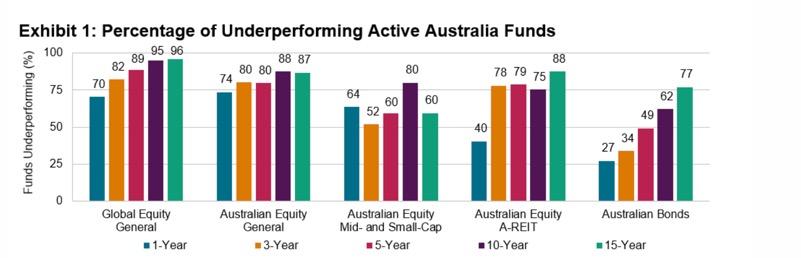
SPIVA Australia (S&P Global, Year-End 2025 — published March 2026)
What a great gig that must be. Get paid a fortune to underperform the index. I bet they all have really impressive business cards.

But what about index funds?
Here are the verified figures as of February 2026:
VAS (Vanguard Australian Shares Index ETF) — after fees, total return
- 1 year: 16.38%
- 3 years p.a.: 12.12%
- 5 years p.a.: 10.62%
- 10 years p.a.: 10.69% → vanguard.com.au (as of 28 Feb 2026)
A200 (BetaShares Australia 200 ETF) — after fees
- 1 year: 16.46%
- 3 years p.a.: 12.28%
- 5 years p.a.: 10.97% → betashares.com.au (as of 27 Feb 2026)
Over 5–10 years the return 10–11%, the same as the SPDR200 (which is what you’d expect).
On the other hand.…
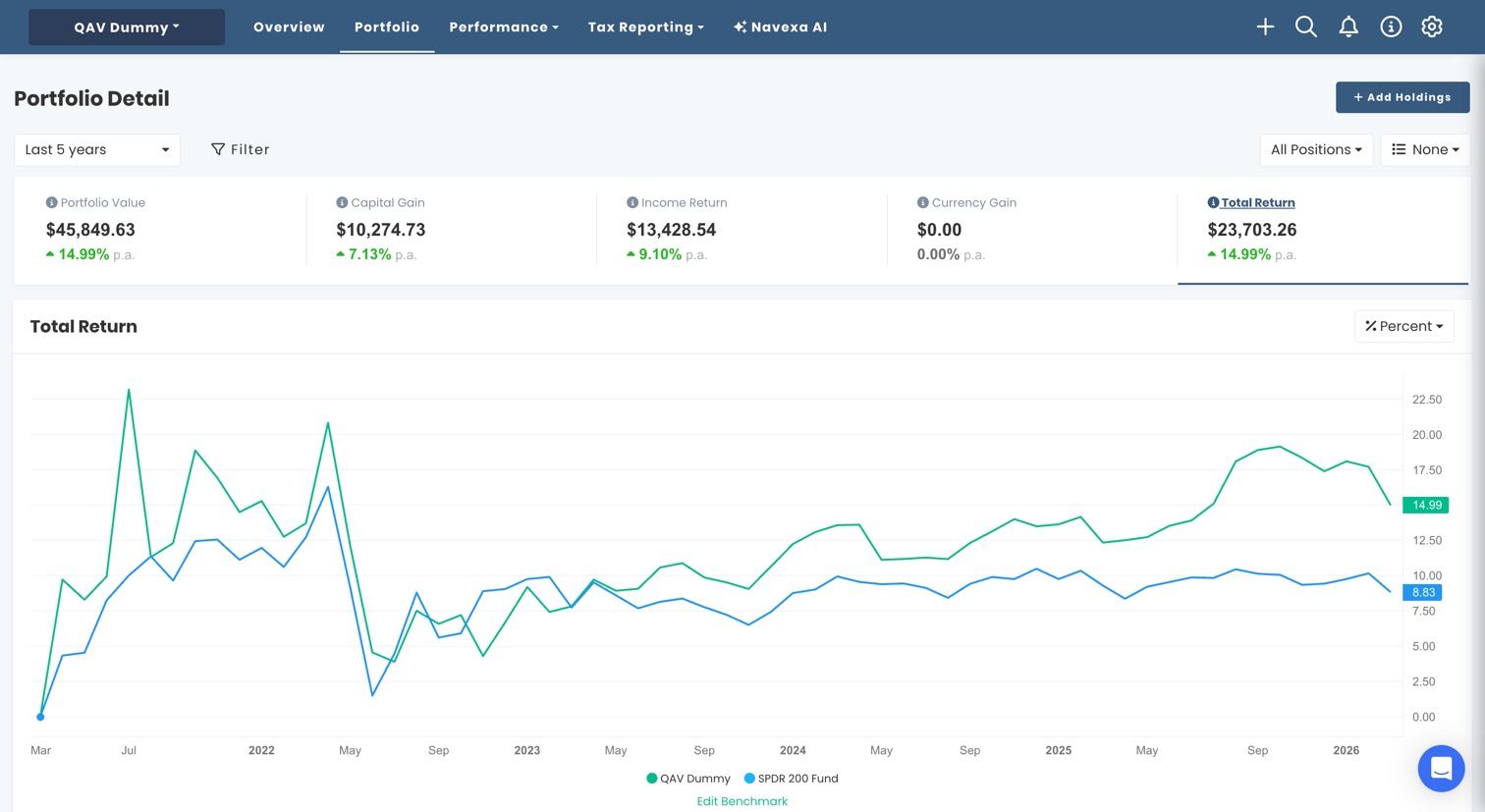
And we do this part-time. I’ve probably spent less than an hour a week managing the QAV portfolio in the last year. During the last 12 months, in this portfolio, I’ve only done 21 trades (10 sells, 11 buys). That’s an average of less than one trade per month. Despite all of the chaos and volatility, I’ve had to trade less than once a month.
Beating the system isn’t hard if you have a system. It takes a system to beat the system.
QAV Myth Killers is a weekly column in the QAV newsletter, taking apart a piece of
investing conventional wisdom. Read the series, or
get it by email every Friday.
General advice only. Spacecraft Publishing Pty Ltd
trading as QAV is a Corporate Authorised Representative (CAR 001292718) of MF & Co.
Asset Management Pty Ltd (AFSL 520442). This is general information and does not take your
personal circumstances into account. See our
disclosure.
Leave a Reply