
Hi folks,
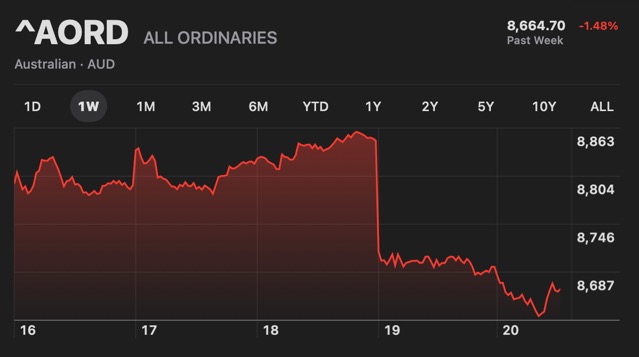
I hope you’re all having a great week. We are obviously still in a period of great volatility thanks to Trump’s Iranian adventure (it’s not a war, as Tony kept pointing out in the week’s show). I’m doing my best to ignore the market day-to-day, just looking at my alerts in the evening and seeing what I need to action the next day. No stress, just follow the model. It all works out in the end.
So, let’s get into my weekly updates and see where we are at.
All the Best,
Cam
QAV MYTH KILLERS
On our American episode this week, while talking about Colombian oil exploration outfit GeoPark, we had reason to mention the classic value investing book “What Works on Wall Street: A Guide to the Best-Performing Investment Strategies of All Time” by James P. O’Shaughnessy (his cousin was a co-founder of GeoPark — their grandfather was an OG American wildcatter).
This prompted me to pull out WWOWS again and review it. This caught my eye.
In Chapter 2 “The Unreliable Experts: Getting in the Way of Outstanding Performance”, he talks about decision making, and the two basic models people use to make decisions.

“Generally, there are two ways to make predictions. Most common is for a person to run through a variety of possible outcomes in his or her head, essentially relying on knowledge, experience, and common sense to reach a decision. This is known as a “clinical” or intuitive approach, and is the way traditional active money managers make choices. The stock analyst may pore over a company’s financial statements; interview management; talk to customers and competitors; and finally try to make an overall forecast. The graduate school administrator might use a host of data, from college grade point average to interviews with applicants, to determine if students should be accepted. This type of judgment relies on the perceptiveness of the forecaster.
The other way to reach a decision is the actuarial, or quantitative, approach. Here, the forecaster makes no subjective judgments. Empirical relationships between the data and the desired outcome are used to reach conclusions. This method relies solely on proven relationships using large samples of data. The graduate school administrator might use a model that finds college grade point average highly correlated to graduate school success and admit only those who have made a certain grade. In almost every instance, from stock analysts to doctors, we naturally prefer qualitative, intuitive methods. In most instances, we’re wrong.
Jack Sawyer, a researcher who published a review of 45 studies comparing the two forecasting techniques: In none was the clinical, intuitive method—the one favored by most people-found to be superior. What’s more, Sawyer included instances where the human judges had more information than the model and were given the results of the quantitative models before being asked for a prediction. The human judges still failed to beat the actuarial models!”
As the Sawyer study was done in 1966, and is a little long in the tooth, I did some digging into this theory that models out-perform human intuition, and found that while the original Sawyer review covered 45 studies, modern meta-analyses now encompass hundreds of cases across medicine, psychology, finance, and criminal justice, consistently showing that mechanical/actuarial models outperform human intuition by a margin of 10% to 15% on average.
However, there are caveats.
- The “Broken Leg” Rule , developed by Paul Meehl, an American clinical psychologist. He pointed out that the most significant exception is when a human possesses a single, high-validity piece of information that the model was never designed to account for. Example: If a model predicts a person will go to the cinema tonight based on a five-year pattern, but you know that person just broke their leg, you should overrule the model. The catch, however, is that “Experts” tend to see “broken legs” everywhere. They mistake “interesting” or “salient” information for “predictive” information. To beat the model, the human must only intervene for rare, high-impact facts that truly negate the base rate.
- High-Validity Environments (Kahneman & Klein). Daniel Kahneman (who championed the model-is-better view) and Gary Klein (who championed expert intuition) found a truce. They concluded that human intuition can be superior, but only if two conditions are met: The environment must have stable, predictable regularities (e.g., firefighting, chess, anesthesiology). And the expert must have had years of practice with immediate, high-quality feedback. Unfortunately, they concluded that in “noisy” environments like psychiatry, political forecasting, or stock picking, there is no “regularity” for the brain to learn, and models remain undefeated.

The bottom line for us as investors is that there’s a very high probability that our intuition is almost always going to be wrong.
What works best over the long term is a model that tells us what to do.
I might think I know better than the model. My gut feeling might tell me I shouldn’t invest in, say, APOLLO TOURISM because they have let me down time after time (a reference our long-time listeners will understand).
I should ignore my gut feeling.
That’s probably the hardest lesson to learn. Our brains suck at making decisions. Listen, brains are great. Nice work, evolution. Sure, it took millions of years and lots of side quests, but you did something pretty cool.
But a model will beat a brain almost every time.
Yeah yeah, the brains built the models. Sure. So the brains win in the end.
But only if they let go of their feeling of superiority and give in to the models.
STOCK ANALYSIS OF THE WEEK
Despite the chaos in the markets, I’ve found a few things to buy this week and you can see my Light posts here.
I also added something to the U.S. Light portfolio this week. U.S. Light and Club members can read about it here.
On the full Australian podcast this week, Tony did a deep dive on BFL. See the podcast link down below if you want to listen to his analysis.
On the American episode, I did a deep dive on GPRK. See the podcast link down below if you want to listen to my analysis.
BUY LIST
Each week, we produce a buy list based on our value investing system that we share with our QAV Club members. The intended primary purpose of this buy list is for club members to use as a reference for comparing their own buy list. In theory, all of our buy lists should look pretty similar each week.
Australian Club members can find my weekly buy list here.
Below is a link to the US list for this week (available to our U.S. Club members):
QAV American Value Investing Buy List 2026-03-18
PORTFOLIOS
We compare our performance to what we think is the most relevant benchmark (SPDR 200 in Australia, S&P500 in the USA), but if you’re new to investing, these comparisons might not mean much. Instead, you can compare our performance to the top-performing Super Funds in Australia and see why an amateur active investor (who has a system to follow) can out-perform most of the “professionals”.
AUSTRALIAN
QAV DUMMY
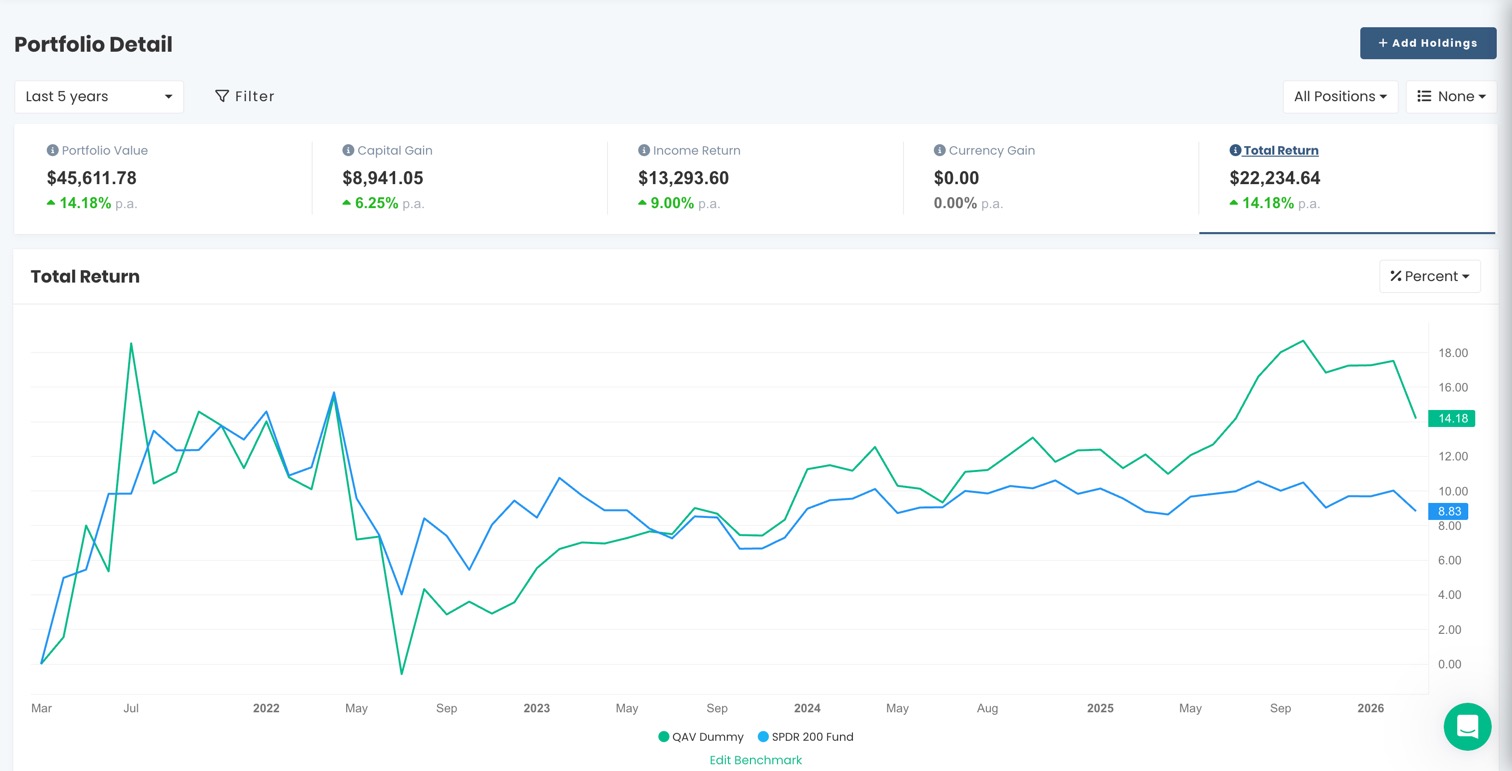
Five Year Report: Over the last five years, our portfolio is +14% p.a. vs the benchmark +8.8% p.a.
Monthly Report: The AU Dummy Portfolio was ‑9% p.a. for the last 30 days vs the benchmark ‑5% p.a.
No changes to our portfolio this week.
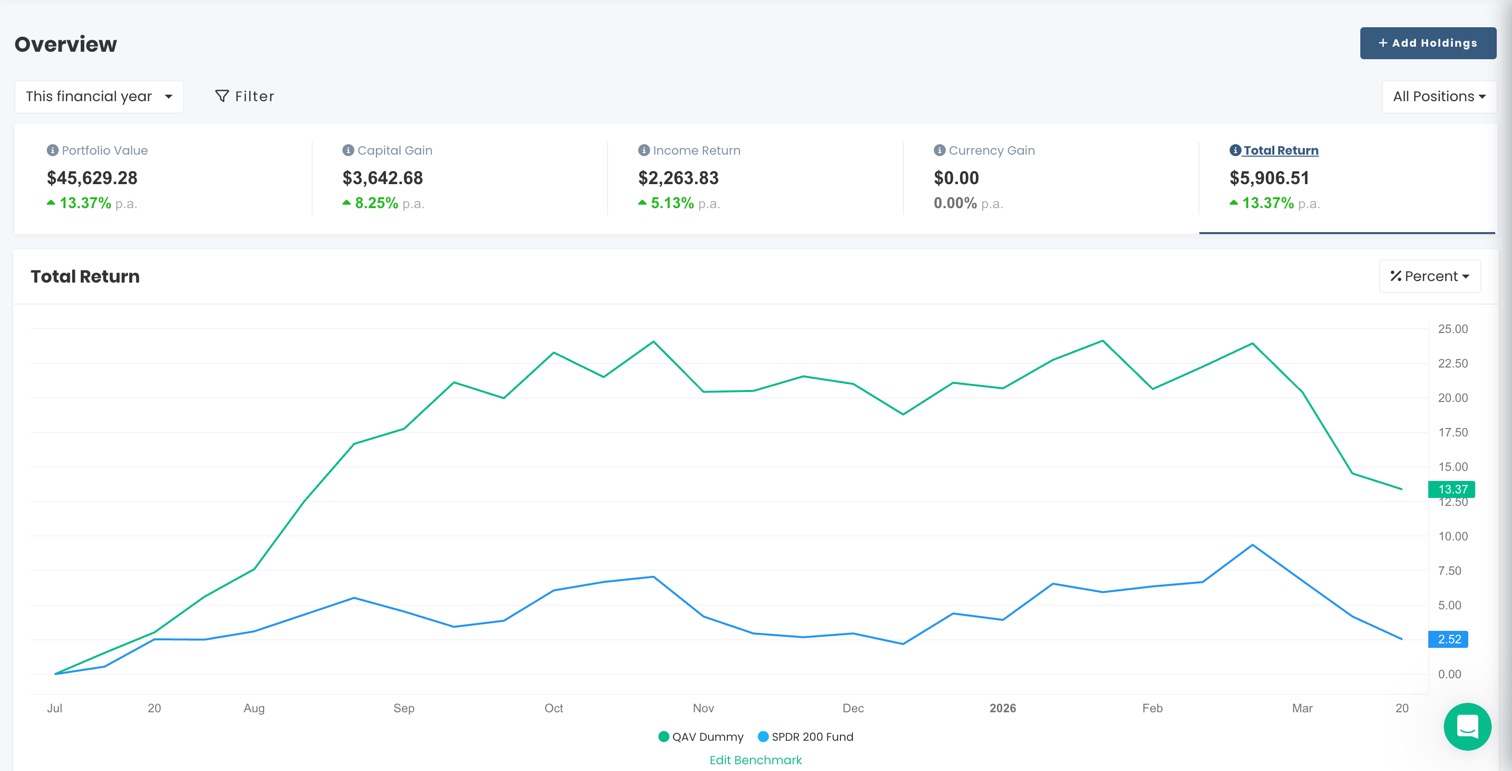
For FY26, our portfolio is +13% vs +2.5% for the index.
QAV LIGHT
As of Monday this week (the last time I did a report), In the last 30 days, the Light portfolio was ‑3.95% vs the index which was ‑2.43%.
Our best return for the last 30 days is still dental manufacturer SDI Limited which is now up 40% for the month.
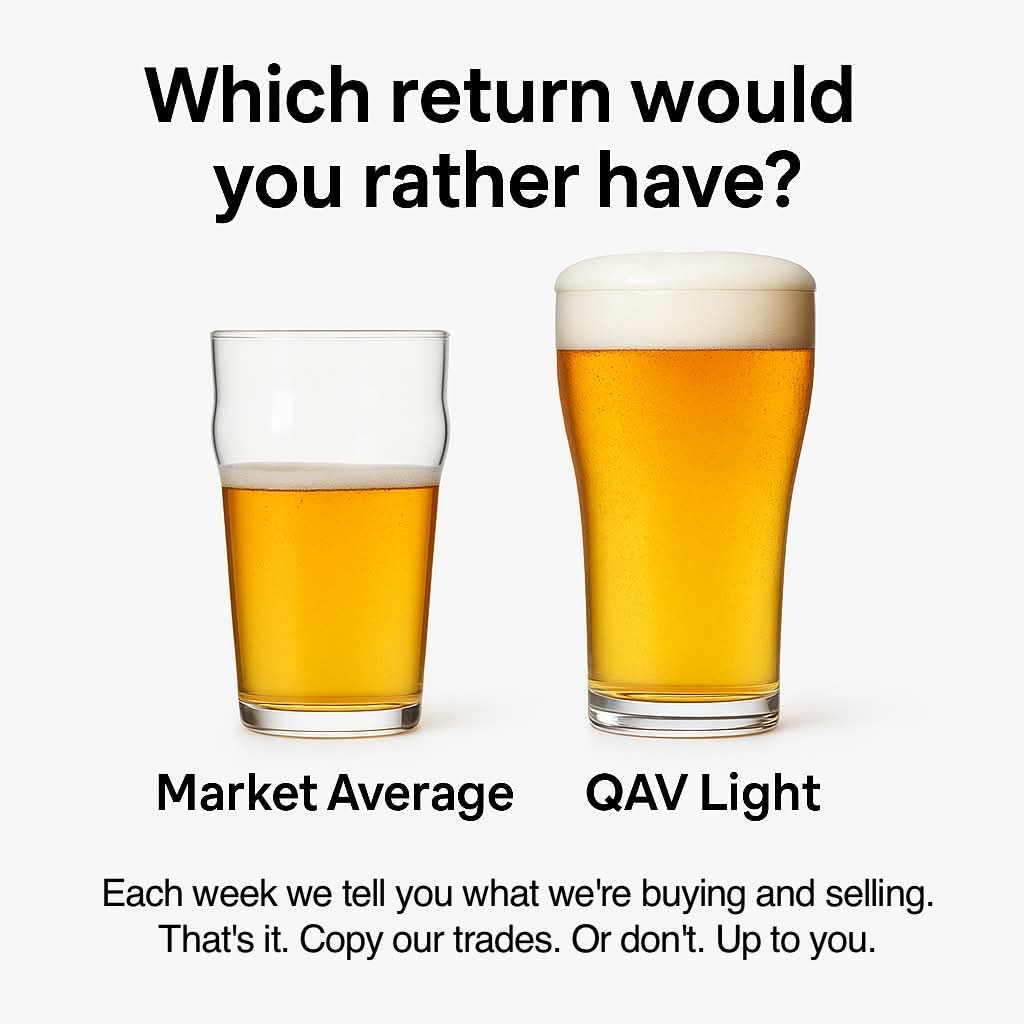
QAV LIGHT IS OUTPERFORMING THE MARKET
For the last 12 months, the Light portfolio is +32.5% vs the index +15%.
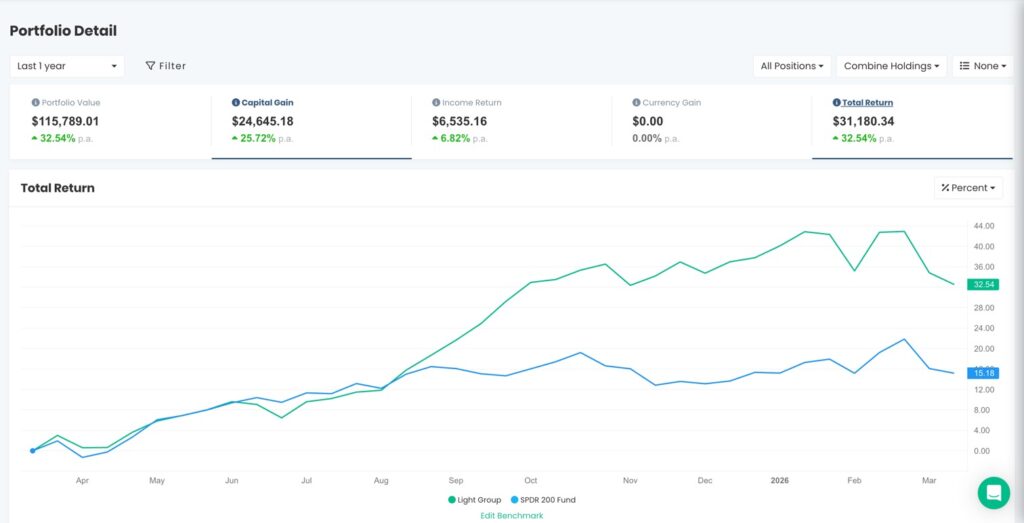
Since inception (Feb 2022), the Light portfolio is +17.7% p.a. vs the index +10%.
Become a QAV Light Member today and start your investing on the right track
If you want to find out what we’re trading in QAV Light each week, sign up to become a member. You’ll get an email from me every Monday letting you know what we’re buying and selling in that portfolio. You can choose to copy our trades or not. It’s the easiest way to start your rules-based investing career… and you don’t even need to know the rules. I’ll follow the rules for you. It’s a good first step to eventually becoming a QAV Club member and learning how to run the system by yourself.
(Note: Americans interested in joining QAV Light or Club please go here instead.)
AMERICAN
QAV DUMMY
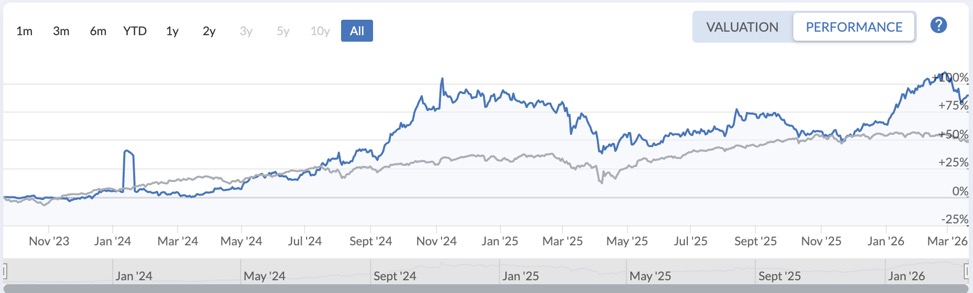
Since inception (Sep 2023), our portfolio is +89% vs the S&P 500 +48%. Not quite double market but pretty close.
Our U.S. portfolio for the last 30 days was ‑7.6% vs ‑3.7% for the S&P 500.
No trades this week.
QAV LIGHT
I recently started our U.S. Light portfolio, and it’s off to a slow start, currently ‑1% vs the S&P 500 ‑4%.
THIS WEEK’S EPISODES
Entangled Interests – QAV AU 911

The Crude and the Ruthless (GPRK) – QAV AMERICA 44
STOCK NEWS AND UPDATES
COMMODITIES
This week the big changes to commodities were the following :
Iron Ore SELL (although I’m holding off on selling my FEX, as the price is trending upwards and it’s a weird sell line, with Feb 2026 as L1 due to the flat line rule)
Gold BUY
Steel SELL
LNG SELL
Nickel JOSEPHINE
Wheat JOSEPHINE
Lithium BUY
DISCLOSURE
Please review our trading and disclosure policy.
SIGNING OFF
Well that’s it for this week! Keep focused and don’t let the market volatility scare you. As I said in last week’s article, volatility is normal. If we want to have long-term success in investing, we have to get used to volatility, avoid using our gut feelings, and just follow the model.
SSDD!
- Cam
That’s it for the week!
QAV A GOOD SHAREMARKET!
Got a question? [email protected]