
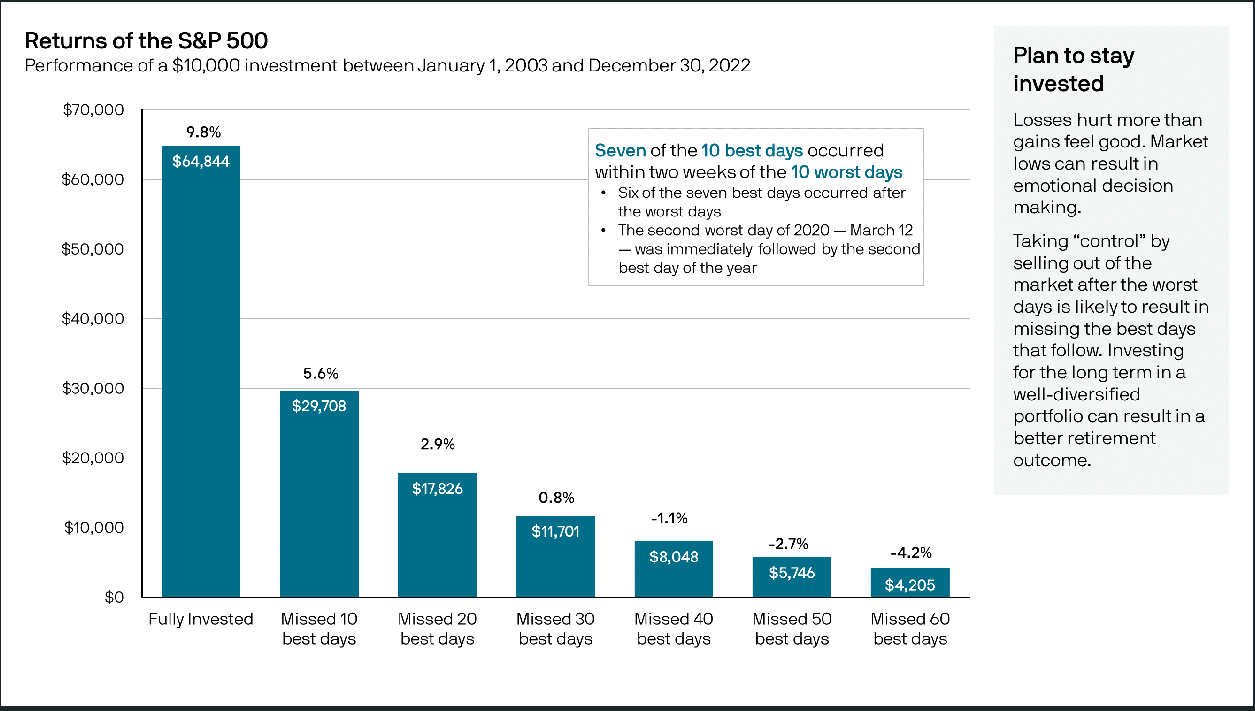
This analysis from JP Morgan explains why we need to stay fully invested at all times. If you miss out on the 10 best days, your long-term return is halved. If you miss the 20 best days, you lose 60% of your returns. And, as the chart says, “Six of the seven best days occurred after the worst days. The second worst day of 2020 — March 12 — was immediately followed by the second best day of the year.”
For more on this topic, see “Does Market Timing Work?”
Hi Cam, It seems very arbitrary to say if you miss out on the 10 or 20 best days. What about if you also missed out on the 10 or 20 worst days ? I think its meaningless to look at either the best or the work in isolation.
Hah that’s a fair point, Neil. I’ll see if anyone has done a study on that approach. Although I think the point of the study is that people tend to capitulate after the worst days, not before them, and then miss out on the best days. The old saying is that it is “time in the market, not timing the market” that counts. I think if you can time the market to avoid the worst days, then you might be on to something. 🙂
Here is another article about timing. It compares a variety of strategies including perfect timing, investing at the beginning of each year, dollar cost averaging and buying at the peak of the market each year. Perfect timing was the obvious winner but investing your money as soon as you get it without trying to time the market and dollar cost averaging weren’t too far behind. I guess the point is to be invested if you want to make money.
Hi Cam, I put the link to the article in the website box but it hasn’t made it to my comment. Here it is again.
https://www.schwab.com/learn/story/does-market-timing-work
Hi Cam, sorry. My bad. I saw that you put the article on the QAV facebook