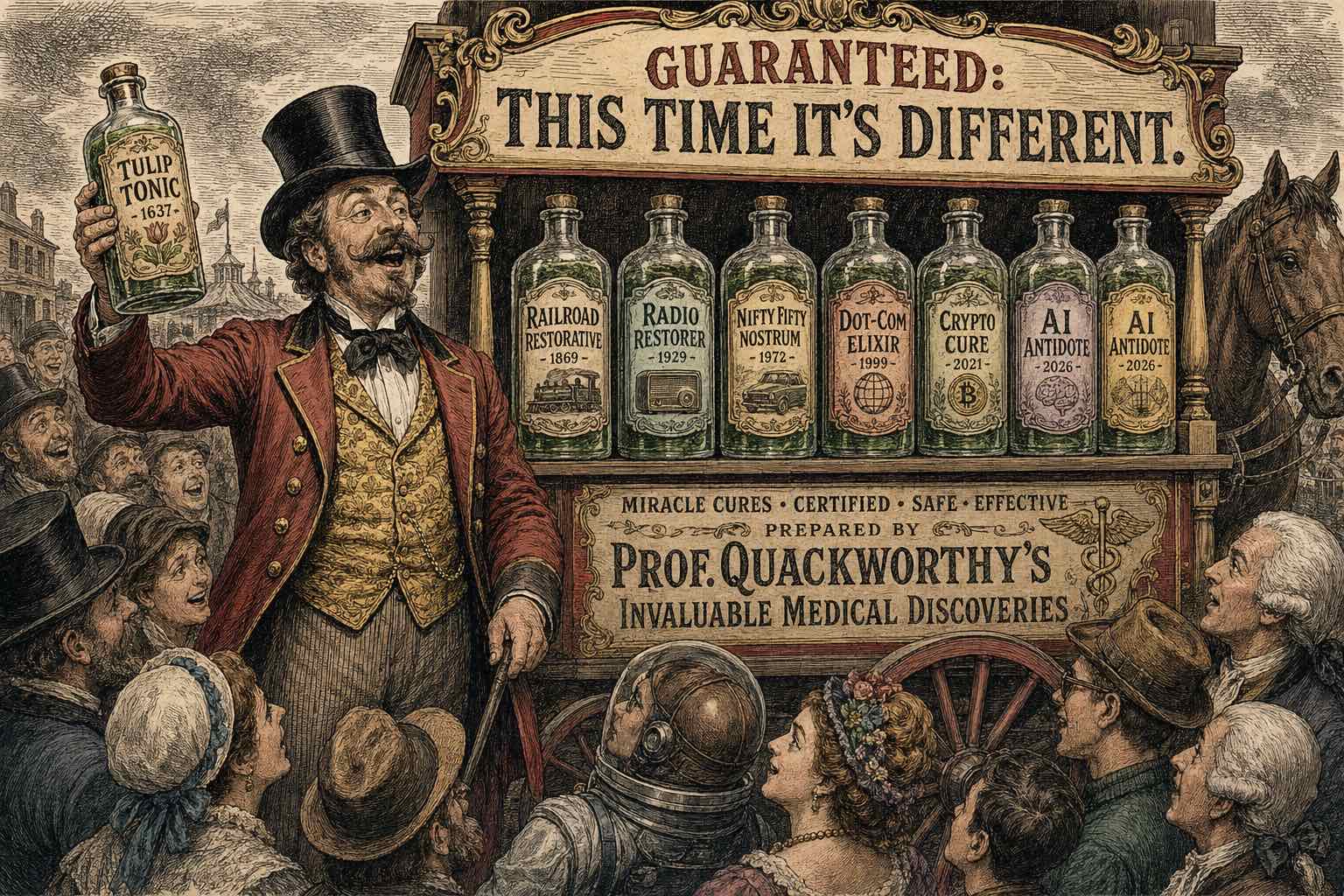
There’s a line in investing, usually attributed to Sir John Templeton, that the four most expensive words in the English language are: “This time it’s different.”
I think about that one a lot.
Long-time listeners to the QAV podcast will remember that one of Australia’s most respected finance commentators once said exactly those words to us, on air, with a completely straight face. He was wrong. They almost always are.
The phrase gets pulled out whenever a new technology, a new economic paradigm, or a new business model is being sold as the reason it’s now safe to throw out the rule book. AI today. Crypto in 2021. The “new economy” in 1999. The Nifty Fifty in 1972. Railroads in 1869. The South Sea Company in 1720. Tulips in 1637.
We don’t buy it.
As Tony likes to say, history may not repeat but it rhymes. (He stole that from Mark Twain, who almost certainly never said it. Either way, the point holds.)
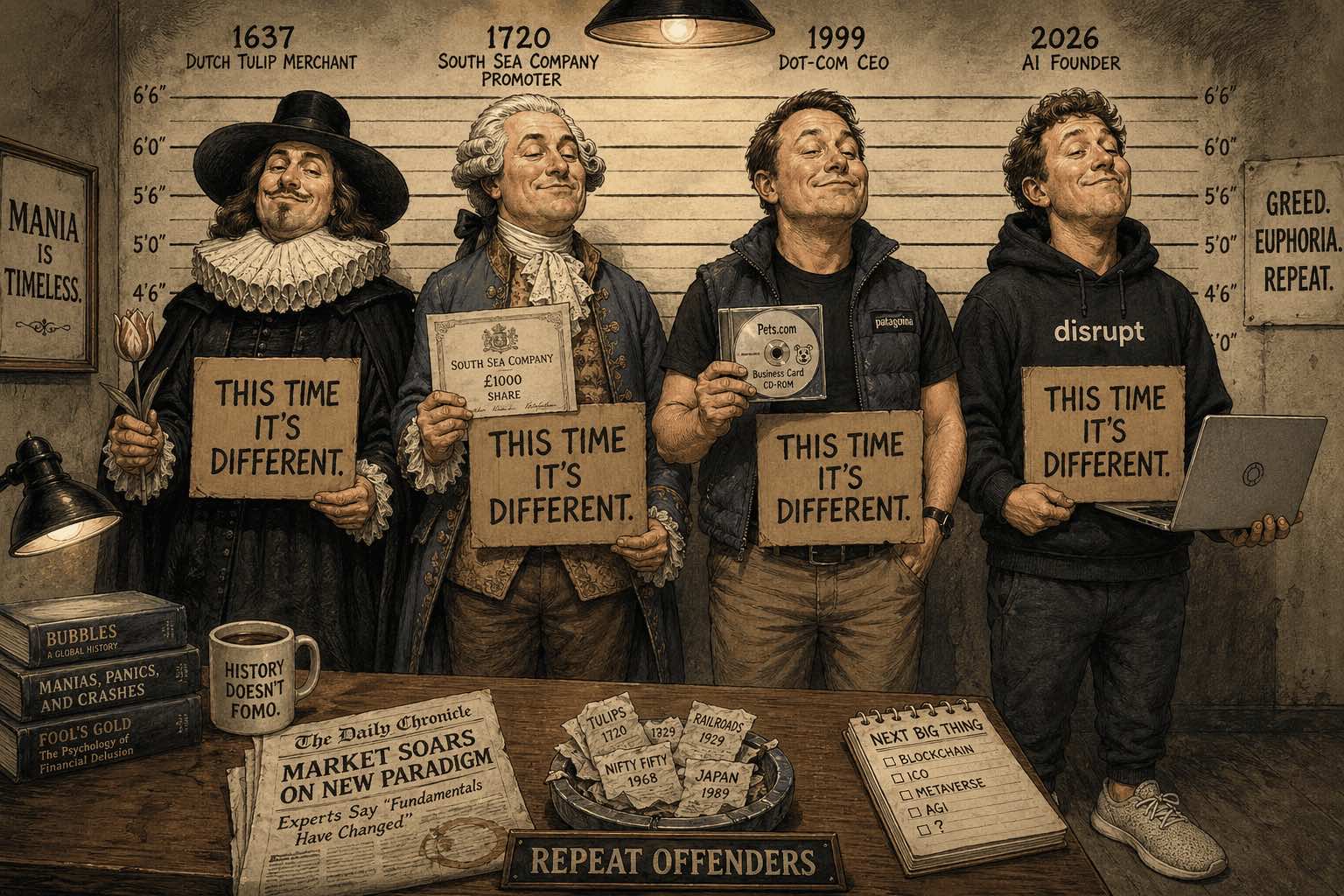
There are always new business models and paradigm shifts that are the flavour of the month. So far, none of them have fundamentally changed the basic principles behind investing — which is to find companies that are well run, that know how to make a dollar, and to only buy them when you can get them at a discount.
I Was There For The Last One
Tony and I were both around for the dot-com boom in the late 90s. We remember the hype. We remember being told all the rules were obsolete because the internet had changed everything.
And here’s the thing: it had. Sort of.
The internet really did revolutionise large parts of the economy. Amazon and Google emerged from that era and produced trillions of dollars in shareholder value. But that didn’t mean every dot-com startup was a good investment. Most of them were spectacularly bad ones.
Between March 2000 and October 2002, the Nasdaq fell from 5,048 to 1,114. A drop of about 78%. Pets.com, Webvan, eToys, Boo.com, Kozmo, Flooz — all vapourised. Companies that had been valued at billions on the strength of a slide deck and a clever URL went to zero.
I was personally invested in a number of those startups. Friends of mine were running and floating them during those heady days, with huge dreams of building dot-com empires that all ended in dust like the kingdom of Ozymandias.
I had a front-row seat in Silicon Valley during those years. And I can tell you with confidence that the loudest voices selling the future had no more idea whether they were right than you or I did. They just had more confidence in promoting their ideas. That’s not insight. That’s marketing.
When people get caught up in the hype of a paradigm shift, it’s easy to forget that the people selling them the brave new world are making it up as they go along.
So What Is A Quality Business?
The question every “this time it’s different” pitch tries to dodge is this: how do you tell the real businesses from the hype machines?
Is it the quality of the slide deck? The promotional video? The amount of venture capital raised? The market cap the day after the IPO?
Obviously not. We can all rattle off a list of very flashy, very splashy companies that didn’t survive their own hype cycle.
A venture capitalist once told an audience I was sitting in, back in the late 90s: “A big vision and 50 cents will buy you a cup of coffee.”
What matters is execution. Can you turn that vision into a real business? And the only honest way to answer that question is to look at the output.
The output takes the form of financial reports. What did the business actually produce in the last 12 months? Two years? Three years? Five years?
That’s where the rubber meets the road. And it doesn’t matter what technological revolution or business model innovation is supposedly driving your sector. At the end of the day, for a company to be a successful investment, it needs to be making money. Real money. The kind that shows up in the cash flow statement, not the kind that lives in a pitch deck.
Why We Anchor On Operating Cash Flow
This is why QAV’s primary value metric is operating cash flow. Not earnings. Not adjusted EBITDA. Not “annualised recurring revenue at scale.” Operating cash flow.
Cash is harder to fake than almost any other line on the financial statements. A company can tell you a beautiful story about its future. It can manage its earnings within accounting rules. It can find creative ways to describe its losses. But it has a much harder time inventing the cash that physically lands in its bank account each quarter.
When AI is the next big thing — and right now, it very much is — the same rules apply. A handful of real businesses will emerge from the current cycle and produce cash for decades. Hundreds more will look identical from the outside, until the music stops.
The QAV checklist doesn’t care which sector is in vogue. It cares whether the numbers stack up.
That’s why we don’t get caught up in “this time it’s different.”
Because every time, it isn’t.
QAV Myth Killers is a weekly column in the QAV newsletter, taking apart a piece of
investing conventional wisdom. Read the series, or
get it by email every Friday.
General advice only. Spacecraft Publishing Pty Ltd
trading as QAV is a Corporate Authorised Representative (CAR 001292718) of MF & Co.
Asset Management Pty Ltd (AFSL 520442). This is general information and does not take your
personal circumstances into account. See our
disclosure.