
“Don’t fight the tape.”
“Make the trend your friend.”
“Cut your losses and let your winners run.”
All these Wall Street maxims mean the same thing — bet on price momentum. Of all the beliefs on Wall Street, price momentum makes efficient market theorists howl the loudest. The defining principle of their theory is that you cannot use past prices to predict future prices. A stock may triple in a year, but according to efficient market theory, that will not affect next year.… Conversely, another school of thought says you should buy stocks that have been most battered by the market. This is the argument of Wall Street’s bottom fishers, who use absolute price change as their guide, buying issues after they’ve done poorly. Let’s see who is right.
I’m quoting from Chapter 15 of “WHAT WORKS ON WALL STREET” by James O’Shaughnessy.
He did some analysis on the 50 stocks with the best and the worst 1‑year price changes from both the All Stocks and the Large Stocks universes to see which cohort performed the best in the following year, using December 31, 1951 as the starting date — and holding them until the end of 1994. That’s a very long, 43-year game of “buy and hold”.
So what happened?
The stocks from the “best” list performed pretty well — a compound return of 14.45 percent a year. They were, however, highly volatile, and he warns that not many investors would have the stomach for that kind of wild ride.
How about the stocks from the “worst” list? Well they had a compound return of… 2.54 percent a year.
His conclusion?
“Runyon’s quote is apt. Winners continue to win and losers continue to lose.”
The same $10,000, over the same 43 years, became $3,310,255 in the winners and $29,351 in the losers.
And while, yes, this version of this book uses 1951–1994 US data, later editions and modern momentum research confirm the pattern still holds.
Runyon Who?
If you aren’t too sure who “Runyon” was — Damon Runyon was the American short-story writer best known for the Broadway tales that became the musical Guys and Dolls. He wrote stories celebrating the world of Broadway in New York City that grew out of the Prohibition era — gamblers, hustlers and showgirls, who spoke distinctive wisecracking slang where gangsters had colourful names like “Nathan Detroit”, “Harry the Horse”, “Good Time Charley”.
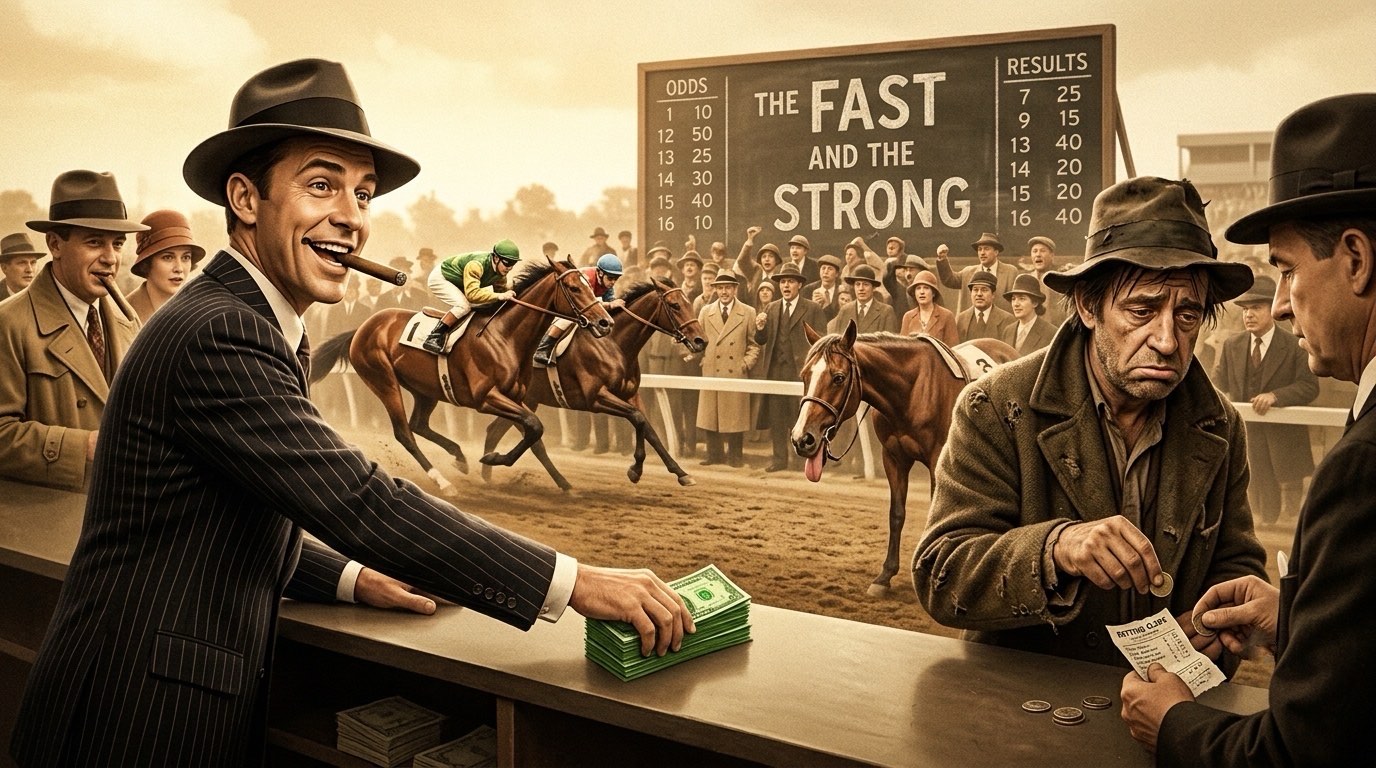
The line O’Shaughnessy uses is Runyon’s most quoted: “It may be that the race is not always to the swift, nor the battle to the strong, but that’s the way to bet.”
It’s itself a riff on Ecclesiastes (“the race is not to the swift, nor the battle to the strong…”). Runyon’s twist is the punchline: sure, upsets happen, but if you’re betting, he would back the fast and the strong. So do we. We just refuse to pay full price for them.
Isn’t this like the DOGS of the DOW?
Long-time listeners might recall us discussing the “Dogs of the Dow” concept over the years. It’s the same same but different. The Dogs of the Dow is an investment strategy popularised by Michael B. O’Higgins in a 1991 book which proposes that an investor annually select for investment the ten stocks listed on the Dow Jones Industrial Average whose dividend is the highest fraction of their price, i.e. stocks with the highest dividend yield. So they tend to be high-yielding stocks whose share price has been battered over the last twelve months. This is the big distinction with the O’Shaughnessy experiment, which didn’t take into account dividend yield (he looks at that in a different chapter).
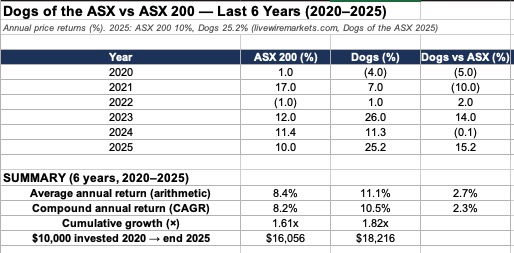
Similar Dogs experiments have been done annually in Australia. The strategy tends to perform okay — overall it beats the index, which is better than most active fund managers — but it doesn’t perform as well as QAV over the long-term.
From the results provided by the annual updates from Hugh Dive (Atlas Funds Management) over the 11 years 2014–2024:
The ASX200 returned 7.5% p.a. and the Dogs returned 10.3% Compound (CAGR). So it outperformed but nowhere near the double market outperformance we strive for.
As a better direct comparison to QAV:
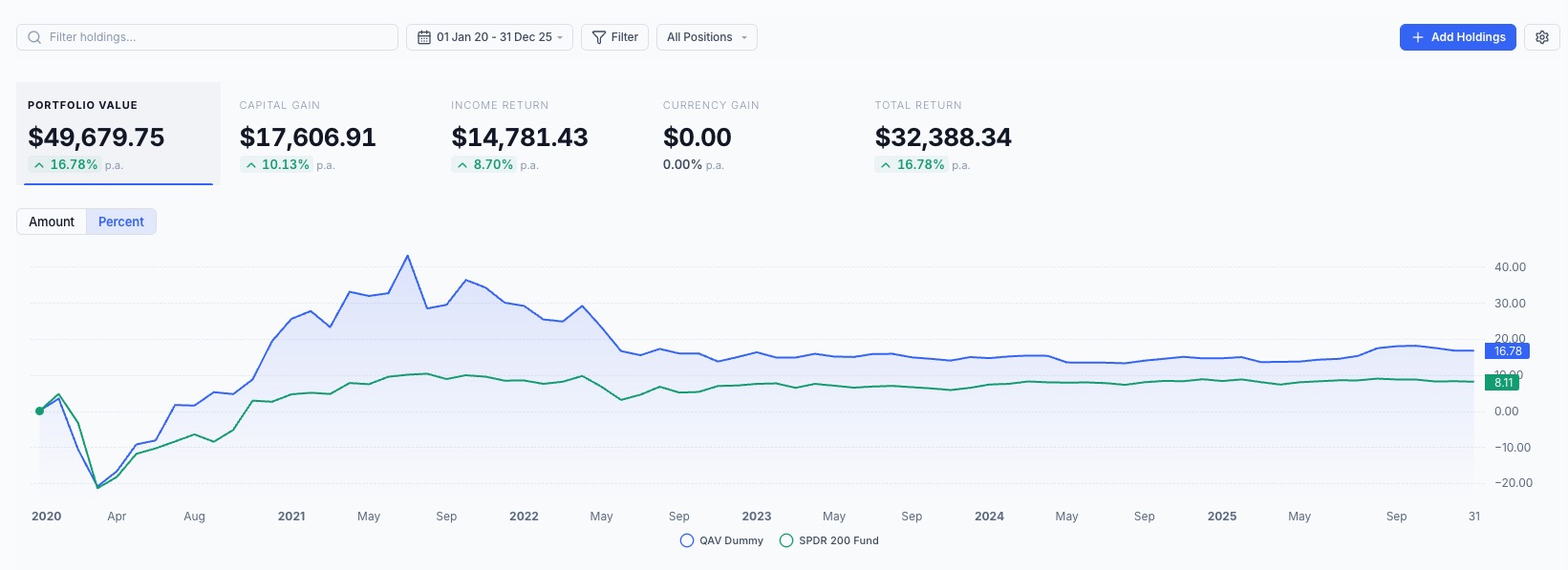
For the calendar years 2020 — 2025, the Dogs returned 10.5% versus the ASX200 8.2% CAGR.
The QAV Dummy Portfolio returned 16.8%.
How does this apply to the QAV strategy?
We like investing in winners of a particular variety — cheap winners. We try to invest in companies that have a history of generating cold, hard cash, which we take as a signal of a healthy business and strong management. But, of course, we only invest in those companies when we can buy the stock at a discount to their intrinsic valuation. Why? Because valuing a stock is a bit of a dark art. There are lots of variables that we can’t be completely aware of, market nuances that aren’t obvious, industry trends that we don’t appreciate, things like that. So we try to build in a moat around our investments, which means that even if we get things a bit wrong, we should still come out on top — most of the time. It’s a security measure.
So the Dogs aren’t “buy losers.” They’re “buy quality at a temporary discount.” That’s a value strategy wearing a contrarian costume — and it’s exactly why O’Shaughnessy’s own work shows high dividend yield works among large stocks while worst price performers fail across all stocks. No contradiction. The two findings are best friends.
We don’t buy losers hoping they bounce, and don’t chase winners blindly off a cliff. Buy quality businesses that are winning and still cheap.
Here’s the twist. O’Shaughnessy is watching share prices. We’re watching businesses. We don’t buy a stock because its price is climbing — we buy a cheap, quality company and then let our rules do the sorting. The sell discipline cuts the losers before they become falling knives, and lets the winners run until the trend breaks. We end up holding winners and dumping losers — the exact pattern O’Shaughnessy rewards — but we get there through rules, not by chasing a chart. No tree grows to the sky, as Tony says. We just let our system tell us when it’s stopped growing.
QAV Myth Killers is a weekly column in the QAV newsletter, taking apart a piece of
investing conventional wisdom. Read the series, or
get it by email every Friday.
General advice only. Spacecraft Publishing Pty Ltd
trading as QAV is a Corporate Authorised Representative (CAR 001292718) of MF & Co.
Asset Management Pty Ltd (AFSL 520442). This is general information and does not take your
personal circumstances into account. See our
disclosure.
Leave a Reply