
In a recent interview on CNBC, Warren Buffett compared the markets to a church with a casino attached.
He wasn’t wrong when he stated that “investing is like a church with a casino attached… people can move between the church and the casino.… but the casino’s gotten very attractive to people.”
Since the launch of Robinhood in 2013, whose co-founder Vlad Tenev claimed to be giving the “poor” access to the glamorous domain of rich traders, “democratizing finance for all”, there’s been a Cambrian explosion of investing apps and services trying to capitalise on the idea of the gamification of investing. Dopamine-fuelled behavioural drivers, the kind that have been the engine of social media and educational apps like Duolingo have been leveraged in finance to create stickiness and investing fever.
(Sidenote: I just hit my 2,100-day Duolingo streak this week. The owl owns me. I know exactly what dopamine-driven stickiness feels like — and that’s the point.)

We all remember the GameStop trading frenzy that Robinhood became the focal point of in 2021.
In 2022, the CFA Institute published a report called Fun and Games, Investment Gamification and Implications for Capital Markets.
It says that gamification and the broader use of behavioural techniques can be a powerful tool when used well to drive engagement and positive outcomes — but it can also be leveraged by firms to drive “excessive trading” as well as “induce trading in complex or high-risk products”.
Even Keynes — back in 1936 — called the share market a ‘beauty contest’ where investors don’t try to pick the best company, they try to guess what everyone else will pick. Now we just call it WallStreetBets.
CFA goes on to say:
“With social media, it is easier than ever to infer the average opinion in real time, as evidenced by the success of such groups as WallStreetBets, or to be led by the opinion of the few, as the rise of social influencers attests.”
In the United States, there have been a number of cases that demonstrate the dangers in gamified investing.
In December 2020, Robinhood paid $65M to settle SEC charges of misleading customers about how it made its money (payment for order flow) and the inferior trade prices that resulted. In the same month, the Massachusetts Securities Division became the first US securities regulator to file an enforcement action explicitly citing gamification — confetti animations, push notifications, lists of “100 most popular stocks” — as the actual harm to retail investors.
Six months later, in June 2021, Robinhood paid $70M to the Financial Industry Regulatory Authority (FINRA), the largest financial penalty FINRA had ever ordered at the time, for misleading customers, system outages during the GameStop saga, and approving unsuitable customers for options trading.
The most tragic story might be the Alex Kearns case from June 2020. A 20-year-old university student in Illinois took his own life after Robinhood’s UI showed him a $730K negative balance that wasn’t real — it was an options-trading display glitch. His family settled with Robinhood in 2021 for an undisclosed sum.
To be fair, these apps have got hundreds of thousands of Australians into the market who’d never have walked into a stockbroker’s office. Whether or not that’s ultimately a good thing, remains to be seen.
Closer to home, the Australian Securities and Investments Commission has explicitly named gamification as a regulatory priority, listing ‘leaderboards, gamification, inducements and other behavioural levers’ as practices it is actively reviewing. In 2023, ASIC took its first design-and-distribution-obligations action against a retail broker, suing eToro for selling CFDs to Australians whose “screening test was very difficult to fail.”
Sidenote: A CFD (Contract for Difference) is a derivative. You don’t own the underlying share; you take a leveraged bet on its price movement. If the price moves your way, you collect the difference; if it moves against you, you owe it — often more than you originally deposited. CFDs are legal for Australian retail clients but banned for US retail investors entirely (SEC won’t allow them). And I thought we were the Nanny State?
Across the broader sector, ASIC’s most recent review found that 133,000 Australians — 68% of retail CFD clients — lost more than $458 million in 2023–24 alone. Robinhood itself — the original confetti merchant — hasn’t been let into Australia yet. ASIC has been forcing them to accept strict borrowing limits and dispute-resolution rules first.

At QAV HQ we have more of an old school view of investing.
We like our investing to be really boring.
Our style of investing is more like eating broccoli, brushing your teeth, getting eight hours of sleep, or getting your 10,000 steps in.
Like sex after you’ve been married 20 years, it might be a little predictable, but it works. (Don’t tell Chrissy I wrote that or I’ll be in all sorts of trouble.…)
QAV’s dummy portfolio — publicly tracked and verifiable on the website — has returned roughly 14% CAGR over the past five years against the ASX 200’s 8.6%. Tony’s been running the method for over 30 years and his personal returns track similarly.
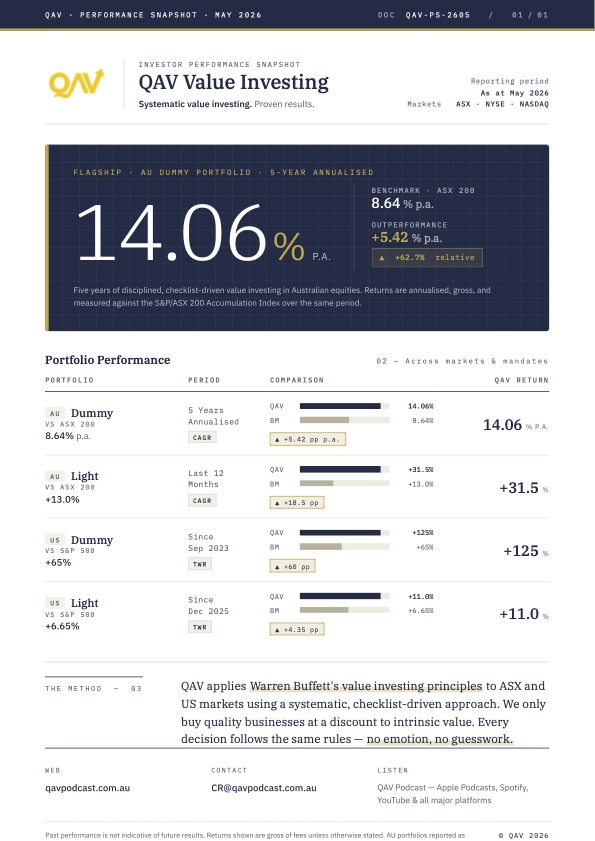
Boring investing delivers long-term results, but it requires a small amount of regular discipline. Part of that discipline is ignoring the dopamine. Tony built the checklist precisely because intuition and emotions are unreliable.
QAV isn’t a quick solution. It’s the opposite of Ozempic.
We prefer the excitement of long-term, reliable double market returns to the short-term, quick-fix pleasures of leaderboards and checking an app every 15 minutes.
Oliver Stone is probably not going to make a movie about QAV in a hurry. But if he did… who do you think should play Tony?
QAV Myth Killers is a weekly column in the QAV newsletter, taking apart a piece of
investing conventional wisdom. Read the series, or
get it by email every Friday.
General advice only. Spacecraft Publishing Pty Ltd
trading as QAV is a Corporate Authorised Representative (CAR 001292718) of MF & Co.
Asset Management Pty Ltd (AFSL 520442). This is general information and does not take your
personal circumstances into account. See our
disclosure.
Leave a Reply