
Australians have a near-spiritual belief in property. It’s practically encoded in the national DNA. Bricks and mortar. Safe as houses. You can’t go wrong with real estate.
And look, they’re not entirely wrong. Sydney and Melbourne property has delivered stunning returns over the past 30 years. A house bought in Paddington in 1990 for $400K is worth $4M+ now. Hard to argue with that.
But the myth almost always conflates leverage with returns. Most people buy property with an 80% mortgage. If a $500K house rises to $600K, that’s a 100% return on a $100K deposit — not a 20% return. Shares rarely get compared on a leveraged basis. When you strip out the debt and compare asset-to-asset performance, the story changes.
Even the Federal Reserve Bank of San Francisco noticed. In a landmark 2015 paper “The Rate of Return on Everything”, they analysed nearly 150 years of data across asset classes. Looking at the full dataset, Australian real estate returned 6.37% per annum in real terms, against 7.81% for stocks. Zoom in on the period from 1980 onwards, the era most relevant to today’s investors, and it’s not even close: stocks returned 8.78% per annum against property’s 7.16%.
And that’s before you account for the costs property investors prefer not to think about.

Stamp duty on a $1M property purchase in NSW runs to around $40,000. That’s 4% you need to earn back before you’ve made a cent. Add agent commissions on sale (around 2–2.5%), annual holding costs for rates, insurance, maintenance and property management (typically 1–1.5% of property value per year), and the real return shrinks considerably. Compare that to a $10 brokerage fee on a $10,000 share purchase (0.1%) and you start to see how skewed the comparison has always been.
None of this is to rain on real estate’s parade entirely. Tony often talks about how he leveraged into property after the GFC to turbocharge his stock portfolio. Used strategically, it can work. But it’s a tool, not a religion.
Liquidity is another thing property investors tend to wave away. Tony’s been trying to sell his sky palace apartment in Sydney for a couple of years and can’t find the right buyer. Outside of a major correction, he could offload $10 million in stocks in 24 hours.
For my money, though, there’s one difference that almost never gets mentioned in these property-versus-shares debates: you can vastly outperform average returns if you’re an intelligent, disciplined investor in stocks. You can’t outperform the Sydney property market by being smarter about Sydney property. You’re just along for the ride.
QAV’s dummy portfolio has returned roughly 15% per annum over the past 5 years against an ASX 200 benchmark of 8% — roughly double market. Tony’s been achieving that kind of result for 30 years, using a checklist that asks hard quantitative questions property investors almost never apply to their own portfolios.
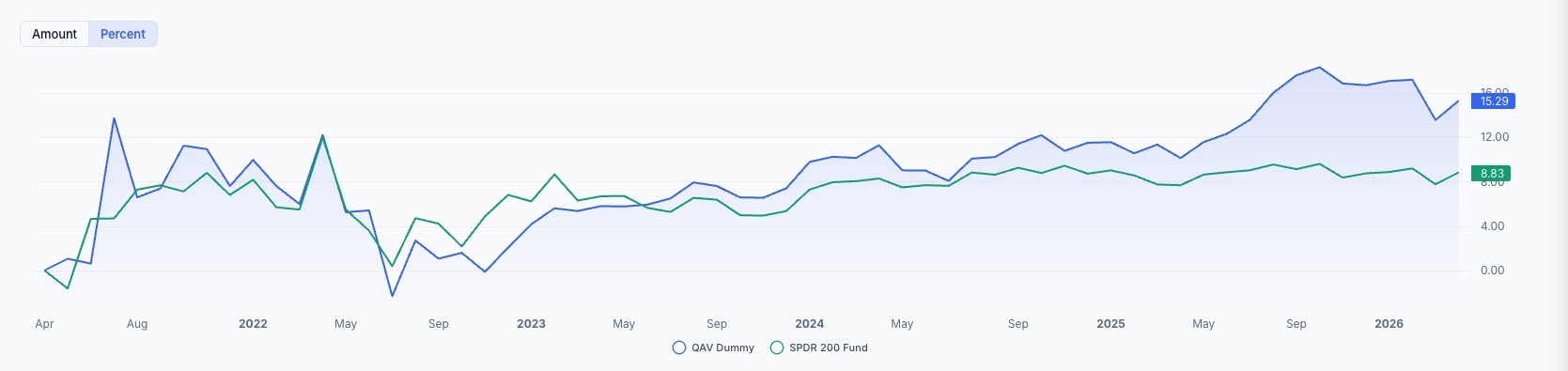
The QAV checklist doesn’t ask “is this a nice suburb?” It asks whether a business is genuinely profitable, whether the price is right, and whether the numbers justify the risk. That’s it. No stamp duty. No tradies. No tenants.
Property made a generation of Australians wealthy. But it did it on borrowed money and borrowed time. A system that compounds quality returns, reinvests dividends, and doesn’t charge you stamp duty doesn’t need a narrative. It just needs to keep running.
QAV Myth Killers is a weekly column in the QAV newsletter, taking apart a piece of
investing conventional wisdom. Read the series, or
get it by email every Friday.
General advice only. Spacecraft Publishing Pty Ltd
trading as QAV is a Corporate Authorised Representative (CAR 001292718) of MF & Co.
Asset Management Pty Ltd (AFSL 520442). This is general information and does not take your
personal circumstances into account. See our
disclosure.
Leave a Reply