Peter Lynch once said: “Far more money has been lost by investors preparing for corrections, or trying to anticipate corrections, than has been lost in corrections themselves.”
Warren Buffett liked that one so much he repeated it.
And yet, every time markets get wobbly — and right now, with the US-Iran war pushing oil toward $100 a barrel and the Strait of Hormuz blockade threatening what the IEA is calling the largest supply disruption in oil market history, they are very wobbly — the advice comes flooding back: go to cash. Protect yourself. Sit it out. Wait for the bottom, then buy back in.
On the surface of it, this makes sense.
Here’s the problem: nobody can actually do it.
Not the timing part. Not reliably. Not even Howard Marks, who has been doing this for 50 years and is one of the smartest people in the business. His view? “In my experience, most people who are lucky enough to sell something before it goes down get so busy patting themselves on the back they forget to buy it back.”
But forget the buying-back problem for a moment. Let’s just talk about what sitting in cash actually costs you.
According to Hartford Funds, if you’d been invested in the S&P 500 over the last 30 years but missed just the 10 best days, your returns would have been cut in half. Miss the 30 best days — 30 days out of roughly 7,500 trading days — and your returns drop by 84%. And here’s the part that should make any cash-holder nervous: 76% of the market’s strongest days happened either during bear markets or in the first two months of a bull market.
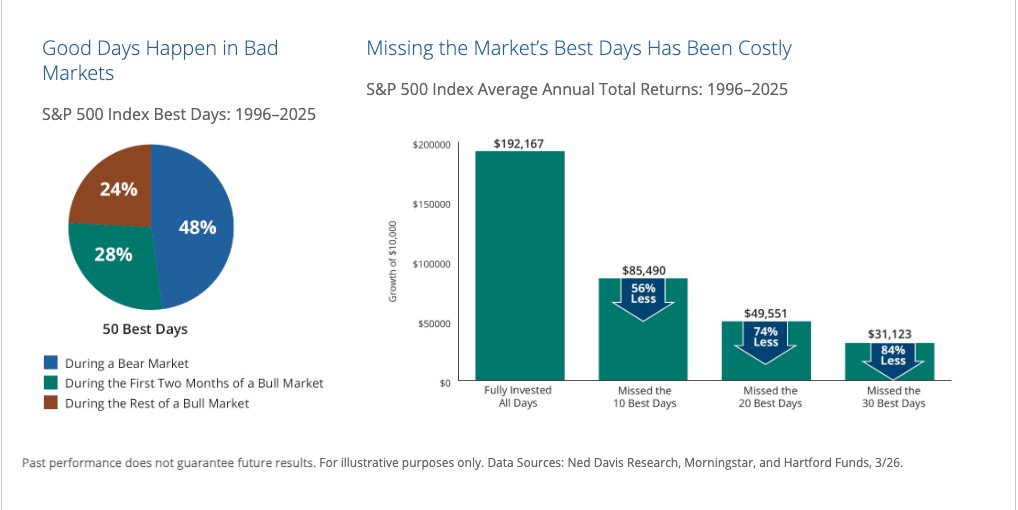
Here’s the kicker: the market’s best recoveries happen fast and without warning. If you’re in cash waiting for the signal to get back in, you’ll almost certainly miss them.
We saw a perfect illustration of this on April 8th. Markets had been tanking on war fears. Then a US-Iran ceasefire was announced and the Dow surged over 1,000 points in a single session. That was one of those days. If you’d been sitting in cash waiting for things to “calm down”, you missed it.
This is the trap. The instinct to go to cash feels like prudence. It feels like doing something. And right now — with economists predicting recessions, oil prices spiking, and war headlines every morning — I understand the temptation more than ever. Even Tony, who’s been at this for 30+ years, would tell you the macro picture looks genuinely alarming.
But that’s exactly the point. We don’t actually know what the market will do next.
We’ve said this on the show for years, and it keeps being proved right. And yet markets keep surprising us — both up and down — and nobody calls the turns with any consistency.
So in QAV, we don’t try to.
Instead, we use a rules-based system to tell us when to act. When a stock drops below our Sell Line, we sell. When the checklist identifies a high-scoring stock at a compelling value, we buy. We’re not second-guessing the macro. We’re not reading headlines and making gut calls. We have no opinion about whether the Iran war will cause a recession — because that opinion wouldn’t be reliable, and even if it were right, we still wouldn’t know when to get back in.
There are times when the system naturally puts us in cash — when the checklist can’t find anything worth buying. But that’s a different thing entirely from going to cash because you’re scared.
Think of it this way. Our sell triggers are our helmets and seat belts. There’s real risk in being in the market, just like there’s real risk every time you get in a car. But the answer isn’t to never drive. The answer is to buckle up.

You accept the risk. You take precautions. You follow the rules that give you the best chance of getting where you want to go in one piece. What you don’t do is leave the car in the garage forever because something bad might happen.
That’s not prudence. That’s just being stuck.
Far more money has been lost by investors waiting for the all-clear than by investors who stayed in, protected themselves as best they could, and let the system do its job.
QAV Myth Killers is a weekly column in the QAV newsletter, taking apart a piece of
investing conventional wisdom. Read the series, or
get it by email every Friday.
General advice only. Spacecraft Publishing Pty Ltd
trading as QAV is a Corporate Authorised Representative (CAR 001292718) of MF & Co.
Asset Management Pty Ltd (AFSL 520442). This is general information and does not take your
personal circumstances into account. See our
disclosure.
Leave a Reply