
If you’ve spent five minutes reading mainstream investment media or listening to the high priests of Old Guard value investing, you’ve heard the sermon. They tell you to find a great company, buy it, and hold it until the heat death of the universe. They preach that if you’ve done your homework, you should be prepared to “weather the storm” and “ignore the noise.”

The gurus want you to believe that selling a stock is a sign of intellectual weakness, a failure of your original thesis. They’ve romanticised the act of holding through a 40% drawdown as a badge of honour, a test of your “conviction.”
Why People Believe It
It’s easy to see why this sticks. It feels noble. It sounds like the “sophisticated” thing to do. We are told that Warren Buffett’s favourite holding period is “forever,” so we try to emulate that stoicism. It also appeals to our natural human laziness and our psychological aversion to admitting we were wrong. If we don’t sell, we haven’t lost. We’re just “long-term investors.” It’s a comforting blanket that protects us from the harsh reality of a red screen.
The Trap: Your Thesis Doesn’t Control the Market
Here is the blunt truth: The market does not care about your thesis. It doesn’t care how many late nights you spent pouring over annual reports or how much you love the CEO’s “vision.”
The trap of “falling in love” is that you stop being an investor and start being a fan-boy. You become invested in being right rather than making money. When the price starts to slide, the “Buy and Hold” cult tells you to double down because the “fundamentals haven’t changed.”
But fundamentals are lagging indicators. By the time the balance sheet reflects the rot, your capital has already evaporated. The logic that you should stay loyal to a falling stock assumes the market is “wrong” and you are “right.” That is a level of arrogance that leads straight to the poorhouse. In 2008, plenty of “great businesses” with “strong theses” went to zero or spent a decade in the wilderness. Loyalty to a piece of paper is not a strategy. It’s a suicide pact.
The Humility of the Exit
A major point of departure between us and the Buffett acolytes is a simple admission of reality: we aren’t experts on these businesses. We don’t spend hundreds of hours studying the intricacies of a company’s logistics or its five-year market share projections. We have better things to do with our lives, like playing golf, doing kung fu, or spending time with our families.
However, we know there are thousands of analysts at massive funds who do spend their lives doing that. They might know something we don’t. When the market starts dumping a stock, it’s often because those people are heading for the exits. Maybe they see a structural shift in the industry or a looming debt crisis that hasn’t hit the headlines yet.
The market might be wrong, but we aren’t going to bet our retirement on it. We err on the side of caution. If the big money is leaving, we follow them out the door. We don’t need to be the smartest person in the room; we just need to be the one who isn’t left holding the bag when the lights go out.
The Hidden Cost: The Decade of Lost Time
The mainstream logic ignores the most expensive thing in the world: Opportunity Cost.
When you “stay the course” through a massive market collapse, you aren’t being brave. You’re being a hostage. Look at the GFC. It took the All Ordinaries ten years to claw back to its 2008 peak. Ten years of your life. Ten years where your capital sat stagnant, doing nothing but trying to get back to zero.
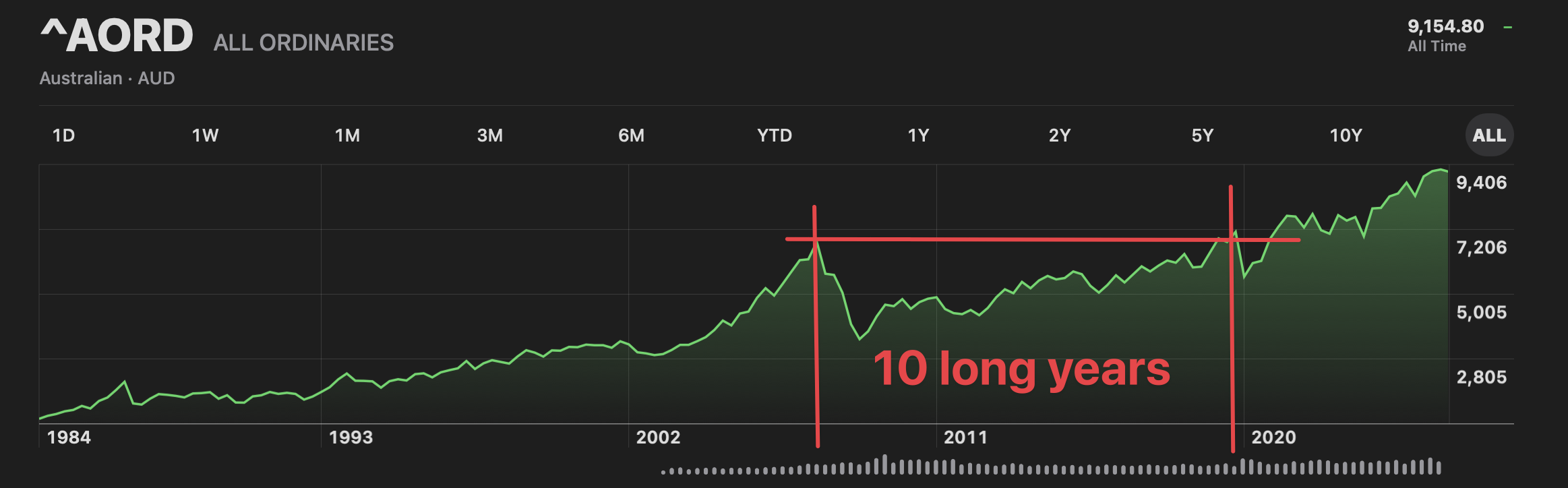
If you’re “in love” with your stocks, you’re paralyzed. You watch the value plummet and you do nothing because your “thesis” says the company is still good. Meanwhile, the real professionals are liquidating. The hidden cost isn’t just the money you lost on the way down; it’s the massive gains you could have made if you had preserved your capital and had it ready to deploy when the market finally bottomed. In 2020, the “conviction” crowd sat trembling while their portfolios halved. The mercenaries sold, waited for the dust to settle, and bought back in when the tide turned. They didn’t care about the names on the stocks. They cared about the direction of the money.
The Hint of the Fix: Logic Over Loyalty
We don’t do “conviction.” We don’t do “loyalty.” We are cold-blooded mercenaries.
The secret to surviving and thriving in this game isn’t finding a better “story” to believe in. It’s removing the human element entirely. You need a way to kill your darlings before they kill your bank account. You need a cold, hard set of triggers that tell you exactly when the party is over, regardless of how much you like the host.
We don’t “hope” a stock recovers. We don’t “feel” like it’s a good time to buy. We operate based on a rigorous, dispassionate framework that prioritises the preservation of capital above all else. When the light turns red, we stop. When it turns green, we go. No ego, no “thesis,” and absolutely no love.
We use a system of rules because our brains are designed to make us fail at investing. Rules don’t get emotional. Rules don’t care about “forever.” And rules are the only thing that will keep you from being the one holding the bag when the next “unforeseen” crash hits.
QAV Myth Killers is a weekly column in the QAV newsletter, taking apart a piece of
investing conventional wisdom. Read the series, or
get it by email every Friday.
General advice only. Spacecraft Publishing Pty Ltd
trading as QAV is a Corporate Authorised Representative (CAR 001292718) of MF & Co.
Asset Management Pty Ltd (AFSL 520442). This is general information and does not take your
personal circumstances into account. See our
disclosure.
Leave a Reply