The Myth
Gold is marketed as the last honest asset in a dishonest world. You hear the same slogans everywhere: “Central banks are hoarding it,” “It’s stood the test of time,” “It protects you when everything else fails,” “Fiat currency is worthless.”
The people pushing this story include newsletter preppers, YouTube fear-merchants, bullion dealers, and the usual parade of self-appointed financial prophets who’ve been predicting economic Armageddon every year since the 1970s. Gold is their security blanket, and they want you to buy one too.
Why People Believe It
Fear makes bad ideas sound wise. Gold feels safe because it’s old, shiny, and doesn’t produce quarterly earnings that can disappoint. It looks serene while everything else looks chaotic. And for people who don’t trust governments or markets, gold feels like a rebellion against the system.
The psychological comfort is real. The financial logic isn’t.
The Trap Behind the Logic
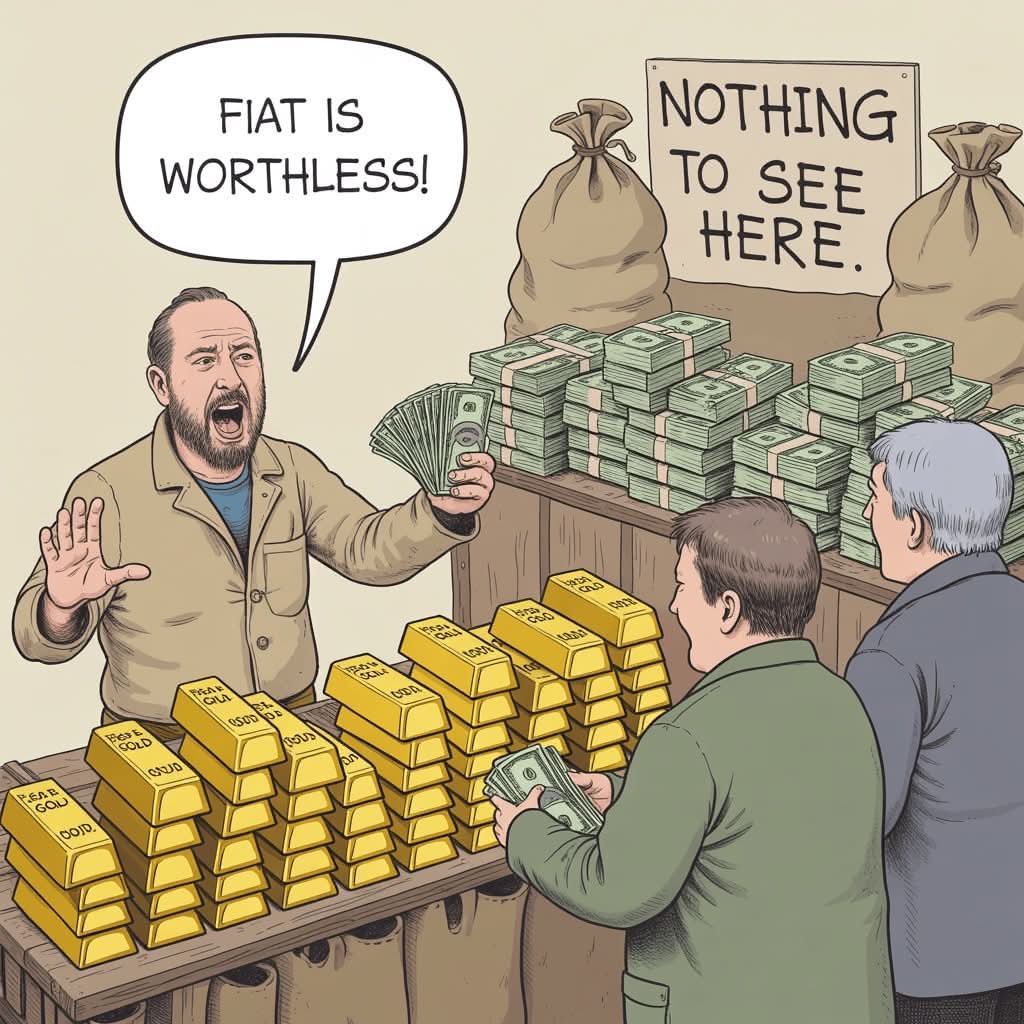
If gold were truly the superior store of value that its evangelists claim, the behaviour of gold holders would reflect that. Yet the people telling you fiat money is doomed are the same people who happily trade their “precious” metal for that supposedly doomed money. If gold were about to soar beyond imagination, they wouldn’t be trying to unload it onto strangers on the internet. They’d be hoarding it in silence.
Then there’s the fundamental issue: gold has no internal engine. It doesn’t produce anything, generate earnings, pay dividends, employ people, innovate, or compound. Its entire value depends on collective mood. And mood is one of the least reliable forces in finance. Gold doesn’t create wealth. It just sits there waiting for someone else’s fear to spike.
You also hear the same recycled lines from the gold faithful. “Central banks are buying!” Central banks also hold mountains of the same fiat currency gold bugs tell you to distrust, and they transact in that currency every day. “Gold has survived thousands of years!” So have pyramids; that doesn’t make them good investments. “Gold protects against crisis!” Sometimes it rises, sometimes it falls, and sometimes it does nothing at all. Its crisis performance has never been consistent enough to rely on.
The Hidden Cost
The real financial damage from gold isn’t the volatility. It’s the opportunity cost. Decade after decade, gold drifts sideways for long stretches while businesses in the stock market reinvest profits, innovate, expand, and grow. That difference compounds into a gulf.
This is why every long-term chart looks the same: the stock market climbs over time because businesses generate returns. Gold meanders, occasionally spiking when fear takes over, then sinking back into long stretches of stagnation. Productivity beats permanence. It always has.
And the psychological cost is just as damaging. Gold encourages a bunker mentality. Once someone commits to the gold worldview, every headline looks like the beginning of the end. That mindset sabotages long-term decision-making because it replaces rational thinking with a constant drip of paranoia.
Why We Prefer Businesses to Metal
Gold doesn’t compound. Gold-mining companies do. A gold bar will sit in a vault, inert, forever. A mining business turns gold into cashflow. It sells the metal, manages costs, expands operations, invests in equipment, and leverages rising gold prices in a way the metal itself never can.
In other words, a miner participates in the economic world. Gold avoids it. And long-term wealth belongs to the participants, not the spectators.

Why Gold Fails the Apocalypse Test
Gold bugs love to talk about “when the system collapses.” But in a real collapse, gold is one of the least useful materials you could own. You can’t eat it. You can’t heat your home with it. You can’t fix machinery with it. It can’t purify water, heal injuries, grow crops, replace fuel, or protect your family.
After a genuine collapse, people will trade in calories, tools, medicine, fuel, labour, and shelter. Gold would sit somewhere between decorative rock and deadweight. If someone offered you gold for your last loaf of bread, you’d think they’d lost their mind.
Why the Stock Market Leaves Gold Behind
Across almost every meaningful timeframe, diversified equities have outperformed gold by a wide margin. The reason is structural: the stock market is filled with businesses that expand, reinvest, grow earnings, and compound over decades. Gold relies on sentiment. The market relies on productivity. Productivity wins.
The Hint of the Fix
There is a better way to invest than following fear stories. It involves discipline, evidence, and rules that don’t change depending on the news cycle. We follow rules because rules keep emotion out of the equation. They give us a map while everyone else reacts to headlines.
If you want to invest with rules instead of folklore, join QAV Light today. Your first 30 days are free so you can check it out and see what you think.
QAV Myth Killers is a weekly column in the QAV newsletter, taking apart a piece of
investing conventional wisdom. Read the series, or
get it by email every Friday.
General advice only. Spacecraft Publishing Pty Ltd
trading as QAV is a Corporate Authorised Representative (CAR 001292718) of MF & Co.
Asset Management Pty Ltd (AFSL 520442). This is general information and does not take your
personal circumstances into account. See our
disclosure.
Leave a Reply