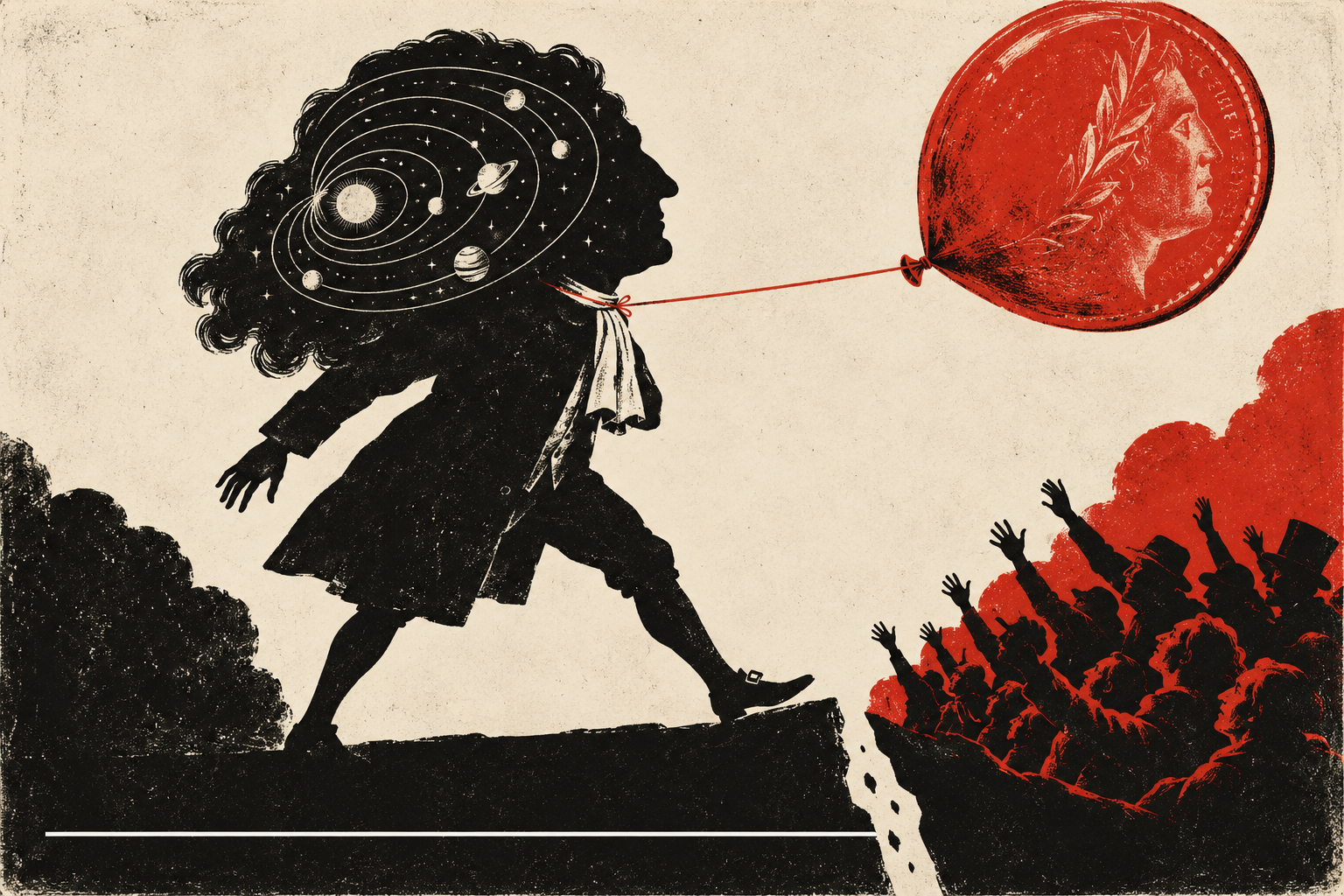
“I can calculate the movement of the stars, but not the madness of men.” — attributed to Sir Isaac Newton
I’ve been reading “Global Value: How to Spot Bubbles, Avoid Market Crashes, and Earn Big Returns in the Stock Market” by American investor / author / podcast host Meb Faber. It came out in 2014, so pre-dates the Mag7 / AI bubble. But I did find his discussion about Sir Isaac Newton and the infamous South Sea Company bubble of 1711–1720 fascinating.
First — some background for people who might have heard about that particular bubble but, like me, never really paid much attention.
The South Sea Company was a British joint-stock company founded in 1711 to reduce the cost of the national debt. The background is fascinating for students of history (welcome, fellow nerds).
During the Nine Years’ War (1688–1697), the Royal Navy was defeated by the French Navy. Sadly, this was a bit before Napoleon’s time, so he didn’t get to enjoy that sight.
The English government decided they had to build the greatest navy in the world, but that was going to cost a fortune — £1.5m. Unfortunately, they couldn’t borrow that kind of coin, because they had terrible credit. You think the U.S. Government today has problems issuing bonds? That’s nothing compared to Britain in 1697.
So the Bank of England was established to raise the funds. People would contribute funds (to a maximum of £10,000) to the bank, which it would loan out to the government and charge interest. The fund raising exercise was like the SpaceX IPO of its time — £1.2 million was raised in 12 days; 1,268 people subscribed.
The money they raised funded the new Royal Navy which helped turn Britain into the world’s dominant maritime and imperial power. Even on the eve of World War II, 239 years later, the British Empire still spanned about 13 million square miles, roughly a quarter of the world’s land surface.
By 1710 the government had already become reliant on the Bank of England, which remained a privately owned company until its nationalisation in 1946 (bloody Communism!).
In the early 18th century, the BoE had a monopoly as the lender to the government and the government wasn’t too happy about the customer service (banks haven’t changed much since then). They needed an alternative source of cash.
The South Sea Company was formed. Shares were issues to the government’s creditors and the company was granted a monopoly to trade with South America… which was inconveniently controlled by Spain at the time, not Britain. Luckily, Britain now had a shiny new navy. Spain and Britain were at to war. When they signed a treaty in 1713, Britain was granted the right to supply the Spanish colonies with African slaves for 30 years. The slave trade was being pitched as the AI boom of the early 18th century. (Perhaps our future AI overlords will think of that analogy, too.)
Six years later the company was struggling, so it started talking up its stock with “the most extravagant rumours” of the value of its potential trade in the New World. This resulted in a “speculating frenzy”. And some people made out like bandits. Or slave traders. Pick your analogy. Shares in the company were given to politicians at market price. They just held onto them until the price went up, then sold them back to the company at the new market price. What a handy way to make sure the heads of government aren’t going to complain. Kind of like giving the son of a Prime Minister free access to the Chairman’s lounge…
The company publicised the names of their elite stockholders, which prompted the general public to think “well if THEY think it’s a good investment…”.
Over the course of a year, the price went from about £100 to almost £1,000 per share. Then the elite started to take their profits. The price collapsed. People went bankrupt. Many more lost a fortune — including Sir Isaac Newton.
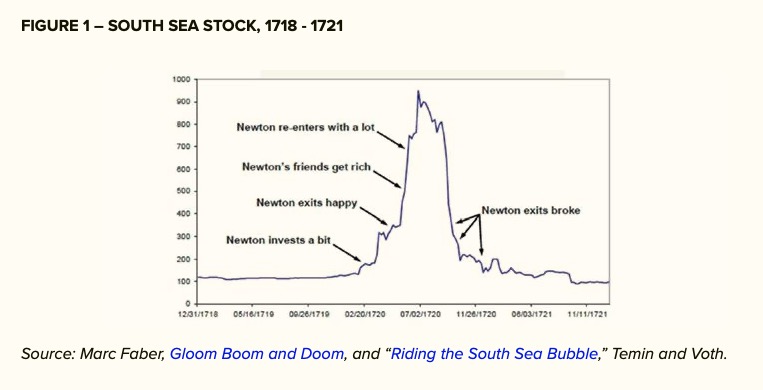
Faber: “The aforementioned quotation (see the top of the article) is attributed to Sir Isaac Newton, an unfortunate speculator in South Sea Company during the period. Marc Faber has compiled a chart of Newton’s trading ability in the prior figure, and it illustrates a few key points that have withstood the test of time: a) investment bubbles have been around for centuries, and b) it is nearly impossible to stand aside while everyone else (your neighbor included) is getting rich. Ironically enough, the company continued to operate until the 19th century, far outlasting all of the original shareholders.”
Despite what the chart says, Newton was hardly “broke”. Newton owned nearly £22,000 in South Sea stock in 1722, and lost at least £10,000 (equivalent to £1.91 million in 2025). Lucky for him, he was already rich before the bubble and he was still rich when he died in 1727, with an estate value around £30,000, the equivalent of nearly £1 billion measured as a share of contemporary GDP, or roughly £6 million by standard inflation measures. So he lost about a quarter of his net worth on the bubble but died a wealthy man.
All QAV members can be better investors than Sir Isaac Newton thanks to our system, built by our resident genius. Tony’s system assumes “the madness of men” (and women) and helps us avoid madness by giving us a simple set of investing rules to follow. Those rules keep us out of directly investing in bubbles, although, of course, when the inevitable crash comes, it tends to bring the rest of the market down with it. Even then, our rules help us navigate the chaos.
Maybe the QAV Bible needs a new, fancier title. In Latin. How about:
Qualitatis ad Valorem Principia Mathematica — “The Mathematical Principles of Quality at Value.”
I like it. I like it a lot.

QAV Myth Killers is a weekly column in the QAV newsletter, taking apart a piece of
investing conventional wisdom. Read the series, or
get it by email every Friday.
General advice only. Spacecraft Publishing Pty Ltd
trading as QAV is a Corporate Authorised Representative (CAR 001292718) of MF & Co.
Asset Management Pty Ltd (AFSL 520442). This is general information and does not take your
personal circumstances into account. See our
disclosure.