
AVERAGE DOWN ON LOSERS
There’s a piece of value-investing folklore that goes like this: if you’ve done your homework and the price drops after you buy, that’s a gift. Buy more. Lower your average cost. Double down on your conviction. The fundamentals haven’t changed.
At a certain level, sure, it makes sense.
But more often than not, we think it’s an ego trade dressed up as analysis.
Maybe if you’re Warren Buffett or Charlie Munger, and you’ve spent 500 hours reading everything there is to read about a business, its sector, and its competitors, you’ve earned that level of conviction.
But who has time for that?
The right question is never “is this cheaper than I paid?”
It’s “would I buy this today if I owned no shares?”
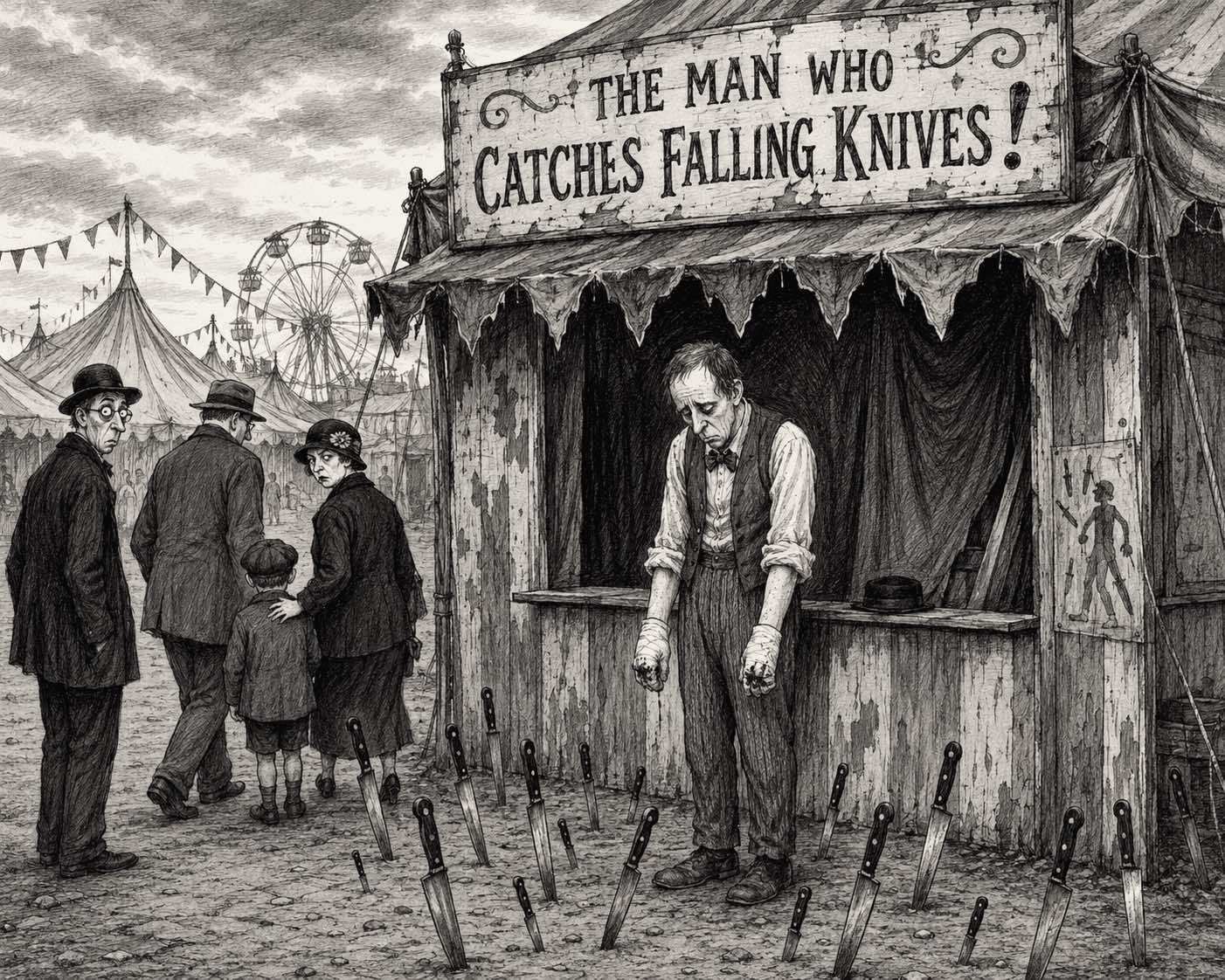
Those are very different questions. The first one is about defending a decision you already made. The second one is about whether the decision still makes sense right now.
One of the reasons we use a sentiment chart (the 3PTL) to guide our investing is that we accept we can never know everything there is to know about a company and its short-term future. We rely on historical financials. But there are people out there who know far more about the business than we ever will — analysts who cover the sector, people who work in the company, its suppliers, its competitors. They have insights we can’t possibly match.
If the market is selling a business down, maybe there’s a good reason. Maybe there isn’t. Either way, we’re not willing to bet our house on which it is.
So we err on the side of caution. Even if our fundamental analysis says the stock is undervalued, if sentiment has turned against it, we sit on our hands and wait for the trend to reverse. That’s true whether or not we already own it.
We have a few guards built into the system. The first is sentiment-based sell triggers, with a layer of “trouble at the mill” red flags on top. The second is the Josephine trigger (“not tonight, Josephine”) that stops us from buying something while we wait for the sentiment to turn around. And the third, above all, is Rule 1: a hard 20% stop. If a stock falls 20% from its peak, it’s gone. The losers don’t stay in the portfolio long enough for averaging down to even become a temptation.
Because if a share price is heading in the wrong direction, you have no idea how long it’s going to continue. Months. Years. Maybe forever.
CSL is a stock a lot of people have been groaning about over the years. It had a great run, peaked just before COVID in February 2020 at $320, and then drifted between $320 and $248 for four years. In August 2024 it began a slide that has continued to today, with the share price now south of $124.
There were plenty of people in the Australian investing media plugging the hell out of CSL for the last six years. Buy the dip. Average down. The fundamentals haven’t changed.
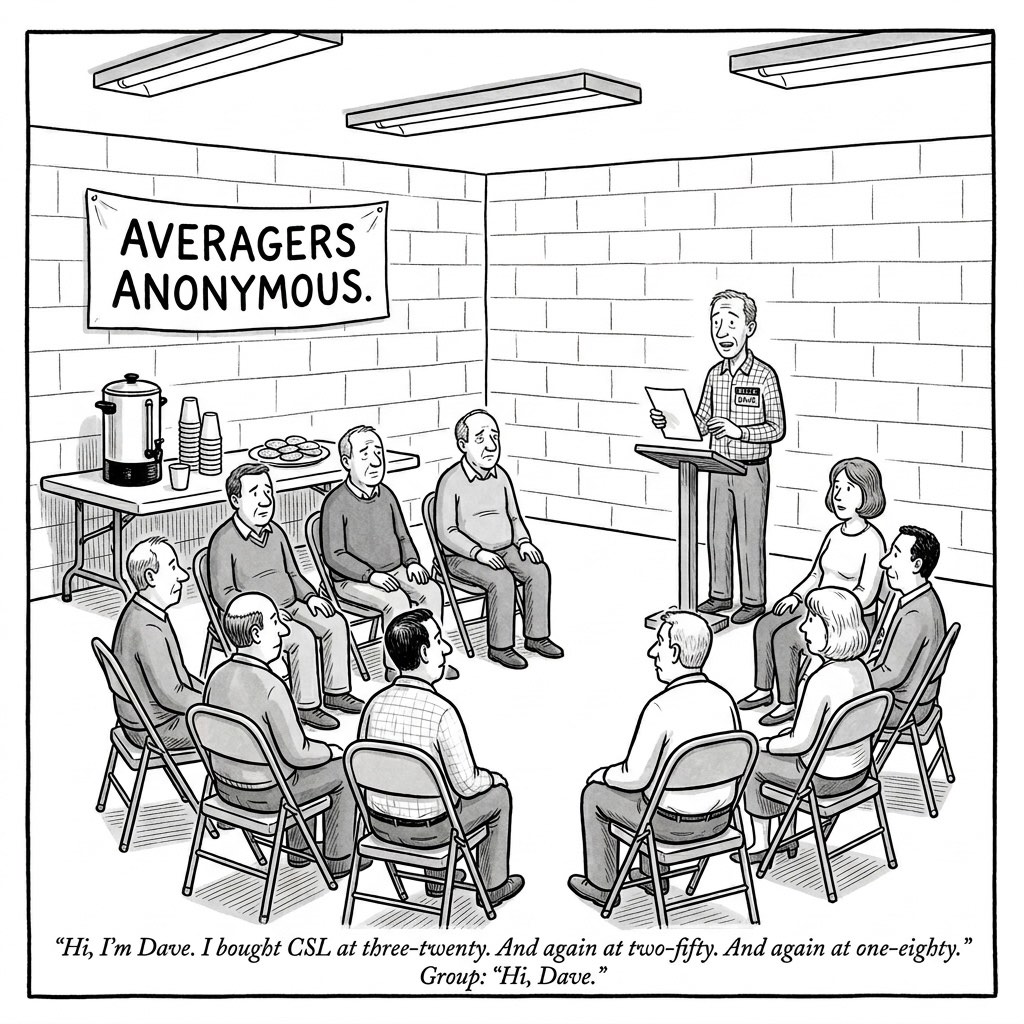
We thought it was overvalued at the time and stayed clear. We admire CSL as a business, of course. But it’s a textbook example of why you shouldn’t keep buying something regardless of valuation and regardless of sentiment.
You don’t need conviction in your picks. You need a system that doesn’t care if you have any. Put your conviction in your SYSTEM, not in your ego.
QAV Myth Killers is a weekly column in the QAV newsletter, taking apart a piece of
investing conventional wisdom. Read the series, or
get it by email every Friday.
General advice only. Spacecraft Publishing Pty Ltd
trading as QAV is a Corporate Authorised Representative (CAR 001292718) of MF & Co.
Asset Management Pty Ltd (AFSL 520442). This is general information and does not take your
personal circumstances into account. See our
disclosure.