
Hi QAVVERS,
I just finished recording a couple of episodes of my Cold War podcast (we’re talking about Castro and Cuba at the moment), had a piece of my sourdough, listening to a Glen Hansard playlist (who sadly passed away yesterday in a motorcycle accident, only seems like yesterday he was playing at Shane MacGowan’s funeral), and now I’m ready to getting into my review of the QAV week.
AUSTRALIAN MARKET UPDATE
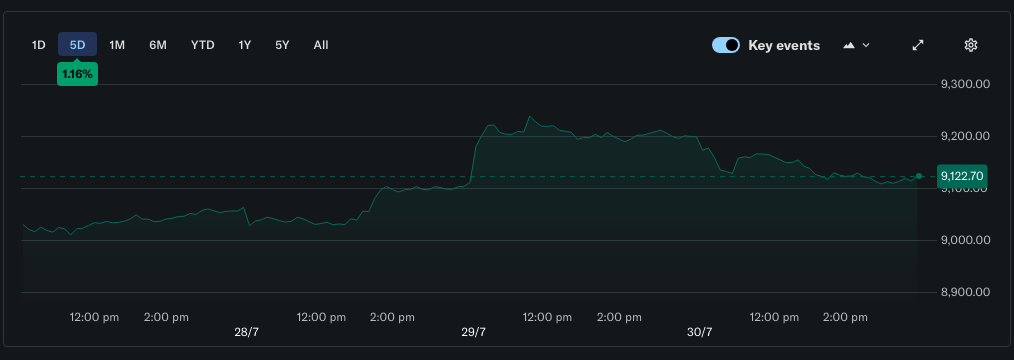
The All Ordinaries ended the last seven days up approximately 1.16%, and it’s up again this morning.
-
The ABS released June quarter CPI data showing headline inflation rose 3.8% in the 12 months to June 2026, down from 4.0% in the year to May; trimmed mean inflation, the RBA’s preferred measure, held steady at 3.6% annually.
-
RBA Governor Michele Bullock told the Anika Foundation that demand growth was moderating as expected following three cash rate increases in 2026, but housing and labour market conditions had weakened more sharply than anticipated, prompting markets to push out expectations for another rate hike from end-2026 to March 2027; consumer discretionary stocks led Monday’s gains with a 2.7% rise.
-
The ASX 200 is on track for a fourth consecutive month of gains, up 2% month-to-date, while the Nasdaq 100 is down 10.19% for July, the Nikkei has lost 12.31%, and Korea’s KOSPI has suffered a 33.86% decline over the same period.
-
Thursday’s session saw sharp sector rotation, with Materials falling 1.59%, Industrials down 0.84%, and Financials easing 0.37%, while Energy added 0.32% as renewed US military strikes on Iranian targets pushed WTI crude to US$84 per barrel and Brent to US$92.
US MARKET UPDATE
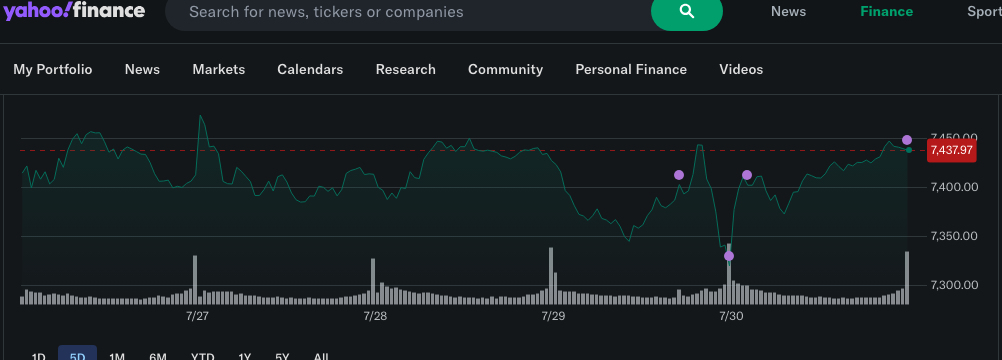
The S&P 500 ended a volatile seven days roughly flat to slightly lower, closing around 7,316 on Wednesday before rebounding toward 7,400 on Thursday, for a net weekly decline of around 0.2% from last Friday’s close of approximately 7,412:
-
The Fed held its key interest rate steady at 3.5% to 3.75% for the fifth consecutive meeting, with the FOMC voting 9 to 3 to hold, the three dissenters wanting a rate hike to combat above-target inflation.
-
The hold failed to reassure investors, with Treasury yields surging sharply, the 30-year yield climbing above 5.2%, its highest level since 2007, as markets questioned whether policymakers were moving aggressively enough to contain inflation.
-
Microsoft surged nearly 12% after posting 43% growth in cloud revenues, the most since 2022, while Meta tanked 10% after its guidance missed expectations, with markets skeptical on whether its AI spending will drive revenue.
-
On Wednesday the S&P 500 fell 1.5%, pummeled in part by a rout in chipmakers, and the Nasdaq 100 extended its slide from its record to 11%, entering a technical correction.
-
Core PCE inflation accelerated from 3.0% in December 2025 to 3.4% in May 2026, while crude oil, which peaked above $113 a barrel in April, rose back above $84 this week, complicating the Fed’s inflation outlook.
So, let’s get into my weekly updates and see where we are at.
All the Best,
Cam
QAV MYTH KILLERS
“Don’t Overthink The Form Guide”
I’ve recently been reading a fascinating book called “Psychology of Intelligence Analysis” (1999), written by Richards Heuer, who worked for the CIA for 45 years. He wrote this book initially for internal use at the CIA to provide a methodology for overcoming intelligence biases by using a framework for decision-making. Heuer came up with an analytic process known as Analysis of Competing Hypotheses (ACH) to improve the intelligence work done inside the agency. Sadly, it wasn’t enough to help them prevent the 9/11 attacks or to avoid the quagmires the U.S.A. found themselves in during the wars in Iraq and Afghanistan — but that’s beside the point.
One of the interesting points the book makes is that human minds are poorly wired to cope effectively with inherent uncertainty.
Chapter 5 really jumped out at me as having implications for investing. In that chapter, he talks about experiments done by psychologists to test whether experts provided with more information make superior decisions.
What they discovered was, once an experienced analyst has the minimum information necessary to make an informed judgment, obtaining additional information generally does not improve the accuracy of his or her
estimates. Additional information does, on the other hand, lead the analyst to become more confident in their judgment, to the point of over-confidence.
As it turns out, experienced analysts have an imperfect understanding of what information they actually use in making judgments. They are unaware of the extent to which their judgments are determined by a few dominant factors, rather than by the systematic integration of all available information. In other words, analysts actually use much less of the available information than they think they do.
In one experiment that TK will love, eight experienced horserace handicappers were shown a list of 88 variables found on a typical past-performance chart, eg the weight to be carried, the percentage of races where the horse finished first, second or third, the jockey’s record, etc. Each handicapper was asked to identify what he considered to be the five most important items of information, those that he would use to handicap a race if he were limited to only five bits of data per horse. Each was then asked to select the 10, 20 and 40 most important variables they would use. Then they were given true data that had been sterilised so the horses in actual races couldn’t be identified for 40 past races and were then asked to rank the top five horses in each race in order of expected finish. Each handicapper was given the data in increments of the 5, 10, 20 and 40 variables that they had judged to be most useful. And each one predicted each race four times, once with each of the four different levels of information. For each prediction, each handicap were assigned a value from 0 to 100% to indicate their degree of confidence in the accuracy of their prediction. When their predictions were compared with the actual outcomes of these 40 races, it turned out that the average accuracy of predictions remained the same, regardless of how much information they had available.
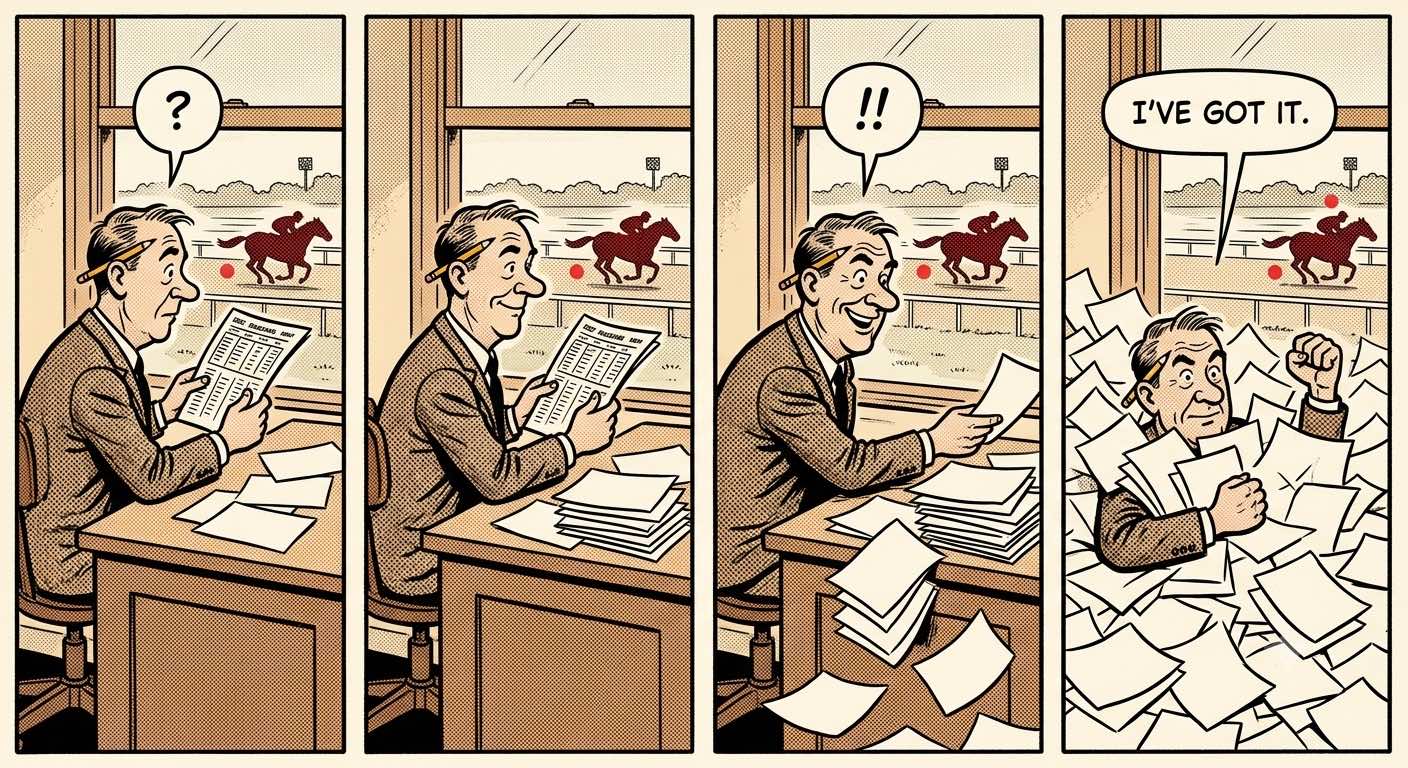
Three of the handicappers actually showed less accuracy as the amount of information increased. Two improved their accuracy and three were unchanged. What’s fascinating though is that all of them expressed increased confidence in their judgments as they were given more information to work with. When they were only working with five items of information their confidence was pretty well calibrated to their accuracy but the more information they were given the more overconfident they became.
Other experiments have shown the same relationships between the amount of information, accuracy and analyst confidence in other fields. There was one experiment with clinical psychologists where 32 psychologists with varying levels of experience were made to ask, made to make judgments about the life of a relatively normal individual. As in the handicapping experiment, the more information they had, the more confident they were about their analysis even though there was a negligible increase in accuracy. Another series of experiments worked with medical doctors diagnosing illnesses. Same results.
So what, you might be asking, does any of this have to do with QAV?
Over the years we’ve been producing the show it’s always struck me how well the model performs by using such a relatively limited set of data. We don’t spend hours, days or weeks going deep on a particular company’s financials, or management, or their sales pipeline, their R&D, or their competitive landscape, their culture or their accounting practices. Lots of fund and firms, on the other hand, employ lots of analysts who do those sorts of things. Guess what? We outperform most of them. There might be a range of reasons we are able to do that, but I suspect one of them is that Tony designed a system which looks at a limited range of data points and, from those, is able to make a pretty accurate prediction whether or not the stock will outperform the rest of the market. The system doesn’t always get it right, of course, but then we have other rules that accommodate for those scenarios.
I used to have a sticker on the water bottle I take to kung fu which said “Hold On — Let Me Overthink This”, because my Sifu was always telling me “Cameron — don’t overthink it” (you have to imagine that in a Scottish accent). Kung fu, like QAV, is built around a series of techniques which, if applied with discipline, will deliver a good result most of the time. My brain likes to go down rabbit holes — “what about if this happens” and “what if they do X instead of Y”? I’ve had to learn not to do that. I’ve had to learn to trust the system. It works. Generations of kung fu masters before me have designed a system that works — most of the time.
We are only in the second generation of QAV (if TK is the first and we are all the second), but he learned from the black belts that came before him. Sifu Buffett and Sifu Munger. They learned it from Sifu Graham.
I know, I know. More kung fu analogies. I can’t help myself.
Don’t overthink it.

STOCK ANALYSIS OF THE WEEK
I added a stock to the AU Light portfolio this week and members can read about it here.
I also added a stock to our U.S. Light portfolio this week. Members can read about it here.
BUY LIST
Each week, we produce a buy list based on our value investing system that we share with our QAV Club members. The intended primary purpose of this buy list is for club members to use as a reference for comparing their own buy list. In theory, all of our buy lists should look pretty similar each week.
AUSTRALIAN BUY LIST
QAV Value Investing Buy List (AU) 2026-07-26
U.S. BUY LIST
QAV Value Investing Buy List 2026-07-26
PORTFOLIO PERFORMANCE
We compare our performance to what we think is the most relevant benchmark (SPDR 200 in Australia, S&P500 in the USA), but if you’re new to investing, these comparisons might not mean much. Instead, you can compare our performance to the top-performing Super Funds in Australia and see why an amateur active investor (who has a system to follow) can out-perform most of the “professionals”.
We publish a fresh performance snapshot once a month. Weekly noise doesn’t tell you much in a value-investing system — what matters is the trend.
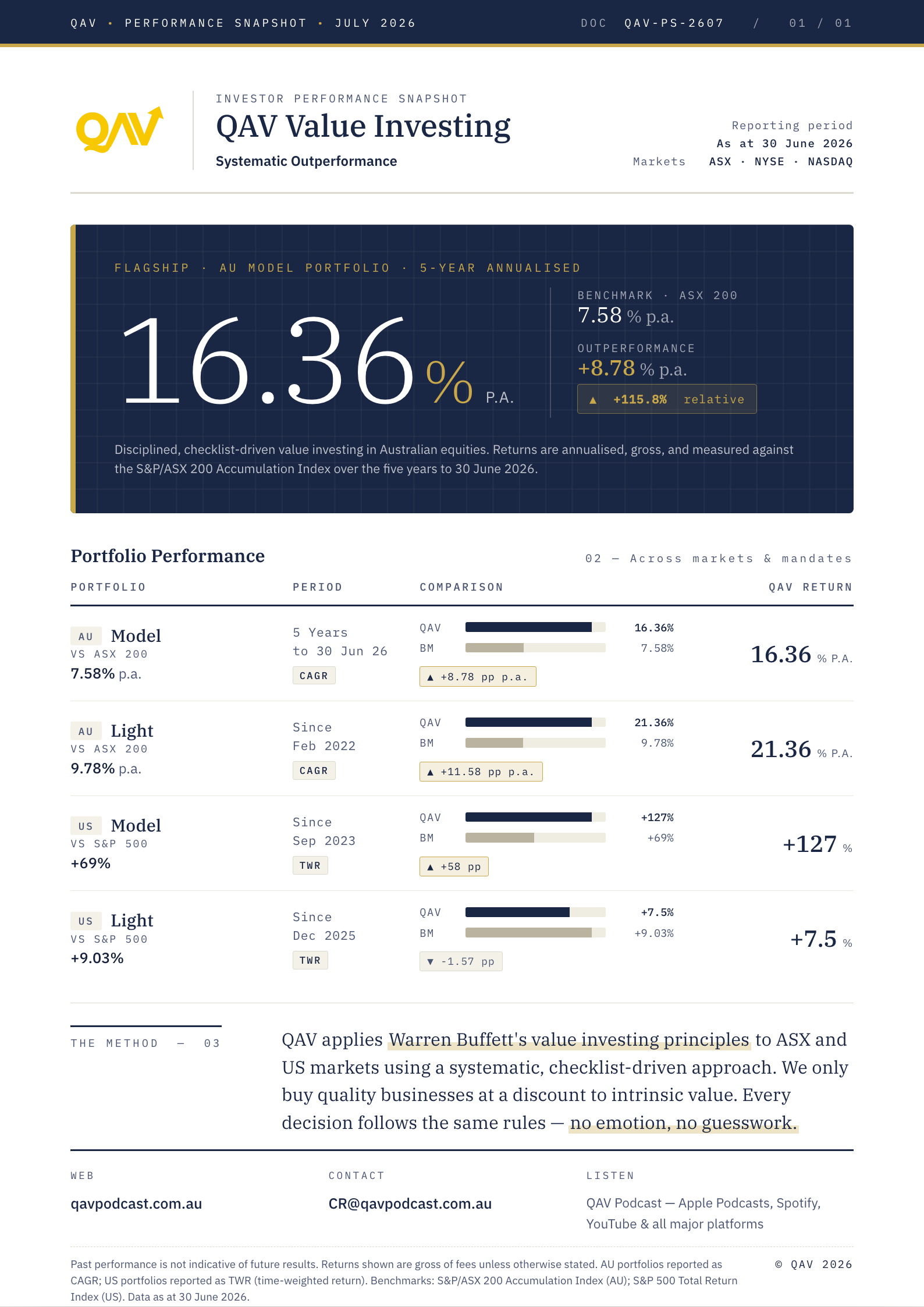
July 2026 performance snapshot.
Australian Model Portfolio: No trades this week.
American Model Portfolio: No trades this week.
Become a QAV Light Member today and start your investing on the right track
If you want to find out what we’re trading in QAV Light each week, sign up to become a member. You’ll get an email from me every Monday letting you know what we’re buying and selling in that portfolio. You can choose to copy our trades or not. It’s the easiest way to start your rules-based investing career… and you don’t even need to know the rules. I’ll follow the rules for you. It’s a good first step to eventually becoming a QAV Club member and learning how to run the system by yourself.
QAV LIGHT: Someone already cleared the way.

(Note: Americans interested in joining QAV Light or Club please go here instead.)
Add QAV America — US stocks, the same QAV method
Already a QAV member? You can add QAV America as your second membership at 50% off — US-listed stocks, the same QAV approach, billed in AUD through this site (just one payment to keep an eye on). Add QAV America →
Not a QAV member yet? Join QAV first, then you can add QAV America at the 50% member rate.
THIS WEEK’S EPISODES
With TK on vacation, we put out the same interview this week as the AU and the U.S. episode. Back to our normal schedule this coming week but we actually have a couple of new interviews coming out.

Wild Lions and Zoo Animals: The Case for Skin in the Game: QAV AU #930
Wild Lions and Zoo Animals: The Case for Skin in the Game: QAV America #63
STOCK NEWS AND UPDATES
COMMODITIES
This week the big changes to commodities were the following:
| Commodity | Status |
|---|---|
| Copper | BUY |
| Zinc | BUY |
| Magnesium | BUY |
| Steel | JOSEPHINE |
| LNG | JOSEPHINE |
DISCLOSURE
Please review our trading and disclosure policy.
SIGNING OFF
That’s it from us for this week. Tony took the scalpel to an Australian stock and I had a crack at one on the US side, so between us we covered a fair bit of ground in the pulled pork department. On the commodities front, copper, zinc, and magnesium all flipped to buy signals, which Tony will have thoughts on, and steel and LNG are sitting in Josephine territory, so we’ll watch those. Nothing dramatic, just the checklist doing its job.
SSDD!
- Cam
That’s it for the week!
QAV A GOOD SHAREMARKET!
Got a question? [email protected]