
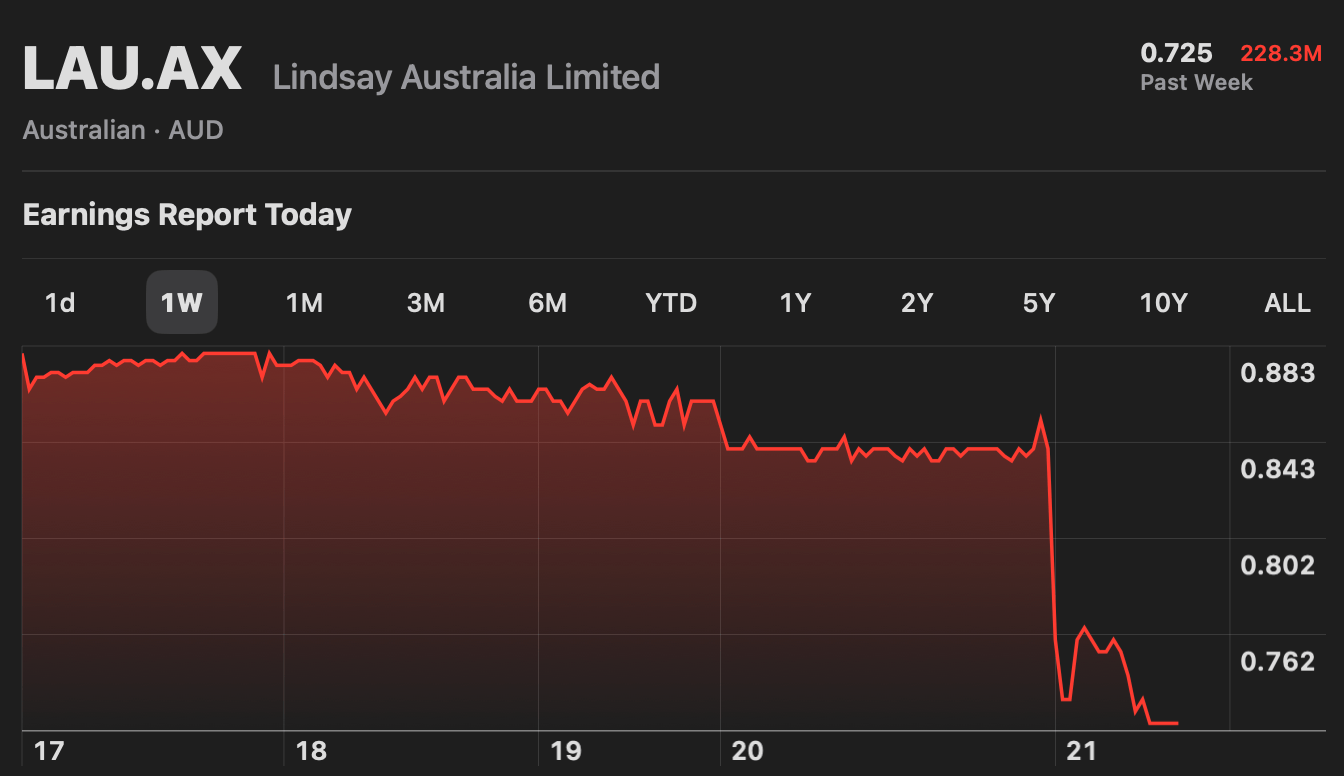
Here’s a concise summary of the half-year (1H FY2025) results and key points that might explain the sharp (14%) drop in the share price:
• Headline Numbers
• Revenue rose 3.5% to A$427.8M (from A$413.3M).
• Net Profit After Tax (NPAT) fell about 19% year-on-year, down to A$14.7M (from A$18.1M). That drop in profit, despite revenue growth, is the clearest red flag that often rattles markets.
• Earnings Per Share also slipped to 4.7 cents (from 5.8 cents).
• Profit Margin squeezed: Profit-before-tax as a percentage of revenue slid to 5.0% (from 6.35%).
• What Drove Profit Lower?
1. Subdued Volumes & Competitive Pressures: The Transport division in particular noted less horticultural freight out of certain regions (e.g. North Queensland), and more pressure on margins.
2. Higher Costs: Wage inflation and fuel costs put a squeeze on margins, coupled with “transformation” expenses (e.g. property investments, enterprise agreement updates) and M&A‑related costs.
3. Integration of WB Hunter & Acquisitions: While these help expand geographic reach and product lines, the short-term effect on costs (e.g. M&A fees, new store integration) dampened this half’s profit.
4. Weather & Market Uncertainty: Ongoing “adverse weather events” and broader consumer demand uncertainty both contributed to patchy freight volumes and rural merchandise sales.
• Dividend Bumped Up Despite Lower Profit
• The interim dividend was raised to 2.3 cents per share (vs. 2.1 cents last year), which is a modest improvement. Normally, you’d see share price relief from a dividend hike, but apparently the net profit contraction and unclear outlook overshadowed it.
• Potential Reason for the 14% Share Price Drop
Markets tend to react poorly when profits decline unexpectedly despite revenue growth—particularly if management flags challenging conditions and margin pressures going forward. Put simply, while sales went up, profitability went down nearly 19%, a mismatch that often signals structural cost issues or a tougher market environment.
• Management Commentary on Outlook
The company pointed to uncertain consumer demand, competition in refrigerated transport, and additional adverse weather after period-end. That sort of cautious guidance can also weigh heavily on a share price.
In short, the primary trigger for a sharp sell-off seems to be the significant drop in net profit and the cautious forward outlook, even though sales rose and the dividend was raised.