This week Tony’s at the Melbourne Cup, so I’m holding the fort solo with a bit of market commentary before handing over to a pre-recorded Pulled Pork. Tony does a deep dive on Tabcorp Holdings (TAB), the wagering behemoth behind the TAB platform, the MAX gaming services brand, and a pretty fascinating turnaround story under new CEO Gillon McLachlan. We cover the QAV score (spoiler: not great), the one pool strategy, the BetMakers acquisition, and whether this one’s worth a punt.
This week’s full episode is for QAV Club members only. The free episode is available below. Also check out our podcast archives link and our pages on Apple Podcasts or Spotify or watch clips on TikTok. Or visit our homepage to learn more about QAV and how it works as a value investing system that you can learn and apply to beat the market.
Transcription
QAV AU 954
Bernard: [00:00:00] welcome back to QAV Australia. This is episode 954. Recording this on Tuesday the 3rd of November 2026, which is Melbourne Cup day, and that explains why I’m here by myself today because Tony’s at the Cup. So, uh, it’s, well, kind of a solo intro, but not a solo show because we did pre-record a Pulled Pork last week.
Tony was kind enough to take some time out of his week and, uh, he will be here kind of virtually with me in a few minutes to do his Pulled Pork for the week. But it’s gonna be a short show. Um, it’s gonna be basically just the Pulled Pork this week, although I did want to provide a little bit of market commentary.
Uh, market’s having a choppy week, probably something to do with the US midterms, which happen on Tuesday in the US. Uh, that [00:01:00] should be fascinating to see how that plays out, and I guess the market’s holding its breath, particularly over there, but that affects all of us as we know. The market here has been very, very choppy over the course of the last week.
Uh, up and down like a bride’s nightie, as I like to say. But in fact, if you look back over the last 18 months, it’s just been going sideways really. Um, we’re– you know, the All Ords is running about nine thousand, a little bit less than nine thousand at the moment. If you go backwards, that’s kind of where it was in July of twenty twenty-five, and it wasn’t much below that in February of twenty twenty-five.
It was around eight seven eighty. But, uh, it’s, you know, been sort of going sideways more or less for the last, um, year and a half, maybe two years.
So if we look at the model portfolio over the last two years, it’s up about fifteen and a half [00:02:00] percent versus the STW, which is up eight point eight percent. So we’re doing roughly double market over the last two years. But if I look at the last twelve months, not doing as well. We’re basically flat, neutral over the last twelve months.
Slightly negative, zero point seven six percent per annum negative versus the STW, which is up four percent. So it hasn’t been a great year for the model portfolio. It’s just been going sideways. We– And we know that happens, right? We have years where we go up, we have years that we go sideways, and we have years that we go down, but overall, we’re more up than down.
If I look at the light group of portfolios for the last two years, they’re up twenty-one point six seven percent per annum versus nine point one six for the STW. So again, about double market, bit better than double market. But over the last one year, pretty much the same, up about four percent versus the [00:03:00] STW up four percent.
So, uh, interesting space the market has been in from a QAV perspective for the last year. If I look at the last thirty days, the light portfolio as a group is actually down seven percent versus the STW up two. And if I look at the model portfolio, we’re down five percent in the last thirty days versus the STW up about two.
So yeah, not a great climate for QAV stocks in the last year, but that’s okay. If, uh, again, like if you’re new, um, if I do the last five years for the QAV model portfolio, we’re up thirteen percent per annum versus seven point eight or eight really for the STW. So not quite double market in the last five years.
If I look at, um, all time, we’re up fourteen point five versus eight [00:04:00] point four. It’s not quite double market, but pretty close. If I look at the light group for all time, it’s up seventeen point three seven per annum versus ten for the STW. It’s a clean ten, ten point zero zero for the STW. Again, not quite double market, but pretty close.
And if I look at the last, uh, well it hasn’t been around five years, but I’ll look at the last three years, twenty-three point three percent for the light group versus fourteen point nine for the STW. Again, not quite double market, but not far off it. So really, really good years, some average years, a bad year every now and again.
That’s just the way the cycles work. What else can I tell you? Well, I did have in the news to talk about the Binance, uh, crypto hack. Six point three billion dollars, the largest heist in history. Not just the largest crypto heist, but the largest heist [00:05:00] in history they’re calling it. So there you go. That’s crypto for you.
Um, some people are suggesting it might have been North Korea. Who knows? I was gonna talk to Tony about that, but he’s not here, so I guess we’ll talk maybe about that next week if we remember. Well, that’s all from me. I don’t really have anything else to tell you. I’m going to kick into Tony’s Pulled Pork, and I’ll see you next week.
Happy hunting.
Cameron: Uh, okay. TK, uh, pre-recorded TK, TK in the past, uh, TK who’s not at the races today, who are you doing a Pulled Pork on for us today in advance?
Tony Kynaston: Well, because it’s. You’re listening to this during Cup Week, I’m assuming, I’m gonna do a Pulled Pork on Tabcorp Holdings.
Cameron: Hopefully it hasn’t blown up between the 29th of October and Cup Day.
Tony Kynaston: It did blow up many years ago because they, they got overloaded on [00:06:00] Melbourne Cup Day and had to shut down for a couple of hours, which, which hurt them.
Cameron: recall that, yeah.
Tony Kynaston: were on track when that happened. Um, yeah, hopefully it doesn’t happen. Hopefully they have a successful Melbourne Cup and there’s a bit of a share price bump afterwards, but we’ll see.
Cameron: Is this their biggest day of the year?
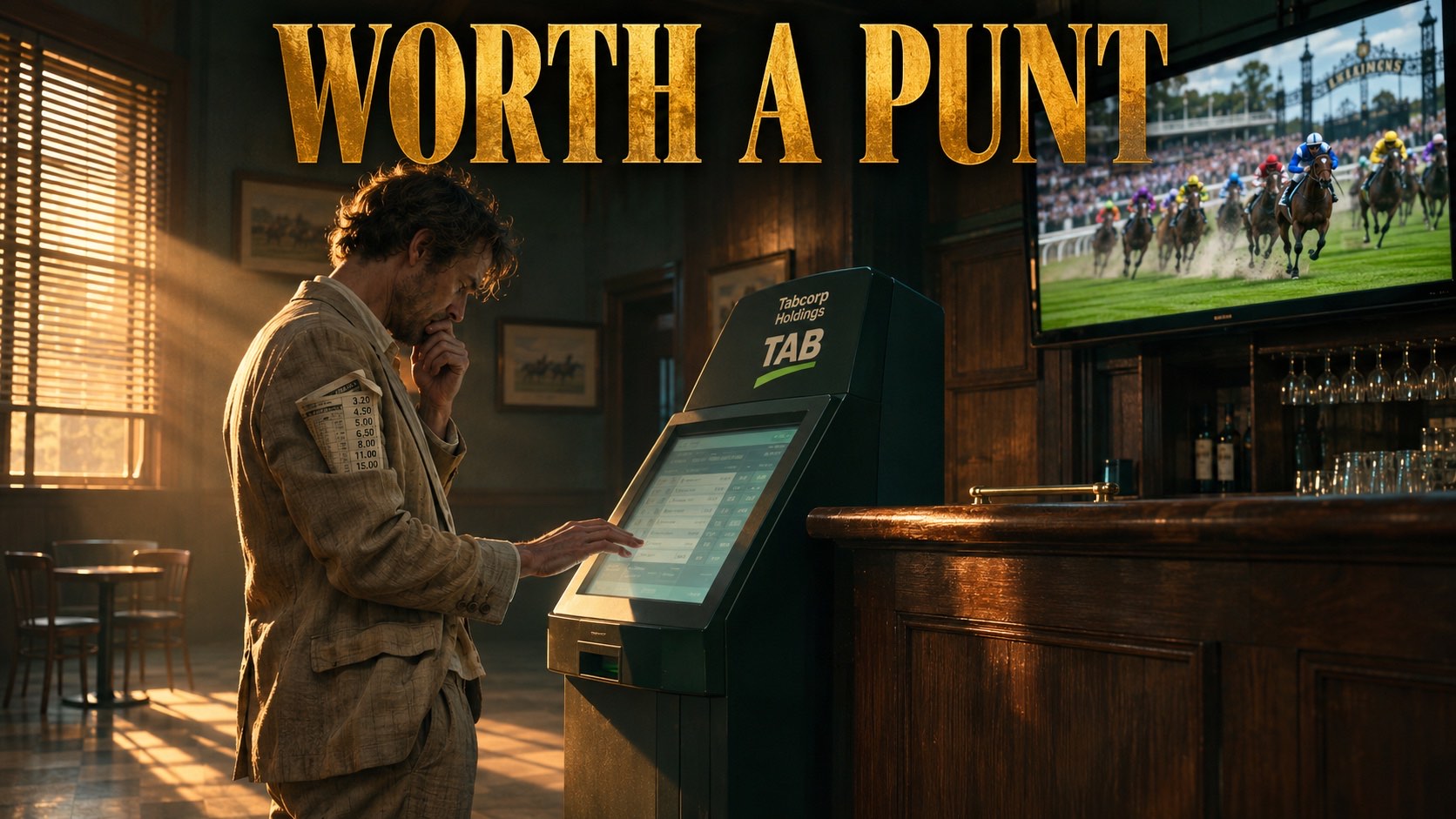
Tony Kynaston: Yeah, it would be. I’d s- I, I don’t know for sure, but I’d say so. Yeah, I’d say probably AFL Grand Final and NRL Grand Final on the sports betting side, and Cup Day on the, the wagering side. So I’ve titled this Worth a Punt. Um, it’s, it’s not a QAV stock, but it’s a special request by me, given it’s Cup Day that we’re putting this out on.
Um,
Cameron: Special request by
Tony Kynaston: yeah.
Cameron: I like it.
Tony Kynaston: Uh, so, um, yeah, I mean, there’s a few, few caveats there. We’ll get to the score in a little while. But, um, I should also highlight too, it’s not gonna be on everyone’s [00:07:00] to-do list because it’s gotta, it’s gonna have ESG concerns for some people. Um, so if you say nope to the Cup, you can pass on this pork.
Cameron: Whoa, look at
Tony Kynaston: Yeah.
Cameron: to the Cup. That’s even a better title.
Tony Kynaston: Um, yeah, because obviously some people don’t like investing in gambling stocks. Uh, and part of this business, even though most of it’s wagering, part of it is also to do with the management of poker machines as well. So some people don’t like investing in businesses that, uh, operate poker machines. But it is the, it is the wagering behemoth in Australia.
There’s, um, something like 4,000 or 5,000 staff across Australia, and obviously that fluctuates with casuals and, and race days going up and down. Uh, so it’s pretty large. Uh, most people would know that it operates the TAB horse and sports betting platforms, um, on your phone and also on retail venues. It owns and operates a media [00:08:00] business, so it broadcasts all the, uh, racing, not just horse racing, but greyhounds and international racing and, um, some sports.
Uh, and it also broadcasts it on radio as well through a few channels there. So it’s a significant player in the broadcasting world. Uh, and it also has a business called MAX, M‑A-X, and that provides services to the poker machine, uh, venues around Australia. Most of them, or a lot of them are on, um, the MAX service.
Uh, TAB provides compliance, monitoring, and also will, uh, do bulk buying procurement services, um, of poker machines for venues. So it gives them, it gives a small operator a bit of leverage. Uh, but the overall part of the business, the biggest part of the business is wagering and media, and that’s about 85% of total group revenue, with the rest coming from the gaming services MAX division.
I thought it, it’s, it’s a really interesting [00:09:00] business from the funding point of view, and it’s worthwhile drilling into that a bit, uh, to work out how horse racing and betting is funded in Australia. So the relationship between Australian racing, uh, clubs and jurisdictions and state governments and the, the wagering operators relies heavily on a number of different, um, agreements and ecosystems, I guess.
So historically, Tabcorp, as it used to be called, held a long-term joint venture. Um, all commercial agreements were state racing bodies like Racing New South Wales and Racing Victoria. Uh, in exchange for that, they got retail exclusivity, which is why you only see TAB shops and TAB venues in pubs and not Sportsbet or Ladbrokes or any of their other competitors.
Uh, so, so they had a relationship that gave them exclusivity on the retail side, and they paid fees for that, [00:10:00] and they sh- actually share the, um, a percentage of its wagering profits or revenue back to the local industry. A lot of that was used to fund prize money, um, and, and obviously, uh, racetrack maintenance and, um, breeding initiatives, et cetera.
Uh, and that, that’s evolved a bit, so I’ll, I’ll go into that in a minute. Um, but if I keep explaining what else happens, um, they also. The Tabcorp or, or Tab Holdings also pays race field fees. So this was a, a new fee income for the racing clubs and the racing states, uh, racing bodies, um, which basically said, “If you’re going to, on your app, show the details of the horses, the form guide, um, and information about the horses, you have to pay us a fee to, to reprint our race field information.”
And so that, that came in, um, partly because of a, a wrinkle in the, uh, in the [00:11:00] national legislation or which was really a collection of different state regulations, um, and was exploited when overseas companies like Sportsbet and Ladbrokes, um, Bet365 came in. They realized if they operated in the Northern Territory, they, they paid very little in taxes, and, um, that enabled them to come in and get big, uh, and have an advantage over the incumbent, Tabcorp Holdings.
Uh, and, uh, less money was going back into the racing industry for prize money and, and track maintenance, et cetera. And so the state bodies decided to start charging race field fees to make up for that, uh, lost tax. But they also, um, eventually, uh, changed laws to be able to, uh, levy what’s called the point of consumption tax or the POCT.
So it doesn’t matter where the bookmaker is resident, it’s where the punter places the bet [00:12:00] that, um, now is charged or taxed, um, when the bets are made. Or in fact, I think it’s a monthly tally, uh, that gets reported and taxed back to the, the state government. So, so fairly, um, reasonably complicated taxation system for this operator.
Uh, the other dimension to it is that there’s two types of wagering in Australia. Um, one is the, what’s typically called fixed odds, which is how a bookie operates, where they, you know, you walk up and you know what you’re going to get, um, as the return for your bet when you place the bet. So if the favorite’s $4, you get four times your money, um, back if you, if it wins.
Um, there’s that or there’s what– there’s also what’s called the tote, um, which has been the probably more traditional way of placing at least, uh, horse racing bets. And tote betting is a pool. It’s often called. It’s actually called a parimutuel pool, and that means that, um, all the [00:13:00] money that’s, uh, staked gets put into a pool, and then the dividends are divided among the winners.
And so the odds can fluctuate, um, oftentimes quite dramatically from when you place your bet to when the payouts are calculated at the end, and they can still be accepting bets right up till start time. So the, the odds can even change after the, the horse has jumped. So, um, that’s traditionally how Tabcorp operated, uh, and they had a monopoly on that, and there’s pros and cons for that.
Um, the monopoly situation, I guess, gave size to the pool, which was, uh, important, um, to attract people to bet with it. Um, and the take on the pool was, uh, reasonably high. So as Tabcorp paid out people, it deducted a tax back to the, the racing body, so that was how prize money was often funded in the past.
Um, there, there have obviously been [00:14:00] arguments against it, um, that oftentimes the, the fixed odds or bookies would have better odds than the, the tote when, when the tote actually finally tallied up all the bets. Um, uh, often to do with the margins and the, and the takeouts from the pools that, that were levied.
But also some people would say there’s only one pool operator, so there’s no competition. And I guess the last criticism, which has often been levied at the, the tote pool, is that, um, there’s been very little product innovation over the years. So if you look around the world, there are some places like Hong Kong that operate very big parimutuel pools, and they have developed, uh, kind of more like, um, TattsLotto-type products.
So they have things like a, a triple trio. So you don’t– You’re not just picking. If you can pick the first three winners in three races that they nominate, there can be million-dollar prize, um, payouts for people who get that right, because the odds are so, [00:15:00] um, combinatorially difficult to get and, um, the, the pool is so large.
So, uh, but those kinds of things haven’t really come to Australia, and one of the reasons for that is the tech stack for, for the TAB hasn’t changed much over the years. And in fact, one of the problems, which is sometimes identified at the Melbourne Cup, in the actual cup itself, is that there’s only ever 24 horses allowed to run in the race.
And that means if there’s a, a scratching, for example, on race day, there’s no emergency to step in. Um, and the reason for that is there’s the– only 24 lines on the screen that, that TAB hard-coded many years ago and, um, haven’t been able to change or update or get around. So there are some limitations with the current tech stack, and I’ll, and I’ll, I’ll just talk on that a bit in, in a moment as well.
Um, the other thing to note about the tote pool, the parimutuel pool, is there are different takeout rates [00:16:00] depending on the type of product. So, um, and these are, again, contractually mandated, um, by state, uh, or racing body in the state. So, for example, uh, for, for your, you know, basic win bet, uh, the takeout rate is 14.5%.
Um, same for a place bet. A quinella, it rises to 17.5. For a bet called an exacta, which is getting the first two horses in order right, you get, uh, 20% taken out. A quaddie, 20.5. A trifecta, 21.5. A first four, 23%. And what’s called a big six, which is picking the winner of six races in a row, 25%. So basically, uh, as the bet gets harder to win, the, uh, Tabcorp, um, well, Tab Holdings take out more and more of that pool.
So if you’re a gambler, it’s actually worse to play the exotics even though, um, they get the headlines because the [00:17:00] payouts are, are often, are often huge. So, um, there’s a lot of complications in what gets taken out of those takeouts I just mentioned. Some of that is margin for Tab, but a lot of it is also going back to, uh, the, the racing bodies either via POCT taxes or race field taxes or whatever.
Um, it’s, it’s actually pretty complex trying to work out what Tabcorp pays to various, um, state bodies, and up until recently they’ve been different across Australia. But, um, you could, you could basically say they were giving, say between 2 and 3% of turnover, um, in, in, uh, returns back to the, the racing bodies and then keeping the rest as a, a margin themselves.
That’s a kind of rough rule of thumb. Um, that was before POCT [00:18:00] came in. The point of consumption tax is a bit higher. It’s a lot higher actually. Um, but again, it’s, it’s taken out a bit differently as well. It’s taken out of net wagering revenue. So what I was talking about before of 2 to 3% was taken out of gross turnover.
The POC taxes, um, vary between 15 and 20% depending on the state, but that’s net wagering revenue. So if you looked at, say, the win bet I spoke about before, where Tabcorp takes out 12, uh, 14.5%, um, that’s the net that they’re then paying 20% of to the Queensland Racing, um, state body if it, if the bet was placed in Queensland.
Uh, so if, if you kind of unpick it, if I look at, um, an example. So if there’s a punter sitting in Sydney, they put on a $100 trifecta bet on the premier race day at Randwick and, and the. Again, the contracts with the state racing [00:19:00] bodies can vary depending on whether it’s a, um, a midweek race or a premier race day.
Um, but if we’re looking at a, this example, we’re saying it’s a Sydney meeting, um, $100 trifecta bet placed in Sydney. Uh, $21.50, uh, goes straight off the top. That goes to Tabcorp. That’s the, the tote takeout margin, so that leaves $78.50 in the pool. Uh, Tabcorp pays roughly $3, um, for the race field fee, and then whatever the final gross profit Tab retains from New South Wales customer accounts activity over the month, they pay another 15% of.
So yeah, the, it’s $100 might go in, but you know, it’s, it’s getting down to sort of, um, $70 being left after all the fees are taken out. Um, I spoke, spoke about the, the NT bookmakers. That was a real, uh, wake-up call for the racing industry and [00:20:00] significantly undermined the Tab’s business models over the years and They, first of all, did a couple of things, um, and I’ll.
I might just leave that until we get to the history section. But they branched out into casinos and, uh, lotto-type businesses to try and, um, make up for their lost revenue. I think, uh, both of those two businesses have now since been divested. But what they’ve done now since, um, under new management, and I guess it was started under, uh, old management, um, but finished now, is they now have what’s called the One Pool.
Um, so instead of having all these different state-based, um, contracts and state-based regulations, they now have one tote pool across most of Australia. I think, I think most states are in now. Um, New South Wales is in, uh, Victoria is in, South Australia is in, uh, Queensland’s in. [00:21:00] I think, I’m not sure about WA, but anyway, most of Australia’s in.
Um, the benefits of that are that with a bigger pool, you can start to offer big jackpot-style, uh, payouts on, on, on accumulator bets, so, uh, quaddies or big sixes or whatever, uh, first fours, et cetera. You’re picking the first four horses in a race. And so the strategy is, if you can leverage up how much people are winning by picking the last four winners on a big race day, and it, it gets into the millions of dollars, that will attract people back to the tote for, um, for business.
Um, the other thing that they’re, they’ve been able to do is negotiate with the state bodies to have a variable takeout rate. So, um, I guess in broad terms, they still will pay the same amount, but they, they have some flexibility [00:22:00] now to, uh, say in the Melbourne Cup, um, to, to take out, uh, less from the pools in the Melbourne Cup and therefore offer bigger prize payouts to punters to attract business.
And that variability across the race card and across the race days, um, will work for them as well, I think. Uh, and they also, uh, in, in putting together this one pool, it. they’re able to enhance their sports betting, um, side of things. So they’re not just, uh, looking at horse racing, but there’s also, of course, a lot of, um, business done on, um, cricket matches and tennis matches and a lot on football matches.
Um, and lastly. Or a couple of other things, I guess, that will benefit from what they’ve done is, uh, they’re, they’re branching off into a wholesale-type service now. So, um, as I said before, the international competitors came into the Northern Territory, [00:23:00] um, and with the changes to levying a race field fee and the point of consumption tax, their margins have also gone down because they’re now paying more tax than they were when they first came in.
Um, so they’re trying to limit their costs, and by having this one pool, uh, and a more flexible tech stack, Tab is, is going to start selling, um, wholesale B2B services to the other corporate bookmakers. So that’s another revenue stream for them which will open up. And lastly, uh, with the big pool, they’re also starting to forge alliances with other big pools around the world to allow people in Hong Kong, for example, to bet in the local Hong Kong pool but have it co-mingled with the Australian pools.
And so the pools get even bigger, um, which I said before is an attraction because, um, if you have a, uh, if you’re the winning holder of a, you know, a, a, a difficult, [00:24:00] um, bet to get like, uh, you know, picking the first four winners in the Melbourne Cup, you’ll probably get a bigger payout, so it becomes more attractive.
Um, to, to do all this, so that’s the strategy. Not only did, um, management at, at, at this company have to negotiate with all the racing bodies and the state regulators, um, which they did, but they also had to, uh, upgrade its, its tech stack. And the, rather than sort of spend hundreds of millions of dollars, uh, doing it themselves, they went out and bought a company called BetMakers Technology Group for about $260 million in, uh, well, just recently actually, in August of this year.
And that provides them with a, a much better tech stack than what they have now and a much more flexible offering. And the idea is that it won’t just be that they can do these variable [00:25:00] takeout, uh, races. They’ll be able to promote, you know, happy hours, um, in the venues where you can come in and get a better deal than normal.
Um, but also too the, the venues will look differently because instead of having the old teletext type television screen display, the displays will, uh, have a, an upgraded GUI interface, so they’ll look more like the betting app does on your phone. So that’s happening. Um, BetMakers also allows them to provide these better services to the corporate bookmakers and open up that as a revenue stream.
So there’s been a fair, a fair bit done in the last couple of years, and that’s. A lot of that’s down to a new CEO called Gillon McLachlan, who used to be the CEO of the AFL in Victoria for a, for a long time. Had a lot of experience there with managing stakeholders, with doing big, uh, media rights deals.
Um, and there are some people who are, who are contemplating that there might be a [00:26:00] media deal coming with the broadcast side of, uh, TAB in the future. So I guess watch that space. But he seems to have done a pretty good job. Um, since taking over, he did the classic new CEO, uh, clean out of costs and, and wrote down assets.
But he’s also, uh, done the one pool negotiation, or completed the one pool negotiation. I think it had started under previous management. But he made the BetMakers acquisition, which has given them the tech stack to be able to leverage the one pool. But he’s also done something else which I think is interesting.
Um, he’s changed the model with the retail outlets. So TAB historically has had that, um, market to themselves, and they’ve, they have something like three thousand seven hundred, uh, retail venues, either in licensed venues like in pubs or in standalone outlets in, in shop fronts that they own and operate.
What Gillon McLachlan has done is to change the financial model for those. So in the [00:27:00] past, um, the venues used to, uh, uh, pay a commission or get a commission percentage for whatever turnover they had taken in the, in the pub. That’s now changing and, uh, they, they get a, uh, model, well, there is now a model where the pubs and clubs are charged directly, um, for terminals and for broadcasting the Sky Racing Channel.
Uh, and then they, uh, they also, as part of the deal, are paying less, um, as a commission return. So it’s, it’s reset the position, um, more in favor of the TAB. What do the pubs get out of this and the venue operators get out of it is the, the tech upgrade and the product improvements to, um, to drive people back into the locations.
So I guess he’s, he’s, uh, taken some, some of the revenue that was going to those pub venues and put it into tech to be able to, [00:28:00] uh, have a better service, uh, for customers to drive them back into the venues. That’s, um. There was a, a lot of hiccups during that negotiation, obviously. You know, pubs are gonna not wanna pay more, but I think most of them have now signed up.
So there is a, um, again, a watch this space on are there new products that come down the line from the, uh, acquisition of BetMakers and the OnePool negotiations. Are they gonna drive people back into venues to, uh, take advantage of those offerings, offerings? So it was called the renovation rescue, um, of technology for the pubs.
So there’ll be changes there as well. I– And I think, um, my notes are saying that over 95% of the retail network have, um, have signed up. Uh, I think there’s still a couple of large groups, um, that might be holding out. Uh, I know some of them initially did, but I think most of those have now signed over as well, like an Endeavour group, for example.
So that’s the, the wagering side of things. Um, major [00:29:00] reset this year, and it’s probably a good time to go back and look at the business because of that, and, uh, a fairly complicated revenue side of, uh, uh, the, uh, revenue side of the business, but also the taxation side of the business. And, and some of that’s been cleaned up, um, with the latest, uh, round of restructuring.
The other business that, uh, Tab operates is the Max Brand. Um, it’s the, the largest gaming services provider in Australia. It’s largely a B2B operation. And, um, for anyone who has gone into a, a pokie venue, you, you’ll often see, um, that it’s all. You’ll see, uh, linked machines. So there’s often, uh, jackpots which are paid across a number of machines at a venue, but also across a number of venues.
Um, and all of that has to be monitored, uh, for compliance, for tax collection, for data integrity, make sure the payouts are at the right ratios. Um, and also now increasingly to, um, [00:30:00] monitor for anti-money, uh, laundering legislation. So, um, all of that is, is done by this Max Brand. They handle all that. They also, as I said before, will handle, um, services for the venue operators to, um, to get data on their business and to be able to enter into, um, procurement pools, to be able to buy new machines, um, to run loyalty systems and cashless gaming options.
And that’s, uh, and player tracking, and some of that is also being tested and trialed in different jurisdictions in different states to, um, limit gambling. So, um, there are some trials going on to, uh, use, um, uh, face recognition, um, on the poker machines to limit people, um, staying on them for too long. So all this is being operated via the Max Brand, and, and that’s the responsible gaming tech, um, is doing that.
Um, interesting history. So as I said [00:31:00] before, uh, a lot of, a lot of changes to tax, a lot of changes to competition. Originally, I guess if I go back as far as the start of the TAB era as a company, it privatized in 1961, uh, as the Totalisator Agency Board. So those tote pools are officially, um, totalisator pools, tote for short.
So the TAB stands for Totalisator Agency Board. They were, um, set up to, uh, you know, uh, as, as the, the pools were getting big and needed, um, proper corporatisation, taxation and regulation. Um, and also, uh, to, uh, I guess facilitate and regulate off-course betting. So, you know, prior to the ’60s and I guess during the ’60s, there was a lot of what was called SP betting, where someone in the pub would have a telephone and, and you could ring up and take a bet, um, with them, and it was all unlicensed and untaxed.
So the TAB, um, eventually was [00:32:00] able to, uh, overtake that business, that, uh, black market in betting. Um, in 1994, they listed. Uh, uh, first of all, in Victoria, uh, and, um, Tabcorp Holdings, um, was the first one to list, uh, on the ASX, and then, uh, New South Wales followed, uh, suit a little bit after that as well, um, with the TAB it was called up there.
Um, once they listed, Tabcorp in particular started an aggressive cross-state expansion campaign. So there was always this view, I think in the racing industry in particular, that, um, a, a federation of state-based bodies and companies and legislation was never gonna be able to scale enough to, to make a real go of, of the industry.
And so one of the things, one of the benefits of listing was they could then go and, and, um, acquire other businesses in other [00:33:00] states and expand that way. Uh, but one of the, the things that they did first of all was that they acquired the Star Casino in 1999, uh, which was the, the Sydney Casino, and then they merged it with Jupiters, which was the Queensland-based casinos in 2003.
And then, uh, that, uh, made the Victorian TAB big enough to take over the New South Wales TAB, which listed in 2004. And then, um, everything was, uh, was put together into the, the one company. Uh, and certainly synergies and, and scale was obtained through that. But then, um, in 2011, Tabcorp decided that the casinos were too capital intensive, um, being large hotels and being large, um, food venues and, and, uh, staff, um, heavy businesses and compliance heavy businesses.
And they thought that, uh, the casinos were dragging [00:34:00] down the performance of the core wagering and, and, uh, other businesses, so they decided to divest, um, the casinos. They went out into a separate ASX company called Echo Entertainment Group, and that was later rebranded as Star Entertainment Group. And people might be familiar with the travails of Star if they read the papers, um, that, uh, you know, they’re, they’re kind of fighting for their life, I guess.
Um, there’s been some, um, anti-money laundering, uh, issues. There’s been some, uh, issues with the way high rollers, which are often big funders of the revenue at casinos, the way they were treated and accounted for. But anyway, I won’t go into that. Um, Star Entertainment Group has, has had a rocky, uh, ride after, um, Tabcorp got rid of them or demerged them in 2011.
Um, a few years later, they decided that they would take over the Tatts Group and start, uh, getting into the lotto [00:35:00] business, and, uh, that, that was an $11 billion merger with the Tatts Group in 2017. And, uh, they decided that they didn’t want to, um, operate a, a, a Tatts business. Um, I guess that, um, for the reverse reasons of the Star, the merger of the casinos, analysts after a few years of operating the combined business said, “Hey, the lotto business is much better than the wagering business.
It should be spun off.” So in 2022, Tabcorp split again, and Lotteries and Keno went into a business called The Lottery Corporation, which was separately listed. And so now, um, Tabcorp is a, a pure play business, um, as I said before, 85% wagering and some gaming, uh, services as well. Um, that’s the potted history of Tabcorp.
That’s what it’s been doing in the last sort of s- 12 months to try and [00:36:00] restructure racing. Uh, a lot of that was in, um, because of the competition that came in from overseas bookies and the way they had a tax advantage by operating in the Northern Territory, which actually kept at a fairly low rate the amount of tax they paid in the year.
Um, so all of that work has actually produced some, uh, reasonable results this year. So if I go through the FY26 financial results and compare them to the prior year, revenue was pretty flat, so 2.6 billion this year, 2.6 billion last year. It was u- up by less than 1%. Um, however, margin improved, um, from 15% to 16.4%, and, uh, net profit after tax improved from 50 million to 71 million, so that’s about a 43% improvement.
Some of that, um, had, uh, you know, uh, write-downs and write-backs, et cetera, in it. So [00:37:00] underlying statutory NPAT was up 26.5%. They increased their dividend by a third from 2.25 cents to 3 cents, and they actually paid off a lot of debt, so the gearing reduced from 1.8 times down to 1.2 times. So they’ve been able to, um, restructure the balance sheet as well.
And that also meant that, um, the, uh, ROI went up from 10% to 12%. So, um, not, not a big change on the revenue side of things yet, but certainly a, a big change on the margin side of the business, um, driven by cost reductions and, uh, all of these renegotiations, both with the regulators and with the venue operators.
Um, there was a Uh, what can I say? No, that’s, that’s probably a good summary of where it was. If I look at the QAV numbers, uh, it’s a high ADT stock, so roughly $4 million is traded per day on average. Um, I’m– did the analysis at [00:38:00] 85.2 cents, and that’s the Thursday before cup day, so may go up and down next week.
That, uh, 85 cents is 84% of the consensus target, but it’s above our IV1 and IV2, 17 cents and 38 cents respectively. The yield’s 3.5% for the dividend, so we can’t score it for that. Stock Doctor gives it a financial health of strong and a trend of steady. The Stockopedia quality rank is only 70, which is down a bit.
Overall, it’s o‑only 81, so again, you know, wouldn’t score it for that if, if we were using Stockopedia. But the F score is seven out of nine, which is good. Um, PE ratio is high, 25.3 times, but it’s always had a reasonably high PE ratio, so it’s not the highest or the lowest. And PROPCAF is 6.3 times, so just below our seven times cutoff.
Uh, and, um, it’s, it’s worthy of consideration, but it’s not gonna reach our [00:39:00] threshold score. There’s no consistently increasing equity. Can’t buy it for book plus 30, uh, which is 72 cents. Forecast earnings per share growth is, is reasonable. It’s, um, just under 20%, but if you put it over the high PE, we’re scoring, um,.75, so it’s not enough for us to, to score that.
Doesn’t have an owner founder because it’s been around for a long time. Uh, so excuse me. Overall, the Q score is four out of 15 and the QAV score is only.04. Um, and if you look at the breadline, the sentiment is a hold and it’s, um, it’s now tracking back towards its sell price. It’s only two cents above its sell price.
So, um, why am I doing a Pulled Pork on this? Well, it’s cup week and, but also too, I think there’s a fair amount of interest in the business community around the McLoughlin turnaround story and it’s kind of a watch this space to see how that plays out and whether they do achieve bigger pools, bigger payouts, attract people back into venues, um, and all the [00:40:00] benefits they get from their renegotiations and, um, and the tech changes.
Uh, what are the positives for the stock? Well, um, 19% earnings per share growth forecast is good. Um, if they do get the tech changes right and they do get the new product offerings right, then, uh, it should drive more in, in venue. It should, um. Well, sorry, one of the things I should have said about the in venue is that there is a prohibition at the moment for sports betting where you can’t bet on a live event.
So once it starts, uh, you can’t place a bet, um, unless you actually ring up a telephone operator and, uh, that’s meant to limit, um, betting on events because there has been cases of corruption in the past where a cricketer would be paid by a, um, a corrupt, uh, organization to bowl a wide for a, at a certain ball in the over and then the that organization will place a bet that the wide would be bowled at certain ball in the over.
So I guess the betting companies have got better about not offering those kinds of, um, [00:41:00] those kinds of propositions, but, um, the legislation’s also cracked down. But what’s proposed is that with the tech changes, there’ll be, uh, machines in the venues which will allow you to bet, um, in play, which will be a, um, an enhancement to, to revenue, I would think.
Uh, expanding into B2B services to the other betting companies, uh, will have some benefits and international tie-ups will. On the negative side of things, um, none of this makes the ESG critics, uh, happy, especially if, um, betting revenue goes up. So there’s always gonna be restrictions on the ability of this company to raise debt from banks.
Um, there’ll always be some protests around what it does. I think probably the, the biggest impact at the moment is the government, uh, I think it’s now brought in legislation restricting gambling ads on TV in the evenings and around sporting events. Um, or it might, it might still be considering it, but it’s certainly been a hot topic and is [00:42:00] likely to continue.
Um, and obviously if, uh, the business can’t advertise as much, that might hurt revenue. Another risk that, um, has popped up recently is, uh, the increasing anti-money laundering scrutiny that the, um, the regulators are, are, are, are shining a light on in these kinds of businesses. And, um, you only have to go into a pub and peek into where the poker machines are to see that the same people are sitting there putting money through the machines, and you’ve got to wonder where that’s coming from.
So AML scrutiny is an issue for them going, going p- uh, forward. And the last thing you– I could say is that the stock price did go for a run-up after the change of CEOs and, and Gil McLaughlin’s appointment, and after the early wins that he was able to achieve. And it has been trending down again now, um, I guess while the, the, uh, analysts and the investors wait to see the actual execution of what the, the promise is for this company.
So, um, i- [00:43:00] is it worth a bet? At the moment, no. It’s a bit of a roughy, but, um, interesting to, to do it on cup day, and it might come onto our, our radar if, uh, some of these, um, enhancements come off.
Cameron: I thought you were gonna get into the whole Polymarket of space.
Tony Kynaston: It didn’t c- didn’t come up in the analysis, but you do wonder whether. I mean, um, it’s– Betfair has operated a number of those kinds of Polymarket bets on, particularly on political elections, um, but not as widely as Polymarket. So, um, it’s, it’s possible that Tabcorp could get into that space as well, but, uh, they haven’t announced any plans yet.
Cameron: Well, I asked GPT about it, and it was saying that there’s limitations in Australia about prediction markets and all that kind of stuff, so.
Tony Kynaston: Yeah.
Cameron: that Betfair had done a couple of those things. But you just have to wonder, I mean, the way these things happen, if [00:44:00] it’s huge in the US it’ll– somebody’ll be putting pressure on them to do something here.
And I wonder if that is competition to the TABs of the world. I mean, it’s not directly competing with horse racing or greyhound.
Tony Kynaston: Mm-hmm.
Cameron: gambling’s gambling, right?
Tony Kynaston: Yeah. And, and look, it certainly is a, would be a threat if it came in and not operated by Tabcorp, and they, they’d probably have to do their own version of it. But also, you gotta understand that the sports betting in the US has had a different history. So, um, historically, you were only ever able to gamble on sports, uh, at, in Las Vegas, and you had to be there to place the bet.
Um, and there, there were some tech advances on that, doing it over phones and things. But the, the SP operation in, in the US, the illegal black market operation was still going until recently. So the sort of prediction market has grown up out of that unregulated space. And what’s happened [00:45:00] in the US recently, which some Australian companies have tried to get in on, was when.
I, I, I suppose I can draw a line between marijuana decriminalization. A lot of states said, “Hey, we should be legalizing this and taxing it,” and, you know, driving the underground, um, providers either to legitimate business people or out of the market. They then said, “Well, hang on. Why aren’t we doing this to the SP bookies?”
So they’re also, you know, operating without paying taxes and regulation. And so state by state, they started to compete against Nevada to, um, allow local venues and local operators to run wagering and sports betting operations. Um, and it was kind of on the back of that legislation, I think, that the prediction markets were able to open in the US.
Cameron: I just had to look up SP again. Starting price.
Tony Kynaston: Yeah. It’s u- usually. I mean, SP [00:46:00] doesn’t sound, um, in and of itself illegal, but it usually denotes illegal bet taking. Mm.
Cameron: And what are your, uh, Melbourne Cup tips,
Tony Kynaston: I had a look yesterday to try and come up with some, but I’ll have to text them to you on Monday or Tuesday because the
Cameron: ’cause
Tony Kynaston: hasn’t finalized yet.
Cameron: oh, no, because Gemini deleted all of your, uh, betting stuff.
Tony Kynaston: Gemini’s been paying– been– I don’t know if they’ve– I’ve exceeded my token use or something, but now, like, when I use Gemini, um, after like five minutes of work, it doesn’t even keep up with my typing anymore. It’s like it just chokes me right down. So I guess they’re trying to monetize the usage and get me to up-upsell.
Cameron: Nobody, nobody uses Gemini,
Tony Kynaston: Ah.
Cameron: uh. No, no, you gotta get a real, get a real one. Get a real AI. Uh, when you were going through the early bit o- um, of [00:47:00] that Pulled Pork, I was like, “I don’t understand it.” It, it reminded me of when we started doing QAV. I didn’t understand a word you were talking.
Tony Kynaston: Yeah.
Cameron: A- and I know we have joked in the past about doing a, uh, horse
Tony Kynaston: Mm-hmm.
Cameron: or just a gambling podcast. Like, I did try and read, um, Beating the, Beating
Tony Kynaston: Beetje, beetje delen.
Cameron: Beat the Dealer
Tony Kynaston: Mhm.
Cameron: other one, which is Beat the
Tony Kynaston: Ja.
Cameron: got two books. I tried reading Beat the Dealer ’cause I’m like, “Yeah, I’m gonna get into this. I’m gonna, I’m gonna. Finally, I’m gonna get.” And I was like, “Nah.”
I got, like, three pages in and I’m like, “Nah, I can’t do this.”
Tony Kynaston: I remember like, uh, when did the casino open in Melbourne? The ’90s, I think. Um, reading Beat the Dealer and memorizing the strategies and going in and playing blackjack for many, many, many hours. Having a lot of fun. Um, some nights you’d win, some nights you wouldn’t. Uh, but, but yeah, the casinos worked it out and they, they just keep decreasing the odds.
So it [00:48:00] became, in the end it just became entertainment.
Cameron: Yeah.
Tony Kynaston: Yeah.
Cameron: Odds. I do not understand odds.
Tony Kynaston: Oh.
Cameron: Yeah,
Tony Kynaston: Well, that’s what we do with QAV, isn’t it? The, like the market goes up 10%, um, how do we increase the odds with, um, not increasing the risk really?
Cameron: Yeah. I mean, I understand it at that
Tony Kynaston: Yeah. Right.
Cameron: talking about horse racing, it goes over my head. All right. uh, good luck with your betting next week. You don’t have any horses running.
Tony Kynaston: I don’t, No,
unfortunately. But anyway.
Cameron: Hmm.
Tony Kynaston: Yep. They’re all, um, uh. Yeah, nothing, nothing is running. Um, Dun Dirt Sweet ran in the country, ran seventh recently, so he’ll probably go out for a spell. There’s a few starting work. They’ll be coming back in the next month or so, but nothing for Cup week. [00:49:00] It is fun having a, having a horse on, on Cup day.
Cameron: Oh, I
Tony Kynaston: We’ve been in the mounting yard with a b- huge crowd, 100,000 people looking on. Yeah. Hmm.
Cameron: All
Tony Kynaston: Okay.
Cameron: next week, and thanks for taking the time out to do a, uh, pre, uh, Pulled Pork.
Tony Kynaston: No, my pleasure.
Cameron: That was interesting.
Tony Kynaston: Good.
QAV LIGHT
He already knows where they are.
Click the picture to learn more!