
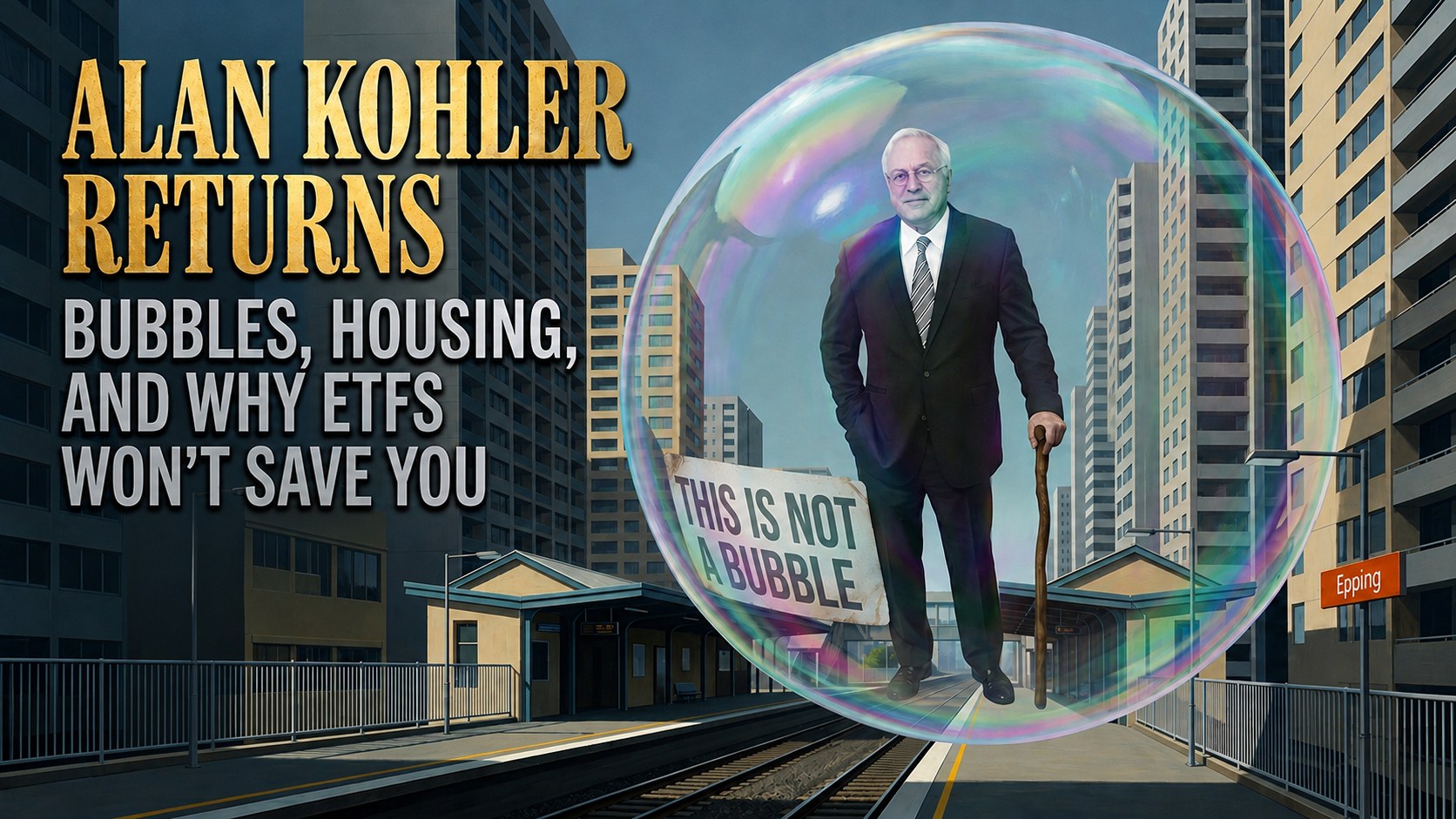
This week we sit down with Alan Kohler for his first return to the show since May 2019, covering everything from whether the ASX is in a bubble, to housing affordability, superannuation, and what retail investors keep getting wrong. We also dig into the new CGT changes coming in July 2027, why Aurizon hit a three-point sell, and Tony shares the news that the Sky Palace has finally sold.
This week’s full episode is for QAV Club members only. The free episode is available below. Also check out our podcast archives link and our pages on Apple Podcasts or Spotify or watch clips on TikTok. Or visit our homepage to learn more about QAV and how it works as a value investing system that you can learn and apply to beat the market.
Transcription
QAV AU 933
[00:00:00]
Cameron: Welcome to QAV episode 933. This is the 18th of August 2026. How are you, TK?
Tony Kynaston: Very well. Thank you, Cam. How are you?
Cameron: Good. By the way, I, I, I like the fact that when we, um, had Alex Passmore on from NMG last week, he referred to you as TK
Tony Kynaston: Hmm.
Cameron: that.
Tony Kynaston: Might be a listener. Yeah.
Cameron: I’m sure he is now.
Tony Kynaston: Yeah
Cameron: for coming on. And we have another great guest, the ultimate guest coming on, uh, today, uh, which we just recorded, pre-recorded with, uh, the man himself who needs no introduction, Warren Buffett.
No, Alan Kohler, the other man himself. Um, return– Alan Kohler returning to the show. The last time he was on the show was May 2019, pre-COVID. Um, I did hope to ask him about the stocks that he said that he liked back then, which were Domicom, [00:01:00] Pushpay, PPH, and Xero, XRO. Um, I think he said he was invested in Domicom and Pushpay.
I think they’ve both delisted. And, uh, Xero, I looked at, was about 60 bucks when we talked about it in May 2019. They were taking over the world. Seven years later, they’re about 80 bucks. they haven’t gone backwards, but not exactly the kind of performance we would have. They, they’ve been h- they have been higher than that.
They
Tony Kynaston: Yeah. To be, to be fair, Alan may have sold them along the way too.
Cameron: Myer
Tony Kynaston: We didn’t get a chance to discuss it. He was on the, on a, a strict timetable with us, wasn’t he?
Cameron: He was. He has better things to
Tony Kynaston: Hmm
Cameron: an important man. Anyway, before we get into that, uh, couple of things, um, I will cover. Let’s have a look at our portfolios. How are they doing today? Uh, the model [00:02:00] portfolio, formerly known as the dummy portfolio, since inception’s per annum versus the SPDR 200 up 8.2, so almost exactly double market. The light portfolio since February– Oh, that one, by the way, inception is September 2019 for new listeners, so seven years almost exactly. The light portfolio inception date February 2022, uh, AKA the worst possible time to have started a portfolio in the last five years. It was, like, uh, the week of the Ukraine invasion. It is up, uh, 20.3% per annum versus the SPDR 200 up 10.7% per annum. Again, almost exactly double market. We should just call this podcast
Tony Kynaston: Double Market, yeah.
Cameron: Yeah,
Tony Kynaston: I named a racehorse Double Market, and it did well, won a group, uh, group two race. So yeah. And it’s, it, the name’s free now ’cause I [00:03:00] sold it recently. Sold the racehorse I mean. Yeah
Cameron: What hasn’t done well this week is Aurizon. I had to sell Aurizon out of a portfolio, out of my super, I think it was yesterday. Became a three-point sell for us. Reported a 24% jump in profit yesterday morning and the stock fell 9.9%. Went from $4.16 down to $3.75. Uh, the analysis that, uh, various AIs did for me, uh, was that it wasn’t so much this year’s profit that was the problem, it was their guide for next
Tony Kynaston: Yeah
Cameron: earnings, and, uh, problem with their coal contracts.
So Aurizon’s coal customers commit to a set number of tons each year and pay for them whether the coal actually moves or not, sounds good, it’s like a guaranteed income. But the [00:04:00] contracts they have for next year, that falls by 20 million tons from 231 million to 211 million. So yeah, there’s a number of other things as well, but that was the big thing.
So yeah, they fell and I had to sell them. So if anyone didn’t see my post on that yesterday and you’ve got, uh, Aurizon in a portfolio, AZJ, you might want to, uh, have a look at that. It’s now breached a three-point sell line. Um, the only other thing I’ve got is a question from Philip. Tony, do you wanna jump into that?
Philip said,
Tony Kynaston: Yes
Cameron: been lots of commentary around capital gains tax changes and downside of direct share investing with these new changes. Could Tony comment on how this might affect QAV investing going forward?”
Tony Kynaston: Sure. Uh, thanks for the question, Philip. It’s I’ll, I’ll tell you what I know and what my comments are. Um, I, [00:05:00] I do want to preface it with I think, I’m not sure if the legislation has been announced yet, um, or if it has, whether there’s been enough time for tax advisors, et cetera, to have a look at it. But I think some of the nuances might come out in the next six to 12 months, um, as they, as it gets pored over.
But that aside, uh, the question around CGT comes down to changes which happen in July of 2027, so it’s next year’s, um, tax return, and, and basically it’s capital gains after that date, so it’s, um, it’s not retrospective. Uh, but the tax changes on capital gains tax from being half your top marginal rate, um, if you hold the asset for more than a year, uh, to being, um, indexed, indexed or the cost base being indexed by inflation.
Uh, and so that means if you hold onto the asset long enough, it should, you know, approximate a 50% [00:06:00] discount, and there’ll be cases where it’s more or less. But if you’re turning over things quickly, then, uh, it, it’s, uh, more, more of a burden in, from a tax point of view under the new regime, which is actually the old regime than under the 50% discount rules.
Uh, and there’s also another, um, wrinkle in the legislation which says that regardless of how you account for things, it’s a minimum 30% capital gains tax, so just be aware of that as well. Um, and the kind of perverse thing about that is that affects people on low tax brackets more than it affects people on high tax brackets because, um, if, if you’re listening to this and you’re on a top marginal rate of 47 and a half percent, you’re already above 30% anyway.
But if you’re someone who’s not paying much tax, then you’ll pay, as a percentage, more tax on capital gains than you do from your income, so that’s kind of strange, I think. But anyway, um, and I should also say assets inside super are unchanged, so they still have the current CGT, uh, regime, uh, [00:07:00] which remains in place next year.
Uh, the other thing I should say is that, um, the tax offsets still work the same way as they do now. So if you have a capital loss, you can, uh, uh, offset that against the capital gain. And when I say capital loss, I mean crystallized capital loss. And I know that every year in June or May, I do remind people that they should check their portfolios, and if they expect to have a capital gain in their tax returns, they might want to look at, uh, whether they’re carrying any capital losses that they could sell and offset.
Uh, I think it probably makes it even more important to do that going forward after July when these new changes come in. Uh, but anyway, um, it’s. You can still do that offsetting process. Uh, there’s a, there’s a. I think probably the area that’s attracted the most commentary, um, certainly in the social media world, and you’ve got to be careful of listening to a lot of people on the social media world, except for us, uh, and Alan Kohler, who we’ve- we, we have on later.
But, [00:08:00] um, there’s a, uh, an issue around what’s called a nominal loss versus a real loss. And I think, you know, it is a real thing, but in some ways it’s a bit of a furphy. So, uh, what, what this means in a nutshell is that. I’ll g- and I’ll give an example as a way of, um, highlighting the, the issue. If I buy a share for $10,000, and in five years’ time I sell it for $5,000, I generate a $5,000 loss, and that can be offset against capital gains or carried forward to offset capital gains tax in future years.
However, in real terms, the purchase price in five years should have been 10,000 plus inflation and, you know, say if that ran around 3% per annum, an inflation-adjusted cost base is gonna be something between 11 and $12,000. So the real tax loss after inflation is actually more like $6,500 and not the $5,000, um, nominally.
So, uh, when you carry forward [00:09:00] losses or even, um, take losses into account after 2027, you’re using the face value of the loss, so you’re not getting the benefit of deducting the inflation from the capital gain. However, you do deduct the inflation from the capital gain when you’re working out the capital gain.
So it’s kind of all in there. And I, I should also say that the way that I’ve just described is the way that losses are used now. So there’s no change to the accounting of losses, um, now and how they can be offset. Uh, and so some commentators have said that’s a terrible thing. Um, as I said, it’s unchanged, and yes, you would get a bigger deduction if you allowed for inflation on the base of your loss.
Um, you’re not allowed to, so yes, the– you know, you may be– you, you, you will suffer, um, degradation in the– if the losses are carried forward for a long time. So, you know, if you, if you, for example, hold two shares and, and one of them you sell now for a $5,000 loss and you don’t sell the other one for twenty years, then that [00:10:00] $5,000 loss offset is gonna be virtually worthless because of inflation over that time.
But I, I, I would also hope that $5,000 is neither here nor there when you come to doing your tax return in twenty years’ time if you’ve invested wisely. So I, I don’t see it as being a big thing, but it is a thing to be aware of. And consequently though, what people have said is maybe you’re better off owning an ETF than direct, uh, investing in shares.
I don’t believe so. Um, the, the argument that’s put forward is that ETFs can pool gains and losses and, uh, therefore you’re not as, you’re not as exposed to individual share movements. Um, but I should say that if there is a, a net CGT event in an ETF, they do pass it through to you while you hold the ETF.
So, um, you can get a surprise at tax time when a statement comes out saying the ETF had a net positive capital, uh, gain in the year. Um, so say for example, it might occur this year because, uh, Commonwealth Bank was up very high and then ETFs that tracked that [00:11:00] index started selling it, and so they would have a capital gain, um, on their sale, uh, crystallized, and if they didn’t have enough capital losses, then you may get a portion of that CGT passed through to you as a, an ETF shareholder or an ETF unit holder.
Um, the thing is though, that, that may or may not happen. It’s usually a, a small part of, um, of capital gains tax from the individual’s point of view. The bigger capital gains tax event is going to be when you come to sell the ETF, hopefully. You’ve made a capital gain over a long period of time, you index it, you pay your tax.
A lot of people who are investing passively in indexes don’t hold a lot of, um, ETFs. They might hold a couple or, um, half a dozen or whatever. So you– if you crystallize one, um, you may not have crystallization of a loss-making ETF to offset against the capital gain of the ETF you just sold. So it’s a bit of swings and roundabouts.
Um, you’ll, you’ll certainly have a CGT [00:12:00] event when you sell your holding in an ETF, and you may not have a corresponding asset that you’ve sold at a loss to be able to deflect the tax, um, that you’re paying for CGT on that. So that’s more likely to happen in a portfolio of individually held shares. So I am calling BS on the ETFs are better than shares from a CGT perspective, but please do your own research and get personal advice.
It’s a tax matter and it’s, it’s, it– you know, it’s going to come down to your individual circumstances, both from whether you’re holding assets in your own name, a company name, a trust, or in super, um, and when you sell them and all of those kinds of things. So it’s, it’s worth looking into, but do it yourself or get advice
Cameron: And somewhat irrelevant to QAV, uh, members because we don’t have losses, we only have wins
Tony Kynaston: Well, well, we just had a loss on Aurizon, as you said. So, um,
Cameron: No, I made a profit
Tony Kynaston: oh, you’re mate’s the made a profit. Well done. Okay.
Cameron: yeah,
Tony Kynaston: I know–
Cameron: its [00:13:00] sell line. I didn’t say I made a loss
Tony Kynaston: Ah, okay. Well done.
Cameron: Hmm
Tony Kynaston: yeah, and, and, um, you know, I, I do make losses from time to time, and I do use them to offset capital gains, so it’s a part of, um, share investing, I think
Cameron: Yeah, you’re doing it wrong, Tony. I’ve, I’ve never sold a share at a loss in all the time we’ve been doing this.
Tony Kynaston: Wow
Cameron: F- let’s leave out 2022 to 2024 anyway. Kidding. We make things go wrong.
Tony Kynaston: Yeah
Cameron: Yeah. Okay. Well, thank you for that question, Philip. Thank you for that answer, Tony. You got anything else?
Tony Kynaston: No, that’s all I’ve got. Thanks. It is company reporting season, so stay awake out there and you may, uh, trip some sell lines or buy lines as, um, as we said before
Cameron: The only other buy that I had on the buy list this week was PLT Group, which also has a March reporting period
Tony Kynaston: Mm-hmm.
Cameron: So did, uh, [00:14:00] was able to suggest that one to our Lite members but that was it. It was NMG again and, uh, PLT were the only two that were actionable this week. Uh, but we’re past the halfway mark, so we should start to see a bunch of them hit in the next week or two.
Tony Kynaston: Correct. Yep
Cameron: Yes, here he is, the man himself.
Tony, I’ll let you kick it off
Tony Kynaston: Thank you. Alan, it’s my absolute pleasure to have you back on QAV. Thank you very much for, for coming on. I think, I think we last chatted some six years ago before COVID.
Alan: crikey.
Tony Kynaston: I think it was before COVID. And, and I have to say, you were our kickoff interview, I think, and, and certainly helped us get started in, uh, in our life as podcasters and, uh, share market, uh, prognosticators, and watchers, and investors
Alan: Well, here you are 60 years later still going. That’s
Tony Kynaston: We are and that’s, that’s saying something, isn’t it?
Alan: Well, [00:15:00] that’s right. Uh, abs- absolutely
Tony Kynaston: Yeah. Well, uh, well, you know, while we’ve got you here, uh, y- you do a podcast, uh, The Money Cafe, so we’ll give that one a plug, where you talk about, uh, various things. But I thought we’d kick off our chat, uh, uh, to focus on stocks and the stock market because that’s what this podcast is about. And my, my first question is, do you think that the ASX is in a bubble at the moment?
Alan: Well, no, it’s obviously, the ASX is definitely not in a bubble. Um, it’s, uh, you know, it’s up, what, 25% in three years. So that’s, um, compound annual growth of, uh, 7.5% over three years. So, um, that’s kind of normal, I’d say
Tony Kynaston: It, yeah, it feels that way to me too. We don’t have much of the AI froth and bubble that the US has at the moment. Is, is the US market in a bubble, do you think?
Alan: Well, uh, probably. Uh, well, the trouble is that– the trouble with bubbles is you don’t know, uh, when they’re gonna stop. Um, [00:16:00] uh, usually people call the bubble well before it actually peaks, which I think is probably what’s likely to happen this time, and people saying. been saying for a while it’s a bubble and it keeps going. Um, mind you, the, the AI stocks, tech stocks have not continued to bubble this year. There’s been a– There was a burst chip stocks, going through the roof, but I think on the whole, they’re not. And the other thing is that, um, the valuations are not excessive. I mean, I think, um, they’re nowhere near what they were in the, in the ni- in the 2000, ’90s bubble. So probably it’s fair to say that if there is a bubble, it’s an earnings bubble, not a share price valuation bubble
Tony Kynaston: Yeah, I, I think, I think I agree with you there. It’s the, the thing about bubbles is the last leg is always the sweetest, isn’t it? Until it crashes and you, and you give it all back and some. But, um, it, it, in terms of even just simple metrics like forward PE [00:17:00] ratios, it’s, so it doesn’t look like 2007 or it doesn’t look like ’87 or ’99 to me.
Yeah. We, I think we’re both old enough to have been through a few bubbles, and I, I think it possibly was in the bubble, the US last year when the Mag, or the year before, when the Mag Seven was still quite strong, but it’s, uh, it’s quietened down a bit over there
Alan: That’s right
Tony Kynaston: One of the things that you do a lot of is CEO interviews, and we, we do them occasionally here. Um, I, I guess I’d like some tips from the master. We, um, my CEO interviews tend to go one way or the other. They’re either a softball because we like the stock, or I ask a, um, a pertinent question and, uh, the interview kind of finishes quickly.
So what, uh, what’s your approach?
Alan: Oh, well, my approach is to, in a sense, represent investors to, you know, try, try to, try to think about what investors wanna know about this company. Um, the way I see [00:18:00] CEO interviews is that they are a sort of an introduction of the company. You should never, no one should ever see the interview with the CEO as being the kind of the definitive tale. Um, but it’s an introduction, perhaps the beginning of research. Um, it would start, it can start you off in terms of, um, raising questions that need to be looked into, um, in more depth. Um, so, uh, yeah, my, my approach to a CEO interview is to basically try to get the, try to get an understanding of, um, what the history of the business is, how it started, what’s the culture of the place, what’s the CEO like, um, and most important of all, how does the business make money? What, what are the, what’s the, what’s the model? Um, and so usually CEOs are okay with that stuff.
Tony Kynaston: Do, do you find that CEOs tend to be more marketing than, uh, than managers? That they, they’re [00:19:00] selling a story?
Alan: Well, that’s their job, so, you know,
Tony Kynaston: Hmm
Alan: mean, you’ve gotta, gotta give them that. That’s th- their job is to market the company, particularly when they’re talking to journalists and podcasters, um, to analysts. I mean, that’s what they’re doing all the time is, is trying to get people to, uh, get interested in their business. So yeah, I mean, I don’t, I don’t see a problem, uh, with that. Um, uh, I, I do f- I mean, I, I’ve given up inter- interviewing large company CEOs on the whole ’cause I think they, are much more media trained and much more inclined to be marketers. So I’m, uh, I like interviewing small company CEOs ’cause they.
It’s not just that they tell the truth, um, but, but there’s more of a story to tell often, um, and, uh, they’re, they’re just a bit easier and nicer to interview in my view
Tony Kynaston: Yeah, definitely. I, I think I agree with you. And they don’t get the same sort of coverage that the big stocks get anyway, so it’s, uh, it’s good for them. They’re more, more open, I think, to, to come onto a [00:20:00] show and, and talk about.
Alan: it, it’s a bit more useful too for
Tony Kynaston: Yeah
Alan: to, to hear from a small company CEO because they don’t actually hear from them usually
Tony Kynaston: Yeah. No, that’s right. Um, and y- and, and you’re right about doing further research, and we, we focus on the figures and what we talk about and teach here. Uh, ’cause often, you know, if you wanna buy a story, go to Dimmick’s. Um, but, but as you say, it’s, it’s. If we can shed some light on the numbers through the interview, it’s not a bad thing to do.
Alan: Yeah, that’s right
Tony Kynaston: Yeah. If, uh. One of the most common questions that I get asked, uh, sometimes on the show, sometimes when I’m, you know, at dinners or whatever, is, uh, what, what advice do, should I give to someone starting off in the share market? So what advice would you give, and what’s, what’s the most common sort of mistake that you see, um, retail investors making in the share market?
Alan: I think the most common one is probably just following the herd and, you know, jumping aboard some, you know, some hot stock, uh, that they’re hearing about. I, I think, um, you know, you, uh, it’s, uh, you’re much better off [00:21:00] tr- uh, trying to invest in something you know a bit about, uh, either because you’ve researched it or because you shop in the, in that shop. You know you like the business, you know a little bit about it. I think, um, people, particularly people who are starting out, I mean, should use investing as an extension of their life, I think, if they can, um, to, to turn, to make the investing part of the life, part of your life.
Um, and so, you know, uh, uh, I can’t think of an exact example, but look, if you, if, um, as, uh, as I do, you like shopping in or you go to JB Hi-Fi a bit, maybe you’d, um, you’d want to invest in that company, although it’s not
Tony Kynaston: Stop today maybe.
Alan: day
Tony Kynaston: Well, maybe we should. The stock price is down.
Alan: That’s right.
Tony Kynaston: Yeah
Alan: Well, you know, that’s right. And, and so the s- the price is down a fair bit, um, this week.
Um, maybe it’s a good time to buy it. look, [00:22:00] I mean, i- if you, if you particularly like Coles versus Woolworths, then buy that stock, not, rather than Woolworths. I mean, I, I just kind of. I mean, these are all retailers, so, uh, uh, we tend to have more to do with retailers in our lives, I guess. Um, but maybe there’s other companies that you know a bit about or, you know, maybe you’re a builder and you know a bit about, um, uh, James Hardie or something and, you know, you like their product.
So look, I, I just think if possible, and it’s not always possible, but if possible, make, uh, investing an, an extension of your life
Tony Kynaston: Yeah, that’s, I mean, that’s the Peter Lynch theory, isn’t it? The what, uh, One Up On Wall Street, uh, where if you, if you go out and buy an iPhone and you haven’t bought a mobile phone before, it’s, you might wanna go and buy the stock as well. Yeah. One of the interesting things I’ve, I’ve found is, um, I’ve been party to some investment committees at various places, and it’s, it’s, they’re often very dry things.
You know, let’s discuss this company and its latest results. Mm. But [00:23:00] occasionally something will come up where people around the room will get excited. So, um, I mean, not wishing to use an example as a recommendation, but like, uh, you know, they’ll talk about, say, Life360, and then they’ll all start saying, “Oh, yes, we use that,” and, you know, “My kids have it, and we track them through the use of that app.”
And so they start to get excited, and that’s, um, that’s not necessarily a reason to invest in that company, but it’s an interesting take on what you’re saying, which is that if there’s a bit of excitement there, it’s worth looking into.
Alan: Well, I think if you’re using Life360 and you like it, then that’s a start at least. I mean, y‑y-y- I don’t think it means you should suddenly go out and buy it, buy the stock, but, you know, it, it’d be a good, good place to start and think about and have a look into it and then do some work on it. Um, uh, that’s certainly the case.
I mean, and, and another thought is that, you know, if you’re using AI and you, you know, you’re interested in, um, maybe you should have a look at copper because, um, you know, copper [00:24:00] is, uh, what’s been, you know, what’s going up. Uh, the copper price is at, um, all-time highs, I think, and, um, uh, BHP’s just announced a huge profit and it’s now mostly a copper company. maybe, maybe that’s something you want to think about
Tony Kynaston: Yeah, it’s an interesting point, isn’t it? Whenever there’s a boom on, you buy the picks and shovels rather than the gold miner.
Alan: Oh, well that’s true
Tony Kynaston: Yeah. Yeah. You, you said before, don’t follow the crowd, and I think your point was, don’t take tips from taxi drivers, which is often the sign of a boom. But, um, are, are people following the crowd now when they get into ETFs and passive investing?
Is there. How, how would you contrast today’s market with, say, the market of 2006, which didn’t have those things as much anyway?
Alan: a lot more, a lot more ETFs now. And I think, uh, look, uh, um, I both understand why people like ETFs and go into them because it gives you diversification, um, you know, simply and easily and cheaply. but, [00:25:00] but on the other hand, I, I don’t think ETFs, predominating is a good thing for the, a good thing for anyone. Um,
Tony Kynaston: that, Alan?
Alan: well, because it, it tends to mean that the market tends to, sort of feeds on itself. Um, stocks go up simply because they’re big rather than because they’re good. Um, so, you know, I, I, I’m, I, I guess I’m a little bit concerned about that. I mean, CBA has had a huge run, um, Commonwealth Bank because, simply because it’s big, but on the other hand, it’s also good.
So there you go. BHP
Tony Kynaston: But, and it works in reverse too. When, and when the downturn does come, those stocks will fall pretty hard,
Alan: That’s right
Tony Kynaston: they’re big parts of the ETFs which are forced to sell. Yeah. Um, no, it’s, it’s, it’s very interesting. Um, when I talk about this with people and I say that I, I think ETFs, and I’m not just talking about ETFs, it could be listed investment companies or whatever, but people who are following an index, um, [00:26:00] passively, uh, will, will amplify the market up and amplify the market down.
They always throw back at me, “Yes, but, um, but over the long term, individual stock pickers don’t beat the market.” What, what’s your response to that?
Alan: Look, I think that’s, is that, I think it’s, uh, statistically correct, um, uh, over all of, uh, over all stock, stock pickers. I think that’s right. Um, but look, I, I do think, well, clearly the only way to beat the market is to pick stocks and not to do the, not to do an ETF of the market because otherwise, you know, if you do an ETF of the market, that’s what you get. So you don’t meet the, beat the market. So the only way to beat the market is by picking stocks. And clearly there are a number of, um, um, funds, stock picking funds that do really well. Um, you know, they say and everyone says past performance is no guide to future performance, which is true. Um, [00:27:00] but the thing is, it’s all you’ve got.
So if, if, if, if there’s a fund that’s consistently beat the market over the past five or 10 years, then there’s a fair chance that it’s gonna continue to do that, I think, ’cause they know what they’re doing
Tony Kynaston: Yeah, it’s, it’s very much an evolutionary type environment, isn’t it? If you’re not outperforming the market, you’re gonna have funds outflows, and you’re not gonna be around in five years’ time. So, you know, you’re not gonna have a long-term record to, to boast about. Yeah.
Alan: Yeah, exactly
Tony Kynaston: Yeah, no, I, I, I agree with you. And, and, you know, in fact, it’s always been a bit puzzling to me.
I, I think one of the reasons why fund managers don’t beat the market is because they put themselves in a box, and they’re either growth or they’re value or they’re this or that. Um, and eventually that, that sort of style goes out of favor. Whereas if you’re an individual retail investor, you can change styles as you need to or change sectors or whatever, or go to cash, I guess, if you need to as well. Yeah, I think that’s a big thing.
Um, what about, [00:28:00] uh, things like, uh, super funds and the, and the part they play in the market? The fact that we, uh, as, as employees will have large exposures to the US market. Um, also too, the super funds h- are now tested against the benchmark. Is that causing them to be passive investors? Is there a, is there, is there a need for s- a super fund, I guess, of some size to be more like a, an active manager?
Alan: Well, I mean, su- super funds are, um, a bit different in the sense that they are there for the long term. Well, they should be there for the long term. So they’re, they’re, they’re saving for your retirement. Um, and the process of, of doing that is a 40-year, um, a 40-year investment. Um, the trouble is that they’re kind of judged, quarterly or half-yearly or yearly or whatever.
I mean, they’re, they’re, they’re judged or they, they have to report their performance pretty often. you [00:29:00] get. And everyone has Super Choice now so that you can switch funds, which is fine. That’s the way it ought to be, of course. But the trouble is that, um, you know, short-term performance is not really what these things ought to be about. Um, I, I don’t really know what the answer to that is. I mean, I, I think that, um, uh, super funds tend to, cluster around the benchmarks because, you know, they, they don’t want to be too far away. Um, uh, but on the other hand, you know, the, they, they are, what they’re trying to do is achieve, uh, diverse, uh, performance, beat the, beat the benchmarks, their own benchmarks, and, and provide a decent return o- over the long term, um, with diversification.
So they, they tend to have a, a broad range of, uh, investments. And I. Look, um, I mean, a lot of them, a lot of their investments are into sort of [00:30:00] infrastructure, unlisted, um, private equity, all that sort of thing. And, um, some of them more than others in those unlisted things. Um, and they’re the sort of things that, you know, us as small investors can’t really do. Um, and so they, they give you a bit of extra exposure to some asset classes that are not otherwise available. And I think that’s, that’s a good thing, you know. So I mean, I’m, I’m thinking about actually putting some of my money in a super fund. I’m, I’m, I haven’t done it yet, but I’m thinking about that
Tony Kynaston: You don’t have money in a super fund. That’s interesting
Alan: Well, I’ve got, I’ve got my own self-managed super fund, um, but I haven’t got money in a, um, in a large industry fund, for
Tony Kynaston: Right. Okay
Alan: but I’m thinking that maybe I should
Tony Kynaston: Right. Yeah, it’s in-interesting, isn’t it? I, I think, um, you, you comment about the 40-year n- existence of super. It’s, it’s kind of coming to a, a, a real litmus test now, isn’t it? Because I, I, [00:31:00] I’m not seeing the, uh, pension or the amount of the budget the federal government spends on pensions going down, and yet the, the pe- that we should be getting to the retirement stage for the first people who were going into super 40 years ago.
Um, maybe you need to have 80 years of super fund existence before you can say on average people are at, who are retiring have been in the system the whole time. But it’s certainly at this stage, and it was set up to, to cap the government’s welfare spend on pension. That’s certainly not happening yet, so does that mean it’s b- needs to be looked at?
Alan: to, I think it’s beginning to cap it because, you know, uh, people are sort of, a lot of, a lot more people are, um, you know, going above the, the, um, the assets and income tests for the pension. So the go- the government’s never going to sort of announce a reduction in the pension or something in re- in response to super.
But what should happen is that over time, uh, perhaps over a long time, the, um, the amount being spent on the pension declines as people kind of go above the, [00:32:00] um, uh, go above the income and assets test, test
Tony Kynaston: Yeah, I’d like to have a long-term bet on that, Alan. I think, um,
Alan: No, maybe you’re right.
Tony Kynaston: p- pensioner as a voter is not gonna vote for a reduction in the pension. They want their cake and eat it too, I think. They want both. Um
Alan: Yeah, but you can’t have both. Come on
Tony Kynaston: Uh, the other thing I think that’s interesting about super, which I’ll, I’ll toss into the conversation, is I wonder whether, uh, uh, someday someone will wake up and say, “Gee, we really should have had a sovereign wealth fund and had all that money in one place managed by.” Much like the, uh, Future Fund’s doing now, managed by a central team of professionals.
And then the government has a say on where the, the money is used, whether it’s in for infrastructure or whatever in Australia or, or it’s left alone to invest wherever it sees fit
Alan: Yeah. Well, the, um, that’s not gonna happen. The train, that train has left the station. But, um, the super fund– The Future Fund is not a bad sovereign wealth fund. They do okay. Um, [00:33:00] I mean, I, I think there is a case, this is possibly a big, bigger subject than we’ve got time for, but, uh, but I do think there’s a case for that theoretically, because the problem with the super system as it currently sits is that we’re all in different funds we therefore end up with different retirement outcomes. And the super choice is meaningless because what you’re choosing, what you’re basing a choice on is the future returns of the fund, which you don’t know what they are, You’ve got no idea. um, you can’t possibly make a choice, an informed choice about the future because it hasn’t happened yet. I mean, y‑you can make a choice on past returns, but as they say, the past returns are no guide to the future returns. So, uh, I mean, uh, so you, you know, you end up with people with all sorts of different outcomes in retirement, has nothing. Usually from no choice of their own. They just get, they just get bunged into a fund, according [00:34:00] to the industry they work in.
If you’re, if you’re, um, a checkout person at Coles, you’re in the Rest fund. you’re, uh, a nurse, you’ll be in, uh, HESTA. You know? And if you, if you’re a waiter, you’ll end, you’ll end up in Hostplus. And, you know, there’s maybe a 1% or 2% difference per annum in return of those funds. You’ll end up with $500,000 less in, in retirement than, than, than your neighbor, and you had nothing.
You, there’s no say in it. So I, I think those differences are a problem. But anyway, there’s nothing that can be done about it.
Tony Kynaston: Yeah, I mean, it, it, it– we often go in cycles, and I think, you know, when I first joined the workforce, super funds were pension funds, and they were defined benefit. So you’re guaranteed a multiple of your last salary. And, um, and, you know, for people who aren’t in work and they’re relying on the government to do that, that’s a pension.
You know, it’s, it’s al– as I said, it’s almost gonna get to the stage where [00:35:00] if super doesn’t work because enough people have retired and been underfunded, then it’s gonna go back to, we’ll control it as a central government, as a federal government, and we’ll give you a defined pension, which is how it was.
Anyway, um, moving on. We are in the middle of reporting season, which is an important time for us as, uh, share market investors. And we’ve actually, um, stopped buying shares in the month of reporting season because in the last year or so in particular, it’s become very, very wild in its fluctuations on, on reporting day.
And we spoke about a couple of s‑stocks that have moved dramatically after they, their reports, BHP and JB Hi-Fi, to, to name a few. It used to be the case that continuous disclosure would force companies in confession season to say, “Hey, the market is guiding wrong. We believe that you think we’re gonna make X, but we’re gonna make Y.”
That’s– I can’t think of [00:36:00] a, of anyone in confession season this year who’ve come out and said something like that. They, they probably have been examples, but, uh, I mean, I don’t think JB Hi-Fi did, I don’t think BHP did. Um, so what’s going on, Alan? Has, has things changed?
Alan: I don’t know, um, to be honest. I mean, I, I, I agree with you. I think that’s, there is, uh, a bit less, uh, guidance this year, but I, to be honest, I have no idea why. I’m sorry
Tony Kynaston: Okay. Well, I mean, I guess I’m begging the question, is the regulator going to act on this? Because, you know, how can you have a continuous disclosure regime regulated by ASIC and then companies coming out on the day of, uh, their reports, uh, and announcing something which has completely blindsided the market?
Alan: Yes, I, I agree. I mean, I, I’m not sure whether guidance is, um, mandated by the law. Um, I s- I, I suppose there’s a matter of interpretation whether, whether continuous disclosure involves some guidance [00:37:00] or just telling you when you know what the answer is, you know, when you know what your results are, which is on reporting day. So look, I d- um, I, I think you’re right that, I mean, it, it ought to be that, the market is not blindsided. Um, uh, occasionally companies have been found to be on the wrong side of the law with that. But, um, yeah, I, just don’t know why, why that’s happening.
Tony Kynaston: Yeah, I think one of– I mean, I think one of the reasons is companies are, are now subject to, uh, very, very quick share trading by, um, quant-based funds. And, you know, you hear stories of, uh, of AI listening into announcements and using the language to base a decision on whether to buy or sell the stock. Um, so I, I, I wonder if CEOs are becoming a little bit more conservative in what they say publicly leading into, uh, company reporting seasons
Alan: Yeah, I think they might be right
Tony Kynaston: Yeah. One of [00:38:00] the things that you do a lot of, uh, talking about on, on, um, the various platforms, and I, I do, I think, listen to most of them, is the macro environment. What’s going on in the economy, what’s going on internationally, what’s happening with rates and bonds, and all those kinds of things. Do, do you think knowing about all, all of that in detail makes you a better stock investor?
Alan: Well, I think there are four things that determine a share price. One is obviously the company’s earnings. The other is the valuation of those earnings. Um, that’s related to the third thing, which is sentiment, which is a little different because it’s, sentiment is to do with the whole market on the whole.
Valuation is to do with that particular stock. The fourth thing is macro. I mean, um, every company operates in a macro environment. They’re all operating in the, in the economy, and some of them operate in the domestic economy, some of them operate in the global economy. Um, so it seems to me, in order to make an investment in a [00:39:00] company, you really need to have a sense, some sort of understanding of all those four things, including macro. Um, and, uh, I’m not a stock analyst. I’m basically my, my expertise such as, such as it is, is to do with the macro environment, and that’s what I report on. When I started Eureka Report, thought there was a gap in the market for individual investors to get some sort of macro guidance, and that’s what I tried to achieve.
Tony Kynaston: Bet you do. Very, very much so. So, so how would you take macro information and, and feed it into a, a, an a- an analysis of a company? Is it around rates? Is it around the industry? What, what goes into that analysis?
Alan: Well, about a bit of everything. Obviously, it’s to do with interest rates is, uh, are a part of it. Um, clearly the bond rate, um, helps determine valuation. Um, but, but– And inter- you know, short-term interest rates tend to have, have, uh, have an impact on consumer spending and, uh, [00:40:00] also the, um, uh, the interest costs of the particular company.
So, so those things, interest rates are, are clearly important, but also just s- uh, consumer sentiment, all those things. You just– I mean, I, I, I’m not saying I understand or have a, have some sort of clear guidance on how ar-arithmetically you do it, what, how, you know, whether you should– to what extent you should put it into a spreadsheet on a particular company.
But just think you should have some understanding the environment, um, that the company is operating in and also cons- its customers are operating in
Tony Kynaston: Fair, fair enough. Um, one of the macro issues that you, you give a lot of coverage to is housing. Um, what’s, what’s your take on the housing market following the government’s changes to negative gearing, CGT, and borrowing and SMSFs?
Alan: Well, we’re clearly in the midst of a correction, uh, in housing. The, the, um, the national price is down about 2%. The [00:41:00] prices nas- the median prices in Sydney and Melbourne are down about five and a half percent. So, um, the correction has begun. There are various forecasts, uh, of what it will, uh, you know, get to.
Some, you know, seem to be clustering around 8 to 10%. Uh, I’ve got no idea what will happen. I think there are a couple of things to bear in mind when thinking about what house prices might do. One is, um, uh, that w- the, it’s not just interest rates. I- interest rates are the main factor causing house prices to rise and fall. and obviously we’ve had three rate hikes this year. Uh, that’s, that’s the main, the main reason house prices are falling. Uh, but the other one is that there’s been a fundamental change to the tax deal, uh, for investors with the, uh, change to the capital gains tax rules from discount back to, um, back to inflation adjustment, and also negative gearing rules. Now, um, [00:42:00] think those things are clearly already having a big impact on the sentiment of housing investors. Um, so we’re seeing a big decline already since the budget in, um, investor loan applications. All the banks, uh, CBA, NAB, and Westpac have all kind of reported a big drop-off in investor loan applications.
So they’re kind of. That’s, that’s, uh, well underway. But the other thing fundamentally is that housing got too expensive. I mean, we’ve been talking about this for years, uh, that housing affordability in Australia is a problem. So, um, if people can’t afford something, they won’t buy it. and I think that there’s a b‑basic, basic problem with house prices got too high. so it’s a bit like the share market, uh, gets a bit, um, get a bit too high, it comes down. That’s what’s happening
Tony Kynaston: You think, uh, an-any of the changes that have come through are actually helping first home buyers? Have you seen some [00:43:00] numbers around whether they’re, uh, being more successful in their bidding?
Alan: Oh, well, um, not really, not specifically about first-time buyers. Al- although I’d say that, you know, um, fall in house prices in Melbourne and Sydney is very helpful to first-time buyers. The problem, is that the, the most of the falls are at the expensive end of the market. You know, places like Toorak and Mosman and Point Piper and all that, I mean, they’ve had massive falls. The biggest fall so far is in Curl Curl in, um, Sydney, North Curl Curl, down I think 29% or something. So, uh, that’s a big fall. S- uh, and you know, there’s 25, 26% falls in all the expensive suburbs, but first-time buyers aren’t, aren’t in those suburbs. And the f- the, the suburbs in which first-time buyers are operating have fallen a bit, but not [00:44:00] very much.
So that’s, you know, w- that’s, that’s in front of us, one hopes that. I mean, I, I’m, I’m, someone who’s been, uh, on about housing affordability for a while now, and I think that it has been a problem, is a problem. House prices do need to, uh, come down and not keep rising as they have been. So, you know, so I’m basically in favor.
I’m a, I’m a, an owner of a house, and I don’t want it to go down in value too much, but I mean, th- I do recognize the problem that it causes, how the high house prices have caused for Australian society and economy
Tony Kynaston: Is there a secondary effect though of, of falling house prices that affects the economy anyway because, uh, people feel like they have less equity or less ability to borrow to spend?
Alan: Sure. I mean, yeah. I mean, one, uh, one of the, one of the things that’s been supporting the economy has been rising house prices, and as that turns around, um, uh, the economy, [00:45:00] uh, will be, uh, will be. Will suffer, I guess. Um, the economy might have to stand on its own two feet instead of rising house prices
Tony Kynaston: Yes, quite, quite po- quite possibly. You, you’ve obviously thought a lot about, uh, this issue. What. You know, if, if you could wave a wand and, and change one thing, what would you do, uh, apart from what’s happened, I guess, what would you, you do additionally to, um, help, help people into the market, first-time buyers into the market?
Alan: Well, look, um, uh, um, the, the, the, s- the, um, solution that has been decided upon by Australia’s governments is to densify the suburbs, to raise height limits around train stations in particular, and so that, uh, existing infrastructure is used. Um, I, I understand why they’re doing that. It’s because they haven’t got any money.
They can’t afford to build new, lots of new infrastructure, so they just have to do that. Um, they have to use existing transport, sewerage, water [00:46:00] infrastructure, um, I, I think that’s the second best solution. Um, I mean, a lot of people in this a- in this area, including the government, disagree with me. Fair enough. Um, I, I think that, uh, uh, the roads are already pretty crowded. You know, I think that the suburbs are all pretty, pretty dense. So, you know, my. If I had a magic wand, um, I would improve the, uh, transport infrastructure for regional areas around capital cities so that instead of taking, um, more than an hour to get from, say, Geelong or Bendigo to Melbourne, it took half an hour, and people could viably live there or around there, or on the way to Geelong, or on the way to Bendigo, or on the way to Bathurst and Newcastle and so on. So I’d improve, I’d, I’d, I’d, um, quicken [00:47:00] up the trains to go to those places so people could live there and commute. And, um, also they’d spend some more money than they’re spending on, uh, water and sewerage, which both, uh, parties, including the government, uh, have committed some, you know, a few billion dollars to that, but it’s nowhere near enough. Um, there needs to be much more, ’cause at the moment, the w- you know, the way it works is somebody developing houses, uh, in a housing estate in the outer suburbs, they have to pay for, the, the developer has to pay for the inf- you know, the infrastructure, the roads and the water and the sewerage and everything, that just goes onto the price, and it makes the whole, uh, it makes the whole project less viable and the houses much more expensive. And that’s a recent development over the past 20 or 30 years when the cost of infrastructure, um, housing infrastructure was shifted from governments to developers. And I mean, that’s one of the reasons that housing has [00:48:00] become, um, less affordable is because of the, uh, of that shift. So I mean, I th- I’d like to see that go back to, taxpayers in general it’s a part of, you know, it’s a part of society’s, I think, obligation to build, to, enable housing,
Tony Kynaston: Look, I agree with you 100%. I, I, I don’t know why the government isn’t, um. And it does to a certain extent, but why every federal department isn’t, uh, located in the regional center. So the tax office is in Wagga Wagga or the, you know, various other, you know, Department of Health is in Geelong or whatever,
Alan: Yeah, but the
Tony Kynaston: to get
Alan: But yeah, that’s f- that’s fine. I mean, you could do that and, but the trouble is you can’t actually get to the city. I mean, it’s, like it’s too isolating. At the moment, the train to Geelong, for example, is a V/Line country train, and it takes too long, and it doesn’t run often enough. I mean, it’s just, um, the whole thing is completely, um, uh, um, messed [00:49:00] up, I, I think.
They need to, they need to get their act together on. The trouble is they haven’t got any money, you know, like the. And you can’t just, you can’t just whack, uh, a fast electric train on the existing tracks. You gotta write, lay a. I think that’s true. You gotta lay new tracks. I mean, that’s very expensive. And the, um, I mean, the government, the Victorian government has decided to spend all this money on a, on a suburban rail loop underground, connecting suburbs that don’t need to be connected.
So I don’t know.
Tony Kynaston: Yeah, look, I,
Alan: problem
Tony Kynaston: I, I agree. Um, the, uh, not only like are you right that we should improve the transport to places like Geelong, but we should also be building along the way. I mean, I, I live on Mo- on the Mornington Peninsula, and there’s so much underused land between here and Melbourne, uh, which could easily be used for, for housing, um, a- and nice housing.
Alan: I know, but the, but the transport’s no good and there’s no, the, the, there isn’t any s- water and sewerage there. So, you know, it, it needs to [00:50:00] be. You can’t just say build a house there. It’s got There, there’s a lot more, lot more needed
Tony Kynaston: Yeah. A- and I think one of the reasons that we’re, we have that kind of problem is it’s a disconnect. I mean, the money comes from Canberra and gets spent by the states, but the states have other competing pressures. So, and, and then the. when they build the land, it’s, it’s taxed by the council, so the states don’t see the revenue from, from the houses ongoing.
So, you know, I wonder if there’s some kind of disconnect that can be repaired quite easily. Um, uh, what shall I wrap, wrap up with? Um, again, with your magic wand, what’s the one thing that you would do to boost productivity or to make Australia better?
Alan: Um, look, I think the, the reason– You gotta look at what, what’s the reason that productivity’s declined, and I think the, the reason f- the k- uh, key part of the reason for it is businesses haven’t been investing enough. So, um, the, you know, the, in, in [00:51:00] equipment or anything. I mean, I, I think that they’re starting to invest in AI. Maybe that’ll boost productivity. Um, I, I, I think that probably i- if you’re, if you’re focusing on that, you probably need to find some way to encourage businesses to invest more in their, you know, in their equipment and their, in their buildings and their, you know, just making themselves more productive, um, ’cause they don’t seem to be int-interested in doing it themselves in Australia.
I don’t know why.
Tony Kynaston: I, I think one of the reasons is overregulation, Alan. I s- I sit on the board where we just spend so much time on compliance
Alan: Yes. Well, look, I, I mean, I think that that’s happened in housing where the, the National Construction Code has gone to more than 2,000 pages. You know, it’s a r- it’s an absolute disgrace. So
Tony Kynaston: if you believe the HIA, half the cost is in taxes
Alan: Yeah, that’s right. So look, uh, yeah, it’s the government’s fault. Let’s, let’s be
Tony Kynaston: Which means it’s our fault ’cause we [00:52:00] elect them. Yeah. Well, look, thank you very, very much
Alan: That’s true
Tony Kynaston: for giving us your time. It’s, it’s been terrific talking to you again. It’s a nice, uh, bookend, I guess, to six years ago when we had you on, and, uh, I appreciate it very much
Alan: No worries
Cameron: Thank you, Alan. Well, we’ll let you get to your other, uh, appointment. Appreciate it. Enjoy the rest of your day.
Alan: Okay thanks. See ya.
Cameron: Thanks, mate. Bye
Alan: Bye
Tony Kynaston: Very good
Cameron: well, after hours, Tony, you got some big news
Tony Kynaston: Yeah, we had some big news. Uh, we actually sold the Sky Palace last week, or we exchanged on a contract to s- to sell the Sky Palace. So, um, a bit of a surprise to us. We weren’t expecting it, but, uh, our, uh, tenants, uh, broke their lease, which they’re allowed to do. Uh, and so we re-advertised. That kind of flushed out, uh, a local agent who approached Jenny and said, “I’ve got a buyer.”
Couldn’t he– Was in a– failed to buy another, [00:53:00] um, penthouse in Sydney, and would, would he– could he see through your place? So we said yes, but we are going to still try and rent it out. And, um, so yeah, it was a, a b- a busy week of contract negotiations and, and showing him through and getting all our ducks lined up.
Uh, but yep, we managed to confirm a sale, which is good. Good for Jenny. She, um, she can’t wait to get back into Melbourne, so that’s the next, next thing that will take up all my time is trying to find a place to live in Melbourne and buy that. So, um, uh, but it’s good. She’s, she’s feeling a bit isolated down here.
Um, doesn’t play golf and can’t walk to coffee shops and things, so, or, and has to commute a fair bit for work, so, uh, for her boards. So, um, it’ll be a good thing to get back into Melbourne.
Cameron: Make sure the place you buy in Melbourne has a granny flat out the back for Chrissy and I and Fox to come and stay in
Tony Kynaston: Yeah.
Cameron: more often
Tony Kynaston: Okay. [00:54:00] Well, you and Alex, she wants me to buy one with a studio so she can do a painting
Cameron: That’s
Tony Kynaston: there.
Cameron: can, she can. Yeah, we can combine the two, granny flat and a studio. Yeah. Very
Tony Kynaston: It’d be great to have you there
Cameron: Oh, that’s nice. Well, you know, I, I was thinking, you know, afford to fly down to Melbourne, but we, we just drive down, come down, hang out for a week, drive down, go for a couple of days, stay in, you know, I don’t know, somewhere on the way down, halfway down.
Take a couple of days, drive down like we did back in the old days, and
Tony Kynaston: Mm-hmm.
Cameron: and then drive back up. Yeah, it’ll be lovely. Could
Tony Kynaston: You could stop in Wagga. Stop in Wagga on the way.
Cameron: Is that halfway?
Tony Kynaston: It’s halfway between Sydney and Melbourne,
Cameron: Right.
Tony Kynaston: so three-quarters of the way from Brisbane. Yeah
Cameron: Yeah, yeah, it’s trip. that’d be nice. We can do some more Melbourne events too when I
Tony Kynaston: Yeah, lovely
Cameron: Well, uh, what have I got [00:55:00] for you? Um, put a cinnamon stick in your black coffee. That’s my big tip for this week. you ever done that?
Tony Kynaston: No, I haven’t.
Cameron: Trust me, Uh, change your life. and I were. For the last few weeks, we’ve been putting- we’ve moved to drinking black coffee in the mornings,
Tony Kynaston: Mm-hmm.
Cameron: w- we were putting, first of all, cardamom powder I started putting in the coffee, which was fantastic. And then Chrissy said, “Let’s put some cinnamon, ground cinnamon in as well,” which is great. But then I had. I’ve had this jar of cinnamon sticks that have been sitting in our pantry for 15 years, and I pulled them out and I stuck a cinnamon stick in, and I was like, “Oh my God.” ‘Cause the oils from the cinnamon stick, um, leach out into the coffee, and you get this beautiful cinnamon oily coffee thing.
It’s absolutely amazing. I thought I’d invented it, and, uh, Claude said, “Bitch, people have been doing that in Persia for [00:56:00] 2,000 years.” So I was like, “Okay. Well, fair enough. I’m,
Tony Kynaston: Yeah
Yeah. I think S- is it Cinnabon, the chain of, uh, stores in the US that sell buns? I think they do it as well in their coffee. They– Oh, they’re here too, are they? Okay, I haven’t seen them here.
Cameron: yeah, yeah. They,
Tony Kynaston: Yeah.
Cameron: shops in different
Tony Kynaston: Okay.
Cameron: here. Oh, they do it too. Wow, it’s fantastic. Highly recommend it. Um, music this week, I discovered that Public Image Ltd has put out albums
Tony Kynaston: Uh-huh.
Cameron: 10 years that I
Tony Kynaston: Right
Cameron: I was very familiar with their, I don’t know, late ’70s, ’80s, maybe early ’90s catalog.
But, uh, apparently they took a break for, like, 17 years, then Johnny ’em back together, and they’re touring. They’re coming to Brisbane, uh, year, yeah. Do you like PIL?
Tony Kynaston: I do, yes. I haven’t heard their recent stuff though. Yeah.
Cameron: good. It surprisingly
Tony Kynaston: All right
Cameron: [00:57:00] Like, I don’t know why, but all of his PIL stuff, just riffs you know, I, I, I– There’s something about Johnny Rotten’s voice which just kinda works,
Tony Kynaston: Ja. Ja
Cameron: like– I, I kinda like it, kinda dig it. Always have, from the Pistols day through PIL. Anyway, I know he’s, he’s sort of a bit of a caricature, um, in real life these days, but, um, so is David Lee Roth. You know, I can’t, I, you know,
Tony Kynaston: Hmm.
Cameron: criticize. But,
Tony Kynaston: Yeah.
Cameron: yeah, Rec- uh, the End of World was the last album, 2023, and, um, digging it.
And there was another one before that too, which was I think 20- like 20-teens, ’15, ’17, something like that. It’s really good.
Tony Kynaston: Oh, very good. I’ll check it out ’cause I do [00:58:00] like them. And that’s– that, uh, series on one of the streamers that Danny Boyle did, um, on the Sex Pistols story, that’s, that’s really worth looking at too. It’s so good.
Cameron: Oh, I
Tony Kynaston: a couple of years ago. Yeah. No, really good. Yeah, yeah, yeah. No, it’s great. Yeah.
Cameron: Huh
Tony Kynaston: It’s told from the, uh.
Is it, uh, is it Steve Jones from memory, the guitar player? It’s told from his perspective, but, um, yeah, really great story, you know, about the boutique that, uh, Vivienne Westwood ran with, um, Malcolm McLaren. Yeah, how he put them all together. You get the backstory betw- you know, behind some of the songs which I wasn’t aware of.
Um, you know, she was a girl from Birmingham. She just had an abortion. There’s a whole story around that, um, backstory around that. And, uh, yeah, it’s, it’s good. And yeah, the various other players come into it. Chrissie Hynde
Cameron: Yeah.
Tony Kynaston: Yeah. So it’s, it’s great
Cameron: of Malcolm McLaren. I thought Malcolm McLaren was a freaking genius man. Like, he, um, ability [00:59:00] just to, l- a bit like Bowie, just to surf trends and stay sort of relevant and current and pick stuff out. Did you ever hear his Paris album?
Tony Kynaston: No, I didn’t know he had an album.
Cameron: He’s got a
Tony Kynaston: Really? Really? Okay
Cameron: well, yeah, yeah, yeah.
You, you must have heard, um, Duck Rock. Buffalo Gals.
Tony Kynaston: Ja, ja.
Cameron: buffalo gals
Tony Kynaston: Ja, ja, ja, ja
Cameron: round the outside. Well, that was him.
Tony Kynaston: I, I thought that was actually a– I thought they were bands he pulled together for those records, that they were artists that he was managing
Cameron: no. I mean, um, yeah, yes and no. I mean, l- like the Pistols, it was kind of, he would grab artists and pull them together, but he fronted the, that,
Tony Kynaston: Oh, okay. Yep
Cameron: Rock. came out in ’83 originally, and it was him doing the vocals, but he pulled together,
Tony Kynaston: Right
Cameron: I think, um, they became Art of Noise, um, a lot
Tony Kynaston: Okay
Cameron: [01:00:00] on that. but then came out with an album ooh, in the early ’90s. see if I can. Yeah. 1994, Paris, that is just all about Paris, and it’s kind of a jazz And Catherine Deneuve does vocals on one of the tracks. Francoise Hardy does one of the tracks. He’s got a, it’s a track called Miles and Miles of Miles Davis.
He talks, uh, he sings on some of the tracks and talks on some of the tracks, but it’s this beautiful, lush, uh, atmospheric production which I’ve always loved and it, I think it’s been pretty much derided by pretty much everyone else on the planet. It’s got [01:01:00] a two-star rating on
Tony Kynaston: No.
Cameron: Um, uh, but I love it.
I’ve always loved it. I listen to it all the time. It wasn’t available on streaming for years. I had it on CD. I had to have a rip of it to listen to it. one of
Tony Kynaston: Oh, check it out
Cameron: I think I’m the only person on the planet who really liked it.
Tony Kynaston: Yeah, right
Cameron: But anyway, there you go. PIL and Malcolm McLaren, they’re my tips for you to listen to this week
Tony Kynaston: Thank you. Well, I’ve just been listening to, um, The Rolling Stones latest. That’s been good fun. And then gone back and listened to some Nick Drake. Yeah
Cameron: Oh, Nick Drake’s great, yeah. Yeah, like, the, the Stones’ new album again is, like, just good. Like, ridiculously good
Tony Kynaston: It is, isn’t it? Yeah. And, and just that it– You know, they’re just tossing them off, I guess, but it’s just like simple blues riffs. But the way they put them together and the way they perform [01:02:00] them, it’s, it’s very special
Cameron: You know, they kind of, uh, like a lot of guys from their era, I think in the ’80s and ’90s into a little bit, kind of lost it. They,
Tony Kynaston: Mm-hmm.
Cameron: became a little bit formulaic, overproduced,
Tony Kynaston: Mm-hmm
Cameron: um, a little bit of a phoning it in kind of thing. Bowie had albums like that. Lou Reed had albums like that. Iggy. uh,
Tony Kynaston: Oh, and the Stones broke up for three or four years, didn’t they? When Mick went off and did Primitive Cool, so
Cameron: Which I like. I, I kind of
Tony Kynaston: I did too.
Cameron: right? And I love Keith’s solo stuff.
Tony Kynaston: Oh, ex-
Cameron: Keith’s solo
Tony Kynaston: I do too. The Expensive Winos, those, they’re great albums. Mm.
Cameron: and I’ve, I know I’ve said this before, like Keith’s vocal tracks on Stones albums are always my favorites, and, um, his vocals on his solo albums, uh, the Winos albums I think is just great. He’s just got such a [01:03:00] no bullshit, bluesy kind of rock voice.
Tony Kynaston: does, doesn’t he? Yeah, cigarette, cigarette. You can hear the cigarettes through the voice, can’t you?
Cameron: Yeah, yeah, Hear us! Yeah, yeah, yeah. It’s a little bit, kinda a little bit Tom Waits‑y,
Tony Kynaston: Mm-hmm.
Cameron: bit blues man. He just growls stuff into it, and you can, you can, you can feel the life lived
Tony Kynaston: Yeah.
Cameron: coming through the music, you
Tony Kynaston: I remember like the– I think his biggest single was “Happy,” and it took me a long time, ’cause I never saw the name of it. It took me a long time to work out what he was going on about, and it was actually like an upbeat, optimistic song. All I heard was, “Ah, ah.”
Cameron: Yeah
Tony Kynaston: Yeah.
Cameron: um, thing I’ve been trying to re- um, find a comparable album to this week is, um, Scott Walker, Scott Walker’s, um, the Walker Brothers album, I think it was Nite [01:04:00] Flights. You
Tony Kynaston: Don’t know it. No
Cameron: You know Scott Walker though, right?
Tony Kynaston: No, I don’t. Who’s he?
Cameron: Your daughter knows Scott Walker. you not know Scott Walker?
Tony Kynaston: I’m not
Cameron: years ago, years ago, Alex texted me going, “Oh my God, do you know who Scott Walker is?” I was like, “Of course I know who Scott Walker is.” And she was like, “Oh my God, I’m so into Scott Walker.”
Tony Kynaston: Okay. No, she hasn’t told me about him
Cameron: oh man, check out Scott Walker, um, Flights”, N‑I-T‑E,
Tony Kynaston: Right
Cameron: Bowie covered on Black Tie White Noise, and I, I didn’t realize it was a, it was a cover until many years later. But, uh, oh, that reminds me of something else I’ll tell you about in a sec. But, you know, Bowie would famously just, you know, ch- several times in his career, um, just not only his kind of music, but his vocal stylings and his [01:05:00] musical stylings. He would steal and borrow and all that kind of stuff.
So one of the guys that he ripped off massively the ’90s was Scott Walker. He basically you know, stole Scott Walk- Scott Walker’s musical styles and vocal styles and made it his own, and then paid tribute to him by covering one of his songs. Um, but yeah, so Scott Walker was part of a band called The Walker Brothers in the ’60s, ’70s, ’80s, and they were kind of okay, middle of the road, sort of LA band. Good, but not massively, uh, innovative. But then as he got older and started doing solo stuff, he, he really became very innovative and very, um, nouveau art rock kind of stuff, which Bowie loved, and then, and, [01:06:00] um, sort of a, a- adopted or adapted his stuff.
Tony Kynaston: So
Cameron: with the Walker Brothers and did some more stuff.
But yeah
Tony Kynaston: And so what’s a, what’s a Bowie album or a Bowie song that is based on that kind of copying of Scott Walker?
Cameron: uh, like a lot of stuff that he did in the ’90s was sort of started with stealing that. So Black Tie White Noise, again, an album that I kind of love. You like, do you like that
Tony Kynaston: No. No. Well, I shouldn’t. I haven’t listened to it for a long time
Cameron: it was after he got married to Iman,
Tony Kynaston: Mm-hmm.
Cameron: um, he wa- it’s, it was sort of when he was, know, when he was coming out of the ’80s. And I know, you know, you met your, or dated, was it your first date with Jen at the Bowie
Tony Kynaston: Yeah, the Glass Spider concert at Kooyong. Yes. Yeah
Cameron: I didn’t really love his, his late ’80s stuff, [01:07:00] Bowie, but then he kind of reinvented himself.
He did Tin Machine, which I loved, and then he came out, he married Iman, and then he came out with Black Tie White Noise, which was kind of more artistically getting back to, you know, where he’d once been. It was poppy, but, you know, he worked with Nile Rodgers, and it, it wasn’t Let’s Dance, but it was more sort of, um
He, he got Mick Ronson back in and Mike Garson back in, and it was more avant-garde jazz started to creep back into it. And s- and that was some of the Scott Walker influenced stuff. So he covered Nite Flights, this Scott Walker song. Uh, when he sings this, and he gets more into his sort
Tony Kynaston: Right.
Cameron: register
Tony Kynaston: okay.
Cameron: Instead of Ziggy played guitar. You ever seen that Flight of the [01:08:00] Conchords where they do Bowie? You ever watch Flight of the Conchords, the
Tony Kynaston: I, I did, yeah
Cameron: Oh, they, they have one where they, uh, I think it was in their second season, where they, they do a Bowie dream song, and it’s, “Which David Bowie are you today, David Bowie?
Are you nasally David Bowie, or are you baritone David Bowie?” Anyway, it’s a bit like the Michael Caine thing. Michael Caine up hair. oh, uh, so you ever heard of, uh, uh, Legendary Stardust Cowboy? S- the Legendary Stardust Cowboy?
Tony Kynaston: No
Cameron: I’ve been listening to him a lot this week too. So guy, the guy that invented, uh, what’s c- psychobilly, um, this is a song Bowie u- used to tell. When Bowie signed to Mercury Records in the late ’60s, they said, “You [01:09:00] like weird stuff, right?” And he goes, “Yeah, yeah.” And they go, “Listen to this.” The only other artist they had signed was this guy called the Legendary Stardust Cowboy, and he was this crazy guy from Texas had like, he’d produced a handful of s- I think he only did one album. uh, it, it wa- you know, it was just really, really crazy country mixed with LSD, mixed with, you know, rockabilly, mixed with God knows, Hendrix‑y type stuff. A song called “I Took a Trip on a Gemini Spaceship”, it w- which was just, you know, kind of just weird. He couldn’t sing, he couldn’t play any instruments.
It was just this mishmash of like psychedelic noise, and Bowie loved it. Anyway, loved it so much that when he invented his character Ziggy Stardust, he stole the name
Tony Kynaston: Oh.
Cameron: [01:10:00] Stardust Cowboy an homage to that guy. And then later on in the Heathen, on the Heathen album, he actually covered “I Took a Trip on a Gemini Spaceship”, as a, you know, I guess a way of throwing this guy some, some belated coin for ripping off his name. Anyway, don’t listen to Legendary Stardust Cowboy. It’s terrible. It’s unlistenable But do listen to Scott Walker, “Nite Flights”. Trust me, you’ll, you’ll dig it,
Tony Kynaston: Okay, thanks.
Cameron: Let me know next week.
Tony Kynaston: Yeah
Cameron: All right, let’s go talk America
Tony Kynaston: Yeah, all right. Thank you. See you, people
Cameron: a good week. Happy hunting
QAV LIGHT
Someone already cleared the way.
Click the picture to learn more!