
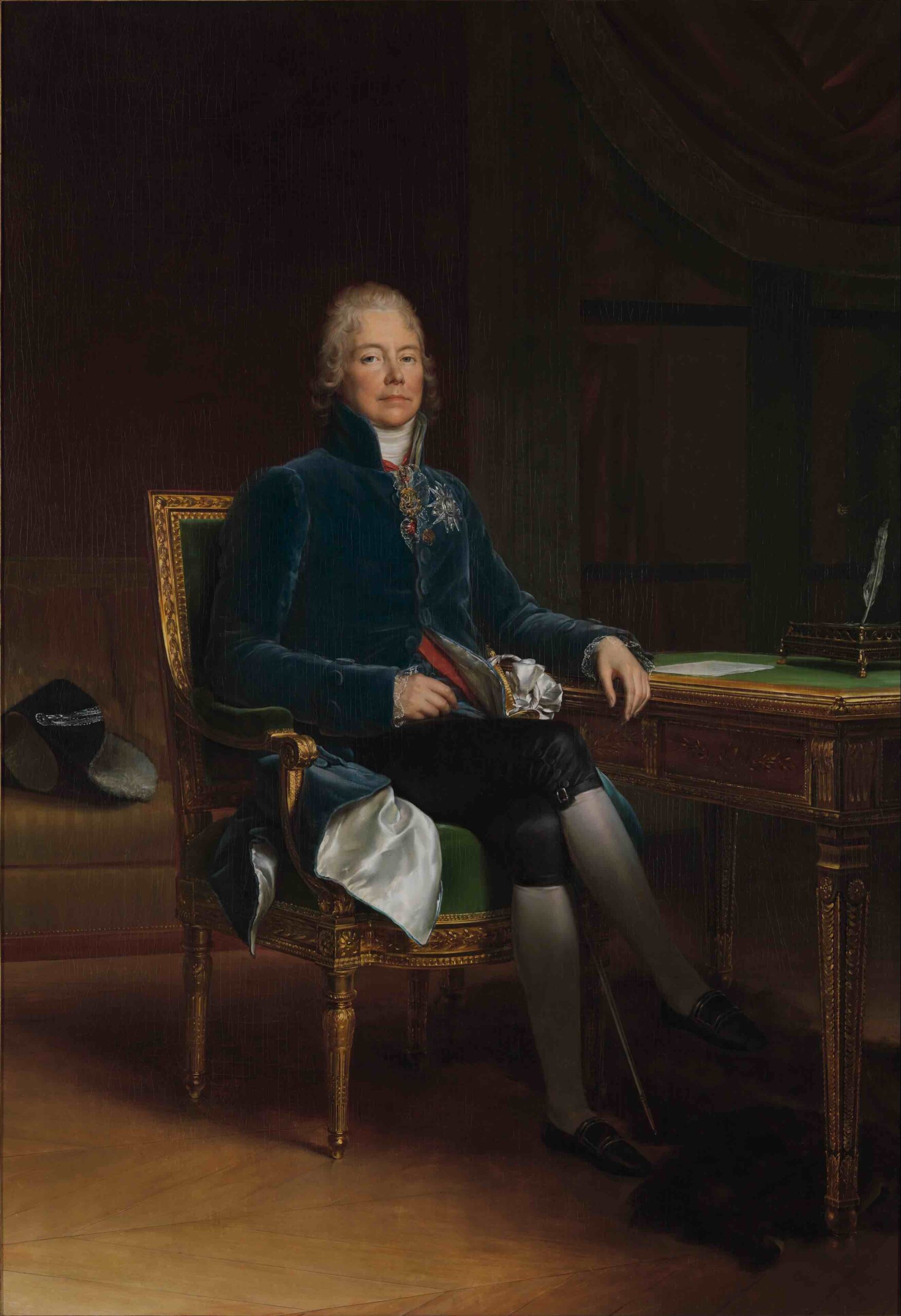
This week on QAV Australia we chatted with James Kirby, one of Australia’s most popular finance journalists. Towards the end of our conversation we discussed his prized collection of antiquarian books. And the book he happened to highlight was one about Talleyrand, Napoleon Bonaparte’s foreign minister. Of course, as I did years of podcasts about Napoleon, this is totally in my wheelhouse, and I’m sure there are some investing lessons to be learned.
For those of you who don’t know the character, let me provide a quick bio.
Charles Maurice de Talleyrand-Périgord, born 1754, fifteen years before Napoleon, is one of those historical characters like Cicero — revered by some, despised by others. I tend to sit in the middle. I admire some of their qualities, while also recognising them as complicated characters who were partly heroic and partly self-serving. In other words — human. He was born with a clubfoot, might have fathered up to two dozen illegitimate children, and was known as a great conversationalist, gourmet and wine connoisseur.
Talleyrand’s parents were aristocrats, but they weren’t rich. As his clubfoot prevented him from a career in the military, they decided the best path to riches was to get him into the church. So they put him into boarding school at the age of 8 and seminary at 16. By age 25, he was a priest. By age 34, a bishop. By age 37, he was out of a job, excommunicated by the Pope, because he supported the French Revolution and rejected Catholicism. Despite that, after the Revolution he was forced to flee Paris, accused of secretly supporting a return of the monarchy. He fled to England, then to the United States, before finally getting a pardon and returning to France to work for The Directory. He then helped overthrow The Directory and assisted the creation of the French Consulate, supporting the political ambitions of the young general, Napoleon Bonaparte. He and Napoleon had a long and fractious relationship. They each found the other to be useful, but there was little trust. Napoleon famously once referred to Talleyrand, to his face, in front of his Ministers, as “shit in a silk stocking”. It sounded fancier in French. Talleyrand ended up switching sides and working for Napoleon’s enemies in and outside of France. During Napoleon’s first exile, Talleyrand worked for the Bourbon monarchy, as he did again after Napoleon’s second exile on St Helena and subsequent demise. He later switched allegiance again, from one branch of the Bourbons to another.
He was quite notorious as something of a diplomatic mercenary. As foreign minister, he wanted to get paid, and paid very well, to represent other nations’ interests back to France. Paid by the other nations, that is. What you might call a bribe. He had a very large network of powerful people around Europe and the United States who knew him and liked to work with him. He was the ultimate diplomat.
Above all, Talleyrand was unsentimental. While he invested in regimes, he never fell in love with any particular regime. His ideology, if he had one at all, was simple: “SURVIVE”. When he thought the church was powerful, he supported it. When he thought the revolution was going to win, he joined it. In exile in the United States, he swore allegiance to the US. He worked for The Directory, then overthrew them and supported Napoleon’s rise to power. When he felt Napoleon’s power declining, he jumped ship again. Then again from one Bourbon house to a rival. He always survived. At the very end of his life, literally the day before he died in 1838 at the age of 84, he jumped ship one last time — he reconciled with the Catholic Church. Just in case he’d backed the wrong horse. This time he was concerned about the survival of his immortal soul.
As investors, we adopt the Talleyrand mindset. Be unsentimental. Survive. Jump ship if a stock isn’t achieving the goals we thought it would achieve when we first invested in it. Of course, we don’t just jump ship willy-nilly. We have our few rules. Rule 1. 3PTL. Commodity charts. Red flags.
But the main rule is to always survive. Don’t fall in love with stocks and don’t gamble. Investing always comes with risks, but we have a system designed to minimise those as much as possible. First of all, it stops us from investing in risky ventures, and, secondly, it extracts us from bad investments before we lose too much of our capital.
If you survive, protecting your capital, and building a portfolio of reasonable investments, holding them for as long as possible, you’ll probably do better than most investors.
Be like Talleyrand. Survive.

QAV Myth Killers is a weekly column in the QAV newsletter, taking apart a piece of
investing conventional wisdom. Read the series, or
get it by email every Friday.
General advice only. Spacecraft Publishing Pty Ltd
trading as QAV is a Corporate Authorised Representative (CAR 001292718) of MF & Co.
Asset Management Pty Ltd (AFSL 520442). This is general information and does not take your
personal circumstances into account. See our
disclosure.