
In last week’s article I talked about long-term double market returns and whether or not they could just be luck. The statistics suggested that isn’t the case.
But how much of success in life is luck? Is “work hard to be successful” a myth worth examining?
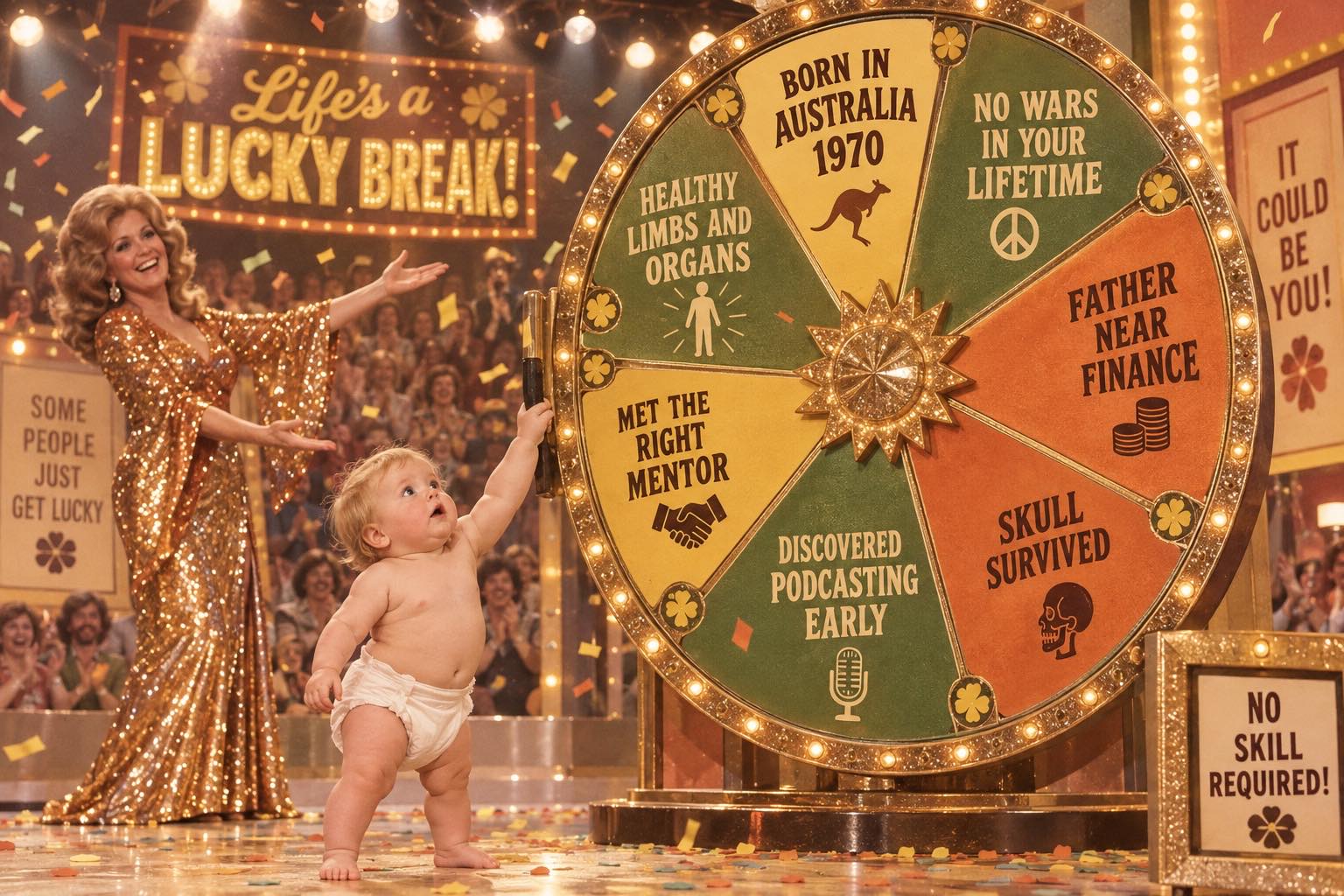
This week I was reading “Richer, Wiser, Happier” by William Green and he tell this cute story about Howard Marks:
“I once gave an interview in which I mentioned that Marks has a high IQ, which has no doubt contributed significantly to his success. In response, he sent me a charmingly modest email, remarking, “People who don’t fully acknowledge their luck miss the fact that being intelligent is nothing but luck. No one does anything to ‘deserve’ a high IQ.”
Warren Buffett believes his success is largely due to luck, and once said that “out of eight billion people, I may be one of the 10 luckiest in the world.” He said it was an “accident” that he gained early exposure to the world of finance thanks to his stockbroker father.
“If my father had been a plumber,” he said, “I would not have had the same advantage I had.” He has a natural talent for investing which has been so much more lucrative than if he’d been a “great violin player or anything else.”
I’m a big believer in the role luck plays in life and that we should embrace it happily. I tell Hunter and Taylor all the time, that being smart and working hard are great, but, at the end of the day, a lot of life comes down to dumb luck.
I always go back to that Al Pacino speech in “Any Given Sunday”:
“You find out life’s this game of inches. So is football because in either game, life or football, the margin for error is so small. I mean, one half a step too late or too early and you don’t quite make it. One half second, too slow, too fast, you don’t quite catch it. The inches we need are everywhere around us.”
He’s talking about a work ethic, but I hear it as a story about luck. Sometimes you’re an inch (or a week or a year) too early (like starting a podcast network in 2004, a few years before iPhones and 5G came along). Sometimes you’re an inch (or a year) too late. You’re Gwyneth Paltrow in Sliding Doors, missing the train home. Or you’re Ethan Hawke in Before Sunrise, meeting the right person at the wrong time.
Back in 2004, not long after I’d quit my job at Microsoft, I was having a siesta in the middle of a week day (as you do) when I dreamed that one of my ancestors, some Irish potato farmer from a few hundred years ago, got to see how I lived. There I was, in an inner Melbourne three-bedroom townhouse with piped heating and aircon, clean running water, plenty of food in my kitchen, health care, books, no brigands trying to burn my house down, no marauding armies, and enough money saved up that I could afford to quit my job at 34 and take a year off to think about what I wanted to do with the rest of my life. They would think I was some kind of lord or a member of the landed gentry. But I had really done nothing to deserve it. I was in that situation mostly because I was just very lucky.
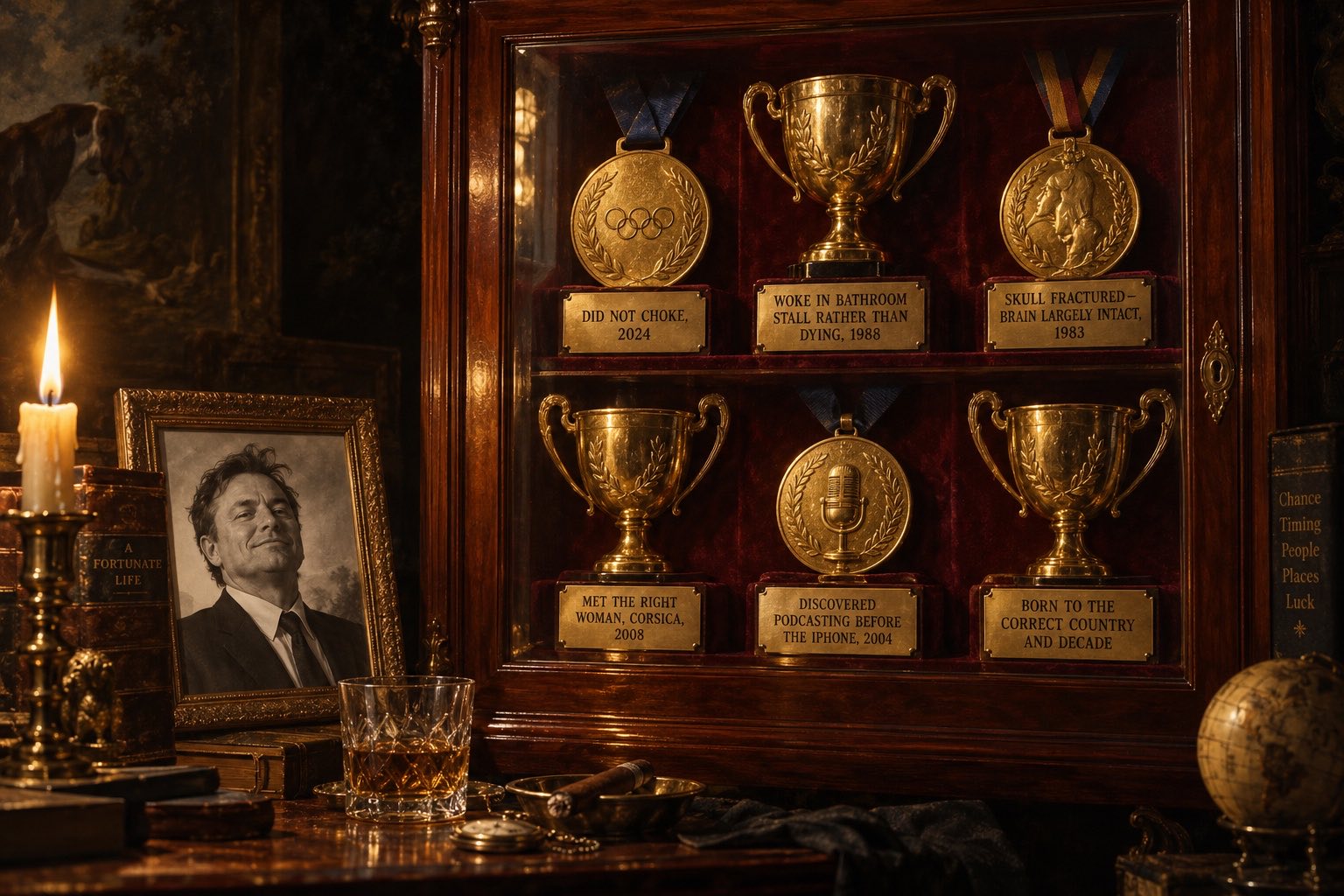
I was lucky to be born in Australia in 1970, growing up with Whitlam’s health care and education. I’m lucky that I’ve never had to fight in a war. I’m lucky that my grandfather, father and children didn’t have to go to war, either. I’m lucky that I was born with all of my limbs and organs working properly. I’m lucky to be relatively smart and to have always had a healthy appetite for learning new things. I was lucky to discover podcasting as a career in 2004. For a guy who loves to read books and talk about what he learned, that was the ultimate “job” (instead of just boring my work colleagues and spouse). For 22 years I’ve been able to just talk about things I’m interested in for a living. It was luck that put me in Chrissy’s path in Ajaccio, Corsica, in 2008 (unlike Before Sunrise, which we’d both seen, we did overcome living on different continents to make it work). I was lucky to meet Tony not long after that, and that he liked me enough (or found me weird enough) to want to be my friend.
I was even lucky when, aged 13, I got my skull fractured when some drunk idiot at the Bundaberg gun range pressed the “pull” button on the automatic clay target thrower without warning me first (I was kneeling in front of it, loading it — that was my weekend job). I should have died — as it turns out, I just have a big section of dead brain matter (which is my go-to excuse when I do something stupid). I was lucky at age 18 when I drank myself unconscious at a Citibank Xmas party and woke up in a bathroom stall at 3am covered in my own puke. I could have easily ended up like Bon Scott. I was lucky a year later when I met one of my first teachers, “Sailor” Bob Adamson, who reconnected me with non-dual philosophy (eg Zen Buddhism and Advaita Vedanta) and probably saved my life as a result.
I was lucky last week that Chrissy didn’t choke on a piece of cauliflower. I’m lucky that I discovered kung fu when I was 50 and my health was declining.
I guess I could say I’ve also had a little “bad luck” along the way — the GFC wiped out my early podcasting momentum, I’ve had two business partners screw me over, I’ve had a couple of failed marriages… but really, I think I’m Charlie Sheen-level #WINNING on the luck scales, all things told. Lots and lots of luck.
Back to the Green’s book (to keep it somewhat investing related):
“One way that Marks keeps his own ego in check is by reminding himself of the starring role that luck has played in his life. After reading Malcolm Gladwell’s book Outliers, which explores various causes of success, Marks compiled a list of lucky breaks that have helped to propel him to where he is today. His streak began with the “demographic luck” of being born to white, middle-class parents in the United States at the start of a golden era of postwar growth… ”
What is luck? As a confirmed eternalist, I think of it as the simply laws of nature playing out. I wear an old rusty bike cog around my neck on a piece of leather string. When people ask what it means, I tell them that it reminds me that I’m just a cog, part of a bigger machine (the universe) and that I started a philosophy called “Cogism” (it has a membership of one).
As the Athenian playwright Euripides (Euripides pants, Eumenides pants!) remarked nearly twenty-five hundred years ago, “How can you think yourself a great man when the first accident that comes along can wipe you out completely?”
Acknowledging luck doesn’t diminish the work we’ve done. It just stops us pretending that we created all of the conditions that made the work possible. Learn to laugh at your luck, both the bad and the good. Embrace the cog.
QAV Myth Killers is a weekly column in the QAV newsletter, taking apart a piece of
investing conventional wisdom. Read the series, or
get it by email every Friday.
General advice only. Spacecraft Publishing Pty Ltd
trading as QAV is a Corporate Authorised Representative (CAR 001292718) of MF & Co.
Asset Management Pty Ltd (AFSL 520442). This is general information and does not take your
personal circumstances into account. See our
disclosure.
Leave a Reply