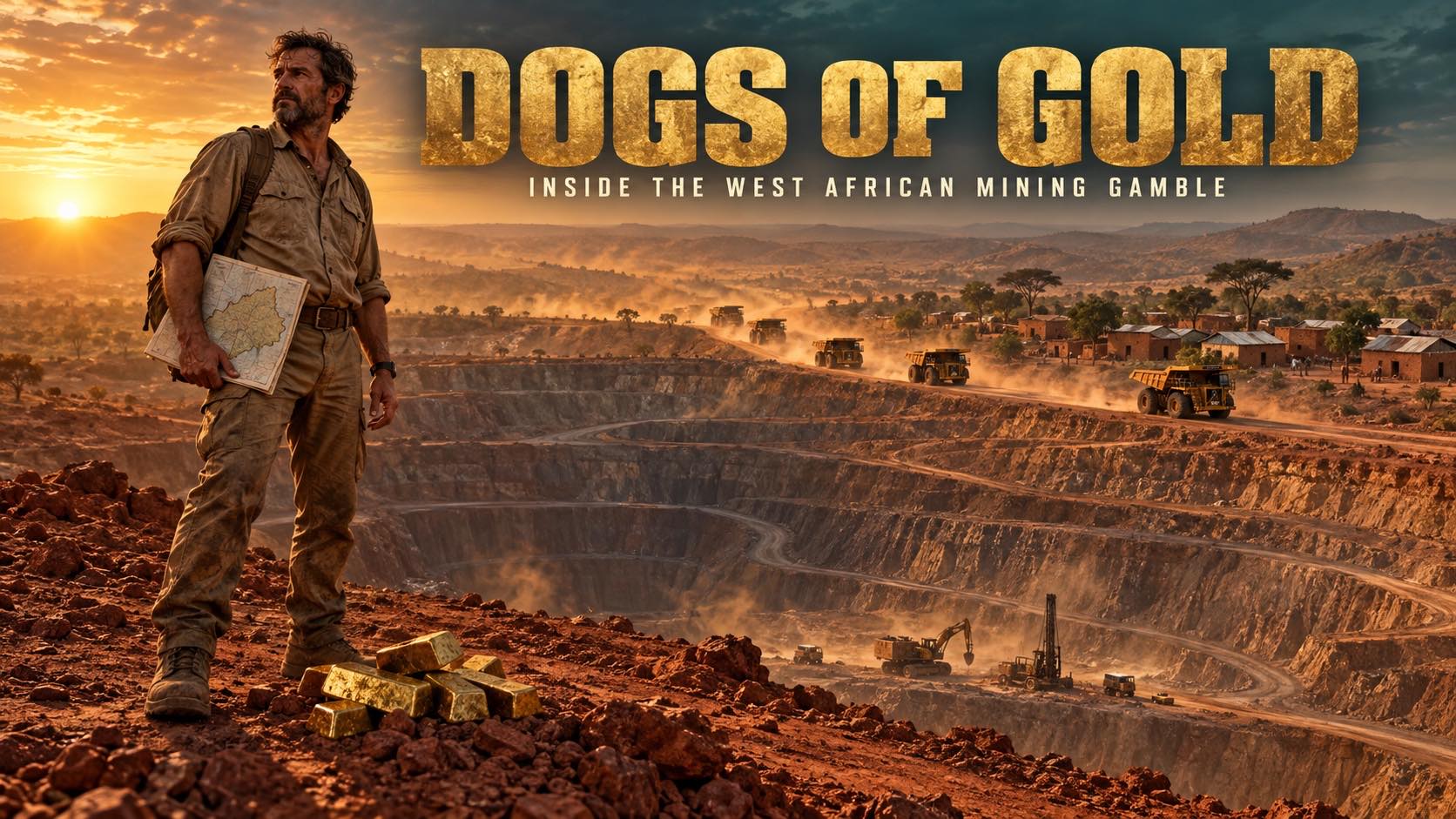
This week we do a deep dive on West African Resources (WAF), a gold miner operating in Burkina Faso that reads more like a Forsyth novel than a company report: private road networks through hostile territory, government free-carry negotiations after military coups, and margins above 100% on gold. Tony walks through the QAV numbers (an F score of nine out of nine, ROE of 41%, QAV score of 0.21) and the very real risks, including what happens to your capital if Burkina Faso becomes a pariah state. We also cover the state of our portfolios, why the gold price is being a Josephine despite global chaos, and oil pushing past $100 a barrel thanks to the Houthis taking out the East-West pipeline.
This week’s full episode is for QAV Club members only. The free episode is available below. Also check out our podcast archives link and our pages on Apple Podcasts or Spotify or watch clips on TikTok. Or visit our homepage to learn more about QAV and how it works as a value investing system that you can learn and apply to beat the market.
Transcription
QAV AU 947
[00:00:00]
Cameron: QAV Australia, TK. 947 is the episode number. It’s 1:05 PM, the 15th of September 2026. What’s going on, TK?
Tony Kynaston: Not much, Cam. I couldn’t find much to talk about today. Nothing’s really changed from last week, has it? Interest rates are likely to rise, oil price is up.
Cameron: the Houthis have destroyed the East-West pipeline Saudi Arabia and taken control of the Red Sea. both WTI and Brent are up well over 100 bucks now. I think like 103 for WTI and 108 for Brent maybe this morning when I looked.
Tony Kynaston: Mm-hmm.
Cameron: yeah, it’s, uh, going well. Perfect. Perfect. Seamless, seamless operation there,
Tony Kynaston: And,
Cameron: Trump
Tony Kynaston: and Northern Ireland should join with the Republic again to form one island. Yeah. Yeah.
Cameron: Yeah,
Tony Kynaston: that’s the biggest problem on the Trump horizon at the moment.
Cameron: I, as an, as [00:01:00] somebody of Irish heritage, I agree with that, uh, too, but that’s, they should, you
Tony Kynaston: Never gonna happen
Cameron: get their independence. OpenAI has canceled their IPO plans for year while calling for a general slowdown uh, the, uh, AI development because we’re all gonna die if they keep it up at their current pace.
But you’re a cynical, but as I said, quoting,
Tony Kynaston: I’m not cynic. I agree with them. They, we should slow it down or regulate it or something, but they’re not gonna do it.
Cameron: You
Tony Kynaston: just saying that. No
Cameron: As I, as I told you, I was listening to Yes Minister audiobook again the other day, and it was one of the lines was, cynic is what an idealist calls a realist.”
Tony Kynaston: Yep, I’m a realist.
Cameron: Yeah
Tony Kynaston: Uh, it’s, tell it as you see it. But, um, it’s an arms race. It’s exactly like the nuclear arms race, in my opinion. You only, it only ever levels off or the. Like, I wouldn’t say the threat goes away or diminishes, but mutually assured destruction is the only strategic outcome that [00:02:00] protects us, I guess, to a certain extent
Cameron: Protects us from what?
Tony Kynaston: an existential event
Cameron: Okay. But what’s the mutually assured destruction? Mutually
Tony Kynaston: you don’t, if you,
Cameron: humans and AIs or
Tony Kynaston: between AIs. I mean, it’s, AIs are fairly analogous to nuclear weapons in this context. They’re, they’re both. If one unleashes one, if one country unleashes one, another country’s gonna copy it quickly and unleash it back and whatever the destruction scenario is, biological weapons, destruction of infrastructure, whatever.
Um, no one’s gonna survive
Cameron: Right, but I don’t think it’s country versus country which is the threat. I think it’s AI versus humans which is the threat
Tony Kynaston: Yeah, but that’s like saying nuclear warheads versus humans. It’s just the tool, isn’t it?
Cameron: Well, except in this case, the tool is intelligent and, uh, you know, may decide that we’re unnecessary
Tony Kynaston: yeah. I [00:03:00] think it’s more likely there’s a side we compete for resources with it. That’s generally how things go. Yeah
Cameron: Yeah. It’s the, uh, the ultimate paperclip scenario, I think it’s called, something like that. I mean, there was a. It’s, it’s a sci-fi meme that’s been around for decades, but somebody gives an AI the plan to build a better paperclip, and it decides that the way to build a better paperclip is to completely mine the Earth, uh, you know,
Tony Kynaston: Yeah.
Cameron: you know.
Tony Kynaston: Yeah
Cameron: what happened with the Hugging Face hack, is
Tony Kynaston: Mm-hmm.
Cameron: it some relatively, uh, mundane task, and it decided the best way to achieve that task was to break out and go and hack Hugging Face. So yeah, which is why everyone’s freaked out. Anyway, that’s not what people came here to talk about, you and I prognosticating about the future of the world. Let me, Because we have
Tony Kynaston: ‘Cause we’re so good at that.
Cameron: A, A, I’ve been doing this for a long time, [00:04:00] and I’ve been right. Uh, yeah, I said podcasting was gonna be big. Was I right? I also
Tony Kynaston: It’s big in our lives.
Cameron: Yeah.
Tony Kynaston: You and me
Cameron: Um, the model portfolio up 16.4% per annum versus the SPDR 200 up 7.7% per annum. So doing above double market on that.
The light portfolio is up 19.6 per annum versus the SPDR up 9.8. So not too shabby, both of those. And the American portfolios are doing good to. Well, actually, let me backtrack. The US model portfolio, which was doing double market, is now only doing, mm, 50%. Um, it’s, uh, 105.8% versus the S&P up 71.5%. It’s come back [00:05:00] quite a bit from when it was doing double market, thanks to oil shenanigans among other things. QAV America light portfolio, which was underperforming for a while there, is now outperforming the S&P. It’s up 12.4%, this is only since December last year, versus 10.8 for the S&P 500. So they’re both, all of our portfolios are above water except maybe the light 221 portfolio. I think that’s still struggling.
Let me see. 7.5 versus 8.43. It’s still slightly underwater. Never really got back above that line since the, uh, invasion of Ukraine. But, uh, it’s nearly reached parity. The rest are doing, is up 13 versus seven. 223 is 22 10, 23.1 is 24 versus nine and a half. So yeah, the other three are pulling it up.
But that first one, still trying to [00:06:00] see the light of day and, mm. And it’s also only, doesn’t have many stocks in it too. I think it’s only got like 10 or eight or
Tony Kynaston: Oh, really? Okay. Right
Cameron: Anywho, uh, US economy great. Um, interest rate rises are predicted for this week. Oil prices gone up.
Diesel, it’s all Zelensky’s
Tony Kynaston: but they get $5,000 back, Cam, after the midterms.
Cameron: but we’re gonna give you all a $5,000. “And the economy can handle it, no worries,” Donald Trump says. “No
Tony Kynaston: Yeah. and
Cameron: in the kitty for
Tony Kynaston: I think the check for the, uh, tariff dividend got lost in the mail. That was $2,000 a head. And the DOGE dividend, I think that one got lost in the mail, too. The mail service in America’s not that great, is it?
Cameron: Well,
Tony Kynaston: get through
Cameron: Well, yeah, the tariffs got put the kibosh on by the Supreme Court, so
Tony Kynaston: Ah,
Cameron: now, you know
Tony Kynaston: right. So if you got a [00:07:00] tariff check, you have to send it back, do you?
Cameron: I don’t think anyone got tariff checks, companies that
Tony Kynaston: Yeah
Cameron: I don’t know. Oh, no, they paid tariffs. They’re trying to get it back. Uh, the market today is not good. The All Ords is currently at 8847. It’s dropped from 9414 on the 26th of August. So the last three weeks it’s come back quite a bit. It’s, uh, back now to where it was in June of last year. We’ve lost, um, over a year’s worth of progress there. Uh, that’s not, actually, you go back even further. Um,
Tony Kynaston: Yeah, it’s been over nine thousand for a while now, but, um, market’s expecting interest rate rises and it doesn’t like it, and it doesn’t like, you know, where the housing market is and the impact that’ll have on consumer confidence, et cetera, et cetera
Cameron: Well, we’ve basically gone back to where we were [00:08:00] February 2025, February last year. It’s gone down low as seven and a half, up as high as nine and a half, give or take. yeah, we’re back down. So it’s, um, not a good, not a good year for stocks in general at the moment. We’ve sort of been moving more or less sideways if you look at it over the last year.
Tony Kynaston: Mhm
Cameron: Hmm
Tony Kynaston: Living off dividends
Cameron: Great, great, um, Bon Jovi song from 1986. Living on a dividend. Yeah. Take my yield and I’ll make it I swear, oh, oh. Um, I got nothing else, Tony. I got no, no news really this week. It’s just the world’s going to hell.
Tony Kynaston: Yeah, I don’t know about that
Cameron: life. Did you see that in my
Tony Kynaston: I did, yeah. You.
Cameron: was my big news for the week
Tony Kynaston: Well, that’s big news
Cameron: [00:09:00] It was big news for me.
Tony Kynaston: Ooh.
Cameron: I tell you, man, there was a moment there when I was performing the Heimlich on her and realizing I had no idea what I wa-
Tony Kynaston: Yeah
Cameron: thinking, “She’s gonna die ’cause I didn’t know how to do this properly, and I’m, and I’m gonna have to live with that for the rest of my life.” But fortunately, I’ve must have done it well enough. She pulled through. But, uh, yeah, that was, that was scary
Tony Kynaston: Is it like that Sam Rockwell movie, Choke? The Pa, Palahniuk, what’s his name? Chuck Palahniuk, who wrote, uh, Fight Club.
Cameron: Oh, yeah. I that.
Tony Kynaston: No, it’s good.
Cameron: was.
Tony Kynaston: Yeah. The lead character makes a living out of, um, going into restaurants and choking on the food until someone does a Heimlich, yeah, to do a scam, get a free meal.
Cameron: Right. Oh, I have to check that out. You know I love me a bit of Sam Rockwell.
Tony Kynaston: he’s good
Cameron: Uh, yeah, you think she was scamming me? She was trying to get, uh, a free meal
Tony Kynaston: A [00:10:00] free cauliflower? Yeah.
Cameron: Yeah. No, those sorts of things, uh, put everything into perspective, I tell you, you know.
Tony Kynaston: Hmm.
Cameron: big news for the week. Um, stocks wise, just ticking along. What about the, um, commodities apart from. Gold’s a Josephine. You’re gonna talk about a gold stock today, even
Tony Kynaston: I am. Yeah. Well, uh, I thought, uh, I thought twice about it, but we didn’t have many big ADT stocks on the buy list to talk about that we haven’t spoken about. So I’ll talk about West African Resources, which was new this week. Um, even though the gold price is a Josephine, they’ve delivered some good results, so their stock price is up.
So I thought it’s worth having a look at
Cameron: I wanted to ask you about the gold price thing though because like as we know, as we’ve said, the world’s going to hell. Um, US economy’s going to hell. Um, everything’s, oil price is going to hell. But, and [00:11:00] usually when things are like that, gold price is going
Tony Kynaston: Yeah.
Cameron: price is going down.
Tony Kynaston: Yep
Cameron: It peaked back in February.
It’s been coming down more or less ever since. Did spike a little bit July and August by the looks of it, but, uh, it’s back down now. how do you, how do you think that
Tony Kynaston: Yeah. Well, funnily enough, I did a bit of research on that because I had the same question and it, it looks like, um, I guess if you trace it back to the start of the Ukraine war when a lot of the Russian assets were frozen, a lot of the central banks, not necessarily the big countries, but some of the, um, some of the, uh, smaller players said, “Oh, okay, we don’t wanna have our assets frozen, so let’s start hoarding gold.”
So central banks started buying gold. Um, gold price ran up and now they’re kind of selling off to rebalance a little bit. Don’t wanna be too exposed to the one asset. Uh, so yeah, that’s probably the biggest [00:12:00] thematic. Um, also too, the US, it often, the US dollar, if the dollar’s high, the gold price goes down a little bit.
Uh, there’s a little bit of that going on because the US dollar’s recovered a little bit. If the US dollar sinks, it’s the same sort of argument that the central banks don’t want their US denominated treasuries to reduce, so they hedge in gold. Um, but the dollar’s been stronger recently, so that’s, uh, stopped them from buying.
Um, and the other thing is with interest rates rising, gold doesn’t have a yield, so the further it gets away from interest rates, the more it drags money towards bonds rather than gold. Um, so when interest rates are low, people often say, “Well, I’ll buy gold. It’s, you know, the yield’s not that important in my thinking at the moment when I’m looking at where to park money safely.”
Cameron: Right
Tony Kynaston: So all those kind of things are playing out. Um, a lot of the big banks are saying that, uh, the [00:13:00] reduction in the gold price recently is probably running its course and it might start to turn up, but they’re not seeing it as being a continuing trend. They’re seeing it as being just a, a bit of a cycle at the moment with a higher US dollar and central banks rebalancing.
Cameron: Wasn’t everyone saying that China was driving it up six months
Tony Kynaston: Yeah, well, they were,
Cameron: stocking up
Tony Kynaston: Yeah, that was part of the, um, the let’s get out of US dollar assets and the, you know, and ones that we can’t, uh, put our hands on if they get seized by a foreign country. So yeah, they were, they were stocking up on gold
Cameron: Hmm. Hmm. right. You got anything else to talk about or you just wanna get into
Tony Kynaston: Yeah, let’s get into WAF. What a great story. Uh, I know I’ve talked about them before, and I think we’ve talked about them at results times in the past, but it’s been a long time since I’ve done a Pulled Pork on them. It wasn’t in our list, so it’s, it’s, you know, goes back a long time. Uh, so if I, if I frame the discussion like this, I’m, I’m [00:14:00] gonna talk about an organization that deals with armed gunmen, runs a network of private roads through enemy territory, has embedded itself in the local community, invested heavily to cement its place by building schools and buying hospitals, endearing itself to the locals, uh, and then does it all it can to defend an operation delivering a product that it can sell for at least 100% margin.
What does that business sound like to you, Cameron?
Cameron: The Mob
Tony Kynaston: Yeah, that’s the first thing I thought of too. But this is West African Resources. It’s, it’s kind of their business model.
Cameron: right
Tony Kynaston: So as I said, gold’s a Josephine, so we’re kind of doing this one now almost academically, um, so you understand what it is and, uh, can buy it again when, when gold turns up.
But, uh, the share price is going up. It’s ticked up recently on the back of some good results. Uh, why are the results good when the, when gold is a Josephine? So the gold price is trending down a little bit. Um, and [00:15:00] it’s really around their, their excellent results. So this half marked the first full six months of operations from both the established Sanbrado mine and a new growth project called Kiaka.
Uh, both of those are now delivering almost 500,000 ounces per year, um, which they’re pretty close to. They’ll probably do in the next half, which has always been their long-term plan. And I, I should also say that they’re, these guys are based in Burkina Faso, in, um, West Africa, as their name suggests, West African Resources.
Um, they’ve really done a good job at, at ramping up gold production in the area, keeping their costs down, and they’ve done such a good result that they’ve also declared a special dividend of 20 cents per share. And bear in mind, it’s unfranked because it, um, the income’s generated outside of Australia, so you don’t get franking credits on it.
Um, but that [00:16:00] high-yielding capital returns caught the attention of some income investors, and they’ve been buying up the stock as well as people who are impressed by the results. Um,
probably if I can talk a little bit more about what they are. So even though they’re headquartered in Perth in WA, they operate in Burkina Faso. They have, uh, three major projects. A couple I’ve spoken about, the Sanbrado, which is their foundation project. It’s been going since 2020, uh, and it’s delivering maybe forty percent of their gold production at the moment.
Kiaka is the new one. It’s, it’s within forty-five Ks of Sambrado. It’s been, um, ramping up since twenty twenty-one. It was ac-acquired from another company called B2Gold, and, um, it’s one of the largest gold mines in Burkina Faso. It’s also, uh, likely to produce more or e- about the same or more than the Sambrado project.
And then they [00:17:00] have a new one called Toiga Gold, which is thirteen kilometers away from Sambrado, and that’s pretty close to, um, production. So I expect th-this company again to have another leg up in terms of its gold production. Uh, founded by a chap called Richard Hyde. He’s the owner-founder, executive chairman still.
Uh, he’s an Australian geologist with over thirty years of mining experience. Uh, he spent more than twenty-five y- of those years operating directly in West Africa, founded WAF in two thousand and six, led the IPO in twenty ten. He, um, doesn’t have a big stake at the moment. He’s got one point five-ish percent of the company, but that’s still worth nearly sixty million dollars at the moment on current prices.
So he’s still got a meaningful stake, even though he doesn’t qualify as an owner-founder from a checklist point of view. bit of a history lesson, they, uh, listed in 2010. 2015, ’16, they [00:18:00] discovered, um, the M1 South gold deposit at Zambrano and then started to, um, develop that as a, as a mine. 2020, they pulled their first gold from Zambrano, and that was six months ahead of schedule and 20 million under budget, which is kind of, it’s been the history of this company of, um, under-promising and over-delivering, which is, um, you know, uh, well-received by investors.
And then, um, in 2021, they, uh, uh, acquired, uh, another big deposit, the Kiaka deposit, and in 2025 pulled their first gold in June. Uh, and so by mid-2026, the latest results, they’re putting out around 450 to 490,000 ounces per year. And their long-term plan’s always been to be a, a 500,000 ounce per year company, which is, which is pretty good.
Um, that puts them into the sort of high end of the mid-tiers, [00:19:00] uh, in gold production ranks if they were, if they were operating in Australia. They’re based in Australia and listed here, but operating overseas. And it’s that, it’s that, um- That sovereign risk of operating in Burkina Faso, uh, which is the interesting part of the story and the reason why it comes up on our buy list because this, this company, if it was operating in Australia, would probably worth, be worth three or four or maybe five times the value.
And you can certainly pick comparables in Australia, and they, they do trade on multiples of the valuation of this company. So how, how risky is Burkina Faso? Uh, well, it’s, it’s had two military coups, um, in the last four or five years, so it’s, it’s very risky. Um, what is West, what is West African Resources doing about that?
Uh, well, along the way, they’ve done a couple of things. Um, they have decided to buy all their own equipment, [00:20:00] which includes a, a fleet of Caterpillar trucks and, uh, drilling equipment, and to stock their workforce with local, uh, people from, uh, the area. And so over ninety percent of their, their workforce is, um, from Burkina Faso.
And they, they call it heavily protecting their social license to operate by investing millions back into regional infrastructure, hospitals, local development funds, um, and training in particular so they can train up their employees. They also invest heavily in OH&S to, uh, keep the local inhabitants safe, and they boast a lower, uh, lost time injury frequency than the, the WA average for gold miners.
So, um, the WA being Western Australia, not West Africa, for gold miners. So they’re doing a lot to, to keep in the good books of the local community and the local government. Um, the reason for owning their own [00:21:00] equipment is, is what they found in the past was that, uh, as soon as there was an outbreak of, um, military action in Burkina Faso, and that is something which happens, uh, unfortunately with some frequency, if, if you have external contractors, they generally get on a plane and leave, and so the mine, um, has to shut down.
So they wanted to, um, to insulate themselves from that risk by hiring locals and having their own equipment. Um
The other, other thing that they have done is as the governments have changed, they’ve gone on the front foot and negotiated directly with the highest levels of government. Um, I guess they’re at pains to, to talk about not dealing with the, the people who are holding the machine guns and doing the coup, but they’re, they’re not dealing with the lower or middle levels of bureaucracy either.
But the upshot of all that is that the government has what’s called a free carry interest in the operations [00:22:00] of this company. So the, some of the, of the operations or some of the local gold mines are actually, um, o‑owned via a corporate structure in West Africa, in Burkina Faso, and the government has what’s called free carried interest in those local operating companies.
And, um, uh, they originally gave the government a ten percent interest in the mines, and now it’s been up to fifteen percent with, uh, some of the latest, uh, deals that have been done to keep operating when the government has changed. Um, having said that though, even though they’re, they’re giving a 15% free carry to the government and they also have to pay out a dividend, um, to the government, uh, every year of, uh, based on what they earn.
They’re still highly profitable. So they’ve decided to, um, to, uh, get in bed with the government and give them an interest in, in the gold mines, give them a dividend out of the gold mines, knowing that they’re still gonna make a lot of money from the [00:23:00] gold mines. And gold’s important to the government and the economy of Burkina Faso.
It’s, I’ve seen reports of it being between 70 and 80% of the exports from this country. So the government, the government isn’t about to shut down the mines. They, there is always the risk that they nationalize them and take them over. But, um, West African Mining has tried to make, you know, themselves ingratiated to the government so it’s, uh, more of a sensible option to let them continue to keep operating the mines and to pay a, a dividend, um, back to, back to the government instead.
So they’ve done a lot of deals along the way. Um, the other thing that they do to operate in, in this area and operate successfully is to, uh, run their own network of roads, um, around these projects. So as I said before, Kiaka is fif- 45 kilometers away from Sambrado. The new mine is about 15 kilometers [00:24:00] away.
Um, they’ve, West African Resources have built their own network of roads that run through the villages which house the employees who work in the mines and so the villagers are more likely to have eyes on the road and let, let the company know if there’s a, you know, someone’s trying to set up a roadblock to rip off the, the trucks as they go through or whatever.
Um, so these dedicated private corridors allow West African Resources to keep their trucks hauling off public roads where possible and to keep that, I guess, uh, highway of trucks, um, heavily monitored, um, through their own, uh, network of, uh, of roads and through the people who are directly employed and benefit from the employ- employment in the businesses.
So it’s, um, interesting how they do that. Um- What else can I say about them? That’s pretty much. Oh, yeah. So I did come across an article, uh, in The Fin from twenty [00:25:00] twenty-three which talked about this issue, and they quoted, uh, this, the executive chairman, Hyde, who was saying that, uh, who said he’s realistic about Burkina’s sovereign risk profile but notes the nation’s gold mining industry is too big to fail.
So that’s the other thing too, is that, um, they’ve kind of built themselves up, them and some other companies, one being a Canadian company called Endeavour Mining, as being an industry that’s, uh, too big to fail and if the government tried to take it over or shut it down, then they, they’re gonna really impact the economy.
So the article goes on and quotes Hyde as saying, “We don’t have a lot of conversations with the junta directly, but we know that in our discussions with the government, gold mining in Burkina makes up eighty percent of the country’s export revenue and is critical to the country. It’s a developing country, so they know they need to keep all the gold mines operating because we provide a lot of employment and almost all the export revenue.
We go to Africa because the projects are better. We would rather work on good [00:26:00] projects in a challenging jurisdiction rather than challenging projects in a better jurisdiction. That is the reality. If you look at the West African gold producers, generally we are making a lot more free cash flow per ounce than our Australian counterparts.
As we should. We are dealing with different risks,” Mr. Hyde said. ” Investors need to be comfortable trading project risk for juris-jurisdictional risk.” Uh, that’s, um, a quote from a chap called Darko Kuzmanovic, and he helps manage Janus Henderson Investors’ Global Natural Resources Fund and said the gold mines in Burkina and Mali tended not to be located in the most dangerous parts of those nations.
He says the best placed gold companies today are West African ones. They’re, they’ve delivered new mines and that means they are much more efficient and they haven’t seen the same cost inflation that a typical West Australian gold miner has faced. Um, so Perseus Mining also operates in the area.
Canada’s B2Gold [00:27:00] also operates in the area and they throw off lots of cash. Uh, the article continues, “If the valuation discount compared to less profitable peers such as Ramelius, Mr. Hyde may need to find alternative ways to reward shareholders than by continuing to hope for capital growth in the share price.
Hyde says, ‘Once we’ve got Kiaka up and running, it is time to pull back and start paying dividends, or do we look for a third project?’ ” he said rhetorically. And of course, they paid a special dividend this half. So I guess that answers that question. Um I wanted to put sovereign risk into, I, I guess a sort of comparative framework, and I’m k- gonna compare the risk we’ve just spoken about from, uh, coup d’états and the government in Burkina Faso with the risk that gold miners face in Australia.
And one that was called out last year was Regis Resources and its attempt to get the McPhillamys Gold Project, which is operated, uh, which is, uh, located in the Bathurst Orange [00:28:00] region of New South Wales. And the McPhillamys saga is just a textbook e- um, example of the regulatory meat grinder that companies can go through in Australia to try and get it up and running.
So this gold project, um, was approved by the New South Wales Government in March 2023. But then surprisingly in August 2024, just as the company prepared to start construction, the Federal Environment Minister intervened and, um, a declaration was made protecting a section of the Belubula River, which is where, um, this gold mine was, was chosen to construct this critical tailing storage dam.
And so the mine was, was halted. So, uh, the, the company, Regis Resources, backed away from the project and said it wasn’t viable in its current form. Uh, so that’s, you know, there’s sovereign risk, I guess, across the globe in all different forms. Um, I guess we have to assess whether Burkina Faso, [00:29:00] with its own risk, is different to the kind of risk that companies face here.
And there are also, of course, different ways of dealing with the risk in Burkina Faso and its West African, um, Resources, uh, way of dealing with it is different to other companies that operate in the same area. So Endeavour Mining, which is a Canadian-based company, uh, doesn’t do the same things that, uh, WAF does, and they do use, um big contractors to operate their, their, um, gold mines in, in West, in Burkina Faso.
Uh, in fact, they, Endeavour Mining uses, um, Perenti, which is an Australian mining services company, and Perenti signed a five-year, $1.1 billion contract with Endeavour Mining to operate the underground mines in Burkina Faso for them. Um, but one thing that, uh, Endeavour has, which West African doesn’t [00:30:00] have, is it’s diversified across the region.
Um, so they don’t operate just in Burkina Faso. They also operate in Côte d’Ivoire and Senegal, and they assess jurisdictional risk, and if it gets too high in one area, they actively divest assets and move, um, quickly somewhere else. And that’s one of the, one of the easy, one of the ways of facilitating that is to have contractors that you can terminate if you need to move on quickly.
So there are different, different ways of coping with this. Um,
I think this is, this is really about a risk-reward, uh trade-off, I guess. And again, to, to give it some context, the results, uh, for West African Resources in dealing with all these problems have really paid off in spades this year. So if I compare KPIs for 2026 first half versus 2025 first half. Gold production [00:31:00] has jumped from ninety-five thousand ounces in 2025 to two hundred and thirty-three thousand ounces in 2026.
So, you know, that’s two and a half times. Uh, they’ve likewise, uh, had a big jump in what they’ve sold. The realized gold prices helped that. So, um, the gold price, uh, went up even though it’s come back down again now. They were realizing, uh, in 2026 four thousand seven hundred US an ounce versus three thousand and forty-nine US an ounce in 2025.
Um, the all-in sustaining cost, which is, you know, one of the key metrics for gold companies, has gone up by some thirty-two percent. Uh, and part of that is that jump in the, uh, free interest carry that the government now gets from ten percent to fifteen percent and the dividends that get, that get pa- that get paid.
But with a gold price over four thousand US and, uh, [00:32:00] even with the all-in sustaining cost of eighteen hundred dollars, they’re still making more than a hundred percent margin out of, um, out of, uh, selling gold. So it’s still highly profitable. Uh, revenue was up, um, from four hundred and seventy-seven million to one point four six billion, and net profit was, um, more than doubled from two hundred and fourteen million to four hundred and thirty-seven million.
Both of those are Australian dollars. Operating cash went up nearly four times from a hundred and fifty million to nearly seven hundred million. And I guess importantly as well in all of this is that they now have just under a billion dollars worth of cash and bullion on the balance sheet, and, uh, that’s up from two hundred and seventy-nine million dollars the year before.
So bringing that, uh, Kiaka plant fully online has caused a big increase in revenue and profit. Um, th- they have, um, unhedged sales, so they were [00:33:00] able to capitalize on the increase in gold price. Um, but yeah, they had to, they, um, AISC, their all-in sustaining cost went up, um, but they were able to pay a special dividend and to bank a lot of, um, uh, cash and gold on their balance sheet.
I’ll, I’ll get, come back to that in a little while, but I’ll go through the QAV numbers first. So remembering the, the gold is a Josephine, so I’m just gonna run through these numbers. Um, not saying that we should look at buying it just yet, but, uh, they’re pretty compelling numbers. So, um, it’s a h- high ADT stock.
It does, uh, twelve point eight million on average per day in trade. Price for the analysis is three eighty-five. IV1 is three thirteen, but we have no IV2 because there’s no consensus target. And that’s one of the interesting things about this company. So it’s a top two hundred company, and it’s probably knocking on the door of being a top one hundred company, uh, you know, as the share price goes up.
But we don’t get a [00:34:00] consensus target. And that’s even though there are, um, a number of, uh, mid-tier brokers who cover this, there are no top-tier brokers who cover it, and that’s largely because of the, um, sovereign risk, uh, that they see with the stock. So they’re not gonna cover it from that, uh, point of view, which gives us a bit of a leg up if we’re interested in buying it, uh, ’cause there’s no, uh, there’s no consensus value in Stock Doctor or forecast earnings per share.
Stock Doctor financial health is strong. The trend is steady. Um, we don’t have a yield for this stock, even though it’s paid a special dividend. It’s, it’s not a recurring dividend, so the yield is zero, so we can’t score it for that. Stockopedia rank it very highly. I’m just gonna take a minute to run through their scoring.
So from a quality perspective, Stockopedia give this ninety-seven in their ranking. From a value perspective, ninety and from momentum, ninety for a total ranking of ninety-nine, which is really high. And [00:35:00] an F score of nine out of nine, which I rarely see. So perfect F score for this one. Um, so very highly ranked by Stockopedia.
ROE, if you’re interested, is forty-one percent, again, incredibly high, especially for a gold mining company, which is putting a lot of money into infrastructure and paying off the government with a special dividend, all those kinds of things. Still recording a PROPCAF of three point three times. PE is just under seven, um, and it narrowly misses out on being the lowest in the last, uh, six halves, so we can’t score it for that.
It’s a new three-point trendline upturn. The, the price was turning down, I guess, in line with the gold price until it had this special dividend and good results announcement. Now it’s turning up. Uh, it, this is a company with an increasingly, um, with, with increasing continuous equity, continuously increasing equity, so that’s a, a positive, I think.
We can’t buy it for book plus thirty percent, which is two dollars twenty-seven. [00:36:00] Um, we don’t have a forecast growth, so we can’t score it for growth over PE. And the founder, Richard Hyde, um, and the board only own two percent, so we can’t score it for owner founder, even though he still, um, has a legitimate stake in the company.
So overall quality score is eight out of twelve or sixty-seven percent, and the QAV score is point two one, which is reasonably high. That leads me to the risks and, and trying to assess those. So I think the first risk is Richard Hyde’s done a great job of of running the, the maze of dealing with the West African government and dealing with the locals and keeping your social license up to date.
Um, so there’s a risk that he’ll leave. However, I think they’ve recognized that, and there’s been a lot of work at, uh, bringing the COO, Lyndon Hopkins, into most of the discussions and putting him in the middle of, of everything that goes on at, uh, this company in Burkina Faso. So it looks like it’s [00:37:00] being set up to hand over to him, uh, which is a, a nice structured way of doing it.
Um, and with, with ninety percent local workforce and, and strong community ties, it, this may well, um, survive the founder leaving. Uh, I think another risk we have is that, um, the free interest carry increases. Um, so the government, uh, asked for an extra five percent this time. Um, what’s gonna happen next time there’s a coup?
So that is a risk. And I think two things that mitigate that are that there is a lot of, um, margin to absorb that kind of, um, increased payment. Uh, and I think the social license is valid for this company, that, um, if it is, if it is, I guess, leaned on too heavily by the government and they start having to cut back on workforce or anything else that they [00:38:00] do that might affect the local economy, there’ll be blowback to the government.
So I think there is a, a kind of dance to be done around that. I’ll, I’ll call it, um, a reality check on, um, on, uh, an increase in that dividend, but it’s a risk. I think the biggest risk for this company is that Burkina Faso becomes a pariah state. And I, I note that the current, um, leader of the country, a, a guy called Traoré or Traoré, has already aligned himself with Russia and is ceasing ties with some Western countries.
So to a certain extent, um, they’re progressing down a path which could lead to that. Um, but that, that hasn’t happened and, uh, everyone still trades with them and buys their gold, so it hasn’t affected West African Resources yet. But there are cases where companies, mining companies operating in jurisdictions which have become pariah states have had to shut down and move.
Um, so for [00:39:00] example, Resolute Mining, um, well, they didn’t shut down and move actually. They got through this. But they, that was the company you might recall where the CEO, um, was held, uh, in detention while the government negotiated
Cameron: He was, he was a guest of the government
Tony Kynaston: to the government, yeah, for like negotiated new, uh, royalty.
Cameron: Hmm.
Tony Kynaston: the company, the, uh, the, the company I think eventually, uh, come to a deal and the CEO was released.
Um, the stock did
Cameron: moved to London.
Tony Kynaston: Right. The stock did drop 30% after that, so that, that is a risk. Another one, um, which is probably a better example was a company called Tiger’s Realm Coal, which were operating in Russia in 2024, and then when the, uh, Ukraine war started, um, they were delisted from the ASX, uh, and shareholders did suffer a near 100%, um, loss, uh, of their market value.
So, um, there [00:40:00] are, there are some real possibilities that that could happen here. The only mitigating factor, I think, for West African Resources is it does hold this $876 million in cash and bullion, um, offshore from, from, um, uh, Burkina Faso. Now, some of that, if there, if there ever happened to be a problem with trading in, um, in Burkina Faso and the borders were shut or, uh, you know, corporations weren’t allowed to buy the gold that was mined there or whatever, um, that would be a problem.
Um, the mine would probably shut because, A, they couldn’t get sales, but, uh, you know, they import a lot of their, um, operating needs from other countries. So, so they’d need to buy explosives, um, which wouldn’t, wouldn’t be available to them if the, if the state was a pariah. Um, so they would probably have to rely on.
Well, the only asset left for shareholders would be that, that gold, which is only about 76 cents a share, um, when [00:41:00] the share price is well north of that. And of course, um, I, I would think lenders to this company would, would get first dibs at that gold, and there’s currently about $388 million of debt. So if that gets taken out, um, shareholders are left with about 47 cents a share in unencumbered cash or gold backings for the company.
So, um, you are taking your risk that something happens and, and it becomes a pariah state and you get, you know, your market, uh, price goes down to 47 cents a share. Um, and that risk probably is not comparable to, say, Regis Resources in Australia. Um, they did take a hit and write down their McPhillamys gold project, but they had plenty of other ones to, um, to, uh, offset that and their share price recovered.
So, you know, the question in my mind is, is West African Resources a rule one risk? In other words, um, doesn’t matter what, how good the business model is, if you [00:42:00] risk losing all your capital, is it, is it worth the, um, the, uh, investment? On the other hand, gee, it’s profitable, so, um, I guess with gold being a Josephine, we can think about the risk later when gold becomes a buy again.
But that’s the, um, that’s the dilemma I guess we face. Is that a dilemma we face with all investments? To a certain extent it is. Um, anything could happen to any of our investments, um, like a Ukraine war, and even if we’re not directly involved in that, we certainly take a hit. So, um, it is a risk and reward, um, incredibly profitable, and I guess it’s up to individuals to decide whether they wanna take that risk or not.
And that’s WAF, Cam.
Cameron: Thank you, Tony. I looked up my notes on it. Uh, the last mention I had was from episode 835, which we recorded, uh, or published on the 3rd of September last year, almost a year ago. [00:43:00] Andrew had written in and said that he had bought WAF at 99 cents, it was on the buy list in mid-2021. “I was a naughty boy and didn’t sell it when it went south, but with gold booming, it’s been having a tear.”
He said it was up over $3 at the moment. I think it’s, this is around that, a bit three,
Tony Kynaston: 360, 370. Yeah.
Cameron: 370? Yeah. Um, he said, “That was until their trading halt on Friday as the Burkina Faso government wanted 35% more of their latest mine.” So, uh, yeah. And I read a little bit, uh, over the years about, uh, what’s going on in Burkina Faso.
Traoré, Ibrahim, uh, coup. Uh, kicking out France and the French colonial influence in there and, uh, more aligning themselves with Russia, as you said. Uh, yeah. Part of the long and proud legacy of France’s colonial involvement in Africa and [00:44:00] quasi-independence in the ’60s, but really not. And actually, hearing you tell the story reminds me of Dogs of War, the Forsyth novel that I half read recently and then got bored with it.
But, uh, sort of plots of bigger, uh, British, uh, influence in overthrowing or threatening to overthrow small African nations to get their hands on the mining rights for minerals, et cetera, et cetera.
Tony Kynaston: Well, this, this reminded me so much of Landman, the series. Like, I could just see Billy Bob Thornton being this hard fellow running around doing deals with governments to keep him off his back, getting, you know, investing in the local communities to get them to watch out for him and all this kind of stuff.
It’s a. Yeah, it’s, it’s a, it is like a Forsyth novel, I guess, but very much like Landman as well. And of course, the other risk is that, um, Traoré is, I think, came to power not, not just to, um, you know, reinforce independence with, with France, but also I think there is an Islamic terrorist, um, [00:45:00] undercurrent in the area that he was fighting as well, and if that flips, then there is a risk that Burkina Faso does become a pariah state, I would think.
Cameron: Yeah. Very good. That’s WAF. I don’t hold it in any of my portfolios. Do you hold it?
Tony Kynaston: I don’t. Now, I have owned it in the past, so I wasn’t, uh, you know, I, I was going in eyes open knowing that it’s, um, you know, incredibly undervalued, incredibly cash productive, but you are taking a risk that something happens which, um, you know, sees you unwind all your investments quickly.
Cameron: Which did happen for me with Resolute when it dropped 30%.
Tony Kynaston: right.
Cameron: get rid of.
Tony Kynaston: Hmm.
Cameron: Thank you, TK. Well, that’s that. After Hours.
Tony Kynaston: Have you watched The Gentlemen at all on Netflix?
Cameron: the new. I watched the first
Tony Kynaston: Yeah,
Cameron: have both watched the second season, and they said, uh, it’s even better than the first season, they think. So
Tony Kynaston: I thought so too. And I, [00:46:00] I’ll, I won’t do a spoiler, but I was watching it going, “This reminds me of something.” And, uh, I said, like after about the third last episode, I said, “This is the freaking Godfather.” It’s. And then I looked it up and, yeah, Guy Ritchie’s wanted to make it a homage to The Godfather Part II.
Cameron: Right.
Tony Kynaston: the, the plot sort of parallels that a lot.
Cameron: Right. Good.
Tony Kynaston: Yeah.
Cameron: Uh, what Chrissy and I’ve been watching is actually a Japanese film from 1953 called Tokyo Story by a director called Ozu. You ever heard of
Tony Kynaston: No,
Cameron: 100% rating on Rotten Tomatoes. In a 2012 Sight & Sound poll, it was voted the third greatest film of all time by critics worldwide, and in the same poll it was voted the greatest film of all time by 358 directors and filmmakers worldwide.
Tony Kynaston: Wow.
Cameron: Yeah. 1953, black and white. It’s [00:47:00] about an elderly couple living in a regional part of Japan who go to Tokyo to visit their kids. And, um, it’s beautifully shot, very slow, uh, beautifully framed and everything, but it’s pretty much about how their kids are busy, their kids are living in, uh, the Americanized, uh, you know, world of Japan post-World War II.
They’re all about money and business and, you know, they don’t really don’t have time. They’re trying to get rid of their parents to send them off to this or send them off to that so they don’t have to spend time with them, and parents just, um, realizing that, you know, well, it’s done. You know. We’re not important anymore. It’s, um, a classic example, uh, of mono no aware, I think, in Japanese cinema, the, um, sadness of impermanence, [00:48:00] time has moved on and no longer, um, relevant really in their kids’ lives. Um, anyway, touching, slow, but beautiful if you like that kind of thing.
Tony Kynaston: Something we’ll all face, I guess, hopefully down the track as long as possible, that we become irrelevant into our kids’ lives.
Cameron: I wish I was more irrelevant. They’d stop calling me every day, wanting to talk to me for hours. Like, “I got things to do. I don’t have time for this. You told me all this yesterday. Call me back when you have something to tell me.”
Tony Kynaston: Tell him to watch Tokyo Story. Take a hint.
Cameron: Yeah, yeah. I’m irrelevant. Leave.
Tony Kynaston: yeah. It’s Alex’s birthday tomorrow. I’m going up to Melbourne to have dinner with her. Yeah, yeah. Mm. 27.
Cameron: 27. Yeah, she’s older than my boys, not
Tony Kynaston: Mm.
Cameron: She looks younger. Um, Chrissy’s near-death experience. Uh, Nippon Guitars, my music recommendation for you this week, by Takeshi Terauchi. More Japanese influence. Um, a mate of mine put me onto [00:49:00] it. It’s kind of surf guitar music like, um, Dick Dale, but with a Japanese tinge to it. It’s literally, you know, you can imagine it in a Tarantino film. It’s sort of like a combination of Pulp Fiction and, um, Kill Bill. Tarantino knows and loves this album, but, um, I’ve been listening to it a lot. It’s a lot of fun.
Tony Kynaston: Are they using plastic guitars? I know, uh, a mate of mine who was into guitars used to have a plastic Japanese guitar. It had that, yeah, it had that sort of twangy sound that you hear a lot in their traditional music.
Cameron: Oh,
Tony Kynaston: it was amplified. Yeah.
Cameron: Well, no, I, I, I don’t know, but I, it sounds like it’s real guitars, but, um, yeah, a lot of tremolo picking and vibrato arms. That kind of,
Tony Kynaston: Yeah.
Cameron: But kind of upbeat, fun, surf [00:50:00] rocky, you know. It’s just a lot of fun. A lot of chill, chilling. Uh, and I’m still reading, um, Nabokov’s Pale Fire, which Nabokov will come up in our American episode this
Tony Kynaston: Oh, okay. I didn’t, didn’t see that part in my research.
Cameron: No,
Tony Kynaston: No.
Cameron: down. Did you come up with Seymour Cray in your research? Cray supercomputers?
Tony Kynaston: No.
Cameron: Rabbit holes, Tony, rabbit holes. I went down rabbit holes. Well, that’s, uh, QAV for this week. Um, the world’s going to hell, but we’re just surfing the waves with surf, with Japanese surf rock playing in the background.
Tony Kynaston: Yeah. All right. Well, good hunting people.
QAV LIGHT
Someone already cleared the way.
Click the picture to learn more!