
Hi QAVVERS,
I’m listening to Sakamoto’s last album, “12″, as I write this, which evokes an appropriate sense of mono no aware for this newsletter.
AUSTRALIAN MARKET UPDATE
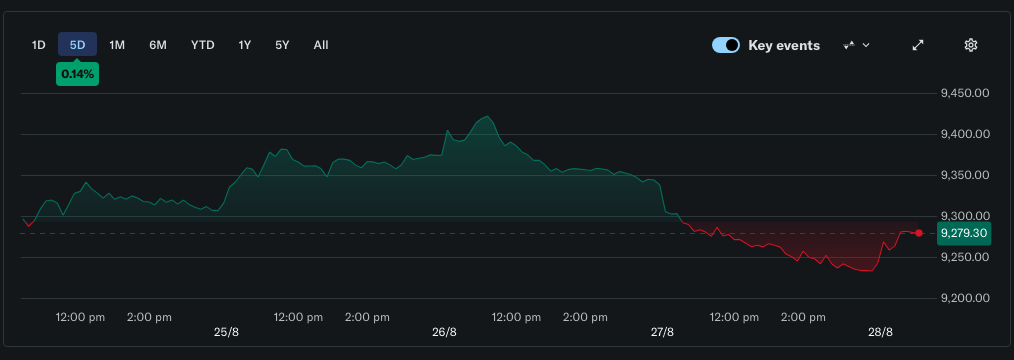
The All Ordinaries was trading around 9,279 on Friday morning, close to where it started the week, after a mid-week rally faded on a hotter-than-expected inflation print:
-
The dominant market event of the week was July CPI: headline inflation rose 3.5% year-on-year, above consensus around 3.3%, with the monthly CPI increase coming in at 1.0% against forecasts of about 0.8%.
-
The July inflation data forced three of the four major bank economists to revise their interest rate forecasts higher, with CBA’s Belinda Allen now predicting a November rate hike.
-
Sentiment on Friday was partially supported by a surge in US futures after Nvidia’s blowout earnings (see below), with technology stocks the top performer in Australia on Friday, led by Xero, WiseTech and Zip.
US MARKET UPDATE
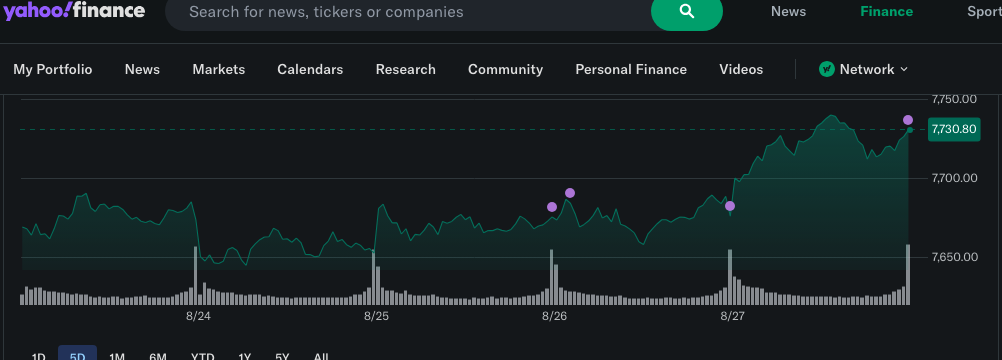
The S&P 500 gained roughly 0.7% week-to-date through Thursday to close in on the 7,730 level, with the week not yet complete heading into Fed Chair Warsh’s Jackson Hole speech on Friday (meanwhile Wall Street is apparently losing faith in Warsh and Bessent):
-
Nvidia reported $96.2bn in revenue and guided to $108bn for the next quarter, excluding any data-center compute revenue from China, sending the stock up roughly 8.5% on Thursday and adding approximately $435bn in market value.
-
The Jackson Hole Economic Policy Symposium this week marks the first under new Federal Reserve Chair Kevin Warsh, who took over from Jerome Powell in May 2026, with Treasury yields still elevated by sticky inflation and fiscal deficit concerns putting pressure on him to give clearer guidance on the Fed’s path for the rest of the year.
-
The core personal consumption expenditures price index, the Fed’s preferred inflation measure, came in line with expectations for July, rising 0.2% month over month and 3.3% year over year.
-
President Trump announced the US will increase tariffs on imports of all cars, trucks, automotive parts, and steel from Canada to 50%, effective January 1, 2027, adding to a week of macro pressure on equities.
So, let’s get into my weekly updates and see where we are at.
All the Best,
Cam
QAV MYTH KILLERS
The Myth: Success in Investing is about Picking Winners.
Another one of Morgan Housel’s “100 Little Ideas ” leaped out at me this week.
Inversion: Avoiding problems can be more important than scoring wins.
Investing, I’ve come to learn, is more about avoiding problems than it is about being some kind of genius.
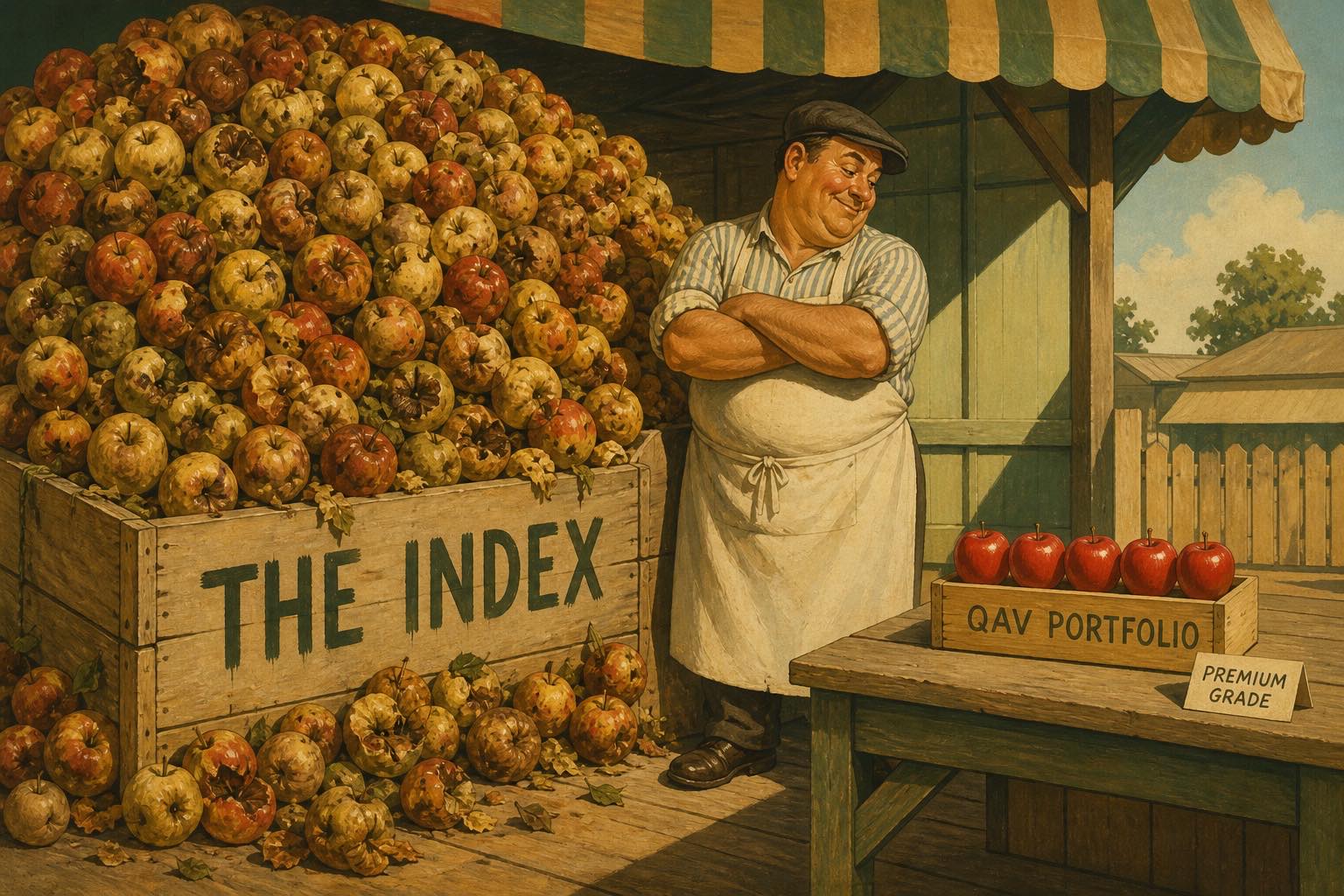
On the show this week, TK and I had a chat about bad apples.
Me:
“the index is made up of a whole bunch of companies, good companies, bad companies, average companies. If you take out the bad ones, what’s left should do better than the index. … If you take out the bad apples, what’s left must be not necessarily 100% good apples, but you’d expect to have a higher percentage of good apples than you would from the entire market, and it should outperform.”
TK:
“It’s basic retailing, isn’t it? As the greengrocer beside the supermarket said, ‘How do you charge more? Well, you take out all the bad apples, and you can charge more for the rest.’ ”
I think one of the keys to QAV’s success as an investing system is that we don’t try to pick winners — we try to eliminate the losers. And then we buy what’s left.
Tony’s often told the story about Dr Merv Lincoln, the co-founder of Stock Doctor, who did a PhD on predicting insolvency and how he started with the general idea of looking at the history of the ASX and the companies that failed, that went bankrupt, or had been delisted, and then he looked at their financial metrics, and went looking for a common set that always occur when a company goes bad. Then he said, well, if companies score well on these metrics, they’re less likely to go bankrupt. And that’s the genesis of Stock Doctor’s financial health rating.
It’s a pretty simple idea. Study failure and invert it to learn what success looks like.
Tony’s said before that he didn’t deliberately think of things that way (inversion) as he was building the checklist — but it happened anyway. The checklist is made up of indicators that a company (probably) isn’t going to fail, and (probably) isn’t overvalued. I say (probably) because it’s not 100% accurate, 100% of the time. There are too many hidden variables. But it’s a heat map. It’s a pirate treasure map. It’ll get you close to the treasure. You might need to dig a few holes until you find the treasure chest.
By the way, Dr Lincoln’s thesis is online. You can go read it. It’s called “An Empirical Study of the Usefulness of Accounting Ratios to Describe Levels of Insolvency Risk”.
One of the most interesting findings in his report, in my opinion, is that by looking at the accounts, he could predict failure of the business several years in advance.
“The function was derived from Year 4 data and predicted with a consistently high level of accuracy for all years. This confirmed the previously stated hypothesis that if the model could be derived from data which predicted well some years out from failure, then it could be a better model than that derived from data at the year before failure.”
And this:
“One finding of this study has been that lenders continue to make additional funds available to most failing firms. … It is important for lenders to realise that the mere provision of additional finance does not solve the problems of a firm which is in the failure zone.”
You can’t spend your way out of a bad business model. Or bad management.
Getting back to bad apples. Investing can also learn from tennis.
**Charles D. Ellis wrote “The Loser’s Game” in 1975. It won the 1975 Graham and Dodd Award.
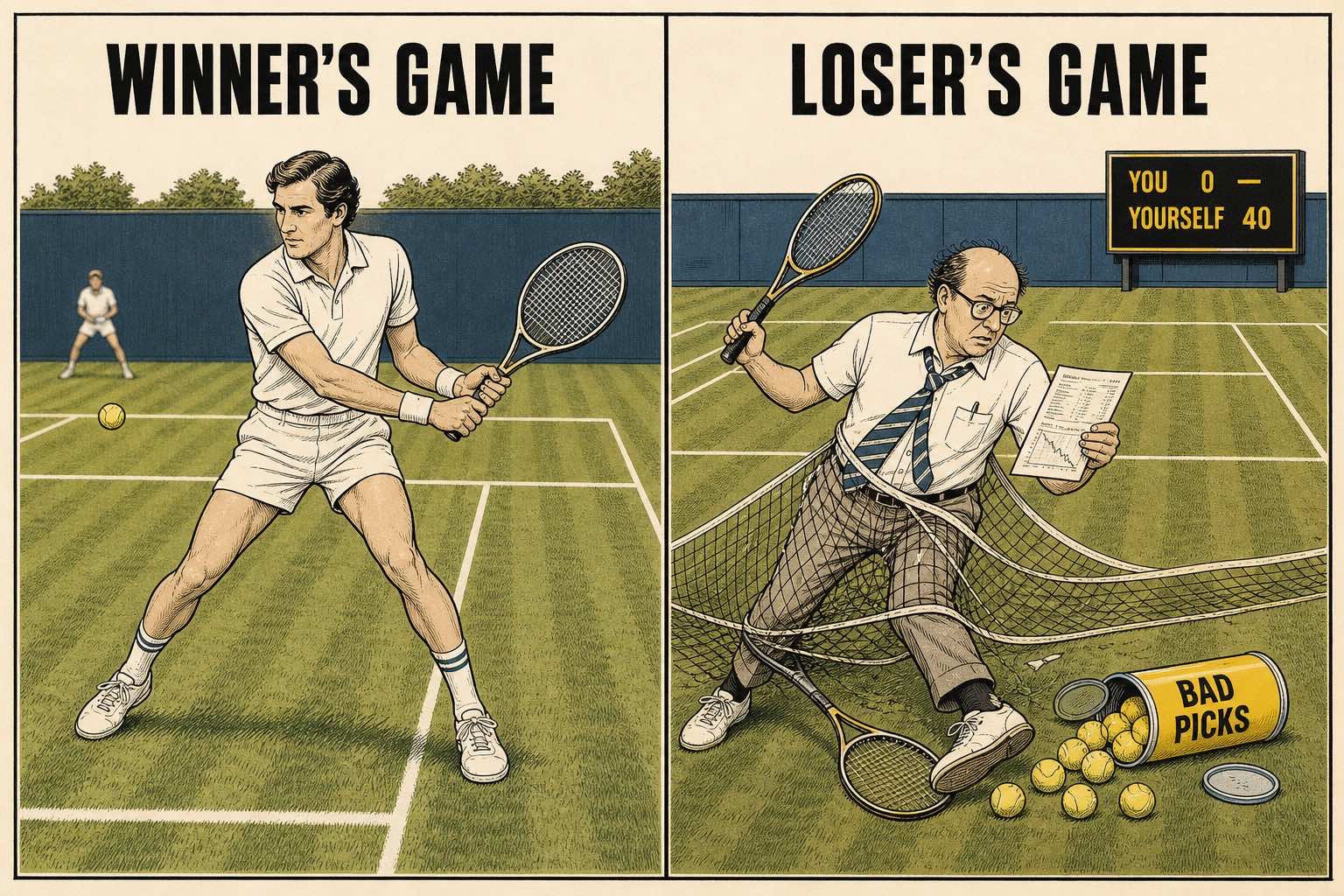
“In expert tennis, about 80 per cent of the points are won; in amateur tennis, about 80 per cent of the points are lost. In other words, professional tennis is a Winner’s Game — the final outcome is determined by the activities of the winner — and amateur tennis is a Loser’s Game — the final outcome is determined by the activities of the loser. The two games are, in their fundamental characteristic, not at all the same. They are opposites.”
“After extensive scientific and statistical analysis, Dr. Ramo summed it up this way: Professionals win points; amateurs lose points.”
“The amateur duffer seldom beats his opponent, but he beats himself all the time.”
He’s writing to institutional fund managers, and his argument is about the competitive field, not about buying as an activity. His point is that institutions had become the market, so the average manager is trading against other managers and cannot beat the average he constitutes, minus fees.
“… concentrate on your defenses. Almost all of the information in the investment management business is oriented toward purchase decisions. The competition in making purchase decisions is too good. It’s too hard to outperform the other fellow in buying. Concentrate on selling instead. In a Winner’s Game, 90 per cent of all research effort should be spent on making purchase decisions; in a Loser’s Game, most researchers should spend most of their time making sell decisions.”
As someone who has played chess for 50 years, I can confirm that most games I lose are due to my stupid mistakes, not the skill of my opponent (unless it’s their skill not to make as many mistakes).
QAV helps with both the buying side of investing as well as the selling side. It stops us from buying bad apples, but it also tells us when to sell the apples we bought that, sadly, went bad anyway. And that is sometimes the hardest part. Knowing when to get out of something. I’ve found that to be true in investing, in marriages, in business partnerships. Unfortunately, the last two don’t usually come with a checklist. QAV wins at buying because its buying is made of exclusions. The checklist tells us what NOT to buy.
Of course I can’t end an article about inversion without quoting the late, great, Charlie Munger. Tony would never forgive me.
Charlie Munger’s, commencement address, Harvard School, Los Angeles, 13 June 1986. (taken from my copy of ‘Poor Charlie’s Almanack — The Wit and Wisdom of Charles T Munger’.)
He said that to prepare for his speech he thought about all of the best graduation speeches he had heard, and one of them was by Johnny Carson.
“What Carson said was that he couldn’t tell the graduating class how to be happy, but he could tell them from personal experience how to guarantee misery. Carson’s prescription for sure misery included:
- Ingesting chemicals in an effort to alter mood or perception;
- Envy; and
- Resentment.”
Much later in the speech he gets to the famous inversion passage:
“What Carson did was to approach the study of how to create X by turning the question backward, that is, by studying how to create non‑X. The great algebraist, Jacobi, had exactly the same approach as Carson and was known for his constant repetition of one phrase: ‘Invert, always invert.’ It is in the nature of things, as Jacobi knew, that many hard problems are best solved only when they are addressed backward.”
And he finished with this toast:
“It is fitting now that a backward sort of speech end with a backward sort of toast… To the class of 1986: Gentlemen, may each of you rise high by spending each day of a long life aiming low.”
Howard Marks, in his Oaktree 2023 memo “Fewer Losers, or More Winners?”, not surprisingly mentions both Ellis and Munger.
“Warren Buffett – arguably the investor with the best long-term record (and certainly the longest long-term record) – is widely described as having had only twelve great winners in his career. His partner Charlie Munger told me the vast majority of his own wealth came not from twelve winners, but only four. I believe the ingredients of Warren’s and Charlie’s great performance are simple: (a) a lot of investments in which they did decently, (b) a relatively small number of big winners that they invested in heavily and held for decades, and © relatively few big losers. No one should expect to have – or expect their money managers to have – all big winners and no losers.”
Marks’s conclusion:
“The proper choice between the two approaches – fewer losers or more winners – depends on each investor’s skill, return aspiration, and risk tolerance. As with many of the things I discuss, there’s no right answer here. Just a choice.”
So there you have it, folks. Aim low. Invest in hot meme stocks. Take tips from your Uber driver. Ignore evidence and logic. And, whatever you do, give up if you make some mistakes and screw up.
Wait a minute. Strike that, reverse it.
“Nothing’s ever worked out for me with tuna on toast.”
STOCK ANALYSIS OF THE WEEK
Australian Members can check out the stocks we traded in QAV Australian Light portfolios this week.
American Members can check out the stocks we traded in QAV American Light portfolios this week.
Tony did a Pulled Pork on Genesis Energy (GNE), a New Zealand electricity company working through its Gen35 strategy to go greener. Find the full deep dive in the podcast link below.
On the American podcast this week, I did a pulled pork on CRGY. The podcast link is down below if you want the full analysis.
BUY LIST
Each week, we produce a buy list based on our value investing system that we share with our QAV Club members. The intended primary purpose of this buy list is for club members to use as a reference for comparing their own buy list. In theory, all of our buy lists should look pretty similar each week.
AUSTRALIAN BUY LIST
QAV Value Investing Buy List (AU) 2026-08-22
U.S. BUY LIST
QAV Value Investing Buy List 2026-08-24
PORTFOLIO PERFORMANCE
We compare our performance to what we think is the most relevant benchmark (SPDR 200 in Australia, S&P500 in the USA), but if you’re new to investing, these comparisons might not mean much. Instead, you can compare our performance to the top-performing Super Funds in Australia and see why an amateur active investor (who has a system to follow) can out-perform most of the “professionals”.
We publish a fresh performance snapshot once a month. Weekly noise doesn’t tell you much in a value-investing system — what matters is the trend.
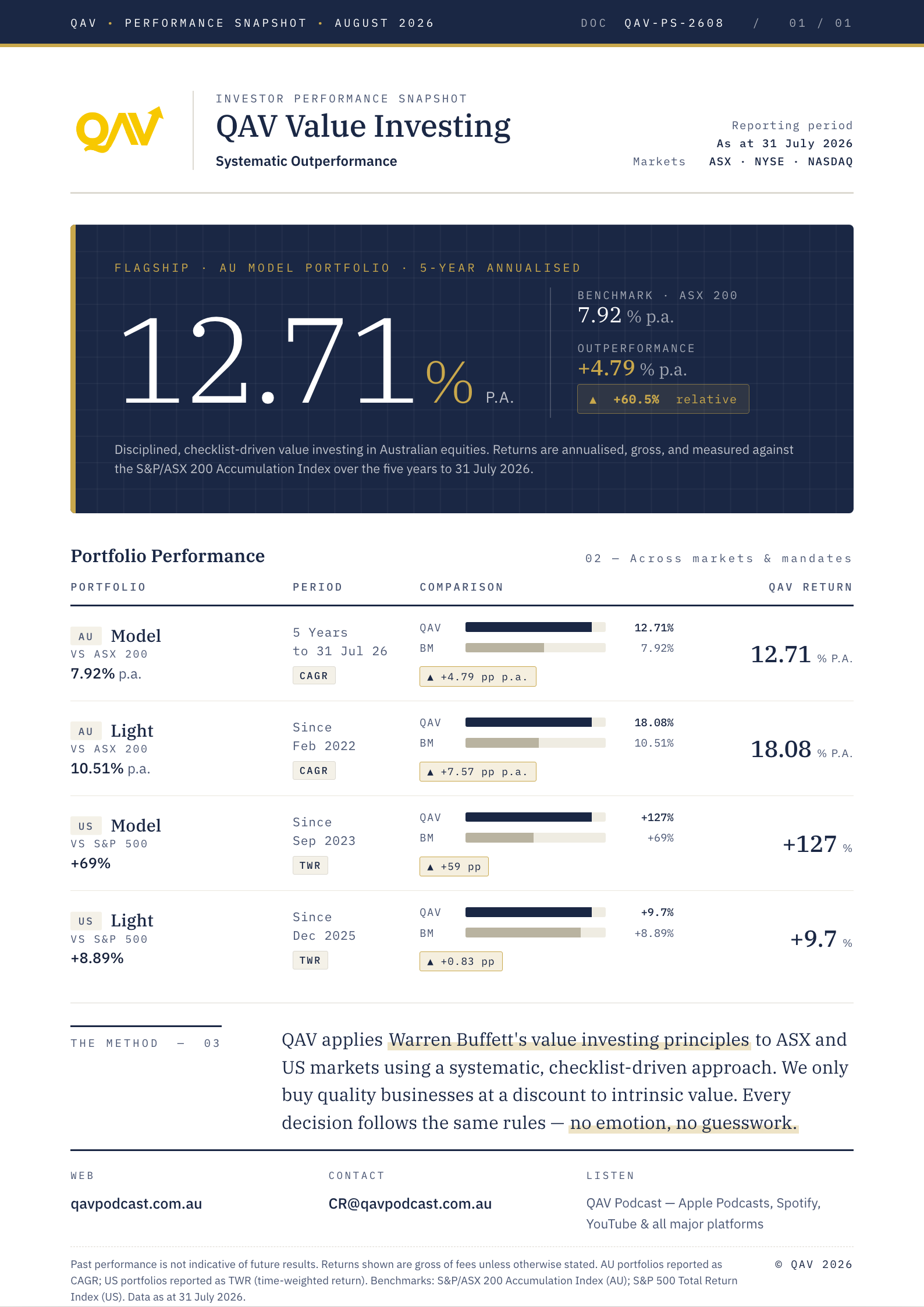
August 2026 performance snapshot.
Australian Model Portfolio: No trades this week.
American Model Portfolio: No trades this week.
Become a QAV Light Member today and start your investing on the right track
If you want to find out what we’re trading in QAV Light each week, sign up to become a member. You’ll get an email from me every Monday letting you know what we’re buying and selling in that portfolio. You can choose to copy our trades or not. It’s the easiest way to start your rules-based investing career… and you don’t even need to know the rules. I’ll follow the rules for you. It’s a good first step to eventually becoming a QAV Club member and learning how to run the system by yourself.
QAV LIGHT: Someone already cleared the way.

(Note: Americans interested in joining QAV Light or Club please go here instead.)
Add QAV America — US stocks, the same QAV method
Already a QAV member? You can add QAV America as your second membership at 50% off — US-listed stocks, the same QAV approach, billed in AUD through this site (just one payment to keep an eye on). Add QAV America →
Not a QAV member yet? Join QAV first, then you can add QAV America at the 50% member rate.
THIS WEEK’S EPISODES

Double the Market, Half the Drama: QAV AU #944
Show Me the Incentive: KKR, Crescent Energy, and the Art of the Roll-Up: QAV America #67
STOCK NEWS AND UPDATES
COMMODITIES
This week the big changes to commodities were the following:
| Commodity | Status |
|---|---|
| Coal (coking) | BUY |
| Steel | BUY |
| LNG | JOSEPHINE |
| WTI Crude | BUY |
DISCLOSURE
Please review our trading and disclosure policy.
SIGNING OFF
SSDD!
- Cam
That’s it for the week!
QAV A GOOD SHAREMARKET!
Got a question? [email protected]
Leave a Reply