This week Tony’s back from the Murray River, and we dive straight into the chaos: oil sliding on yet another Trump-Iran “peace deal”, the Japanese yen rescue and what it might mean for US bond yields, and the spectacular implosion of a 24-year-old’s AI hedge fund. Tony does a Pulled Pork on Alliance Aviation (AQZ), a company that built its business on cheap Fokker jets, then watched the whole thing unravel when the maintenance costs blew out a million dollars a month over budget. We also answer a listener question on sell rules, talk horse-race handicappers and CIA intelligence analysis, and wrap up with what’s worth watching on the couch.
This week’s full episode is for QAV Club members only. The free episode is available below. Also check out our podcast archives link and our pages on Apple Podcasts or Spotify or watch clips on TikTok. Or visit our homepage to learn more about QAV and how it works as a value investing system that you can learn and apply to beat the market.
Transcription
QAV AU 931
[00:00:00]
Cameron: All right. Welcome to QAV. It is Tuesday, the 4th of August 2026. TK is back from vacay. How was the vacay, TK?
Tony Kynaston: A really good one, Cameron. Yeah, not good.
Cameron: Cameron is my other show. Uh, remind me again what you, what you were off to, Tony.
Tony Kynaston: at the Murray River. Uh, the Sebel have a hotel at Lake Mulwala, which is very nice. So we had a, um. I guess it was kinda like an apartment, uh, overlooking the lake, which was fantastic. So Jen had a break, and we got her out of Cape Schanck for a while, which she enjoyed. And, uh, Brody came down from Wagga for one day, and we played golf, ’cause it’s got a golf course attached to it.
But, uh, most of it was just walking around the lake and having spa days and, uh,
Cameron: So
Tony Kynaston: and saw the Silo Art trail. That was good fun.
Cameron: instead of playing golf, you, you went on holiday and played [00:01:00] golf,
Tony Kynaston: Yeah.
Cameron: essentially. Yeah
Tony Kynaston: played golf for a long time actually.
Cameron: Really?
Tony Kynaston: Yeah, I’ve had a struggling, struggling with a bad back and it’s been pretty wet down here and dreary too, yeah.
Cameron: Hmm.
Tony Kynaston: Hmm
Cameron: Well, that’s good. Well, uh, in the interim, uh, big, big drop in our portfolios in the last 30 or so days,
Tony Kynaston: away for a, go away for a week.
Cameron: away
Tony Kynaston: Hmm
Cameron: oh well, I don’t know. Um, oil has slid today. I don’t know if you’ve heard this, Tony, but Trump has negotiated a peace deal with Iran
Tony Kynaston: I hadn’t heard that. I heard that Iran was being duplicitous and saying one thing and doing another. That’s the last I heard
Cameron: It’s the 10th peace deal he’s negotiated with Iran in the last couple of months. But, uh, you know, what they say, 10th time lucky. He’s, he’s absolutely, he’s absolutely sure that this one is gonna stick. Iran apparently is saying, “Well, I don’t know what he’s talking about. We’re not, we’re not in discussions [00:02:00] with anyone. He’s dreaming. Tell him he’s dreaming.” But, uh, yeah.
Tony Kynaston: Yeah, I was surprised to see the market rebound over, in Australia today and overnight on Wall Street. It’s like, like fool me once, shame on, shame on you. Fool me 47 times, shame on me.
Cameron: Is that because he’s the 47th POTUS? Is that why you picked 47? I mean, it’s just, uh, uh, yeah, it begs belief. The
Tony Kynaston: Hmm.
Cameron: market reacts to these things and yeah.
Tony Kynaston: I mean, there’s a lot going on. I think bond yields went down last night in the US too, but, um, that’s in a bit of turmoil and chaos as well because the, the guy running the Federal Reserve over there is saying nothing when everyone expects him to put the interest rates up. So the market’s kinda leading him now
Cameron: Then you got the Japan story, which we’ll
Tony Kynaston: Hmm.
Cameron: get into in a minute, I tried to get my head around for a good [00:03:00] couple of hours this morning. before we get into that, reporting season is underway, it being the 4th of August. I’ve put a hold on buying in the portfolios as per our rules, unless something is reporting outside of
Tony Kynaston: Yeah
Cameron: season or they come out with a report.
So I’m keeping an eye on that when I do the buy list each week. Nothing this week, uh, had, uh, anything to work with, so I didn’t add anything this week. Did have to sell something, though. Had to sell good old Stanmore Resources, SMR, because coking coal has become a sell
Tony Kynaston: Mm-hmm.
Cameron: Okay, that’s it? Not much
Tony Kynaston: Yep.
Cameron: Okay. Yeah,
Tony Kynaston: Well, happens.
Cameron: Yeah. Sure, fine.
Tony Kynaston: I got no idea why coking coal is a sell, but anyway, it’s a sell
Cameron: Uh, Musk is referring to himself as former trillionaire Elon Musk. I mean, you gotta
Tony Kynaston: Billionaire Emeritus, yeah
Cameron: uh, gotta admire his sense of humor. SpaceX shares currently around about 114, sorry. from 211, where they were just after the float.
Tony Kynaston: Wow
Cameron: Tesla shares also down. Tesla shares at one point in May were up at 445. They’re currently at 322.
Tony Kynaston: Mm-hmm.
Cameron: A lot of gnashing of teeth going on in the whole tech sector
Tony Kynaston: Not around here.
Cameron: No. Uh, so
Tony Kynaston: let them.
Cameron: on
Tony Kynaston: Mm-hmm.
Cameron: Uh, Andrew Mabb, sorry, Steven Mabb, uh, Andrew’s brother. Steven Mabb sent us an email. “Hi, hey, Cam. [00:05:00] Catching up on some of the podcast episodes and I heard the Andrew Page discussion.” That was on an email somebody sent us, uh, Andrew Page from Strawman. Steve says, “Just for clarity, Andrew has an excellent long-term record with his personal dummy portfolio, even after the tough year he had with some of his companies.
It’s a different way of investing to QAV, and not everyone on Strawman will beat the market, of course, but one can judge his returns better with this info.” And he sent me his, uh, Strawman profile on Strawman, which is Strawman. He’s ranked number two. Wonder who’s ranked number one.
Tony Kynaston: Wow
Cameron: Um, but it says his total return per annum, and it looks like it goes back, it’s a bit cut off here, but I think 2018 maybe, is 17.7% per annum. So that’s a really good return. Gotta hand it to him.
Tony Kynaston: Hmm.
Cameron: Um, it’s down a lot since the beginning of this year or the end of
Tony Kynaston: Yeah.
Cameron: last year by the looks of it [00:06:00]
Tony Kynaston: Which is why I think we commented. He, um, I think, uh, he posted something which one of our listeners sent in talking about what do you do when all your stocks are going down
Cameron: Yeah
Tony Kynaston: in, in general. Yeah
Cameron: Yeah, it looks like they had, well, he had a really bad 2026, whereas we had a really good FY26. Um, so but I did say to Steve, well, A, you know, that’s good. Do you know what his methodology is? And I think he said he invests in a lot of small sort of stocks, but, um, we should get him back on because I think the last time we had Andrew on was years ago, and he was basically talking about Strawman. But I think we should get him back on and maybe talk about his methodology and what he does and how it works, because 17.7%, uh, I don’t know if it’s CAGR or time-weighted return or whatever it is, but it’s, either way, it’s, it’s great.
Tony Kynaston: Yeah
Cameron: Probably double market, so, um, yeah, very good. Actually, if you look at, if you look at his little chart here, it says the market’s done about 100% return since he’s been running it, and he’s [00:07:00] up around about 300% return.
So triple market maybe. Have to drill into his numbers. The only other news story I’ve got is the world’s sexiest hedge fund just imploded. Just a month ago, this is from Chanticleer in the Financial Review. Just a month ago, 24-year-old Leopold Aschenbrenner was the hottest thing on Wall Street, but the AI trade’s sudden reversal has left his firm in tatters. Now, you probably don’t know who Leopold Aschenbrenner is, Tony
Tony Kynaston: I, I read the article in The Fin.
Cameron: Before that,
Tony Kynaston: Where, where do you.
Cameron: Leopold Aschenbrenner
Tony Kynaston: No. No, I’m not up with the sexy fund managers of Wall Street. Where do you think we rate on the sexiness scale of fund management?
Cameron: Well, me very high. Um, you know, do I have to show you my abs again, Tony? Do I, do I. Is this in the. Is that, is that your excuse for getting me to show you my [00:08:00] abs? Is that, is that your coded way of saying, “Show me your abs.”
Cameron: I will.
Tony Kynaston: No.
Cameron: I will sing.
Tony Kynaston: I’m not,
Cameron: I will sing.
Tony Kynaston: I’m definitely not the Alan Jones of fund management either, so no, don’t show me your abs
Cameron: Guy at Kung Fu the other day. I was, I was just, I was pulling up my shirt to adjust my uniform and my belt, and he goes, “Put your shirt down, Cameron. We don’t need to see that.” I was like, “Yeah, you do. Gaze upon the glory of my abs, you mere mortals.” Anyway, Leopold Aschenbrenner and I knew, ’cause he was at OpenAI, um, going back, uh, six months, a year ago, and kind of I think he was part of their, um, security team, then when they sort of were getting rid of their security team, he wrote a manifesto on
Tony Kynaston: Mm-hmm.
Cameron: this kind of stuff. So I, I kind of heard about him at the time. It was a bit of a big deal when [00:09:00] he left, was talking about security issues and blah, blah, blah.
But I didn’t know that he went and started an AI fund.
Tony Kynaston: Well, he did one other thing too. Do you. Sorry to interrupt. He worked for Sam Bankman-Fried for a while as well
Cameron: Well, there you go. What a track record. I, I mean, now who else would you trust your money with? Did Sam Bankman-Fried get a pardon from Trump? Has, did he get one
Tony Kynaston: Oh, I haven’t heard. No
Cameron: Hmm. Anyway, he went and he launched. He’s 24 years old, no investing experience, launched a hedge fund built around AI, up 439% this year to the end of June, up more than 1000% since he started the fund in June 2024. And, uh, funds under management were a billion US dollars. Surprised I hadn’t heard of this. But then it all came crashing down when China launched Kimi K3 and the South Korean stuff went belly up, et cetera, [00:10:00] et cetera. So apparently he’s, he’s in a bit of problems now.
Tony Kynaston: I think there was a lot, there was a lot of margin loans going on too, wasn’t there? That was the problem
Cameron: Well, that’s, yes. A lot of people borrowing money, him borrowing money,
Tony Kynaston: Yeah
Cameron: to invest in getting big returns
Tony Kynaston: So I think, yeah, from what I read that, that yes, he was borrowing. The people watching his fund were worried that there were gonna be margin calls, so they stopped buying into the shares he was investing in, which took the volume out of that market, so it sent the shares down, caused the margin calls, et cetera, et cetera.
And I think his remaining stocks have been bought out by somebody else, and he’s kept some for himself.
Cameron: Right
Tony Kynaston: But yeah, $20 billion of Wall Street toast
Cameron: Yeah.
Tony Kynaston: It’s Bonfire of the Vanities.
Cameron: I’m sure it won’t be the, uh, last
Tony Kynaston: Oh, no.
Cameron: that we hear
Tony Kynaston: No
Cameron: Got an
Tony Kynaston: That’s incre, [00:11:00] just let me just stop there, though. How incredible is it that a 24-year-old guy who’s held one, maybe two jobs writes a manifesto and gets $20 billion to invest?
Cameron: Yeah.
Tony Kynaston: Just incredible
Cameron: yeah. It’s, that’s, that’s, you know. That’s tech bubbles, right?
Tony Kynaston: Yeah, and we’ve seen it all before too, haven’t we?
Cameron: “All of this has happened before and all of this will happen again,”
Tony Kynaston: Correct.
Cameron: Battlestar Galactica
Tony Kynaston: Yeah
Cameron: Um, got a, got a, not an email, it was a Facebook message from Mark. “Morning, Cam. Still confused about our sell rules. I thought that we just sold on the 3PTL and on a 10% drop on the initial buy price. However, after speaking with a couple of friends of mine who I introduced to QAV and who are still actively following QAV, they mentioned that we/I should be taking profits off the table. I [00:12:00] followed this advice and thought I must have missed it in a podcast. I started to track my portfolio and reset my sell prices every month. I was either using the 3PTL or 10% lower than the share price high point, whichever was higher to take the higher profit. Hope I’m explaining this okay. I found the majority of times I did this, the share price would come back up and I would miss out on the run. Plus, I seem to be selling regularly. Can you please tell me if we’re only selling on the 3PTL on a 10% drop of the initial purchase and/or on a 10% drop of the high on the share price to take profits? I’ve been with QAV for a fair while, but due to work and young kids, excuses, I know, I’ve not followed it religiously and I wanna make a conscious effort to change that.” Uh, I said, “Well, you need to get new friends, Mark.” Um,
Tony Kynaston: Well, thanks for introducing them to QAV though, Mark. That’s great.
Cameron: Yeah, just don’t listen to them.
Tony Kynaston: Che,
Cameron: Here’s my reply. Um, they mentioned that we should be taking profits off the table. No, that’s the exact opposite [00:13:00] of QAV. Who the hell told you that? I followed this advice and thought I must have missed it in the podcast. I said, “You should have checked with me first.” 10% drop on the initial buy price.
I pointed out we changed that to 20% a while ago. Our back testing showed it doesn’t make much difference in returns, but reduces the number of trades slightly. Um, on a 10% drop of the high of the share price to take profits. I said, “No, never. TK’s motto is water your flowers, cut your weeds. Pretty sure I’ve written a couple of weekly newsletter articles about that exact principle in recent months.
Obviously, you don’t read my newsletters. If you ever want to get in touch, just let me know.” He did say, “Thank you, Cam. I’ll be coming to you forever now.” Uh, yeah. So, yeah, I’m, I’m not taking the piss. Um, these things get confusing and, you know,
Tony Kynaston: Yeah
Cameron: life does get in the way. We, we totally understand that, Mark.
Um, but, and I apologize for reading this. I did keep your surname out. Uh, we have lots of Marks. Could be any Mark. If you’re [00:14:00] listening to this and you know a Mark, lots of Marks on QAV. But,
Tony Kynaston: could be a real name either
Cameron: yeah. Yeah. Oh, hi, Mark. it, look, yes. Um, look, you, you can sell anything you want whenever you want. This is, this is, um, it’s your portfolio.
We don’t give financial advice. That said, that is not how we run things. Um, three PTL, rule one, which is now 20%, commodity sells, um, red flags, sudden CEO or CFO unexplained resignations, um, malfeasance, um, evidence that the company is doing bad stuff behind the scenes, they get pinged by someone or I think recently we introduced a thing where they, if they don’t submit their [00:15:00] financial returns on time or something like that, we’re like, “Hmm, not sure we’re trusting you with our money.” That, uh, or if you need the money. Um, we have a list of things in the Bible, a list of reasons that are legitimate reasons to sell. But, um, no, taking profits off the table not one of those unless you need the money for something. But, um, you wanna talk more about that, TK?
Tony Kynaston: No, you’ve summed it up really well. Um, so has Warren Buffett when he says you don’t bench Michael Jordan. That’s how he summed it up. Um, and look, it’s, the whole, the whole theory behind QAV is you’re trying to get the odds stacked in your favor. Will every stock that go up, goes up, keep going up? No, some will come down.
Um, and we have sells for that, and you might rue the fact that you’ve given back everything you’ve gained. Um, if you had have sold last year, you would’ve made more money. But for every one of those, there’s a, you know, maybe [00:16:00] 1.2 or 1.5 of stocks that keep going up, um, which we’ve seen before. Like a Fortescue Metals Group back in its heyday.
Like, um, there’s one called EDU at the moment which is going asymptotic. But, you know, those kinds of stocks. Yep, Duratech, they, they don’t always go up in a straight line. They tend to retrace for a while and then get a second wind or a third wind. So if you sell out on the first downturn, um, then you’re, uh, you’re missing out on quite a lot.
And you don’t get to buy back in for those stocks either ’cause they’re off the buy list because their price is so high
Cameron: Yeah. We have back-tested these. I
Tony Kynaston: Mm-hmm.
Cameron: not, you know, like, not like, you know, the ultimate in back test, but we have back-tested this. I’ve, I’ve run analysis on it. I know you’ve run analysis on it. And we, we know. You know, I’ve, I did. I can’t remember the last time I did this, but it was a year or two ago.
But went back over, like, four or five years and said, “Well, what, what would’ve happened if we had have [00:17:00] sold this at this time or at that time?” what we found was, as you said, yeah, you would’ve saved money sometimes. You would’ve lost money sometimes. more often than not, uh, our rules And
Tony Kynaston: Yeah
Cameron: 55% of the time or 60% of the time our rules win, that makes a big difference over
Tony Kynaston: Yeah, and I’ve, I’ve done the same sort of testing. I, I mean, recently, uh, most recent test I did was to look at if a stock got to twice its sell price, um, you should start taking profits. And again, I couldn’t, I couldn’t make it work. It was always better to hold. Like, look, n‑not in every case, not in 100% of cases, but in most cases it was better off holding on, ’cause you’re getting out of the EDUs and DURs too soon
Cameron: Yeah
I’ve got
the DUR chart in front of me just as an example. So over fi- five years ago it was trading at 41 cents. it had a nice little run up to, um, [00:18:00] $1.38, dropped back down to $1.18. I don’t know what that is, like a 10% drop. Then it shot back up to $1.60, dropped down to a dollar. a big drop. But then to rise up, got to $1.66, $1.73, dropped back down to $1.45, then up to $2.15, dropped down to $1.78, then got up to $2.82.
It’s dropped back down. It’s now to, like, 2.16. one of the reasons portfolios are down, is ’cause we’ve got a lot of DU- DUR. But, I mean, I, I don’t know what’s going on with DUR. I haven’t really paid much attention to their news stories. Uh, they do turn up in my news alerts from time to time, and it’s usually good stuff. just see it as a bit of profit taking
Tony Kynaston: Yeah, I think so too.
Cameron: taking profit off the table. There
Tony Kynaston: Yep
Cameron: and professional funds that have to do it for various [00:19:00] reasons. We’re not one of those, so unless they break something, we go, “Hey, here’s a really great business that’s doing really well,” and, uh, we’re gonna stick with them until they screw up. And if I, you know, open my alerts sheet. Well, I’d have to do that. Let me just get into Navexa. Oh no, maybe I do need to do that. If I look at, uh, D‑U-R, doo, doo, doo, doo, doo, DUR. You know, and even though it has come off a lot, um, one of our portfolios, we’ve held it since November 2022, it’s up 328%. Another of our portfolios, we’ve held it since February ’23, it’s up 200%. Another one we’ve held it since June 2023, it’s also up 200%. And then the rest of them, we– it’s up [00:20:00] 100, 150, 150 since we’ve held it from March 2023. So yeah, like you don’t get the 300, you know, triple baggers if you take profits off the table, right?
Tony Kynaston: Yep. Correct
But thanks for reaching out, Mark. Good, uh, good question
Cameron: Yeah, I’m glad you finally checked in with me, Mark. Um, good instinct. Bit late, but better late than never. Um, other email I’ve got is from Scott. Um, “Hey, mate. Really enjoyed this week’s podcast,” which I think was the, the guest that we put out last week, the, um, Ownership guy, Hassan. He says, “Made me think, the ticker QAV surely is free.
Let’s set up an ETF. Work on Tony.” Okay. Tony, QAV ETF, what do you think?
Tony Kynaston: Oh,
Cameron: If, if Leopold Aschenbrenner can raise $20 billion
Tony Kynaston: Yeah.
Cameron: a [00:21:00] fund, I mean, you could throw in 10, and we just have to get the other 10 billion from somewhere else. Good idea, Scott. Keep thinking.
Tony Kynaston: Yeah.
Cameron: hmm
Tony Kynaston: Don’t know about an ETF. I don’t know how an ETF would work for QAV. They, they tend to, you know, follow an index or follow a thematic. I guess they could manage a buy list perhaps. It’s more, it’s more like an LIC.
Cameron: don’t you? You have value ETFs?
Tony Kynaston: Yeah, but they tend to be robotic, like they pick the lowest quartile of PE ratios, that kind of thing.
Cameron: Yeah, yeah.
Tony Kynaston: Hmm
Cameron: We’re more just a fun fund.
Tony Kynaston: Yeah.
Cameron: What do you got, uh, what do you got, Tony?
Tony Kynaston: I got a few things. Um, gonna do a Pulled Pork, which was a request a couple of weeks ago, um, on Alliance Aviation. Uh, I saw a, I saw an article in The Wall Street Journal about, um, how Wall [00:22:00] Street bots are cashing in on Trump’s Truth Social posts, which I thought was interesting. So, um, Trump’s social media platform, Truth Social, is now selling stock market traders super fast access to his posts.
So for a. So the article in the Wall Street Journal says many big investment firms have developed automated systems to monitor Truth Social and take action, often within the fraction of a second. Uh, and a journal review of trading data shows how quickly some traders have pounced on the president’s online comments, and, uh, some trades cause swings of more than 2% in almost two dozen energy and industrial stocks.
A new product from Trump Media and Technology will let firms pay for an even faster readout of Trump’s posts. At least five firms have signed up.
Cameron: The grift goes on. There
Tony Kynaston: It doesn’t it?
Cameron: to the grift
Tony Kynaston: Yeah, I saw on the Wall Street [00:23:00] Journal too last week that Trump’s kids are all now, I think all, if not billionaires, all almost billionaires since he’s been, um, back in office. Hmm.
Cameron: Wow
Tony Kynaston: It’s incredible, isn’t it?
Cameron: It’s astounding. It’s an astounding time to be alive, Tony
Tony Kynaston: It is. I mean, that just, that’s almost bordering on inside information, isn’t it? That, that Truth Social’s going to give you early access to what the president says. That’s almost like
Cameron: even apply to presidents?
Tony Kynaston: No, maybe probably not, I suppose. Yeah, I don’t know. But it’s, it’s, in concept it’s fairly similar, isn’t it?
Cameron: Mm-hmm
Tony Kynaston: Yeah. Anyway, back on our home shores, uh, Fleet Partners hasn’t been on our buy list for a while, but I know it was a core part of our buy list, um, in the past, and it’s now, uh, it’s probably gonna be taken out.
Um, SG Fleet, one of the competitors, which is backed [00:24:00] by private equity, has, uh, lobbed a bid yesterday, which has seen the share price rise 20 or 30% today
Cameron: What’s, uh, FPR? FP
Tony Kynaston: FPR from memory, yeah
Cameron: I’ll have to make a note just in case it turns up.
Tony Kynaston: Yeah.
Cameron: you go
Tony Kynaston: I don’t know if it’s any of y- in any of your portfolios still
Cameron: I don’t think so. I’ll just check. I haven’t seen it for a long time
Tony Kynaston: Yeah, I think we did well out of it when it was back on the buy list
Cameron: Hmm. Yeah, no, it’s not on my buy list
Tony Kynaston: Okay. And then Shanta Cleary wrote an article about it today saying that, uh, uh, with the way the markets have changed over the years, uh, with a lot of passive investing, et cetera, that more companies like Fleet Partners are being taken out by private equity, and it’s really the only way for them to, to, uh, get some [00:25:00] kind of, um, takeover activity happening in the share market at the moment.
So
Cameron: Right
Tony Kynaston: that was an interesting article. Um, and one other thing that caught my eye in the Fin Review today, and this is why I like Capitalism Cam, uh, Canada’s TMX throws down the gauntlet to ASX on trading and tech. And this is about, um, uh, TMX is a Canadian firm that have, um, bought a, a company in Australia and look like they might launch a competitor to the ASX.
And it just strikes me that, you know, there’s been, I think, two CEO resignations, three CEO resignations at the ASX. They’ve tried to replace the CHESS system. They’ve abandoned the, the blockchain technology, I think, to replace the CHESS system. But it’s really. It’s been looked at by. There’s been all sorts of investigations by ASIC into it, but it’s really gonna be competition which shakes up the, the market, not, um, not regulation, I [00:26:00] think.
So this will be interesting to see what happens. That’s what capitalism is.
Cameron: You can have ca- you can have competition outside of capitalism. Well, look, it’s China. Plenty of competition in China
Tony Kynaston: China’s capitalist, mate. With a,
Cameron: According
Tony Kynaston: a, a different label.
Cameron: According to whom? Oh, right. Yeah, yeah.
Tony Kynaston: Myer
Cameron: with Chinese characteristics, Tony
Tony Kynaston: Is that what capitalism is?
Cameron: No, that’s what China is
Tony Kynaston: It’s, it’s socialism with, with what? Chinese characteristics. So are the Chinese characteristics capitalism?
Cameron: No. It’s, it’s allowing some forms of, uh, corporations in there as long as they’re all beholden to the state. So they’re working for the good of the state, the good of the people, not for their own good.
Tony Kynaston: [00:27:00] Reilly?
Cameron: Hmm.
Tony Kynaston: Okay
Cameron: Jack, uh, whatever his name
Tony Kynaston: Ma?
Cameron: Yeah, go ask Jack Ma how it works when you get to the top of the tree if you think you’re bigger than the state.
Tony Kynaston: Yeah
Cameron: see the inside of a little room for a couple of years until you get re-educated
Tony Kynaston: Yeah, not sure that’s a good thing. Anyway,
Cameron: China seems to be doing all right
Tony Kynaston: Yeah, it is. Hang on, though, you’re saying that Chinese companies aren’t capitalist in nature? Why would you set up, why would you set up a company?
Cameron: I’m saying that the way the economy is run in China by the isn’t capitalism. It’s not laissez-faire capitalism. It’s socialism that allows some level of corporations and free enterprise, but it’s not capitalism.
Tony Kynaston: Isn’t that what, isn’t that what we have in Australia? Regulated capitalism
Cameron: Um, [00:28:00] yes, we have regulated capitalism, but nowhere near what they have in China.
Tony Kynaston: Right. So it’s just, we’re just on shades of gray here, aren’t we?
Cameron: There are, they, you could say that, sure. But
Tony Kynaston: Thank you. I just did.
Cameron: what they call it, is socialism with Chinese characteristics. And this
Tony Kynaston: Right.
Cameron: Xiaoping.
Tony Kynaston: does. Doesn’t matter what color the cat is, as long as it catches mice.
Cameron: Yeah, drinks
Tony Kynaston: As long as, as long as we call cap- we call it capitalism.
Cameron: Yeah All
Tony Kynaston: it doesn’t matter what they call it, it’s c- regulated capitalism. It doesn’t
Cameron: what, what, what, matters is, you know, what the principles are it. Do the capitalists get to run amok and take over the
Tony Kynaston: Oh, no.
Cameron: state,
Tony Kynaston: Right
Cameron: are they held in check by the state?
Tony Kynaston: Oh, it’s regulated capitalism, yeah. Yeah
Cameron: Well, but we, you know, you could say we have that here, but do we though?
Like, who’s, powerful here, Gina Rinehart and Rupert Murdoch or, [00:29:00] uh, the state
Tony Kynaston: Well, you don’t know that’s not the case in, in China. I don’t know their economy well. I’d love to know whether it’s actually run by Xi Jinping, Xi Jinping or whether he’s beholden to somebody.
Cameron: Mm-hmm.
Tony Kynaston: Hmm. It’s all. But it. Um, yeah, maybe.
Cameron: for sure.
Tony Kynaston: Might be the person who runs BYD.
Cameron: Could be
Tony Kynaston: Hmm. Anywho, I thought that was an interesting article.
Cameron: Yeah
Tony Kynaston: I did wanna talk quickly about the, um, the joint yen rescue, uh, which you al-alluded to before.
Cameron: Hmm.
Tony Kynaston: fairly arcane article, but it’s. I’m, I’m wondering how much this, again, is a canary in the coal mine for the way the market’s at at the moment. So, uh, on the weekend, uh, the American government bought a lot of Japanese yen, uh, to stop it from going down.[00:30:00]
Um, and that was fine. And one of the, the problem is that, um. Sorry, so that’s. I said Chinese, I meant Japanese. Um, the, this Japanese government owns a lot of US Treasuries and, um, if their, if their yen to the dollar, uh, slips too much, then they’re forced to sell, uh, US Treasuries, which isn’t good for US Treasuries.
Um, selling pressure on US bonds forces up yields, uh, which is, um, not to the US’s liking because it makes it harder to do business when the borrowing costs are increased. And so the US government was, was artificially inflating the Japanese yen recently, and that’s, that’s all fine. That’s, you know, kind of international trade or international, you know, governmental cooperation.
But I guess the thing is if, if, if something’s being supported [00:31:00] artificially, how long can it go on being supported artificially? And what happens when it can’t be supported anymore? And, um, you know, I’m, I’m thinking back to times, uh, famously when the US government. Uh, sorry, when the UK government tried to keep the pound high and, uh, George Soros bet against it, and eventually the pound collapsed because it couldn’t be supported anymore because you can throw money at these things, and you can print money and throw it at them, but eventually they have a reckoning, um, which is more based on logic than just based on the flow of money.
And, uh, so, you know, I don’t know whether it’s gonna be soon, sooner or later, but eventually the US will fatigue from trying to support the yen, and if that forces a big sell-off in US bond securities, then bond yields will rise and that, um, will be a negative around the world, I think, for share markets. So interesting development
Cameron: the article that you, are [00:32:00] referring to a- says that US 30-year Treasury yields are already sitting near 20-year highs. So I guess they don’t want it to go even higher.
Tony Kynaston: Correct
Cameron: Japanese economy, again, like I don’t, I don’t understand this stuff. I, I spent, as I said, like a long time this morning trying to get my head around this story and the Japanese economy.
And what I could gather is, um, uh, I think the technical term economists use for it is it’s screwed, um, has been for decades. And it seems like it’s a, like an impossible scenario. So they’ve got, um, rates near zero to try and the economy humming, trying to keep people borrowing money, investing money, keep, you know, or investing money into businesses, borrowing money and spending it on the economy because people just weren’t doing that after their economy in the early ’90s after the ’80s. [00:33:00] And at the same time, they have the highest national debt, um, in the world to over 200% GDP. And to put that in context, I saw like the US and some European countries are around 110, 120%, uh, GDP, so it’s way higher. they have a, a, a population that is very old, is one of the oldest populations, uh, on the planet. So problems in the labor market and taxation and all that kind of stuff. Plus they have a population of people who save money very, very well. So their, pension funds are sitting on trillions of dollars or trillions of yen. Uh, so they’ve had to invest that somewhere. So they’re investing it in, have been investing in US bonds, which is why they’re the number one holder of US Treasuries. [00:34:00] they’ve got one point something trillion in US Treasuries. Um, but yeah, the, the, the, the yen is weakening. They have to keep buying it to stop it from weakening even further.
Tony Kynaston: Yeah
Cameron: the US are panicking that in order to keep being able to buy back their own currency, they’re gonna have to sell off tens of billions of dollars of US Treasuries, which will affect the US economy.
So yeah, trickle on effects. When you say artificial, I mean countries, reserve banks, et cetera, buy their own currency all the time, right? This isn’t, isn’t unusual, but it’s just, uh, higher levels than normal I think in Japan right now
Tony Kynaston: Well, it’s, it’s, it’s unusual in that you wouldn’t see the US government buying Japanese yen, um, very often. Count- you’re right, countries do buy other currencies all the time for, usually for trade reasons. [00:35:00] Like we’re doing a deal with you to buy AUKUS submarines, and we don’t want the currency to get in the way of it, so we’re gonna buy US dollars, for example.
That kind of thing. Yeah.
Cameron: in US dollars Yeah
Tony Kynaston: Yeah. Um, but, but the US is, is deliberately putting a platform under the Japanese yen to suit interest rates in the US
Cameron: the US has taken over Japan before. Maybe Trump’s thinking Greenland, Venezuela, Japan, we’ll just add it. effectively it’s been a US state since 1945 anyway. They’ve still got a, they’ve still got a reasonable sized military force there occupying the country, so, you
Tony Kynaston: Well, I think it’s, um, I think the interesting thing about Japan is, is to look at what happened in the ’80s and ’90s. I remember, you know, being in Queensland in the 1980s, it seemed like every day you turned around and a Japanese person or company was buying real estate, um, or corporations in Queensland in particular.
And that was, um, you know, there was all kinds of hue and cry about, um, [00:36:00] overseas ownership and encroachments on our nationhood and all that kind of thing. And then it all went shh
Cameron: Paulus Peter Elyard was behind that. Did
Tony Kynaston: Oh, really?
Cameron: story?
Tony Kynaston: I do, yeah. And the, uh.
Cameron: Hmm.
Tony Kynaston: Go on
Cameron: Well, he came up with the idea when he was, I think he was, uh, working for Aquingo in Adelaide, and he was, he wanted to build it in South Australia. then Hawke picked it up and thought it was a great idea, and it was gonna move to Alice Springs or something like that, uh, Northern Territory.
I don’t remember where.
Tony Kynaston: Yeah. Yeah, there’s all kinds of resorts being mooted on the Rockhampton coast and things like that, Yeppoon and
Cameron: Hmm. Great
Tony Kynaston: point,
Cameron: Island and
Tony Kynaston: yeah
Cameron: I think they were buying or
Tony Kynaston: Yeah. So Japan went through a real economic boom, largely a bit like China now. They were, they were supplying. You know, when, when the oil crunch happened in the, in ’75, they started, Americans started buying small four-cylinder cars, and that [00:37:00] suited Japan fine, selling Datsuns and Nissans and, well, they’re the same thing, but Datsuns and Hondas and Toyotas, um, and, you know, became very dominant.
Um, and one of the things that happened when the economy got very buoyant in Japan was that the house prices went up. And I, and, and, and I think that governments around the world, Western governments in particular, would do a lot. could do a lot worse than studying Japan in the ’80s and ’90s. Because what happened was, uh, it’s a bit like we have now, like y- y- people couldn’t afford to buy a house, and so they took out a longer and longer and longer mortgage.
S- to have got to the stage where grandchildren were beholden to the grandparents because the mortgage was held for three generations, basically, um, to, to be able to afford a normal house in Japan. And, um, that’s kind of where things are heading into in Australia or in around in most Western countries now.
You know, we talk about the bank of mom and dad. You, you know, if you’re a young [00:38:00] person starting out, you probably need help from somewhere to at least afford a deposit, so it comes from mom and dad. Well, that’s kind of one generation removed from your grandparents taking out a mortgage for you and you paying it off when you’ve, when you’ve grown up as a grandchild.
Um, so that kind of deflated the Japanese economy because it basically stopped any sort of local purchasing power in Japan. People were just working to pay off the mortgage and then handing it on to their kids, and their kids were handing it on to their grandkids, um, before it was all paid off. So Japan went through a whole, uh, stage of stagflation and deflation and, uh, didn’t grow for a long time, and they printed a lot of money, and then interest rates came to zero, and that kind of then was managed in that kind of environment for 30 years.
Um, the s- the stock market still did okay. Um, wasn’t like everything ground to a halt. There’s been a lot of great Japanese companies over the time, but the, the [00:39:00] local econ- the local economy became fairly stagnant. Um, and that led to population decline, and we’re seeing that a bit now in Western countries where, um, birth rates are down.
You know, our population in Australia is only growing because of immigration, really. It’s in a natural state of decline if you look at how many people are born every year compared to how many people are dying. Um, so people aren’t wanting to raise kids in this environment, um, whether that’s a conscious decision or whether it just happens because, um, you can’t afford a big family, for example.
Cameron: Kids are annoying
Tony Kynaston: kids are annoying. Yeah. But I, but I think Jap- Japan is really the, the, the lesson for Western countries. We might just be coming into our Japan moments now. But very interesting.
Cameron: All right, moving right along ’cause we’re running out of time
Tony Kynaston: What will pork then?
Cameron: Yes
Tony Kynaston: So this was a request, and very interesting one to do a Pulled Pork on. [00:40:00] The, I can’t recall who the request came from. It might have been Scott. Cam, you can look it up perhaps while I’m talking.
Cameron: I will
Tony Kynaston: thank you. So the Pulled Pork is on AQZ, uh, Alliance Aviation. And many years ago, I was a shareholder in Alliance Aviation, so, um, it has been on the buy list or pre-QAV buy list that I used to operate anyway.
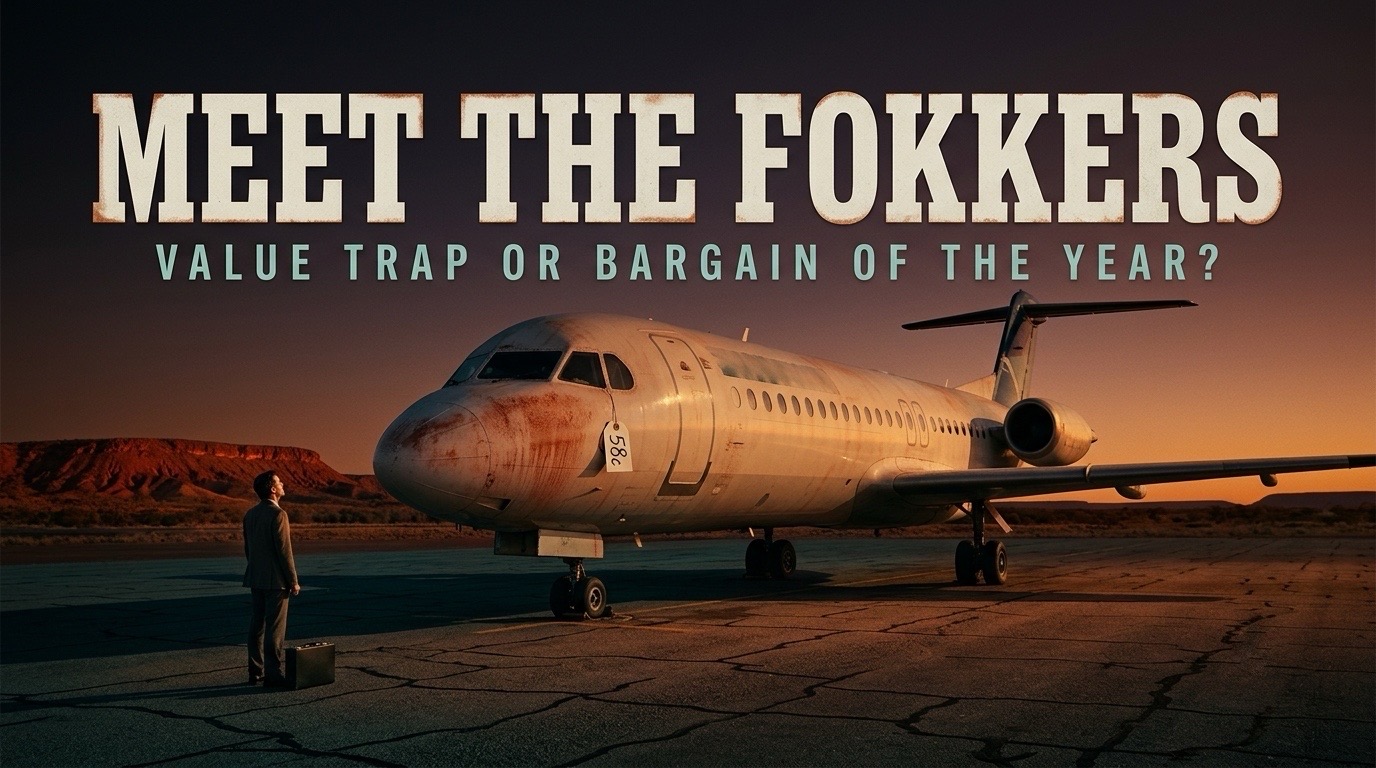
Uh, and I’m gonna call this, uh, episode Meet the Fokkers and maybe Toss the Fokkers because, uh, at one time in the history of this company, it was the biggest, uh, buyer and user of Fokkers, the type of, uh, aircraft that gets used on short-haul flights that people in Australia will be fairly f‑familiar with.
They’re turboprop planes that operate in regional areas. Um, so Alliance Aviation. Sorry.
Cameron: by the way. This
Tony Kynaston: Trent, thank you. Thanks, Trent. Um, so Alliance Aviation, uh, [00:41:00] as it says, aviation company. They provide contract charter maintenance services, uh, to basically regional sectors. They operate a lot in the fly-in, fly-out market, so they contract with mining companies in particular to fly their staffing in and out on a regular basis.
Uh, and they also got into a concept called wet leasing aircraft. Do you know what wet leasing is, Cam?
Cameron: I know it sounds sexy
Tony Kynaston: Wet leasing is when you contract to provide the plane, the maintenance, and the crew to Qantas or Virgin or somebody else to, um, fulfill a, a, a s- a hole in their schedules, like flying from Melbourne to Wagga, for example.
Cameron: Wet leasing to fill a hole. You’re just making it worse, Tony
Tony Kynaston: Uh, interesting history. So founded in 2002 by an owner, couple of owner founders, Scott McMillan and Steve Paget. [00:42:00] Uh, they began with, uh, two Fokker F1, uh, two Fokker 100 aircrafts, and, uh, they, uh, began contract charter services for mining workers in the Australian Outback. They grew from there, um, systematically bought up Fokker 70 and Fokker 100 planes and, uh, kind of a big leg up oc- happened in 2015 when they acquired 21 aircraft from a, um, a defunct airline called Australian Airlines.
Um, they purchased most of their aircraft very cheaply at low capital costs, and then, um, they built a kind of a very highly reliable and high margin monopoly in the FIFO, uh, side of things in the aircraft industry in Australia. Uh, in 2011, they listed on the ASX, and in February 2019, Qantas bought a 19.9% [00:43:00] strategic stake in AQZ.
And by May 2022, Qantas announced that they were gonna launch a full scale takeover of the remaining 18.1%, um, of Alliance for a premium. However, the ACCC rained on that party and they blocked the takeover. It took them a year to go through the investigation, but they, uh, blocked the takeover and so Qantas abandoned the bid, but it kept its 19.9% shareholding in the company.
Uh, moving forward, uh, the company did very well during the pandemic. Um, even though commercial airline aviation pretty much collapsed, uh, mi- the mining companies, the professional sporting codes, um, in Australia that relied heavily on Alliance’s, uh, uh, charter operations to go between bubbles, um, and actually triggered a bit of a boom for the company in Covid times.
Um, at the same time, the company recognized that the Fokker fleet [00:44:00] was aging, and so they launched a, uh, a capital pivot, a massive capital pivot in August 2020, and they bought their first batch of Embraer, E‑M-B-R-A-E‑R, Embraer or Embraer E190 jets. And, uh, they did so on the back of, um, uh, one of these wet lease, uh, contracts to provide aircraft crew maintenance and insurance for 30 Embraer E190s to QantasLink, the regional part of Qantas.
Uh, so that fundamentally altered Alliance’s business model from being a pure mining charter operator into a, I guess a gap fulfiller for Qantas and Virgin. However, by late 2025, inflation had, uh, taken hold pretty severely with-within the company, and they were spending a million dollars more than they budgeted [00:45:00] to every month on maintaining the, uh, aging Fokker fleet.
Um, and a‑as well as, um, at the same time having to service the wet lease operations for Qantas under a fixed, uh, price contract, um, or largely a fixed price contract, uh, contract. They were slowly going broke, and they, um, called out in their November 2025 announcement that they were taking a massive write-down on their Fokker fleet of $165 million, a non-cash asset impairment, um, which led to a $105 million statutory net loss, uh, in February 2026 when they, um, walked people through their profit announcement.
Um, in November 2025, the owner founder, or one of them anyway, Scott McMillan, and the CFO, uh, s- Andrew Evans, resigned in [00:46:00] tandem and left the company, and the c- the stock was actually suspended from trading for seven days at that time. The S- Scott McMillan was the CEO or co-CEO at the time. So, uh, in February 2026 earlier this year, they formally acknowledged that the, uh, Fokker fleet was reaching the end of its economical life, and they raised a material uncertainty related to going concern note in their, uh, their audit report or in their financials, and it was called out in the audit report.
Uh, they promoted Stuart Tully, who was the, who was also the co-CEO, but probably acted more like the chief operating officer to, uh, to become the full CEO of Alliance. And he came out with a strategy to turn the company around, um, including, uh, getting or trying to sell as much as they could of the Fokker, uh, network, moving more towards the Embraer [00:47:00] E190 jets.
Um, he, uh, he faced a problem with his banks because, um, there was, uh, banking covenants on, um, on all their loans. And in the past, this company had a, a reasonable, um, sort of side trade or side hustle in buying up cheap Fokker planes as they became available at different other airlines around the world.
And then either using them as, for spare parts or, uh, dismantling them and then selling spare parts to other airlines at inflated prices. So, uh, that was stopped even though it was profitable. It was, it was, uh, tying up capital, and so, uh, they decided to stop it. Um, they sold as much as they could of their current fleet and did a sale and leaseback program, which is still continuing.
And, um, they have been negotiating with Qantas since, uh, since that time to try and, uh, alter the, the wet lease contract that [00:48:00] they have with them. But that, that remains ongoing. One of the things that they have been able to do is to pass on rising fuel costs, uh, which normally can be a problem for airlines, but in this case, their contracts did allow fuel increases to pass on to end users in the FIFO business and in the wet lease contracts.
So, um, I’ve got a, a note in my notes here or a heading in my notes here which says the Fokker business is now fokked. So they, uh, their strategy was built on buying used Fokker jets, uh, for very little capital and then putting them to work on this endless cycle of flying staff to mines and back. And in fact, they could actually afford to s- to have some of these, um, airplanes sit idle, uh, between mining shifts and still, uh, make money.
But, um, a bit of background on Fokker. The business, the airline producer, Fokker, actually went bankrupt in 1996, and so they haven’t been [00:49:00] manufacturing the airlines for three decades. Uh, and that’s where Alliance kind of, uh, found its niche because it was able to, to, uh, buy up the, uh, used aircraft cheaply, uh, conv-convert them into spare parts and engine components, um, develop specialized engineering expertise and staff, and, um, they, uh, overcome logistical bottle-bottlenecks in continuing to operate the fleet.
Um, but that all came crashing down this month or this year, sorry, uh, with the budget, um, with the cost of maintaining the fleet a million dollars over budget every month. And, uh, I guess they weren’t the only ones feeling that kind of pain and weren’t able to offload as much, uh, to other carriers because, uh, the, the planes having not been manufactured for 30 years are coming to their, uh, their natural end of life.
Um, the cost of keeping those planes airworthy [00:50:00] now vastly outweighs the benefit of purchasing them even at a low cost and so they’re being retired. Uh, commercial partners no longer wanted older, less fuel efficient aircraft on their schedules and QantasLink and Virgin are both re-aggressively retiring their own network of Fokker 100s.
Um, and they’re being replaced where they can by Boeing 737s. Uh, but, um, uh, there’s still a, still room for smaller jets like Embraers, which, uh, Alliance is providing to QantasLink, but they do need to change the QantasLink contract to make it all work out for them. So a lot going on. Um, I thought it was very interesting in their annual accounts how this material of uncert- material uncertainty over going concern statement was treated and, um, just wanted to highlight that.
So in the half year report, the directors stated that the audit was unqualified. [00:51:00] They, they themselves signed off on the material uncertainty re going concern, uh, in their financial accounts and then the auditors referred to it in their audit. Technically, it’s an unqualified audit, um, according to the accounting standards because all the auditors are required to do is to say that, um, uh, the figures are, you know, true under accounting standards and can be relied upon, and then they point to the material uncertainty, uh, listed in the financial accounts and, you know, that apparently makes an, an unqualified audit.
But I think we should treat it as a qualified audit because there is an uncertainty whether this company can keep, keep going. And to be fair to the directors of, of the company when they put in their notes that, uh, they had a material uncertainty of going concern, they then listed all the things they were doing to mitigate that.
So, um, that’s being fair to them. [00:52:00] But, but yeah, there is a material uncertainty whether this company can keep going and, and the biggest one I think is the game of chicken that they have going between Qantas and themselves. Uh, it’s complicated by the fact that Qantas is a major shareholder in AQZ, but the ACCC won’t let Qantas take AQZ over.
Um, but it is possible though, if, if, uh, this country– company was forced into administration and it would be Qantas that would probably lead to do that, although the banks could, if they breached, um, debt covenants also lead down that path. Um, but if Qantas does tip this company into administration then the ACCC might have to change its mind.
So that is one possible way out of the current situation Um, but whatever happens, um, the CEO Tully has to fix the capital and cost situation and get Qantas to pay more for their QantasLink wet leases. He can’t walk away from the [00:53:00] contract. Uh, AQZ would face big damages claims from Qantas as it scrambled to plug the hole in its schedules, and he would also be left with stranded aircraft and crew, which would be hard to, um, to, uh, get rid of quickly.
So I, I guess, uh, interesting question that Trent raises, is this a classic value investor, investor’s dilemma? Is this company cheap or is it a trap? Uh, put it, put, to put it another way, is it value or is it crap? Um, I, I don’t like playing in this space because I think it’s gambling, even though I like to gamble.
How do I assess the odds of AQZ and its management team getting through this, um, uh, situation? I think the extreme cases are that, um, uh, Tully, uh, gets the QantasLink deal to work or he exits it grace-gracefully, and then the, the company goes back to being, uh, an operator of FIFO [00:54:00] flights, so back to where it was in the past.
So I guess it shrinks its way to, to greatness. Um, that’s one sort of end of the spectrum. Um, or is AQZ forced into administration and Qantas or possibly Virgin picks apart the, the, the assets for scrap? Um, or is there something in between? Like, does the ACCC let Qantas take AQZ over or do they muddle through?
So there’s a lot of different things in play here, and it’s very hard to know, uh, as an outsider which way things will go. I know Trent has some opinions on that, um, and if he has a better insight, then it’ll be less of a gamble for him. But for me, it’s a bit of a gamble. Um I think it’s also important to note that even if AQZ does just go back to being a FIFO business operator, that does come with its problems as well.
And soon after the company listed, and if you look at the share price between 2012 and [00:55:00] 2015, the price dropped from, uh, well, the price dropped down to 40 cents when the last mining boom ended. Uh, I forget now what the– Let me see if I can see what the listing price was at the time. I think its high was 225 just soon after it listed, and it dropped all the way down to 40 cents.
So, uh, and that was on the basis that, um, the mining boom, uh, went through a little bit of a recession in that kind of time. Commodity prices were down. The mines, uh, cut their costs and, uh, so there was less FIFO traffic. At the time, AQZ faced some stranded planes and crews and less revenue coming in, and in fact, I think their profit halved over that period.
So, um, even if, uh, the CEO Tully does thread the needle and survive, then how much will investors want to back a company with a history of troubles and risks? Um, the, the share price ha- [00:56:00] has never been strong, um, and, uh, you know, it’s, it’s, it’s been disappointing from time to time. Um, which is why I think, you know, I like to look at sentiment.
It’s one of our, um, one of our gates to say we either go or no go is, is the sh-share price going up or is the share price going down? And, um The, uh, you know, we have a buy price of $2.34 on the business, and it’s currently trading at 58 cents. So it’s, uh, it’s gone down a lot this year, and you can see why from what I’ve just said.
And it reminds me again of the, the Keynes quote that, “The game of investing isn’t finding the prettiest girl, it’s finding who ev-everyone else thinks is the prettiest.” And that’s why sentiment is so important, uh, and why even though we can be contrarian and we can look for value, which this company does possess, it, uh, unless everybody else likes it, it, it ca- it really counts for naught.
[00:57:00] Uh, so that’s a summary of the business, what’s happened, where it is, and the Q. I’ll go through the QAV numbers. Uh, and, but I will say that, um, you know, the QAV numbers are backward-looking to a large extent, and, uh, we’re in reporting season now, so I wouldn’t be buying the stock anyway, but I’ll just put that caveat out there.
It looks great on the current numbers, even, even though the half was a, um, a massive write-down, uh, but it, it doesn’t have sentiment to, to back us up. Um, so the current price, uh, was 58 and a half cents that I did the evaluation at. ADT is $123,000. It’s down a lot, uh, this year. Uh, at 58 and a half cents is less than consensus target by 30%, less than IV1 of a $1.28, less than IV2 of a $1.64, and less than two times share price.
So, um, all of those things score well for us. Uh, if you look at the yield in Stock Doctor, it says it’s [00:58:00] 5.3%, but, um, I need to back that out of my scoring because, uh, the dividend’s been cut going forward as part of the cost, uh, saving measures that the company’s undertaking, so there’ll be no yield going forward.
Stock Doctor financial health and trend is strong and steady, which I find a bit hard to believe. Um, Stockopedia is probably more realistic, and their quality rank is 56. Overall is 69 in Stockopedia, so I think that’s probably a, a better assessment of where the company’s at. F score is four out of nine, which is, um, lower than I’d like.
Uh, looking at its PE ratio, it’s 2.3 times, so it’s the lowest in the last three halves, so we would score it for that. Um, again, uh, you know, you w- wanna run these numbers when the full year results come out, and we’ll see what they score. Pr/OpCaf is less than one. It’s 0.8 times, which is, um, very good if you’re looking at the past numbers.
Net equity per share $2.22, so we can, um, buy it way less than book [00:59:00] value. Earnings per share growth is negative 32%, so we mark it down for that. The owner founder has left abruptly, so we mark it down for that. Um, I think it has a qualified audit, even though, um, technically the accounting standard’s called unqualified.
If I see material uncertainty of going concern, I think it’s a, it’s a qualified audit. Uh, it obviously doesn’t have a new three-point upturn. It’s a sell. Does not have consistently increasing equity. It did up until the last half, but, uh, it’s all come crashing down. Uh, PE is less than yield, um, but there’ll be no yield going forward.
Uh, so overall, without adjusting for things that we know, uh, won’t be there in the future, it’s scoring eleven out of seventeen or sixty-five percent, and because of a very low Pr/OpCaf, it’s scoring 0.79 for a QAV score. Um, but like I said, we have to back out some of those items like financial health, I think, and yield.
Uh, but e- but even if we back those out with a low quality [01:00:00] score, with that low Pr/OpCaf score, it’s still gonna score probably above our buy list cutoff of 0.10. But, you know, I want to add it faces three red, red flags. The CEO, the CFO, and the CEO as a founder all abruptly exited the business. There’s a material uncertainty of a going concern in its financial accounts, and it’s a three-point trendline sell.
So, uh, even though I like taking contrarian positions from time to time, this one has few friends, and, um, it’s not one I’d be buying into. Trent, Trent may well, um, and he– I don’t know, you know, maybe he’s just doing it for, uh, a test. But, um, yeah, I, I think this is probably more a good example of why we use sentiment and red flags to, uh, stop us from getting into value traps than, um, necessarily a screaming buy as the QAV numbers would suggest.
Cameron: Trent did say it was in the gambling part of his portfolio, d- I, I, I missed that bit in the Bible, but, uh, apparently there’s [01:01:00] a gambling section of
Tony Kynaston: gamble, but, but the rule one of gambling is, you know, frame your market and then, and then look at what your odds are com- compared to what you can get in the market and
Cameron: Right
Tony Kynaston: gamble according to that. That’s my rule one of gambling anyway. But, um,
Cameron: Right
Tony Kynaston: hard to frame this market. Is, is the company going bankrupt and it’s worth zero?
Or is it, um, is it gonna trade its way out and it’s worth probably higher than what it is now? It’s hard to say
Cameron: Did you have a look at their, um, H1 investor presentation?
Tony Kynaston: I did
Cameron: Page 24, interesting slide in the deck, commodity exposure. commodity exposure as a percentage of the top 15 contracted FIFO clients’ revenue for the year ended December 31st, 2025
Tony Kynaston: So they’re obviously attuned to the fact that if commodities turn down, their business turns down.
Cameron: Yeah. They’re
Tony Kynaston: Yeah.
Cameron: a QAV commodity
Tony Kynaston: You’re [01:02:00] right.
Cameron: sell to their business. I was pretty cool.”
Tony Kynaston: Yeah
Cameron: Do we have to start doing that for, uh, businesses now? Look at where their exposure is, of indirect exposure to clients and commodities
Tony Kynaston: Well, we did think about that when we looked at mining services businesses and then,
Cameron: Hmm.
Tony Kynaston: of them have many, many commodities,
Cameron: Hmm.
Tony Kynaston: ore, gold, coal, whatever else, lithium these days too, I suppose. So it became pretty complicated to work out which one
Cameron: Mm-hmm.
Tony Kynaston: to, uh, like, you know, if you had two sells and two holds or two buys and two holds, how do you, how do you work it out?
Cameron: Hmm.
Tony Kynaston: And I think a lot of this, there’ll be some mining contractors which are just one, you know, single industry focus, but most of the bigger ones try and expose themselves to as many as possible to mitigate that problem.
Cameron: Hmm.
Tony Kynaston: Hmm. What, what, how’s it like?
Cameron: m‑many as possible
Tony Kynaston: [01:03:00] No, that adds to the problem in the Epstein case. Doesn’t help. Yeah.
Cameron: Not a good thing.
Tony Kynaston: Yeah
Cameron: All right. Thank you, TK. Thank you, Trent, for that suggestion. Not gonna be on our buy list for a while, if ever, but, uh, we’re looking at that three-point trend line graph. But good luck to you. Hope it does well for you. Well, quick, uh, after-hours, Tony, because we still gotta get off and do an American show in time for me to go to kung fu
Tony Kynaston: Okay.
Cameron: to tell me about?
Tony Kynaston: Uh, not, not much good. Um, don’t bother with “The Mandalorian” and Grogu. Don’t bother with “Devil Wears Prada 2.” They’re both, they’re both crap. Um, I watched the first episode on SBS of something called “Empathy,” which was interesting, a French, French-Canadian, uh, drama, which is worth having a look at. I’ve only seen the first episode, but that was interesting.[01:04:00]
But we’ve been getting into “Clarkson’s Farm.” Have you seen that, Cam?
Cameron: No, I
Tony Kynaston: Yeah. Well, I was kind of, you know, probably blasé about it like you are. Um, but we’ve really enjoyed it. Alex got us into it. We watched it with Alex, and then, uh, we’re up to Season 3 at the moment, and it’s a lot of fun. I reckon, I reckon Fox would probably enjoy it as well.
Is he a, is he a “Top Gear” fan?
Cameron: No, he’s my son. He wouldn’t know a Top Gear if he fell over. But y- I, I don’t know if you’ve ever seen any of James May’s travel shows,
Tony Kynaston: yeah
Cameron: we, enjoyed watching those. I’ve,
Tony Kynaston: Mm-hmm.
Cameron: I’ve. I I’ve seen maybe one episode of Top Gear in my life, or half an episode or something like that.
Tony Kynaston: Do yourself a favor.
Cameron: he was good
Tony Kynaston: get, um, Google Top Gear turning a reliant car into a space shuttle and show, show Fox that clip. It’s magnificent. Yeah. And it– But, but Clarkson’s Farm, show him a few episodes of that too, especially the– You’ll probably get– You’ll [01:05:00] know whether you like it if you watch the first one.
It’s, it’s,
Cameron: Right
Tony Kynaston: it’s basically Clarkson bumbling his way through farming, but highlighting all the problems with regulation and health and safety and compliance and all the problems that farmers face and how they’re not helped by the environments which are designed to protect them. It’s, it’s a lot of fun
Cameron: Yeah, I flat out getting Fox to sit down and watch anything with me.
Tony Kynaston: Okay
Cameron: watch Aus- the first Austin Powers film with me over the last few days, which was a struggle. Um, well, uh, to add to the list of don’t bother, latest Spider-Man film, Brand New Day, or as I would call it, that’s two hours of my life I’ll never get back or I could’ve been at Kung Fu. Went with Hunter to the premiere of that last week here and, oh my God, such a load of nonsense. So boring.
Tony Kynaston: Right
Cameron: Masters of the Universe,
Tony Kynaston: Hmm
Cameron: uh, recent reboot or remake of [01:06:00] Uh, watched that with Chrissy over the weekend ’cause she grew up watching the original cartoon. That was sort of her demographic as a kid and she really wanted to see it. They did a good job. Very funny.
Tony Kynaston: Okay.
Cameron: Yeah, sort
Tony Kynaston: I’ll have a look
Cameron: in the realm of a Taika Waititi Thor kind
Tony Kynaston: good
Cameron: you know, just making fun of how ridiculous it all is, uh, kind of thing. It was pretty good. I, uh, listened to Anthony Hopkins’ memoir as an audiobook. I finished that while I was
Tony Kynaston: So I wanna do that.
Cameron: over the weekend. Hmm
Tony Kynaston: Good. I want, I wanna do that. It’s been on my list for a while
Cameron: Well, it’s, it, it was pretty good. Um, interesting is it’s narrated by Kenneth Branagh, who I think is also Welsh, and he sort of does a lot of accents and voices in it, which is interesting. And particularly interesting at the end when Anthony Hopkins is talking about being in the first Thor film that was directed by Kenneth [01:07:00] Branagh, and talks about what a great director Kenneth Branagh is. So Kenneth Branagh narrating this, talking about what a great director he is. Um, the one, the most disappointing thing in the book is I didn’t get a mention. Um, I was waiting for it, never came up, so was like, “All right, I guess he couldn’t put
Tony Kynaston: You,
Cameron: that
Tony Kynaston: must be disappointed a lot, Cam.
Cameron: I am. I am on a daily basis, Tony. But, you know, I met Anthony Hopkins. I thought, uh, you
Tony Kynaston: Eh.
Cameron: it would’ve meant a lot to him. Uh, apparently not so much. Um, RIP Glenn Hansard. Don’t know if you’re a
Tony Kynaston: Oh
Cameron: fan. Did you ever see Once, the film that won all the awards, that he
Tony Kynaston: No
Cameron: I can highly recommend that.
It’s
Tony Kynaston: Okay.
Cameron: film.
Tony Kynaston: All right
Cameron: Listened to some of his music. Um, great Irish singer-songwriter. I mean, he, he, he, you know, if, I don’t know if you saw the [01:08:00] Shane MacGowan but when they performed, uh, “Fairytale of New York,” it was, uh, Glenn Hansard taking the
Tony Kynaston: Okay.
Cameron: it,
Tony Kynaston: Yeah, right
Cameron: and he passed away in a motorcycle accident on the weekend.
He did a gig at a pub, jumped on his motorcycle, had an accident, died, 56. Leaves behind a three-year-old son. But a lot of, lot of obits from him, from everyone from Bono to Springsteen to many, many people who worked with him and loved him. He’s, it was a really great troubadour in the style of the troubadours.
You know, he could pick up a guitar anywhere, anytime, and bang out a song. And then I’ve been reading this CIA book that I wrote about in my newsletter last week, um, that reminded me of you and
Tony Kynaston: was it five, five KPIs for gambling or whatever it was? Yeah.
Cameron: It’s called “The [01:09:00] Psychology of Intelligence Analysis.” And, um, I, I, I came across it because I’m writing an app for myself, um, analyze geopolitical events and, and also investing stories for QAV. Um, trying to look at. I, I’m calling it the cui bono framework, but trying to come up with. I’m using Bayesian, Bayesian, uh, reasoning to look at a range of hypotheses for why X event might have occurred, and then looking for the evidence to support or refute those hypotheses and scoring those, and trying to come up with a systematic way of applying, you know, some sort of a, an intelligence framework around geopolitical events. Came across this guy’s book, Richards Heuer, who worked for the CIA in one capacity or another for 45 years, wrote this book in 1999, and came up with this thing [01:10:00] called the analysis of competing hypotheses, the ACH, which was basically a way for them to, you know, the CIA to bring a more logical framework for understanding what was going on in the world, ’cause apparently he felt the CIA was crap at that.
And having done a lot of podcasts about the CIA, I would agree. Don’t think they learned much from it, but, uh, he wrote the book nonetheless. But he, he talks, this is, I don’t know if. Did you read the newsletter? Did you see the
Tony Kynaston: I did. Yeah. Yeah
Cameron: for people who didn’t, like, you know, apparently Mark doesn’t read my newsletters, so for other people who don’t read my newsletters, um, really inter-
Tony Kynaston: Dis- are you disappointed again?
Cameron: disappointed but not surprised is what I. Um,
Tony Kynaston: Is that your epitaph, is it?
Cameron: yeah,
Tony Kynaston: the headstone. Disappointed but not surprised, yeah.
Cameron: When I
Tony Kynaston: I’m
Cameron: it’ll be
Tony Kynaston: Disappointed but not surprised.
Cameron: Not surprised. I’ll be disappointed and surprised if I die. [01:11:00] Yeah I’ll just read it from the newsletter. In one experiment that TK will love, horse race handicappers were shown a list of 88 variables found on a typical past performance chart. For example, the weight to be carried, the percentage of races where the horse finished first, second, or third, the jockey’s record, et cetera. Each handicapper was asked to identify what he considered to be the five most important items of information, those that he would use to handicap a race if he were limited to only five bits of data per horse. Each was then asked to select the 10, 20, and 40 most important variables they would use. They were then given true data that had been sterilized, so the horses in actual races couldn’t be identified for 40 past races, and were then asked to rank the top five horses in each race in order of expected finish. Each handicapper was given the data in increments of the five, 10, 20, and 40 variables that they had judged to be the most useful, [01:12:00] each one predicted each race four times, once with each of the four different levels of information. For each prediction, each handicapper assigned a value from zero to 100% to indicate their degree of confidence in the accuracy of their prediction. When their predictions were compared with the actual outcomes of these 40 races, it turned out that the average accuracy of predictions remained the same regardless of how much information they had available. Three of the handicappers actually showed less accuracy as
Tony Kynaston: Uh-huh.
Cameron: increased. Two improved their accuracy, and three were unchanged. What’s fascinating, though, is that all of them expressed increased confidence in their judgments as they were given more information to work with. When they were only working with five items of information, their confidence was pretty well calibrated to their accuracy.
But the more information they were given, the more [01:13:00] overconfident they became. then he talks about a whole ser- this, this experiment was done with psychologists, with medical doctors, a range of. He goes on and on about um, variations of this experiment. They all showed exactly the same thing. The, the level of accuracy of predictions does not increase with the amount of data or time spent on it, but the level of confidence in the predictions does go up.
Tony Kynaston: It’s comf- it’s comforting, isn’t it? More data’s comforting, yeah. It’s like, it’s, well, it’s like QAV, isn’t it? We, you know. You could probably run QAV on price to operating cash flow and, you know, maybe one or two other things, uh, and a three-point trend line graph. Um, you know, um, but, and we could, but.
And, and QAV doesn’t use much data anyway. But my point is people still wanna go and listen to the CEO, hear what they have to say, read analyst reports. Yeah, it’s, it’s just comfort,
Cameron: Well,
Tony Kynaston: [01:14:00] bias
Cameron: well, yeah, the point that came to me, and, and I mentioned this in the newsletter, is, you know, there are analysts spend all day
Tony Kynaston: Mm-hmm.
Cameron: analyzing companies and sectors and the competition and their R&D departments and all of that kind of stuff. And, know, I’m not ’cause Steven Mabb will send me an email if we do, but we, you know, but we beat most of them with a limited amount of time and a limited amount of data that we pay attention to.
I know there’s a whole bunch of complicated reasons why they don’t get the same level of performance. But day, what matters is, um, our limited amount of data and the limited amount of time that we spend still works. So I thought that was interesting.
Tony Kynaston: Yeah, no, I agree. Um, and, and I agree with the, the punting analogy. There’s only a couple of KPIs that I look at or a couple of inputs I look at. Yeah.
Cameron: How’s your, how’s your punting going?
Tony Kynaston: Good. Yeah. It’s going well. Yep. I mean, it usually ends up breakeven for the year, but, uh, it’s a little bit ahead [01:15:00] at the moment. Yeah. Um, Rodd- you could give Roddy all the information in the world, he’d still pick the scratching.
And be very confident about it
Cameron: uh-huh. Yeah. And still send me emails a month late telling me that I had to pay a bill that he forgot to tell me that I had to pay
Tony Kynaston: Yeah.
Cameron: We
Tony Kynaston: got
Cameron: show to do and I got a kung fu to go to. Thank you, T‑Vey. H- T- T- Vey? TK. Happy hunting, everybody
QAV LIGHT
You don’t need to build it yourself.
Click the picture to learn more!